

|
시장보고서
상품코드
2114053
FEVE 불소 수지 코팅 : 시장 점유율 분석, 업계 동향 및 통계, 성장 예측(2026-2031년)FEVE Fluoropolymer Coatings - Market Share Analysis, Industry Trends & Statistics, Growth Forecasts (2026 - 2031) |
||||||
 Mordor Intelligence
Mordor Intelligence에 의하면, FEVE 불소 수지 코팅 시장 규모는 2025년 2억 45만 달러에서 2026년에는 2억 1,124만 달러에 이르고, 2026-2031년 CAGR 5.38%로 성장을 지속하여 2031년에는 2억 7,446만 달러에 달할 것으로 예측됩니다.
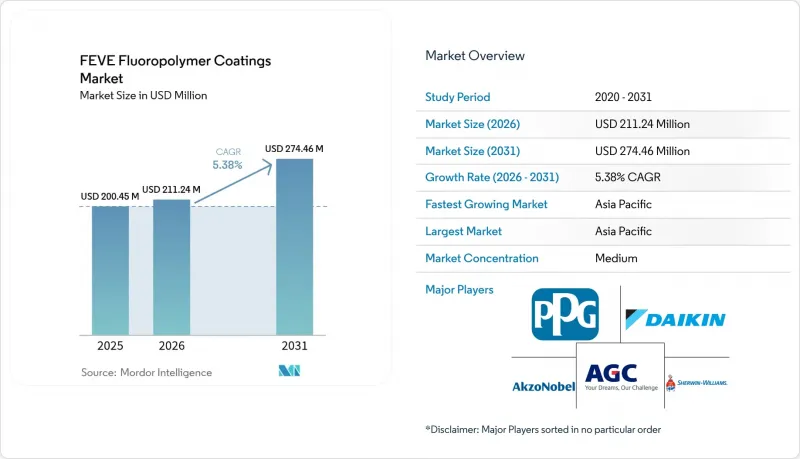
본 보고서는 최종 사용자 산업별(산업, 건축 및 건설, 자동차, 선박, 항공·우주, 기타 최종 사용자 산업) 및 지역별(아시아태평양, 북미, 유럽, 남미, 중동 및 아프리카)로 분류되어 있습니다. 시장 예측은 금액(달러) 기준으로 제시되어 있습니다.
전 세계 FEVE 불소 수지 코팅 시장 동향 및 인사이트
세계적인 건설 붐 속에서 장수명 파사드에 대한 수요
초고층 빌딩 개발업자가 FEVE 커튼월용 도료를 선택하는 이유는 연간 피막 침식률이 0.1µm 미만으로 억제되어 폴리우레탄의 약 절반 수준이기 때문에 고비용인 비계 설치 주기를 최소화할 수 있기 때문입니다. 일본 도료공업회에 따르면, 재도장 비용 절감분을 고려할 경우 30년간의 총 비용은 염화고무계 도료의 37%에 해당하는 것으로 알려져 있습니다. 중국, 걸프 연안 국가, 동남아시아는 미국 건축 제조업체 협회(AAMA) 규격 2605 준수가 요구되는 고층 프로젝트의 최대 공급원이 되고 있습니다. ‘페라리 월드 아부다비’나 ‘부르즈 알 아랍’ 등의 사례 연구에서는 50°C를 넘는 자외선으로 인한 온도 변동 하에서도 FEVE가 알루미늄 패널을 보호하고 있음이 입증되었습니다. 내진 기준에 따라 경량 외장 패널의 사용이 허용됨에 따라, 패널의 변형을 일으키지 않으면서 저온 경화를 실현하는 FEVE 분말에 대한 수요가 증가하고 있습니다.
재생에너지 설비에서의 FEVE 분말 채택
FEVE로 코팅된 태양광 발전 모듈의 백시트는 실외에서 1년간 노출된 후에도 초기 출력의 95% 이상을 유지하며, 코팅이 적용되지 않은 대조군보다 10퍼센트 포인트 더 우수한 성능을 발휘합니다. 풍력 터빈 타워에는 200°C 미만의 온도에서 경화되고, 오버스프레이를 재활용할 수 있으며, 해상 환경의 염수 분무 부식에 내성을 가진 단층 코팅 FEVE 분말 도장이 채택되고 있습니다. 그래핀으로 강화된 FEVE/폴리우레탄 하이브리드 블렌드는 최대 99%의 선단 침식 저항성을 실현하여, 유럽 및 중국의 메가와트급 블레이드 생산 목표를 뒷받침하고 있습니다. 미국과 EU에서 용제 규제가 강화되는 가운데, 밸류체인에서는 이 수지의 VOC 제로 특성을 높이 평가했습니다.
폴리우레탄계 시스템과의 가격 차이
FEVE의 정가는 폴리우레탄의 2-4배로, 예산에 제약이 있는 지역에서의 채택을 저해하고 있습니다. ChemQuest의 조사 데이터에 따르면, 리모델링 업체들이 프로젝트를 연기함에 따라 2023년 건축용 도료 출하량은 4.6% 감소했고, 예산이 압박받으면서 초기 비용에 대한 장벽이 높아졌습니다. 폴리우레탄의 1.5배 가격대에 속하는 폴리실록산 탑코트는 현재, 특히 사업자들이 5-15년이라는 단기적인 전망만을 세우고 있는 분야에서 중가대 수요를 확보하고 있습니다. FEVE의 각 공급업체들은 라이프사이클 계산 도구와 교육을 통해 수십 년에 걸친 총 비용의 15-30% 절감이라는 이점을 강조하고 있습니다.
부문 분석
2025년, 건축 및 건설 부문은 FEVE 불소수지 코팅 시장 점유율의 47.38%를 차지할 것으로 예상되며, 이는 해당 부문이 30년 보증의 단층 외벽 도장 프로그램을 조기에 도입한 것을 반영합니다. 이 부문에서 FEVE 불소 수지 코팅 시장 규모는 2026년부터 2031년까지 연평균 성장률(CAGR) 6.59%로 확대될 것으로 예측됩니다. 커튼월 소유주들은 내구 연한 연장으로 인해 재도장 주기가 2-3회 연기되는 점을 높이 평가하고 있으며, 이를 통해 밀집된 도심 지역의 비계 비용과 임차인에 미치는 영향을 줄일 수 있습니다. FEVE를 유일한 승인된 탑코트로 지정한 일본 교량 기준의 개정에 따라 유틸리티 전반에 걸쳐 수요가 정착되고 있습니다.
산업용 장비 분야에서는 꾸준한 속도로 수요가 확대되고 있습니다. 석유 및 가스 업계의 사업자들은 FEVE의 긴 재도장 주기와 비용이 30-40% 저렴한 폴리실록산계 도료와의 비교를 검토하고 있습니다. 자동차 용도는 여전히 틈새 분야에 머물러 있으며, 자외선 저항성 및 칩 저항성이 요구되는 특수 차량이나 알루미늄 트림 등이 대상입니다. 선박·항공 업계의 구매자들은 대체품이 제한적인 방오 및 와이어 하네스 보호 용도에서 FEVE를 채택하고 있습니다. 아시아와 북미에서 확대되고 있는 리모델링 시장에서는 거주자의 대피를 피하기 위해 저취성 수성 FEVE 등급이 채택되고 있습니다. 분체 도료는 200°C 미만에서 경화되고 오버스프레이를 재활용할 수 있기 때문에 공장에서 도장된 지붕 패널이나 알루미늄 압출 성형품 분야에서 점유율을 확대되고 있습니다. 또한, 색상 안정성과 차단 성능이 요구되는 교량의 아치 리브에는 FEVE와 세라믹을 혼합한 하이브리드 도료가 등장하고 있습니다. 라틴아메리카의 지자체 프로젝트에서는 여전히 가격에 대한 민감성이 나타나고 있지만, 수명 주기 비용 계산에 따르면 15-30%의 비용 절감이 가능한 것으로 밝혀지면서 조달 기준이 서서히 변화하고 있습니다.
지역별 분석
아시아태평양은 중국의 도시화, 일본의 교량 기준, 그리고 한국의 해상 구조물 건설에 힘입어 2025년에는 51.05%의 점유율을 차지하고 연평균 성장률(CAGR) 6.42%를 나타낼 것으로 예측되는 등 FEVE 불소 수지 코팅 시장을 주도하고 있습니다. 중국의 코일 코터 각사는 HG/T 4104-2019를 준수하는 수성 등급을 제공하여 VOC 규제로 인한 벌금을 피하면서도 30년 동안 광택을 유지하고 있습니다. 일본 국토교통성은 공공 교량의 탑코트를 FEVE로 한정하고 있어, 이로 인해 고가 대가 확보되고 있습니다. 한국의 조선소는 LNG 운반선의 상부 구조물에 수명이 긴 마감재를 지정하고 있어, 이로 인해 도크 입항 빈도를 줄이고 있습니다.
북미는 시장의 약 24.85%를 차지하고 있습니다. AASHTO가 정한 교량의 설계 내구 연한 75년 기준에 따라, 신축 및 개보수 공사에서는 FEVE로의 전환이 진행되고 있으며, 미시시피강에 놓인 I-74 교량이 그 대표적인 예입니다. 이 교량에서는 셔윈-윌리엄스(Sherwin-Williams)사의 ‘Fluorokem’이 3,400피트의 강재를 보호하고 있습니다. EPA의 에어로졸 규제는 VOC 규제를 강화하는 한편, PFAS 보고 의무를 통해 규정 준수에 대한 노력을 한층 더 높이고 있습니다. 캐나다의 수명 주기 조사에서는 교통 체증 등의 사회적 비용을 절감하는 저VOC 솔루션이 권장되고 있습니다. 멕시코에서는 정유시설 및 특수 차량 프로젝트에서 선택적 도입이 진행되고 있으며, 긴 수명이 설비 투자를 상쇄하고 있습니다.
유럽은 시장 규모의 17.80%를 차지하고 있지만, 가장 엄격한 규제 과제에 직면해 있습니다. 제안된 총 불소 농도 50 ppm 상한선은 밸류체인을 복잡하게 만들 것입니다. 독일 및 북유럽 국가에서는 QUALICOAT 클래스 3 규격에 부합하는 해상 풍력 발전 타워 도장에 FEVE 분말 등급이 채택되고 있습니다. 남유럽에서는 공공 예산이 빠듯하지만, 공항 및 소매점 외관에는 여전히 FEVE가 지정되어 있습니다. 러시아에서는 무역 제재의 영향으로 북극권 파이프라인 관련 사업 기회는 여전히 제한적입니다.
기타 혜택:
- 엑셀 형식 시장 예측(ME) 시트
- 3개월간의 애널리스트 지원
자주 묻는 질문
목차
제1장 서론
제2장 조사 방법
제3장 주요 요약
제4장 시장 구도
제5장 시장 규모와 성장 예측
제6장 경쟁 구도
제7장 시장 기회와 향후 전망
LSH 26.08.25According to Mordor Intelligence, the FEVE fluoropolymer coatings market size is expected to grow from USD 200.45 million in 2025 to USD 211.24 million in 2026 and is forecast to reach USD 274.46 million by 2031 at 5.38% CAGR over 2026-2031.
This report is Segmented by End-User Industry (Industrial, Building and Construction, Automotive, Marine, Aviation and Aerospace, and Other End-User Industries) and Geography (Asia-Pacific, North America, Europe, South America, and Middle East and Africa). The Market Forecasts are Provided in Terms of Value (USD).
Global FEVE Fluoropolymer Coatings Market Trends and Insights
Long-Life Facade Demand in Global Construction Boom
Skyscraper developers select FEVE curtain-wall coatings because the annual film erosion rate stays below 0.1 µm, roughly half that of polyurethane, which limits expensive scaffold cycles. The Japan Paint Manufacturers Association values the total 30-year costs at 37% of those for chlorinated rubber systems when repainting savings are factored in. China, the Gulf states, and Southeast Asia supply the largest pipelines of high-rise projects needing American Architectural Manufacturers Association 2605 compliance. Case studies such as Ferrari World Abu Dhabi and Burj al Arab show FEVE protecting aluminum panels under UV swings exceeding 50°C. Lighter cladding panels permitted by seismic codes intensify the need for low-temperature cures that FEVE powders deliver without panel distortion.
Renewable-Energy Hardware Adoption of FEVE Powders
Photovoltaic module backsheets coated with FEVE sustain more than 95% of initial power after one year of outdoor exposure, outperforming uncoated controls by 10 percentage points. Wind-turbine towers utilize single-coat FEVE powder finishes that cure at temperatures below 200 °C, recycle overspray, and resist salt-spray corrosion in offshore environments. Hybrid FEVE/polyurethane blends reinforced with graphene achieve up to 99% leading-edge erosion resistance, supporting megawatt-scale blade production targets in Europe and China. Supply chains value the resin's zero-VOC profile as the U.S. and EU ratchet solvent regulations.
Premium Price Versus Polyurethane Systems
FEVE lists at two to four times the price of polyurethane, discouraging adoption in budget-constrained regions. ChemQuest survey data show 2023 architectural volumes dipped 4.6% as remodelers delayed projects, squeezing budgets and elevating first-cost hurdles. Polysiloxane topcoats, priced at 1.5 times the cost of polyurethane, now capture mid-range demand, especially where operators calculate only five- to 15-year horizons. FEVE vendors respond with lifecycle calculators and training to spotlight 15-30% total cost savings over decades.
Other drivers and restraints analyzed in the detailed report include:
- Industrial Infrastructure Corrosion-Control Programs
- Regulatory Pivot to Low-VOC/High-Durability Coatings
- Rising PFAS-Related Regulatory Scrutiny
For complete list of drivers and restraints, kindly check the Table Of Contents.
Segment Analysis
Building and Construction commanded 47.38% of the FEVE Fluoropolymer Coatings market share in 2025, reflecting the segment's early embrace of 30-year, single-coat facade programs. The FEVE Fluoropolymer Coatings market size for this segment is projected to expand at a 6.59% CAGR from 2026 to 2031. Curtain-wall owners credit service life extensions that defer two to three repaint cycles, cutting scaffold expenses and tenant disruption in dense urban cores. Japan's updated bridge standards, which name FEVE as the sole approved topcoat, embed demand across public works.
Industrial equipment follows at a measured pace. Operators in oil and gas weigh FEVE's longer intervals against polysiloxane options that cost 30-40% less. Automotive applications remain niche, covering specialty vehicles and aluminum trim that require UV and chip resistance. Marine and aviation buyers pursue FEVE for antifouling and wire-bundle protection where acceptable alternatives are scarce. Growing retrofit markets in Asia and North America lean on low-odor, waterborne FEVE grades to avoid occupant evacuation. Powder variants win share in factory-coated roof panels and aluminum extrusions because they cure below 200 °C and recycle overspray. Hybrid FEVE-ceramic blends emerge in bridge arch ribs needing color stability and barrier strength. Demand remains price-sensitive in Latin American municipal projects, yet lifecycle calculators reveal 15-30% cost savings that gradually shift procurement criteria.
Complete Report Scope:
- By End-user Industry
- Industrial
- Building & Construction
- Automotive
- Marine
- Aviation & Aerospace
- Other End-user Industries
- By Geography
- Asia-Pacific
- China
- India
- Japan
- South Korea
- ASEAN Countries
- Rest of APAC
- North America
- United States
- Canada
- Mexico
- Europe
- Germany
- United Kingdom
- France
- Italy
- Spain
- Russia
- NORDIC Countries
- Rest of Europe
- South America
- Brazil
- Argentina
- Colombia
- Rest of South America
- Middle-East and Africa
- Saudi Arabia
- South Africa
- Rest of Middle-East and Africa
- Asia-Pacific
Geography Analysis
The Asia-Pacific governs the FEVE Fluoropolymer Coatings market with a 51.05% share in 2025 and a forecasted 6.42% CAGR, driven by Chinese urbanization, Japanese bridge standards, and South Korean offshore fabrication. Chinese coil coaters offer waterborne grades that meet HG/T 4104-2019 to bypass VOC penalties while preserving a 30-year gloss. Japan's Ministry of Land, Infrastructure, Transport, and Tourism restricts topcoats on public bridges to FEVE, securing premium prices. South Korean yards specify long-life finishes for LNG carrier topsides, reducing dry-dock frequency.
North America accounts for approximately 24.85% of the market. AASHTO's 75-year bridge design life shifts new construction and rehabilitation to FEVE, illustrated by the I-74 Mississippi River Bridge, where Sherwin-Williams Fluorokem shields 3,400 ft of steel. The EPA's aerosol rule tightens VOC controls yet raises compliance efforts through PFAS reporting. Canadian lifecycle studies promote low-VOC solutions that reduce social costs, such as traffic congestion. Mexico sees a selective uptake in refinery and specialty vehicle projects, where long service life offsets capital expenditures.
Europe accounts for 17.80% of the value but faces the steepest regulatory tests. The proposed 50 ppm total-fluorine cap will complicate supply chains. Germany and the Nordics lean on FEVE powder grades for offshore wind towers under QUALICOAT Class 3 standards. Southern Europe's public budgets lag, though airport and retail facades still specify FEVE. Russia's Arctic pipeline opportunities remain limited amid trade sanctions.
- A&I Coatings
- AGC Inc.
- Akzo Nobel N.V.
- Axalta Coating Systems Ltd.
- DAIKIN INDUSTRIES, Ltd.
- IFS Coatings
- Innocoat Systems
- Kansai Paint Co., Ltd.
- KCC CORPORATION
- PPG Industries Inc.
- The Sherwin-Williams Company
- Tnemec
Additional Benefits:
- The market estimate (ME) sheet in Excel format
- 3 months of analyst support
TABLE OF CONTENTS
1 Introduction
- 1.1 Study Assumptions & Market Definition
- 1.2 Scope of the Study
2 Research Methodology
3 Executive Summary
4 Market Landscape
- 4.1 Market Overview
- 4.2 Market Drivers
- 4.2.1 Long-life facade demand in global construction boom
- 4.2.2 Industrial infrastructure corrosion-control programs
- 4.2.3 Regulatory pivot to low-VOC/high-durability coatings
- 4.2.4 Renewable-energy hardware (solar/wind) adopA-tion of FEVE powders
- 4.2.5 Government service-life mandates for public bridges & tanks
- 4.3 Market Restraints
- 4.3.1 Premium price versus polyurethane & acrylic systems
- 4.3.2 Rising PFAS-related regulatory scrutiny in United States/European Union
- 4.3.3 Shortage of trained applicators & specialized spray equipment
- 4.4 Value Chain Analysis
- 4.5 Porter's Five Forces
- 4.5.1 Bargaining Power of Suppliers
- 4.5.2 Bargaining Power of Buyers
- 4.5.3 Threat of New Entrants
- 4.5.4 Threat of Substitutes
- 4.5.5 Degree of Competition
5 Market Size & Growth Forecasts (Value)
- 5.1 By End-user Industry
- 5.1.1 Industrial
- 5.1.2 Building & Construction
- 5.1.3 Automotive
- 5.1.4 Marine
- 5.1.5 Aviation & Aerospace
- 5.1.6 Other End-user Industries
- 5.2 By Geography
- 5.2.1 Asia-Pacific
- 5.2.1.1 China
- 5.2.1.2 India
- 5.2.1.3 Japan
- 5.2.1.4 South Korea
- 5.2.1.5 ASEAN Countries
- 5.2.1.6 Rest of APAC
- 5.2.2 North America
- 5.2.2.1 United States
- 5.2.2.2 Canada
- 5.2.2.3 Mexico
- 5.2.3 Europe
- 5.2.3.1 Germany
- 5.2.3.2 United Kingdom
- 5.2.3.3 France
- 5.2.3.4 Italy
- 5.2.3.5 Spain
- 5.2.3.6 Russia
- 5.2.3.7 NORDIC Countries
- 5.2.3.8 Rest of Europe
- 5.2.4 South America
- 5.2.4.1 Brazil
- 5.2.4.2 Argentina
- 5.2.4.3 Colombia
- 5.2.4.4 Rest of South America
- 5.2.5 Middle-East and Africa
- 5.2.5.1 Saudi Arabia
- 5.2.5.2 South Africa
- 5.2.5.3 Rest of Middle-East and Africa
- 5.2.1 Asia-Pacific
6 Competitive Landscape
- 6.1 Market Concentration
- 6.2 Strategic Moves
- 6.3 Market Share/ Ranking Analysis
- 6.4 Company Profiles (includes Global level Overview, Market level overview, Core Segments, Financials as available, Strategic Information, Market Rank/Share for key companies, Products & Services, and Recent Developments)
- 6.4.1 A&I Coatings
- 6.4.2 AGC Inc.
- 6.4.3 Akzo Nobel N.V.
- 6.4.4 Axalta Coating Systems Ltd.
- 6.4.5 DAIKIN INDUSTRIES, Ltd.
- 6.4.6 IFS Coatings
- 6.4.7 Innocoat Systems
- 6.4.8 Kansai Paint Co., Ltd.
- 6.4.9 KCC CORPORATION
- 6.4.10 PPG Industries Inc.
- 6.4.11 The Sherwin-Williams Company
- 6.4.12 Tnemec
7 Market Opportunities & Future Outlook
- 7.1 White-space & Unmet-need Assessment


