

|
시장보고서
상품코드
2114054
부인과용 의료기기 : 시장 점유율 분석, 업계 동향 및 통계, 성장 예측(2026-2031년)Gynecological Devices - Market Share Analysis, Industry Trends & Statistics, Growth Forecasts (2026 - 2031) |
||||||
 Mordor Intelligence
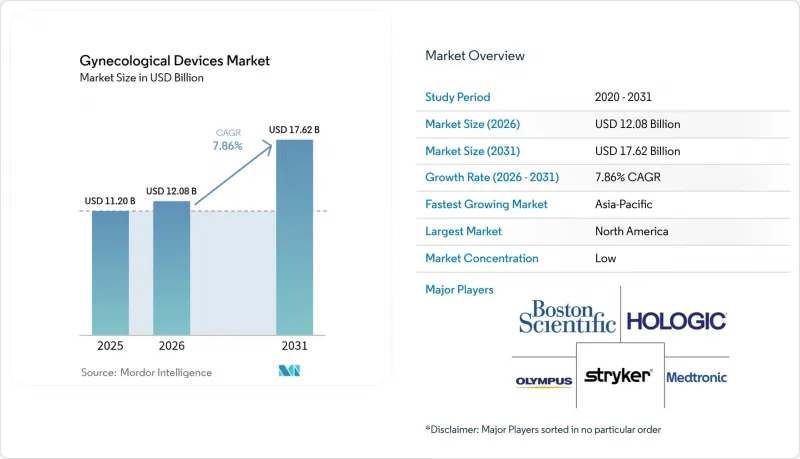
Mordor Intelligence에 의하면, 부인과용 의료기기 시장 규모는 2025년 112억 달러에서 2026년에는 120억 8,000만 달러에 이르고, 2026-2031년 CAGR 7.86%로 성장을 지속하여 2031년에는 176억 2,000만 달러에 달할 것으로 예측됩니다.
본 보고서는 제품 유형(부인과용 내시경 기기, 자궁내막 절제 기기, 피임 기기, 영상 진단 시스템, 체액 관리 시스템 등), 용도(복강경 검사, 자궁경 검사 등), 최종 사용자(병원, 부인과 클리닉 등), 지역(북미, 유럽 등)별로 분류되어 있습니다. 시장 전망은 금액(달러) 기준으로 제시되어 있습니다.
전 세계 부인과용 의료기기 시장 동향 및 인사이트
부인과 질환 유병률 증가
만성 및 악성 부인과 질환의 발생률이 증가함에 따라, 빈번한 선별 검사 및 치료용 기기에 대한 필요성이 높아지고 있습니다. 아시아의 일부 지역에서는 자궁경부암 및 자궁암으로 인한 사망률이 여전히 높은 수준을 유지하고 있는 반면, 북미에서는 발생률이 안정적이지만 조기 발견 도구에 대한 수요는 여전히 크게 증가하고 있습니다. 의료 기관에서는 1차 검사에서 전암성 병변을 검출하기 위해 광학 기능이 강화된 콜포스코프 및 생검 시스템의 도입이 진행되고 있습니다. 성장세가 가장 두드러지는 곳은 도시 지역으로, 체계적인 검진 프로그램과 인식 제고 캠페인을 통해 질환이 초기 단계에 있는 환자를 조기에 포착하고 있습니다. 이와 병행하여 재택 진단에 대한 투자가 진행되고 있어, 검진율 향상과 병원 수용 능력의 제약 완화가 도모되고 있습니다. 이러한 동향이 맞물리면서 정밀 기기 및 소모품의 도입 대수가 증가하여, 제조업체에게 지속적인 수익원이 강화되고 있습니다.
여성 인구의 고령화와 의료비 증가
50세 이상 여성이 세계 인구에 차지하는 비율은 꾸준히 증가하고 있으며, 장기 탈출증, 요실금 및 악성 부인과 질환의 위험이 높아지고 있습니다. 미국에서는 2018년 골반 장기 탈출증 수술의 연간 비용이 15억 2,300만 달러에 달했으며, 그 중 82.5%가 외래에서 치료되었습니다. 서유럽에서도 유사한 경향이 나타나고 있으며, 병원들은 비용 대비 효과가 높은 저침습적 치료법의 도입을 추진하고 있습니다. 선진국의 가처분 소득 증가는 자궁근종 소작술이나 장기 작용형 피임법 등의 선택적 치료를 더욱 촉진하고 있으며, 환자 친화적인 기능을 갖춘 고급 의료기기에 대한 수요를 확대시키고 있습니다. 지불자 측면에서는 신흥 시장의 의료보험 확충으로 인해 평균 판매 가격은 낮아지지만, 새로운 수요가 창출되고 있습니다.
의료기기 리콜 및 소송
주목을 모았던 경질식 메쉬 관련 소송과 그에 따른 제품 리콜은 여전히 혁신과 조달에 위축 효과를 미치고 있습니다. 예를 들어, 2023년 2월 대법원이 캘리포니아주의 주장을 인정하는 판결을 내린 후, 존슨앤드존슨의 에시콘(Ethicon) 사업부는 허위 마케팅을 했다는 이유로 3억 200만 달러의 벌금을 부과받았습니다. 병원 측은 공급업체의 실적을 더욱 엄격하게 검토하게 되었고, 평가 주기가 장기화되는 한편, 시장 출시 후 철저한 모니터링 데이터에 대한 수요가 높아지고 있습니다. 제조업체들은 연구개발(R&D) 예산을 규제 준수에 할당하고 있어 신제품 출시 속도가 둔화되고 있습니다. 동시에, 보험사들은 특히 이식형 의료기기에 대해 더 엄격한 급여 기준을 적용하고 있어 단기적인 시술 건수 증가를 억제하고 있습니다.
부문 분석
2025년에는 부인과 내시경 플랫폼이 다양한 질환의 진단 및 치료에 있어 높은 범용성을 바탕으로 부인과용 의료기기 시장 규모의 45.88%를 차지했습니다. 칩 온 칩(Chip-on-Chip) 광학 시스템과 일회용 시스(sheath)의 선택지가 지속적으로 개선됨에 따라 진료소의 워크플로가 간소화되고 교차 오염 위험이 감소하고 있습니다. 그러나 자궁내막 절제술 기기는 2031년까지 연평균 성장률(CAGR) 8.54%를 나타낼 것으로 예측되어, 다른 어떤 제품 카테고리보다 높은 성장률을 보일 것으로 전망됩니다. 2세대 풍선 및 고주파 시스템은 무월경 비율이 높으며, 당일 퇴원을 장려하는 보험 급여 요건에도 부합합니다. 이러한 급속한 보급으로 인해 기존 절제경에 대한 설비 투자 예산이 점차 이동하고 있습니다. 피임 기기는 여전히 견고한 수익 기반을 형성하고 있으며, 그 대표적인 예로 기존 IUD에 비해 구리 사용량을 절반으로 줄이면서도 99%의 유효성을 유지하는 ‘Miudella’가 2025년에 승인된 점을 들 수 있습니다.
올림푸스의 HYF-XP(3.1 mm)와 같은 소형화된 자궁경은 확장 시술이 필요 없는 접근을 가능하게 하여, 마취 설비가 제한적인 소규모 클리닉에서도 자궁경 검사를 시행할 수 있게 하고 있습니다. 진단용 영상 시스템은 형광, 초음파, AI 분석을 통합한 통합형 타워로 수렴되고 있어 수술실의 공간 효율성을 높이고 있습니다. 실시간 압력 모니터링 기능을 갖춘 새로운 펌프가 체액 과다로 인한 합병증 억제를 목표로 하고 있기 때문에 체액 관리는 여전히 매우 중요한 과제로 남아 있습니다. 전반적으로 제품 선택은 시술 시간을 단축하고 재고를 최소화하는 한편, 향후 분석 기능 업그레이드를 위한 소프트웨어 연결 기능을 탑재한 멀티모달리티 플랫폼으로 기울고 있습니다.
지역별 분석
북미는 2025년, 견실한 보험 환급, 로봇 수술의 광범위한 도입, 그리고 영상 진단 인프라의 지속적인 갱신에 힘입어 부인과용 의료기기 시장에서 41.86%의 점유율을 유지했습니다. 의료 기관들은 시술 시간을 단축하고 외래 진료로의 전환을 가능하게 하는 설비 투자를 우선시하고 있으며, 이로 인해 AI를 활용한 시각화 기술과 인체공학적으로 최적화된 기구에 대한 안정적인 수요가 발생하고 있습니다. 보스턴 사이언티픽이 액소닉스를 37억 달러에 인수한 것과 같은 전략적 인수는 핵심인 외과 사업을 보완하는 신경 조절 요법 및 기타 고성장 인접 분야에 대한 이 지역의 강한 관심을 부각시키고 있습니다.
유럽은 여전히 주요 시장이지만, MDR(의료기기 규정) 준수에 따른 자원 수요로 인해 성장이 억제되고 있습니다. 의료 시스템은 재사용 및 지속가능성 노력을 추진하고 있으며, 검증된 재처리 프로토콜과 재활용 가능한 부품을 갖춘 의료기기의 조달을 장려하고 있습니다. 당일 진료(outpatient)를 장려하는 종합적 지불 방식의 도입으로, 진료소에서의 자궁경 검사 투자가 가속화되고 있습니다. 유럽의 연구 거점들은 병원과 기술 기업 간의 협력을 촉진하며, AI 유도식 질 확대경 검사 및 스마트 탐폰 진단 시범 프로그램을 추진하고 있습니다.
아시아태평양에서는 각국 정부가 임산부 건강 및 암 검진 프로그램에 자원을 투입하고 있어, 2026년부터 2031년까지 연평균 성장률(CAGR) 10.74%라는 가장 빠른 성장이 예상됩니다. 가처분 소득 증가와 도시화로 인해 민간 의료에 대한 접근성이 개선되고 있으며, 그 수요는 최소 침습 치료 및 불임 치료 서비스에 집중되고 있습니다. 규제 조화 및 수출 지향적 정책에 힘입어 현지 제조업체들은 세계 시장에서의 경쟁력을 높이기 위해 사업 규모를 확대되고 있습니다. 원격의료를 통해 전문의의 진료 범위가 지방까지 확대되면서, 휴대용 초음파 진단 기기와 재택 모니터링 키트의 보급이 진전되고 있습니다.
기타 혜택:
- 엑셀 형식 시장 예측(ME) 시트
- 3개월간의 애널리스트 지원
자주 묻는 질문
목차
제1장 서론
제2장 조사 방법
제3장 주요 요약
제4장 시장 구도
제5장 시장 규모와 성장 예측
제6장 경쟁 구도
제7장 시장 기회와 향후 전망
LSH 26.08.25According to Mordor Intelligence, the gynecological devices market size is expected to grow from USD 11.20 billion in 2025 to USD 12.08 billion in 2026 and is forecast to reach USD 17.62 billion by 2031 at 7.86% CAGR over 2026-2031.
This report is Segmented by Product Type (Gynecological Endoscopy Devices, Endometrial Ablation Devices, Contraceptive Devices, Diagnostic Imaging Systems, Fluid Management Systems, and More), Application (Laparoscopy, Hysteroscopy, and More), End User (Hospitals, Gynecology Clinics, and More), and Geography (North America, Europe, and More). The Market Forecasts are Provided in Terms of Value (USD).
Global Gynecological Devices Market Trends and Insights
Rising Prevalence of Gynecological Disorders
Chronic and malignant gynecological conditions are increasing in incidence, raising the need for frequent screenings and intervention devices. Cervical and uterine cancers continue to post high mortality in parts of Asia, while incidence in North America remains stable but still drives significant demand for early detection tools. Providers are upgrading colposcopes and biopsy systems that integrate optical enhancements to detect premalignant lesions during first-line exams. Growth momentum is strongest in urban settings where organized screening programs and public awareness campaigns capture patients earlier in disease progression. Parallel investments in home-based diagnostics aim to improve participation rates and relieve hospital capacity constraints. Collectively, these trends increase the installed base of precision instruments and consumables, reinforcing recurring revenue streams for manufacturers.
Aging Female Population and Higher Healthcare Spend
Women older than 50 constitute a steadily rising share of the global population, bringing elevated risk for prolapse, incontinence, and malignant gynecological diseases. In the United States, the annual pelvic organ prolapse surgery cost hit USD 1.523 billion in 2018, with 82.5% of cases managed outpatients. Similar trajectories are emerging in Western Europe, prompting hospitals to adopt cost-efficient, minimally invasive approaches. Higher disposable incomes in developed nations further support elective treatments such as uterine fibroid ablation and long-acting contraception, expanding demand for premium devices with patient-friendly features. On the payer side, improved health coverage in emerging markets unlocks new volumes, though at lower average selling prices.
Device Recalls and Litigation
High-profile transvaginal mesh lawsuits and subsequent product withdrawals continue to exert a chilling effect on innovation and procurement. For instance, Johnson & Johnson's Ethicon division faced a USD 302 million fine for deceptive marketing after the Supreme Court ruled in favor of the State of California in February 2023. Hospitals scrutinize vendor track records more closely, lengthening evaluation cycles and increasing demand for exhaustive post-market surveillance data. Manufacturers redirect R&D budgets toward regulatory compliance, slowing the cadence of new product introductions. At the same time, insurers impose stricter coverage criteria, particularly for implantable devices, dampening near-term procedure growth.
Other drivers and restraints analyzed in the detailed report include:
- Growing Adoption of Minimally-Invasive Surgeries
- Technological Advances in OB-GYN Endoscopy & Imaging
- Heightened FDA / EU MDR Re-classification Hurdles
For complete list of drivers and restraints, kindly check the Table Of Contents.
Segment Analysis
In 2025, gynecological endoscopy platforms commanded 45.88% of the gynecological devices market size thanks to their versatility in diagnosing and treating diverse conditions. Continuous improvements in chip-on-tip optics and disposable sheath options simplify office workflows and reduce cross-contamination risks. However, endometrial ablation devices are projected to post an 8.54% CAGR through 2031, outpacing every other product class. Second-generation balloon and radiofrequency systems deliver higher amenorrhea rates and fit within reimbursement bundles that reward same-day discharge. Their rapid uptake is steering capital budgets away from legacy resectoscopes. Contraceptive devices remain a resilient revenue base, highlighted by the 2025 approval of Miudella, which uses half the copper of earlier IUDs yet maintains 99% efficacy.
Miniaturized hysteroscopes, such as the 3.1 mm Olympus HYF-XP, facilitate dilation-free access, opening hysteroscopy to smaller clinics with limited anesthesia capabilities. Diagnostic imaging systems are converging toward unified towers that integrate fluorescence, ultrasound, and AI analysis to streamline operating-room footprints. Fluid management remains mission-critical as new pumps with real-time pressure monitoring aim to curb fluid overload complications. Overall, product choice is tilting toward multi-modality platforms that compress procedure times and minimize inventory while embedding software hooks for future analytics upgrades.
Complete Report Scope:
- By Product Type (Value)
- Gynecological Endoscopy Devices
- Hysteroscope
- Resectoscope
- Colposcope
- Laparoscope
- Endoscopic Imaging Systems
- Endometrial Ablation Devices
- Balloon Ablation Devices
- Hydrothermal Ablation Devices
- Radiofrequency Ablation Devices
- Other Endometrial Ablation Devices
- Contraceptive Devices
- Temporary Birth Control
- Permanent Birth Control
- Diagnostic Imaging Systems
- Fluid Management Systems
- Other Product Types
- Gynecological Endoscopy Devices
- By Application (Value)
- Laparoscopy
- Hysteroscopy
- Dilation & Curettage
- Colposcopy
- Endometrial Ablation
- Female Sterilization
- Others
- By End User (Value)
- Hospitals
- Gynecology Clinics
- Ambulatory Surgery Centers
- Fertility Centers
- Research & Academic Institutes
- By Geography (Value)
- North America
- United States
- Canada
- Mexico
- Europe
- Germany
- United Kingdom
- France
- Italy
- Spain
- Rest of Europe
- Asia-Pacific
- China
- India
- Japan
- South Korea
- Australia
- Rest of Asia-Pacific
- South America
- Brazil
- Argentina
- Rest of South America
- Middle East and Africa
- GCC
- South Africa
- Rest of Middle East and Africa
- North America
Geography Analysis
North America retained 41.86% share of the gynecological devices market in 2025, supported by robust reimbursement, widespread robotic surgery adoption, and continuous refresh of imaging infrastructure. Providers prioritize capital projects that shorten procedure times and enable outpatient migration, creating steady pull for AI-enabled visualization and ergonomically optimized instrumentation. Strategic acquisitions, such as Boston Scientific's USD 3.7 billion purchase of Axonics, underscore the region's appetite for neuromodulation and other high-growth adjacencies that complement core surgical franchises.
Europe remains a key market, though growth is tempered by the resource demands of MDR compliance. Health systems encourage reuse and sustainability initiatives, steering procurement toward devices with validated reprocessing protocols or recyclable components. Investment in office-based hysteroscopy has accelerated, aided by bundled payments that incentivize day-case care. European research hubs foster collaborations between hospitals and technology firms, driving pilot programs for AI-guided colposcopy and smart tampon diagnostics.
Asia-Pacific is projected to deliver the fastest 2026-2031 expansion at a 10.74% CAGR as governments pour resources into maternal health and cancer screening programs. Rising disposable incomes and urbanization improve access to private care, where demand skews toward minimally invasive and fertility services. Local manufacturers are scaling up to compete globally, aided by harmonized regulatory pathways and export-oriented policies. Telemedicine is extending specialist reach into rural settings, lifting adoption of portable ultrasound and at-home monitoring kits.
- Hologic
- Boston Scientific
- Johnson & Johnson
- Medtronic
- The Cooper Companies
- Karl Storz
- Olympus
- Stryker
- Cook Group
- Richard Wolf
- Intuitive Surgical
- B. Braun
- Coloplast
- Beckton Dickinson
- Conmed
- Teleflex
- Minerva Surgical
- Lumenis
Additional Benefits:
- The market estimate (ME) sheet in Excel format
- 3 months of analyst support
TABLE OF CONTENTS
1 Introduction
- 1.1 Study Assumptions & Market Definition
- 1.2 Scope of the Study
2 Research Methodology
3 Executive Summary
4 Market Landscape
- 4.1 Market Overview
- 4.2 Market Drivers
- 4.2.1 Rising prevalence of gynecological disorders
- 4.2.2 Growing adoption of minimally-invasive surgeries
- 4.2.3 Technological advances in OB-GYN endoscopy & imaging
- 4.2.4 Aging female population plus higher healthcare spend
- 4.2.5 Outpatient hysteroscopy reimbursement bundling surge
- 4.2.6 FemTech-enabled smart OB-GYN instruments
- 4.3 Market Restraints
- 4.3.1 Device recalls & litigation (e.g., vaginal mesh)
- 4.3.2 Heightened FDA/EU MDR re-classification hurdles
- 4.3.3 Shortage of trained gynecologic surgeons
- 4.3.4 Price erosion from generic laparoscopic instruments
- 4.4 Value / Supply-Chain Analysis
- 4.5 Regulatory Landscape
- 4.6 Technological Outlook
- 4.7 Porter's Five Forces
- 4.7.1 Bargaining Power of Suppliers
- 4.7.2 Bargaining Power of Buyers
- 4.7.3 Threat of New Entrants
- 4.7.4 Threat of Substitutes
- 4.7.5 Competitive Rivalry
5 Market Size & Growth Forecasts
- 5.1 By Product Type (Value)
- 5.1.1 Gynecological Endoscopy Devices
- 5.1.1.1 Hysteroscope
- 5.1.1.2 Resectoscope
- 5.1.1.3 Colposcope
- 5.1.1.4 Laparoscope
- 5.1.1.5 Endoscopic Imaging Systems
- 5.1.2 Endometrial Ablation Devices
- 5.1.2.1 Balloon Ablation Devices
- 5.1.2.2 Hydrothermal Ablation Devices
- 5.1.2.3 Radiofrequency Ablation Devices
- 5.1.2.4 Other Endometrial Ablation Devices
- 5.1.3 Contraceptive Devices
- 5.1.3.1 Temporary Birth Control
- 5.1.3.2 Permanent Birth Control
- 5.1.4 Diagnostic Imaging Systems
- 5.1.5 Fluid Management Systems
- 5.1.6 Other Product Types
- 5.1.1 Gynecological Endoscopy Devices
- 5.2 By Application (Value)
- 5.2.1 Laparoscopy
- 5.2.2 Hysteroscopy
- 5.2.3 Dilation & Curettage
- 5.2.4 Colposcopy
- 5.2.5 Endometrial Ablation
- 5.2.6 Female Sterilization
- 5.2.7 Others
- 5.3 By End User (Value)
- 5.3.1 Hospitals
- 5.3.2 Gynecology Clinics
- 5.3.3 Ambulatory Surgery Centers
- 5.3.4 Fertility Centers
- 5.3.5 Research & Academic Institutes
- 5.4 By Geography (Value)
- 5.4.1 North America
- 5.4.1.1 United States
- 5.4.1.2 Canada
- 5.4.1.3 Mexico
- 5.4.2 Europe
- 5.4.2.1 Germany
- 5.4.2.2 United Kingdom
- 5.4.2.3 France
- 5.4.2.4 Italy
- 5.4.2.5 Spain
- 5.4.2.6 Rest of Europe
- 5.4.3 Asia-Pacific
- 5.4.3.1 China
- 5.4.3.2 India
- 5.4.3.3 Japan
- 5.4.3.4 South Korea
- 5.4.3.5 Australia
- 5.4.3.6 Rest of Asia-Pacific
- 5.4.4 South America
- 5.4.4.1 Brazil
- 5.4.4.2 Argentina
- 5.4.4.3 Rest of South America
- 5.4.5 Middle East and Africa
- 5.4.5.1 GCC
- 5.4.5.2 South Africa
- 5.4.5.3 Rest of Middle East and Africa
- 5.4.1 North America
6 Competitive Landscape
- 6.1 Market Concentration
- 6.2 Market Share Analysis
- 6.3 Company Profiles (includes Global level Overview, Market level overview, Core Segments, Financials as available, Strategic Information, Market Rank/Share for key companies, Products & Services, and Recent Developments)
- 6.3.1 Hologic Inc.
- 6.3.2 Boston Scientific Corporation
- 6.3.3 Johnson & Johnson (Ethicon)
- 6.3.4 Medtronic plc
- 6.3.5 CooperSurgical Inc.
- 6.3.6 Karl Storz SE & Co. KG
- 6.3.7 Olympus Corporation
- 6.3.8 Stryker Corporation
- 6.3.9 Cook Medical
- 6.3.10 Richard Wolf GmbH
- 6.3.11 Intuitive Surgical
- 6.3.12 B. Braun Melsungen AG
- 6.3.13 Coloplast A/S
- 6.3.14 Becton, Dickinson and Company
- 6.3.15 CONMED Corporation
- 6.3.16 Teleflex Incorporated
- 6.3.17 Minerva Surgical Inc.
- 6.3.18 Lumenis Ltd.
7 Market Opportunities & Future Outlook
- 7.1 White-space & Unmet-Need Assessment


