|
시장보고서
상품코드
2114087
소프트웨어 정의 데이터센터(SDDC) : 시장 점유율 분석, 업계 동향 및 통계, 성장 예측(2026-2031년)Software Defined Data Center - Market Share Analysis, Industry Trends & Statistics, Growth Forecasts (2026 - 2031) |
||||||
 Mordor Intelligence
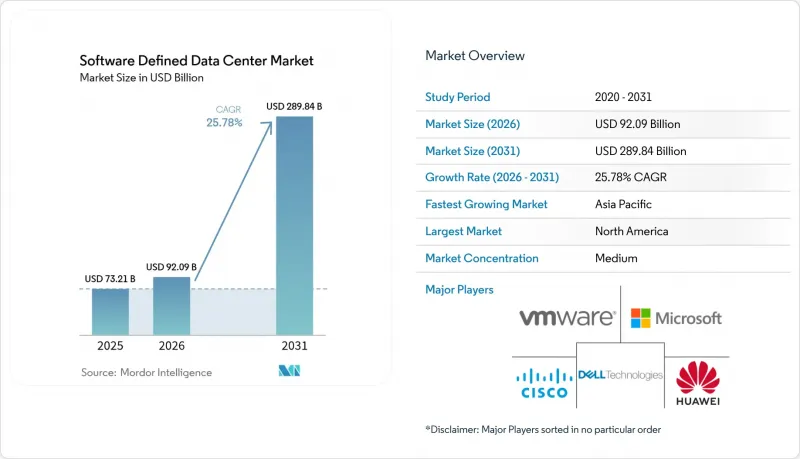
Mordor Intelligence에 의하면, 2026년 소프트웨어 정의 데이터센터(SDDC) 시장 규모는 920억 9,000만 달러로 추정되고 있으며, 2025년 732억 1,000만 달러에서 성장하여 2031년에는 2,898억 4,000만 달러에 달할 것으로 예측됩니다.
2026년부터 2031년까지의 연평균 성장률(CAGR)은 25.78%를 기록할 것으로 전망됩니다.
본 보고서는 구성 요소(솔루션 및 서비스), 도입 모델(On-Premise, 프라이빗 클라우드, 퍼블릭 클라우드, 하이브리드 클라우드), 데이터센터 유형(코로케이션, 하이퍼스케일러/클라우드,엔터프라이즈 및 엣지), 최종 사용자 산업(IT 및 통신, 은행, 금융서비스 및 보험(BFSI), 헬스케어, 소매 등), 그리고 지역별로 분류되어 있습니다. 시장 예측은 금액(달러) 기준으로 제시되어 있습니다.
세계 소프트웨어 정의 데이터센터(SDDC) 시장 동향 및 인사이트
하드웨어 및 리소스 사용에 따른 비용 절감
하드웨어와 소프트웨어의 분리가 널리 진행됨에 따라 설비 투자가 감소하고, 갱신 주기가 단축되고 있습니다. 풀스택 SDDC 플랫폼을 도입한 기업에 따르면, VMware Cloud Foundation 도입으로 인프라 비용이 34% 절감되었으며, 3년간의 ROI는 564%에 달했다고 합니다. 프로비저닝 자동화를 통해 활용도가 향상되어, 기업들은 성능 저하 없이 데이터센터의 설치 면적을 50% 줄일 수 있게 되었습니다. 전력 및 냉각 비용 절감과 더불어, 지역을 불문하고 프로젝트의 투자 회수를 촉진하고 있습니다.
기업 내 클라우드 및 가상화의 급속한 확대
가상화된 컴퓨팅, 스토리지, 네트워크 풀은 지연 시간에 민감한 워크로드와 퍼블릭 클라우드의 확장성을 모두 충족시키는 하이브리드 전략의 기반이 되고 있습니다. 소프트웨어 정의 데이터센터(SDDC) 플랫폼을 채택한 한 금융 기관에서는 intuitive.cloud를 통해 미들웨어 스택을 현대화한 결과, 메시지 처리 속도가 40% 향상되고 다운타임이 30% 감소했습니다. Kubernetes 지원 호스트가 가상 머신과 병행하여 가동됨으로써 DevOps 파이프라인이 간소화되고 배포가 가속화됩니다.
데이터 보안 및 규정 준수의 복잡화
EU의 ‘디지털 운영 복원력 법(Digital Operational Resilience Act)’ 등의 규제로 인해 2025년 1월부터 더욱 엄격한 관리가 의무화됨에 따라, 금융 기관은 가상 계층 전반에 걸친 사이버 복원력을 검증해야 하는 상황에 직면해 있습니다. 추상화된 리소스 풀은 경계 방어에 어려움을 초래하고 있으며, VMware Sovereign Cloud와 통합되는 Fortanix Data Security Manager와 같은 통합형 키 관리 허브에 대한 수요가 증가하고 있습니다. 규정 준수 감사는 프로젝트 일정을 지연시키고, 컨설팅 비용 증가를 초래하고 있습니다.
부문 분석
소프트웨어 정의 데이터센터(SDDC)의 소프트웨어 구성 요소 시장 규모는 2025년에 548억 4,000만 달러에 달할 것으로 예상되며, 이는 총 수익의 74.86%에 해당합니다. 오케스트레이션 엔진 및 정책 기반 컨트롤러는 연평균 성장률(CAGR) 27.63%로 확대되고 있으며, 이는 핸즈프리 프로비저닝에 대한 기업의 높은 수요를 뒷받침합니다. 조기 도입 기업들은 워크플로우 자동화 및 드리프트 시정을 통해 12개월 이내에 투자 회수를 달성하고 있습니다. 생태계가 성숙해짐에 따라 보안 플러그인, AI 가시성 모듈, 개발자용 툴체인이 대상 고객 기반을 확대되고 있습니다.
나머지 시장 점유율은 서비스가 차지하고 있으며, 여기에는 자문, 맞춤화, 연중무휴 24시간 관리형 운영이 포함됩니다. 각 공급업체는 엄격한 규제가 적용되는 산업에의 진입을 용이하게 하기 위해, 마이그레이션 플레이북, 참조 아키텍처, 종량제 과금을 결합한 서비스를 제공합니다. 하드웨어 혁신은 구성 가능한 설계로 전환되고 있지만, 여전히 소프트웨어 정책에 의해 관리되고 있어 코드 주도형 인프라의 중요성을 더욱 강화하고 있습니다.
2025년에는 기밀 데이터를 보호하는 조직들의 지지를 받아 프라이빗 인스턴스가 소프트웨어 정의 데이터센터 시장의 40.72%를 차지했습니다. VMware Cloud Foundation은 On-Premise 거버넌스를 유지하면서 퍼블릭 클라우드의 경제성을 재현하는 턴키 스택의 한 예입니다. 그러나 기업들이 침몰 자산을 포기하지 않으면서도 급증하는 워크로드에 대한 탄력성을 추구하는 가운데, 하이브리드 환경은 25.94%라는 가장 높은 연평균 성장률(CAGR)을 나타낼 전망입니다.
Rackspace SDDC Flex는 사용량 기반 과금 모델 하에서 호스팅형 프라이빗 클라우드와 하이퍼스케일 확장 기능을 통합하고 있으며, 서비스 제공업체가 도입 범주의 경계를 모호하게 만들고 있는 실제 사례를 보여줍니다. 클라우드 네이티브 기업에게는 퍼블릭 클라우드 전용 환경이 여전히 중요하지만, 그러한 기업들조차도 도구 난립을 피하기 위해 여러 영역에 걸쳐 일관된 정책 엔진을 원하고 있습니다.
지역별 분석
북미는 2025년 매출의 47.05%를 차지했습니다. 이는 가상화의 조기 도입, 탄탄한 클라우드 생태계, 그리고 하이퍼스케일러의 확장 경로 덕분입니다. 텍사스주에서 소형 원자로 도입을 발표한 것은 전력 공급 안정화를 위한 독창적인 접근 방식을 시사합니다. 데이터 주권 존에 관한 규제가 명확해짐에 따라 미국과 캐나다 간의 국경을 초월한 재해 복구 협력이 촉진되는 한편, 멕시코의 핀테크 부문에서는 오픈 뱅킹 이니셔티브를 위해 하이브리드 환경의 확대가 진행되고 있습니다.
아시아태평양의 소프트웨어 정의 데이터센터 시장은 소버린 클라우드에 대한 보조금, 전자상거래의 급증, 그리고 디지털 은행 라이선스 발급에 힘입어 2031년까지 연평균 성장률(CAGR) 27.49%로 성장할 전망입니다. 각 하이퍼스케일러 기업들은 대량의 용량을 임대하고 있지만, 토지, 전력, 허가 확보에 대해서는 여전히 제3자 개발업자에 의존하고 있습니다. 싱가포르는 전력 상한선을 충족하기 위해 혁신적인 액체 냉각 방식을 채택한 통신 사업자가 밀집된 캠퍼스를 통해 허브로서의 위상을 유지하고 있습니다. 인도, 일본, 중국에서는 기가와트 규모의 캠퍼스가 개설되는 한편, 호주는 외딴 지역의 광업 사업을 지원하기 위해 엣지 구축을 추진하고 있습니다.
유럽에서는 주권 및 탄소 배출 목표를 충족하기 위해 SDDC가 채택되고 있습니다. DORA의 2025년 1월 마감 기한을 앞두고, 금융 기관들은 사이버 복원력 강화를 서두르고 있으며, 테넌트별 암호화 오버레이에 대한 예산을 확대되고 있습니다. 북부 시장이 도입을 주도하고 있으며, 남부 주에서는 퍼블릭 클라우드 랜딩 존 및 그린 수소 시범 사업을 통해 도입이 가속화되고 있습니다. 아프리카에서는 UAE와 사우디아라비아에서 활동이 활발해지고 있으며, 유틸리티 규모의 태양광 발전소와 모듈형 데이터 홀이 결합되어 청정 에너지를 활용한 호스팅이 실현되고 있습니다.
기타 혜택:
- 엑셀 형식 시장 예측(ME) 시트
- 3개월간의 애널리스트 지원
자주 묻는 질문
목차
제1장 서론
제2장 조사 방법
제3장 주요 요약
제4장 시장 구도
제5장 시장 규모와 성장 예측
제6장 경쟁 구도
제7장 시장 기회와 향후 전망
LSH 26.08.25According to Mordor Intelligence, software-defined data center market size in 2026 is estimated at USD 92.09 billion, growing from 2025 value of USD 73.21 billion with 2031 projections showing USD 289.84 billion, growing at 25.78% CAGR over 2026-2031.
This report is Segmented by Component (Solutions and Services), Deployment Model (On-Premises, Private Cloud, Public Cloud, and Hybrid Cloud), Data Center Type ( Colocation, Hyperscalers/ Cloud, and Enterprise and Edge), End-User Vertical (IT and Telecom, BFSI, Healthcare, Retail, and More), and by Geography. The Market Forecasts are Provided in Terms of Value (USD).
Global Software Defined Data Center Market Trends and Insights
Cost reduction in hardware and resource use
Widespread decoupling of hardware and software lowers capital outlays and shrinks refresh cycles. Enterprises running full-stack SDDC platforms report infrastructure cost savings of 34% and a 564% three-year ROI on VMware Cloud Foundation deployments. Automated provisioning tightens utilization, letting firms cut data center footprints by 50% without performance degradation. Lower power and cooling bills compound the benefit, reinforcing project paybacks across regions.
Cloud and virtualization boom among enterprises
Virtualized compute, storage, and network pools underpin hybrid strategies that reconcile latency-sensitive workloads with public-cloud elasticity. Financial institutions using software defined data center market platforms achieved 40% faster message processing and 30% less downtime after modernizing middleware stacks intuitive.cloud. Kubernetes-ready hosts run side by side with virtual machines, simplifying DevOps pipelines and hastening rollouts.
Data-security and compliance complexities
Regulations such as the EU Digital Operational Resilience Act mandate tighter controls from January 2025, pushing financial institutions to verify cyber resilience across virtual layers. Abstracted resource pools challenge perimeter defenses, driving demand for unified key-management hubs like Fortanix Data Security Manager that integrate with VMware Sovereign Cloud. Compliance audits prolong project timelines and raise consulting spend.
Other drivers and restraints analyzed in the detailed report include:
- Hyper-converged and composable infrastructure uptake
- AI-driven DCIM and digital-twin optimisation
- Legacy integration and migration costs
For complete list of drivers and restraints, kindly check the Table Of Contents.
Segment Analysis
The software-defined data center market size for software components reached USD 54.84 billion in 2025, equating to 74.86% of overall revenue. Orchestration engines and policy-based controllers are expanding at a 27.63% CAGR, underlining enterprise appetite for hands-free provisioning. Early adopters record sub-12-month paybacks on workflow automation and drift remediation. Security plug-ins, AI observability modules, and developer tool chains widen the addressable base as ecosystems mature.
Services contribute the remaining share, encompassing advisory, customization, and 24X7 managed operations. Providers bundle migration playbooks, reference architectures, and consumption-based billing to ease entry for heavily regulated verticals. Hardware innovations shift toward composable designs but stay governed by software policies, reinforcing the primacy of code-driven infrastructure.
Private instances captured 40.72% of the software-defined data center market in 2025, favored by organizations securing sensitive data. VMware Cloud Foundation exemplifies turnkey stacks that mimic public-cloud economies while retaining on-premises governance. Hybrid estates, however, are projected to post the highest 25.94% CAGR as firms seek elasticity for spiky workloads without abandoning sunk assets.
Rackspace SDDC Flex merges hosted private clouds with hyperscale extensions under a consumption model, illustrating how service providers blur deployment categories. Public-only footprints remain relevant for cloud-native firms, yet even they demand consistent policy engines across zones to avoid tool sprawl.
Complete Report Scope:
- By Component
- Solutions (SDN, SDS, SDC, Automation and Orchestration Security)
- Services (Consulting and Integration, Managed, Training and Support)
- By Deployment Model
- On-Premises
- Private Cloud
- Public Cloud
- Hybrid Cloud
- By Data Center Type
- Colocation
- Hyperscalers/Cloud
- Enterprise and Edge
- By End-user Vertical
- IT and Telecom
- BFSI
- Healthcare
- Retail and E-Commerce
- Manufacturing
- Government and Defense
- Media and Entertainment
- Energy and Utilities
- Other End Users
- By Geography
- North America
- United States
- Canada
- Mexico
- Europe
- United Kingdom
- Germany
- France
- Italy
- Spain
- Rest of Europe
- Asia-Pacific
- China
- Japan
- India
- Singapore
- Australia
- Malaysia
- Rest of Asia-Pacific
- South America
- Brazil
- Chile
- Argentina
- Rest of South America
- Middle East and Africa
- Middle East
- United Arab Emirates
- Saudi Arabia
- Turkey
- Rest of Middle East
- Africa
- South Africa
- Nigeria
- Rest of Africa
- Middle East
- North America
Geography Analysis
North America generated 47.05% of 2025 revenue, a consequence of early virtualization adoption, deep cloud ecosystems, and hyperscaler expansion corridors. Nuclear micro-reactor announcements in Texas signal creative approaches to power adequacy. Regulatory clarity around data-sovereignty zones fuels cross-border disaster-recovery pairings between the United States and Canada, while Mexico's fintech sector ramps up hybrid footprints for open-banking initiatives.
The Asia-Pacific software-defined data center market will rise at a 27.49% CAGR to 2031, aided by sovereign cloud grants, e-commerce surges, and digital-bank licensing rounds. Hyperscalers lease bulk capacity yet still rely on third-party developers to secure land, power, and permits. Singapore maintains hub status through carrier-dense campuses employing novel liquid cooling to meet power caps. India, Japan, and China inaugurate gigawatt-scale campuses, while Australia backs edge rollouts to serve remote mining operations.
Europe adopts SDDC in response to sovereignty and carbon targets. DORA's January 2025 deadline is spurring financial institutions to harden cyber-resilience, expanding budgets for encrypted per-tenant overlays. Northern markets lead in adoption, and southern states accelerate via public-cloud landing zones and green-hydrogen pilots. The Middle East and Africa see rising activity in the UAE and Saudi Arabia, where utility-scale solar farms couple with modular data halls for clean-energy hosting.
- VMware Inc.
- Microsoft Corp.
- Dell Technologies
- Cisco Systems
- Hewlett Packard Enterprise
- IBM Corp.
- Huawei Technologies
- Oracle Corp.
- Citrix Systems
- NEC Corp.
- Nutanix Inc.
- Amazon Web Services
- Google Cloud Platform
- Broadcom (VMware division)
- Juniper Networks
- Arista Networks
- Red Hat (IBM)
- Equinix Inc.
- Lenovo Group
- Rackspace Technology
Additional Benefits:
- The market estimate (ME) sheet in Excel format
- 3 months of analyst support
TABLE OF CONTENTS
1 INTRODUCTION
- 1.1 Study Assumptions and Market Definition
- 1.2 Scope of the Study
2 RESEARCH METHODOLOGY
3 EXECUTIVE SUMMARY
4 MARKET LANDSCAPE
- 4.1 Market Overview
- 4.2 Market Drivers
- 4.2.1 Cost reduction in hardware and resource use
- 4.2.2 Cloud and virtualization boom among enterprises
- 4.2.3 Hyper-converged and composable infrastructure uptake
- 4.2.4 AI-driven DCIM and digital-twin optimisation (under-radar)
- 4.2.5 Nuclear micro-reactors unlocking rack-level densities (under-radar)
- 4.2.6 Edge-native micro-SDDC orchestration at 5G sites (under-radar)
- 4.3 Market Restraints
- 4.3.1 Data-security and compliance complexities
- 4.3.2 Legacy integration and migration costs
- 4.3.3 Grid-power scarcity and interconnect delays (under-radar)
- 4.3.4 Increased vendor consolidation/TCO risk (under-radar)
- 4.4 Supply-Chain Analysis
- 4.5 Regulatory Landscape
- 4.6 Technological Outlook
- 4.7 Porter's Five Forces Analysis
- 4.7.1 Threat of New Entrants
- 4.7.2 Bargaining Power of Buyers
- 4.7.3 Bargaining Power of Suppliers
- 4.7.4 Threat of Substitutes
- 4.7.5 Intensity of Competitive Rivalry
- 4.8 Assessment of Macro Economic Trends on Market
5 MARKET SIZE AND GROWTH FORECASTS (VALUE)
- 5.1 By Component
- 5.1.1 Solutions (SDN, SDS, SDC, Automation and Orchestration Security)
- 5.1.2 Services (Consulting and Integration, Managed, Training and Support)
- 5.2 By Deployment Model
- 5.2.1 On-Premises
- 5.2.2 Private Cloud
- 5.2.3 Public Cloud
- 5.2.4 Hybrid Cloud
- 5.3 By Data Center Type
- 5.3.1 Colocation
- 5.3.2 Hyperscalers/Cloud
- 5.3.3 Enterprise and Edge
- 5.4 By End-user Vertical
- 5.4.1 IT and Telecom
- 5.4.2 BFSI
- 5.4.3 Healthcare
- 5.4.4 Retail and E-Commerce
- 5.4.5 Manufacturing
- 5.4.6 Government and Defense
- 5.4.7 Media and Entertainment
- 5.4.8 Energy and Utilities
- 5.4.9 Other End Users
- 5.5 By Geography
- 5.5.1 North America
- 5.5.1.1 United States
- 5.5.1.2 Canada
- 5.5.1.3 Mexico
- 5.5.2 Europe
- 5.5.2.1 United Kingdom
- 5.5.2.2 Germany
- 5.5.2.3 France
- 5.5.2.4 Italy
- 5.5.2.5 Spain
- 5.5.2.6 Rest of Europe
- 5.5.3 Asia-Pacific
- 5.5.3.1 China
- 5.5.3.2 Japan
- 5.5.3.3 India
- 5.5.3.4 Singapore
- 5.5.3.5 Australia
- 5.5.3.6 Malaysia
- 5.5.3.7 Rest of Asia-Pacific
- 5.5.4 South America
- 5.5.4.1 Brazil
- 5.5.4.2 Chile
- 5.5.4.3 Argentina
- 5.5.4.4 Rest of South America
- 5.5.5 Middle East and Africa
- 5.5.5.1 Middle East
- 5.5.5.1.1 United Arab Emirates
- 5.5.5.1.2 Saudi Arabia
- 5.5.5.1.3 Turkey
- 5.5.5.1.4 Rest of Middle East
- 5.5.5.2 Africa
- 5.5.5.2.1 South Africa
- 5.5.5.2.2 Nigeria
- 5.5.5.2.3 Rest of Africa
- 5.5.5.1 Middle East
- 5.5.1 North America
6 COMPETITIVE LANDSCAPE
- 6.1 Market Concentration
- 6.2 Strategic Moves
- 6.3 Market Share Analysis
- 6.4 Company Profiles (includes Global level Overview, Market level overview, Core Segments, Financials as available, Strategic Information, Market Rank/Share for key companies, Products and Services, and Recent Developments)
- 6.4.1 VMware Inc.
- 6.4.2 Microsoft Corp.
- 6.4.3 Dell Technologies
- 6.4.4 Cisco Systems
- 6.4.5 Hewlett Packard Enterprise
- 6.4.6 IBM Corp.
- 6.4.7 Huawei Technologies
- 6.4.8 Oracle Corp.
- 6.4.9 Citrix Systems
- 6.4.10 NEC Corp.
- 6.4.11 Nutanix Inc.
- 6.4.12 Amazon Web Services
- 6.4.13 Google Cloud Platform
- 6.4.14 Broadcom (VMware division)
- 6.4.15 Juniper Networks
- 6.4.16 Arista Networks
- 6.4.17 Red Hat (IBM)
- 6.4.18 Equinix Inc.
- 6.4.19 Lenovo Group
- 6.4.20 Rackspace Technology
7 MARKET OPPORTUNITIES AND FUTURE OUTLOOK
- 7.1 White-space and Unmet-need Assessment