

|
시장보고서
상품코드
2114098
골관절염 치료 시장 : 시장 점유율 분석, 업계 동향 및 통계, 성장 예측(2026-2031년)Osteoarthritis Treatment - Market Share Analysis, Industry Trends & Statistics, Growth Forecasts (2026 - 2031) |
||||||
 Mordor Intelligence
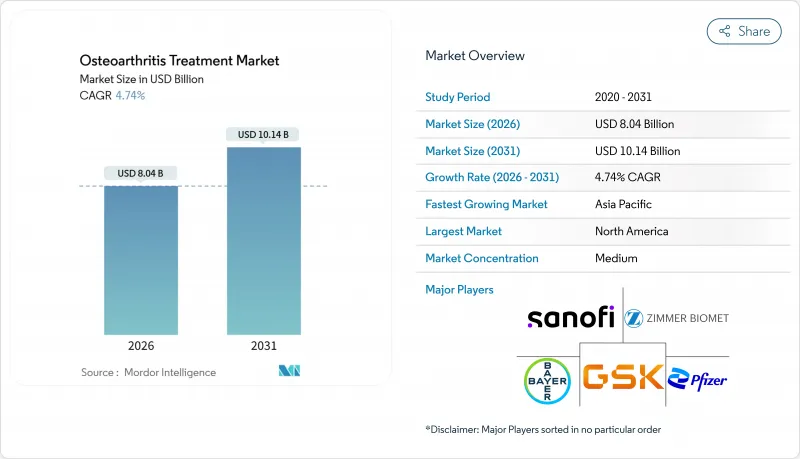
Mordor Intelligence에 의하면, 골관절염 치료 시장 규모는 2026년에 80억 4,000만 달러로 추정되고, 예측 기간(2026-2031년) CAGR 4.74%로 확대될 것으로 예측되며, 2031년에는 101억 4,000만 달러에 이를 전망입니다.
본 보고서는 의약품별(NSAIDs, 기타), 해부학적 부위별(발목, 고관절, 무릎, 어깨, 기타 부위), 유통 채널별(병원, 소매, 온라인 약국), 최종 사용자별(병원, 기타), 지역별(북미, 유럽, 아시아태평양, 중동 및 아프리카, 남미)로 분류되어 있습니다. 시장 전망은 금액(미 달러) 기준으로 제시되어 있습니다.
세계의 골관절염 치료 시장 동향 및 인사이트
급속히 진행되는 전 세계 고령화
유엔의 예측에 따르면, 2020년 10억 명이었던 60세 이상 고령 인구가 2030년까지 14억 명에 달할 것으로 보입니다. 일본은 이러한 영향을 여실히 보여주고 있으며, 이미 주민의 29%가 65세 이상입니다. 골관절염 유병 수는 2050년까지 전 세계적으로 10억 건에 달할 것으로 예측됩니다. 보고서에 따르면, 2024년에 60세 이상이 되는 중국의 2억 8,000만 명의 국민이 수술을 대체할 비용 대비 효과가 높은 주사제에 대한 수요를 가속화하고 있습니다. 제약 기업의 파이프라인도 이에 대응하고 있으며, 노바티스는 2024년 중 Wnt 경로 억제제 LNA043을 2b상 임상시험 단계로 진행했습니다.
비만 증가와 앉아 지내는 생활 방식
세계보건기구(WHO) 보고서에 따르면, 2022년 기준 전 세계 비만 인구는 10억 명을 넘어섰습니다. 비만은 퇴행성 무릎 관절염의 위험을 5배로 높이며, 연골 감소를 가속화합니다. 노보노르디스크의 STEP 9 임상시험에서는 세마글루티드 투여로 13.7%의 체중 감량이 확인되었으며, 2024년에는 무릎 통증 점수가 41.7포인트 감소했습니다. 미국의 비만 관련 의료비는 연간 1,700억 달러를 초과합니다. 2024년 『랜싯』 저널의 연구에 따르면, 하루 걸음 수가 5,000보 미만인 경우 연골이 얇아지는 속도가 22% 빨라지는 것으로 나타났습니다.
고급 생물학적 제제 요법의 고비용
다혈소판 혈장(PRP) 요법은 1회 주사당 700-1,200달러의 비용이 들며, 3회의 시술이 필요하지만, 메디케어에서는 전국적으로 보험 적용 대상에서 제외되어 있습니다. 3,000-7,000달러 가격대의 줄기세포 주사에 대해서는 2023년 『네이처 메디신』지의 임상시험에서 코르티코스테로이드보다 우수하다는 점이 입증되지 않았습니다. 2,500-4,000달러 가격대의 양막 현탁액 동종 이식편에 대해서는 근거 없는 효능을 내세운다는 이유로 FDA로부터 반복적으로 경고장이 발송되고 있습니다. 파실라(Pasila)사는 2025년에 GQ 바이오(GQ Bio)사를 인수하여, 1회당 1만 달러를 초과하는 가격으로 출시될 가능성이 있는 유전자 치료제 ‘PCRX-201’의 개발을 추진하고 있습니다. 인도의 ‘아유슈만 바라트’ 제도에서는 제네릭 NSAID 및 코르티코스테로이드만 보험 적용 대상이며, 점탄성 보충제는 본인 부담으로 구매해야 합니다.
부문 분석
히알루론산 주사제는 1회 투여 제제의 등장으로 복용 순응도의 장벽이 해소됨에 따라, 2031년까지 연평균 성장률(CAGR) 6.54%로 증가할 것으로 예측됩니다. NSAID는 2025년 시점에서 매출 점유율 41.43%를 유지했으나, 전신에 노출되는 양이 적다는 점에서 외용 디클로페낙 겔이 지지를 얻고 있습니다. ‘ZILRETTA’ 등의 코르티코스테로이드는 12주간 증상 완화 효과가 있어, 이에 따라 재시술의 필요성을 줄이고 있습니다. 바이오의약품은 지출에서 차지하는 비중은 작지만, 연구개발(R&D) 예산의 대부분을 차지하고 있습니다. 2024년, 글락소스미스클라인(GSK)은 유전자 표적을 특정하기 위해 릴레이션 테라퓨틱스(Relation Therapeutics)와 제휴하여 마일스톤으로 2억 달러를 지급했습니다. 앞으로 출시될 예정인 질환 수정 치료제 후보가 구조적 개선 효과를 보인다면, 골관절염 치료 시장 점유율은 주사제로 기울어질 가능성이 있습니다.
2025년 HYMOVIS ONE의 FDA 승인은 600명의 환자를 대상으로 한 임상시험에서 3회 투여 요법과 동등한 6개월간의 통증 완화 효과가 입증됨에 따라, 1회 투여 방식의 유효성을 뒷받침하는 계기가 되었습니다. ESCEO의 2024년 지침 개정에 따라, 환급 제도가 파편화되어 있음에도 불구하고 유럽에서 수요가 촉진되었습니다. 미국에서는 CDC 지침 개정 이후, 2020-2024년 골관절염에 대한 오피오이드 처방량이 40% 감소했습니다. 그 결과, 제약사의 파이프라인에서는 관절 치환술의 필요성을 미루고, 제네릭 NSAID와의 경쟁 속에서도 가격 결정력을 유지할 수 있는 구조적 치료제가 우선시되고 있습니다.
2025년에는 높은 생체역학적 부하와 명확한 수술 경로가 존재함에 따라, 골관절염 치료 시장 규모의 46.76%를 무릎 질환이 차지했습니다. 고령 근로자 및 운동선수에서 만성 회전근개 손상이 어깨 관절 퇴행으로 진행되기 때문에 어깨 질환의 사례 수는 2031년까지 연평균 6.76%의 비율로 증가할 것으로 예측됩니다. 고관절 질환도 유사한 성장 패턴을 보이고 있지만, 주사 시술이 기술적으로 복잡하기 때문에 점탄성 보충 요법의 보급은 더딘 임베디드니다. 발목 관절 및 소관절 질환은 합쳐서 의료비의 10% 미만을 차지합니다.
스미스 앤 네퓨(Smith & Nephew)는 2024년, 무릎 관절 치환술에 앞서 발생할 수 있는 국소적 결손을 치료 대상으로 하는 카르티힐(CartiHeal)을 선급금 1억 8,000만 달러에 인수했습니다. 역형 인공 어깨 관절 전치환술의 적응 범위가 확대됨에 따라, 수술 전 주사 사용이 증가하고 있습니다. 임플란트의 생존율이 향상되고, 환자들이 인공 관절 치환술 전 수명 연장 전략을 추구하게 됨에 따라, 어깨 관절 치료 분야에서 골관절염 치료 시장 점유율은 상승할 것으로 예측됩니다.
지역별 분석
2025년, 북미는 골관절염 치료 매출의 42.65%를 차지한 것으로 평가되었으며, 그 주된 요인은 주사 및 수술에 대한 메디케어(Medicare)의 환급이었습니다. 현지 보험 가입자들의 사전 승인 요건이 엄격해진 결과, 2023-2025년 히알루론산 제제의 급여 거부율이 35% 증가했습니다. HYMOVIS ONE의 FDA 승인 및 AI 기반 진단 도구의 등장은 이 지역이 혁신 분야에서 선도적인 위치를 차지하고 있음을 입증합니다. 캐나다에서는 점탄성 보충 요법에 대한 보험 적용이 제한되어 있어, 온타리오주에서의 보급률은 15% 미만에 그치고 있습니다.
아시아태평양은 2031년까지 연평균 5.64%의 성장이 예상되는데, 이는 일본의 초고령화 사회와 중국의 2억 8,000만 명에 달하는 고령층이 수술을 미루기 위해 주사 요법을 찾는 추세에 기인합니다. 일본에서는 연간 200만 건 이상의 점탄성 보충제 주사가 보험 적용을 받고 있습니다. 중국은 2024년에 몇 가지 히알루론산 브랜드를 국가 의약품 목록에 추가하여 국내 생산을 확대했습니다. 인도의 공적 의료 제도에서는 점탄성 보충제가 적용 대상에서 제외되지만, 중산층의 소득 증가가 본인 부담 시장의 확대를 뒷받침하고 있습니다. 한국에서는 국민건강보험 제도와 급속한 고령화가 서울과 부산에서 두 자릿수 성장을 이끌고 있습니다.
유럽에서는 비용 대비 효과 기준이 국가마다 달라 성장 속도가 완만합니다. 영국에서는 NICE(국립의료기술평가기구)가 히알루론산 사용을 구제적 사례로만 제한하고 있습니다. 독일에서는 주입량을 늘리는 다회 주사 요법을 보험 적용 대상으로 하고 있지만, 환자 1인당 지출액에는 상한선을 두고 있습니다. ESCEO가 2024년에 1회 주사 제제를 승인함에 따라, 향후 보험 환급 기준의 통합이 진행될 가능성이 있습니다. 중동에서는 UAE와 사우디아라비아가 의료 관광객을 유치하기 위한 성형외과 센터를 건설하고 있는 반면, 사하라 이남 아프리카에서는 저비용의 NSAIDs에 의존하고 있습니다. 남미의 성장은 브라질에 집중되어 있으며, 통화 변동이 있기는 하지만 민간 보험의 보급으로 인해 점탄성 보충제에 대한 접근성이 개선되고 있습니다.
기타 혜택 :
- 엑셀 형식 시장 예측(ME) 시트
- 3개월간의 애널리스트 지원
자주 묻는 질문
목차
제1장 서론
제2장 조사 방법
제3장 주요 요약
제4장 시장 구도
제5장 시장 규모 및 성장 예측
제6장 경쟁 구도
제7장 시장 기회 및 향후 전망
AJY 26.08.26According to Mordor Intelligence, the osteoarthritis treatment market size is estimated at USD 8.04 billion in 2026, and is expected to reach USD 10.14 billion by 2031, at a CAGR of 4.74% during the forecast period (2026-2031).
This report is Segmented by Drugs (NSAIDs, and More), Anatomy (Ankle, Hip, Knee, Shoulder, Other Anatomies), Distribution Channel (Hospital, Retail, and Online Pharmacies), End User (Hospitals, and More), and Geography (North America, Europe, Asia-Pacific, Middle East and Africa, and South America). The Market Forecasts are Provided in Terms of Value (USD).
Global Osteoarthritis Treatment Market Trends and Insights
Rapidly Aging Global Population
United Nations projections indicate that 1.4 billion people will be aged 60 or older by 2030, up from 1 billion in 2020. Japan illustrates the impact, with 29% of residents already over 65 years. The prevalence of osteoarthritis is expected to reach 1 billion cases worldwide by 2050. China's 280 million citizens aged 60 and above in 2024 are accelerating demand for cost-effective injections over surgery, according to. Pharmaceutical pipelines are adjusting; Novartis advanced its Wnt-pathway inhibitor LNA043 into Phase 2b during 2024.
Rising Obesity and Sedentary Lifestyles
The World Health Organization reported more than 1 billion obese individuals worldwide in 2022. Obesity raises the risk of knee osteoarthritis fivefold and quickens cartilage loss. Novo Nordisk's STEP 9 trial demonstrated a 13.7% weight loss with semaglutide, reducing knee pain scores by 41.7 points in 2024. U.S. obesity-related medical costs exceed USD 170 billion annually. A 2024 Lancet study linked fewer than 5,000 daily steps to 22% faster cartilage thinning.
High Cost of Advanced Biologic Therapies
Platelet-rich plasma costs USD 700-1,200 per injection and requires three sessions, yet Medicare offers no national coverage. Stem-cell injections priced at USD 3,000-7,000 showed no superiority to corticosteroids in a 2023 Nature Medicine trial. Amniotic suspension allografts, priced at USD 2,500-4,000, have faced repeated FDA warning letters for unsubstantiated claims. Pacira acquired GQ Bio in 2025 to develop PCRX-201 gene therapy that may debut at above USD 10,000 per dose. India's Ayushman Bharat scheme reimburses only generic NSAIDs and corticosteroids, leaving viscosupplements as out-of-pocket purchases.
Other drivers and restraints analyzed in the detailed report include:
- Growing Adoption of Single-Injection Viscosupplements
- AI-Enabled Early Diagnostics
- Safety Concerns and Regulatory Scrutiny Around Long-Term NSAID Use
For complete list of drivers and restraints, kindly check the Table Of Contents.
Segment Analysis
Hyaluronic acid injections are forecast to rise at a 6.54% CAGR through 2031 as single-dose products remove adherence barriers. NSAIDs retained a 41.43% revenue share in 2025, yet topical diclofenac gels are gaining favor due to their lower systemic exposure. Corticosteroids, such as ZILRETTA, offer 12 weeks of relief, thereby limiting the need for repeat procedures. Biologics account for a small portion of spending but dominate R&D budgets. In 2024, GlaxoSmithKline partnered with Relation Therapeutics to identify genetic targets, with USD 200 million in milestones. The osteoarthritis treatment market share is likely to tip toward injectables if forthcoming disease-modifying candidates demonstrate structural benefit.
The FDA approval of HYMOVIS ONE in 2025 validated the one-shot approach, following a 600-patient trial that demonstrated six-month pain reduction equivalent to that of three-dose regimens. ESCEO's 2024 guideline shift triggered European demand despite fragmented reimbursement. Opioid prescribing for osteoarthritis dropped 40% in the U.S. between 2020 and 2024 after CDC guideline updates. Pharmaceutical pipelines, therefore, prioritize structural agents that can postpone the need for replacement surgery and preserve pricing power in the face of generic NSAID competition.
Knee disease accounted for 46.76% of the osteoarthritis treatment market size in 2025, owing to its high biomechanical load and clear surgical pathways. Shoulder cases are projected to grow at 6.76% through 2031 as chronic rotator-cuff injuries progress to glenohumeral degeneration in aging workers and athletes. Hip disease follows a similar growth pattern but faces slower viscosupplement uptake because injections are technically complex. Ankle and small-joint disease together account for less than 10% of spending.
Smith & Nephew acquired CartiHeal for USD 180 million upfront in 2024, targeting focal defects that can precede knee replacement. Reverse total shoulder arthroplasty has expanded indications, leading to increased use of presurgical injections. The osteoarthritis treatment market share for shoulder interventions is expected to climb as implant survival improves and patients seek delay strategies before prosthesis.
Complete Report Scope:
- By Drugs
- Non-Steroidal Anti-Inflammatory Drugs (NSAIDs)
- Corticosteroids
- Hyaluronic Acid Injections
- Biologics & Disease-Modifying Therapies
- Other Drugs
- By Anatomy
- Ankle Osteoarthritis
- Hip Osteoarthritis
- Knee Osteoarthritis
- Shoulder Osteoarthritis
- Other Anatomies
- By Distribution Channel
- Hospital Pharmacies
- Retail Pharmacies
- Online Pharmacies
- By End User
- Hospitals
- Ambulatory Surgical Centers
- Orthopedic & Rheumatology Clinics
- Sports Medicine Centers
- Homecare Settings
- Geography
- North America
- United States
- Canada
- Mexico
- Europe
- Germany
- United Kingdom
- France
- Italy
- Spain
- Rest Of Europe
- Asia-Pacific
- China
- Japan
- India
- Australia
- South Korea
- Rest Of Asia-Pacific
- Middle East And Africa
- GCC
- South Africa
- Rest Of Middle East And Africa
- South America
- Brazil
- Argentina
- Rest Of South America
- North America
Geography Analysis
North America generated 42.65% of osteoarthritis treatment revenue in 2025, primarily driven by Medicare reimbursement for injections and surgeries. Local contractors tightened prior authorization, resulting in a 35% increase in denial rates for hyaluronic acid between 2023 and 2025. The FDA approval of HYMOVIS ONE and AI-based detection tools underscores the region's leadership in innovation. Canada limits viscosupplement coverage, keeping penetration below 15% in Ontario.
The Asia-Pacific region is projected to expand at a rate of 5.64% through 2031, as Japan's super-aged population and China's 280 million seniors seek injections to defer surgery. Japan reimburses over 2 million viscosupplement injections annually. China added several hyaluronic acid brands to its national drug list in 2024, boosting domestic output. India's public scheme excludes viscosupplements, but the rising income of the middle class is supporting a self-pay market. South Korea's universal coverage and rapid aging underpin double-digit growth in Seoul and Busan.
Europe grows more slowly because cost-effectiveness thresholds vary. NICE confines hyaluronic acid use to salvage cases in the UK. Germany covers multi-injection regimens that boost volume but cap per-patient spend. ESCEO's 2024 endorsement of single-injection products may harmonize reimbursement over time. In the Middle East, the UAE and Saudi Arabia are building orthopedic centers that attract medical tourists, whereas sub-Saharan Africa relies on low-cost NSAIDs. South American growth is concentrated in Brazil, where private insurance uptake is improving viscosupplement access despite currency volatility.
- Abbott Laboratories
- Anika Therapeutics
- Bayer
- Bioventus
- Ferring Pharmaceuticals
- Flexion Therapeutics Inc.
- GlaxoSmithKline
- Johnson & Johnson
- LG Chem
- Novartis
- Pfizer
- Sanofi
- Seikagaku
- Smiths Group
- Teva Pharmaceutical Industries
- Viatris
- Zimmer Biomet
Additional Benefits:
- The market estimate (ME) sheet in Excel format
- 3 months of analyst support
TABLE OF CONTENTS
1 Introduction
- 1.1 Study Assumptions & Market Definition
- 1.2 Scope Of The Study
2 Research Methodology
3 Executive Summary
4 Market Landscape
- 4.1 Market Overview
- 4.2 Market Drivers
- 4.2.1 Rapidly Aging Global Population and Rising Osteoarthritis Prevalence
- 4.2.2 Rising Obesity and Sedentary Lifestyles
- 4.2.3 Growing Adoption of Minimally Invasive Intra-Articular Injections and Single-Injection Viscosupplements
- 4.2.4 Expanding Insurance Coverage and Reimbursement for Non-Surgical Therapies in Emerging Markets
- 4.2.5 Advances in Regenerative Medicine and Disease-Modifying Therapies
- 4.2.6 AI-Enabled Early Diagnostics and Personalized Treatment Pathways
- 4.3 Market Restraints
- 4.3.1 High Cost of Advanced Biologic Therapies
- 4.3.2 Safety Concerns and Regulatory Scrutiny Around Long-Term NSAID and Opioid Use
- 4.3.3 Limited Clinical Evidence for Novel Regenerative Treatments Hindering Physician Adoption
- 4.3.4 Variability in Reimbursement Policies Across Regions
- 4.4 Value / Supply-Chain Analysis
- 4.5 Regulatory Landscape
- 4.6 Technological Outlook
- 4.7 Porter's Five Forces
- 4.7.1 Bargaining Power Of Suppliers
- 4.7.2 Bargaining Power Of Buyers / Consumers
- 4.7.3 Threat Of New Entrants
- 4.7.4 Threat Of Substitute Products
- 4.7.5 Intensity Of Competitive Rivalry
5 Market Size & Growth Forecasts (Value, USD)
- 5.1 By Drugs
- 5.1.1 Non-Steroidal Anti-Inflammatory Drugs (NSAIDs)
- 5.1.2 Corticosteroids
- 5.1.3 Hyaluronic Acid Injections
- 5.1.4 Biologics & Disease-Modifying Therapies
- 5.1.5 Other Drugs
- 5.2 By Anatomy
- 5.2.1 Ankle Osteoarthritis
- 5.2.2 Hip Osteoarthritis
- 5.2.3 Knee Osteoarthritis
- 5.2.4 Shoulder Osteoarthritis
- 5.2.5 Other Anatomies
- 5.3 By Distribution Channel
- 5.3.1 Hospital Pharmacies
- 5.3.2 Retail Pharmacies
- 5.3.3 Online Pharmacies
- 5.4 By End User
- 5.4.1 Hospitals
- 5.4.2 Ambulatory Surgical Centers
- 5.4.3 Orthopedic & Rheumatology Clinics
- 5.4.4 Sports Medicine Centers
- 5.4.5 Homecare Settings
- 5.5 Geography
- 5.5.1 North America
- 5.5.1.1 United States
- 5.5.1.2 Canada
- 5.5.1.3 Mexico
- 5.5.2 Europe
- 5.5.2.1 Germany
- 5.5.2.2 United Kingdom
- 5.5.2.3 France
- 5.5.2.4 Italy
- 5.5.2.5 Spain
- 5.5.2.6 Rest Of Europe
- 5.5.3 Asia-Pacific
- 5.5.3.1 China
- 5.5.3.2 Japan
- 5.5.3.3 India
- 5.5.3.4 Australia
- 5.5.3.5 South Korea
- 5.5.3.6 Rest Of Asia-Pacific
- 5.5.4 Middle East And Africa
- 5.5.4.1 GCC
- 5.5.4.2 South Africa
- 5.5.4.3 Rest Of Middle East And Africa
- 5.5.5 South America
- 5.5.5.1 Brazil
- 5.5.5.2 Argentina
- 5.5.5.3 Rest Of South America
- 5.5.1 North America
6 Competitive Landscape
- 6.1 Market Concentration
- 6.2 Market Share Analysis
- 6.3 Company Profiles {(Includes Global Level Overview, Market Level Overview, Core Segments, Financials as Available, Strategic Information, Market Rank/Share for Key Companies, Products & Services, and Recent Developments)}
- 6.3.1 Abbott Laboratories
- 6.3.2 Anika Therapeutics Inc.
- 6.3.3 Bayer AG
- 6.3.4 Bioventus LLC
- 6.3.5 Ferring Pharmaceuticals
- 6.3.6 Flexion Therapeutics Inc.
- 6.3.7 Glaxosmithkline Plc
- 6.3.8 Johnson & Johnson
- 6.3.9 LG Chem
- 6.3.10 Novartis AG
- 6.3.11 Pfizer Inc.
- 6.3.12 Sanofi SA
- 6.3.13 Seikagaku Corporation
- 6.3.14 Smith & Nephew
- 6.3.15 Teva Pharmaceutical Industries Ltd.
- 6.3.16 Viatris Inc.
- 6.3.17 Zimmer Biomet
7 Market Opportunities & Future Outlook
- 7.1 White-space & Unmet-Need Assessment


