|
시장보고서
상품코드
2114162
의료 품질 관리 시장 : 시장 점유율 분석, 업계 동향 및 통계, 성장 예측(2026-2031년)Healthcare Quality Management - Market Share Analysis, Industry Trends & Statistics, Growth Forecasts (2026 - 2031) |
||||||
 Mordor Intelligence
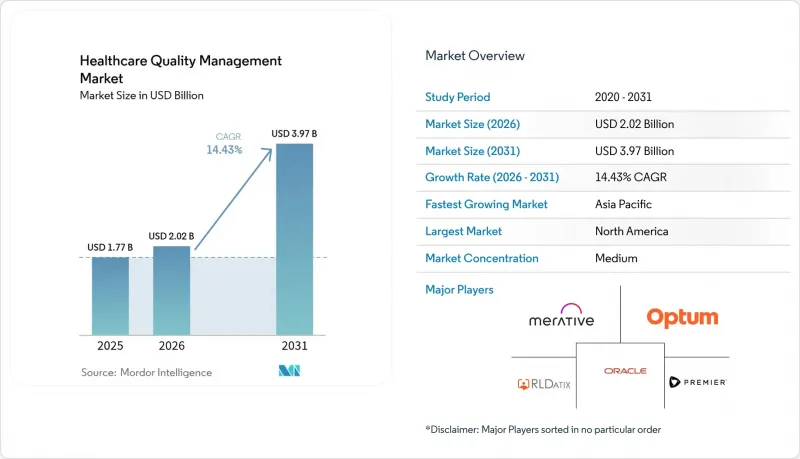
Mordor Intelligence에 의하면, 의료 품질 관리 시장 규모는 2025년에 17억 7,000만 달러로 평가되었고, 2026년 20억 2,000만 달러에서 2031년까지 39억 7,000만 달러에 이를 것으로 예측되며, 예측 기간(2026-2031년) CAGR은 14.43%를 나타낼 전망입니다.
본 보고서는 소프트웨어 유형별(비즈니스 인텔리전스 및 고급 분석, 기타), 제공 형태별(클라우드 기반, 기타), 용도별(데이터 관리 및 품질 보고, 기타), 최종 사용자별(외래 진료 및 전문 클리닉, 기타), 지역별(북미, 유럽, 기타)로 분류되어 있습니다. 시장 예측은 금액(달러)으로 표시되어 있습니다.
세계의 의료 품질 관리 시장 동향 및 인사이트
품질 보고에 관한 정부의 의무화 및 인센티브
규제 당국은 현재 환급 제도에 금전적 보상과 벌칙을 포함시켜 병원 및 책임 의료 기관(ACO)에 보고의 고도화를 요구하고 있습니다. 메디케어·메디케이드 서비스 센터(CMS)는 책임의료(ACO)의 품질 평가 지표를 2025년 4개 항목에서 2028년 11개 항목으로 확대할 예정이며, 이로 인해 수작업에 의존하는 스프레드시트 관리는 높은 위험을 수반하는 부채로 변모하고 있습니다. 매년 6가지 전자 임상 품질 지표를 제출해야 지급액이 조정되므로, 대응이 늦어진 의료 기관은 최신 플랫폼으로의 전환을 서둘러야 합니다. 이러한 규정을 무시하는 병원은 수익 손실과 가치 기반 프로그램에서 배제되는 두 가지 위험을 모두 감수하게 됩니다. ‘21세기 치료법(21st Century Cures Act)’에서는 정보 차단에 대한 제재가 추가되어 상호 운용 가능한 데이터 흐름이 필수 요건으로 규정되었습니다. 그 결과, 엔드투엔드 품질 관리 솔루션에 대한 투자는 선택적 예산에서 미션 크리티컬 예산으로 전환되고 있습니다.
고령화와 만성 질환의 부담
비감염성 질환은 전 세계 사망 원인의 74%를 차지하며, 다중 동반 질환이라는 과제를 야기하고 진료비 보상제의 경제성을 압박하고 있습니다. 아시아태평양은 가장 심각한 인구 구조적 부담을 안고 있어, 의료 제공업체 간에 종단적인 치료 계획을 조정하는 집단건강관리 품질 플랫폼에 대한 투자를 촉진하고 있습니다. 가치 기반 계약에서는 치료 성과에 따라 재무적 위험이 전가되므로, 예방적 질환 관리 대시보드가 필수적입니다. 이러한 시스템을 도입한 기관에서는 재입원율 감소와 환자 1인당 비용 절감이 관찰되었으며, 인구통계학적 압력이 향후 10년 이상에 걸쳐 플랫폼에 대한 지속적인 수요를 뒷받침하고 있음이 입증되었습니다.
높은 도입 및 통합 비용
소규모 의료 기관들은 HIPAA 보안 개정안 대응만으로도 전미에서 첫해 규정 준수 비용으로 93억 달러가 소요되는 상황에서 플랫폼 도입 자금 조달에 어려움을 겪고 있습니다. 새로운 품질 관리 모듈을 기존 전자건강기록(EHR)과 연동하려면 대부분의 경우 도입 기간이 최대 2년 연장되고, 컨설팅 비용도 수배로 불어납니다. 총 소유 비용에는 지속적인 업그레이드와 사용자 교육이 포함되며, 이는 초기 라이선스 비용의 2배에서 3배에 달하는 경우가 빈번합니다. 그 결과, 일부 중견 시스템에서는 수작업에 의한 임시 방편으로 되돌아가는 사례도 나타나고 있으나, 이는 결국 지속 불가능한 것으로 판명되어 비용에 민감한 지역에서 시장 침투를 지연시키고 있습니다.
부문 분석
비즈니스 인텔리전스 및 고급 분석은 보고 의무를 이행하는 대시보드에 대한 근본적인 수요를 반영하여 여전히 가장 큰 점유율을 유지하고 있습니다. 한편, ‘인구 건강 및 품질 관리’ 분야는 연평균 성장률(CAGR) 16.28%로 빠르게 확대되고 있습니다. 이는 보험사 및 통합 네트워크가 선제적인 위험 계층화 도구를 필요로 하기 때문입니다. 벤더들은 이러한 모듈에 AI 예측 기능을 통합하고 있으며, 의료 품질 관리 시장은 사후적인 진료 기록 분석에서 실시간 개입 엔진으로 전환되고 있습니다. ‘품질 보고·벤치마킹’ 제품군은 CMS(미국 의료보험서비스센터) 규정 준수를 위해 여전히 필수적인 반면, ‘임상 위험·환자 안전’ 플랫폼은 인증 기준의 엄격화에 따라 주목을 받고 있습니다.
이러한 융합 추세에 따라 시각화, 예측 분석, 안전 모니터링을 통합한 통합 스택이 유리해지고 있습니다. 월터스 크루어의 ‘UpToDate’를 탑재한 ‘AI Labs’는 의사결정 지원과 품질 분석이 이제 하나의 워크플로우 내에서 공존하고 있음을 보여줍니다. 풀 스펙트럼 플랫폼을 도입한 병원에서는 연간 1,330만 달러의 비용 절감과 신속한 ROI가 보고되고 있으며, 이는 추가적인 보급을 뒷받침하고 있습니다. AI 투명성에 관한 규제가 강화되는 가운데, 설명 가능한 모델을 보유한 벤더는 헬스케어 품질 관리 시장에서 경쟁 우위를 누리고 있습니다.
2025년 매출 중 클라우드 기반 도입이 58.05%를 차지했으며, 의료 서비스 제공업체들이 탄력적인 인프라를 강력히 요구하고 있음이 부각되었습니다. 웹 호스팅형 SaaS는 연평균 성장률(CAGR) 15.63%로 성장을 주도하고 있으며, 자본 예산을 피하는 구독형 경제로의 전환이 두드러지고 있습니다. 의료 시스템의 클라우드 연간 평균 지출액은 3,800만 달러를 초과하여, 벤더가 관리하는 보안 및 이중화에 대한 신뢰도가 높음을 보여줍니다. 온프레미스 도입은 주로 데이터 주권 관련 법률이나 레거시 인터페이스로 인해 로컬 호스팅이 의무화된 지역에서 여전히 지속되고 있습니다.
Oracle Health가 TEFCA에서 ‘Qualified HIN’ 지위를 획득하고자 하는 것은 클라우드 백본을 통한 안전한 정보 교환이 우선시되고 있음을 보여줍니다(oracle.com). 또한, SaaS를 통한 제공은 IT 인력을 충분히 확보할 수 없는 지방이나 지역 병원에서도 고도의 분석 기능을 널리 이용할 수 있게 해줍니다. 그 결과, 클라우드 네이티브 공급업체들은 의료 품질 관리 시장에서 기존 경쟁사들을 능가하는 성장을 이루고 있습니다.
지역별 분석
북미는 엄격한 CMS 프로그램과 대규모 IT 예산에 힘입어 2025년에도 매출 점유율 40.02%로 선두를 유지했습니다. 제안된 HIPAA 보안 개정안만으로도 규정 준수 관련 지출을 수십억 규모로 끌어올려, 중규모 병원조차 인프라 현대화를 서두르게 될 것입니다. 캐나다와 멕시코는 연방 정부의 디지털화 전략을 통해 성장세를 보이고 있지만, 이 지역 수요 중심은 여전히 미국입니다.
아시아태평양은 호주, 인도, 말레이시아의 국가 차원 디지털 헬스 청사진에 힘입어 2031년까지 연평균 성장률(CAGR) 15.52%를 기록하며 가장 빠른 성장이 전망되는 지역입니다. 통합형 1차 진료 기술에 대한 투자는 비전염성 질환의 높은 유병률을 해결하기 위한 것으로, 집단건강관리 모듈에 유망한 시장을 창출하고 있습니다. 클라우드 도입을 통해 신흥 시장은 온프레미스 방식의 제약을 극복할 수 있게 되었으며, 이는 의료 품질 관리 시장을 더욱 활성화시키고 있습니다.
유럽에서는 상호 운용성 및 의료 기술 평가 체계가 지역 전체로 확산되며 꾸준한 성장이 관찰되고 있습니다. 독일의 ‘미래 병원법’, 프랑스의 ‘MaSante 2022’ 계획, 영국의 NHS 디지털화 의제는 모두 투명성이 높은 성과 지표를 요구하고 있습니다. GDPR(EU 개인정보보호규정) 준수가 공급업체의 로드맵을 형성하고 있으며, 정교한 동의 관리 및 가명화 기능을 갖춘 플랫폼이 우위를 점하고 있습니다. 이러한 동향들이 맞물려 지역 성장을 뒷받침하는 한편, 전 세계 진출 기업들에 대한 규제 장벽을 높이고 있습니다.
기타 혜택 :
- 엑셀 형식 시장 예측(ME) 시트
- 3개월간의 애널리스트 지원
자주 묻는 질문
목차
제1장 서론
제2장 조사 방법
제3장 주요 요약
제4장 시장 구도
제5장 시장 규모 및 성장 예측
제6장 경쟁 구도
제7장 시장 기회 및 향후 전망
AJY 26.08.26According to Mordor Intelligence, the healthcare quality management market size was valued at USD 1.77 billion in 2025 and estimated to grow from USD 2.02 billion in 2026 to reach USD 3.97 billion by 2031, at a CAGR of 14.43% during the forecast period (2026-2031).
This report is Segmented by Software Type (Business Intelligence & Advanced Analytics, and More), Mode of Delivery (Cloud-Based, and More), Application (Data Management & Quality Reporting, and More), End User (Ambulatory Care & Specialty Clinics, and More), Geography (North America, Europe, and More). The Market Forecasts are Provided in Terms of Value (USD).
Global Healthcare Quality Management Market Trends and Insights
Government Mandates and Incentives for Quality Reporting
Regulators now embed financial carrots and sticks in reimbursement, compelling hospitals and accountable-care organizations to elevate reporting sophistication. The Centers for Medicare & Medicaid Services will expand accountable-care quality measures from 4 in 2025 to 11 in 2028, turning manual spreadsheets into high-risk liabilities. Annual submission of six electronic clinical quality measures determines payment adjustments, pushing laggards toward modern platforms. Hospitals that ignore these rules risk both revenue loss and exclusion from value-based programs. The 21st Century Cures Act adds penalties for information blocking, making interoperable data flows a non-negotiable requirement. As a result, investment in end-to-end quality suites has shifted from discretionary to mission-critical budgeting.
Aging Population and Chronic Disease Burden
Noncommunicable diseases account for 74% of global deaths, creating multicomorbidity challenges that strain fee-for-service economics. Asia-Pacific bears the heaviest demographic load, spurring investments in population-health quality platforms that orchestrate longitudinal care plans across providers. Value-based contracts place downside financial risk on outcomes, making proactive disease-management dashboards indispensable. Organizations deploying such systems see hospital-readmission reductions and per-patient cost savings, demonstrating that demographic pressure is fuelling sustained platform demand well into the next decade.
High Implementation and Integration Costs
Smaller providers struggle to fund platform rollouts when HIPAA security amendments alone require USD 9.3 billion nationwide in first-year compliance costs. Linking new quality modules with legacy EHRs often extends timelines by up to two years and multiplies consulting fees. Total cost of ownership includes ongoing upgrades and user training that frequently double or triple initial license expenditure. As a result, some mid-tier systems revert to manual workarounds that eventually prove unsustainable, slowing market penetration in cost-sensitive regions.
Other drivers and restraints analyzed in the detailed report include:
- Advancement of Artificial-Intelligence Analytics
- Rise of Consumer Transparency and ESG Accountability
- Data Security and Privacy Concerns
For complete list of drivers and restraints, kindly check the Table Of Contents.
Segment Analysis
Business Intelligence & Advanced Analytics retained the largest footprint, reflecting fundamental demand for dashboards that fulfill reporting obligations. Population-Health Quality Management however is accelerating at 16.28% CAGR because payers and integrated networks need proactive risk-stratification tools. Vendors embed AI prediction into these modules, shifting the Healthcare quality management market from retrospective charts toward real-time intervention engines. Quality Reporting & Benchmarking suites remain vital for CMS compliance, while Clinical Risk & Patient-Safety platforms gain attention amid stricter accreditation rules.
The convergence trend favours unified stacks that merge visualization, predictive analytics, and safety surveillance. Wolters Kluwer's UpToDate-powered AI Labs illustrates how decision support and quality analytics now coexist in one workflow. Hospitals adopting full-spectrum platforms report USD 13.3 million annual savings and rapid ROI, propelling further uptake. As AI transparency rules tighten, vendors with explainable models enjoy a competitive edge in the Healthcare quality management market.
Cloud-based deployment captured 58.05% of 2025 revenue, underscoring provider appetite for elastic infrastructure. Web-Hosted SaaS leads growth at 15.63% CAGR, highlighting movement toward subscription economics that sidestep capital budgets. Average annual health-system cloud spend has surpassed USD 38 million, signalling confidence in vendor-managed security and redundancy. On-premise implementations persist mainly where data-sovereignty law or legacy interfaces dictate local hosting.
Oracle Health's pursuit of Qualified HIN status within TEFCA underscores the priority on secure information exchange across cloud backbones oracle.com. SaaS delivery also democratizes advanced analytics for rural and community hospitals that lack extensive IT staff. Consequently, cloud-native suppliers are poised to outpace legacy competitors in the Healthcare quality management market.
Complete Report Scope:
- By Software Type
- Business Intelligence & Advanced Analytics
- Quality Reporting & Benchmarking Suites
- Clinical Risk & Patient-Safety Management
- Provider Performance & Productivity Improvement
- Population-Health Quality Management
- By Mode Of Delivery
- Cloud-Based
- Web-Hosted (SaaS)
- On-Premise
- By Application
- Data Management & Quality Reporting
- Risk & Compliance Management
- Outcome & Cost Analytics
- Patient-Safety & Adverse-Event Surveillance
- By End User
- Hospitals & Integrated Delivery Networks
- Ambulatory Care & Specialty Clinics
- Payers & Accountable-Care Organizations
- Other Providers (Rehab, Long-Term Care)
- Geography
- North America
- United States
- Canada
- Mexico
- Europe
- Germany
- United Kingdom
- France
- Italy
- Spain
- Rest of Europe
- Asia-Pacific
- China
- Japan
- India
- Australia
- South Korea
- Rest of Asia-Pacific
- Middle East & Africa
- GCC
- South Africa
- Rest of Middle East & Africa
- South America
- Brazil
- Argentina
- Rest of South America
- North America
Geography Analysis
North America retained leadership at 40.02% revenue share in 2025, supported by rigorous CMS programs and large-scale IT budgets. Proposed HIPAA security amendments alone will drive billions in compliance spend, pressing even mid-size hospitals to modernize infrastructures. Canada and Mexico add momentum through federal digitization strategies, but the United States remains the anchor of regional demand.
Asia-Pacific is the fastest-growing territory at 15.52% CAGR to 2031, catalyzed by national digital-health blueprints across Australia, India, and Malaysia. Integrated primary-care technology investments combat high noncommunicable-disease prevalence, creating fertile territory for population-health modules. Cloud uptake lets emerging markets leapfrog on-premise constraints, further stimulating the Healthcare quality management market.
Europe shows steady expansion as interoperability and health-technology-assessment frameworks spread across the bloc. Germany's Hospital Future Act, France's MaSante2022 plan, and the United Kingdom's NHS digitization agenda all demand transparent outcome metrics. GDPR compliance shapes vendor roadmaps, favouring platforms with advanced consent and pseudonymization controls. Collectively, these dynamics sustain regional growth while raising the regulatory bar for global entrants.
- Oracle
- Optum
- Merative
- Premier
- Mckesson
- RLDatix
- Health Catalyst
- CitiusTech
- Nuance (Microsoft)
- Dolbey Systems
- Medisolv
- Clarity Group
- Riskonnect Inc.
- Press Ganey
- Quantros Inc.
- Wolters Kluwer Health
- Flatiron Health
- MedeAnalytics
- Koninklijke Philips
Additional Benefits:
- The market estimate (ME) sheet in Excel format
- 3 months of analyst support
TABLE OF CONTENTS
1 Introduction
- 1.1 Study Assumptions & Market Definition
- 1.2 Scope Of The Study
2 Research Methodology
3 Executive Summary
4 Market Landscape
- 4.1 Market Overview
- 4.2 Market Drivers
- 4.2.1 Government Mandates and Incentives for Quality Reporting
- 4.2.2 Surge In Healthcare Data Volume and Complexity
- 4.2.3 Aging Population and Chronic Disease Burden
- 4.2.4 Digital Transformation of Provider Workflows
- 4.2.5 Advancement of Artificial Intelligence Analytics
- 4.2.6 Rise of Consumer Transparency and ESG Accountability
- 4.3 Market Restraints
- 4.3.1 High Implementation and Integration Costs
- 4.3.2 Data Security and Privacy Concerns
- 4.3.3 Lack of Interoperability Standards
- 4.3.4 Algorithmic Bias and Regulatory Liability
- 4.4 Regulatory Landscape
- 4.5 Porter's Five Forces
- 4.5.1 Bargaining Power Of Suppliers
- 4.5.2 Bargaining Power Of Buyers/Consumers
- 4.5.3 Threat Of New Entrants
- 4.5.4 Threat Of Substitute Products
- 4.5.5 Intensity Of Competitive Rivalry
5 Market Size & Growth Forecasts (Value, USD)
- 5.1 By Software Type
- 5.1.1 Business Intelligence & Advanced Analytics
- 5.1.2 Quality Reporting & Benchmarking Suites
- 5.1.3 Clinical Risk & Patient-Safety Management
- 5.1.4 Provider Performance & Productivity Improvement
- 5.1.5 Population-Health Quality Management
- 5.2 By Mode Of Delivery
- 5.2.1 Cloud-Based
- 5.2.2 Web-Hosted (SaaS)
- 5.2.3 On-Premise
- 5.3 By Application
- 5.3.1 Data Management & Quality Reporting
- 5.3.2 Risk & Compliance Management
- 5.3.3 Outcome & Cost Analytics
- 5.3.4 Patient-Safety & Adverse-Event Surveillance
- 5.4 By End User
- 5.4.1 Hospitals & Integrated Delivery Networks
- 5.4.2 Ambulatory Care & Specialty Clinics
- 5.4.3 Payers & Accountable-Care Organizations
- 5.4.4 Other Providers (Rehab, Long-Term Care)
- 5.5 Geography
- 5.5.1 North America
- 5.5.1.1 United States
- 5.5.1.2 Canada
- 5.5.1.3 Mexico
- 5.5.2 Europe
- 5.5.2.1 Germany
- 5.5.2.2 United Kingdom
- 5.5.2.3 France
- 5.5.2.4 Italy
- 5.5.2.5 Spain
- 5.5.2.6 Rest of Europe
- 5.5.3 Asia-Pacific
- 5.5.3.1 China
- 5.5.3.2 Japan
- 5.5.3.3 India
- 5.5.3.4 Australia
- 5.5.3.5 South Korea
- 5.5.3.6 Rest of Asia-Pacific
- 5.5.4 Middle East & Africa
- 5.5.4.1 GCC
- 5.5.4.2 South Africa
- 5.5.4.3 Rest of Middle East & Africa
- 5.5.5 South America
- 5.5.5.1 Brazil
- 5.5.5.2 Argentina
- 5.5.5.3 Rest of South America
- 5.5.1 North America
6 Competitive Landscape
- 6.1 Market Concentration
- 6.2 Market Share Analysis
- 6.3 Company Profiles (includes Global level Overview, Market level overview, Core Business Segments, Financials, Headcount, Key Information, Market Rank, Market Share, Products and Services, and analysis of Recent Developments)
- 6.3.1 Oracle
- 6.3.2 Optum, Inc.
- 6.3.3 Merative
- 6.3.4 Premier Inc.
- 6.3.5 McKesson Corporation
- 6.3.6 RLDatix
- 6.3.7 Health Catalyst
- 6.3.8 CitiusTech Inc.
- 6.3.9 Nuance (Microsoft)
- 6.3.10 Dolbey Systems Inc.
- 6.3.11 Medisolv Inc.
- 6.3.12 Clarity Group
- 6.3.13 Riskonnect Inc.
- 6.3.14 Press Ganey
- 6.3.15 Quantros Inc.
- 6.3.16 Wolters Kluwer Health
- 6.3.17 Flatiron Health
- 6.3.18 MedeAnalytics
- 6.3.19 Philips Healthcare
7 Market Opportunities & Future Outlook
- 7.1 White-Space & Unmet-Need Assessment