

|
시장보고서
상품코드
2114166
뇌심부자극 디바이스 : 시장 점유율 분석, 업계 동향과 통계, 성장 예측(2026-2031년)Deep Brain Stimulation Devices - Market Share Analysis, Industry Trends & Statistics, Growth Forecasts (2026 - 2031) |
||||||
 Mordor Intelligence
Mordor Intelligence에 따르면 2026년 뇌심부자극 디바이스 시장 규모는 15억 8,000만 달러로 추정되고 있으며, 2025년 14억 3,000만 달러에서 확대하며, 2031년에는 25억 6,000만 달러에 달할 것으로 예측됩니다.
2026-2031년의 연평균 성장률(CAGR)은 10.18%에 달할 전망입니다.
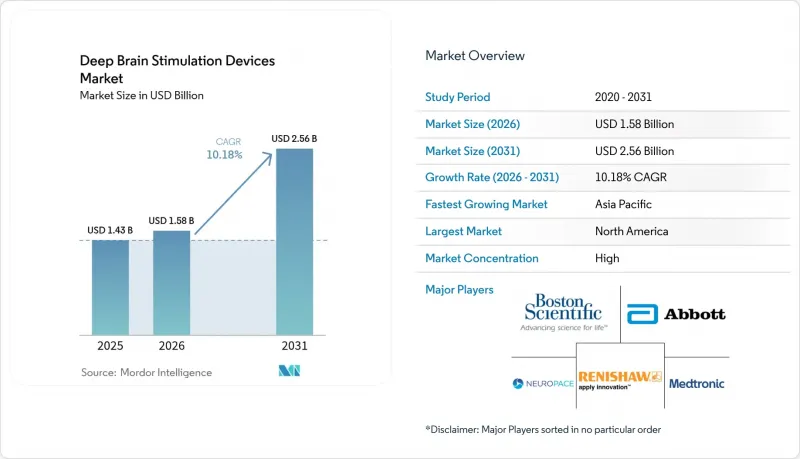
이 보고서는 제품 유형(장치: 단일 채널 시스템, 이식형 펄스 발생기, 이중 채널 시스템; 부속품: 리드/전극, 연장 케이블 및 부속품),적응증(파킨슨병, 본태성 진전 등), 최종사용자(병원, 신경과 클리닉 등) 및 지역(북미, 유럽 등)별로 분류되어 있습니다. 시장 전망은 금액(달러) 기준으로 제시되어 있습니다.
전 세계 심부 뇌 자극 기기 시장의 동향 및 인사이트
센싱 기능을 갖춘 폐쇄 루프형 IPG의 급속한 보급
BrainSense Adaptive DBS는 2025년 2월 FDA 승인을 획득하여, 실시간 신경 신호를 기반으로 자극 강도를 자동으로 조정하는 최초의 상용 폐쇄 루프 플랫폼이 되었습니다. 다기관 공동 연구 데이터에 따르면 오픈 루프 시스템에 비해 운동 증상이 중앙값 기준으로 50% 감소했으며, 프로그래밍을 위한 내원 횟수가 3분의 1로 줄어든 것으로 나타났습니다. 의사들은 최적화 곡선이 더 빠르고 부작용도 적다고 보고하고 있으며, 이는 환자 만족도와 의료 경제적 가치 향상으로 이어지고 있습니다. 조기 도입이 가장 활발한 곳은 치료 성과에 기반한 모델에 대해 보험 환급이 이루어지는 미국 및 독일의 의료기관입니다. 간질 및 우울증으로의 적응증 확대에 따라 심부 뇌 자극 기기의 시장은 더욱 확장되고 있습니다.
파킨슨병 초기 단계 환자에 대한 보험 적용 범위 확대
메디케어는 2024년 말에 ‘진행기에 한함’이라는 기준을 철폐했으며, 이에 따라 미국의 적용 대상 인구는 즉시 확대되었습니다. 민간 보험사들도 6개월 이내에 방침을 조정하여 의뢰 건수의 증가를 가속화했습니다. 프랑스의 HAS와 독일의 G-BA에 의한 유사한 움직임이 유럽 전역에서의 보급을 지원하고 있습니다. 조기 개입은 장기적인 기능 상태를 개선하고 레보도파의 비용 부담을 경감시키기 때문에 심부 뇌 자극 기기 시장의 전망을 더욱 공고히 하고 있습니다. 각 제조사들은 이러한 정책 전환을 지원할 RWE(Real-World Evidence)를 생성하기 위해 결과 등록부에 자금을 지원하고 있습니다.
이식 후 감염률이 예방적 재검토를 촉구하고 있습니다.
하드웨어와 관련된 감염은 이식 사례의 2.6-6.9%에서 발생하며, 대부분의 경우 시스템 전체를 적출하거나 장기간 항생제를 투여해야 합니다. 재수술 비용은 건당 2만 달러를 초과하며, 발표된 결과로 인해 신뢰가 훼손되면 새로운 환자 유입이 정체될 수 있습니다. 여름철의 계절적 요인과 동반 질환의 유병률은 위험을 높이며, 특히 층류식 수술실을 갖추지 않은 시설에서는 이러한 경향이 두드러집니다. 항균 코팅이 적용된 리드선과 더욱 엄격한 수술 전후 프로토콜 덕분에 수술 건수가 많은 미국의 의료 시설에서는 감염률이 감소하고 있지만, 신흥 시장에서의 광범위한 도입은 여전히 제한적인 상황입니다. 감염에 대한 우려가 뿌리 깊게 자리 잡고 있으며, 심부 뇌 자극 장치 시장의 침투 곡선은 완만한 양상을 보이고 있습니다.
부문 분석
2025년에는 센싱 기능, 충전식 배터리, MRI 안전 기능을 통합한 이식형 펄스 발생기를 주축으로, 기기 부문이 매출의 83.12%를 차지했습니다. 신규 이식 수술에서 듀얼 채널 발생기가 싱글 채널 유닛을 앞질렀으며, 이는 양측 수술의 증가를 반영합니다. 액세서리(지향성 리드, 감지 전극, 연장 케이블)는 폐쇄 루프 시스템에 전용 하드웨어 업그레이드가 필요하므로 연평균 성장률(CAGR) 10.47%로 성장하고 있습니다. 액세서리의 교체 주기가 짧기 때문에 환자 1인당 평생 수익을 3배로 늘리는 정기적인 수입원이 창출되고 있습니다. 심부 뇌 자극 장치 시장의 액세서리 규모는 지역 신경과 전문의들이 채택하는 소프트웨어 기반 프로그래밍 키트의 인기에 힘입어 2031년까지 4억 4,000만 달러에 달할 것으로 예측됩니다. 경쟁 압력은 단순한 가격 책정보다는 전극의 형태와 재료 과학에 집중되어 있으며, 이를 통해 이익률이 유지되고 있습니다.
세분화된 리드선 분야의 기술적 혁신으로 인해 더 정확한 표적 설정이 가능해지고 부작용도 완화되어, 구형 시스템에서 신형 시스템으로의 전환이 촉진되고 있습니다. 제조업체들은 기존 제너레이터에 대한 업그레이드 경로를 번들로 제공하고 있으며, 이로 인해 병원의 전환 장벽이 높아지고 있습니다. 적응형 리드에 대한 유럽 및 미국 규제 당국의 승인으로 인해 액세서리는 주요 혁신의 최전선으로서의 입지를 강화하고 있습니다. 연장용 리드선을 위한 재생 및 재멸균 서비스의 확대 또한 특히 비용에 민감한 시장에서 이 부문의 수익에 기여하고 있습니다. 그 결과, 액세서리의 성장률은 기기 본체의 성장률을 상회하는 반면, 심부 뇌 자극 기기 시장에서는 이미 도입된 제너레이터 대수에 계속해서 의존하게 될 것입니다.
지역별 분석
북미는 메디케어(Medicare)의 광범위한 보험 적용, 신경외과 전문의의 높은 밀도, 그리고 폐쇄 루프 시스템의 조기 도입에 힘입어 2025년에도 심부 뇌 자극 기기 시장에서 41.88%의 점유율을 차지하며 수익의 주축으로 남아 있었습니다. 미국에서는 외래 이식 수술이 증가함에 따라 성장이 지속되고 있으며, 캐나다에서는 국민건강보험제도로 인해 기기의 이익률은 낮아지고 있지만 안정적인 판매량이 유지되고 있습니다.
유럽은 전 세계 매출의 4분의 1을 차지하고 있으며, 독일, 프랑스, 북유럽의 주요 의료 센터에서 안정적인 보험 환급과 일관된 시술 건수가 특징입니다. 충전식 제너레이터와 지향성 리드의 도입은 성숙 단계에 이르렀으나, 관료적인 조달 절차로 인해 교체 주기가 장기화되고 있습니다.
아시아태평양은 중국의 뇌-컴퓨터 인터페이스(BCI) 관련 가격 책정 체계와 3차 의료 기관의 적극적인 설비 확충에 힘입어 연평균 성장률(CAGR) 11.12%로 시장 확대를 주도하고 있습니다. 일본에서는 고령화 사회와 활발한 연구 성과로 인해 고부가가치 기기에 대한 수요가 유지되고 있는 반면, 인도에서는 가격 측면의 제약을 해결하기 위해 비용 효율이 뛰어난 솔루션이 추진되고 있습니다. 현지 제조 파트너십 및 규제 조화를 위한 노력으로 진입 장벽이 낮아지면서, 이 지역은 심부 뇌 자극 기기 시장에서 전략적인 격전지가 되고 있습니다. 중동 및 아프리카는 자본 설비 부족과 환급 제도의 격차로 인해 한 자릿수 성장에 그치고 있지만, 걸프 국가들에서는 보다 광범위한 보급의 계기가 될 수 있는 ‘센터 오브 엑설런스(Center of Excellence)’에 대한 투자가 진행되고 있습니다.
기타 혜택:
- 엑셀 형식의 시장 예측(ME) 시트
- 3개월간의 애널리스트 지원
자주 묻는 질문
목차
제1장 서론
제2장 조사 방법
제3장 개요
제4장 시장 구도
제5장 시장 규모와 성장 예측
제6장 경쟁 구도
제7장 시장 기회와 향후 전망
KSA 26.08.26According to Mordor Intelligence, the deep brain stimulation devices market size in 2026 is estimated at USD 1.58 billion, growing from 2025 value of USD 1.43 billion with 2031 projections showing USD 2.56 billion, growing at 10.18% CAGR over 2026-2031.
This report is Segmented by Product Type (Devices: Single-Channel Systems, Implantable Pulse Generators, Dual-Channel Systems; Accessories: Leads/Electrodes, Extensions & Accessories), Application (Parkinson's Disease, Essential Tremor, and More), End User (Hospitals, Neurology Clinics, and More), and Geography (North America, Europe and More). The Market Forecasts are Provided in Terms of Value (USD).
Global Deep Brain Stimulation Devices Market Trends and Insights
Rapid uptake of sensing-enabled closed-loop IPGs
BrainSense Adaptive DBS won FDA clearance in February 2025, marking the first commercial closed-loop platform that automatically titrates stimulation from real-time neural signals. Multicenter data show median 50% motor-symptom reduction compared with open-loop systems, alongside a one-third cut in programming visits. Physicians report faster optimization curves and fewer side effects, improving patient satisfaction and health-economic value. Early adoption is strongest in U.S. and German centers where reimbursement rewards outcome-based models. Expanding indications in epilepsy and depression further widen the deep brain stimulation devices market.
Reimbursement expansion for earlier-stage Parkinson's patients
Medicare removed the "advanced-stage only" criterion in late 2024, instantly enlarging the U.S. eligible population. Private payors aligned policies within six months, accelerating referral volumes. Comparable moves by France's HAS and Germany's G-BA support broader European uptake. Earlier intervention improves long-term functional status and reduces levodopa cost burden, reinforcing the deep brain stimulation devices market outlook. Manufacturers are funding outcomes registries to generate real-world evidence that sustains the policy shift.
Post-implant infection rates driving precautionary revisions
Hardware-related infections occur in 2.6-6.9% of implants, often requiring complete system explantation and extended antibiotic courses. Revision costs exceed USD 20,000 per episode and stall new referrals when publicized outcomes erode confidence. Summer seasonality and comorbidity prevalence escalate risk, especially in facilities lacking laminar airflow theaters. Antimicrobial-coated leads and stricter peri-operative protocols are lowering rates in high-volume U.S. centers, yet widespread uptake in emerging markets remains limited. Persistent infection fears moderate the deep brain stimulation devices market's penetration curve.
Other drivers and restraints analyzed in the detailed report include:
- Surge in Asia-Pacific neurosurgeon training programs
- Miniaturized rechargeable IPGs lengthen replacement cycles
- Global shortage of ^99Mo for imaging prolongs diagnosis windows
For complete list of drivers and restraints, kindly check the Table Of Contents.
Segment Analysis
Devices generated 83.12% revenue in 2025, anchored by implantable pulse generators that integrate sensing, rechargeable batteries, and MRI safety features. Dual-channel generators now surpass single-channel units in new implants, reflecting bilateral procedure growth. Accessories-directional leads, sensing electrodes, and extensions-grow at 10.47% CAGR as closed-loop systems require specialized hardware upgrades. Replacement cycles are shorter for accessories, creating an annuity stream that triples lifetime revenue per patient. Deep brain stimulation devices market size for accessories is projected to reach USD 0.44 billion by 2031, amplified by software-based programming kits adopted by community neurologists. Competitive pressure centers on electrode geometry and material science rather than standalone pricing, protecting margins.
Technological breakthroughs in segmented leads deliver more precise targeting and reduce adverse effects, spurring conversion from legacy systems. Manufacturers bundle upgrade paths with existing generators, raising switching barriers for hospitals. Regulatory clearances in Europe and the United States for adaptive leads position accessories as the primary innovation frontier. Growth in refurbishment and resterilization services for extensions also contributes to segment revenue, especially in cost-sensitive markets. Consequently, accessories will outpace device unit growth yet remain reliant on installed generator bases within the deep brain stimulation devices market.
Complete Report Scope:
- By Product Type
- Device
- Single-Channel Systems
- Implantable Pulse Generators
- Dual-Channel Systems
- Accessories
- Leads / Electrodes
- Extensions & Accessories
- Device
- By Application
- Parkinson's Disease
- Essential Tremor
- Dystonia
- Epilepsy
- Obsessive-Compulsive Disorder
- Depression (Investigational)
- By End User
- Hospitals
- Neurology Clinics
- Ambulatory Surgical Centers
- By Geography
- North America
- United States
- Canada
- Mexico
- Europe
- Germany
- United Kingdom
- France
- Italy
- Spain
- Rest of Europe
- Asia-Pacific
- China
- India
- Japan
- South Korea
- Australia
- Rest of Asia-Pacific
- South America
- Brazil
- Argentina
- Rest of South America
- Middle East and Africa
- GCC
- South Africa
- Rest of Middle East and Africa
- North America
Geography Analysis
North America remained the revenue anchor with 41.88% deep brain stimulation devices market share in 2025, bolstered by broad Medicare coverage, high neurosurgeon density, and early adoption of closed-loop systems. U.S. growth continues as outpatient implants rise, while Canada's universality sustains steady volume albeit with tighter device margins.
Europe contributes a quarter of global sales, characterized by stable reimbursement and consistent procedure volumes across leading German, French, and Nordic centers. Adoption of rechargeable generators and directional leads is mature, yet bureaucratic procurement processes elongate replacement cycles.
Asia-Pacific leads expansion at 11.12% CAGR, propelled by China's pricing frameworks for brain-computer interfaces and aggressive capacity building in tertiary hospitals. Japan's aging demographics and robust research output sustain premium device demand, whereas India advances value-engineered solutions to address affordability constraints. Local manufacturing partnerships and regulatory harmonization initiatives lower entry barriers, making the region the strategic battleground for the deep brain stimulation devices market. Middle East and Africa record single-digit growth, limited by capital equipment scarcity and reimbursement gaps, yet Gulf states invest in centers-of-excellence that could seed broader adoption.
- Medtronic
- Boston Scientific
- Abbott Laboratories
- Beijing PINS Medical
- SceneRay Corporation Ltd.
- Aleva Neurotherapeutics SA
- Newronika S.p.A.
- Functional Neuromodulation Ltd.
- Soterix Medical
- Alpha Omega Engineering Ltd.
- NeuroPace
- BrainsWay Ltd.
- AlphaDBS Solutions (Deep Brain Innovations)
- NeuroStar/Neuronetics Inc.
- Synaptic Medical (Shenzhen) Co., Ltd.
- Shanghai Sinovation Medical Tech.
- LivaNova plc
- PulseNeuro LLC
- Neuralink Corp. (long-term pipeline)
- Kinetica Ventures (Implanet DBS)
Additional Benefits:
- The market estimate (ME) sheet in Excel format
- 3 months of analyst support
TABLE OF CONTENTS
1 Introduction
- 1.1 Study Assumptions & Market Definition
- 1.2 Scope of the Study
2 Research Methodology
3 Executive Summary
4 Market Landscape
- 4.1 Market Overview
- 4.2 Market Drivers
- 4.2.1 Rapid uptake of sensing-enabled closed-loop IPGs
- 4.2.2 Reimbursement expansion for earlier-stage Parkinson's patients
- 4.2.3 Surge in Asia-Pacific neurosurgeon training programs
- 4.2.4 Miniaturised rechargeable IPGs lengthen replacement cycles
- 4.2.5 FDA fast-track for adaptive DBS algorithms
- 4.2.6 AI-guided patient selection improves responder rates
- 4.3 Market Restraints
- 4.3.1 Post-implant infection rates driving precautionary revisions
- 4.3.2 Global shortage of ^99Mo for imaging prolongs diagnosis windows
- 4.3.3 Cyber-security vulnerability disclosures for Bluetooth-enabled IPGs
- 4.3.4 High capital cost of intra-operative imaging suites in South America
- 4.4 Value / Supply-Chain Analysis
- 4.5 Technological Outlook
- 4.6 Regulatory Landscape
- 4.7 Porter's Five Forces
- 4.7.1 Threat of New Entrants
- 4.7.2 Bargaining Power of Suppliers
- 4.7.3 Bargaining Power of Buyers
- 4.7.4 Threat of Substitute Products
- 4.7.5 Intensity of Competitive Rivalry
5 Market Size & Growth Forecasts
- 5.1 By Product Type
- 5.1.1 Device
- 5.1.1.1 Single-Channel Systems
- 5.1.1.2 Implantable Pulse Generators
- 5.1.1.3 Dual-Channel Systems
- 5.1.2 Accessories
- 5.1.2.1 Leads / Electrodes
- 5.1.2.2 Extensions & Accessories
- 5.1.1 Device
- 5.2 By Application
- 5.2.1 Parkinson's Disease
- 5.2.2 Essential Tremor
- 5.2.3 Dystonia
- 5.2.4 Epilepsy
- 5.2.5 Obsessive-Compulsive Disorder
- 5.2.6 Depression (Investigational)
- 5.3 By End User
- 5.3.1 Hospitals
- 5.3.2 Neurology Clinics
- 5.3.3 Ambulatory Surgical Centers
- 5.4 By Geography
- 5.4.1 North America
- 5.4.1.1 United States
- 5.4.1.2 Canada
- 5.4.1.3 Mexico
- 5.4.2 Europe
- 5.4.2.1 Germany
- 5.4.2.2 United Kingdom
- 5.4.2.3 France
- 5.4.2.4 Italy
- 5.4.2.5 Spain
- 5.4.2.6 Rest of Europe
- 5.4.3 Asia-Pacific
- 5.4.3.1 China
- 5.4.3.2 India
- 5.4.3.3 Japan
- 5.4.3.4 South Korea
- 5.4.3.5 Australia
- 5.4.3.6 Rest of Asia-Pacific
- 5.4.4 South America
- 5.4.4.1 Brazil
- 5.4.4.2 Argentina
- 5.4.4.3 Rest of South America
- 5.4.5 Middle East and Africa
- 5.4.5.1 GCC
- 5.4.5.2 South Africa
- 5.4.5.3 Rest of Middle East and Africa
- 5.4.1 North America
6 Competitive Landscape
- 6.1 Market Concentration
- 6.2 Market Share Analysis
- 6.3 Company Profiles (includes Global level Overview, Market level overview, Core Segments, Financials as available, Strategic Information, Market Rank/Share for key companies, Products & Services, and Recent Developments)
- 6.3.1 Medtronic plc
- 6.3.2 Boston Scientific Corporation
- 6.3.3 Abbott Laboratories
- 6.3.4 Beijing PINS Medical Co., Ltd.
- 6.3.5 SceneRay Corporation Ltd.
- 6.3.6 Aleva Neurotherapeutics SA
- 6.3.7 Newronika S.p.A.
- 6.3.8 Functional Neuromodulation Ltd.
- 6.3.9 Soterix Medical Inc.
- 6.3.10 Alpha Omega Engineering Ltd.
- 6.3.11 NeuroPace, Inc.
- 6.3.12 BrainsWay Ltd.
- 6.3.13 AlphaDBS Solutions (Deep Brain Innovations)
- 6.3.14 NeuroStar/Neuronetics Inc.
- 6.3.15 Synaptic Medical (Shenzhen) Co., Ltd.
- 6.3.16 Shanghai Sinovation Medical Tech.
- 6.3.17 LivaNova plc
- 6.3.18 PulseNeuro LLC
- 6.3.19 Neuralink Corp. (long-term pipeline)
- 6.3.20 Kinetica Ventures (Implanet DBS)
7 Market Opportunities & Future Outlook
- 7.1 White-space & Unmet-Need Assessment


