|
시장보고서
상품코드
2114168
반려동물용 암 치료제 : 시장 점유율 분석, 업계 동향 및 통계, 성장 예측(2026-2031년)Pet Cancer Therapeutics - Market Share Analysis, Industry Trends & Statistics, Growth Forecasts (2026 - 2031) |
||||||
 Mordor Intelligence
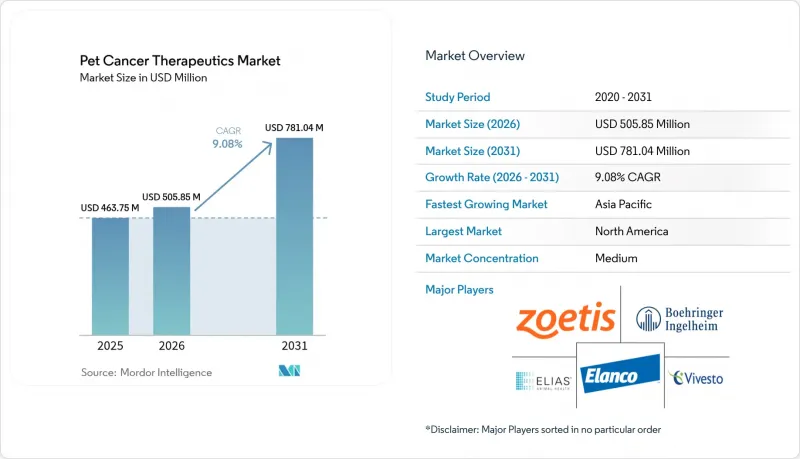
Mordor Intelligence에 의하면, 2026년 반려동물용 암 치료제 시장 규모는 5억 585만 달러로 추정되고 2025년 4억 6,375만 달러에서 확대해, 2031년에는 7억 8,104만 달러에 이를 것으로 예측됩니다.
2026년부터 2031년까지 연평균 성장률(CAGR) 9.08%로 성장할 것으로 전망됩니다.
본 보고서는 치료법(화학요법, 방사선 요법 등), 동물 종(개, 고양이, 기타 반려동물), 암 유형(림프종, 비만세포종 등), 투여 방법(주사제 등), 유통 채널(동물병원 등), 지역(북미, 유럽, 아시아태평양 등)별로 분류되어 있습니다. 시장 전망은 금액(달러) 기준으로 제시되어 있습니다.
세계의 반려동물용 암 치료제 시장 동향 및 인사이트
신흥국에서의 수의학 원격 종양학을 통한 접근성 확대
아시아태평양 및 라틴아메리카의 인증된 종양 전문 수의사 부족은 일반 수의사와 전문의를 연결하는 디지털 플랫폼을 통해 완화되고 있습니다. FidoCure사의 원격 의료 인터페이스는 50개 이상 시장에서 치료 프로토콜 설계 및 의약품 물류를 지원하여, 지리적 거리에도 불구하고 표준화된 치료를 가능하게 하고 있습니다. 또한, 원격 종양학은 치료제를 합법적으로 배송하는 온라인 약국과 연계되어 있어 지방 도시에서의 신약 도입을 가속화하고 있습니다.
정밀 수의학 종양학 플랫폼의 도입 확대
동물병원에서는 개별 종양의 변이 프로파일에 맞추어 표적 치료제를 특정하는 유전체 검사가 급속히 보급되고 있습니다. Zoetis사의 ‘AI Masses’와 같은 AI 기반 세포진단 도구는 임상 현장에서의 진단 속도를 향상시켜 수의사가 더 조기에 치료를 시작할 수 있도록 돕고 있습니다. 빅데이터 분석과 저비용 차세대 시퀀싱 기술의 융합으로 인해, 전문 종양 센터 이외의 장소에서도 치료 접근성이 확대되고 있습니다. 예측 알고리즘이 계속 늘어나는 데이터 세트에서 학습함에 따라 치료 효과가 향상될 것으로 기대되며, 이에 따라 정밀의료용 의약품 및 동반 진단제에 대한 수요가 더욱 높아질 것으로 전망됩니다. 이러한 발전들이 결합되어 진단과 치료 간의 피드백 루프가 강화되고, 임상 성과가 향상됨과 동시에 디지털화에 대비된 지역 전반에서 도입이 가속화될 것입니다.
자가 유래 암 백신의 규제 경로 불일치
FDA는 획기적인 의약품을 신속하게 임상 현장에 도입하기 위해 조건부 승인을 실시하고 있지만, 다른 지역에서는 규제가 크게 달라 다국적 시장 진출에 드는 비용과 복잡성이 증가하고 있습니다. 각 환자의 세포에서 제조해야 하는 자가 유래 백신은 무균성, 유효성, 표시와 관련된 기준이 지역마다 달라 광범위한 상용화를 저해하고 있습니다. 소규모 생명공학 기업들은 규정 준수 관련 비용 부담이 커지면서 사업 확장이 지연되고, 중요한 초기 단계의 수익 전망이 불투명해지고 있습니다.
부문별 분석
2025년에도 화학요법은 반려동물용 암 치료제 시장에서 여전히 가장 큰 비중을 차지했으며, 병용 요법 및 메트로노믹 요법이 임상 현장에서 정착됨에 따라 매출의 37.65%를 차지했습니다. 그러나 면역요법은 14.05%라는 놀라운 연평균 성장률(CAGR)을 기록하고 있으며, 구강 선암 및 기타 고형 종양에서 지속적인 치료 효과를 보이는 개용으로 최적화된 항 PD-1 항체의 승인으로 인해 2031년까지 그 격차를 좁힐 것으로 전망됩니다. 면역요법 분야의 반려동물용 항암제 시장 규모는 우수한 안전성 프로파일과 반려인의 수용도 증가에 따라, 치료 구성비가 바이오의약품으로 이동할 것으로 예측됩니다.
상용화 과정은 FDA의 ‘수의학 혁신 프로그램’을 통해 원활하게 진행되고 있습니다. 이 프로그램은 롤링 리뷰 지침과 화학·제조·품질 관리(CMC)에 관한 실시간 지원을 제공하여 규제 절차 기간을 단축하고 있습니다. 단일클론 항체와 저용량 화학요법, 또는 종양 용해성 바이러스를 조합한 병용 임상시험이 진행 중이며, 완전 반응률의 향상이 기대됩니다. 개·고양이용 항체 라이브러리를 구축하는 스타트업 기업에 대한 벤처 자금 유입에서도 투자자들의 지속적인 관심을 엿볼 수 있습니다.
2025년 매출의 71.05%를 개용 제품이 차지했으며, 이는 암 발병률이 높을 뿐만 아니라 치료 선택지가 폭넓다는 점을 반영합니다. 개용 제품이 반려동물용 암 치료제 시장에서 높은 점유율을 차지하고 있는 배경에는 꾸준한 임상시험 참가자 수를 기반으로 한 수십 년에 걸친 종양학 연구의 성과도 있습니다. 종 특유의 내약성 문제로 인해 그동안 충분한 치료 선택지가 제공되지 않았던 고양이의 경우, 고양이 전용 제제가 등장함에 따라 현재 연평균 성장률(CAGR) 10.89%로 성장을 지속하고 있습니다.
진정 프로토콜의 발전과 기호성이 높은 경구 현탁액으로 투여상의 과제가 극복되는 한편, 고양이 전문 클리닉에서의 영상 진단 보급으로 악성 종양의 조기 발견이 가능해졌습니다. 빈혈 치료제 ‘Varenzin-CA1’의 성공적인 출시는 규제 당국이 고양이를 우선시하는 승인 경로에 긍정적인 태도를 보이고 있음을 보여주며, 개발 후기 단계에 있는 항암 후보 약물에 대한 신뢰를 높이고 있습니다.
지역별 분석
북미는 반려동물 보험의 조기 도입, 전문 동물 병원의 높은 밀도, 그리고 신약 출시를 가속화하는 합리화된 조건부 승인 체계 덕분에 2025년 매출의 45.62%를 차지했습니다. 현재 연방 의회에서 심의 중인 ‘PAW 법안’은 수의학 치료비에 대한 세제 혜택을 제공하는 것을 목표로 하고 있으며, 법안이 통과되면 접근성이 더욱 확대될 가능성이 있습니다. 플로리다 대학교와 콜로라도 주립대학교 등의 대학에서는 과학적 돌파구를 상업화 파이프라인으로 연결하는 중개 종양학 프로그램을 운영하고 있어, 이 지역의 리더십을 더욱 공고히 하고 있습니다.
유럽은 일정한 시장 점유율을 확보했으나, 보급률에는 큰 편차가 나타납니다. 스웨덴에서는 반려견 보험 가입률이 83%에 달하고, 고부가가치 치료의 보급이 두드러지는 반면, 남유럽 시장에서는 보상 수준이 낮아 수요가 비교적 주춤하고 있습니다. 사모펀드가 지원하는 동물병원 체인의 지속적인 통합은 서비스 표준화를 촉진하는 한편, 진료비 상승에 따라 가격 책정을 둘러싼 논란을 불러일으키고 있습니다. 유럽의약품청(EMA)은 생물학적 제제 시장 출시 기간을 단축할 수 있는 상호 승인 체계를 구축하기 위해 동물용 의약품 규정의 개정을 추진하고 있습니다.
아시아태평양은 중국의 중산층 확대와 반려동물의 수명 연장을 배경으로 연평균 성장률(CAGR) 12.34%라는 가장 높은 성장 전망을 보이고 있습니다. 1급 도시의 도심에 위치한 동물병원에서는 밀레니얼 세대가 CT나 MRI 등의 진단 검사에 가처분 소득을 지출하고 있어, 종양학 분야의 수익이 두 자릿수 성장을 기록하고 있습니다. 규제 체계는 여전히 성숙 단계에 있지만, 일본과 호주에서의 시범 프로그램을 통해 미국 및 EU의 특정 안전성 자료가 승인됨에 따라 수요가 높은 치료제의 승인 주기가 단축될 가능성이 있습니다. 암 선별 진단을 전문으로 하는 지역 원격의료 스타트업에는 벤처 캐피털이 유입되고 있으며, 아시아태평양은 기존의 인프라적 제약을 뛰어넘어 전 세계 반려동물용 항암제 시장에서 점유율을 확보할 준비를 갖추고 있습니다.
기타 혜택 :
- 엑셀 형식 시장 예측(ME) 시트
- 3개월간의 애널리스트 지원
자주 묻는 질문
목차
제1장 서론
제2장 조사 방법
제3장 주요 요약
제4장 시장 구도
제5장 시장 규모 및 성장 예측
제6장 경쟁 구도
제7장 시장 기회 및 향후 전망
KTH 26.08.28According to Mordor Intelligence, pet cancer therapeutics market size in 2026 is estimated at USD 505.85 million, growing from 2025 value of USD 463.75 million with 2031 projections showing USD 781.04 million, growing at 9.08% CAGR over 2026-2031.
This report is Segmented by Therapy (Chemotherapy, Radiation Therapy, and More), Animal (Dog, Cat, Other Companion Animals), Cancer Type (Lymphoma, Mast Cell Tumor, and More), Mode of Administration (Injectable, and More), Distribution Channel (Veterinary Hospitals, and More), and Geography (North America, Europe, Asia-Pacific, and More). The Market Forecasts are Provided in Terms of Value (USD).
Global Pet Cancer Therapeutics Market Trends and Insights
Veterinary Tele-Oncology Expanding Access in Emerging Countries
Shortages of board-certified oncologists in Asia-Pacific and Latin America are mitigated by digital platforms that connect primary veterinarians with specialists. FidoCure's telemedicine interface supports protocol design and medication logistics across 50-plus markets, enabling standardized care despite geographic gaps. Tele-oncology also integrates e-pharmacies that legally ship therapies, accelerating adoption of novel drugs in second-tier cities.
Growing Adoption of Precision Veterinary Oncology Platforms
Veterinary practices are rapidly embracing genomic testing that matches targeted drugs to the mutational profile of individual tumors. AI-enabled cytology tools, such as Zoetis' AI Masses, improve diagnostic speed in clinical settings, allowing practitioners to initiate treatment earlier. The convergence of big-data analytics with lower-cost next-generation sequencing is expanding access beyond specialty oncology centers. As predictive algorithms learn from growing datasets, treatment efficacy is expected to increase, thereby reinforcing demand for precision drugs and companion diagnostics. These developments collectively tighten the feedback loop between diagnosis and care, bolstering clinical outcomes and supporting stronger adoption curves across regions with high digital readiness.
Unharmonized Regulatory Pathways for Autologous Cancer Vaccines
Although the FDA awards conditional approvals that speed breakthrough medicines to clinics, rules vary widely elsewhere, inflating the cost and complexity of multinational launches. Autologous vaccines, which must be manufactured from each patient's cells, face divergent sterility, potency, and labeling standards that discourage broad commercialization. Small biotechnology firms shoulder higher compliance spend, delaying expansion and dampening revenue visibility in pivotal early years.
Other drivers and restraints analyzed in the detailed report include:
- Commercialization of Monoclonal Antibody Immunotherapies
- Rise in Pet Humanization and Oncology Awareness Among Pet Owners
- Limited Reimbursement for Advanced Radiation Modalities
For complete list of drivers and restraints, kindly check the Table Of Contents.
Segment Analysis
Chemotherapy remained the largest pillar of the pet cancer therapeutics market in 2025, holding 37.65% of revenue as combination protocols and metronomic regimens retained clinical familiarity. Immunotherapy, however, posted a blazing 14.05% CAGR and is set to narrow the gap by 2031 thanks to approvals of canine-tuned anti-PD-1 antibodies that deliver durable responses in oral adenocarcinoma and other solid tumors. The pet cancer therapeutics market size within immunotherapy is projected to shift the treatment mix toward biologics as owner acceptance rises alongside favorable safety profiles.
The commercialization journey is eased by the FDA's Veterinary Innovation Program, which offers rolling-review guidance and real-time chemistry, manufacturing, and controls support that compress regulatory timelines. Combination studies pairing monoclonal antibodies with low-dose chemotherapy or oncolytic viruses are underway and may improve complete-response rates. Sustained investor interest is evident in venture rounds flowing to startups building canine-feline antibody libraries.
Dogs generated 71.05% of 2025 sales, reflecting both higher cancer incidence and broader therapeutic armamentarium. The pet cancer therapeutics market share of canine products also benefits from decades of oncology research anchored by robust clinical-trial enrollment. Cats, historically underserved due to species-specific tolerability challenges, are now registering an 10.89% CAGR as feline-exclusive formulations emerge.
Advances in sedation protocols and palatable oral suspensions overcome administration hurdles, while growing diagnostic imaging in cat-preferred clinics unveils earlier malignancies. The successful launch of Varenzin-CA1 for anemia signals regulator openness to feline-first pathways, building confidence for oncology candidates in late-stage development.
Complete Report Scope:
- By Therapy
- Chemotherapy
- Radiation Therapy
- Immunotherapy
- Targeted Small-Molecule TKIs
- Gene Therapy & Oncolytic Viruses
- Other Therapies
- By Animal
- Dog
- Cat
- Other Companion Animals
- By Cancer Type
- Lymphoma
- Mast Cell Tumor
- Melanoma
- Mammary & Squamous-Cell Cancer
- Osteosarcoma
- Other Cancer Types
- By Mode of Administration
- Injectable
- Oral
- Topical
- By Distribution Channel
- Veterinary Hospitals & Specialty Clinics
- Retail & Community Veterinary Clinics
- Online Pharmacies & Tele-Oncology Platforms
- By Geography
- North America
- United States
- Canada
- Mexico
- Europe
- Germany
- United Kingdom
- France
- Italy
- Spain
- Rest of Europe
- Asia-Pacific
- China
- Japan
- India
- Australia
- South Korea
- Rest of Asia-Pacific
- Middle East & Africa
- GCC
- South Africa
- Rest of Middle East & Africa
- South America
- Brazil
- Argentina
- Rest of South America
- North America
Geography Analysis
North America commanded 45.62% of 2025 revenue thanks to early adoption of pet insurance, high specialty-clinic density, and a streamlined conditional-approval framework that accelerates novel drug launches. The PAW Act, now under Congressional review, seeks to offer tax advantages for veterinary expenses and could broaden access once enacted. Universities such as Florida and Colorado State maintain translational oncology programs that funnel scientific breakthroughs into commercial pipelines, further entrenching regional leadership.
Europe captured moderate market share, though penetration varies sharply. Sweden's 83% dog-insurance rate fosters robust uptake of premium therapies, whereas southern markets show softer demand due to lower reimbursement levels. Ongoing consolidation by private-equity-backed veterinary chains enhances service standardization but sparks pricing debates as consultation fees rise. The European Medicines Agency is updating its Veterinary Medicinal Products Regulation to create mutual-recognition pathways that could shrink launch timelines for biologicals.
Asia-Pacific posted the fastest 12.34% CAGR outlook, anchored by China's expanding middle class and rising pet longevity. Urban clinics in Tier-1 cities record double-digit oncology revenue growth as millennials allocate discretionary income to diagnostics such as CT and MRI. Regulatory capacity is still maturing; however, pilot programs in Japan and Australia allow recognition of selected U.S. or EU safety dossiers, potentially truncating approval cycles for high-need therapeutics. Venture capital is flowing into regional telemedicine start-ups that specialize in oncology triage, positioning Asia-Pacific to leapfrog traditional infrastructure constraints and capture share in the global pet cancer therapeutics market.
- AB Science
- Vivesto AB (AdvaVet)
- Boehringer Ingelheim (Merial)
- Elanco
- Zoetis
- Dechra Pharmaceuticals (Anivive)
- Karyopharm Therapeutics
- ELIAS Animal Health
- Torigen Pharmaceuticals
- Virbac
- Norbrook
- Elekta
- QBiotics Group
- Vetoquinol
- KindredBio
- Regeneus Ltd
- Orion Corp (Animal Health)
- Nippon Zenyaku Kogyo (Zenoaq)
- PetCure Oncology
- Heska Corp
- VCA Animal Hospitals (Mars Inc.)
Additional Benefits:
- The market estimate (ME) sheet in Excel format
- 3 months of analyst support
TABLE OF CONTENTS
1 Introduction
- 1.1 Study Assumptions & Market Definition
- 1.2 Scope of the Study
2 Research Methodology
3 Executive Summary
4 Market Landscape
- 4.1 Market Overview
- 4.2 Market Drivers
- 4.2.1 Veterinary Tele-Oncology Expanding Access in Emerging Countries
- 4.2.2 Growing Adoption of Precision Veterinary Oncology Platforms
- 4.2.3 Commercialization of Monoclonal Antibody Immunotherapies
- 4.2.4 Rise in Pet Humanization and Oncology Awareness Among Pet Owners
- 4.2.5 Expansion of Pet Insurance Covering Oncology
- 4.2.6 Advancements in Companion Animal Tumor Genomics
- 4.3 Market Restraints
- 4.3.1 Unharmonized Regulatory Pathways for Autologous Cancer Vaccines
- 4.3.2 Limited Reimbursement for Advanced Radiation Modalities
- 4.3.3 Shortage of Board-Certified Veterinary Oncologists in Emerging Markets
- 4.3.4 Limited Clinical Trial Infrastructure for Veterinary Oncology Products
- 4.4 Regulatory Landscape
- 4.5 Porter's Five Forces Analysis
- 4.5.1 Threat of New Entrants
- 4.5.2 Bargaining Power of Buyers
- 4.5.3 Bargaining Power of Suppliers
- 4.5.4 Threat of Substitutes
- 4.5.5 Intensity of Competitive Rivalry
5 Market Size & Growth Forecasts (Value in USD)
- 5.1 By Therapy
- 5.1.1 Chemotherapy
- 5.1.2 Radiation Therapy
- 5.1.3 Immunotherapy
- 5.1.4 Targeted Small-Molecule TKIs
- 5.1.5 Gene Therapy & Oncolytic Viruses
- 5.1.6 Other Therapies
- 5.2 By Animal
- 5.2.1 Dog
- 5.2.2 Cat
- 5.2.3 Other Companion Animals
- 5.3 By Cancer Type
- 5.3.1 Lymphoma
- 5.3.2 Mast Cell Tumor
- 5.3.3 Melanoma
- 5.3.4 Mammary & Squamous-Cell Cancer
- 5.3.5 Osteosarcoma
- 5.3.6 Other Cancer Types
- 5.4 By Mode of Administration
- 5.4.1 Injectable
- 5.4.2 Oral
- 5.4.3 Topical
- 5.5 By Distribution Channel
- 5.5.1 Veterinary Hospitals & Specialty Clinics
- 5.5.2 Retail & Community Veterinary Clinics
- 5.5.3 Online Pharmacies & Tele-Oncology Platforms
- 5.6 By Geography
- 5.6.1 North America
- 5.6.1.1 United States
- 5.6.1.2 Canada
- 5.6.1.3 Mexico
- 5.6.2 Europe
- 5.6.2.1 Germany
- 5.6.2.2 United Kingdom
- 5.6.2.3 France
- 5.6.2.4 Italy
- 5.6.2.5 Spain
- 5.6.2.6 Rest of Europe
- 5.6.3 Asia-Pacific
- 5.6.3.1 China
- 5.6.3.2 Japan
- 5.6.3.3 India
- 5.6.3.4 Australia
- 5.6.3.5 South Korea
- 5.6.3.6 Rest of Asia-Pacific
- 5.6.4 Middle East & Africa
- 5.6.4.1 GCC
- 5.6.4.2 South Africa
- 5.6.4.3 Rest of Middle East & Africa
- 5.6.5 South America
- 5.6.5.1 Brazil
- 5.6.5.2 Argentina
- 5.6.5.3 Rest of South America
- 5.6.1 North America
6 Competitive Landscape
- 6.1 Market Concentration
- 6.2 Market Share Analysis
- 6.3 Company Profiles (includes Global level Overview, Market level overview, Core Segments, Financials as available, Strategic Information, Market Rank/Share for key companies, Products & Services, and Recent Developments)
- 6.3.1 AB Science
- 6.3.2 Vivesto AB (AdvaVet)
- 6.3.3 Boehringer Ingelheim (Merial)
- 6.3.4 Elanco Animal Health
- 6.3.5 Zoetis
- 6.3.6 Dechra Pharmaceuticals (Anivive)
- 6.3.7 Karyopharm Therapeutics
- 6.3.8 ELIAS Animal Health
- 6.3.9 Torigen Pharmaceuticals
- 6.3.10 Virbac
- 6.3.11 Norbrook
- 6.3.12 Elekta
- 6.3.13 QBiotics Group
- 6.3.14 Vetoquinol
- 6.3.15 KindredBio
- 6.3.16 Regeneus Ltd
- 6.3.17 Orion Corp (Animal Health)
- 6.3.18 Nippon Zenyaku Kogyo (Zenoaq)
- 6.3.19 PetCure Oncology
- 6.3.20 Heska Corp
- 6.3.21 VCA Animal Hospitals (Mars Inc.)
7 Market Opportunities & Future Outlook
- 7.1 White-Space & Unmet-Need Assessment