
|
시장보고서
상품코드
2114332
북미의 중고 트럭 시장 : 시장 점유율 분석, 업계 동향 및 통계, 성장 예측(2026-2031년)North America Used Truck - Market Share Analysis, Industry Trends & Statistics, Growth Forecasts (2026 - 2031) |
||||||
 Mordor Intelligence
Mordor Intelligence에 의하면, 북미의 중고 트럭 시장 규모는 2025년에 198억 7,000만 달러로 평가되었고, 2026년 210억 1,000만 달러에서 2031년까지 278억 달러로 확대될 전망이며, 2026-2031년 CAGR 5.76%를 나타낼 것으로 예측됩니다.
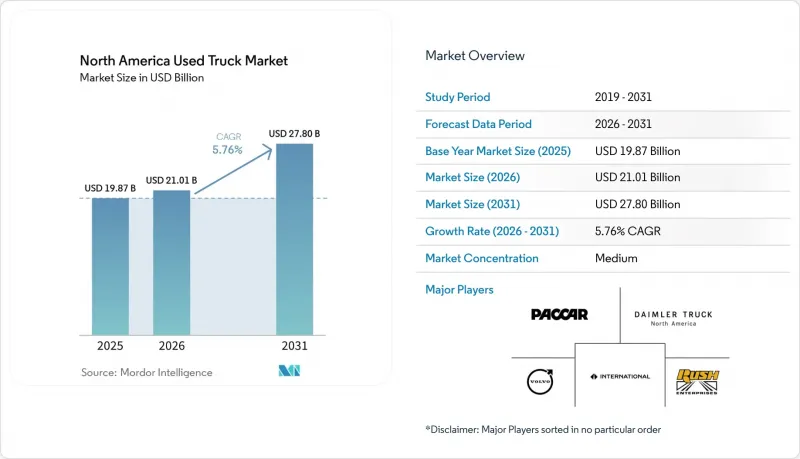
본 보고서는 차종별(소형 트럭(클래스 3-5), 중형 트럭별(클래스 6-7), 기타), 연료별(디젤, 가솔린, 기타), 차량 연식별(3년 이하, 4-7년, 기타), 최종 이용 산업별(건설 및 인프라, 물류·전자상거래 배송, 기타), 판매 채널 및 국가별로 분류되어 있습니다. 시장 예측은 금액(달러) 및 수량(대)으로 제시되어 있습니다.
북미의 중고 트럭 시장 동향 및 인사이트
전자상거래의 급속한 성장이 단거리 화물 운송 수요를 끌어올렸으며
2025년에는 소포 배송량이 대폭 증가하고 배송 시간 제약이 엄격해짐에 따라, 물류 사업자들은 노선 마일당 더 많은 클래스 3-5 트럭을 투입할 수밖에 없게 되었습니다. 중고 소형 및 중형 트럭은 신차 가격의 40-60% 수준에 불과하면서도 기동성 요건을 충족하기 때문에 자본 효율이 높은 차량 운영 기업들은 매물이 나온 지 30일 이내에 이를 임베디드하고 있습니다. 도시 지역의 거점으로 복귀하는 운행 패턴은 예측 유지보수를 통해 가동 중단 시간을 최소화할 수 있어, 노후 자산에 따른 추가 유지보수라는 단점을 상쇄하고 있습니다. 2025년에 전자상거래의 보급이 진전되고 2028년까지 추가 성장이 예상되는 가운데, 단거리 화물 운송의 수송 능력은 OEM의 생산 속도를 능가하는 속도로 계속 확대되고 있으며, 이로 인해 차령 3-7년 트럭에 대한 프리미엄 가격 유지가 뒷받침되고 있습니다. 따라서 북미 중고 트럭 시장은 도시 지역 배송용 차량 교체에 따른 경기 순환적 요인이 아닌 구조적인 수요 증가의 혜택을 받고 있습니다.
반도체 부족으로 인한 신차 공급 부족이 잔여 수요를 창출하고 있습니다.
2025년, 지속되는 반도체 할당 문제로 인해 클래스 8 트럭의 생산 대수는 팬데믹 이전의 최고 수준을 밑돌았습니다. 각 차량 운용사들이 교체 주기를 연장함에 따라 중고 트랙터의 잔존 가치가 크게 상승했습니다. ADAS 기술을 탑재한 트랙터는 현재 초기 가치에 비해 사상 최고가를 기록하고 있으며, 기존의 감가상각 곡선에 변화를 가져오고 있습니다. 반도체 제조 공장의 생산 능력은 2026년에 정상화될 것으로 예상되지만, 특별 주문 사양의 차량에 대해서는 계속해서 납기 지연이 이어질 전망입니다. 이러한 지연으로 인해 즉시 인도 가능한 중고 재고는 높은 마진을 유지하고 있습니다. 단기간 내에 차량 인도가 가능한 딜러들은 이 기회를 활용하여, 북미 중고 트럭 시장을 지탱하는 공급 제약에 따른 가격 동향을 뒷받침하고 있습니다.
변동이 심한 현물 운임이 소유주 운전자의 구매력을 잠식하고 있다.
2025년에는 드라이밴(일반 화물용 컨테이너)의 현물 운임 평균이 하락하여, 독립 운영자가 일반적으로 직면하는 비용 기준을 약간 상회하는 수준에 그쳤습니다. 같은 해, 소유주 겸 운전자의 대거 이탈이 관찰되면서 독립 운영자가 선호하는 가격대의 트랙터 시장이 위축되었습니다. 단거리 운송으로의 전환에 따라, 오너 오퍼레이터 모델의 주류인 슬리퍼 캡 수요가 감소했습니다. 캘리포니아주 AB5법에 따른 재분류로 인해 2024-2025년 독립 계약업자가 현저히 감소했고, 이들의 재량 지출이 억제되었습니다. 이러한 독립 계약자를 고객으로 둔 딜러들은 현재 선택의 기로에 서 있습니다. 매출액에 기반한 상환 전략을 채택할 것인지, 아니면 재고 정체라는 위험을 감수할 것인지의 문제입니다. 재고 정체는 북미 중고 트럭 시장의 성장을 저해할 우려가 있습니다.
부문 분석
2025년, 소형 트럭은 시장 점유율이 미미한 수준에 그쳤으나, 라스트 마일 배송 업체들이 도시 지역의 밀집된 노선을 확대함에 따라 1회 정차당 비용 측면에서 밴이 트랙터를 앞지르기 때문에 연평균 성장률(CAGR) 6.63%로 모든 등급 중 가장 높은 성장률을 기록할 전망입니다. 대형 차량은 장거리 화물 운송 및 특수 용도의 적재량 측면에서 여전히 클래스 8의 출력이 필수적이기 때문에 45.03%라는 압도적인 점유율을 유지하고 있습니다. 중형 트럭은 지역 배송의 양면 역할을 담당하고 있으며, 집배 거점까지의 왕복 주기와 일치하는 150-200마일이라는 신흥 배터리 주행 거리의 혜택을 받고 있습니다. 소매 매출의 16%를 차지하는 전자상거래의 점유율 확대는 빈번한 배송을 촉진하고 있으며, 이로 인해 3-5년마다 교체되는 클래스 3-5 플랫폼에 대한 조달 경향이 강해지고 있습니다. 그 결과, 거의 신차에 가까운 차량이 북미 중고 트럭 시장에 재유입되고 있습니다. 신속한 재고 회전을 중시하는 소매용 밴을 취급하는 딜러들은 소포 배송 업체들의 자본 효율성 중시라는 우선순위에 부응하고 있는 반면, 특수 사양의 대형 트럭은 부문 간 경쟁을 억제하는 전문적인 구성 덕분에 높은 잔존 가치를 유지하고 있습니다.
차선 유지 및 충돌 완화 기술을 완비한 최신 모델의 슬리퍼형 트럭은 장거리 운송 사업자가 규제 준수와 운전기사 확보를 모두 필요로 하기 때문에 최고 수준의 평가액으로 거래되고 있습니다. 반면, 중형 트럭 구매자들은 디젤 차량의 잘 갖춰진 주유 네트워크와 CARB 관할 주에서 2032년까지 제로 배출 차량 보급률을 40%로 끌어올리겠다는 엄격해지는 규제 요건을 저울질하고 있으며, 이로 인해 불균일한 감가상각 상황이 초래되고 있습니다. 재판매업자의 경우, 재고의 세분화된 분류(도시 내 배송, 지역 허브 앤 스포크, 본격적인 장거리 운송)가 북미 중고 트럭 시장 규모 전반에 걸친 매출 총이익 최적화를 좌우하는 요인이 되고 있습니다.
2025년 수요 중 디젤 차량이 여전히 75.12%를 차지했으며, CARB 규제와 기업의 ESG 요건이 영향을 미치면서 하이브리드 차량과 배터리식 전기차는 낮은 기저에서 연평균 14.12%의 성장률을 보일 것으로 전망됩니다. 가솔린 차량은 경차 부문의 지자체용 틈새 시장에서 살아남고 있으나, CNG와 LNG는 재생 가능 천연가스 공급망을 통해 수명 주기 배출량을 최대 80%까지 감축할 수 있는 지역에서 국지적인 성장을 이루고 있습니다. 2021-2023년식 eCascadia와 VNR Electric이 중고 시장에 조금씩 유입되면서 구매자의 선택 폭은 넓어지고 있지만, 배터리 팩의 상태는 통일된 시험 기준이 없어 여전히 평가상의 장벽으로 남아 있습니다. 용량이 85-90%로 확인된 차량은 신차 가격보다 30-40% 저렴하게 판매되고 있어, 보조금이 풍부한 주의 얼리 어답터들을 끌어들이고 있습니다.
예측 기간 동안 디젤의 우위는 완화되겠지만, 완전히 무너지는 일은 없을 것입니다. 이는 하루 400마일 이상의 운행 주기에서는 에너지 밀도나 급유 시간 지표가 여전히 화석 연료에 유리하게 작용하기 때문입니다. 그렇긴 하지만, 중형 BEV는 거점에서의 충전이 가능한 지역 노선에서 비용 면에서의 대등성을 달성하고 있으며, 지금까지 디젤이 지배적이었던 부문으로 점유율을 서서히 확대되고 있습니다. 또한, 주행 거리를 희생하지 않으면서 배출 가스의 일부 감축을 목표로 하는 차량 함대 사이에서는 하이브리드 차량이라는 과도기적인 해결책이 보급되고 있습니다. 전반적으로 이러한 변화로 인해 북미 중고 트럭 시장에서 연료 유형별 점유율이 미묘하게 재조정되는 한편, 이용률이 높은 노선에서는 디젤이 여전히 핵심적인 지위를 유지하게 될 것입니다.
기타 혜택 :
- 엑셀 형식 시장 예측(ME) 시트
- 3개월간의 애널리스트 지원
자주 묻는 질문
목차
제1장 서론
제2장 조사 방법
제3장 주요 요약
제4장 시장 구도
제5장 시장 규모 및 성장 예측
제6장 경쟁 구도
제7장 시장 기회 및 향후 전망
AJY 26.08.26According to Mordor Intelligence, the north american used truck market size was valued at USD 19.87 billion in 2025 and is projected to expand from USD 21.01 billion in 2026 to USD 27.80 billion by 2031, registering a 5.76% CAGR between 2026 and 2031.
This report is Segmented by Vehicle Type (Light Trucks (Class 3-5), Medium-Duty Trucks (Class 6-7), and More), Fuel Type (Diesel, Gasoline, and More), Age (Up To 3 Years, 4 To 7 Years, and More), End-Use Industry (Construction and Infrastructure, Logistics and E-Commerce Delivery, and More), Sales Channel, and Country. The Market Forecasts are Provided in Terms of Value (USD) and Volume (Units).
North America Used Truck Market Trends and Insights
Rapid E-Commerce Growth Boosting Short-Haul Freight Demand
Parcel deliveries rose significantly in 2025, compressing fulfillment windows and obliging logistics providers to field more Class 3-5 trucks per route-mile. Used light- and medium-duty units meet maneuverability requirements at 40-60% of new prices, hence capital-efficient fleets snap them up within 30 days of listing. Urban return-to-base patterns dilute the disadvantage of extra maintenance on older assets because predictive servicing minimizes downtime. As e-commerce penetration advances in 2025 and is expected to grow further by 2028, short-haul freight capacity continues to expand more quickly than OEM production, supporting sustained premiums for three-to-seven-year-old trucks. The North American used truck market, therefore, benefits from a structural, not cyclical, uplift in urban-delivery equipment turnover.
Tight New-Truck Supply Due to Semiconductor Shortages Creating Residual Demand
In 2025, Class 8 output remained below the pre-pandemic peak due to ongoing chip allocation challenges. Fleets extended their replacement cycles, leading to a significant increase in residual values for used tractors. Tractors equipped with ADAS technology now command record-high prices relative to their original value, altering the typical depreciation curve. While fab capacity is expected to normalize in 2026, bespoke specifications continue to face extended lead times. This delay allows ready-to-roll used inventory to maintain premium margins. Dealers capable of delivering within a short timeframe are capitalizing on this opportunity, bolstering the supply-constrained pricing dynamics that support the North American used truck market.
Volatile Spot-Freight Rates Eroding Owner-Operator Purchasing Power
In 2025, dry-van spot averages declined, barely surpassing the cost threshold that independent operators typically face. That year saw a significant exit of owner-operators, shrinking the market for tractors in the price range favored by independents. A shift towards shorter hauls has diminished the demand for sleeper cabs, a staple of the owner-operator model. California's AB5 reclassification led to a notable reduction in independent contractors during 2024-2025, curbing their discretionary spending. Dealers catering to these independents now face a choice: adopt revenue-based repayment strategies or risk stagnant inventory, which could stifle growth in North America's used truck market.
Other drivers and restraints analyzed in the detailed report include:
- OEM-Led Certified Pre-Owned (CPO) Programs Expanding Finance Access
- CARB and EPA GHG Phase 3 Regulations Accelerating Fleet-Renewal Cycles
- Rising Benchmark Interest Rates Inflating Floor-Plan and Lease Costs
For complete list of drivers and restraints, kindly check the Table Of Contents.
Segment Analysis
Light trucks secured a modest slice in 2025, yet will outpace all classes at 6.63% CAGR as last-mile couriers expand dense urban routes where vans outperform tractors for cost per stop. Heavy-duty vehicles clung to a dominant 45.03% share because long-haul freight and vocational payloads still require Class 8 muscle. Medium-duty units straddle regional distribution and benefit from emerging battery ranges of 150-200 miles that dovetail with depot return cycles. Rising e-commerce share, now 16% of retail, propels high-frequency deliveries, tilting procurement toward Class 3-5 platforms that turn every three to five years, injecting nearly new units back into the North America used truck market. Dealers focusing on quick-turn retail vans match capital-efficiency priorities of parcel integrators, whereas vocational heavy-duty assets retain premium residuals where specialized configurations curb cross-segment competition.
Late-model sleepers replete with lane-keeping and collision-mitigation tech command top valuations because long-haul carriers need both compliance and driver-retention features. Meanwhile, medium-duty buyers weigh diesel's mature refueling network against tightening mandates that will require 40% zero-emission penetration by 2032 in CARB states, creating uneven depreciation landscapes. For remarketers, finely tuned inventory segmentation-urban delivery versus regional hub-and-spoke versus bona-fide long haul-now shapes gross-margin optimization across the North America used truck market size continuum.
Diesel still covered 75.12% of 2025 demand, yet hybrids and battery-electrics will advance 14.12% annually from a low base as CARB and corporate ESG imperatives bite. Gasoline survives in light-duty municipal niches, while CNG and LNG enjoy pockets of growth where renewable natural-gas supply chains slash lifecycle emissions up to 80%. The trickle of 2021-2023 eCascadias and VNR Electrics entering secondary channels broadens buyer access, though pack health remains an evaluation hurdle lacking uniform testing. Units carrying verified 85-90% capacity sell for 30-40% below new, enticing early adopters in subsidy-rich states.
Over the forecast period, diesel's supremacy eases but does not break because energy-density and refueling-time metrics still favor fossil fuel above 400-mile daily duty cycles. Nevertheless, medium-duty BEVs find cost parity on depot-charged regional routes, channeling incremental share into segments previously diesel-dominated. The hybrid bridge solution grows among fleets seeking partial emissions relief without range compromises. In aggregate, these shifts delicately rebalance the North America used truck market share among fuel types while preserving diesel as the anchor in high-utilization lanes.
Complete Report Scope:
- By Vehicle Type
- Light Trucks (Class 3-5)
- Medium-Duty Trucks (Class 6-7)
- Heavy-Duty Trucks (Class 8 and Above 15 t)
- By Fuel Type
- Diesel
- Gasoline
- Natural Gas and LPG
- Hybrid and Battery-Electric
- By Age
- Up to 3 Years
- 4 to 7 Years
- 8 to 12 Years
- Above 12 Years
- By End-Use Industry
- Construction and Infrastructure
- Logistics and E-commerce Delivery
- Mining and Quarrying
- Agriculture and Forestry
- Municipal and Utilities
- Others
- By Sales Channel
- Independent Dealer
- Franchised Dealer
- OEM-Backed Certified Pre-Owned
- Online Peer-to-Peer and Auction
- By Country
- United States
- Canada
- Rest of North America
List of Companies Covered in this Report:
- PACCAR Inc
- Daimler Truck North America
- Volvo Group
- International Motors, LLC
- Hino Motors, Ltd.
- Isuzu Commercial Truck of America, Inc.
- Ford Motor Company
- General Motors Company
- Stellantis N.V.
- Rush Enterprises, Inc.
- Penske Used Trucks
- Ryder System, Inc.
- Arrow Truck Sales, Inc.
- IronPlanet, Inc.
- Murphy-Hoffman Company (MHC)
Additional Benefits:
- The market estimate (ME) sheet in Excel format
- 3 months of analyst support
TABLE OF CONTENTS
1 Introduction
- 1.1 Study Assumptions & Market Definition
- 1.2 Scope of the Study
2 Research Methodology
3 Executive Summary
4 Market Landscape
- 4.1 Market Overview
- 4.2 Market Drivers
- 4.2.1 Rapid E-Commerce Growth Boosting Short-Haul Freight Demand
- 4.2.2 Tight New-Truck Supply Due to Semiconductor Shortages Creating Residual Demand
- 4.2.3 OEM-Led Certified Pre-Owned (CPO) Programs Expanding Finance Access
- 4.2.4 CARB and EPA GHG Phase 3 Regulations Accelerating Fleet-Renewal Cycles
- 4.2.5 AI-Driven Predictive-Maintenance Tools Extending Viable Service Life
- 4.2.6 Corporate ESG Mandates Encouraging Reuse and Circular-Fleet Models
- 4.3 Market Restraints
- 4.3.1 Volatile Spot-Freight Rates Eroding Owner-Operator Purchasing Power
- 4.3.2 Rising Benchmark Interest Rates Inflating Floor-Plan and Lease Costs
- 4.3.3 Persistent Driver Shortage Limiting Incremental Capacity Absorption
- 4.3.4 Inadequate Public Charging For Electric Used Trucks
- 4.4 Value/Supply-Chain Analysis
- 4.5 Regulatory Landscape
- 4.6 Technological Outlook
- 4.7 Porter's Five Forces
- 4.7.1 Bargaining Power of Suppliers
- 4.7.2 Bargaining Power of Buyers
- 4.7.3 Threat of New Entrants
- 4.7.4 Threat of Substitutes
- 4.7.5 Competitive Rivalry
5 Market Size & Growth Forecasts (Value (USD) and Volume (Units))
- 5.1 By Vehicle Type
- 5.1.1 Light Trucks (Class 3-5)
- 5.1.2 Medium-Duty Trucks (Class 6-7)
- 5.1.3 Heavy-Duty Trucks (Class 8 and Above 15 t)
- 5.2 By Fuel Type
- 5.2.1 Diesel
- 5.2.2 Gasoline
- 5.2.3 Natural Gas and LPG
- 5.2.4 Hybrid and Battery-Electric
- 5.3 By Age
- 5.3.1 Up to 3 Years
- 5.3.2 4 to 7 Years
- 5.3.3 8 to 12 Years
- 5.3.4 Above 12 Years
- 5.4 By End-Use Industry
- 5.4.1 Construction and Infrastructure
- 5.4.2 Logistics and E-commerce Delivery
- 5.4.3 Mining and Quarrying
- 5.4.4 Agriculture and Forestry
- 5.4.5 Municipal and Utilities
- 5.4.6 Others
- 5.5 By Sales Channel
- 5.5.1 Independent Dealer
- 5.5.2 Franchised Dealer
- 5.5.3 OEM-Backed Certified Pre-Owned
- 5.5.4 Online Peer-to-Peer and Auction
- 5.6 By Country
- 5.6.1 United States
- 5.6.2 Canada
- 5.6.3 Rest of North America
6 Competitive Landscape
- 6.1 Market Concentration
- 6.2 Strategic Moves
- 6.3 Market Share Analysis
- 6.4 Company Profiles (includes Global Level Overview, Market Level Overview, Core Segments, Financials as Available, Strategic Information, Market Rank/Share for Key Companies, Products and Services, SWOT Analysis, and Recent Developments)
- 6.4.1 PACCAR Inc
- 6.4.2 Daimler Truck North America
- 6.4.3 Volvo Group
- 6.4.4 International Motors, LLC
- 6.4.5 Hino Motors, Ltd.
- 6.4.6 Isuzu Commercial Truck of America, Inc.
- 6.4.7 Ford Motor Company
- 6.4.8 General Motors Company
- 6.4.9 Stellantis N.V.
- 6.4.10 Rush Enterprises, Inc.
- 6.4.11 Penske Used Trucks
- 6.4.12 Ryder System, Inc.
- 6.4.13 Arrow Truck Sales, Inc.
- 6.4.14 IronPlanet, Inc.
- 6.4.15 Murphy-Hoffman Company (MHC)
7 Market Opportunities & Future Outlook
- 7.1 White-space & Unmet-Need Assessment