
|
시장보고서
상품코드
2114393
유럽의 목질 플라스틱 복합재(WPC) : 시장 점유율 분석, 업계 동향 및 통계, 성장 예측(2026-2031년)Europe Wood-plastic Composite (WPC) - Market Share Analysis, Industry Trends & Statistics, Growth Forecasts (2026 - 2031) |
||||||
 Mordor Intelligence
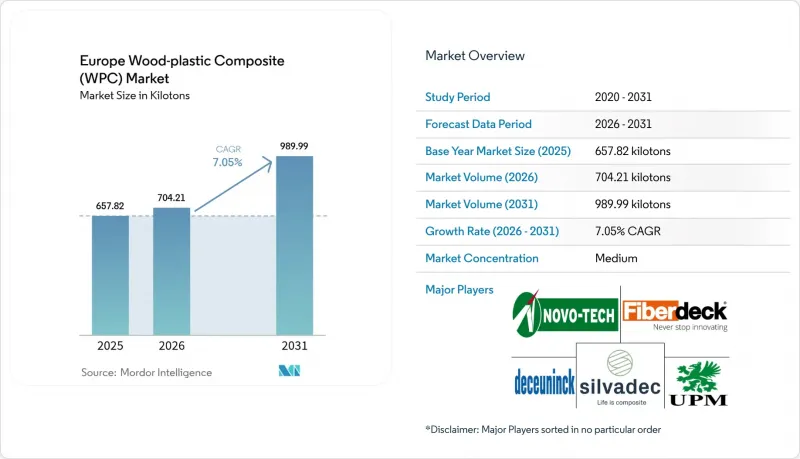
Mordor Intelligence에 의하면, 유럽의 목질 플라스틱 복합재 시장 규모는 2025년 657.82킬로톤에서 2026년에는 704.21킬로톤으로 확대되고, 2026-2031년 CAGR 7.05%로 성장을 지속하여 2031년에는 989.99킬로톤에 이를 것으로 예측됩니다.
본 보고서는 폴리머 유형별(폴리에틸렌, 폴리프로필렌, 기타 폴리머 유형), 용도별(데크 자재, 자동차 내장 부품, 사이딩·펜스, 기술 용도, 가구, 소비재), 지역별(독일, 영국, 프랑스, 벨기에, 이탈리아,스페인, 핀란드, 노르웨이, 덴마크, 스웨덴, 기타 유럽)으로 분류되어 있습니다. 시장 예측은 수량(톤) 기준으로 제시되어 있습니다.
유럽의 목질 플라스틱 복합재(WPC) 시장 동향 및 인사이트
WPC의 지속가능성이 순환 경제 도입을 촉진
유럽의 각 브랜드는 유럽의 목질 플라스틱 복합재 시장용 제품을, 폴리머 매트릭스의 최대 절반을 재활용 소재로 대체하면서도 VinylPlus의 감사 기준을 충족할 수 있는 보다 탄소 효율적인 대안으로 포지셔닝하고 있습니다. 기계적 재활용 업체는 분리 수거된 필름과 경질 플라스틱을 이축 스크류 압출기에 투입하고, 커플링제가 섬유와 매트릭스의 접착력을 회복시킴으로써 데크 보드의 굽힘 강도를 유지합니다. 도시 고형 폐기물 흐름을 통합함으로써 매립 처리되는 양을 줄이고, 가공 업체를 버진 폴리머의 가격 변동 위험으로부터 보호하고 있습니다. 독일의 회수 제도에서는 현재 지리적으로 추적 가능한 목질 섬유 흐름이 인증되어 있으며, 이러한 규제상의 우위가 구매자의 신뢰를 높이고 있습니다. 여러 용융 주기를 거친 후 폴리머 사슬이 절단되더라도, 컴파운더는 조정된 임계값에 따라 버진 펠릿을 혼합함으로써 치수 안정성을 유지하고 있습니다. 그 결과, 유럽의 목재 플라스틱 복합재(WPC) 시장은 환경 크레딧을 확보하고 있으며, 이는 공공 부문 계약업체와의 사양 채택으로 이어지고 있습니다.
건설 부문 수요 회복이 인프라 투자를 가속화
ING의 2025년 전망에 따르면, 유럽의 건설 생산량은 플러스로 전환될 전망이며, EU 부흥 기금의 지출이 보수 공사비로 전환됨에 따라 유지보수가 적은 외장재가 선호되는 추세입니다. 북유럽의 개발업자들은 동결·융해 주기를 견디는 단열 복합재 외벽을 사용하여 학교와 시청을 보수하고 있습니다. 프랑스에서는 해안가 마을을 대상으로 한 자본 프로젝트에서 WPC로 제작된 보도와 홍수에 강한 방조 시스템이 결합되고 있습니다. 각 공급업체는 현장 노동력을 줄이기 위해 숨겨진 클립식 시스템을 채택하고 있으며, 이는 임금 수준이 높은 서유럽에서 큰 장점이 되고 있습니다. 지붕 재시공 및 발코니 개보수가 전문 유통 채널의 재고 회전율을 높이는 한편, 공공 조달 체계에서는 수명 주기 배출량을 바탕으로 입찰 평가가 이루어지는 사례가 증가하고 있습니다. 그 결과, 건설 산업의 회복은 유럽의 목재-플라스틱 복합재 시장에 지속적인 수량 기준을 제공합니다.
높은 초기 비용과 가압 처리 목재와의 비교가 대중 시장으로의 확산을 제한하고 있습니다.
루마니아와 불가리아의 가격 비교에 따르면, WPC 데크 자재의 소매 가격은 가압 처리된 가문비나무에 비해 40-60% 더 비싸기 때문에 자금 사정에 어려움을 겪는 주택 소유자들은 여전히 기존 목재를 선택하고 있습니다. 인건비 절감 효과는 수년이 지나야 비로소 나타나지만, 구매 결정 시 여전히 청구서 총액이 주요 판단 기준이 되고 있습니다. 건설업자는 EN 15534에 따른 CE 마킹 인증 비용을 부담해야 하므로, 소량 생산 시 진입 장벽이 높아지고 있습니다. 보조금 프로그램이 복합재료를 대상으로 하는 경우는 거의 없기 때문에 가공업체는 독자적인 자금 조달 방안을 마련할 수밖에 없습니다. 생산에서의 규모의 경제나 재생재 함유로 인한 크레딧을 통해 비용 곡선이 하락하기 전까지는 이러한 제약으로 인해 주변 경제권에서 단위당 채택이 진전되지 않아 유럽의 목질 플라스틱 복합재(WPC) 시장의 수량 확대가 억제될 것입니다.
부문 분석
2025년, 폴리에틸렌(PE)은 유럽의 목질 플라스틱 복합재 시장에서 52.06%의 점유율을 기록했습니다. 이는 확립된 가공 인프라와 연질 목재 섬유와의 우수한 호환성을 뒷받침합니다. 비발포 PE 프로파일은 용융 점도가 낮기 때문에 높은 라인 속도가 가능해져 미터당 비용 면에서 우위를 점합니다. 이 부문은 병 재활용 업체에서 조달되는 사용 후 고밀도 폴리에틸렌(HDPE) 원료가 널리 구할 수 있다는 점에서 이점을 얻고 있으며, 이러한 원료는 압출 성형 배합에 쉽게 포함될 수 있습니다. 각 컴파운더 업체들은 말레산 무수물 그래프트화 호환제를 활용하여 계면을 안정화하고 있으며, 이를 통해 버진 폴리머의 첨가량을 최소화하면서도 EN 310의 굽힘 시험을 통과하는 보드를 제조할 수 있게 되었습니다. 이러한 강점이 있는 반면, PE의 열변형 온도는 비교적 낮기 때문에 사용 온도가 90°C를 초과하는 자동차용 패널이나 기술용 패널에의 채택은 제한되고 있습니다.
폴리프로필렌(PP)은 생산량 면에서는 뒤처지고 있지만, OEM 각사가 내장 모듈에 대해 더 높은 내열 성능과 강성을 요구하는 가운데, 이 부문에서 최고 수준인 연평균 성장률(CAGR) 7.75%를 나타낼 것으로 예측됩니다. 유럽 연구 기관의 연구원들은 동등한 섬유 함유량에서 PP 기반 복합재료가 PE 기반 동등 제품보다 굽힘 탄성률을 15% 상회하고, 또한 흡습량을 25% 저감할 수 있음을 입증했습니다. 착색 성형(Mold-in-color) 기능은 도장이 필요 없는 클래스 A 표면을 원하는 자동차 제조업체의 요구에 부합합니다. 그러나 PP 가공에는 산화 열화를 방지하기 위해 보다 엄격한 온도 관리가 필요하기 때문에 가공 업체들은 질소 가스 환경 하에서 중량식 피더에 투자할 수밖에 없습니다. PVC는 창틀이나 선박용 데크와 같은 부문에서 비용보다 고유한 자외선 저항성과 난연성이 중시되는 틈새 시장을 유지하고 있습니다. PLA나 PHA와 같은 신흥 바이오 수지는 가격 측면에서 시장 점유율이 1% 이하에 그치고 있지만, 네덜란드에서는 파일럿 라인을 통한 통합이 검토되고 있어 유럽의 목질 플라스틱 복합재 시장의 다변화를 향한 미래의 가능성을 시사하고 있습니다.
기타 혜택
- 엑셀 형식 시장 예측(ME) 시트
- 3개월간의 애널리스트 지원
자주 묻는 질문
목차
제1장 서론
제2장 조사 방법
제3장 주요 요약
제4장 시장 구도
제5장 시장 규모와 성장 예측
제6장 경쟁 구도
제7장 시장 기회와 향후 전망
LSH 26.08.26According to Mordor Intelligence, the Europe wood-plastic composite market size is expected to grow from 657.82 kilotons in 2025 to 704.21 kilotons in 2026 and is forecast to reach 989.99 kilotons by 2031 at 7.05% CAGR over 2026-2031.
This report is Segmented by Polymer Type(Polyethylene, Polypropylene, and Other Polymer Types), Application (Decking, Auto-Interior Components, Siding and Fencing, Technical Applications, Furniture, and Consumer Goods), and Geography (Germany, United Kingdom, France, Belgium, Italy, Spain, Finland, Norway, Denmark, Sweden, and Rest of Europe). The Market Forecasts are Provided in Terms of Volume (Tons).
Europe Wood-plastic Composite (WPC) Market Trends and Insights
Sustainable Characteristics of WPC Drive Circular Economy Adoption
European brands position Europe Wood Plastic Composite market offerings as carbon-smarter substitutes that can lock up to half of their polymer matrix in recyclate while still clearing VinylPlus audits. Mechanical recyclers feed sorted film and rigids into twin-screw extruders, and coupling agents restore fiber-matrix adhesion so decking boards retain flexural strength. The integration of municipal solid-waste streams diverts landfill tonnage and shields processors from virgin polymer volatility. Germany's take-back schemes now certify geo-tracked wood fiber streams, a regulatory advantage that increases buyer confidence. Even with polymer chain scission after multiple melt cycles, compounders maintain dimensional stability by blending virgin pellets at calibrated thresholds. As a result, the Europe Wood Plastic Composite market secures environmental credits that translate into specification wins with public-sector contractors.
Construction-Sector Demand Resurgence Accelerates Infrastructure Investment
ING's 2025 outlook confirmed that Europe's building output returns to positive territory, converting EU Recovery Fund disbursements into renovation outlays that favor low-maintenance cladding. Nordic developers retrofit schools and municipal offices with insulated composite facades that withstand freeze-thaw cycles. Capital projects in France bundle WPC walkways with flood-resilient flood-barrier systems for coastal towns. Suppliers embed hidden-clip systems to reduce onsite labor, an advantage in high-wage Western Europe. Re-roofing and balcony revamps fuel inventory turnover in specialty merchant channels, while public procurement frameworks increasingly score bids on life-cycle emissions. Consequently, the construction rebound supplies a durable volume baseline for the Europe Wood Plastic Composite market.
Higher Upfront Cost vs. Pressure-Treated Timber Limits Mass-Market Penetration
Price comparisons in Romania and Bulgaria show WPC decking retailing at 40-60% premiums versus impregnated spruce boards, keeping cash-constrained homeowners on traditional lumber. Labor savings only accrue over years, whereas purchase decisions remain dominated by invoice totals. Builders face certification fees for CE marking under EN 15534, inflating entry barriers for small lot sizes. Subsidy programs rarely target composite materials, leaving processors to craft own-brand financing schemes. Until production economies of scale or recycled-content credits compress cost curves, this restraint moderates unit uptake in peripheral economies, tempering volume expansion for the Europe Wood Plastic Composite market.
Other drivers and restraints analyzed in the detailed report include:
- Lightweighting Push in European Automotive Interiors Creates Niche Opportunities
- EU Anti-Dumping Duties on Asian Plywood Spur WPC Substitution
- UV / Weathering and Color-Fade Challenges Require Advanced Stabilization Systems
For complete list of drivers and restraints, kindly check the Table Of Contents.
Segment Analysis
Polyethylene recorded a 52.06% share of the Europe Wood Plastic Composite market in 2025, underscoring the entrenched processing infrastructure and its compatibility with softwood fibers. Un-foamed PE profiles exhibit low melt viscosity, enabling high line speeds that translate into cost-per-linear-meter advantages. The segment benefits from widespread availability of post-consumer high-density polyethylene streams sourced from bottle reclaimers, which plug easily into extrusion recipes. Compounders leverage maleic-anhydride-grafted compatibilizers to stabilize the interface, allowing boards to pass EN 310 flexural testing with modest virgin polymer additions. Despite these strengths, PE's comparatively low heat-deflection temperature curtails its use in automotive or technical panels that encounter service temperatures above 90 °C.
Polypropylene, although trailing in volume, is projected to register the segment-leading 7.75% CAGR as OEMs seek higher heat performance and stiffness for interior modules. Researchers at European institutes demonstrate that PP-based composites deliver 15% higher flexural modulus than PE analogues at equal fiber loadings, while absorbing 25% less moisture. Mold-in-color capability aligns with carmaker demands for class-A surfaces that avoid paint. However, PP processing necessitates tighter thermal windows to avert oxidative degradation, compelling processors to invest in nitrogen-blanketed gravimetric feeders. PVC maintains smaller niches in window profiles and marine decking where inherent UV and flame behavior outweigh cost. Emerging bio-resins such as PLA and PHA remain below 1% share due to price, yet pilot lines in the Netherlands explore their integration, signaling future possibilities for diversifying the Europe Wood Plastic Composite market.
Complete Report Scope:
- By Polymer Type
- Polyethylene (PE)
- Polypropylene (PP)
- Polyvinyl Chloride (PVC)
- Other Polymer Types
- By Application
- Decking
- Auto-interior Components
- Siding and Fencing
- Technical Applications
- Furniture
- Consumer Goods
- By Geography
- Germany
- United Kingdom
- France
- Belgium
- Italy
- Spain
- Finland
- Norway
- Denmark
- Sweden
- Rest of Europe
List of Companies Covered in this Report:
- Bausano S.p.A
- Beologic NV
- Coperion GmbH
- Deceuninck
- Fiberdeck
- FKuR
- JELU-WERK J. Ehrler GmbH & Co. KG
- Kosche Holzwerkstoffe GmbH & Co. KG
- MOLLER GMBH & CO. KG
- Naftex GmbH
- NaturinForm
- NOVO-TECH GmbH & Co. KG
- Novowood by Iperwood srl
- PolyPlank Solutions AB
- RENOLIT SE
- Silvadec
- TECHWOODN Co., Ltd.
- The AZEK Company Inc.
- Trex Company, Inc.
- UPM
Additional Benefits:
- The market estimate (ME) sheet in Excel format
- 3 months of analyst support
TABLE OF CONTENTS
1 Introduction
- 1.1 Study Assumptions and Market Definition
- 1.2 Scope of the Study
2 Research Methodology
3 Executive Summary
4 Market Landscape
- 4.1 Market Overview
- 4.2 Market Drivers
- 4.2.1 Sustainable Characteristics of WPC Drive Circular Economy Adoption
- 4.2.2 Construction-Sector Demand Resurgence Accelerates Infrastructure Investment
- 4.2.3 Lightweighting Push in European Automotive Interiors Creates Niche Opportunities
- 4.2.4 EU Anti-Dumping Duties on Asian Plywood Spur WPC Substitution
- 4.2.5 EUDR Traceability Boosts Demand for Certified-Origin WPC
- 4.2.6 Low-Temperature Silicone-Coupling Tech Enables High-Recycled-Content WPC
- 4.3 Market Restraints
- 4.3.1 Higher Upfront Cost vs. Pressure-Treated Timber Limits Mass-Market Penetration
- 4.3.2 UV / Weathering and Color-Fade Challenges Require Advanced Stabilization Systems
- 4.3.3 Fire-Performance Compliance Costs Under EU Building Codes
- 4.4 Value Chain Analysis
- 4.5 Porter's Five Forces
- 4.5.1 Bargaining Power of Suppliers
- 4.5.2 Bargaining Power of Buyers
- 4.5.3 Threat of New Entrants
- 4.5.4 Threat of Substitutes
- 4.5.5 Degree of Competition
5 Market Size and Growth Forecasts (Volume)
- 5.1 By Polymer Type
- 5.1.1 Polyethylene (PE)
- 5.1.2 Polypropylene (PP)
- 5.1.3 Polyvinyl Chloride (PVC)
- 5.1.4 Other Polymer Types
- 5.2 By Application
- 5.2.1 Decking
- 5.2.2 Auto-interior Components
- 5.2.3 Siding and Fencing
- 5.2.4 Technical Applications
- 5.2.5 Furniture
- 5.2.6 Consumer Goods
- 5.3 By Geography
- 5.3.1 Germany
- 5.3.2 United Kingdom
- 5.3.3 France
- 5.3.4 Belgium
- 5.3.5 Italy
- 5.3.6 Spain
- 5.3.7 Finland
- 5.3.8 Norway
- 5.3.9 Denmark
- 5.3.10 Sweden
- 5.3.11 Rest of Europe
6 Competitive Landscape
- 6.1 Market Concentration
- 6.2 Strategic Moves
- 6.3 Market Share (%)/Ranking Analysis
- 6.4 Company Profiles {(includes Global level Overview, Market level overview, Core Segments, Financials as available, Strategic Information, Market Rank/Share for key companies, Products and Services, and Recent Developments)}
- 6.4.1 Bausano S.p.A
- 6.4.2 Beologic NV
- 6.4.3 Coperion GmbH
- 6.4.4 Deceuninck
- 6.4.5 Fiberdeck
- 6.4.6 FKuR
- 6.4.7 JELU-WERK J. Ehrler GmbH & Co. KG
- 6.4.8 Kosche Holzwerkstoffe GmbH & Co. KG
- 6.4.9 MOLLER GMBH & CO. KG
- 6.4.10 Naftex GmbH
- 6.4.11 NaturinForm
- 6.4.12 NOVO-TECH GmbH & Co. KG
- 6.4.13 Novowood by Iperwood srl
- 6.4.14 PolyPlank Solutions AB
- 6.4.15 RENOLIT SE
- 6.4.16 Silvadec
- 6.4.17 TECHWOODN Co., Ltd.
- 6.4.18 The AZEK Company Inc.
- 6.4.19 Trex Company, Inc.
- 6.4.20 UPM
7 Market Opportunities and Future Outlook
- 7.1 White-space and Unmet-need Assessment