

|
시장보고서
상품코드
2114430
3D 프린팅 의료기기 : 시장 점유율 분석, 업계 동향 및 통계, 성장 예측(2026-2031년)3D Printed Medical Devices - Market Share Analysis, Industry Trends & Statistics, Growth Forecasts (2026 - 2031) |
||||||
 Mordor Intelligence
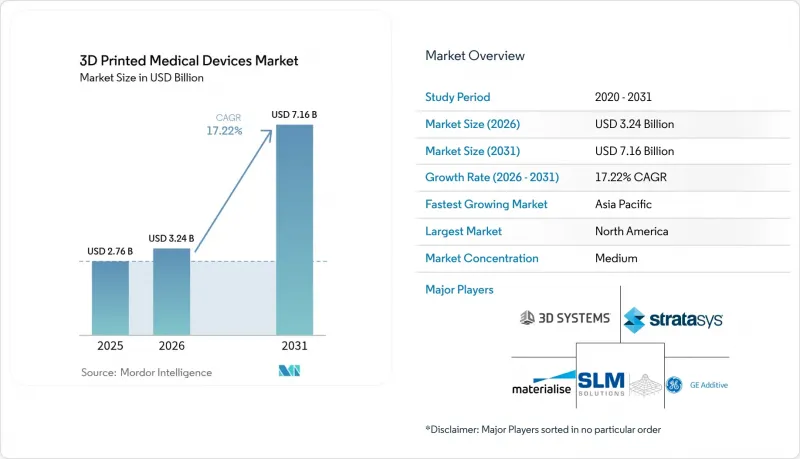
Mordor Intelligence에 의하면, 3D 프린팅 의료기기 시장 규모는 2025년 27억 6,000만 달러에서 2026년에는 32억 4,000만 달러로 확대되고, 2026-2031년 CAGR17.22%로 성장을 지속하여 2031년에는 71억 6,000만 달러에 달할 것으로 예측됩니다.
본 보고서는 제품군(하드웨어 및 소프트웨어), 유형(수술 가이드, 수술 기구, 보철물 및 임플란트, 기타),소재(플라스틱, 기타), 기술(레이저 빔 용융, 광중합(UV), 전자빔 용융, 기타), 최종 사용자(병원 및 외과 센터, 전문 클리닉, 기타), 지역별로 분류되어 있습니다. 시장 전망은 금액(달러) 기준으로 제시되어 있습니다.
세계 3D 프린팅 의료기기 시장 동향 및 인사이트
손쉬운 맞춤형 제작 기능
환자별로 최적화된 프린팅을 통해 ‘원 사이즈 핏 올(one size fits all)’ 의료기기의 한계가 해소됩니다. 2024년 8월 이후, 3D Systems의 EXT 220 MED 플랫폼은 환자의 해부학적 구조에 각각 정밀하게 부합하는 60건 이상의 두개골 성형술을 지원해 왔습니다. 2025년 3월, 바젤의 외과의사들은 장기화된 외부 공급망을 우회하여 MDR을 준수하는 3D 프린팅 PEEK 재질의 안면 임플란트를 최초로 이식했습니다. 현재 수술실에서는 치수 정확도 100%의 수술 가이드가 제작되어, 템플릿을 반복적으로 수정할 필요가 없어졌습니다. 티타늄이나 PEEK로 프린팅된 복잡한 골주 구조는 골유착을 촉진하고 스트레스 실드를 완화함으로써 정형외과 치료 성과를 직접적으로 향상시킵니다. 대량 생산에서 맞춤형 생산으로의 전환은 더 높은 임상적 가치를 뒷받침하며, 프리미엄 보상 모델을 촉진하고 있습니다.
이식 대기자 수 증가
10만 명 이상의 미국인이 여전히 이식 대기자 명단에 등록되어 있으며, 이는 조직 및 장기 바이오프린팅에 대한 투자를 촉진하고 있습니다. 바이오프린팅 기업들은 2024년에 사상 최대 규모의 자금 조달을 달성했으며, 관련 시장은 2034년까지 연평균 성장률(CAGR) 11.8%를 나타낼 것으로 예측됩니다. 2025년, 골웨이의 연구진은 세포가 만들어내는 힘에 의해 형태를 변화시키는 수축성 심장 조직을 바이오프린팅으로 제작하여, 기능성 장기의 임상 적용을 현실로 한 걸음 더 가까이 다가서게 했습니다. 혈관 신생 기술이 성숙해짐에 따라, 바이오프린팅을 통한 조직 구조는 연구 단계에서 규제 대상 치료법으로 전환되고 있으며, 이 부문은 장기 부족에 대한 장기적인 해결책으로서의 입지를 확립해 가고 있습니다.
FDA의 클래스 III 의료기기 승인 절차의 엄격성
이식형 의료기기는 대부분의 경우 클래스 III로 분류되므로, 철저한 생체 적합성과 임상적 증거가 요구됩니다. ISO 10993-1 지침에 따라 심사 기간은 기존 제품에 비해 12-18개월 더 길어질 가능성이 있습니다. 그럼에도 불구하고, FDA의 510(k) 데이터베이스에는 2024년의 주목할 만한 승인 사례가 기록되어 있습니다. Curiteva의 PEEK 재질 요추 고정술용 임플란트와 Restor3D의 시멘트리스 인공 슬관절이 승인을 획득한 것은 적층 가공된 임플란트라도 동등성을 주장할 수 있음을 보여줍니다. 다만, 격자 구조나 농도 구배를 가진 구성에서 과거의 유사 사례가 존재하지 않는 경우, 기존 승인 제품과의 적합성을 입증하는 것은 여전히 어렵습니다.
부문 분석
2025년에는 병원과 서비스 뷰로가 프린터 및 클린룸 개보수에 초기 투자를 단행함에 따라, 하드웨어가 3D 프린팅 의료기기 시장 규모의 60.32%를 차지했습니다. 산업용 바이오 프린터의 가격은 20만-50만 달러로, 초기 투자의 자본 집약도가 높음을 뒷받침합니다. 그 후, 프린터의 가동으로 폴리머, 금속 분말, 세포 함유 하이드로겔을 통한 지속적인 수익이 창출됩니다. 이 추세는 2024년에 총 매출이 감소했음에도 불구하고, 스트라타시스(Stratasys)가 소모품 매출에서 사상 최고치를 기록한 사실에서 분명하게 드러납니다.
더 이상 프린터 자체가 공급업체의 유일한 차별화 요소가 아닙니다. 워크플로우 소프트웨어를 통해 설계 반복 작업이 단축되고, 지지재 생성이 자동화되며, 멸균 로그와 직접 연동할 수 있게 되었습니다. 그러나 소프트웨어 시장은 예측 기간(2026-2031년) 동안 연평균 성장률(CAGR) 17.64%라는 급속한 성장을 이루고 있습니다. AI 기반 플랫폼을 통해 복잡한 해부학적 모델 제작 시간이 100시간에서 18시간으로 단축되어, 과도한 업무 부담을 안고 있는 임상 엔지니어의 처리 능력이 향상되고 있습니다. 서비스 제공은 여전히 하위 세분화되어 있지만, 의료 기관의 구매 담당자들 사이에서는 하드웨어, 검증된 소재, 클라우드 렌더링, 현장 지원 계약을 결합한 통합 생태계에 대한 수요가 높아지고 있습니다.
2025년에는 3D 프린팅 의료기기 시장 점유율의 38.55%를 보철물 임플란트가 차지할 것으로 예상되며, 그 주된 요인은 두개악안면 및 정형외과 부문 수요에 기인합니다. 외과 의사들은 스트레스 쉴드를 줄이고 영상 선명도를 높이는 격자 구조의 티타늄 고관절 컵과 PEEK 두개골 플레이트를 높이 평가했습니다. 재생 의학은 골격의 혈관 신생 및 면역 조절 기술이 성숙해짐에 따라 연평균 성장률(CAGR) 18.45%로 조직 공학을 주도하고 있으며, 이는 기존 임플란트의 성장률을 상회하고 있습니다.
3D 프린팅된 수술용 가이드와 기구는 적용 범위를 더욱 확대하고, 수술 시간을 단축하는 동시에 절제 정확도를 높이고 있습니다. 바젤 대학병원은 2025년 3월, 병원 팀이 MDR(의료기기규정)을 준수하는 안면용 PEEK 장치를 병원 내에서 최초로 이식함으로써 규제상의 실현 가능성을 입증했습니다. 조직 공학은 2026년부터 2031년까지 18.45%라는 가장 높은 성장률을 나타낼 것으로 예측됩니다. 조직 공학은 신약 개발을 지원하는 ‘장기 온 칩(organ-on-a-chip)’ 플랫폼으로 확대되어, 의료기기와 제약 분야의 워크플로우 간 융합을 더욱 강화해 나갈 것으로 보입니다.
지역별 분석
2025년, 북미는 전 세계 매출의 45.42%를 차지했습니다. 이는 FDA의 조기 지침, 성숙한 보험 급여 코드, 병원 인프라에 대한 막대한 투자를 반영한 결과입니다. DARPA가 전장에서의 바이오 프린팅과 적층 전자 기술 및 항균제 전달 기능을 융합한 스마트 붕대에 보조금을 지원하고 있어, 이 지역의 생태계는 더욱 심화되고 있습니다. 산업 재편은 계속되고 있으며, 에노비스(Enovis)는 리마 코퍼레이트(Rima Corporate)를 8억 유로에 인수하여 3D 프린팅된 티타늄 인공 고관절 제품 라인업을 확대했습니다.
아시아태평양은 예측 기간 동안 18.05%라는 세계 평균 연평균 성장률(CAGR)을 상회하는 성장률을 보였습니다. 중국 국가약품감독관리국(NMPA)은 2024년에 61건의 혁신적인 의료기기를 승인했는데, 이는 전년 대비 11% 증가한 수치로, 국내 스타트업 기업 시장 출시 기간을 단축시키고 있습니다. 일본의 의료기기 부문은 저침습 임플란트를 요구하는 고령화 사회를 배경으로 매년 놀라운 속도로 성장하고 있습니다. 인도는 규제 기준을 IMDRF의 원칙과 조화시켜, 현지 프린터 조립 및 분말 분무화에 활용되는 외국인 직접 투자를 유치하고 있습니다.
유럽에서는 엄격한 MDR 요건과充?した 연구 개발(R&D) 인센티브 간의 균형이 잘 잡혀 있습니다. 독일은 자동차 제조업체에서 정형외과용 공급업체로 노하우를 이전하는 적층 가공 기술의 인증에 투자하고 있는 반면, 영국의 대학에서는 생성형 임플란트 설계를 전문으로 하는 소프트웨어 스타트업이 스핀아웃하고 있습니다. 순환형 제조를 중시하는 지속가능성 정책은 분말을 재사용하고 기계 가공으로 인한 폐기물을 제거하는 적층 가공 기술을 뒷받침하고 있습니다.
기타 혜택
- 엑셀 형식 시장 예측(ME) 시트
- 3개월간의 애널리스트 지원
자주 묻는 질문
목차
제1장 서론
제2장 조사 방법
제3장 주요 요약
제4장 시장 구도
제5장 시장 규모와 성장 예측
제6장 경쟁 구도
제7장 시장 기회와 향후 전망
LSH 26.08.26According to Mordor Intelligence, the 3D printed medical devices market size is expected to grow from USD 2.76 billion in 2025 to USD 3.24 billion in 2026 and is forecast to reach USD 7.16 billion by 2031 at 17.22% CAGR over 2026-2031.
This report is Segmented by Offerings (Hardware and Software), Type (Surgical Guides, Surgical Instruments, Prosthetics and Implants, and More), Material (Plastics, and More), Technology (Laser Beam Melting, Photopolymerization (UV), Electron Beam Melting, and More), End User (Hospitals and Surgical Centers, Specialty Clinics, and More), and Geography. The Market Forecasts are Provided in Terms of Value (USD).
Global 3D Printed Medical Devices Market Trends and Insights
Easy Mass-Customization Capability
Patient-specific printing removes the constraint of one-size-fits-all devices. Since August 2024, 3D Systems' EXT 220 MED platform has supported over 60 cranioplasties, each precisely matched to the patient's anatomy. Basel surgeons implanted the first MDR-compliant 3D-printed PEEK facial implant in March 2025, bypassing prolonged external supply chains. Operating rooms now generate surgical guides with 100% dimensional accuracy, eliminating the need for iterative template revisions. Complex trabecular structures printed in titanium or PEEK foster osseointegration and mitigate stress shielding, directly improving orthopedic outcomes. The shift from mass production to mass customization underpins higher clinical value and supports premium reimbursement models.
Rising Transplant Waiting Lists
More than 100,000 Americans remain on transplant lists, spurring investment in tissue and organ bioprinting. Bioprinting firms secured a record amount of funding in 2024, and the related market is projected to grow at a 11.8% CAGR through 2034. Galway researchers in 2025 printed contractile heart tissue that morphs under cell-generated forces, bringing functional organs closer to clinical reality.As vascularization techniques mature, bioprinted constructs are transitioning from research to regulated therapy, positioning the segment as a long-term solution to organ shortages.
Stringent FDA Class-III Device Clearance Pathway
Implantable devices often default to class-III, demanding exhaustive biocompatibility and clinical evidence. ISO 10993-1 guidance can stretch review cycles 12-18 months longer than for traditional forgings. Still, the agency's 510(k) database logged notable 2024 wins: Curiteva's PEEK lumbar fusion and Restor3D's cementless knee replacement gained clearance, illustrating that equivalence arguments are possible even for additively manufactured implants. Achieving predicate alignment remains complex when lattice structures or gradient compositions have no historical analogs.
Other drivers and restraints analyzed in the detailed report include:
- Cost and Lead-Time Reduction vs. Subtractive Manufacturing
- Surge in Hospital-Owned Point-of-Care Print Labs
- High Material Qualification Costs
For complete list of drivers and restraints, kindly check the Table Of Contents.
Segment Analysis
Hardware generated 60.32% of the 3D printed medical devices market size in 2025, as hospitals and service bureaus initially invest in printers and clean-room modifications. Industrial bioprinters cost USD 200,000 to USD 500,000, reinforcing the up-front capital intensity. Printer utilization subsequently generates recurring revenue through polymers, metal powders, and cell-laden hydrogels, a pattern evident as Stratasys posted record consumables revenue despite total sales slipping in 2024.
Printers alone are no longer the sole differentiator of suppliers; workflow software now shortens design iterations, automates support generation, and links directly to sterilization logs. However, Software grows at a rapid rate of 17.64% CAGR during the forecast period (2026-2031). AI-driven platforms cut complex anatomical model preparation from 100 hours to 18 hours, lifting throughput for overstretched clinical engineers. Service offerings remain fragmented, yet health-system buyers increasingly demand integrated ecosystems that combine hardware, validated materials, cloud rendering, and on-site support contracts.
Prosthetics and implants accounted for 38.55% of the 3D printed medical devices market share in 2025, driven primarily by demand in cranio-maxillofacial and orthopedic applications. Surgeons value latticed titanium hip cups or PEEK skull plates that reduce stress shielding and enable imaging clarity. Regenerative medicine pushes tissue engineering forward at an 18.45% CAGR, outpacing traditional implant growth as scaffold vascularization and immune modulation mature.
Printed surgical guides and instruments further expand the application mix, reducing intraoperative time and enhancing resection accuracy. University Hospital Basel proved regulatory viability when its team implanted the first MDR-compliant facial PEEK device on-site in March 2025. Tissue engineering is expected to register the fastest growth of 18.45% from 2026 to 2031. Tissue engineering will expand into organ-on-chip platforms that support drug discovery, reinforcing the convergence between device and pharmaceutical workflows.
Complete Report Scope:
- By Offerings
- Hardware
- 3D Printers
- FDM Printers
- SLS Printers
- SLA/DLP Printers
- Bioprinters
- Materials
- 3D Printers
- Software
- Hardware
- By Type
- Surgical Guides
- Surgical Instruments
- Prosthetics and Implants
- Orthopedic
- Dental
- Cranio-maxillofacial
- Tissue Engineering Products
- By Materials
- Plastics
- Metal and Metal Alloy Powders
- Biocompatible Polymers
- Ceramics
- By Technology
- Laser Beam Melting
- Photopolymerization (UV)
- Electron Beam Melting
- Extrusion-based
- Binder Jetting
- By End User
- Hospitals and Surgical Centers
- Specialty Clinics
- Academic and Research Institutes
- Others
- By Geography
- North America
- United States
- Canada
- Mexico
- South America
- Brazil
- Argentina
- Rest of South America
- Europe
- Germany
- United Kingdom
- France
- Italy
- Spain
- Russia
- Rest of Europe
- Asia-Pacific
- China
- Japan
- India
- South Korea
- Rest of Asia-Pacific
- Middle East
- Gulf Cooperation Council (GCC)
- Turkey
- Israel
- Rest of Middle East
- Africa
- South Africa
- Egypt
- Rest of Africa
- North America
Geography Analysis
North America contributed 45.42% of global revenue in 2025, reflecting early FDA guidance, mature reimbursement codes, and heavy hospital infrastructure investment. The region's ecosystem deepens as DARPA channels grants into battlefield bioprinting and smart bandages that merge additive electronics with antimicrobial delivery. Consolidation continues; Enovis paid EUR 800 million for LimaCorporate, expanding its 3D-printed titanium hip portfolio.
Asia-Pacific outpaced the global CAGR with 18.05% during the forecast period. China's NMPA approved 61 innovative devices in 2024, representing an 11% year-over-year increase that shortens the time-to-market for domestic startups. Japan's medical device sector is growing at a significant rate annually, driven by aging demographics that demand minimally invasive implants. India harmonizes its regulatory code with IMDRF principles, attracting foreign direct investment for local printer assembly and powder atomization.
Europe balances strict MDR requirements with robust R&D incentives. Germany invests in additive qualifications that transfer know-how from automotive firms to orthopedic suppliers, while UK universities spin out software startups specializing in generative implant design. Sustainability policies that emphasize circular manufacturing favor additive techniques, which reuse powders and eliminate machining waste.
- 3D Systems
- Stratasys
- Materialise
- EOS GmbH
- SLM Solutions
- Renishaw
- GE Additive
- Carbon
- Desktop Metal
- Organovo
- PrintBio
- Prodways Group
- Curiteva
- Formlabs
- Concept Laser
- Arcam AB
- Dentsply Sirona
- Zimmer Biomet
- Johnson and Johnson (DePuy Synthes)
- Medtronic
Additional Benefits:
- The market estimate (ME) sheet in Excel format
- 3 months of analyst support
TABLE OF CONTENTS
1 INTRODUCTION
- 1.1 Study Assumptions and Market Definition
- 1.2 Scope of the Study
2 RESEARCH METHODOLOGY
3 EXECUTIVE SUMMARY
4 MARKET LANDSCAPE
- 4.1 Market Overview
- 4.2 Market Drivers
- 4.2.1 Easy mass-customization capability
- 4.2.2 Rising transplant waiting lists
- 4.2.3 Cost and lead-time reduction vs. subtractive manufacturing
- 4.2.4 Surge in hospital-owned point-of-care print labs
- 4.2.5 ISO/ASTM 52931 biocompatibility standard unlocking new polymers
- 4.2.6 Defense-funded battlefield bioprinting programs
- 4.3 Market Restraints
- 4.3.1 Stringent FDA class-III device clearance pathway
- 4.3.2 High material qualification costs
- 4.3.3 Shortage of GMP-grade bio-inks
- 4.3.4 Cyber-sabotage risks in distributed print files
- 4.4 Industry Value Chain Analysis
- 4.5 Regulatory Landscape
- 4.6 Technological Outlook
- 4.7 Porter'ss Five Forces
- 4.7.1 Threat of New Entrants
- 4.7.2 Bargaining Power of Buyers
- 4.7.3 Bargaining Power of Suppliers
- 4.7.4 Threat of Substitutes
- 4.7.5 Competitive Rivalry
5 MARKET SIZE AND GROWTH FORECASTS (VALUE)
- 5.1 By Offerings
- 5.1.1 Hardware
- 5.1.1.1 3D Printers
- 5.1.1.1.1 FDM Printers
- 5.1.1.1.2 SLS Printers
- 5.1.1.1.3 SLA/DLP Printers
- 5.1.1.1.4 Bioprinters
- 5.1.1.2 Materials
- 5.1.1.1 3D Printers
- 5.1.2 Software
- 5.1.1 Hardware
- 5.2 By Type
- 5.2.1 Surgical Guides
- 5.2.2 Surgical Instruments
- 5.2.3 Prosthetics and Implants
- 5.2.3.1 Orthopedic
- 5.2.3.2 Dental
- 5.2.3.3 Cranio-maxillofacial
- 5.2.4 Tissue Engineering Products
- 5.3 By Materials
- 5.3.1 Plastics
- 5.3.2 Metal and Metal Alloy Powders
- 5.3.3 Biocompatible Polymers
- 5.3.4 Ceramics
- 5.4 By Technology
- 5.4.1 Laser Beam Melting
- 5.4.2 Photopolymerization (UV)
- 5.4.3 Electron Beam Melting
- 5.4.4 Extrusion-based
- 5.4.5 Binder Jetting
- 5.5 By End User
- 5.5.1 Hospitals and Surgical Centers
- 5.5.2 Specialty Clinics
- 5.5.3 Academic and Research Institutes
- 5.5.4 Others
- 5.6 By Geography
- 5.6.1 North America
- 5.6.1.1 United States
- 5.6.1.2 Canada
- 5.6.1.3 Mexico
- 5.6.2 South America
- 5.6.2.1 Brazil
- 5.6.2.2 Argentina
- 5.6.2.3 Rest of South America
- 5.6.3 Europe
- 5.6.3.1 Germany
- 5.6.3.2 United Kingdom
- 5.6.3.3 France
- 5.6.3.4 Italy
- 5.6.3.5 Spain
- 5.6.3.6 Russia
- 5.6.3.7 Rest of Europe
- 5.6.4 Asia-Pacific
- 5.6.4.1 China
- 5.6.4.2 Japan
- 5.6.4.3 India
- 5.6.4.4 South Korea
- 5.6.4.5 Rest of Asia-Pacific
- 5.6.5 Middle East
- 5.6.5.1 Gulf Cooperation Council (GCC)
- 5.6.5.2 Turkey
- 5.6.5.3 Israel
- 5.6.5.4 Rest of Middle East
- 5.6.6 Africa
- 5.6.6.1 South Africa
- 5.6.6.2 Egypt
- 5.6.6.3 Rest of Africa
- 5.6.1 North America
6 COMPETITIVE LANDSCAPE
- 6.1 Market Concentration
- 6.2 Strategic Moves
- 6.3 Market Share Analysis
- 6.4 Company Profiles (includes Global level Overview, Market level overview, Core Segments, Financials as available, Strategic Information, Market Rank/Share for key companies, Products and Services, Recent Developments)
- 6.4.1 3D Systems
- 6.4.2 Stratasys
- 6.4.3 Materialise
- 6.4.4 EOS GmbH
- 6.4.5 SLM Solutions
- 6.4.6 Renishaw
- 6.4.7 GE Additive
- 6.4.8 Carbon
- 6.4.9 Desktop Metal
- 6.4.10 Organovo
- 6.4.11 PrintBio
- 6.4.12 Prodways Group
- 6.4.13 Curiteva
- 6.4.14 Formlabs
- 6.4.15 Concept Laser
- 6.4.16 Arcam AB
- 6.4.17 Dentsply Sirona
- 6.4.18 Zimmer Biomet
- 6.4.19 Johnson and Johnson (DePuy Synthes)
- 6.4.20 Medtronic
7 MARKET OPPORTUNITIES AND FUTURE OUTLOOK
- 7.1 White-space and Unmet-need Assessment


