

|
시장보고서
상품코드
2118259
커넥티드 의료기기 소프트웨어 시장 : 시장 점유율 분석, 업계 동향 및 통계, 성장 예측(2026-2031년)Connected Medical Device Software - Market Share Analysis, Industry Trends & Statistics, Growth Forecasts (2026 - 2031) |
||||||
 Mordor Intelligence
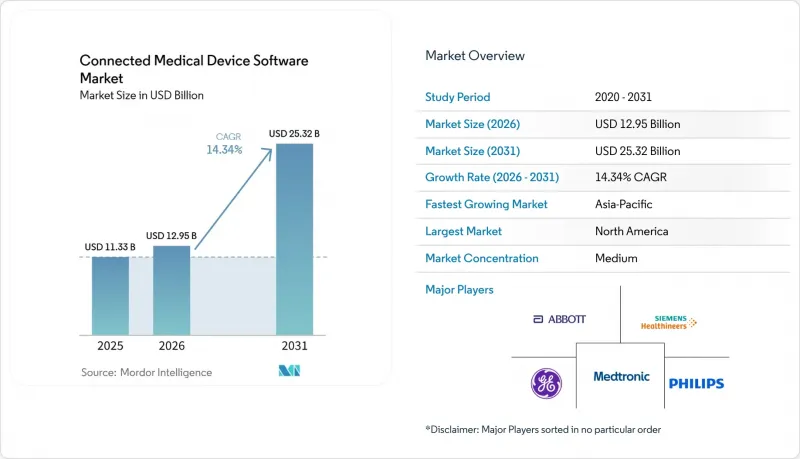
Mordor Intelligence에 의하면, 커넥티드 의료기기 소프트웨어 시장 규모는 2025년에 113억 3,000만 달러로 평가되었고, 2026년 129억 5,000만 달러에서 2031년에는 253억 2,000만 달러에 이를 것으로 추정되며, 예측 기간(2026-2031년)에서 CAGR은 14.34%를 나타낼 전망입니다.
본 보고서는 구성 요소별(클라우드 기반, 온프레미스형, 엣지형, 하이브리드형), 연결 방식별(유선, 무선, 하이브리드), 기기 유형별(환자 모니터링, 호흡기, 수액, 심장, 외과, 웨어러블/재택), 용도별(10종), 최종 사용자별(6종), 지역별(북미, 유럽, 아시아태평양, 중동 및 아프리카, 남미)로 분류되어 있습니다. 시장 예측은 금액(달러) 기준으로 제시되어 있습니다.
세계의 커넥티드 의료기기 소프트웨어 시장 동향 및 인사이트
원격 생리학적 모니터링 및 치료 모니터링의 확대
CMS는 원격 치료 모니터링과 관련된 CPT 코드 98975-98980을 최종 확정했습니다. 이에 따라 커넥티드 디바이스 플랫폼의 소프트웨어 조달 주기가 정착되었으며, 보험 급여 주도형 수요가 시장의 구조적 특징이 되었습니다. FDA가 2025년 12월에 실시한 ‘TEMPO 디지털 헬스 기기 파일럿 프로그램’에서는 실세계 증거를 수집하는 동시에, 시판 전 요건에 관한 집행상의 재량권이 인정되었습니다. 덱콤은 2026년 7월 첫 번째 참여 기업으로 합류하여, G7 및 Stelo의 CGM 데이터를 상황에 따른 영양, 수면, 활동량 신호와 통합한 AI 기반 혈당 관리 프로그램을 출시했습니다. 에드워즈 생명과학(Edwards Lifesciences)가 2025년 5월에 HePI 알고리즘을, 2026년 6월에 호흡수 알고리즘을 승인받은 사례는 벤더가 기존 커넥티드 하드웨어에 AI를 활용한 매개변수 감지 기능을 추가함으로써 소프트웨어 수익을 확대한 실례를 보여줍니다.
상호 운용성 및 전자건강기록(EHR) 통합 요건
ONC의 FHIR 상호운용성 규정에 따라, 인증된 EHR 기술이 미국 전역의 비연방 급성기 병원에서 표준화된 API 인터페이스를 지원해야 할 의무가 부과됨에 따라, 병원용 연결 기기 소프트웨어의 EHR 통합은 조달상의 우선순위에서 계약상의 필수 요건으로 발전했습니다. 독일의 병원 부문도 비슷한 길을 걷고 있으며, SAP와 프레제니우스는 2026년 1월, HL7 FHIR 인터페이스와 KHZG 디지털화 프로그램 자금을 활용하여 자율적인 유럽 헬스케어 생태계를 구축하기 위한 제휴를 발표했습니다. FHIR의 도입으로 독자적인 사양의 데이터에 기반한 경쟁 우위가 약화되었고, 크로스 플랫폼 분석 기능을 통해 차별화를 이루지 못한 벤더들은 이익률에 대한 압박이 커졌습니다. ISO/IEC 80001-1은 계속해서 전 세계 규정 준수의 주요 프레임워크로 남아 있었지만, EU의 MDR 제83조에 따라 유럽 시장 진출 시 시판 후 소프트웨어 모니터링 의무가 추가되었습니다.
분산된 레거시 프로토콜과 독자적인 사양의 디바이스 아키텍처
대부분의 대규모 의료 시스템에 도입된 의료기기에는 HL7 v2, DICOM, 독자적인 직렬 프로토콜 및 새로운 FHIR 호환 API가 포함되어 있습니다. 이러한 아키텍처의 비통일성으로 인해 벤더 중립형 미들웨어가 통합상의 과제를 해결하는 능력이 제한되고 있습니다. 독일의 DigitalRadar가 실시한 평가에 따르면, 연결 기기의 통합이 독립적인 디지털화 지표로 병원에 점수가 부여되었으며, 공개된 중간 데이터에 따르면 조사 대상 시설의 상당 부분이 여전히 병상 기기와 임상 정보 시스템 간의 수동 데이터 전송에 의존하고 있는 것으로 나타났습니다. 중국의 NMPA는 2026년 3월 YY/T 1406-2026을 공표하여 소프트웨어 위험 관리 요건을 개정함과 동시에, 기존 검증 프레임워크를 채택하고 있는 제조업체에 대해 연결 제품 시장 승인을 유지하기 전에 새로운 평가를 실시할 것을 의무화했습니다.
부문 분석
2025년, 클라우드 기반 소프트웨어는 연결형 의료기기 소프트웨어 시장의 48.22%를 차지했습니다. 이는 여러 거점에서의 도입, 경보의 일원화된 표준화, 단계적인 소프트웨어 업데이트를 지원하며, 시판 후 유지보수 및 보안 관리 요구를 충족시켰습니다. 또한 상시 연결성을 통해 유럽 내 지속적인 임상 데이터 검토 및 정기 보고 의무도 지원되었습니다. 데이터 거주지에 관한 규제로 인해 국경을 넘는 의료 데이터 전송이 제한되는 지역에서는 온프레미스형 소프트웨어가 여전히 중요하게 여겨졌습니다. 반면, 아시아태평양의 대규모 의료 시스템에서는 각국의 개인정보 보호 및 데이터 관리 규정에 따라 현지 배포가 선호되었습니다.
하이브리드형 소프트웨어는 2026년부터 2031년까지 연평균 성장률(CAGR) 17.86%를 나타낼 것으로 예측되며, 이는 구성 요소 유형 중 가장 높은 성장률입니다. 이 소프트웨어는 병상이나 로컬 에지에서 시간적 제약이 있는 처리를 가능하게 하는 동시에, 집단 수준의 분석을 위해 시간 경과에 따른 정보를 클라우드에 저장합니다. 병원 조달 팀이 제안 요청서(RFP)에 하이브리드 지원 플랫폼을 명시하는 사례가 늘고 있습니다. 하이브리드 솔루션을 위한 연결형 의료기기 소프트웨어 시장 규모는 신속한 대응과 전사적 데이터 접근이라는 두 가지 요구에 의해 뒷받침되고 있습니다.
2025년 시점에서 유선 연결은 커넥티드 의료기기 소프트웨어 시장의 57.68%를 차지했습니다. 중환자실과 수술실에서는 지속적인 중요 모니터링을 위해 여전히 유선 네트워크에 의존하고 있습니다. 이러한 환경에서는 신뢰할 수 있는 연결이 요구되며, 관리되지 않는 무선 주파수의 간섭을 최소화해야 했습니다. 커넥티드 의료기기 소프트웨어 시장은 중단 없는 고도의 모니터링이 필요한 상황에서 계속해서 유선 네트워크에 의존하고 있습니다.
무선 연결은 2026-2031년 연평균 성장률(CAGR) 19.67%를 나타낼 것으로 예측됩니다. Wi-Fi 6E 및 프라이빗 5G의 도입으로, 이전에는 무선 모니터링을 중요도가 낮은 용도로만 제한했던 지연 및 간섭에 대한 우려가 해소되고 있습니다. 병원에서는 중요한 경보에 대비해 유선 백업 경로를 유지하는 하이브리드 연결 모델이 채택되고 있습니다. 병원이 모니터링 범위를 고정된 병상 주변을 넘어 확대함에 따라, 무선 연결용 커넥티드 의료기기 소프트웨어 시장 규모는 확대되고 있습니다. 2025년, 환자 모니터링 기기는 커넥티드 의료기기 소프트웨어 시장의 36.78%를 차지했습니다. 이 점유율은 중환자실, 원격 측정, 일반 병동과 같은 환경에서 광범위하게 활용되고 있음을 반영한 것입니다. 메드트로닉과 GE 헬스케어는 2026년 3월, 제휴 관계를 확대하여 넬콜의 맥박 산소 측정, 마이크로스트림의 카프노그래피, INVOS의 국소 산소 측정 및 BIS 뇌 모니터링을 GE 헬스케어의 모니터링 플랫폼에 통합했습니다. 이 제휴를 통해 양사의 장비를 운영하는 의료 시스템 내 인터페이스의 복잡성이 완화되었습니다.
웨어러블 의료기기 및 재택치료기기는 2026-2031년 연평균 성장률(CAGR) 18.35%를 나타낼 것으로 예측됩니다. 이러한 성장은 부정맥, 혈당 관리, 수면 호흡 장애에 대한 휴대용 모니터링이 임상 현장에서 널리 수용되고 있기 때문입니다. ZEUS 플랫폼은 Zio 모니터에서 수집된 연속 심전도 기록을 분석하여 의사와의 일치율이 99%에 달하는 부정맥 보고서를 생성하는 AI 및 머신러닝 지원 소프트웨어로서, 2026년 5월 FDA 510(k) 승인을 획득했습니다. 웨어러블 및 가정용 의료기기를 위한 연결형 의료기기 소프트웨어 시장 규모는 이러한 임상 용도의 확대에 힘입어 성장하고 있습니다.
지역별 분석
2025년, 북미는 커넥티드 의료기기 소프트웨어 시장 점유율의 39.76%를 차지했습니다. 이 지역은 확립된 원격 모니터링 보험 환급 제도, 병원의 높은 의료기기 도입 밀도, 그리고 디지털 헬스에 대한 FDA의 적극적인 감독의 혜택을 받고 있습니다. TEMPO 파일럿 프로그램은 소프트웨어 지원 커넥티드 기기에 대한 실세계 증거 수집을 지원했습니다. 또한, 미국 병원에서는 FHIR 기반의 데이터 교환 및 표준화된 인터페이스 기반이 확대되고 있습니다. 유럽은 지역별 시장 점유율 2위를 차지하고 있으며, 독일은 EU의 MDR 요건, 병원 디지털화에 대한 자금 지원, 그리고 해당 국가의 디지털 헬스 환경을 통해 조달에 영향을 미치고 있습니다.
아시아태평양은 2026-2031년 연평균 성장률(CAGR) 18.56%를 나타낼 것으로 예측되며, 가장 빠르게 성장하는 지역 시장이 될 전망입니다. 주요 지역 시장에서는 의료 인프라 투자와 병행하여 규제 현대화가 진행되고 있습니다. 일본의 ‘DASH for SaMD 2’ 프로그램은 적격한 연결형 모니터링 소프트웨어에 대한 신속한 심사 절차를 지원하고 있습니다. 한국의 ‘디지털 의료기기법’은 병원 구매 담당자들에게 디지털 헬스 지원 기기의 중요성을 높이고 있습니다. 중국에서 개정된 YY/T 1406-2026 소프트웨어 요건으로 인해 업데이트된 검증 문서에 대한 수요가 발생하는 한편, 인도의 민간 병원 그룹과 호주의 재택치료 프로그램에서는 도입이 확대되고 있습니다.
중동 및 아프리카 및 남미는 여전히 커넥티드 의료기기 소프트웨어 시장의 초기 단계에 있는 지역입니다. 도입은 민간 의료 그룹과 주요 공립 병원 프로젝트에 집중되어 있습니다. GCC 국가에서는 신규 병원 건설이 북미나 유럽의 기존 시설 업그레이드에 비해 더 단순한 통합 환경을 제공합니다. 사우디아라비아의 ‘비전 2030’ 프로그램과 UAE의 디지털 헬스 의무화 조치는 커넥티드 모니터링 도입을 촉진하고 있는 반면, 브라질의 디지털 헬스 관련 노력과 남아프리카공화국의 의료 제도 개혁은 공공 부문에서의 장기적인 수요를 시사하고 있습니다.
기타 혜택 :
- 엑셀 형식 시장 예측(ME) 시트
- 3개월간의 애널리스트 지원
자주 묻는 질문
목차
제1장 서론
제2장 조사 방법
제3장 개요
제4장 시장 구도
제5장 시장 규모 및 성장 예측
제6장 경쟁 구도
제7장 시장 기회 및 향후 전망
AJY 26.09.01According to Mordor Intelligence, the connected medical device software market size was valued at USD 11.33 billion in 2025 and is estimated to grow from USD 12.95 billion in 2026 to reach USD 25.32 billion by 2031, at a CAGR of 14.34% during the forecast period (2026-2031).
This report is Segmented by Component (Cloud-Based, On-Premises, Edge-Based, Hybrid), Connectivity (Wired, Wireless, Hybrid), Device Type (Patient Monitoring, Respiratory, Infusion, Cardiac, Surgical, Wearable/Home), Application (10 Types), End User (6 Types), and Geography (North America, Europe, Asia-Pacific, MEA, South America). The Market Forecasts are Provided in Terms of Value (USD).
Global Connected Medical Device Software Market Trends and Insights
Expansion of Remote Physiologic and Therapeutic Monitoring
CMS finalized CPT codes 98975-98980 for remote therapeutic monitoring, anchoring software procurement cycles for connected device platforms and making reimbursement-driven demand a structural market feature. The FDA's December 2025 TEMPO Digital Health Devices Pilot granted enforcement discretion on premarket requirements while generating real-world evidence. Dexcom entered as its first participant in July 2026, deploying an AI-powered glucose health program that integrated G7 and Stelo CGM data with contextual nutrition, sleep, and activity signals. Edwards Lifesciences' May 2025 HePI algorithm clearance and June 2026 Respiration Rate algorithm clearance showed how vendors expanded software revenue by adding AI-enabled parameter detection to existing connected hardware.
Interoperability and Electronic Health Record Integration Requirements
EHR integration advanced from a procurement preference to a contractual mandate for hospital-grade connected device software, as ONC's FHIR interoperability rules required certified EHR technology to support standardized API interfaces across US non-federal acute care hospitals. Germany's hospital sector followed a similar path, with SAP and Fresenius announcing a January 2026 collaboration to build a sovereign European health ecosystem using HL7 FHIR interfaces and KHZG digitalization program funding. FHIR adoption weakened proprietary data moats, increasing margin pressure on vendors without cross-platform analytics differentiation. ISO/IEC 80001-1 remained the leading global compliance framework, while EU MDR Article 83 added post-market software surveillance obligations for European market access.
Fragmented Legacy Protocols and Proprietary Device Architectures
The installed device base across most large health systems includes HL7 v2, DICOM, proprietary serial protocols, and newer FHIR-enabled APIs. This architectural disparity limits the ability of vendor-neutral middleware to resolve integration challenges. Germany's DigitalRadar assessment scored hospitals on connected device integration as a discrete digitalization metric, and published interim data indicated that a material share of surveyed facilities still relied on manual data transfer between bedside devices and clinical information systems. China's NMPA released YY/T 1406-2026 in March 2026, revising software risk management requirements and requiring manufacturers with legacy validation frameworks to conduct fresh assessments before maintaining connected product market authorizations.
Other drivers and restraints analyzed in the detailed report include:
- AI-Enabled Predictive Monitoring and Clinical Workflow Automation
- Growth of Home-Based and Decentralized Care
- High Integration, Validation, and Lifecycle-Maintenance Costs
For complete list of drivers and restraints, kindly check the Table Of Contents.
Segment Analysis
Cloud-based software held 48.22% of the connected medical device software market in 2025. It supported multi-site deployment, centralized alarm normalization, and rolling software updates, aligning with post-market maintenance and security management needs. Persistent connectivity also supported continuous clinical data review and periodic reporting obligations in Europe. On-premises software remained relevant where data residency rules limited cross-border health-data transfers, while large health systems in Asia-Pacific favored local deployment under national privacy and data-control rules.
Hybrid software is forecast to grow at a CAGR of 17.86% from 2026 to 2031, the fastest rate among component types. It enables time-sensitive processing at the bedside or local edge while storing longitudinal information in the cloud for population-level analysis. Hospital procurement teams increasingly specify hybrid-capable platforms in requests for proposals. The connected medical device software market size for hybrid solutions is supported by the need for both rapid response and enterprise-wide data access.
Wired connectivity held 57.68% of the connected medical device software market in 2025. Intensive care units and operating rooms continued to depend on hardwired networks for continuous critical monitoring. These settings required dependable connections and limited unmanaged radio-frequency interference. The connected medical device software market continued to rely on wired networks where uninterrupted high-acuity monitoring was required.
Wireless connectivity is forecast to grow at a CAGR of 19.67% from 2026 to 2031. Wi-Fi 6E and private 5G deployments address latency and interference concerns that previously restricted wireless monitoring to lower-acuity uses. Hospitals are adopting hybrid connectivity models that retain wired backup paths for critical alerts. The connected medical device software market size for wireless connectivity grows as hospitals extend monitoring beyond fixed bedside locations.Patient monitoring devices held 36.78% of the connected medical device software market in 2025. Their position reflected widespread use in intensive care, telemetry, and general ward environments. Medtronic and GE HealthCare expanded their alliance in March 2026 to integrate Nellcor pulse oximetry, Microstream capnography, INVOS regional oximetry, and BIS brain monitoring with GE HealthCare monitoring platforms. The collaboration reduced interface complexity for health systems operating devices from both companies.
Wearable and home medical devices are forecast to grow at a CAGR of 18.35% from 2026 to 2031. Their growth follows broader clinical acceptance of ambulatory monitoring for arrhythmia, glucose management, and sleep-disordered breathing. The ZEUS Platform received FDA 510(k) clearance in May 2026 as AI- and machine-learning-enabled software that analyzes continuous ECG recordings from Zio monitors and generates arrhythmia reports with 99% physician agreement. The connected medical device software market size for wearable and home devices benefits from these expanding clinical applications.
Complete Report Scope:
- By Component
- Cloud-Based Software
- On-Premises Software
- Edge-Based Software
- Hybrid Software
- By Connectivity
- Wired Connectivity
- Wireless Connectivity
- Hybrid Connectivity
- By Device Type
- Patient Monitoring Devices
- Respiratory Devices
- Infusion and Drug-Delivery Devices
- Diagnostic and Imaging Devices
- Cardiac and Implantable Devices
- Surgical and Perioperative Devices
- Wearable and Home Medical Devices
- Others
- By Application
- Continuous Patient Monitoring
- Remote Physiologic Monitoring
- Remote Therapeutic Monitoring
- Tele-ICU and Tele-Stroke
- Chronic Disease Management
- Medication Adherence and Optimization
- Early Warning and Deterioration Detection
- Predictive Maintenance and Asset Utilization
- Clinical Research and Real-World Evidence
- Others
- By End User
- Hospitals and Health Systems
- Ambulatory Surgical Centers
- Diagnostic and Imaging Centers
- Clinics and Physician Practices
- Home Healthcare Providers
- Skilled Nursing and Long-Term Care Facilities
- Others
- By Geography
- North America
- United States
- Canada
- Mexico
- Europe
- Germany
- United Kingdom
- France
- Italy
- Spain
- Rest of Europe
- Asia-Pacific
- China
- India
- Japan
- Australia
- South Korea
- Rest of Asia-Pacific
- Middle East and Africa
- GCC
- South Africa
- Rest of Middle East and Africa
- South America
- Brazil
- Argentina
- Rest of South America
- North America
Geography Analysis
North America held 39.76% of the connected medical device software market share in 2025. The region benefited from established remote monitoring reimbursement, high hospital device density, and active FDA oversight of digital health. The TEMPO pilot supported real-world evidence collection for software-enabled connected devices. U.S. hospitals also had a growing base of FHIR-based data exchange and standardized interfaces. Europe held the second-largest regional position, with Germany influencing procurement through EU MDR requirements, hospital digitalization funding, and its digital health environment.
Asia-Pacific is forecast to grow at a CAGR of 18.56% from 2026 to 2031, making it the fastest-growing regional market. Major regional markets are advancing regulatory modernization alongside healthcare infrastructure investment. Japan's DASH for SaMD 2 program supports faster review pathways for eligible connected monitoring software. South Korea's Digital Medical Products Act is increasing the relevance of digital health support devices for hospital buyers. China's revised YY/T 1406-2026 software requirements create demand for updated validation documentation, while India's private hospital groups and Australia's hospital-at-home programs are expanding adoption.
The Middle East and Africa and South America remain earlier-stage regions in the connected medical device software market. Adoption is concentrated among private healthcare groups and major public hospital projects. In GCC countries, new hospital construction offers a simpler integration environment than legacy upgrades in North America and Europe. Saudi Arabia's Vision 2030 programs and UAE digital health mandates support connected monitoring deployments, while Brazil's digital health activity and South Africa's health system changes indicate longer-term public-sector demand.
- Abbott Laboratories
- Ascom
- Baxter
- Boston Scientific
- Cisco Systems
- Dexcom
- Dragerwerk
- Edward Lifesciences
- GE HealthCare Technologies Inc.
- Insulet
- iRhythm Technologies
- Koninklijke Philips
- Masimo
- Medtronic
- Oracle
- Resmed
- S3 Connected Health Limited
- Siemens Healthineers
- Stryker
- Tandem Diabetes Care
Additional Benefits:
- The market estimate (ME) sheet in Excel format
- 3 months of analyst support
TABLE OF CONTENTS
1 INTRODUCTION
- 1.1 Study Assumptions and Market Definition
- 1.2 Scope of the Study
2 RESEARCH METHODOLOGY
3 EXECUTIVE SUMMARY
4 MARKET LANDSCAPE
- 4.1 Market Overview
- 4.2 Market Drivers
- 4.2.1 Expansion of Remote Physiologic and Therapeutic Monitoring
- 4.2.2 Interoperability and Electronic Health Record Integration Requirements
- 4.2.3 Growth of Home-Based and Decentralized Care
- 4.2.4 Cybersecurity-by-Design Requirements for Connected Devices
- 4.2.5 AI-Enabled Predictive Monitoring and Clinical Workflow Automation
- 4.2.6 Device Fleet Complexity and Demand for Vendor-Neutral Orchestration
- 4.3 Market Restraints
- 4.3.1 Fragmented Legacy Protocols and Proprietary Device Architectures
- 4.3.2 High Integration, Validation, and Lifecycle-Maintenance Costs
- 4.3.3 Cybersecurity Liability and Patient-Data Privacy Exposure
- 4.3.4 Alert Fatigue, Workflow Misalignment, and Clinician Adoption Barriers
- 4.4 Value / Supply-Chain Analysis
- 4.5 Regulatory Landscape
- 4.6 Technological Outlook
- 4.7 Porter's Five Forces Analysis
- 4.7.1 Threat of New Entrants
- 4.7.2 Bargaining Power of Suppliers
- 4.7.3 Bargaining Power of Buyers
- 4.7.4 Threat of Substitutes
- 4.7.5 Competitive Rivalry
5 MARKET SIZE AND GROWTH FORECASTS (VALUE, USD)
- 5.1 By Component
- 5.1.1 Cloud-Based Software
- 5.1.2 On-Premises Software
- 5.1.3 Edge-Based Software
- 5.1.4 Hybrid Software
- 5.2 By Connectivity
- 5.2.1 Wired Connectivity
- 5.2.2 Wireless Connectivity
- 5.2.3 Hybrid Connectivity
- 5.3 By Device Type
- 5.3.1 Patient Monitoring Devices
- 5.3.2 Respiratory Devices
- 5.3.3 Infusion and Drug-Delivery Devices
- 5.3.4 Diagnostic and Imaging Devices
- 5.3.5 Cardiac and Implantable Devices
- 5.3.6 Surgical and Perioperative Devices
- 5.3.7 Wearable and Home Medical Devices
- 5.3.8 Others
- 5.4 By Application
- 5.4.1 Continuous Patient Monitoring
- 5.4.2 Remote Physiologic Monitoring
- 5.4.3 Remote Therapeutic Monitoring
- 5.4.4 Tele-ICU and Tele-Stroke
- 5.4.5 Chronic Disease Management
- 5.4.6 Medication Adherence and Optimization
- 5.4.7 Early Warning and Deterioration Detection
- 5.4.8 Predictive Maintenance and Asset Utilization
- 5.4.9 Clinical Research and Real-World Evidence
- 5.4.10 Others
- 5.5 By End User
- 5.5.1 Hospitals and Health Systems
- 5.5.2 Ambulatory Surgical Centers
- 5.5.3 Diagnostic and Imaging Centers
- 5.5.4 Clinics and Physician Practices
- 5.5.5 Home Healthcare Providers
- 5.5.6 Skilled Nursing and Long-Term Care Facilities
- 5.5.7 Others
- 5.6 By Geography
- 5.6.1 North America
- 5.6.1.1 United States
- 5.6.1.2 Canada
- 5.6.1.3 Mexico
- 5.6.2 Europe
- 5.6.2.1 Germany
- 5.6.2.2 United Kingdom
- 5.6.2.3 France
- 5.6.2.4 Italy
- 5.6.2.5 Spain
- 5.6.2.6 Rest of Europe
- 5.6.3 Asia-Pacific
- 5.6.3.1 China
- 5.6.3.2 India
- 5.6.3.3 Japan
- 5.6.3.4 Australia
- 5.6.3.5 South Korea
- 5.6.3.6 Rest of Asia-Pacific
- 5.6.4 Middle East and Africa
- 5.6.4.1 GCC
- 5.6.4.2 South Africa
- 5.6.4.3 Rest of Middle East and Africa
- 5.6.5 South America
- 5.6.5.1 Brazil
- 5.6.5.2 Argentina
- 5.6.5.3 Rest of South America
- 5.6.1 North America
6 COMPETITIVE LANDSCAPE
- 6.1 Market Concentration
- 6.2 Market Share Analysis
- 6.3 Company Profiles (includes Global Level Overview, Market Level Overview, Core Segments, Financials as available, Strategic Information, Market Rank/Share, Products and Services, Recent Developments)
- 6.3.1 Abbott Laboratories
- 6.3.2 Ascom Holding AG
- 6.3.3 Baxter International Inc.
- 6.3.4 Boston Scientific Corporation
- 6.3.5 Cisco Systems, Inc.
- 6.3.6 Dexcom, Inc.
- 6.3.7 Dragerwerk AG & Co. KGaA
- 6.3.8 Edwards Lifesciences Corporation
- 6.3.9 GE HealthCare Technologies Inc.
- 6.3.10 Insulet Corporation
- 6.3.11 iRhythm Technologies, Inc.
- 6.3.12 Koninklijke Philips N.V.
- 6.3.13 Masimo Corporation
- 6.3.14 Medtronic plc
- 6.3.15 Oracle Corporation
- 6.3.16 ResMed Inc.
- 6.3.17 S3 Connected Health Limited
- 6.3.18 Siemens Healthineers AG
- 6.3.19 Stryker Corporation
- 6.3.20 Tandem Diabetes Care, Inc.
7 MARKET OPPORTUNITIES AND FUTURE OUTLOOK
- 7.1 White-Space and Unmet-Need Assessment


