|
시장보고서
상품코드
2114448
음료 용기 시장 : 시장 점유율 분석, 업계 동향 및 통계, 성장 예측(2026-2031년)Beverage Container - Market Share Analysis, Industry Trends & Statistics, Growth Forecasts (2026 - 2031) |
||||||
 Mordor Intelligence
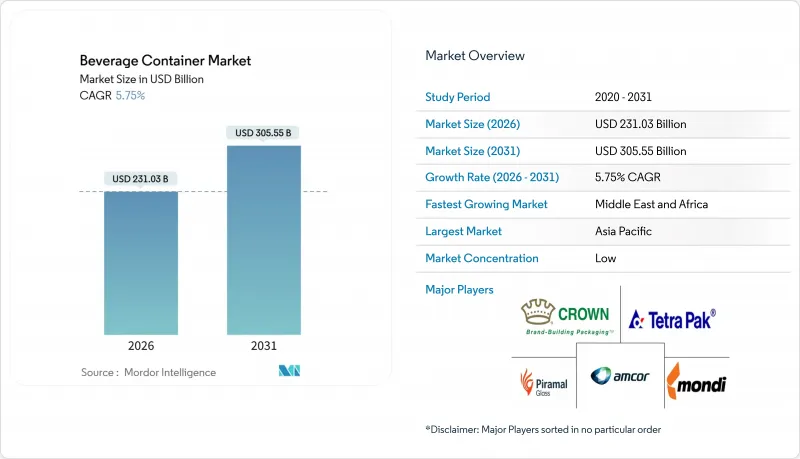
Mordor Intelligence에 의하면, 음료 용기 시장 규모는 2026년에 2,310억 3,000만 달러로 추정되고, 2031년까지 3,055억 5,000만 달러에 이를 것으로 예측되며, 이 기간 CAGR은 5.75%를 나타낼 전망입니다.
본 보고서는 소재별(플라스틱, 금속, 유리, 종이 및 퇴비화 가능·생분해성 소재), 음료 유형별(주류 및 무알코올 음료), 포장 형태별(병·항아리, 캔, 파우치, 백 인 박스, 카톤), 유통 채널별(직접 및 간접), 지역별(북미, 남미, 유럽 등)로 분류되어 있습니다. 시장 전망은 금액(달러) 기준으로 제시되어 있습니다.
세계의 음료 용기 시장 동향 및 인사이트
즉석 음용형 무알코올 음료 소비 급증
건강과 편의성을 중시하는 소비자 동향에 따라, 테이크아웃용 커피, 홍차, 기능성 물에 대한 수요가 증가하고 있습니다. 각 브랜드 소유 기업들은 즉석 음용 제품 라인에서 두 자릿수의 판매량 증가를 보고하고 있으며, 전해질이나 아답토겐을 배합한 신제품 출시는 비알코올 음료 신제품 전체의 5분의 1을 초과하고 있습니다. 이러한 변화에 따라, 냉장 보관 없이도 영양소를 보호하기 위한 무균 충전, 고도의 배리어 코팅 및 질소 충전 기능이 요구되고 있습니다. 얇은 두께의 PET 병과 위조 방지 캡의 조합이 새로운 사양으로 주류를 이루고 있습니다. 각 컨버터 업체들은 서보 구동 블로우 성형기 및 50마이크론 미만의 두께 편차를 감지하는 인라인 비전 시스템에 대한 투자를 확대하고 있으며, 대규모 생산에서도 경량화의 품질을 확보하고 있습니다.
편의성과 경량성을 겸비한 PET 병에 대한 수요 증가
경량화는 단순한 비용 절감책에서 브랜드를 차별화하는 요소로 변화했습니다. 코카콜라의 13.2그램 컨투어 병은 탑로드 성능을 유지하면서도 버진 수지 사용량을 8% 줄여, 연간 6,000메트르톤의 재료 소비를 절감했습니다. 현재 각 공급업체들은 12kgf를 초과하는 팔레트 하중을 견딜 수 있는 9g의 0.5리터 용기 설계를 가능하게 하는 스트레치 블로우 성형 플랫폼을 제공합니다. 규제 움직임이 이러한 추세를 가속화하고 있습니다. 유럽연합(EU)은 2025년까지 PET의 재생재 함유율을 25%로 의무화하고 있어, rPET의 비용 상승을 상쇄하는 박벽화의 경제적 이점을 더욱 높이고 있습니다. 생명주기 평가(LCA)에 따르면, 수십억 개 규모의 제품군에서 1그램을 경량화함으로써 수천 메트르톤의 CO₂ 환산 배출량을 감축할 수 있는 것으로 확인되었으며, 이는 ‘Science Based Targets 이니셔티브’의 벤치마크와도 부합합니다.
일회용 플라스틱에 대한 전 세계의 엄격한 규제
정책의 차이로 인해 다국적 기업들은 유럽의 끈이 달린 뚜껑, 브리티시컬럼비아주의 리필 가능한 용기, 인도의 rPET 함유율 30%와 같은 요건을 제품 포트폴리오에 맞추어 조정할 수밖에 없습니다. 이러한 불일치는 규정 준수에 드는 간접비를 증가시키고, 알루미늄이나 유리로 용기 형태를 전환하는 속도를 가속화하며, 전 세계 SKU의 통합을 복잡하게 만들고 있습니다. 저가 브랜드는 특히 어려움을 겪고 있습니다. 가격에 민감한 시장에서는 330밀리리터 알루미늄 캔의 가격이 PET 캔의 거의 2배에 달하기 때문에 재활용성이 뛰어나음에도 불구하고 채택이 제한되고 있기 때문입니다.
부문 분석
2025년, 음료 용기 시장에서 플라스틱의 점유율은 48.54%를 유지했습니다. 이는 주로 PET의 투명성, 차단 성능의 범용성, 그리고 전 세계 재활용 인프라에 힘입은 결과입니다. 그러나 이 부문의 성장세는 비용을 상승시키고, 혁신 예산을 경량화 및 화학적 재활용으로 전환하게 만드는 더욱 엄격해진 재생 소재 함유율 규제에 직면해 있습니다. 금속의 점유율은 약 28%를 차지하고 있으며, 알루미늄 캔은 무한히 재활용이 가능하고 진열대에서 고급스러운 매력을 어필하기 때문에 에너지 드링크와 수제 맥주 분야에서 지지를 얻고 있습니다. 유리는 약 16%를 차지하고 있으며, 불활성 및 투명성 덕분에 물류 비용이 높은 와인, 증류주, 프리미엄 주스 등의 틈새 시장에서 입지를 굳히고 있습니다.
퇴비화 가능 및 생분해성 수지는 시범 단계에서 상용화로 전환되고 있으며, 2031년까지 연평균 성장률(CAGR) 7.32%로 확대되고 있습니다. 스포츠 음료용 해조류 유래 캡슐, FDA 승인을 받은 폴리하이드록시알카노에이트(PHA) 병, 상온 보관용 차용 옥수수 전분 필름 등은 모두 사용 후 차별화를 꾀하는 브랜드를 반영하고 있습니다. 그러나 서유럽과 캘리포니아주 이외의 지역에서는 산업용 퇴비화 인프라 부족으로 인해 광범위한 보급이 저해되고 있습니다. 종이 카톤과 하이브리드 라미네이트가 시장의 나머지 부분을 차지하고 있지만, 다층 구조가 폐쇄형 회수를 방해하는 경우, 확대 생산자 책임(EPR)에 따른 제재 대상이 됩니다.
2025년에는 무알코올 음료가 시장 점유율의 63.32%를 차지한 것으로 평가되었으며, 2031년까지 연평균 성장률(CAGR) 6.64%를 기록할 전망으로, 음료 용기 시장 전체의 성장을 뒷받침하고 있습니다. 탄산 청량음료는 여전히 판매량에서 1위를 차지하고 있지만, 현재는 새로운 설탕세를 회피하기 위한 다이어트 제품에 대응하기 위해 아스파탐에 내성이 있는 PET에 의존하고 있습니다. 콜드 프레스 주스, 식물성 우유, 단백질 쉐이크의 경우, 신선도와 높은 영양가를 강조하기 위해 유리나 불투명한 HDPE가 선호되고 있습니다. 콤부차와 기능성 물은 절대적인 리터 수로는 규모가 작지만, 한 자릿수 후반의 높은 성장률을 보이고 있으며, 프로바이오틱스를 자외선으로 인한 열화로부터 보호하기 위해 일반적으로 호박색 유리나 슬림한 알루미늄 용기가 선택되고 있습니다.
주류는 36.68%의 점유율을 차지하며, 나머지 부분을 구성하고 있습니다. 수제 맥주나 RTD(Ready-to-Drink) 칵테일의 경우, 알루미늄 캔의 채택이 확대되고 있습니다. 이는 캔이 더 빠르게 차가워질 뿐만 아니라 가볍고, 행사장에서 유리 용기 사용 금지를 피할 수 있기 때문입니다. 백 인 박스(BIB) 와인은 분량 조절이 용이하고 개봉 후 신선도 유지 기간이 길다는 장점 덕분에, 스칸디나비아와 호주에서는 현재 판매량의 두 자릿수 점유율을 차지하고 있습니다. 증류주 분야에서는 축제나 전자상거래(EC)를 통한 소포 배송에 적합한 200밀리리터 알루미늄 병이 시험적으로 도입되고 있지만, 주류 용기로는 여전히 유리가 주류를 차지하고 있습니다.
지역별 분석
2025년, 아시아태평양은 시장 점유율의 40.23%를 차지했습니다. 이는 중국의 레디 투 드링크(RTD) 차 붐과 인도의 콜드체인 구축 가속화가 주도한 결과입니다. 일본의 캔 제조업체들은 재밀봉 가능한 캡이나 감열 잉크를 활용한 혁신을 추진하고 있는 반면, 호주의 보증금 반환 제도 덕분에 PET 회수율은 85%를 초과하고 있습니다. 동남아시아 각지의 현지 병입 업체들은 도시 지역 통근자들의 라이프스타일 변화에 맞추어 소형 패키지용 고속 생산 라인을 도입하고 있습니다.
중동 및 아프리카는 2031년까지 연평균 성장률(CAGR)이 7.84%로 가장 빠른 성장이 예상됩니다. 사우디아라비아의 ‘비전 2030’에 따른 자금 지원이 음료 생산 거점 건설을 뒷받침하고 있으며, 아랍에미리트(UAE)의 고급 생수 시장에서는 PET에서 경량 유리병으로의 전환이 진행되고 있습니다. 이집트와 나이지리아에서는 인구 증가와 수입 대체라는 두 가지 성장 요인이 나타나고 있지만, 주요 도시 이외 지역의 미비한 인프라로 인해 당분간 출하량 증가가 억제되고 있습니다. 또한, 보증금 반환 제도의 시범 도입과 설탕세 도입도 소형 PET 병 및 경량 캔으로의 포장 혁신을 뒷받침하고 있습니다.
유럽은 약 22%의 점유율을 차지하고 있으며, 엄격한 확대 생산자 책임(EPR) 수수료와 보증금 반환 제도가 특징으로, 이러한 요인들이 폐쇄형 알루미늄 및 고함량 rPET의 사용을 촉진하고 있습니다. 독일에서는 현재 일회용 플라스틱 병 10개 중 9개 이상이 회수되고 있어, 국내 재활용 업체들에게 중요한 원료 공급원을 형성하고 있습니다. 프랑스와 영국에서는 버진 플라스틱에 대한 제재가 단계적으로 강화되고 있으며, 이는 리필 제품과 재활용 가능 인증을 획득한 단일 소재 파우치의 보급을 촉진하고 있습니다. 북미는 시장 점유율의 18% 가까이 차지하고 있으며, 캘리포니아주의 재활용 소재 함유율에 관한 법안이 전미의 조달 전략을 형성하고 있습니다. 각 생산 기업은 2032년까지 재활용 플라스틱 사용률을 65%로 높이는 것을 목표로 하고 있습니다. 남미는 세계 지도를 마무리하는 지역으로, 브라질에서는 반환 가능한 유리 용기의 보급률이 높아 포장 비용을 낮게 억제할 수 있으며, 리필 시스템에 대한 소비자의 충성도가 높아지고 있습니다.
기타 혜택 :
- 엑셀 형식 시장 예측(ME) 시트
- 3개월간의 애널리스트 지원
자주 묻는 질문
목차
제1장 서론
제2장 조사 방법
제3장 주요 요약
제4장 시장 구도
제5장 시장 규모 및 성장 예측
제6장 경쟁 구도
제7장 시장 기회 및 향후 전망
AJY 26.08.26According to Mordor Intelligence, the beverage container market size is USD 231.03 billion in 2026 and is projected to reach USD 305.55 billion by 2031, registering a 5.75% CAGR over the period.
This report is Segmented by Material (Plastic, Metal, Glass, Paper, and Compostable and Biodegradable Materials), Beverages Type (Alcoholic, and Non-Alcoholic), Packaging Type (Bottles and Jars, Cans, Pouches, Bag-In-Box, and Cartons), Distribution Channel (Direct, and Indirect), and Geography (North America, South America, Europe, and More). The Market Forecasts are Provided in Terms of Value (USD).
Global Beverage Container Market Trends and Insights
Surging Consumption of Ready-to-Drink Non-Alcoholic Beverages
Health and convenience motives are steering consumers toward grab-and-go coffees, teas, and functional waters. Brand owners report double-digit volume gains in ready-to-drink lines, and launches featuring electrolytes or adaptogens now exceed one-fifth of all non-alcoholic introductions. This shift demands aseptic filling, advanced barrier coatings, and nitrogen-flush capabilities that safeguard nutrients without refrigeration. Thin-wall PET coupled with tamper-evident closures dominates new specifications. Converter investment is flowing into servo-driven blow-molding and inline vision systems that detect sub-50-micron wall variations, ensuring lightweight integrity at scale.
Rising Demand for Convenient and Lightweight PET Bottles
Lightweighting has moved from a cost tactic to a brand differentiator. Coca-Cola's 13.2-gram contour bottle reduced virgin resin use by 8% while maintaining top-load performance, preventing 6,000 metric tons of material consumption annually. Equipment vendors now offer stretch-blow platforms capable of 9-gram half-liter designs that withstand pallet loads exceeding 12 kilogram-force. Regulatory triggers accelerate the trend; the European Union mandates 25% recycled content in PET by 2025, amplifying the economic case for lighter walls that offset higher rPET costs. Life-cycle assessments confirm that shaving a single gram across a multi-billion-unit fleet trims thousands of metric tons of CO2 equivalents, aligning with Science Based Targets initiative benchmarks.
Stringent Global Regulations Against Single-Use Plastics
Policy divergence forces multinational portfolios to juggle tethered closures in Europe, refillables in British Columbia, and 30% rPET content in India. Non-alignment inflates compliance overheads, accelerates format substitution toward aluminum and glass, and complicates global SKU harmonization. Value brands struggle most, since a 330-milliliter aluminum can can cost nearly double its PET counterpart in price-sensitive markets, limiting adoption despite better recyclability.
Other drivers and restraints analyzed in the detailed report include:
- Expansion of Middle-Class Disposable Income in Emerging Economies
- Growth in Sustainable and Recyclable Packaging Mandates
- Volatility in Raw Material Prices for Aluminum and PET Resins
For complete list of drivers and restraints, kindly check the Table Of Contents.
Segment Analysis
Plastic retained 48.54% of the beverage container market share in 2025, powered mainly by PET's clarity, barrier versatility, and global recycling infrastructure. The segment's momentum, however, confronts stricter recycled-content rules that lift costs and shift innovation budgets toward weight reduction and chemical recycling. Metal holds roughly 28% share as aluminum cans gain favor in energy drinks and craft beer owing to infinite recyclability and premium shelf appeal. Glass sits near 16%, defending wine, spirits, and premium juice niches where inertness and transparency warrant higher logistics costs.
Compostable and biodegradable resins are moving from pilot scale to commercialization, expanding at a 7.32% CAGR to 2031. Seaweed-based capsules for sports drinks, FDA-approved polyhydroxyalkanoate bottles, and corn-starch films for ambient tea all speak to brands seeking end-of-life differentiation. Yet industrial composting gaps outside Western Europe and California temper broad uptake. Paper cartons and hybrid laminates round out the remainder, but face Extended Producer Responsibility penalties when multi-layer formats impede closed-loop recovery.
Non-alcoholic lines composed 63.32% of market share in 2025 and are on track for 6.64% CAGR through 2031, underpinning overall beverage container market growth. Carbonated soft drinks still lead units but now rely on aspartame-resistant PET to support diet variants that skirt new sugar taxes. Cold-pressed juices, plant-based milks, and protein shakes favor glass or opaque HDPE to signal freshness and nutritional integrity. Kombucha and functional waters, although smaller in absolute liters, post high-single-digit gains and typically choose amber glass or slim aluminum to shield probiotics from UV degradation.
Alcoholic beverages make up the balance with 36.68% share. Aluminum can adoption is rising in craft beer and ready-to-drink cocktails because cans chill faster, weigh less, and avoid event-venue glass bans. Bag-in-box wine now captures double-digit volume in Scandinavia and Australia by offering portion control and longer post-opening freshness. Spirits experiment with 200-milliliter aluminum bottles that suit festivals and e-commerce parcel shipping, though glass continues to dominate mainstream formats.
Complete Report Scope:
- By Material
- Plastic
- Metal
- Glass
- Paper
- Compostable and Biodegradable Materials (cornstarch, sugarcane, or algae)
- By Beverages Type
- Alcoholic
- Beer
- Wine
- Spirits
- Other Alcoholic Beverages
- Non-Alcoholic
- Juices
- Carbonated Soft Drinks (CSDs)
- Dairy-based Drinks
- Other Non-Alcoholic Beverages
- Alcoholic
- By Packaging Type
- Bottles and Jars
- Cans
- Pouches
- Bag-in-Box
- Cartons
- By Distribution Channel
- Direct
- Indirect
- By Geography
- North America
- United States
- Canada
- Mexico
- South America
- Brazil
- Argentina
- Rest of South America
- Europe
- Germany
- United Kingdom
- France
- Italy
- Spain
- Rest of Europe
- Asia-Pacific
- China
- India
- Japan
- South Korea
- Australia
- Rest of Asia-Pacific
- Middle East and Africa
- Middle East
- Saudi Arabia
- United Arab Emirates
- Turkey
- Rest of Middle East
- Africa
- South Africa
- Egypt
- Nigeria
- Rest of Africa
- Middle East
- North America
Geography Analysis
Asia-Pacific generated 40.23% of market share in 2025, anchored by China's ready-to-drink tea boom and India's accelerating cold-chain build-out. Japanese can makers innovate with resealable tops and thermochromic inks, while Australia's deposit-return scheme has pushed PET recovery above 85%. Local bottlers across Southeast Asia are installing high-speed lines for smaller pack sizes that mesh with rising urban commuter lifestyles.
The Middle East and Africa offer the fastest expansion path, with a 7.84% CAGR through 2031. Vision 2030 funding in Saudi Arabia underwrites beverage production hubs, and the United Arab Emirates' premium water market is shifting from PET to lightweight glass. Egypt and Nigeria see dual drivers of population growth and import substitution, although infrastructure gaps outside tier-one cities temper immediate volume upside. Deposit-return pilots and sugar taxes are also nudging format innovation toward downsized PET and lightweight cans.
Europe holds about a 22% share, distinguished by stringent Extended Producer Responsibility fees and deposit-return mandates that drive closed-loop aluminum and high-rPET usage. Germany now recovers more than 9 out of 10 single-use plastic bottles, forming a critical feedstock pool for domestic recyclers. France and the United Kingdom impose escalating penalties for virgin plastics, catalyzing refills and mono-material pouches with certified recyclability. North America contributes close to 18% share, with California's recycled-content law shaping nationwide sourcing strategies as producers aim for 65% recycled plastic by 2032. South America rounds out the global map, where high returnable glass penetration in Brazil keeps packaging costs low and lifts consumer loyalty to refill systems.
- Amcor plc
- Ball Corporation
- Crown Holdings Incorporated
- Ardagh Group S.A.
- Owens-Illinois Inc.
- Tetra Pak International S.A.
- Mondi Group
- Smurfit WestRock
- Vetropack Holding AG
- Gerresheimer AG
- Piramal Glass Private Limited
- Alpha Packaging Inc.
- Consolidated Container Company LLC
- Silgan Holdings Inc.
- Can-Pack S.A.
- Graphic Packaging International
- Tetra Pak International S.A.
- SIG Group International AG
Additional Benefits:
- The market estimate (ME) sheet in Excel format
- 3 months of analyst support
TABLE OF CONTENTS
1 INTRODUCTION
- 1.1 Study Assumptions and Market Definition
- 1.2 Scope of the Study
2 RESEARCH METHODOLOGY
3 EXECUTIVE SUMMARY
4 MARKET LANDSCAPE
- 4.1 Market Overview
- 4.2 Market Drivers
- 4.2.1 Surging Consumption of Ready-to-Drink Non-Alcoholic Beverages
- 4.2.2 Rising Demand for Convenient and Lightweight PET Bottles
- 4.2.3 Expansion of Middle-Class Disposable Income in Emerging Economies
- 4.2.4 Growth in Sustainable and Recyclable Packaging Mandates
- 4.2.5 Adoption of Digital Watermarking for Automated Sorting
- 4.2.6 Beverage Brands' Shift Toward Direct-to-Consumer E-Commerce Formats
- 4.3 Market Restraints
- 4.3.1 Stringent Global Regulations Against Single-Use Plastics
- 4.3.2 Volatility in Raw Material Prices for Aluminum and PET Resins
- 4.3.3 Limited Food-Grade rPET Feedstock Availability
- 4.3.4 Emerging Refillable and Reuse Systems Cannibalizing Single-Use Volumes
- 4.4 Industry Value Chain Analysis
- 4.5 Impact of Macroeconomic Factors on the Market
- 4.6 Regulatory Landscape
- 4.7 Technological Outlook
- 4.8 Porter's Five Forces Analysis
- 4.8.1 Bargaining Power of Suppliers
- 4.8.2 Bargaining Power of Buyers/Consumers
- 4.8.3 Threat of New Entrants
- 4.8.4 Threat of Substitute Products
- 4.8.5 Intensity of Competitive Rivalry
5 MARKET SIZE AND GROWTH FORECASTS (VALUE)
- 5.1 By Material
- 5.1.1 Plastic
- 5.1.2 Metal
- 5.1.3 Glass
- 5.1.4 Paper
- 5.1.5 Compostable and Biodegradable Materials (cornstarch, sugarcane, or algae)
- 5.2 By Beverages Type
- 5.2.1 Alcoholic
- 5.2.1.1 Beer
- 5.2.1.2 Wine
- 5.2.1.3 Spirits
- 5.2.1.4 Other Alcoholic Beverages
- 5.2.2 Non-Alcoholic
- 5.2.2.1 Juices
- 5.2.2.2 Carbonated Soft Drinks (CSDs)
- 5.2.2.3 Dairy-based Drinks
- 5.2.2.4 Other Non-Alcoholic Beverages
- 5.2.1 Alcoholic
- 5.3 By Packaging Type
- 5.3.1 Bottles and Jars
- 5.3.2 Cans
- 5.3.3 Pouches
- 5.3.4 Bag-in-Box
- 5.3.5 Cartons
- 5.4 By Distribution Channel
- 5.4.1 Direct
- 5.4.2 Indirect
- 5.5 By Geography
- 5.5.1 North America
- 5.5.1.1 United States
- 5.5.1.2 Canada
- 5.5.1.3 Mexico
- 5.5.2 South America
- 5.5.2.1 Brazil
- 5.5.2.2 Argentina
- 5.5.2.3 Rest of South America
- 5.5.3 Europe
- 5.5.3.1 Germany
- 5.5.3.2 United Kingdom
- 5.5.3.3 France
- 5.5.3.4 Italy
- 5.5.3.5 Spain
- 5.5.3.6 Rest of Europe
- 5.5.4 Asia-Pacific
- 5.5.4.1 China
- 5.5.4.2 India
- 5.5.4.3 Japan
- 5.5.4.4 South Korea
- 5.5.4.5 Australia
- 5.5.4.6 Rest of Asia-Pacific
- 5.5.5 Middle East and Africa
- 5.5.5.1 Middle East
- 5.5.5.1.1 Saudi Arabia
- 5.5.5.1.2 United Arab Emirates
- 5.5.5.1.3 Turkey
- 5.5.5.1.4 Rest of Middle East
- 5.5.5.2 Africa
- 5.5.5.2.1 South Africa
- 5.5.5.2.2 Egypt
- 5.5.5.2.3 Nigeria
- 5.5.5.2.4 Rest of Africa
- 5.5.5.1 Middle East
- 5.5.1 North America
6 COMPETITIVE LANDSCAPE
- 6.1 Market Concentration
- 6.2 Strategic Moves
- 6.3 Market Share Analysis
- 6.4 Company Profiles (includes Global Level Overview, Market Level Overview, Core Segments, Financials as available, Strategic Information, Market Rank/Share, Products and Services, and Recent Developments)
- 6.4.1 Amcor plc
- 6.4.2 Ball Corporation
- 6.4.3 Crown Holdings Incorporated
- 6.4.4 Ardagh Group S.A.
- 6.4.5 Owens-Illinois Inc.
- 6.4.6 Tetra Pak International S.A.
- 6.4.7 Mondi Group
- 6.4.8 Smurfit WestRock
- 6.4.9 Vetropack Holding AG
- 6.4.10 Gerresheimer AG
- 6.4.11 Piramal Glass Private Limited
- 6.4.12 Alpha Packaging Inc.
- 6.4.13 Consolidated Container Company LLC
- 6.4.14 Silgan Holdings Inc.
- 6.4.15 Can-Pack S.A.
- 6.4.16 Graphic Packaging International
- 6.4.17 Tetra Pak International S.A.
- 6.4.18 SIG Group International AG
7 MARKET OPPORTUNITIES AND FUTURE OUTLOOK
- 7.1 White-Space and Unmet-Need Assessment