|
시장보고서
상품코드
2114454
결합 연마재 : 시장 점유율 분석, 업계 동향 및 통계, 성장 예측(2026-2031년)Bonded Abrasives - Market Share Analysis, Industry Trends & Statistics, Growth Forecasts (2026 - 2031) |
||||||
 Mordor Intelligence
Mordor Intelligence에 의하면, 결합 연마재 시장 규모는 2026년에 252억 3,000만 달러로 추정되며, 예측 기간(2026-2031년)에 CAGR 5.12%로 확대되어 2031년에는 323억 9,000만 달러에 달할 전망입니다.
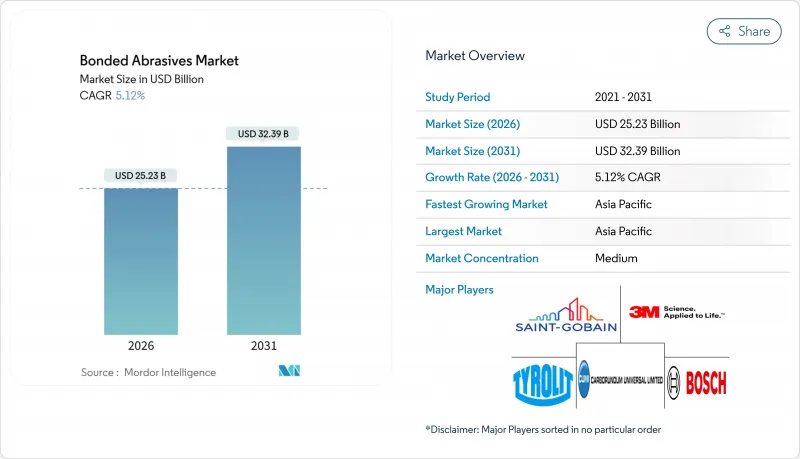
본 보고서는 결합제 유형(유리질 결합, 수지 결합, 고무 결합, 기타), 재료 유형(알루미늄 산화물, 붕소 탄화물, 실리콘 탄화물, 기타), 최종 사용자 산업(자동차, 항공우주, 전기 및 전자, 기타),지역(아시아태평양, 북미, 유럽, 남미, 중동 및 아프리카)별로 세분화되어 있습니다. 시장 전망은 금액(달러) 기준으로 제시되어 있습니다.
전 세계 결합 연마재 시장 동향 및 인사이트
아시아의 인프라 주도형 금속 가공 붐
인도가 2024 회계연도에 전년 대비 13.4% 증가한 1억 4,430만 톤을 생산한 데 더해, 베트남과 인도네시아의 신규 생산 능력 확충으로 인해 건설 프로젝트용 평강 생산량이 증가하고 있어, 이 지역의 철강 생산량은 상승 추세를 보이고 있습니다. 철강 생산량 증가는 빌렛 연삭, 구조용 보의 마감 가공, 철근 절단 증가를 의미하며, 이러한 요인들이 결합 연마재 시장 수요를 직접적으로 끌어올리고 있습니다. 중국 제철소의 가동률은 둔화 추세를 보이고 있지만, 우드맥켄지(Wood Mackenzie)는 2031년까지 인도, 태국, 필리핀이 생산량을 흡수하여 휠 소비가 남쪽으로 이동할 것으로 예측했습니다. 일본과 한국은 반도체 웨이퍼 및 미세 마감 작업용 CBN 및 다이아몬드 휠의 주요 구매국으로 남아 있어, 안정적인 프리미엄 틈새 시장의 존재를 뒷받침하고 있습니다. 각국 정부는 인프라 예산을 지하철, 항만 준설, 교량 확장에 투입하고 있으며, 이로 인해 알루미늄 산화물 휠에 대한 다년간의 수주가 확보되고 있습니다. 그 결과, 세계 및 현지 생산자 모두에게 장기적인 수익 전망이 명확해지고 있습니다.
25m/s를 초과하는 고속 연삭 라인을 실현하는 레지노이드 휠
자동차용 크랭크샤프트나 항공우주용 터빈 가공에서는 비트리파이드 휠이 안전하게 견딜 수 없는 주속으로 가동되는 경우가 늘어나고 있어, 탄성 페놀 매트릭스를 사용한 수지 결합 휠이 선호되고 있습니다. 검토를 거친 검사 결과에 따르면, 수지 결합 다이아몬드 휠은 제조 공정에서 125m/s를 견디며, 사이클 타임을 30% 단축하고 니켈 초합금의 열영향부를 감소시키는 것으로 나타났습니다. 따라서 항공우주 OEM 각사는 Ra <=0.4 마이크로미터의 표면 거칠기를 유지하면서 마무리 가공 횟수를 줄이고 있습니다. 전기자동차용 모터 샤프트에는 5 마이크로미터 이내의 진원도가 요구되지만, 이 공차는 내충격성이 있는 수지 휠을 사용함으로써 달성하기 쉬워집니다. 자동차 산업의 1차 공급업체들은 이러한 휠을 도입함으로써 샤프트 1개당 60초 이하의 택트 타임을 달성하고, 처리량을 확보하고 있습니다. 회전 속도가 여전히 상승하고 있는 가운데, 수요의 탄력성으로 인해 ISO 21940의 버스트 검사 기준에 따라 휠 인증을 취득할 수 있는 공급업체가 유리한 입장에 있습니다.
탄소세 적용 대상인 에너지 집약형 소성로
유리화 휠은 1,200℃ 이상에서 소성되며, 1톤당 3-5MWh의 전력을 소비하고 다량의 CO2를 배출합니다. 유럽연합 집행위원회는 2030년까지 배출량을 55% 감축할 것을 의무화하고 있으며, 세라믹 공장은 각각 1,000만 유로 이상의 비용이 드는 전기 가마 또는 수소 가마로 개조해야만 합니다. 미국의 산업 정책에서는 전기 소성로에 대한 세액 공제가 제공되고 있지만, 소규모 생산 업체의 경우 여전히 800만-1,200만 달러의 초기 투자가 필요합니다. 중국의 ‘이중 규제’에 따른 배출 상한선으로 인해, 이미 허난성과 산둥성의 공장들은 성수기 생산량을 줄일 수밖에 없게 되었으며, 휠의 납기 기간이 8주로 늘어났습니다. 에너지 추가 요금의 상승은 영업이익률을 압박하고, 생산 능력 확충을 지연시킬 가능성이 있으며, 비트리파이드 제품이 주류를 차지하는 결합 연마재 시장의 확장을 둔화시킬 우려가 있습니다.
부문별 분석
2025년, 비트리파이드 결합제는 결합 연마재 시장에서 58.06%의 점유율을 확보하고, 2031년까지 연평균 성장률(CAGR) 5.49%를 나타낼 것으로 예측됩니다. 견고하고 다공성인 구조는 강한 법선력이 가해져도 내소손성을 발휘하여 크랭크샤프트, 캠샤프트, 터빈 블레이드의 형태를 유지합니다. 또한, 비트리파이드 결합제의 다양한 유형을 통해 공정 내 조정이 가능하며, 장시간 연속 생산 시에도 표면 품질을 일정하게 유지할 수 있습니다. Chalmers Grinding 4.0과 같은 조사 파트너십을 통해 드레싱 간격을 예측함으로써 부품당 공구 비용을 절감하고 휠 이용률을 15포인트 향상시키고 있습니다.
200℃ 미만에서 경화되는 수지 결합은 탄성 매트릭스가 충격을 흡수하여 치명적인 파열을 억제하는 고속 용도에서 주목받고 있습니다. 자동차 EV 생산 라인에서는 주속 80m/s를 초과하는 모터 샤프트 연삭에서 그 내구성이 높이 평가되고 있습니다. 고무 결합은 시장 점유율이 한 자릿수 수준으로 틈새 시장이지만, 진동 감쇠를 통해 마감 정밀도가 향상되는 얇은 절삭 디스크나 센터리스 연삭 분야에서 여전히 필수적인 존재입니다. 또한, 금속 결합제나 셸락 결합제는 초정밀 광학 분야에서 사용되며, 다양한 결합 연마재 시장을 보완하고 있습니다.
지역별 분석
아시아태평양은 2025년에 결합 연마재 시장 매출의 56.48%를 차지할 것으로 예상되며, 2031년까지 연평균 성장률(CAGR) 5.71%로 성장할 것으로 전망되는데, 이는 전 세계에서 가장 빠른 성장 속도입니다. 인도는 주요 소비국으로, 2024년 조강 생산량은 13.4% 증가한 1억 4,430만 톤에 달했습니다. 또한, 얇은 휠 및 실리콘 카바이드 휠 생산 라인에 대한 설비 투자는 해당 국가 수요 증가를 뒷받침하고 있습니다. 타이롤리트(Tyloritt)사의 푸네 신공장은 CBN 및 다이아몬드 휠에 대한 지역적 접근성을 강화하고, 유럽에서의 운송 시간을 2주로 단축하고 있습니다. 동남아시아에서는 교량 및 철도 회랑에 대한 공공 자금이 투입되고 있어, 구조용 강재에 사용되는 비용 효율이 뛰어난 알루미늄 산화물 휠에 대한 수요를 견인하고 있습니다. 일본과 한국은 CBN 및 다이아몬드 연마재에 의존하는 반도체 웨이퍼 연삭 분야의 프리미엄 틈새 시장을 점유하고 있습니다.
북미에서는 항공우주 산업의 국내 복귀가 CBN 수요를 자극하고 있지만, 탄소세와 높은 전기 요금이 비트리파이드 휠의 생산 비용을 상승시키고 있습니다. 미국 에너지부(DOE)의 세액 공제로 인해 가마의 전기화가 촉진되고 있지만, 투자에 필요한 규모를 달성할 수 있는 것은 대규모 공장에 한정되어 있습니다. 용융 알루미나 수입의 91%가 중국산이기 때문에 관세 위험은 여전히 심각하며, 호주나 가이아나를 통한 대체 공급망 구축이 요구되고 있습니다.
유럽도 북미와 유사한 과제에 직면해 있습니다. EU의 ‘산업용 탄소 관리 전략’에 따라 2030년까지 CO2 배출량을 55% 감축해야 하므로, Saint-Gobain사는 프랑스에서 수소 가마의 시험 운영을 진행 중이며, 한편 이탈리아의 중견 제조업체들은 LNG에서 전력으로의 전환을 검토하고 있습니다. 독일, 이탈리아, 프랑스는 합쳐서 자동차 및 항공우주 부문의 연마량을 뒷받침하고 있지만, 비용 압박으로 인해 다운스트림 공정의 기계 가공 일부가 동유럽으로 이동하고 있습니다.
남미, 중동 및 아프리카를 합쳐도 결합 연마재 시장의 매출액은 낮은 수준에 머물러 있습니다. 브라질의 자동차 조립 공장에서는 여전히 비트리파이드 알루미늄 산화물 휠을 사용하여 크랭크샤프트를 연마하고 있는 반면, 사우디아라비아의 인프라 프로젝트에서는 파이프라인 제조용 절단 디스크가 구매되고 있습니다. 남아프리카의 광산 사업에서는 마감 품질보다 휠의 수명이 우선시되는 드릴 비트 연마에 수지 결합 휠이 사용되고 있습니다.
기타 혜택
- 엑셀 형식 시장 예측(ME) 시트
- 3개월간의 애널리스트 지원
자주 묻는 질문
목차
제1장 서론
제2장 조사 방법
제3장 주요 요약
제4장 시장 구도
제5장 시장 규모와 성장 예측
제6장 경쟁 구도
제7장 시장 기회와 향후 전망
LSH 26.08.26According to Mordor Intelligence, the bonded abrasives market size is estimated at USD 25.23 billion in 2026, and is expected to reach USD 32.39 billion by 2031, at a CAGR of 5.12% during the forecast period (2026-2031).
This report is Segmented by Bond Type (Vitrified Bond, Resin Bond, Rubber Bond, and Others), Material Type (Aluminum Oxide, Boron Carbide, Silicon Carbide, and Others), End-User Industry (Automotive, Aerospace, Electrical and Electronics, and Others), and Geography (Asia-Pacific, North America, Europe, South America, and Middle-East and Africa). The Market Forecasts are Provided in Terms of Value (USD).
Global Bonded Abrasives Market Trends and Insights
Infrastructure-Led Metal-Working Boom in Asia
Regional steel output is rising as India produced 144.3 million t in fiscal 2024, up 13.4% year on year, while new capacity in Vietnam and Indonesia adds flat-rolled output for construction projects. More steel means more billet grinding, structural-beam finishing, and rebar cutting, which directly lifts bonded abrasives market demand. Chinese mill utilization is softening, yet Wood Mackenzie expects India, Thailand, and the Philippines to absorb volume through 2031, shifting wheel consumption southward. Japan and South Korea remain buyers of CBN and diamond wheels for semiconductor wafer and micro-finishing work, underscoring a stable premium niche. Governments channel infrastructure budgets into metro rail, port dredging, and bridge expansion, locking in multi-year orders for aluminum-oxide wheels. The result is predictable long-cycle revenue visibility for both global and local producers.
Resinoid Wheels Supporting greater than 25 m/s Grinding Lines
Automotive crankshaft and aerospace turbine machining increasingly runs at peripheral speeds that vitrified wheels cannot safely withstand, so resin bonds with elastic phenolic matrices are preferred. Peer-reviewed trials show resin-bond diamond wheels sustain 125 m/s in production, slashing cycle time by 30% and reducing heat-affected zones on nickel superalloys. Aerospace OEMs therefore cut finishing passes while maintaining Ra <= 0.4 µm surface finishes. Electric-vehicle motor shafts require roundness within 5 µm, a tolerance easier to hit with shock-resistant resin wheels. Automotive tier-1 suppliers deploy these wheels to hit takt times below 60 s per shaft, protecting throughput. With peripheral speeds still climbing, demand elasticity favors suppliers able to certify wheels under ISO 21940 burst-test criteria.
Energy-Intensive Firing Furnaces and Carbon Taxes
Vitrified wheels fire above 1,200 °C, consuming 3-5 MWh per tonne and emitting significant CO2. The European Commission requires 55% emissions cuts by 2030, obliging ceramic plants to retrofit electric or hydrogen kilns that each cost more than EUR 10 million. U.S. industrial policy offers tax credits for electrified furnaces, yet smaller producers still face USD 8-12 million up-front capital. Chinese dual-control caps have already forced Henan and Shandong operations to curtail peak-season output, lengthening wheel lead times to eight weeks. Higher energy surcharges narrow operating margins and could delay capacity additions, moderating bonded abrasives market expansion where vitrified products dominate.
Other drivers and restraints analyzed in the detailed report include:
- Precision Ceramics and CBN for EV Powertrains
- AI-Driven Tool-Room Automation
- Ti-Oxide and Phenolic-Resin Price Volatility greater than 18% YoY
For complete list of drivers and restraints, kindly check the Table Of Contents.
Segment Analysis
Vitrified bond secured 58.06% bonded abrasives market share in 2025 and is projected to register a 5.49% CAGR to 2031. Its rigid, porous structure resists burn and preserves geometry on crankshafts, camshafts, and turbine blades even under heavy normal forces. Vitrified variants also enable in-process conditioning that keeps surface integrity consistent during long production runs. Research partnerships such as Chalmers Grinding 4.0 lower tool cost per part by predicting dressing intervals, improving wheel utilization by 15 pp.
Resin bonds, cured below 200 °C, are capturing high-speed applications where elastic matrices absorb shock and limit catastrophic bursts. Automotive EV lines value that resilience for motor shaft grinding at peripheral speeds above 80 m/s. Rubber bonds, while niche at single-digit share, remain essential for thin cutting disks and centerless grinding where vibration damping improves finish. Metal and shellac bonds fill ultra-precision optics roles, rounding out a diverse bonded abrasives market.
Complete Report Scope:
- By Bond Type
- Vitrified Bond
- Resin Bond
- Rubber bond
- Others
- By Material Type
- Aluminum Oxide
- Boron Carbide
- Silicon Carbide
- Others
- By End-user Industry
- Automotive
- Aerospace
- Medical
- Electrical and Electronics
- Industrial Machinery
- Others (Furniture, Building and Construction, Etc.)
- By Geography
- Asia-Pacific
- China
- India
- Japan
- South Korea
- ASEAN Countries
- Rest of Asia-Pacific
- North America
- United States
- Canada
- Mexico
- Europe
- Germany
- United Kingdom
- Italy
- France
- Spain
- NORDIC Countries
- Rest of Europe
- South America
- Brazil
- Argentina
- Rest of South America
- Middle-East and Africa
- Saudi Arabia
- South Africa
- Rest of Middle-East and Africa
- Asia-Pacific
Geography Analysis
Asia-Pacific commanded 56.48% bonded abrasives market revenue in 2025 and is forecast for a 5.71% CAGR to 2031, the quickest global pace. India is the swing consumer as crude steel output rose 13.4% to 144.3 million t in 2024, and capital spending on thin-wheel and silicon-carbide lines underscores local appetite. Tyrolit's new Pune plant strengthens regional access to CBN and diamond wheels, shrinking freight time from Europe to two weeks. Southeast Asia funnels public funds into bridges and rail corridors, pulling demand for cost-effective aluminum-oxide wheels on structural steel. Japan and South Korea hold premium niches in semiconductor wafer grinding, reliant on CBN and diamond grains.
In North America, aerospace reshoring stimulates CBN demand, yet carbon taxes and high electricity tariffs raise vitrified production costs. DOE tax credits encourage kiln electrification, but only large plants achieve the scale to invest. Tariff exposure remains acute because 91% of fused alumina imports originate in China, motivating alternative supply chains from Australia and Guyana.
Europe mirrors North American challenges. The EU Industrial Carbon Management strategy compels 55% CO2 reductions by 2030, so Saint-Gobain pilots hydrogen kilns in France while midsized Italian manufacturers weigh LNG-to-electric transitions. Germany, Italy, and France together sustain automotive and aerospace grinding volumes, but cost pressures shift some downstream machining to Eastern Europe.
South America and Middle East and Africa together represent low bonded abrasives market revenue. Brazil's vehicle assembly plants still grind crankshafts with vitrified aluminum-oxide wheels, while Saudi Arabian infrastructure projects buy cutting disks for pipeline fabrication. South African mining operations use resin-bond wheels for drill-bit sharpening where wheel life outweighs finish requirements.
- 3M
- Asahi Diamond Industrial (ADI)
- August Ruggeberg GmbH & Co. KG
- CUMI
- Fujimi Incorporated.
- Henan Huanghe Whirlwind CO.,Ltd.
- Hermes Schleifmittel GmbH
- Klingspor India Pvt. Ltd.
- Marrose Abrasives
- Mirka Ltd
- Osborn (DRONCO)
- Precision Abrasives Pvt. Ltd.
- Rhodius
- Robert Bosch Power Tools GmbH
- Saint-Gobain
- SAK ABRASIVES LIMITED
- Tyrolit AG
- VSM AG
- Weiler Abrasives
Additional Benefits:
- The market estimate (ME) sheet in Excel format
- 3 months of analyst support
TABLE OF CONTENTS
1 Introduction
- 1.1 Study Assumptions and Market Definition
- 1.2 Scope of the Study
2 Research Methodology
3 Executive Summary
4 Market Landscape
- 4.1 Market Overview
- 4.2 Market Drivers
- 4.2.1 Infrastructure-Led Metal-Working Boom in Asia
- 4.2.2 Resinoid Wheels Enabling greater than 25 M/S High-Speed Grinding Lines
- 4.2.3 Shift To Precision Ceramics and CBN Grains in EV Power-Trains
- 4.2.4 AI-Driven Tool-Room Automation (Self-Sharpening Set-Ups)
- 4.2.5 Re-Shoring of US/EU Aerospace Machining Capacity
- 4.3 Market Restraints
- 4.3.1 Energy-Intensive Firing Furnaces Facing Carbon Taxes
- 4.3.2 Ti-Oxide And Phenolic-Resin Price Volatility greater than 18 % YoY
- 4.3.3 Stricter PM2.5 Limits in India and China Grinding Shops
- 4.4 Value Chain Analysis
- 4.5 Porter's Five Forces
- 4.5.1 Threat of New Entrants
- 4.5.2 Bargaining Power of Suppliers
- 4.5.3 Bargaining Power of Buyers
- 4.5.4 Threat of Substitutes
- 4.5.5 Competitive Rivalry
5 Market Size and Growth Forecasts (Value)
- 5.1 By Bond Type
- 5.1.1 Vitrified Bond
- 5.1.2 Resin Bond
- 5.1.3 Rubber bond
- 5.1.4 Others
- 5.2 By Material Type
- 5.2.1 Aluminum Oxide
- 5.2.2 Boron Carbide
- 5.2.3 Silicon Carbide
- 5.2.4 Others
- 5.3 By End-user Industry
- 5.3.1 Automotive
- 5.3.2 Aerospace
- 5.3.3 Medical
- 5.3.4 Electrical and Electronics
- 5.3.5 Industrial Machinery
- 5.3.6 Others (Furniture, Building and Construction, Etc.)
- 5.4 By Geography
- 5.4.1 Asia-Pacific
- 5.4.1.1 China
- 5.4.1.2 India
- 5.4.1.3 Japan
- 5.4.1.4 South Korea
- 5.4.1.5 ASEAN Countries
- 5.4.1.6 Rest of Asia-Pacific
- 5.4.2 North America
- 5.4.2.1 United States
- 5.4.2.2 Canada
- 5.4.2.3 Mexico
- 5.4.3 Europe
- 5.4.3.1 Germany
- 5.4.3.2 United Kingdom
- 5.4.3.3 Italy
- 5.4.3.4 France
- 5.4.3.5 Spain
- 5.4.3.6 NORDIC Countries
- 5.4.3.7 Rest of Europe
- 5.4.4 South America
- 5.4.4.1 Brazil
- 5.4.4.2 Argentina
- 5.4.4.3 Rest of South America
- 5.4.5 Middle-East and Africa
- 5.4.5.1 Saudi Arabia
- 5.4.5.2 South Africa
- 5.4.5.3 Rest of Middle-East and Africa
- 5.4.1 Asia-Pacific
6 Competitive Landscape
- 6.1 Market Concentration
- 6.2 Strategic Moves
- 6.3 Market Share/Ranking Analysis
- 6.4 Company Profiles {(includes Global level Overview, Market level overview, Core Segments, Financials as available, Strategic Information, Market Rank/Share for key companies, Products and Services, and Recent Developments)}
- 6.4.1 3M
- 6.4.2 Asahi Diamond Industrial (ADI)
- 6.4.3 August Ruggeberg GmbH & Co. KG
- 6.4.4 CUMI
- 6.4.5 Fujimi Incorporated.
- 6.4.6 Henan Huanghe Whirlwind CO.,Ltd.
- 6.4.7 Hermes Schleifmittel GmbH
- 6.4.8 Klingspor India Pvt. Ltd.
- 6.4.9 Marrose Abrasives
- 6.4.10 Mirka Ltd
- 6.4.11 Osborn (DRONCO)
- 6.4.12 Precision Abrasives Pvt. Ltd.
- 6.4.13 Rhodius
- 6.4.14 Robert Bosch Power Tools GmbH
- 6.4.15 Saint-Gobain
- 6.4.16 SAK ABRASIVES LIMITED
- 6.4.17 Tyrolit AG
- 6.4.18 VSM AG
- 6.4.19 Weiler Abrasives
7 Market Opportunities and Future Outlook
- 7.1 White-space and Unmet-need Assessment