|
시장보고서
상품코드
2114465
항공기 나셀 시스템 시장 : 시장 점유율 분석, 업계 동향 및 통계, 성장 예측(2026-2031년)Aircraft Nacelle Systems - Market Share Analysis, Industry Trends & Statistics, Growth Forecasts (2026 - 2031) |
||||||
 Mordor Intelligence
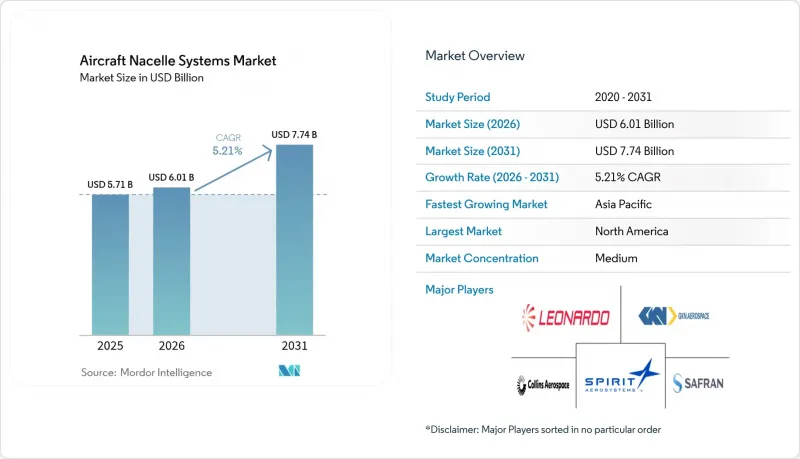
Mordor Intelligence에 의하면, 항공기 나셀 시스템 시장 규모는 2025년 57억 1,000만 달러로 평가되었고, 2026년에는 60억 1,000만 달러로 추정되고, 2026-2031년 CAGR 5.21%로 성장을 지속할 전망이며, 2031년까지 77억 4,000만 달러에 이를 것으로 예측됩니다.
본 보고서는 구성 부품별(인렛 카울, 팬 카울, 추력 역전 장치, 배기 시스템, 기타), 항공기 유형별(민간 항공, 군용 항공, 일반 항공), 엔진 유형별(터보팬, 터보프롭), 최종 사용자별(OEM, 애프터마켓), 지역별(북미, 유럽, 아시아태평양, 기타)로 분류되어 있습니다. 시장 예측은 금액(달러) 기준으로 제시되어 있습니다.
세계의 항공기 나셀 시스템 시장 동향 및 인사이트
연비 효율이 뛰어난 차세대 항공기에 대한 관심이 높아지고 있습니다.
각 항공사가 연료 소비량 감축에 즉각적으로 나서고 있는 만큼, CFM LEAP-1A 및 LEAP-1B와 같은 엔진의 경우, 더 큰 팬 직경, 더 높은 바이패스 비율, 그리고 15-20% 낮은 비연료 소비량을 충족할 수 있는 나셀 설계가 요구되고 있습니다. 중량 증가 문제는 강성을 저해하지 않으면서 항공기 1대당 20-25kg의 경량화를 실현하는 수지 주입형 탄소섬유 배럴의 보급으로 해소되고 있습니다. 또한, 음향 라이너에는 미세 천공 페이스 시트와 단계적 허니컴 코어가 통합되어 있어, 음조 소음의 피크를 최대 3dB 저감함으로써 A320neo 및 B737 MAX 제품군에서 제14장 규정을 준수하고 있습니다. 수요의 지속성은 보잉사가 2026년 하반기 이후 B737 MAX의 월간 생산 대수를 50대 이상으로 늘릴 계획을 세우고 있다는 점에서도 분명하며, 이로 인해 나셀 공급업체에게는 향후 5년간의 전망이 확고해졌습니다. 연료 효율에 관한 규제는 군용 급유기 및 수송기의 업그레이드에도 적용되어, 민간 항공기 기단에 더해 추가적인 수요 증가가 예상됩니다.
진행 중인 기체 현대화와 증가하는 단일 통로기 미인도 주문
미인도 주문에 대한 압박은 여전히 심각합니다. 에어버스에 따르면, 2025년 중반 시점에서 미인도 주문은 8,754건에 달하며, 그 중 82%가 A220/A320 시리즈에 집중되어 있어, 현재 생산 속도로는 향후 8년 분 이상의 생산량에 해당합니다. A320neo 1대당 납품 세트에는 약 100만 달러 상당의 나셀 하드웨어가 필요하며, 생산 확대가 안정화되면 공급업체에 막대한 지속적인 수익이 창출될 것입니다. 아시아태평양의 항공사, 특히 인디고(Indigo)는 최대 100대의 A350 구매권을 확보하고 있으며, 이는 와이드바디 기종의 교체도 가속화되고 있음을 시사합니다. 엔진 부족으로 인한 납기 지연은 수주와 생산 간의 격차를 확대하여, 대량 생산 프로그램에서 생산 할당량의 전략적 가치를 높이고 있습니다.
막대한 설비 투자와 금형 비용
차세대 추력 반전 장치용 캐스케이드 금형 일체의 제조 비용은 1,200만 달러를 초과하며, A320neo의 팬 카울에 대응하는 오토클레이브 라인에는 추가로 2,500만 달러의 비용이 소요됩니다. 헥셀사의 2024년 설비 투자액 8,700만 달러는 주로 수지 사출 성형기와 사내용 비파괴 검사(NDI) 시스템 도입에 사용되었으나, OEM 측의 비용 절감 압박으로 인해 선체 세트 가격이 억제되고 있어,투자 회수 기간은 5-7년에 달할 것으로 전망됩니다. 소규모 Tier 2 제조업체들은 대개 세일 앤 리스백을 통해 자금을 조달하고 있으며, 이로 인해 실질적인 차입 비용이 150-200 베이시스 포인트 상승합니다. 각 OEM 업체들이 공급 충격에 대비해 듀얼 소싱을 요구하고 있기 때문에 일부 공급업체는 서로 다른 대륙에 생산 능력을 중복으로 구축할 수밖에 없으며, 수주량이 보장되지 않았음에도 불구하고 초기 투자를 두 배로 늘릴 수밖에 없는 상황에 처해 있습니다.
부문 분석
2025년, 추력 반전 장치는 안전상 매우 중요한 역할과 엔진 제어 로직과의 통합에 힘입어 항공기 나셀 시스템 시장의 31.12%를 차지했습니다. 시장 규모는 작지만, 인렛 카울은 가변 형상 립과 저소음 라이너를 결합할 수 있는 공급업체를 항공사가 높이 평가하고 있어, 2031년까지 5.64%라는 가장 높은 연평균 성장률(CAGR)을 나타낼 전망입니다. 탈착식 방음 패널이나 적층 가공된 립을 합리화하는 공급업체는 특히 이번 10년 동안 납품의 주류를 이룰 것으로 예상되는 엔진 교체된 나로우바디 항공기에서 시장 점유율을 확대될 전망입니다.
팬 카울과 배기 시스템은 기체 생산과 연동된 안정적인 수요를 유지하고 있지만, 인렛 카울만큼 적극적인 재설계 주기에 직면해 있지는 않습니다. 복합재의 내열 영역과 금속 유로의 융합이 진행되고, 비용 압박이 심화되는 환경 속에서 유지보수 비용을 절감하면서도 이익률을 유지하는 것을 목표로 하고 있습니다. 경계층 흡입의 등장으로 인렛 설계의 복잡성은 더욱 높아지고 있으며, 공급업체의 투자는 플러터를 유발하지 않으면서 왜곡된 유동 입구를 관리할 수 있는 경량이며 구조적 강성이 높은 인렛 덕트로 향하고 있습니다.
2025년에는 상업용 항공기 프로그램이 매출의 대부분을 차지하여 항공기 나셀 시스템 시장의 57.30%를 차지했습니다. A320neo와 B737 MAX가 주도하는 협폭기(narrow-body)는 타의 추종을 불허하는 생산 속도를 유지하고 있으며, 그 결과 나셀 출하량의 대부분을 차지하고 있습니다. 한편, 일반 항공 분야에서는 신형 비즈니스 제트기의 도입과 소형화된 나셀 기술을 활용한 초기 단계의 eVTOL 프로토타입에 힘입어 연평균 성장률(CAGR) 5.78%를 나타낼 것으로 예측됩니다. 비즈니스 제트기 분야의 항공기 나셀 시스템 시장 규모는 걸프스트림 G700 및 봄바르디아 세계 7500의 도입에 따라 확대될 것으로 예측됩니다.
와이드바디 항공기의 나셀은 대당 가치가 가장 높으며, 에어버스는 2028년까지 A350의 월간 생산 대수를 12대로 늘리는 것을 목표로 하고 있습니다. 지역 제트기 및 군용 수송기는 수량은 적지만 안정적인 수요를 창출하고 있으며, 이로 인해 공급업체의 수익원이 다각화되고 상업 주기의 변동이 완화되고 있습니다.
지역별 분석
북미는 보잉사의 생산 회복과 긴밀한 애프터마켓 네트워크 덕분에 2025년 수익의 38.30%를 차지했습니다. 2025년 5월 FAA가월42대 생산을 승인함에 따라 B737 MAX의 생산이 즉시 나셀 수주를 끌어올렸습니다. 스피릿 에어로시스템즈의 ‘펄 10X’ 나셀 계약과 콜린스 에어로스페이스 및 제트제로 간의 블렌디드 윙 바디(Blended Wing Body) 협력은 이 지역에서의 혁신의 중요성을 반영하고 있습니다.
아시아태평양은 중국, 인도, 동남아시아가 항공기 대수를 확대하고 항공기 구조물의 현지 생산을 추진함에 따라 2031년까지 연평균 성장률(CAGR) 5.62%로 업계를 주도할 것으로 예측됩니다. 인디고가 최대 100대의 A350에 대한 구매권을 확보한 것은 이 지역에서 와이드바디기에 대한 수요가 왕성함을 뒷받침합니다. 사프란이 힌두스탄 에어로노틱스 리미티드와 제휴하여 인도에서 LEAP 부품을 생산하는 것은 확고한 입지를 가진 공급업체가 신흥 공급망에 통합되고 있음을 보여줍니다.
유럽은 에어버스, 사프란, GKN과 같은 최고 수준의 벤더를 핵심으로 하여 여전히 주요 공급업체 거점으로서의 지위를 유지하고 있습니다. ‘클린 에이비에이션(Clean Aviation)’이 자금을 지원한 하이브리드 전기식 프로토타입을 통해, 유럽 대륙의 연구개발은 저항이 적고 소음이 적은 나셀 개발에 계속해서 주력하고 있습니다. 에어버스가 2027년까지 월 75대의 A320 계열 항공기를 생산하겠다는 목표는 생산량의 안정성을 뒷받침하고 있습니다. EASA의 규제 강화, 특히 소음 관련 규제는 전 세계 설계 기준을 선도하고 있습니다.
기타 혜택 :
- 엑셀 형식 시장 예측(ME) 시트
- 3개월간의 애널리스트 지원
자주 묻는 질문
목차
제1장 서론
제2장 조사 방법
제3장 주요 요약
제4장 시장 구도
제5장 시장 규모 및 성장 예측
제6장 경쟁 구도
제7장 시장 기회 및 향후 전망
AJY 26.08.26According to Mordor Intelligence, the aircraft nacelle systems market size is expected to grow from USD 5.71 billion in 2025 to USD 6.01 billion in 2026 and is forecast to reach USD 7.74 billion by 2031 at 5.21% CAGR over 2026-2031.
This report is Segmented by Component (Inlet Cowl, Fan Cowl, Thrust Reverser, Exhaust System, and Others), Aircraft Type (Commercial Aviation, Military Aviation, and General Aviation), Engine Type (Turbofan and Turboprop), End User (OEM and Aftermarket), and Geography (North America, Europe, Asia-Pacific, and More). The Market Forecasts are Provided in Terms of Value (USD).
Global Aircraft Nacelle Systems Market Trends and Insights
Growing Emphasis on Fuel-Efficient and Next-Generation Aircraft
Airlines' immediate focus on cutting fuel burn translates into nacelle designs that handle larger fan diameters, higher bypass ratios, and 15-20% lower specific fuel consumption for engines such as CFM LEAP-1A and LEAP-1B. Weight penalties are countered through broader use of resin-infused carbon-fiber barrels that trim 20 to 25 kg per ship-set without compromising stiffness. Acoustic liners now integrate micro-perforated face-sheets and graded honeycomb cores to curb tonal noise peaks by up to 3 dB, ensuring Chapter 14 compliance on the A320neo and B737 MAX families. Sustained demand is evidenced by Boeing's plan to surpass 50 B737 MAX units per month after 2H 2026, locking in five-year visibility for nacelle suppliers. Fuel-efficiency mandates extend to military tanker and transport upgrades, adding incremental volume beyond commercial fleets.
Ongoing Fleet Modernization and Rising Single-Aisle Backlog
Backlog pressures remain acute, as Airbus counted 8,754 open orders by mid-2025-82% concentrated in the A220/A320 lines-translating to more than eight years of forward production at current build rates. Each A320neo ship-set requires roughly USD 1 million worth of nacelle hardware, giving suppliers high-volume recurring revenue once ramp-ups stabilize. Asia-Pacific airlines, notably IndiGo, are securing purchase rights for up to 100 A350 jets, signaling that widebody replacement is also gathering pace. Deferred deliveries owing to engine shortages widen the delta between orders and production, making slots on high-volume programs strategically valuable.
High Capital Investment and Tooling Costs
Fabricating a next-generation thrust-reverser cascade tool set exceeds USD 12 million, while autoclave lines sized for A320neo fan cowls can cost another USD 25 million. Hexcel's 2024 capex of USD 87 million mainly financed resin-injection machines and in-house NDI systems, yet payback horizons stretch 5-7 years because ship-set pricing remains under OEM cost-down pressure. Smaller tier-2 shops often finance through sale-leasebacks that raise effective borrowing costs by 150-200 basis points. As OEMs demand dual-sourcing to buffer supply shocks, some suppliers must duplicate capacity on separate continents, doubling upfront spend without guaranteed volumes.
Other drivers and restraints analyzed in the detailed report include:
- Ramp-Up in Production Rates by Airbus and Boeing
- Stricter Airport Noise Regulations
- Stringent FAA and EASA Certification Requirements
For complete list of drivers and restraints, kindly check the Table Of Contents.
Segment Analysis
Thrust reversers held 31.12% of the aircraft nacelle systems market in 2025, buoyed by their safety-critical role and integration with engine-control logic. Although smaller in value, inlet cowls are on track for the fastest 5.64% CAGR through 2031 as carriers reward suppliers that can marry variable-geometry lips with low-noise liners. Suppliers that streamline removable acoustic panels and additive-manufactured lips stand to grow share, especially on re-engined narrowbodies expected to dominate deliveries this decade.
Fan cowls and exhaust systems still command steady demand that shadows airframe production, yet they face less aggressive redesign cycles than inlet cowls. Composite hot zones and metallic flow paths continue to converge, targeting reduced maintenance while defending margins in a cost-pressured environment. The emergence of boundary-layer ingestion further heightens inlet design complexity, steering supplier investment into lightweight, structurally stiff inlet ducts capable of managing distorted in-flow fields without inducing flutter.
Commercial programs delivered the bulk of revenue in 2025, accounting for 57.30% of the aircraft nacelle systems market. Narrowbodies, led by the A320neo and B737 MAX, sustain unmatched build-rates and thus the lion's share of nacelle shipments. Meanwhile, general aviation is expected to clock a 5.78% CAGR, supported by fresh business jet introductions and early eVTOL prototypes that leverage scaled-down nacelle technologies. The aircraft nacelle systems market size for the business jet niche is predicted to climb alongside Gulfstream G700 and Bombardier Global 7500 roll-outs.
Widebody nacelles have the greatest per-unit value, with Airbus striving to increase A350 output to 12 aircraft per month by 2028. Regional jets and military transports supply steady, albeit lower-volume demand that diversifies supplier revenue and smooths commercial cycle volatility.
Complete Report Scope:
- By Component
- Inlet Cowl
- Fan Cowl
- Thrust Reverser
- Exhaust System
- Others
- By Aircraft Type
- Commercial Aviation
- Narrowbody Aircraft
- Widebody Aircraft
- Regional Jets
- Military Aviation
- Combat Aircraft
- Transport Aircraft
- Special Mission Aircraft
- Others
- General Aviation
- Business Jets
- Others
- Commercial Aviation
- By Engine Type
- Turbofan
- Turboprop
- By End User
- Original Equipment Manufacturer (OEM)
- Aftermarket
- By Geography
- North America
- United States
- Canada
- Mexico
- Europe
- United Kingdom
- France
- Germany
- Italy
- Spain
- Rest of Europe
- Asia-Pacific
- China
- India
- Japan
- South Korea
- Australia
- Rest of Asia-Pacific
- South America
- Brazil
- Rest of South America
- Middle East and Africa
- Middle East
- United Arab Emirates
- Saudi Arabia
- Rest of Middle East
- Africa
- South Africa
- Rest of Africa
- Middle East
- North America
Geography Analysis
North America controlled 38.30% of 2025 revenue due to Boeing's production rebound and dense aftermarket networks. FAA clearance in May 2025 for 42 units per month, B737 MAX output immediately lifted the nacelle order flow. Spirit AeroSystems' Pearl 10X nacelle contract and Collins Aerospace's blended wing body partnership with JetZero reflect the region's innovation weight.
Asia-Pacific is predicted to pace the field with a 5.62% CAGR through 2031 as China, India, and Southeast Asia scale fleets and localize aerostructure work. IndiGo's purchase rights for up to 100 A350s underline the region's widebody appetite. Safran's tie-up with Hindustan Aeronautics Limited to manufacture LEAP parts in India shows established suppliers embedding within emerging supply chains.
Europe remains a pillar supplier hub anchored by Airbus and top-tier vendors like Safran and GKN. Clean-Aviation-funded hybrid-electric prototypes keep continental R&D centered on low-drag, low-noise nacelles. Airbus' target of 75 A320-family jets a month by 2027 underwrites volume stability. Regulatory rigor from EASA, particularly on acoustics, steers global design baselines.
- Safran SA
- Collins Aerospace (RTX Corporation)
- Spirit AeroSystems, Inc.
- GKN Aerospace Services Limited (Melrose Industries plc)
- Leonardo S.p.A.
- The NORDAM Group LLC
- Barnes Group Inc.
- FACC AG
- Triumph Group, Inc.
- Singapore Technologies Engineering Ltd.
- AAR CORP.
- Ducommun Incorporated
Additional Benefits:
- The market estimate (ME) sheet in Excel format
- 3 months of analyst support
TABLE OF CONTENTS
1 INTRODUCTION
- 1.1 Study Assumptions and Market Definition
- 1.2 Scope of the Study
2 RESEARCH METHODOLOGY
3 EXECUTIVE SUMMARY
4 MARKET LANDSCAPE
- 4.1 Market Overview
- 4.2 Market Drivers
- 4.2.1 Growing emphasis on fuel-efficient and next-generation aircraft
- 4.2.2 Ongoing fleet modernization and rising single-aisle aircraft backlog
- 4.2.3 Ramp-up in production rates by Airbus and Boeing
- 4.2.4 Stricter airport noise regulations driving acoustic nacelle integration
- 4.2.5 Adoption of nacelle-as-a-service subscription and maintenance models
- 4.2.6 Advancements in nacelle designs supporting boundary-layer ingestion propulsion
- 4.3 Market Restraints
- 4.3.1 High capital investment and tooling costs for system manufacturing
- 4.3.2 Stringent FAA and EASA certification and regulatory compliance cycles
- 4.3.3 Bottlenecks in the supply of aerospace-grade composite resins
- 4.3.4 Competitive threat from emerging podded electric propulsion systems
- 4.4 Value Chain Analysis
- 4.5 Technological Outlook
- 4.6 Regulatory Landscape
- 4.7 Porter's Five Forces Analysis
- 4.7.1 Bargaining Power of Buyers
- 4.7.2 Bargaining Power of Suppliers
- 4.7.3 Threat of New Entrants
- 4.7.4 Threat of Substitutes
- 4.7.5 Intensity of Competitive Rivalry
5 MARKET SIZE AND GROWTH FORECASTS (VALUE)
- 5.1 By Component
- 5.1.1 Inlet Cowl
- 5.1.2 Fan Cowl
- 5.1.3 Thrust Reverser
- 5.1.4 Exhaust System
- 5.1.5 Others
- 5.2 By Aircraft Type
- 5.2.1 Commercial Aviation
- 5.2.1.1 Narrowbody Aircraft
- 5.2.1.2 Widebody Aircraft
- 5.2.1.3 Regional Jets
- 5.2.2 Military Aviation
- 5.2.2.1 Combat Aircraft
- 5.2.2.2 Transport Aircraft
- 5.2.2.3 Special Mission Aircraft
- 5.2.2.4 Others
- 5.2.3 General Aviation
- 5.2.3.1 Business Jets
- 5.2.3.2 Others
- 5.2.1 Commercial Aviation
- 5.3 By Engine Type
- 5.3.1 Turbofan
- 5.3.2 Turboprop
- 5.4 By End User
- 5.4.1 Original Equipment Manufacturer (OEM)
- 5.4.2 Aftermarket
- 5.5 By Geography
- 5.5.1 North America
- 5.5.1.1 United States
- 5.5.1.2 Canada
- 5.5.1.3 Mexico
- 5.5.2 Europe
- 5.5.2.1 United Kingdom
- 5.5.2.2 France
- 5.5.2.3 Germany
- 5.5.2.4 Italy
- 5.5.2.5 Spain
- 5.5.2.6 Rest of Europe
- 5.5.3 Asia-Pacific
- 5.5.3.1 China
- 5.5.3.2 India
- 5.5.3.3 Japan
- 5.5.3.4 South Korea
- 5.5.3.5 Australia
- 5.5.3.6 Rest of Asia-Pacific
- 5.5.4 South America
- 5.5.4.1 Brazil
- 5.5.4.2 Rest of South America
- 5.5.5 Middle East and Africa
- 5.5.5.1 Middle East
- 5.5.5.1.1 United Arab Emirates
- 5.5.5.1.2 Saudi Arabia
- 5.5.5.1.3 Rest of Middle East
- 5.5.5.2 Africa
- 5.5.5.2.1 South Africa
- 5.5.5.2.2 Rest of Africa
- 5.5.5.1 Middle East
- 5.5.1 North America
6 COMPETITIVE LANDSCAPE
- 6.1 Market Concentration
- 6.2 Strategic Moves
- 6.3 Market Share Analysis
- 6.4 Company Profiles (includes Global level Overview, Market level overview, Core Segments, Financials as available, Strategic Information, Market Rank/Share for key companies, Products and Services, and Recent Developments)
- 6.4.1 Safran SA
- 6.4.2 Collins Aerospace (RTX Corporation)
- 6.4.3 Spirit AeroSystems, Inc.
- 6.4.4 GKN Aerospace Services Limited (Melrose Industries plc)
- 6.4.5 Leonardo S.p.A.
- 6.4.6 The NORDAM Group LLC
- 6.4.7 Barnes Group Inc.
- 6.4.8 FACC AG
- 6.4.9 Triumph Group, Inc.
- 6.4.10 Singapore Technologies Engineering Ltd.
- 6.4.11 AAR CORP.
- 6.4.12 Ducommun Incorporated
7 MARKET OPPORTUNITIES AND FUTURE OUTLOOK
- 7.1 White-space and Unmet-Need Assessment