|
시장보고서
상품코드
2114467
민간 항공기 바닥 패널 : 시장 점유율 분석, 업계 동향 및 통계, 성장 예측(2026-2031년)Commercial Aircraft Floor Panels - Market Share Analysis, Industry Trends & Statistics, Growth Forecasts (2026 - 2031) |
||||||
 Mordor Intelligence
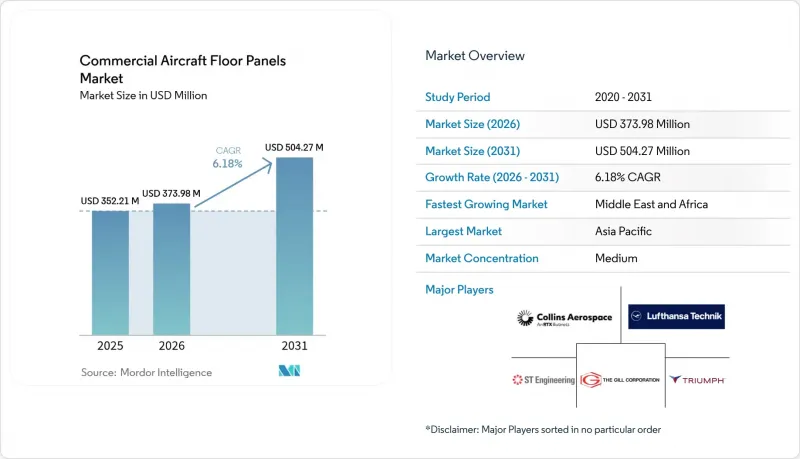
Mordor Intelligence에 의하면, 민간 항공기 바닥 패널 시장 규모는 2025년에 3억 5,221만 달러로 평가되었습니다. 2026년 3억 7,398만 달러에서 2031년까지 5억 427만 달러에 이를 것으로 예상되며, 예측 기간(2026-2031년) CAGR은 6.18%를 나타낼 전망입니다.
본 보고서는 기판(노멕스 허니컴, 알루미늄 허니컴, 탄소섬유 허니컴, 기타),용도(OEM 및 애프터마켓), 항공기 유형(나로우드, 와이드바디, 리저널 제트), 지역(북미, 유럽, 아시아태평양, 남미, 중동 및 아프리카)별로 분류되어 있습니다. 시장 예측은 금액(달러) 기준으로 제시되어 있습니다.
세계의 민간 항공기 바닥 패널 시장 동향 및 인사이트
협폭체 항공기 생산 수주 잔고의 급증
협폭기 기종의 미인도 주문량은 현재 약 13년 치 생산량에 해당하며, 민간 항공기용 바닥 패널 시장의 설치 수요가 지속적으로 확보되고 있습니다. 단일 통로 제트기 1대당 객실 및 화물실 전체에 15-20장의 패널이 필요하기 때문에 생산 대수가 1대 늘어날 때마다 실질적인 자재 수요량이 증가하게 됩니다. B737 MAX의 생산 재개와 에어버스 A320neo 패밀리의월75대 생산 목표에 따라, 일부 부품 공급업체들이 전자기기, 단조품, 허니콤 코어 등공급에 여전히 어려움을 겪고 있음에도 불구하고 조달 압력은 더욱 높아지고 있습니다. 미국 정부감사원(GAO) 보고서에 따르면, 15개 Tier 1 공급업체 중 9곳이 인력과 자재 부족을 지속적인 제약 요인으로 꼽고 있으며, 이로 인해 리드타임이 길어지면서 항공기 제조업체들은 가능한 한 인증된 패널 제품공급처를 2곳으로 분산해야 하는 상황에 처해 있습니다. 아시아태평양 및 북미의 항공사들이 신규 납품 물량의 대부분을 인수하고 있어, 이러한 공급 경로에 대한 지리적 편중이 더욱 심화되고 있습니다.
항공사의 개조 주기는 경량 객실 개조에 중점을 두고 있습니다.
객실 개조 주기는 8년에서 12년이지만, 현재의 개조 붐은 유가 변동이 사상 최고 수준에 달한 시기와 겹치고 있습니다. 그 때문에 각 항공사는 경량화 대책을 우선시하고 있으며, 경량 바닥 시스템이 개조 키트의 핵심 기능이 되고 있습니다. 콜린스 에어로스페이스(Collins Aerospace)는 ‘에어크래프트 인테리어 엑스포(Aircraft Interior Expo)’에서 구조용 시트 레일을 재사용하면서 기존 패널을 차세대 페놀 수지 라미네이트 소재로 대체하는 좌석과 바닥을 통합한 컨셉을 전시했습니다. 사프란의 인테리어 부문은 2024년에 25.2%의 매출 성장을 기록했습니다. 이는 델타항공 등 항공사들이 전체 기단의 재구성이 아닌 스마트 캐빈 모듈을 선택함에 따라, 이와 유사한 개조 수요가 촉진된 결과입니다. 또한, FAR 25.853 시험 프로토콜의 규제 개정에 따라 구형 패널은 더 조기에 운용에서 제외되게 되어, 북미 및 EU의 일부 관할 구역에서 단기적인 교체량이 증가하고 있습니다.
노멕스 및 탄소섬유의 가격 변동이 공급업체의 이익률을 압박
노멕스(Nomex) 종이 및 항공우주 등급 탄소섬유는 석유 유래 원료와 특수 전구체의 생산 능력에 의존하고 있기 때문에 원유 가격 변동 및 에너지 가격 변동의 영향을 받기 쉬운 상황입니다. 헥셀(Hexel)사는 항공기 제조업체들이 납품을 가속화하고 있는 데 따라, 원자재 비용 상승 및 매출채권 회수 주기 장기화를 이유로 2025년 매출 전망을 18억 8,000만-19억 5,000만 달러로 하향 조정했습니다. 듀폰(DuPont)사도 마찬가지로, 일부 메타아라미드 공장의 가동 중단을 계기로 노멕스(Nomex) 제품군에 대해 계속해서 원가 전가를 실시할 방침을 밝혔습니다. 2차 패널 조립업체들은 이익률이 낮고 장기 공급 계약을 체결하지 않은 경우가 많아, 가격 변동을 헤지하거나 흡수할 수밖에 없으며, 그 결과 연구 개발에 투입되는 자금이 압박받고 있습니다.
부문별 분석
2025년, 노멕스(Nomex) 허니컴은 민간 항공기용 바닥 패널 시장에서 66.20%의 점유율을 차지했습니다. 이는 수십 년에 걸쳐 FAR 25.853의 가연성 규정을 준수하고, 폭넓은 기종에 대한 적합 승인을 받아온 것을 반영합니다. 노멕스는 발연량과 독성이 낮고 취급이 용이하기 때문에 지속적인 사용이 장려되고 있으며, 경량화에 대한 압박이 커지는 상황에서도 기본 수요를 지탱하고 있습니다. 헥셀(Hexcel)과 듀폰(DuPont)은 전 세계 아라미드 종이의 대부분을 공급하고 있으며, 소규모 경쟁사들이 따라올 수 없는 규모의 경제를 누리고 있습니다. 그러나 항공사들이 프리미엄 객실이나 장거리 제트기용으로 더 높은 비탄성률을 가진 대체 소재로 전환함에 따라, 이 부문의 성장은 정체되고 있습니다.
탄소섬유 허니컴은 더 얇은 셀 벽과 뛰어난 압축 강도를 겸비하여, 항공기 1대당 최대 10kg의 기내 중량 감소를 실현합니다. 『Journal of Sandwich Structures and Materials』지에 게재된 연구에 따르면, 두꺼운 벽을 가진 탄소 코어는 운용 하중 하에서 전단형 불안정성을 피하고, 90,000 비행 사이클에 걸쳐 피로 수명을 유지할 수 있음이 입증되었습니다. 민간 항공기용 바닥 패널 시장에서 탄소섬유 코어 시장 규모는 연평균 성장률(CAGR) 8.42%로 확대될 것으로 예측됩니다. 그러나 인증 획득 비용 및 수지·필름·접착제와의 호환성 문제로 인해 기존 협폭기(narrow-body)에 대한 보급은 여전히 제한되고 있습니다. 화물실 바닥의 경우, 충격 내성이 연료 절감 가능성을 상회하기 때문에 알루미늄 코어가 여전히 중요한 역할을 하고 있습니다. 한편, 신흥 열가소성 수지 및 바이오 유래 소재에 대해서는 유럽의 순환 경제 요건에 필수적인 재활용 기법에 대한 검증이 진행되고 있습니다.
혁신의 최전선에서는 열가소성 허니콤 소재의 선택지에 주목하고 있습니다. 예를 들어, EconCore사의 ‘ThermHex’는 재생 폴리프로필렌 원료를 통합하여 페놀 수지를 사용하지 않고도 수직 연소 시험을 통과했습니다. 패널 제조업체들은 이러한 코어에 PEI 및 PPS 표피를 결합함으로써, 항공사가 퇴역 후 파쇄 및 재용융이 가능한 완전 용접 가능한 어셈블리를 제조하고 있습니다. 9G 타이다운 시험을 통한 실물 규모의 정적 및 동적 하중 시험을 통해 동등한 구조적 여유가 확인되어, 양산 도입을 위한 초기 장벽이 해소되었습니다. 규제 당국이 ‘제조부터 폐기까지’의 배출량 산정을 정교화하는 가운데, 민간 항공기용 바닥 패널 시장에서는 성능 보증에 더해 투명성이 높은 재활용 인증서를 제공하는 공급업체가 점차 높이 평가받을 가능성이 있습니다.
지역별 분석
아시아태평양은 중국, 인도, 인도네시아 및 일본의 적극적인 기체 증강에 힘입어 2025년 민간 항공기 플로어 패널 시장에서 30.85%의 점유율을 유지했습니다. 에어버스는 이 지역의 항공기 서비스 지출이 2025년 520억 달러에서 2043년까지 1,290억 달러로 급증할 것이며, 정비 지출만으로도 1,090억 달러에 달할 것으로 예측했습니다. 나로우드바디 항공기의 막대한 미인도 주문량, 호황을 누리고 있는 저비용 항공사(LCC) 부문, 그리고 현지 복합재료 생산을 우대하는 오프셋 협정으로 인해 톈진, 하이데라바드, 나고야의 패널 공급업체들의 조달 주기가 장기화되고 있습니다. 정부 지원 연구개발(R&D) 문서에서는 디지털 설계 도입 확대가 강조되는 한편, 유럽 및 미국의 동종 업계 경쟁사들과의 비용 격차가 지적되고 있으며, 이는 바닥 패널의 마감 및 검사 업무의 추가적인 현지화를 시사합니다.
중동 및 아프리카는 2031년까지 연평균 성장률(CAGR)이 7.08%로, 예측된 지역 중 가장 빠른 성장이 예상됩니다. 보잉사의 예측에 따르면, 2031년까지 해당 지역에 2,370대의 신조 항공기(총액 4,700억 달러 상당)가 도입될 전망이며, 그중 69%는 여객 수요 증가와 허브 앤 스포크형 네트워크의 성숙에 기인할 것으로 예측됩니다. 에미레이트 항공, 카타르 항공, 사우디아는 총 880대 이상의 와이드바디 항공기를 주문하거나 옵션 계약을 체결했으며, 이는 프리미엄 클래스 객실을 위해 맞춤 제작된 고부가가치 패널 키트 수요로 이어질 것입니다. 제다와 아디스아바바의 MRO 프리존에 대한 병행 투자를 통해 턴어라운드 시간이 단축되고 현지 패널 수리가 촉진됨에 따라, 해당 지역의 전체 밸류체인이 강화될 것입니다.
북미는 매출액 기준 3위이지만, 기술적 영향력은 매우 크며, 패널 설계 승인의 대부분은 미국 또는 캐나다 당국에 의해 이루어지고 있습니다. 보잉이 스피릿 에어로시스템즈를 83억 달러에 인수함으로써 이루어진 업계 재편을 통해, 국내에서 허니콤 코어 생산 능력을 전략적으로 확보하여 OEM에 대한 납품이 원활해지는 한편, 독립 공장 대상 경쟁 입찰 구조도 재편되고 있습니다. 유럽은 지속가능성에 대한 강력한 집중을 유지하고 있으며, ECO-COMPASS 보조금을 통해 재활용 가능한 열가소성 플라스틱의 채택을 추진하고, 투명성이 더 높은 수명 주기 분석 라벨의 표시를 의무화하고 있습니다. 이로 인해 공급업체들은 함부르크와 툴루즈의 조립 라인에 인접한 폐쇄형 회수 허브의 공동 개발을 요구받고 있습니다. 전반적으로, 이러한 성숙한 지역들은 주기적인 생산 변동과 예측 가능한 개조 주기의 균형을 맞추어 민간 항공기 바닥 패널 시장을 안정시키고 있습니다.
기타 혜택 :
- 엑셀 형식 시장 예측(ME) 시트
- 3개월간의 애널리스트 지원
자주 묻는 질문
목차
제1장 서론
제2장 조사 방법
제3장 주요 요약
제4장 시장 구도
제5장 시장 규모 및 성장 예측
제6장 경쟁 구도
제7장 시장 기회 및 향후 전망
KTH 26.08.28According to Mordor Intelligence, the commercial aircraft floor panels market size was valued at USD 352.21 million in 2025 and estimated to grow from USD 373.98 million in 2026 to reach USD 504.27 million by 2031, at a CAGR of 6.18% during the forecast period (2026-2031).
This report is Segmented by Core Material (Nomex Honeycomb, Aluminum Honeycomb, Carbon-Fiber Honeycomb, and Others), Fitment (OEM and Aftermarket), Aircraft Type (Narrowbody, Widebody, and Regional Jets), and Geography (North America, Europe, Asia-Pacific, South America, and the Middle East and Africa). The Market Forecasts are Provided in Terms of Value (USD).
Global Commercial Aircraft Floor Panels Market Trends and Insights
Surge in Narrowbody Aircraft Production Backlog
Narrowbody order books now span nearly 13 years of output, locking in sustained demand for commercial aircraft floor panels market installations. Each single-aisle jet needs 15-20 panels across the cabin and belly compartments, so every incremental production slot translates into tangible material volumes. The restart of B737 MAX production and the Airbus A320neo family's targeted 75-per-month cadence intensify sourcing pressures, even as select component suppliers continue to struggle with electronics, forgings, and honeycomb cores. The US Government Accountability Office notes that nine of 15 tier-one vendors cite labor and material shortages as persistent constraints, which extend lead times and prompt airframers to dual-source qualified panel lines where possible. Operators in Asia-Pacific and North America absorb the bulk of fresh deliveries, reinforcing the geographic skew toward those supply corridors.
Airline Retrofit Cycles Focused on Lightweight Cabin Refurbishment
Cabin refresh intervals range from eight to 12 years, and the current wave coincides with record fuel price volatility. Airlines, therefore, prioritize mass-reduction options, making lightweight floor systems a core feature of retrofit kits. Collins Aerospace displayed an integrated seating-plus-floor concept at the Aircraft Interiors Expo that reuses structural seat rails while replacing the original panels with next-generation phenolic-resin laminates. Safran's interiors division booked 25.2% revenue growth in 2024, underpinned by similar retrofit demand as carriers such as Delta Air Lines chose smart-cabin modules over full fleet reconfigurations. Regulatory updates to FAR 25.853 test protocols also force older panels out of service sooner, lifting near-term replacement volumes in North America and several EU jurisdictions.
Volatile Nomex and Carbon-Fiber Pricing Compressing Supplier Margins
Nomex paper and aerospace-grade carbon fiber rely on petroleum-based feedstocks and specialized precursor capacity, exposing prices to crude oil swings and energy price fluctuations. Hexcel has trimmed its 2025 revenue outlook to USD 1.88-1.95 billion, citing rising raw-material costs and extended receivable cycles as airframers accelerate deliveries. DuPont likewise signals continued cost pass-through for its Nomex portfolio after capacity outages at select meta-aramid plants. Tier-two panel assemblers operate on thinner margins and often lack long-term supply contracts, forcing them to hedge or absorb volatility, which dilutes the capital available for R&D.
Other drivers and restraints analyzed in the detailed report include:
- Ramp-Up of Composite-Rich Models Requiring Advanced Floor Panel Solutions
- Rising Adoption of Recyclable Thermoplastic Honeycomb Cores for Circularity Goals
- Persistent Supply-Chain Constraints for Aerospace-Grade Honeycomb Cores
For complete list of drivers and restraints, kindly check the Table Of Contents.
Segment Analysis
Nomex honeycomb held a 66.20% slice of the commercial aircraft floor panels market in 2025, reflecting decades of compliance with FAR 25.853 flammability rules and broad line-fit approvals. Nomex's low smoke toxicity and favorable handling encourage continued use, anchoring baseline demand even as weight-saving pressures intensify. Hexcel and DuPont supply most aramid paper worldwide, granting them scale economies that small rivals struggle to match. However, the segment's growth plateaus as operators pivot toward higher specific-modulus alternatives for premium cabins and long-range jets.
Carbon-fiber honeycomb combines thinner cell walls with superior compressive strength, unlocking cabin weight reductions of up to 10 kg per aircraft. Research published in the Journal of Sandwich Structures and Materials demonstrates that thicker-walled carbon cores avert shear-type instability under service loads, sustaining fatigue life across 90,000 flight cycles. The commercial aircraft floor panels market size for carbon-fiber cores is forecast to widen at an 8.42% CAGR. However, qualification costs and resin-film-adhesive compatibility still limit penetration on legacy narrowbody fleets. Aluminum cores remain relevant for cargo floors where impact tolerance outweighs the potential for fuel savings, while emerging thermoplastic and bio-derived variants are testing recycling pathways crucial to European circular economy mandates.
The innovation frontier centers on thermoplastic honeycomb options, such as EconCore's ThermHex, which integrates recycled polypropylene feedstock and passes vertical burn tests without the use of phenolics. Panel makers pair these cores with PEI or PPS skins to produce fully weldable assemblies that airlines can shred and re-melt after decommissioning. Full-scale static and dynamic load trials on 9-g tie-down seats confirm equivalent structural margins, clearing an early hurdle toward line-fit status. As regulatory bodies fine-tune cradle-to-grave emissions accounting, the commercial aircraft floor panels market may progressively reward suppliers that offer transparent recycling certificates alongside performance guarantees.
Complete Report Scope:
- By Core Material
- Nomex Honeycomb
- Aluminum Honeycomb
- Carbon-Fiber Honeycomb
- Others
- By Fitment
- OEM
- Aftermarket
- By Aircraft Type
- Narrowbody Aircraft
- Widebody Aircraft
- Regional Jets
- By Geography
- North America
- United States
- Canada
- Mexico
- Europe
- United Kingdom
- Germany
- France
- Italy
- Russia
- Rest of Europe
- Asia-Pacific
- China
- India
- Japan
- South Korea
- Rest of Asia-Pacific
- South America
- Brazil
- Argentina
- Rest of South America
- Middle East and Africa
- Middle East
- Saudi Arabia
- United Arab Emirates
- Rest of Middle East
- Africa
- South Africa
- Rest of Africa
- Middle East
- North America
Geography Analysis
The Asia-Pacific region retained a 30.85% share of the commercial aircraft floor panels market in 2025, underpinned by aggressive fleet growth in China, India, Indonesia, and Japan. Airbus projects that the region's aircraft services spending will surge from USD 52 billion in 2025 to USD 129 billion by 2043, with maintenance spending alone climbing to USD 109 billion. Significant narrowbody backlogs, a vibrant low-cost carrier (LCC) sector, and offset agreements that favor local composites production extend procurement cycles for panel suppliers in Tianjin, Hyderabad, and Nagoya. Government-backed R&D documents emphasize the increased adoption of digital design and highlight cost gaps compared to Western peers, signaling a further localization of floor panel finishing and inspection activities.
The Middle East and Africa are expected to deliver the fastest forecast expansion at a 7.08% CAGR through 2031. Boeing forecasts 2,370 new-build aircraft, valued at USD 470 billion, entering the region by 2031, with 69% of these expected to stem from passenger traffic growth and the maturation of hub-and-spoke networks. Emirates, Qatar Airways, and Saudia collectively hold more than 880 widebody airframes on order or option, translating into high-value panel kits tailored for premium-class cabins. Concurrent investments in MRO free zones at Jeddah and Addis Ababa reduce turnaround times and facilitate localized panel repairs, thereby reinforcing the region's complete value chain.
North America ranks third in revenue but commands significant technical influence; many panel design approvals are held by US or Canadian authorities. Consolidation through Boeing's USD 8.3 billion acquisition of Spirit AeroSystems brings strategic stockholding of honeycomb core capacity onshore, smoothing OEM deliveries while rearranging competitive bidding for independent shops. Europe maintains a strong sustainability focus, championing the adoption of recyclable thermoplastics through ECO-COMPASS grants and mandating more transparent life-cycle analysis labels, which push suppliers to co-develop closed-loop recovery hubs adjacent to Hamburg and Toulouse assembly lines. Collectively, these mature regions stabilize the commercial aircraft floor panels market by balancing cyclical production swings with predictable retrofit cycles.
- The Gill Corporation
- Collins Aerospace (RTX Corporation)
- Safran S.A.
- Triumph Group Inc.
- Singapore Technologies Engineering Ltd.
- LATECOERE
- Aeropair Ltd.
- Elbe Flugzeugwerke GmbH
- VINCORION Advanced Systems GmbH
- Satair (Airbus SE)
- Lufthansa Technik AG
- Hexcel Corporation
- Jamco Corporation
- Diab Group
- Plascore Inc.
- Euro-Composites S.A.
- FACC AG
- SEKISUI Aerospace
- Showa Aircraft Industry Co. Ltd.
- Honeycomb Company of America, Inc.
Additional Benefits:
- The market estimate (ME) sheet in Excel format
- 3 months of analyst support
TABLE OF CONTENTS
1 INTRODUCTION
- 1.1 Study Assumptions and Market Definition
- 1.2 Scope of the Study
2 RESEARCH METHODOLOGY
3 EXECUTIVE SUMMARY
4 MARKET LANDSCAPE
- 4.1 Market Overview
- 4.2 Market Drivers
- 4.2.1 Surge in narrowbody aircraft production backlog
- 4.2.2 Airline retrofit cycles focused on lightweight cabin refurbishment
- 4.2.3 Ramp-up of composite-rich models requiring advanced floor panel solutions
- 4.2.4 Rising adoption of recyclable thermoplastic honeycomb cores for circularity goals
- 4.2.5 Expansion of integrated MRO and PMA supply chains shortening global TAT
- 4.2.6 Stricter flammability regulations accelerating phase-out of legacy panels
- 4.3 Market Restraints
- 4.3.1 Volatile Nomex and carbon-fiber pricing compressing supplier margins
- 4.3.2 Persistent supply-chain constraints for aerospace-grade honeycomb cores
- 4.3.3 Lengthy certification and qualification cycles for new core materials and bonding processes
- 4.3.4 Adhesive-bond delamination and moisture-ingress incidents triggering fleet-wide inspection directives
- 4.4 Value Chain Analysis
- 4.5 Regulatory Outlook
- 4.6 Technological Outlook
- 4.7 Porter's Five Forces Analysis
- 4.7.1 Bargaining Power of Buyers
- 4.7.2 Bargaining Power of Suppliers
- 4.7.3 Threat of New Entrants
- 4.7.4 Threat of Substitute Products
5 MARKET SIZE AND GROWTH FORECASTS (VALUE)
- 5.1 By Core Material
- 5.1.1 Nomex Honeycomb
- 5.1.2 Aluminum Honeycomb
- 5.1.3 Carbon-Fiber Honeycomb
- 5.1.4 Others
- 5.2 By Fitment
- 5.2.1 OEM
- 5.2.2 Aftermarket
- 5.3 By Aircraft Type
- 5.3.1 Narrowbody Aircraft
- 5.3.2 Widebody Aircraft
- 5.3.3 Regional Jets
- 5.4 By Geography
- 5.4.1 North America
- 5.4.1.1 United States
- 5.4.1.2 Canada
- 5.4.1.3 Mexico
- 5.4.2 Europe
- 5.4.2.1 United Kingdom
- 5.4.2.2 Germany
- 5.4.2.3 France
- 5.4.2.4 Italy
- 5.4.2.5 Russia
- 5.4.2.6 Rest of Europe
- 5.4.3 Asia-Pacific
- 5.4.3.1 China
- 5.4.3.2 India
- 5.4.3.3 Japan
- 5.4.3.4 South Korea
- 5.4.3.5 Rest of Asia-Pacific
- 5.4.4 South America
- 5.4.4.1 Brazil
- 5.4.4.2 Argentina
- 5.4.4.3 Rest of South America
- 5.4.5 Middle East and Africa
- 5.4.5.1 Middle East
- 5.4.5.1.1 Saudi Arabia
- 5.4.5.1.2 United Arab Emirates
- 5.4.5.1.3 Rest of Middle East
- 5.4.5.2 Africa
- 5.4.5.2.1 South Africa
- 5.4.5.2.2 Rest of Africa
- 5.4.5.1 Middle East
- 5.4.1 North America
6 COMPETITIVE LANDSCAPE
- 6.1 Market Concentration
- 6.2 Strategic Moves
- 6.3 Market Share Analysis
- 6.4 Company Profiles (includes Global-level Overview, Market-level Overview, Core Segments, Financials as available, Strategic Information, Market Rank/Share, Products and Services, Recent Developments)
- 6.4.1 The Gill Corporation
- 6.4.2 Collins Aerospace (RTX Corporation)
- 6.4.3 Safran S.A.
- 6.4.4 Triumph Group Inc.
- 6.4.5 Singapore Technologies Engineering Ltd.
- 6.4.6 LATECOERE
- 6.4.7 Aeropair Ltd.
- 6.4.8 Elbe Flugzeugwerke GmbH
- 6.4.9 VINCORION Advanced Systems GmbH
- 6.4.10 Satair (Airbus SE)
- 6.4.11 Lufthansa Technik AG
- 6.4.12 Hexcel Corporation
- 6.4.13 Jamco Corporation
- 6.4.14 Diab Group
- 6.4.15 Plascore Inc.
- 6.4.16 Euro-Composites S.A.
- 6.4.17 FACC AG
- 6.4.18 SEKISUI Aerospace
- 6.4.19 Showa Aircraft Industry Co. Ltd.
- 6.4.20 Honeycomb Company of America, Inc.
7 MARKET OPPORTUNITIES AND FUTURE OUTLOOK
- 7.1 White-space and Unmet-Need Assessment