

|
시장보고서
상품코드
2114805
항공우주 바닥 패널 시장 : 점유율 분석, 업계 동향과 통계, 성장 예측(2026-2031년)Aerospace Floor Panels - Market Share Analysis, Industry Trends & Statistics, Growth Forecasts (2026 - 2031) |
||||||
 Mordor Intelligence
Mordor Intelligence에 의하면, 2026년 항공우주 바닥 패널 시장 규모는 5억 760만 달러로 추정되고 있어 2025년 4억 8,826만 달러에서 확대해, 2031년에는 6억 1,634만 달러에 이를 것으로 예측됩니다.
2026년부터 2031년까지 연평균 성장률(CAGR) 3.96%로 성장할 것으로 전망됩니다.
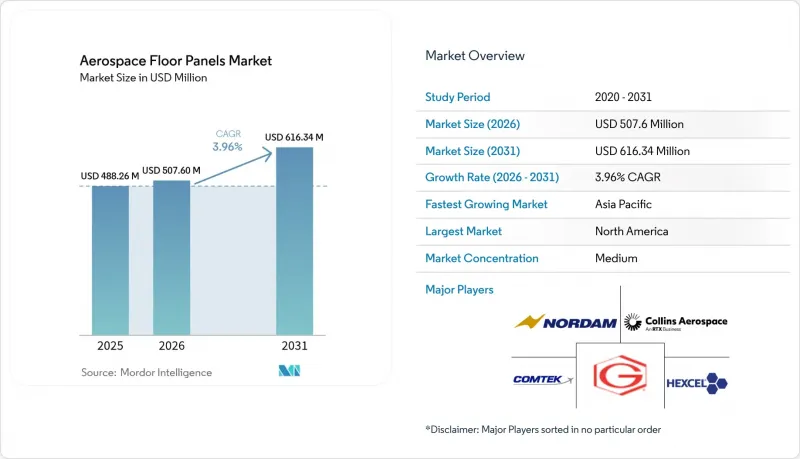
본 보고서는 기판(노멕스 허니컴, 알루미늄 허니컴 등),설치 위치(여객기 객실 바닥, 화물실 바닥 등), 최종 사용자 채널(민간 항공, 군용기, 비즈니스 제트기 등), 지역(아시아태평양, 북미, 유럽, 남미, 중동 및 아프리카)별로 분류되어 있습니다. 시장 예측은 금액(달러) 기준으로 제시되어 있습니다.
전 세계 항공우주 바닥 패널 시장 동향 및 인사이트
신규 제조 및 개조된 항공기 인도 대수 증가
보잉사는 향후 20년 동안 44,000대 미만의 항공기가 추가될 것으로 예측하고 있으며, 그 중 약 4분의 3을 단일 통로형 항공기가 차지할 것으로 전망됩니다. 항공사들은 즉각적인 연료 절감을 실현하기 위해 기존의 알루미늄 패널을 더 가벼운 허니콤 소재로 교체하는 기체 수명 중반에 이루어지는 객실 대대적인 개조를 점점 더 많이 계획하고 있습니다. 인도에서는 향후 20년 동안 4,000대의 항공기 증설과 200곳의 신규 공항 개설이 예상되며, 신규 제조에 더해 개조 수요도 확대될 전망입니다. 중국은 추가적인 성장 요인을 제공합니다. COMAC은 1,000대 이상의 국내 미인도 주문량을 처리하기 위해 2029년까지 C919의 연간 생산 대수를 75대로 늘릴 계획입니다. 항공기 1대당 30-50제곱미터의 주요 객실 바닥재가 필요하기 때문에 지속적인 수요 기반이 보장됩니다. 개조 공사는 MRO 센터에도 이점이 있으며, 구조적인 하중 경로를 변경하지 않고도 정기 정비 기간 중에 인증된 열가소성 플라스틱 패널을 장착할 수 있습니다.
엄격한 연료 소비량 및 CO2 규제가 경량화를 가속화
유럽의 ‘Fit-for-55’ 패키지 및 세계 각국의 유사한 정책에 따라 항공사는 좌석당 배출량을 대폭 감축해야 할 의무가 있으며, 기내 중량은 이를 위한 구체적인 대책 수단이 되고 있습니다. 복합재 바닥 솔루션은 알루미늄 제품에 비해 패널 질량을 최대 30% 줄여, 협폭기 운항 시 블록 연료 효율을 약 0.5% 향상시킵니다. 탄소섬유 스킨과 케플러 허니컴을 결합한 DL 에비에이션의 ‘ECO 사이드월’은 인테리어 프로그램이 경량화와 폐기물 감축을 어떻게 통합하고 있는지를 보여줍니다. 이 컨셉을 통해 질량을 10%, 폐기물을 33% 감축합니다. 또한, 항공사들은 경량화를 지속 가능한 항공 연료(SAF)의 경제성과도 연결하고 있습니다. 이는 1Kg의 무게가 줄어들 때마다 SAF의 연소 효율이 향상되기 때문입니다. 그 결과, 복합재 패널로의 업그레이드는 규제 당국에 제출되는 탈탄소화 로드맵과 공항의 탄소세 협상에서 중요한 위치를 차지하고 있습니다.
원자재 가격 변동(아라미드 섬유, 알루미늄, 티타늄)
우크라이나에서의 채굴 중단과 수출 규제가 겹치면서 항공우주 합금에 압박이 가해진 결과, 2019년부터 2024년까지 전 세계 티타늄 생산량은 12% 감소했습니다. 알루미늄 비용은 여전히 무역 조치의 영향을 받기 쉬운 상황에 놓여 있습니다. 특정 수입품에 대한 미국의 25% 관세로 인해 현물 가격은 무역 전쟁 이전의 평균 가격에 비해 높은 수준을 유지하고 있습니다. 듀폰(DuPont)사의 노멕스(Nomex) 공급망 또한 간헐적인 생산 능력 제약에 직면하고 있으며, 이는 허니콤 코어에 사용되는 아라미드 종이의 분기별 가격이 두 자릿수 변동을 보이는 요인이 되고 있습니다. 각 OEM 업체들은 복수 공급처로부터의 조달, 선물 임베디드, 대체 소재 검토 등의 대응책을 마련하고 있으나, 계약에 따라 카탈로그 가격이 고정된 경우 이익률 압박은 지속되고 있습니다.
부문별 분석
2025년, 노멕스(Nomex) 허니콤은 매출의 44.72%를 차지하고, 이는 OEM 사양이 정착되어 있고 대량 생산에 최적화된 세계 공급업체 생태계를 반영한 것입니다. 이러한 선두에도 불구하고, 항공우주 바닥 패널 시장은 열가소성 허니컴으로 전환되고 있으며, 향후 10년간 연평균 성장률(CAGR) 5.05%를 나타낼 것으로 예측됩니다. 이러한 성능 향상은 기계적 강도와 원샷 성형을 결합한 연속 시트 기술에 힘입은 것으로, 이를 통해 타크트 타임 단축과 스크랩 감소를 실현하고 있습니다. 또한, 열가소성 허니컴 보드는 규제 당국이 점점 더 요구하고 있는 폐쇄형 재활용 목표도 충족하고 있습니다. 알루미늄 허니콤은 비용 지표가 1kg당 무게를 초과하는 화물 갑판에서 여전히 선호되고 있으며, 티타늄 코어는 군용 수송기의 핫존 바닥에 있어 여전히 필수적인 요소로 남아 있습니다. 적층 가공(애디티브 매뉴팩처링)를 통한 티타늄은 기계 가공으로 인한 폐기물을 제거하고 격자 구조의 최적화를 가능하게 함으로써, 향후 비용 경쟁력을 실현할 것으로 기대됩니다. 현무암 섬유에서 바이오 수지에 이르기까지, 그 밖의 실험적인 코어 소재에 대해서도 수명 주기 동안의 탄소 배출량 지표를 고려하여 파일럿 테스트가 계속되고 있습니다.
채용 동향은 기체 등급에 따라 다릅니다. 협폭기 프로그램에서는 사용 온도가 150°C를 넘는 경우가 거의 없기 때문에 PP나 PEI 등의 열가소성 수지 코어가 선호됩니다. 반면, 와이드바디 제트기나 장거리 비즈니스 제트기에서는 더 높은 객실 바닥 하중과 갤리의 열을 견딜 수 있는 PEKK나 PPS로 만든 코어가 선호됩니다. 그 결과, 소재 공급업체들은 획일적인 전략이 아닌 기체 등급별 인증 로드맵을 추구하고 있습니다. 아시아의 각 컴파운더들이 난연성 및 발연 성능을 동등한 수준으로 유지하면서, 비용 면에서 유럽 및 미국의 기존 기업들보다 낮은 가격 설정을 목표로 하고 있어 경쟁이 격화되고 있습니다. 코어 형상에 관한 지적재산권 보호는 여전히 차별화 요인으로 작용하고 있으며, 셀 크기의 그라데이션이나 에지 폐쇄 방법에 관한 특허는 공급업체가 단독 공급 계약을 확보하는 데 도움이 되고 있습니다. 따라서 항공우주 바닥 패널 업계에서는 두 가지 동향이 관찰됩니다. 기존 노멕스(Nomex)공급망은 대규모 생산을 통한 가격 안정성을 제공하는 반면, 열가소성 수지 분야의 신규 진출기업들은 속도와 지속가능성이라는 실적을 무기로 시장 점유율을 확보하고 있습니다.
지역별 분석
북미는 위치타에서 캐롤라이나주를 거쳐 퀘벡주에 이르는 확립된 제조 거점 덕분에 2025년에 매출 점유율의 38.21%를 차지했습니다. 콜린스 에어로스페이스(Collins Aerospace)가 포트워스, 스포캔, 푸에블로에서 실시한 2억 2,500만 달러 규모의 거점 확장을 통해 카본 브레이크 및 허니컴의 생산 능력이 50% 이상 증가하여 패널용 수지의 장기적인 공급이 확보되었습니다. ANA 홀딩스의 북미 노선용 77대 발주를 포함한 지역 항공사들의 기체 갱신이 수주 안정성을 뒷받침하고 있습니다.
한편, 아시아태평양은 4.72%라는 가장 높은 연평균 성장률(CAGR)을 기록하고 있습니다. 인도의 2,500대 이상의 항공기 수요와 적극적인 공항 확장으로 인해 공급망의 지역 구조가 재편되면서, 하이데라바드와 방갈로르 주변에 현지 복합재료 제조업체들이 잇달아 등장하고 있습니다. 중국에서는 2029년까지 연간 75대 생산을 목표로 하는 C919의 발전에 따라, 규격에 부합하는 객실용 부품에 대한 국내 수요가 가속화되고 있습니다. 일본과 한국도 경제 안보 관련 법규에 따라 현지 조달된 내장 부품의 채택을 장려하고 있으며, 이로 인해 전 세계 공급업체들은 기술 라이선싱 및 합작 투자(JV) 추진을 불가피하게 하고 있습니다.
유럽은 독일, 프랑스, 영국에 집적된 복합재료에 대한 깊은 전문 지식을 활용하고 있습니다. 디엘(Diehl)사의 ‘ECO 사이드월’과 같은 프로그램은 에어버스(Airbus)의 내장 패키지에 통합되어 있으며, 이 지역은 설계 권한에 관한 결정에서 계속해서 영향력을 유지하고 있습니다. 라틴아메리카와 중동에서는 관광 산업의 회복 및 LCC(저비용 항공사)의 확장에 따라 성장 양상이 제각각입니다. 두 지역 모두 패널의 대부분을 수입에 의존하고 있지만, 운송 리드타임을 피하기 위해 조립 거점을 육성할 가능성도 있습니다. 이러한 지역적 동향이 맞물리면서, 항공우주 바닥 패널 시장은 전 세계적으로 다양성을 유지하면서도 아시아를 중심으로 한 수량 측면의 성장으로 기울고 있습니다.
기타 혜택:
- 엑셀 형식 시장 예측(ME) 시트
- 3개월간의 애널리스트 지원
자주 묻는 질문
목차
제1장 서론
제2장 조사 방법
제3장 주요 요약
제4장 시장 구도
제5장 시장 규모와 성장 예측
제6장 경쟁 구도
제7장 시장 기회와 향후 전망
JHS 26.08.26According to Mordor Intelligence, aerospace floor panels market size in 2026 is estimated at USD 507.6 million, growing from 2025 value of USD 488.26 million with 2031 projections showing USD 616.34 million, growing at 3.96% CAGR over 2026-2031.
This report is Segmented by Core Material (Nomex Honeycomb, Aluminium Honeycomb, and More), Installation Area (Passenger Cabin Floor, Cargo Deck Floor, and More), End-User Channel (Commercial Aviation, Military Aircraft, Business Jets, and More), and Geography (Asia-Pacific, North America, Europe, South America, Middle East and Africa). The Market Forecasts are Provided in Terms of Value (USD).
Global Aerospace Floor Panels Market Trends and Insights
Growing Number of New-Build & Retrofit Aircraft Deliveries
Boeing forecasts just under 44,000 aircraft additions over the next two decades, with single-aisle models representing roughly three-quarters of the pipeline. Airlines increasingly schedule mid-life cabin overhauls that replace legacy aluminum boards with lighter honeycomb alternatives to secure immediate fuel savings. India anticipates 4,000 incremental airframes and 200 new airports within twenty years, amplifying retrofit prospects alongside new builds. China adds another growth vector: COMAC plans to lift C919 output to 75 units annually by 2029 to meet a domestic backlog topping 1,000 jets. Each incremental frame requires 30-50 m2 of primary cabin flooring, guaranteeing a persistent demand baseline. Retrofit work also benefits MRO centres, which can install certified thermoplastic panels during heavy-check windows without altering structural load paths.
Stringent Fuel-Burn & CO2 Regulations Accelerating Lightweighting
The European Fit-for-55 package and similar schemes worldwide obligate airlines to slash per-seat emissions, making cabin weight an actionable lever. Composite floor solutions cut panel mass by up to 30% versus aluminium, improving block fuel by roughly 0.5% on a narrow-body mission. Diehl Aviation's ECO Sidewall, combining carbon fibre skins and Kepler honeycomb, shows how interior programmes integrate weight and waste reduction; the concept trims 10% mass and 33% scrap. Airlines also link lightweighting to sustainable aviation fuel economics because every kilogram saved extends SAF burn efficiency. Consequently, composite panel upgrades feature prominently in decarbonisation roadmaps filed with regulators or used to negotiate airport carbon charges.
Raw-Material Price Volatility (Aramid Fibre, Aluminium, Titanium)
Global titanium output slid 12% between 2019 and 2024 as Ukrainian mining disruptions collided with export curbs, pressuring aerospace alloys. Aluminium costs remain sensitive to trade actions; U.S. tariffs of 25% on selected imports keep spot prices elevated relative to pre-trade-war averages. DuPont's Nomex supply chain has also faced intermittent capacity constraints, triggering double-digit quarterly price swings for aramid paper used in honeycomb cores. OEMs respond by multisourcing, forward-buying, and engineering substitution options, but margin compression persists when contracts lock in catalog prices.
Other drivers and restraints analyzed in the detailed report include:
- Rapid Adoption of Composite Honeycomb Floor Panels
- Additive-Manufactured Titanium Honeycomb Cores Speeding MRO Turnaround
- Geopolitical Supply-Chain Shocks for Aerospace Honeycomb Cores
For complete list of drivers and restraints, kindly check the Table Of Contents.
Segment Analysis
Nomex honeycomb retained 44.72% revenue in 2025, reflecting entrenched OEM specifications and a global supplier ecosystem tuned for high-volume output. Despite its lead, the aerospace floor panels market is tilting toward thermoplastic honeycomb, which is forecast to grow at 5.05% CAGR this decade. The performance uplift hinges on continuous-sheet technologies that marry mechanical strength with one-shot forming, thus cutting takt time and scrap. Thermoplastic boards also meet closed-loop recycling targets that regulators increasingly require. Aluminium honeycomb still finds favour in cargo decks where cost metrics trump every kilogram, while titanium cores remain vital for hot-zone floors on military transports. Additive-manufactured titanium promises future cost parity by eradicating machining waste and enabling lattice optimisation. Other experimental cores-ranging from basalt fibres to bio-resins-continue pilot testing with an eye on life-cycle carbon metrics.
Adoption trajectories vary by platform class. Narrow-body programmes lean toward PP and PEI thermoplastic variants because service temperatures rarely exceed 150 °C. Wide-body jets and long-range business aircraft prefer PEKK or PPS cores that withstand higher cabin floor loads and galley heat. Consequently, material suppliers pursue platform-specific qualification roadmaps rather than one-size strategies. Competition is intensifying as Asian compounders seek to undercut Western incumbents on cost while matching flame and smoke performance. Intellectual-property protection around core geometry remains a differentiator; patents on cell size gradients and edge-closure methods help vendors secure sole-source contracts. The aerospace floor panels industry therefore exhibits a dual dynamic: legacy Nomex supply chains deliver price stability at scale, whereas thermoplastic disruptors capture share through speed and sustainability credentials.
Complete Report Scope:
- By Core Material
- Nomex Honeycomb
- Aluminium Honeycomb
- Titanium Honeycomb
- Other Core Materials (Thermoplastic Honeycomb, etc.)
- By Installation Area
- Passenger Cabin Floor
- Cargo Deck Floor
- Cockpit Floor
- Galley and Lavatory Zones
- By End-User Channel
- Commercial Aviation
- Military Aircraft
- Business Jets
- Other End-user Channels (Helicopters, etc.)
- By Geography
- Asia-Pacific
- China
- Japan
- India
- South Korea
- ASEAN Countries
- Rest of Asia-Pacific
- North America
- United States
- Canada
- Mexico
- Europe
- Germany
- United Kingdom
- France
- Italy
- Spain
- Russia
- NORDIC Countries
- Rest of Europe
- South America
- Brazil
- Argentina
- Rest of South America
- Middle East and Africa
- Saudi Arabia
- South Africa
- Rest of Middle East and Africa
- Asia-Pacific
Geography Analysis
North America held 38.21% revenue share in 2025, thanks to an established manufacturing base stretching from Wichita through the Carolinas to Quebec. Collins Aerospace's USD 225 million footprint expansion across Fort Worth, Spokane, and Pueblo raised carbon brake and honeycomb capacity by more than 50% and secures long-term panel resin supply. Regional airline fleet renewal, including a 77-aircraft order from ANA Holdings for North American routes, reinforces order stability.
Asia-Pacific, however, is registering the quickest 4.72% CAGR. India's requirement for 2,500-plus aircraft and aggressive airport expansion is reshaping supply-chain geography, with local composite shops popping up around Hyderabad and Bengaluru. China's C919 advance, aided by annual rates of 75 units by 2029, accelerates domestic demand for compliant cabin components. Japan and South Korea are also incentivising locally sourced interiors under economic-security statutes, nudging global vendors to license technology or pursue JVs.
Europe leverages deep composites expertise clustered in Germany, France, and the UK. Programmes such as Diehl's ECO Sidewall feed into Airbus interior packages, keeping the region influential in design authority decisions. Latin America and the Middle East show mixed growth tied to tourism recovery and LCC proliferation; both regions import most panels but could cultivate assembly hubs to sidestep shipping lead times. Collectively, these geographic currents ensure the aerospace floor panels market remains globally diversified while tilting toward Asia-centric volume growth.
- AVIC Cabin Systems (UK)
- Collins Aerospace
- Comtek Advanced Structures Ltd.
- Corex Honeycomb
- DuPont
- Elbe Flugzeugwerke GmbH
- Encore Aerospace LLC
- Gurit Services AG, Zurich
- Hexcel Corporation
- Safran
- Showa Aircraft Industry Co., Ltd.
- Teledyne Aerospace & Defense
- The Gill Corporation
- The NORDAM Group LLC
- Toray Advanced Composites
Additional Benefits:
- The market estimate (ME) sheet in Excel format
- 3 months of analyst support
TABLE OF CONTENTS
1 Introduction
- 1.1 Study Assumptions and Market Definition
- 1.2 Scope of the Study
2 Research Methodology
3 Executive Summary
4 Market Landscape
- 4.1 Market Overview
- 4.2 Market Drivers
- 4.2.1 Growing number of new-build and retrofit aircraft deliveries
- 4.2.2 Stringent fuel-burn and CO2 regulations accelerating lightweighting
- 4.2.3 Rapid adoption of composite honeycomb floor panels
- 4.2.4 Low-cost carrier (LCC) expansion boosting narrow-body demand
- 4.2.5 Additive-manufactured titanium honeycomb cores speeding MRO turnaround
- 4.3 Market Restraints
- 4.3.1 Raw-material price volatility (aramid fibre, aluminium, titanium)
- 4.3.2 Geopolitical supply-chain shocks for aerospace honeycomb cores
- 4.3.3 Certification delays for next-gen thermoplastic floor systems
- 4.4 Value Chain Analysis
- 4.5 Porter's Five Forces
- 4.5.1 Bargaining Power of Suppliers
- 4.5.2 Bargaining Power of Buyers
- 4.5.3 Threat of New Entrants
- 4.5.4 Threat of Substitutes
- 4.5.5 Degree of Competition
5 Market Size and Growth Forecasts (Value and Volume)
- 5.1 By Core Material
- 5.1.1 Nomex Honeycomb
- 5.1.2 Aluminium Honeycomb
- 5.1.3 Titanium Honeycomb
- 5.1.4 Other Core Materials (Thermoplastic Honeycomb, etc.)
- 5.2 By Installation Area
- 5.2.1 Passenger Cabin Floor
- 5.2.2 Cargo Deck Floor
- 5.2.3 Cockpit Floor
- 5.2.4 Galley and Lavatory Zones
- 5.3 By End-User Channel
- 5.3.1 Commercial Aviation
- 5.3.2 Military Aircraft
- 5.3.3 Business Jets
- 5.3.4 Other End-user Channels (Helicopters, etc.)
- 5.4 By Geography
- 5.4.1 Asia-Pacific
- 5.4.1.1 China
- 5.4.1.2 Japan
- 5.4.1.3 India
- 5.4.1.4 South Korea
- 5.4.1.5 ASEAN Countries
- 5.4.1.6 Rest of Asia-Pacific
- 5.4.2 North America
- 5.4.2.1 United States
- 5.4.2.2 Canada
- 5.4.2.3 Mexico
- 5.4.3 Europe
- 5.4.3.1 Germany
- 5.4.3.2 United Kingdom
- 5.4.3.3 France
- 5.4.3.4 Italy
- 5.4.3.5 Spain
- 5.4.3.6 Russia
- 5.4.3.7 NORDIC Countries
- 5.4.3.8 Rest of Europe
- 5.4.4 South America
- 5.4.4.1 Brazil
- 5.4.4.2 Argentina
- 5.4.4.3 Rest of South America
- 5.4.5 Middle East and Africa
- 5.4.5.1 Saudi Arabia
- 5.4.5.2 South Africa
- 5.4.5.3 Rest of Middle East and Africa
- 5.4.1 Asia-Pacific
6 Competitive Landscape
- 6.1 Market Concentration
- 6.2 Strategic Moves
- 6.3 Market Share (%)/ Ranking Analysis
- 6.4 Company Profiles (includes Global level Overview, Market level overview, Core Segments, Financials as available, Strategic Information, Market Rank/Share for key companies, Products and Services, and Recent Developments)
- 6.4.1 AVIC Cabin Systems (UK)
- 6.4.2 Collins Aerospace
- 6.4.3 Comtek Advanced Structures Ltd.
- 6.4.4 Corex Honeycomb
- 6.4.5 DuPont
- 6.4.6 Elbe Flugzeugwerke GmbH
- 6.4.7 Encore Aerospace LLC
- 6.4.8 Gurit Services AG, Zurich
- 6.4.9 Hexcel Corporation
- 6.4.10 Safran
- 6.4.11 Showa Aircraft Industry Co., Ltd.
- 6.4.12 Teledyne Aerospace & Defense
- 6.4.13 The Gill Corporation
- 6.4.14 The NORDAM Group LLC
- 6.4.15 Toray Advanced Composites
7 Market Opportunities and Future Outlook
- 7.1 White-space and Unmet-Need Assessment


