

|
시장보고서
상품코드
2114472
기계 안전 시장 : 시장 점유율 분석, 업계 동향 및 통계, 성장 예측(2026-2031년)Machine Safety - Market Share Analysis, Industry Trends & Statistics, Growth Forecasts (2026 - 2031) |
||||||
 Mordor Intelligence
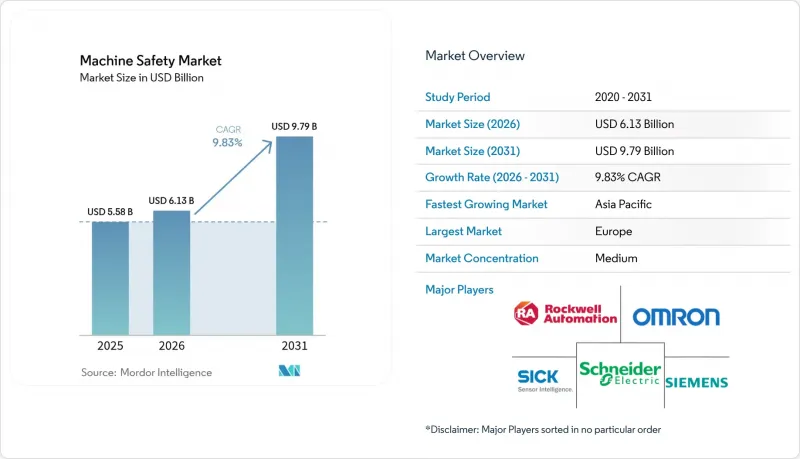
Mordor Intelligence에 의하면, 기계 안전 시장 규모는 2025년에 55억 8,000만 달러로 평가되었고, 2026년 61억 3,000만 달러에서 2031년까지 97억 9,000만 달러에 이를 것으로 예측되며, 예측 기간(2026-2031년) CAGR은 9.83%를 나타낼 전망입니다.
본 보고서는 도입 형태별(개별 구성 요소, 내장형 구성 요소 등), 구성 요소별(존재 감지용 안전 센서, 안전 라이트 커튼, 안전 레이저 스캐너 등), 용도별(자재관리, 로봇 공학 및 협동 로봇 등), 최종 사용자별(자동차, 식품 및 음료 등), 그리고 지역별로 분류되어 있습니다. 시장 예측은 금액(달러) 기준으로 제시되어 있습니다.
세계의 기계 안전 시장 동향 및 인사이트
동아시아 전역의 전자기기 조립 라인에서 협동 로봇 도입 가속화
중국, 한국, 대만의 전자기기 제조업체들은 독립형 산업용 로봇을 작업자와 작업 공간을 공유하는 협동 로봇으로 대체하고 있습니다. 동적 존재 감지형 라이트 커튼과 3D 비전을 통한 가드 존 덕분에 사람이 위험에 처한 경우에만 협동 로봇이 정지하게 되었으며, 이로 인해 라인 전체의 생산성이 18% 향상되는 동시에 기록 대상 사고가 27% 감소했습니다. 로봇 컨트롤러에 내장된 AI 기반 안전 로직 덕분에 강제 정지가 아닌 속도와 간격 감시가 가능해져 사이클 타임이 더욱 단축되었습니다. 그 결과, 인증된 안전 스캐너, 세이프 토크 오프(STO) 드라이브, 소프트웨어로 설정 가능한 PLC를 공급하는 부품 공급업체들은 전자기기 수탁 제조업체로부터의 수주가 급증하고 있습니다. 전자기기 조립 제조업체들이 지역적인 인력 부족을 보완하고 수출 경쟁력을 유지하기 위해 치열한 경쟁을 벌이는 가운데, 코봇 도입 붐은 향후 3년 동안 정점에 달할 것으로 예측됩니다.
2027년부터 신규 설비에 성능 수준 e(Performance Level e)의 안전 기능을 의무화하는 EU 기계 규정 2023/1230
2027년 1월 20일에 발효되는 이 규정은 중요 기능에 대해 법적 구속력이 있는 PL-e 요건을 도입함과 동시에, 해킹으로 인한 오작동을 안전상 위험으로 분류하는 명확한 사이버 보안 조항을 포함하고 있습니다. 따라서 EU에 장비를 공급하는 제조업체는 안전 관련 제어 부품이 무작위적인 하드웨어 장애와 의도적인 공격 모두에 견딜 수 있음을 검증해야 합니다. 이러한 이중 규정 준수 요건으로 인해 안전 및 보안 기능을 통합한 컨트롤러와 인증된 안전한 원격 업데이트 메커니즘에 대한 수요가 증가하고 있습니다. 이 규정은 각국의 국내법에 임베디드될 필요 없이 직접 적용되므로, 공급업체는 하나의 아키텍처를 EU 회원국 27개국 모두에 배포할 수 있어 제품 개발 파이프라인을 효율화할 수 있습니다. 막판 설계 변경을 피하려는 독일과 이탈리아의 OEM 기업들에서는 위험 평가, 소프트웨어 패치 관리, 디지털 트윈 시뮬레이션을 위한 사전 투자가 이미 두드러지게 나타나고 있습니다.
브라운필드 사이트에서 레거시 제어 아키텍처와 안전 네트워크 통합의 복잡성
1980년대에 도입된 많은 분산 제어 시스템에서는 안전 트래픽에 필요한 결정론적 대역폭을 갖추지 못한 독자적인 규격의 버스가 사용되고 있습니다. 그 결과, 통합 업체는 프로토콜 게이트웨이나 섀도 컨트롤러에 의존할 수밖에 없어 프로젝트 비용이 최대 65% 증가하고 시운전 기간이 길어지고 있습니다. 연속 공정 플랜트의 경우, 이러한 가동 중단 시간을 피하고자 하는 이유로 규정 준수 요건을 최소한으로 충족하는 수정 방안이 선택되어, 네트워크화된 안전 시스템의 도입이 지연되고 있습니다. 각 벤더사가 ‘플러그인’형 전환 브리지나 시뮬레이션 기반의 검증 도구를 출시하고 있지만, 레거시 하드웨어와 최신 기능 안전 규격 간의 구조적 불일치는 제어 시스템의 대규모 개편이 이루어질 때까지 해소되지 않을 것입니다.
부문 분석
2025년에도 기존 설비와의 플러그 앤 플레이 호환성 덕분에 개별 구성 요소가 기계 안전 시장 점유율의 64.60%를 차지하며 계속해서 주류를 이루었습니다. 그러나 PLC, 드라이브, HMI에 안전 펌웨어가 통합되어 출하됨에 따라 캐비닛 공간과 배선이 절감되므로, 임베디드 컴포넌트는 연평균 성장률(CAGR) 11.55%로 성장하여 개별 컴포넌트를 능가할 것으로 예측됩니다. 자동차 화이트 바디 생산 라인은 이러한 추세를 여실히 보여주고 있습니다. 현재는 단일 컨트롤러가 표준 모션 프로파일과 PL-e 인터록 로직을 모두 처리하므로 프로세서의 중복이 해소되었습니다. 전자기기 조립 분야에서는 마이크로컨트롤러 기반의 안전 코프로세서가 10밀리초 미만의 반응 시간을 처리하여, 고속 픽 앤 플레이스 장비에 대한 기계 안전 시장의 요구 사항을 충족하고 있습니다. IEC 61508 및 ISO 26262 두 표준 모두에서 콤보 제어 칩 인증을 획득한 공급업체는 디스크리트 릴레이와 비용이 비슷해지고 있기 때문에 OEM으로부터 설계 채택을 이끌어낼 수 있는 입장에 있습니다.
개조 분야에서는 주말 가동 중단 기간 동안 기본 PLC 코드를 재검증할 필요 없이 하드웨어를 교체할 수 있기 때문에 여전히 디스크리트 방식의 라이트 커튼이나 인터록이 선호되고 있습니다. 그러나 이 분야에서도 듀얼 채널 안전 입력을 갖춘 ‘슬라이스’형 I/O 모듈이 서서히 보급되고 있으며, 이를 통해 하나의 백플레인 위에서 표준 배선과 안전 배선을 공존시킬 수 있게 되었습니다. 또한, 유럽과 북미·남미 지역의 규제 조화도 임베디드 솔루션에 대한 투자를 뒷받침하고 있습니다. 안전용 CPU가 한 번 인증되면, 물리적 릴레이 배선을 다시 할 필요 없이 현장에서 소프트웨어 변경 사항을 다운로드할 수 있게 되어, 특히 계절적인 포장 작업에서 더 빠른 투자 회수(ROI)를 실현할 수 있습니다.
2025년에는 존재 감지형 안전 센서가 매출의 29.50%를 차지했으며, 프레스 브레이크에서 팔레타이저에 이르기까지 사실상 모든 안전 조치의 기반이 되고 있습니다. 광학식 및 레이더식 각 유형에는 현재 적재물과 작업자를 구별하는 뮤트 로직이 내장되어 있어, 컨베이어 시스템에서의 오작동을 최소화하고 있습니다. 안전용 PLC는 유연한 제조 환경에서 프로그래밍 가능한 구역과 고속 로직 재구성이 요구됨에 따라, 연평균 성장률(CAGR) 12.3%로 가장 빠르게 성장하는 하위 부문이 되고 있습니다. 하드와이어드 접점에서 매개변수화된 기능 블록으로의 전환을 통해 전기 회로도가 최대 60% 감소하며, 도입 전에 변경 내용을 검증할 수 있는 디지털 트윈 구현이 가능해집니다.
또한, 최신 안전 PLC에는 보안 부트 펌웨어와 암호화 통신 기능이 내장되어 있어, EU 기계 지침이 요구하는 사이버 보안과 기능 안전이라는 이중 요건을 충족하고 있습니다. 안전 PLC의 기계 안전 시장 규모는 각 OEM 업체들이 하나의 CPU로 표준 IEC 61131 태스크와 SIL-3 진단을 모두 실행하는 통합 제어 패널로의 전환을 추진함에 따라 더욱 확대되고 있습니다. 부품 공급업체들은 세이프 토크 오프(Safe Torque Off), 세이프 리미티드 스피드(Safe Limited Speed), 세이프 포지션(Safe Position)을 위한 사전 인증된 라이브러리를 번들로 제공함으로써, 기계 제조업체의 애플리케이션 개발 기간을 단축하고 있습니다.
지역별 분석
2025년에 유럽이 30.70%의 점유율을 차지한 것으로 평가된 것은 규제 선도자 및 자동화 선구자로서 이 지역의 역할을 여실히 보여줍니다. 독일의 자동차, 화학, 공작기계 제조업체들은 사실상 모든 신규 생산 라인에 네트워크화된 안전 백본을 통합하고 있으며, 도입 사례의 68%에서는 이미 진단 데이터가 중앙 대시보드로 스트리밍되고 있습니다. 이탈리아의 포장 장비 OEM 업체는 PL-e 규격을 준수하는 충전기를 북미와 남미로 수출하고 있어, 유럽의 기술 파급 효과를 더욱 확대되고 있습니다. 영국은 수출 접근성을 확보하기 위해 EU 기준을 준수하고 있는 반면, 프랑스의 항공우주 공장에서는 날개 조립 셀에서 인간과 로봇이 공존할 수 있도록 협동 로봇용 가드 시스템을 도입하고 있습니다.
연평균 성장률(CAGR) 11.35%가 예상되는 아시아태평양은 성장의 핵심 시장이 될 것입니다. 중국의 전자제품 조립 제조업체들은 국내 GB 안전 규격과 수출용 CE 마킹을 모두 충족하기 위해 서둘러 대응하고 있으며, 라이트 커튼과 세이프 모션 드라이브의 대량 주문을 주도하고 있습니다. 일본의 로봇 제조업체들은 암에 듀얼 채널 토크 센서를 내장하고, ISO 13849 준수를 표준 사양으로 적용함으로써, 인간과 로봇이 작업을 공유하는 워크스테이션에서의 수용성을 높이고 있습니다. 인도에서는 다국적 제약 기업과 자동차 OEM 각사가 신규 그린필드 현장에 카테고리 3 및 4 시스템을 도입하고 있으며, 이로 인해 현지 인식이 높아지면서 공급업체의 현지화가 진행되고 있습니다. 한국의 반도체 팹에서는 초고순도 화학약품 라인을 위해 SIL 인증 밸브 매니폴드를 조달하고 있으며, 기능 안전과 저입자 구조를 결합하여 작업자와 웨이퍼를 모두 보호하고 있습니다.
북미는 여전히 기술 분야의 선두 주자로 남아 있지만, 성장세는 보다 꾸준한 임베디드니다. 미국의 식품 가공업체들은 배상 책임 및 보험 비용을 줄이기 위해 안전 대책을 강화하고 있으며, 식품 공장의 42%가 2025년에 대규모 현대화를 계획하고 있습니다. 캐나다 광업 부문에서는 운반 트럭의 주행 경로를 위해 무선 SIL-3 비상 정지 네트워크가 도입되고 있습니다. 라틴아메리카의 도입 현황은 제각각입니다. 브라질의 자동차 산업 클러스터는 EU 및 미국의 고객 요구 사항을 준수하고 있는 반면, 소규모 공장에서는 투자가 미뤄지고 있습니다. 중동 및 아프리카에서는 고위험 에너지 분야에서 가장 빠르게 확대되고 있으며, 정유시설 및 LNG 터미널에 화재·가스 감지 및 ESD를 통합한 시스템이 도입되고 있습니다.
기타 혜택 :
- 엑셀 형식 시장 예측(ME) 시트
- 3개월간의 애널리스트 지원
자주 묻는 질문
목차
제1장 서론
제2장 조사 방법
제3장 주요 요약
제4장 시장 구도
제5장 시장 규모 및 성장 예측
제6장 경쟁 구도
제7장 시장 기회 및 향후 전망
AJY 26.08.26According to Mordor Intelligence, the machine safety market size was valued at USD 5.58 billion in 2025 and estimated to grow from USD 6.13 billion in 2026 to reach USD 9.79 billion by 2031, at a CAGR of 9.83% during the forecast period (2026-2031).
This report is Segmented by Implementation (Individual Components, Embedded Components, and More), Component (Presence-Sensing Safety Sensors, Safety Light Curtains, Safety Laser Scanners, and More), Application (Material Handling, Robotics & Collaborative Robots, and More), End User (Automotive, Food & Beverage, and More), and Geography. The Market Forecasts are Provided in Terms of Value (USD).
Global Machine Safety Market Trends and Insights
Accelerated Adoption of Collaborative Robots in Electronics Assembly Lines across East Asia
Electronics producers in China, South Korea and Taiwan are replacing isolated industrial robots with collaborative units that share workspaces with operators. Dynamic presence-sensing light curtains and 3D vision guard zones now stop cobots only when a person is at risk, lifting overall line productivity by 18% while cutting recordable incidents by 27%. AI-powered safety logic embedded in the robot controller enables speed-and-separation monitoring rather than hard stops, which further shortens cycle times. Component vendors supplying certified safety scanners, safe torque off drives and software-configurable PLCs are therefore experiencing outsized order growth from contract electronics manufacturers. The wave of cobot deployment is expected to peak over the next three years as electronics assemblers race to offset regional labor shortages and maintain export competitiveness.
EU Machinery Regulation 2023/1230 Mandating Performance Level e Safety Functions in New Equipment from 2027
The regulation, entering force on 20 January 2027, introduces legally binding PL-e requirements for critical functions and embeds explicit cybersecurity clauses that classify hacking-induced malfunction as a safety hazard. Machine builders supplying the EU must therefore validate that safety-related control parts withstand both random hardware faults and intentional attacks. This dual compliance need is fueling demand for integrated safety-security controllers and certified secure remote-update mechanisms. Because the rule applies directly without national transposition, suppliers can scale one architecture across all 27 member states, streamlining product-development pipelines. Preparatory spending on risk assessments, software patch management and digital-twin simulation is already evident among German and Italian OEMs looking to avoid last-minute redesigns.
High Integration Complexity of Safety Networks with Legacy Control Architecture in Brownfield Sites
Many 1980s-era distributed-control systems use proprietary buses lacking deterministic bandwidth for safety traffic. Integrators therefore resort to protocol gateways and shadow controllers, inflating project costs by up to 65% and extending commissioning windows. Continuous-process plants resist such downtime, opting for minimum-compliance fixes that slow the adoption of networked safety. Although vendors are releasing "plug-in" migration bridges and simulation-based validation tools, the structural mismatch between legacy hardware and modern functional-safety standards will persist until large-scale control-system overhauls occur.
Other drivers and restraints analyzed in the detailed report include:
- Rapid Brownfield Digital Retrofit Programs in North-American Food & Beverage Plants Incorporating Safety I/O-Link Sensors
- Surge in LNG Megaprojects in the Middle East Elevating Demand for SIL-3 Rated Emergency Shutdown Systems
- Capital Budget Freezes in Automotive Tier-2 Suppliers Amid EV Demand Volatility
For complete list of drivers and restraints, kindly check the Table Of Contents.
Segment Analysis
Individual components continued to dominate in 2025 with a 64.60% machine safety market share due to their plug-and-play compatibility with brownfield equipment. However, embedded components are forecast to outpace at an 11.55% CAGR as PLCs, drives and HMIs ship with integrated safety firmware, trimming cabinet space and wiring. Automotive body-in-white lines illustrate the trend: a single controller now hosts both standard motion profiles and PL-e interlock logic, eliminating duplicate processors. In electronics assembly, microcontroller-based safety co-processors handle reaction times below 10 ms, satisfying the machine safety market size requirement for high-speed pick-and-place equipment. Suppliers that certify combo-control chips under both IEC 61508 and ISO 26262 are positioned to capture OEM design wins as cost parity with discrete relays approaches.
The retrofit arena still favors discrete light curtains and interlocks because installers can swap hardware during weekend shutdowns without revalidating the base PLC code. Yet even here, "slice" I/O modules with dual-channel safety inputs are edging in, allowing cabinets to host standard and safety wiring on one backplane. Regulatory harmonization across Europe and the Americas is also tilting investment toward embedded solutions; once a safety CPU is certified, software changes can be field-downloaded rather than rewiring physical relays, delivering faster ROI especially in seasonal packaging operations.
Presence-sensing safety sensors accounted for 29.50% of revenue in 2025, underpinning virtually every safeguarding scheme from press brakes to palletizers. Optical and radar variants now incorporate muting logic that differentiates payload from personnel, minimizing nuisance stops in conveyor systems. Safety PLCs represent the fastest-growing sub-segment at 12.3% CAGR because flexible manufacturing demands programmable zones and high-speed logic reconfiguration. The transition from hard-wired contacts to parameterized function blocks reduces electrical drawings by up to 60% and enables digital twins that validate changes before deployment.
Modern safety PLCs also embed secure-boot firmware and encrypted communications, satisfying the dual requirement of cybersecurity and functional safety posed by the EU Machinery Regulation. The machine safety market size for safety PLCs is further lifted by the migration of OEMs to unified control panels where one CPU executes both standard IEC 61131 tasks and SIL-3 diagnostics. Component suppliers are bundling pre-certified libraries for safe torque off, safe limited speed and safe position, shortening application development time for machine builders.
Complete Report Scope:
- By Implementation
- Individual Components
- Embedded Components
- Retrofit Safety Upgrades
- By Component
- Presence-Sensing Safety Sensors
- Safety Light Curtains
- Safety Laser Scanners
- Emergency Stop Devices
- Safety Interlock Switches
- Safety Controllers / Modules / Relays
- Safety PLCs
- Two-Hand Controls and Enabling Switches
- Other Components (Mats, Edges, Bumpers)
- By Application
- Material Handling
- Robotics and Collaborative Robots
- Packaging and Palletizing
- Cutting, Forming and Machining
- Assembly and Pick-and-Place
- By End-Use Industry
- Automotive
- Food and Beverage
- Electronics and Semiconductor
- Oil and Gas
- Pharmaceuticals and Healthcare
- Chemicals
- Metals and Mining
- Aerospace and Defense
- Packaging Industry
- Other Industries
- By Geography
- North America
- United States
- Canada
- Mexico
- Europe
- United Kingdom
- Germany
- France
- Italy
- Rest of Europe
- Asia-Pacific
- China
- Japan
- India
- South Korea
- Rest of Asia-Pacific
- Middle East
- Israel
- Saudi Arabia
- United Arab Emirates
- Turkey
- Rest of Middle East
- Africa
- South Africa
- Egypt
- Rest of Africa
- South America
- Brazil
- Argentina
- Rest of South America
- North America
Geography Analysis
Europe's 30.70% share in 2025 underscores its role as regulatory pacesetter and automation pioneer. German automotive, chemical and machine-tool builders integrate networked safety backbones on virtually every new line, and 68% of installations already stream diagnostic data to central dashboards. Italian packaging OEMs export PL-e compliant fillers to North and South America, amplifying Europe's technology spillover. The United Kingdom mirrors EU norms to protect export access, while French aerospace plants deploy collaborative-robot guarding to co-locate humans and robots in wing-assembly cells.
Asia-Pacific, projected to post an 11.35% CAGR, is the pivotal growth arena. China's electronics assemblers rush to meet both domestic GB safety codes and CE marking for export, driving volume orders of light curtains and safe-motion drives. Japan's robotics makers embed dual-channel torque sensors in arms, enabling built-in ISO 13849 compliance and boosting acceptance of humans and robots in shared workstations. India sees multinational pharma and automotive OEMs installing Category 3 and 4 systems at new greenfield sites, lifting local awareness and triggering supplier localization. South Korean chip fabs procure SIL-rated valve-manifolds for ultrapure chemical lines, combining functional-safety with low-particulate construction to safeguard both personnel and wafers.
North America remains a technology leader, yet growth is steadier. US processors upgrade safety to mitigate liability and insurance costs, with 42% of food plants planning major modernizations in 2025. Canada's mining sector adopts wireless SIL-3 emergency-stop networks for haul-truck corridors. Latin American adoption is uneven: Brazil's automotive clusters align with EU and US customer mandates, whereas smaller factories delay investments. The Middle East & Africa region expands fastest in high-risk energy sectors, installing integrated fire-and-gas plus ESD systems at refineries and LNG terminals.
- Rockwell Automation, Inc.
- Siemens AG
- Schneider Electric SE
- Omron Corporation
- Sick AG
- Pilz GmbH and Co. KG
- Mitsubishi Electric Corporation
- ABB Ltd.
- Honeywell International Inc.
- Keyence Corporation
- IDEC Corporation
- Banner Engineering Corp.
- Phoenix Contact GmbH and Co. KG
- Datalogic S.p.A.
- Bihl + Wiedemann GmbH
- Euchner GmbH + Co. KG
- Leuze electronic GmbH + Co. KG
- Wenglor sensoric GmbH
- Rockford Systems LLC
- Fortress Safety
Additional Benefits:
- The market estimate (ME) sheet in Excel format
- 3 months of analyst support
TABLE OF CONTENTS
1 INTRODUCTION
- 1.1 Study Assumptions and Market Definition
- 1.2 Scope of the Study
2 RESEARCH METHODOLOGY
3 EXECUTIVE SUMMARY
4 MARKET LANDSCAPE
- 4.1 Market Overview
- 4.2 Market Drivers
- 4.2.1 Accelerated Adoption of Collaborative Robots in Electronics Assembly Lines across East Asia
- 4.2.2 EU Machinery Regulation 2023/1230 Mandating Performance Level e Safety Functions in New Equipment from 2027
- 4.2.3 Rapid Brownfield Digital Retrofit Programs in North American Food and Beverage Plants Incorporating Safety I/O-Link Sensors
- 4.2.4 Surge in LNG Megaprojects in Middle East Elevating Demand for SIL-3 Rated Emergency Shutdown Systems
- 4.2.5 Rising Insurance Premium Penalties for Plant Injuries Above OSHA TRIR Thresholds Pushing US SMEs toward Category 4 Safety Solutions
- 4.2.6 Shift from Hard-wired Relays to Software-Configurable Safety PLCs Enabling Flexible Packaging Lines in Europe
- 4.3 Market Restraints
- 4.3.1 High Integration Complexity of Safety Networks with Legacy Control Architecture in Brownfield Sites
- 4.3.2 Capital Budget Freezes in Automotive Tier-2 Suppliers Amid EV Demand Volatility
- 4.3.3 Limited Skilled Workforce to Program Functional-Safety Software per IEC 61508/62061 in Emerging Markets
- 4.3.4 Perception of Over-Engineering and ROI Uncertainty for Category-4 Safety Systems among Southeast-Asian SMEs
- 4.4 Value / Supply-Chain Analysis
- 4.5 Regulatory Outlook
- 4.6 Technological Outlook
- 4.7 Porter's Five Forces Analysis
- 4.7.1 Bargaining Power of Suppliers
- 4.7.2 Bargaining Power of Buyers
- 4.7.3 Threat of New Entrants
- 4.7.4 Intensity of Competitive Rivalry
- 4.7.5 Threat of Substitutes
- 4.8 Investment Analysis
5 MARKET SIZE AND GROWTH FORECASTS (VALUE)
- 5.1 By Implementation
- 5.1.1 Individual Components
- 5.1.2 Embedded Components
- 5.1.3 Retrofit Safety Upgrades
- 5.2 By Component
- 5.2.1 Presence-Sensing Safety Sensors
- 5.2.2 Safety Light Curtains
- 5.2.3 Safety Laser Scanners
- 5.2.4 Emergency Stop Devices
- 5.2.5 Safety Interlock Switches
- 5.2.6 Safety Controllers / Modules / Relays
- 5.2.7 Safety PLCs
- 5.2.8 Two-Hand Controls and Enabling Switches
- 5.2.9 Other Components (Mats, Edges, Bumpers)
- 5.3 By Application
- 5.3.1 Material Handling
- 5.3.2 Robotics and Collaborative Robots
- 5.3.3 Packaging and Palletizing
- 5.3.4 Cutting, Forming and Machining
- 5.3.5 Assembly and Pick-and-Place
- 5.4 By End-Use Industry
- 5.4.1 Automotive
- 5.4.2 Food and Beverage
- 5.4.3 Electronics and Semiconductor
- 5.4.4 Oil and Gas
- 5.4.5 Pharmaceuticals and Healthcare
- 5.4.6 Chemicals
- 5.4.7 Metals and Mining
- 5.4.8 Aerospace and Defense
- 5.4.9 Packaging Industry
- 5.4.10 Other Industries
- 5.5 By Geography
- 5.5.1 North America
- 5.5.1.1 United States
- 5.5.1.2 Canada
- 5.5.1.3 Mexico
- 5.5.2 Europe
- 5.5.2.1 United Kingdom
- 5.5.2.2 Germany
- 5.5.2.3 France
- 5.5.2.4 Italy
- 5.5.2.5 Rest of Europe
- 5.5.3 Asia-Pacific
- 5.5.3.1 China
- 5.5.3.2 Japan
- 5.5.3.3 India
- 5.5.3.4 South Korea
- 5.5.3.5 Rest of Asia-Pacific
- 5.5.4 Middle East
- 5.5.4.1 Israel
- 5.5.4.2 Saudi Arabia
- 5.5.4.3 United Arab Emirates
- 5.5.4.4 Turkey
- 5.5.4.5 Rest of Middle East
- 5.5.5 Africa
- 5.5.5.1 South Africa
- 5.5.5.2 Egypt
- 5.5.5.3 Rest of Africa
- 5.5.6 South America
- 5.5.6.1 Brazil
- 5.5.6.2 Argentina
- 5.5.6.3 Rest of South America
- 5.5.1 North America
6 COMPETITIVE LANDSCAPE
- 6.1 Market Concentration
- 6.2 Strategic Moves
- 6.3 Market Share Analysis
- 6.4 Company Profiles (includes Global-level Overview, Market-level Overview, Core Segments, Financials as available, Strategic Information, Market Rank/Share, Products and Services, and Recent Developments)
- 6.4.1 Rockwell Automation, Inc.
- 6.4.2 Siemens AG
- 6.4.3 Schneider Electric SE
- 6.4.4 Omron Corporation
- 6.4.5 Sick AG
- 6.4.6 Pilz GmbH and Co. KG
- 6.4.7 Mitsubishi Electric Corporation
- 6.4.8 ABB Ltd.
- 6.4.9 Honeywell International Inc.
- 6.4.10 Keyence Corporation
- 6.4.11 IDEC Corporation
- 6.4.12 Banner Engineering Corp.
- 6.4.13 Phoenix Contact GmbH and Co. KG
- 6.4.14 Datalogic S.p.A.
- 6.4.15 Bihl + Wiedemann GmbH
- 6.4.16 Euchner GmbH + Co. KG
- 6.4.17 Leuze electronic GmbH + Co. KG
- 6.4.18 Wenglor sensoric GmbH
- 6.4.19 Rockford Systems LLC
- 6.4.20 Fortress Safety
7 MARKET OPPORTUNITIES AND FUTURE OUTLOOK
- 7.1 White-space and Unmet-Need Assessment


