

|
시장보고서
상품코드
2114480
밀도계 시장 : 시장 점유율 분석, 업계 동향 및 통계, 성장 예측(2026-2031년)Density Meter - Market Share Analysis, Industry Trends & Statistics, Growth Forecasts (2026 - 2031) |
||||||
 Mordor Intelligence
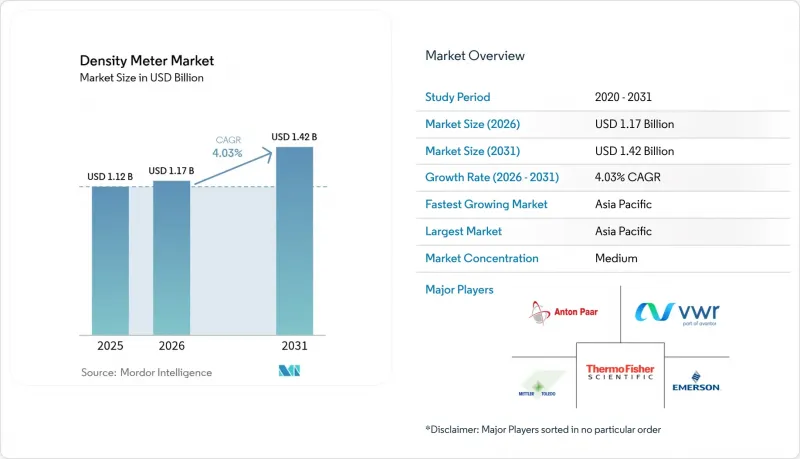
에 의하면, 밀도계 시장 규모는 2025년에 11억 2,000만 달러로 평가되었고, 2026년 11억 7,000만 달러에서 2031년까지 14억 2,000만 달러에 이를 것으로 예측되며, 예측 기간(2026-2031년) CAGR은 4.03%를 나타낼 전망입니다.
본 보고서는 유형별(벤치탑형, 모듈/인라인형, 휴대용/핸드헬드형), 용도별(코리올리식, 핵식, 초음파식, 마이크로파식, 진동 U자관식 등), 유체 매체(액체, 기체, 슬러리 및 현탁액), 최종 사용자 산업(상하수도, 화학제품 및 석유화학제품, 광업 및 금속 가공 등), 지역별로 분류되어 있습니다. 시장 예측은 금액(달러)으로 표시되어 있습니다.
세계의 밀도계 시장 동향 및 인사이트
공정 산업의 디지털 전환이 북미의 실시간 밀도 모니터링 수요를 끌어올리고 있습니다.
현재 북미 전역의 공장에서는 MES(제조 실행 시스템) 및 LIMS(실험실 정보 관리 시스템) 네트워크에 스마트 밀도 센서가 통합되어 있어, 이를 통해 가동 중단 시간을 줄이고 제품 품질의 편차를 최소화하는 예측 모델이 가능해졌습니다. Ergon Refining사의 특수 플랜트에서 입증된 바와 같이, 클라우드 기반 분석 시스템은 밀도, 점도, 유량 데이터를 통합하여 정유시설의 설정값을 최적화합니다. 인라인 계측기는 실험실의 배치 시험을 대체하는 지속적인 검증을 실현하며, 내장된 AI 알고리즘을 통해 규격 외 배치가 발생하기 훨씬 전에 기술자에게 드리프트를 경고하게 되었습니다. 식품 및 제약 업계의 규제 체계 또한 디지털 감사 추적을 통해 규정 준수 보고가 간소화됨에 따라 도입이 더욱 가속화되고 있습니다.
전 세계 석유 및 가스 부문에서 카스토디 트랜스퍼 규제가 강화되면서 인라인 밀도계 도입이 가속화되고 있습니다.
현재 재정 계량 규정은 탄화수소의 카스토디-트랜스퍼에서 불확실성을 0.1% 미만으로 제한하고 있으며, 이에 따라 코리올리식 유량계가 파이프라인 및 부유식 저장 시설에서 표준 솔루션으로 자리 잡고 있습니다. ADNOC의 가스 판매 네트워크에서는 기존 초음파식 기기에 비해 운영 비용(OPEX) 절감 및 넓은 터다운비가 입증되었으며, AGA 및 ISO 규격도 코리올리식의 성능 벤치마크를 참조하도록 개정되었습니다. 아프리카와 라틴아메리카의 신흥 산유국들도 이러한 규격을 채택하고 있어, 이로 인해 질량 유량과 밀도 측정값을 동시에 제공하는 첨단 인라인 계측 장비의 잠재적 도입 시장이 확대되고 있습니다.
유럽의 방사성 원료 면허 발급 관련 문제가 핵밀도계의 보급을 제한하고 있습니다.
지침 2013/59/Euratom에 따라 안전 기준이 강화되고 정기 감사 및 운영자에 대한 필수 교육이 추가됨에 따라 핵식 밀도계의 수명 주기 비용이 증가하고 있습니다. 기기 제조업체는 Part 32 라이선스를 취득하고, 상세한 재고 장부를 통해 밀봉된 방사성 물질을 추적해야 합니다. 이로 인해 과거 감마선식 장비에 의존하던 소규모 가공업체들의 사용이 억제되고 있습니다. 현재 사용자들은 방사선 위험을 제거할 수 있는 초음파식이나 마이크로파식 대체 장비로 눈을 돌리고 있으며, 벌크 고체 처리 플랜트 및 아스팔트 혼합 플랜트 전반에서 기술 대체가 가속화되고 있습니다.
부문 분석
탁상형 장비는 다항목 분석과 엄격한 문서화를 중시하는 제약 품질 관리(QC) 및 화학 제제 연구소를 주축으로 2025년 매출의 44.15%를 차지했습니다. 한편, 핸드헬드형 기기는 연평균 성장률(CAGR) 6.19%를 기록하며, 원격 파이프라인 조사, 음료 현장 검사 및 이동식 광산 작업팀에 힘입어 2031년까지 3억 1,860만 달러를 넘어설 것으로 예측됩니다. 각 제조업체들이 온도 보정 기능, RFID를 통한 시료 추적, LIMS 플랫폼으로의 블루투스 데이터 전송 기능을 추가하고 있어 휴대용 밀도계 시장 규모는 분명히 확대되는 추세입니다.
분산형 의사 결정으로의 광범위한 전환이 이러한 변화를 뒷받침하고 있습니다. 운영자는 현재 충전 현장에서 제품의 밀도를 검증함으로써 실험실 대기 시간을 피하고, 편차를 조기에 발견하고 있습니다. 견고한 ABS 하우징은 먼지와 물보라를 견디며, 내장된 리튬 이온 배터리는 8시간 연속 사용을 가능하게 합니다. 강화된 펌웨어가 자동으로 점도 보정을 수행하여 현장 측정 정확도를 ±0.001 g/cm³ 범위 내로 유지합니다. 이러한 범용성 덕분에 적용 가능한 이용 사례가 유제품 공장에서 바이오디젤 터미널로 확대되었으며, 품질 관리 루프가 강화되고 재작업률이 억제되고 있습니다.
코리올리식 계측기는 2025년 밀도계 시장에서 34.32%의 점유율을 차지했으며, 질량 유량과 밀도를 동시에 측정할 수 있는 독보적인 능력을 통해 그 입지를 공고히 했습니다. 이는 재무 관리 및 배합 제어에 큰 이점이 됩니다. 고사양 모델은 ±0.05%의 밀도 정확도를 달성하고, 코팅 및 이상 유동을 자가 진단함으로써 예기치 않은 가동 중단을 줄입니다. 다양한 기능을 갖춘 펌웨어를 통해 재교정 빈도를 연 1회에서 3년에 1회로 줄여 소유 비용을 절감합니다.
한편, 초음파 방식은 유제품, 펄프, 광업 분야의 파이프라인에서 발생하는 가동 중단 시간과 위생상의 우려를 해소하는 클램프온 설계의 강점을 바탕으로 연평균 성장률(CAGR) 6.78%로 시장을 확대되고 있습니다. 또한, MEMS 기술을 채택한 마이크로 코리올리 방식의 프로토타입도 시료량이 마이크로리터 단위로 측정되는 마이크로 리액터나 약물 전달 용도로 등장하고 있습니다. 구매자가 단순한 센서 정확도보다 예측 유지보수를 우선시하는 가운데, 디지털 트윈과 인라인 진단 기능을 융합한 공급업체가 가장 유리한 입장에 있습니다.
지역별 분석
2025년에는 아시아태평양이 매출의 33.62%를 차지하며 1위를 차지했으며, 그 원동력은 중국의 거대한 정제 및 화학 복합 시설, 인도의 급증하는 바이오의약품 생산 능력, 그리고 한국의 반도체 투자입니다. 밀도계 시장은 스마트 팩토리로의 전환 및 지속가능성 보고를 장려하는 정부 프로그램의 혜택을 지속적으로 누리고 있습니다. 또한, 일본에서 자동차용 유체에 대한 ‘제로 결함’에 주력하고 있는 점이 실험용 장비의 고부가가치 판매를 더욱 뒷받침하고 있습니다.
중동 및 아프리카은 규모는 작지만, 해수 담수화, 그린 수소, 원격 파이프라인 모니터링이 탄력을 받으면서 연평균 성장률(CAGR) 6.08%로 매출 성장을 가속화하고 있습니다. 사우디 아람코의 업스트림 프로젝트에서는 다상 분리기에 코리올리식 유량계가 채택되고 있는 반면, UAE의 유틸리티자는 역삼투 회수율을 높이기 위해 밀도 기반 제어 루프를 채택하고 있습니다. 남아프리카의 백금 광산 업체에서는 광미 농축 설비에서의 물 사용량을 줄이기 위해 초음파 프로브를 개조하고 있습니다. 북미에서는 화학 및 식품 가공 업체들이 기존 플랜트의 디지털화를 추진함에 따라 견조한 업데이트 수요가 유지되고 있습니다. IIoT 도입에 대한 정부의 인센티브로 인해 이더넷-IP(Ethernet-IP) 지원 유량계의 수주가 확대되고 있습니다. 유럽에서는 에너지 비용 상승이라는 역풍이 불고 있음에도 불구하고, 엄격한 탄소세 및 주세 체계가 꾸준한 설비 갱신을 뒷받침하고 있습니다. 남미에서는 광미 댐의 안전성에 대한 관심이 높아짐에 따라 칠레의 구리 광산 및 브라질의 철광산에서 슬러리용 유량계 개조가 촉진되고 있습니다.
기타 혜택 :
- 엑셀 형식 시장 예측(ME) 시트
- 3개월간의 애널리스트 지원
자주 묻는 질문
목차
제1장 서론
제2장 조사 방법
제3장 주요 요약
제4장 시장 구도
제5장 시장 규모 및 성장 예측
제6장 경쟁 구도
제7장 시장 기회 및 향후 전망
AJY 26.08.26According to Mordor Intelligence, the density meter market size was valued at USD 1.12 billion in 2025 and estimated to grow from USD 1.17 billion in 2026 to reach USD 1.42 billion by 2031, at a CAGR of 4.03% during the forecast period (2026-2031).
This report is Segmented by Type (Benchtop, Module/Inline, and Portable/Hand-held), Application (Coriolis, Nuclear, Ultrasonic, Microwave, Vibrating U-Tube, and More), Fluid Medium (Liquids, Gases, and Slurries and Suspensions), End-User Industry (Water and Wastewater, Chemicals and Petrochemicals, Mining and Metal Processing, and More), and Geography. The Market Forecasts are Provided in Terms of Value (USD).
Global Density Meter Market Trends and Insights
Digital Transformation in Process Industries Elevating Demand for Real-Time Density Monitoring in North America
Factories across North America now embed smart density sensors within MES and LIMS networks, enabling predictive models that cut idle time and tighten product-quality distributions. Cloud-hosted analytics combine density, viscosity, and flow data to optimize refinery set-points, as demonstrated at Ergon Refining's specialty plants. Inline meters deliver continuous verification that supersedes lab batch tests, and embedded AI algorithms now alert technicians to drift long before off-spec batches appear. Regulatory regimes in food and pharma further accelerate uptake because digital audit trails simplify compliance reporting.
Stricter Custody Transfer Regulations in Global Oil and Gas Sector Boosting Inline Density Meter Installations
Fiscal metering rules now cap uncertainty at below 0.1% for hydrocarbon custody transfers, positioning Coriolis meters as the default solution for pipelines and floating storage units.ADNOC's sales-gas network has validated lower OPEX and wider turndown compared to legacy ultrasonic devices, while AGA and ISO standards have been amended to reference Coriolis performance benchmarks. Emerging producers in Africa and Latin America are adopting these standards, thereby expanding the addressable pool for advanced inline instruments that deliver simultaneous mass-flow and density readings.
Radioactive-Source Licensing Challenges Limiting Nuclear Density Meter Uptake in Europe
Directive 2013/59/Euratom tightened safety standards, adding recurrent audits and mandatory operator training that raise lifecycle costs for nuclear gauges. Device makers must secure Part 32 licenses and track sealed sources through detailed inventory logs, discouraging small processors that once relied on gamma-ray instruments. Users now gravitate toward ultrasonic or microwave alternatives that eliminate radiological liabilities, accelerating technology substitution across bulk-solids handling and asphalt-mix plants.
Other drivers and restraints analyzed in the detailed report include:
- Rising Adoption of Inline Quality Control in Craft Beverage Industry Across Europe
- Slurry-density optimization in mining
- High Initial Calibration Costs for Coriolis Density Meters in Emerging Economies
For complete list of drivers and restraints, kindly check the Table Of Contents.
Segment Analysis
Benchtop units held 44.15% of 2025 revenue, anchored in pharma QC and chemical formulation labs that value multi-parameter analysis and stringent documentation. Conversely, handheld instruments posted a 6.19% CAGR and will surpass USD 318.6 million by 2031, driven by remote pipeline surveys, on-the-spot beverage checks, and mobile mining crews. The density meter market size for portable devices is on a clear upswing as manufacturers add temperature compensation, RFID sample tracking, and Bluetooth export to LIMS platforms.
A broader push toward decentralized decision-making reinforces the shift. Operators now validate product density at the point of fill, avoiding lab queues and catching deviations early. Rugged ABS housings withstand dust and splash, while on-board lithium packs deliver eight-hour autonomy. Enhanced firmware performs automatic viscosity correction, enabling field accuracy within +-0.001 g/cm3. This versatility is expanding addressable use cases from dairy plants to biodiesel terminals, tightening quality loops and curbing rework rates.
Coriolis instruments commanded 34.32% density meter market share in 2025, cemented by unmatched ability to capture mass-flow and density simultaneously-a boon for fiscal custody and recipe control. High-end models achieve +-0.05% density accuracy and self-diagnose coating or two-phase flow, lowering unplanned outages. Feature-rich firmware reduces recalibration frequency from yearly to triennial, trimming ownership costs.
Ultrasonic variants, however, are advancing at a 6.78% CAGR on the strength of clamp-on designs that avert downtime and sanitation worries in dairy, pulp, and mining pipelines. MEMS-powered micro-Coriolis prototypes also surface for micro-reactor and drug-delivery applications where sample volumes are measured in microliters. Suppliers that blend digital twins with inline diagnostics are best positioned as buyers prioritize predictive maintenance over mere sensor accuracy.
Complete Report Scope:
- By Type
- Benchtop
- Module/Inline
- Portable/Hand-held
- By Measurement Technology
- Coriolis
- Nuclear (Gamma)
- Ultrasonic
- Microwave
- Vibrating U-Tube
- Gravimetric (Hydrometer Replacement)
- By End-user Industry
- Water and Wastewater
- Chemicals and Petrochemicals
- Mining and Metal Processing
- Food and Beverage
- Healthcare and Pharmaceuticals
- Electronics and Semiconductors
- Oil and Gas (Upstream, Midstream, Downstream)
- Power and Utilities
- Research and Academic
- By Fluid Medium
- Liquids
- Gases
- Slurries and Suspensions
- By Geography
- North America
- United States
- Canada
- Mexico
- Europe
- Germany
- United Kingdom
- France
- Nordics
- Rest of Europe
- South America
- Brazil
- Rest of South America
- Asia-Pacific
- China
- Japan
- India
- South-East Asia
- Rest of Asia-Pacific
- Middle East and Africa
- Middle East
- Gulf Cooperation Council Countries
- Turkey
- Rest of Middle East
- Africa
- South Africa
- Rest of Africa
- Middle East
- North America
Geography Analysis
Asia-Pacific led with 33.62% revenue in 2025, propelled by China's vast refining and chemical complexes, India's surging biologics capacity, and South Korea's semiconductor investments. The density meter market continues to benefit from government programs that reward smart-factory retrofits and sustainability reporting. Japan's focus on zero-defect automotive fluids further sustains premium sales of laboratory instruments.
The Middle East and Africa, though smaller, deliver top-line acceleration at a 6.08% CAGR as desalination, green hydrogen, and remote pipeline monitoring gain momentum. Saudi Aramco's upstream projects utilize Coriolis meters in multiphase separators, whereas UAE utilities employ density-based control loops to enhance reverse-osmosis recovery ratios. South African platinum miners retrofit ultrasonic probes to cut water use in tailings thickeners. North America maintains robust replacement demand as chemical and food processors digitize legacy plants. Government incentives for IIoT adoption amplify orders for Ethernet-IP-enabled meters. Europe's stringent carbon and alcohol tax frameworks underpin steady upgrades, despite energy cost headwinds. South America's focus on tailings dam safety catalyzes slurry-meter retrofits in Chilean copper and Brazilian iron-ore operations.
- Anton Paar GmbH
- Mettler-Toledo International Inc.
- Emerson Electric Co.
- Endress+Hauser Group
- Siemens AG
- Yokogawa Electric Corporation
- Vega Grieshaber KG
- Krohne Messtechnik GmbH
- Ametek Inc.
- Thermo Fisher Scientific Inc.
- Berthold Technologies GmbH and Co. KG
- Rhosonics Analytical B.V.
- Rudolph Research Analytical
- KRUSS Optronic GmbH
- Red Meters LLC
- Toshiba Infrastructure Systems and Solutions Corporation
- VWR International (Avantor)
- Schmidt + Haensch GmbH and Co.
- Micromeritics Instrument Corp.
- Beijing ZhongKe Analytical Instruments Co.
Additional Benefits:
- The market estimate (ME) sheet in Excel format
- 3 months of analyst support
TABLE OF CONTENTS
1 INTRODUCTION
- 1.1 Study Assumptions and Market Definition
- 1.2 Scope of the Study
2 RESEARCH METHODOLOGY
3 EXECUTIVE SUMMARY
4 MARKET LANDSCAPE
- 4.1 Market Overview
- 4.2 Market Drivers
- 4.2.1 Digital Transformation in Process Industries Elevating Demand for Real-Time Density Monitoring in North America
- 4.2.2 Stricter Custody Transfer Regulations in Global Oil and Gas Sector Boosting Inline Density Meter Installations
- 4.2.3 Rising Adoption of Inline Quality Control in Craft Beverage Industry Across Europe
- 4.2.4 Mining Industry's Shift to Slurry Density Optimization in South America
- 4.2.5 Growth of Biopharmaceutical Continuous Manufacturing Necessitating High-Precision Density Measurement in Asia-Pacific
- 4.2.6 Water-Scarcity Driven Desalination Projects Fuelling Density Meter Demand in Middle East
- 4.3 Market Restraints
- 4.3.1 Radioactive Source Licensing Challenges Limiting Nuclear Density Meter Uptake in Europe
- 4.3.2 High Initial Calibration Costs for Coriolis Density Meters in Emerging Economies
- 4.3.3 Performance Drift of Ultrasonic Density Meters in High-Temperature Slurries
- 4.3.4 Fragmented Low-Cost Chinese Suppliers Intensifying Price Pressure Globally
- 4.4 Industry Ecosystem Analysis
- 4.5 Technological Outlook
- 4.6 Porter's Five Forces Analysis
- 4.6.1 Bargaining Power of Suppliers
- 4.6.2 Bargaining Power of Buyers
- 4.6.3 Threat of New Entrants
- 4.6.4 Threat of Substitutes
- 4.6.5 Intensity of Competitive Rivalry
5 MARKET SIZE AND GROWTH FORECASTS (VALUE)
- 5.1 By Type
- 5.1.1 Benchtop
- 5.1.2 Module/Inline
- 5.1.3 Portable/Hand-held
- 5.2 By Measurement Technology
- 5.2.1 Coriolis
- 5.2.2 Nuclear (Gamma)
- 5.2.3 Ultrasonic
- 5.2.4 Microwave
- 5.2.5 Vibrating U-Tube
- 5.2.6 Gravimetric (Hydrometer Replacement)
- 5.3 By End-user Industry
- 5.3.1 Water and Wastewater
- 5.3.2 Chemicals and Petrochemicals
- 5.3.3 Mining and Metal Processing
- 5.3.4 Food and Beverage
- 5.3.5 Healthcare and Pharmaceuticals
- 5.3.6 Electronics and Semiconductors
- 5.3.7 Oil and Gas (Upstream, Midstream, Downstream)
- 5.3.8 Power and Utilities
- 5.3.9 Research and Academic
- 5.4 By Fluid Medium
- 5.4.1 Liquids
- 5.4.2 Gases
- 5.4.3 Slurries and Suspensions
- 5.5 By Geography
- 5.5.1 North America
- 5.5.1.1 United States
- 5.5.1.2 Canada
- 5.5.1.3 Mexico
- 5.5.2 Europe
- 5.5.2.1 Germany
- 5.5.2.2 United Kingdom
- 5.5.2.3 France
- 5.5.2.4 Nordics
- 5.5.2.5 Rest of Europe
- 5.5.3 South America
- 5.5.3.1 Brazil
- 5.5.3.2 Rest of South America
- 5.5.4 Asia-Pacific
- 5.5.4.1 China
- 5.5.4.2 Japan
- 5.5.4.3 India
- 5.5.4.4 South-East Asia
- 5.5.4.5 Rest of Asia-Pacific
- 5.5.5 Middle East and Africa
- 5.5.5.1 Middle East
- 5.5.5.1.1 Gulf Cooperation Council Countries
- 5.5.5.1.2 Turkey
- 5.5.5.1.3 Rest of Middle East
- 5.5.5.2 Africa
- 5.5.5.2.1 South Africa
- 5.5.5.2.2 Rest of Africa
- 5.5.5.1 Middle East
- 5.5.1 North America
6 COMPETITIVE LANDSCAPE
- 6.1 Market Concentration
- 6.2 Strategic Developments
- 6.3 Market Share Analysis
- 6.4 Company Profiles (includes Global level Overview, Market level overview, Core Segments, Financials as available, Strategic Information, Market Rank/Share for key companies, Products and Services, and Recent Developments)
- 6.4.1 Anton Paar GmbH
- 6.4.2 Mettler-Toledo International Inc.
- 6.4.3 Emerson Electric Co.
- 6.4.4 Endress+Hauser Group
- 6.4.5 Siemens AG
- 6.4.6 Yokogawa Electric Corporation
- 6.4.7 Vega Grieshaber KG
- 6.4.8 Krohne Messtechnik GmbH
- 6.4.9 Ametek Inc.
- 6.4.10 Thermo Fisher Scientific Inc.
- 6.4.11 Berthold Technologies GmbH and Co. KG
- 6.4.12 Rhosonics Analytical B.V.
- 6.4.13 Rudolph Research Analytical
- 6.4.14 KRUSS Optronic GmbH
- 6.4.15 Red Meters LLC
- 6.4.16 Toshiba Infrastructure Systems and Solutions Corporation
- 6.4.17 VWR International (Avantor)
- 6.4.18 Schmidt + Haensch GmbH and Co.
- 6.4.19 Micromeritics Instrument Corp.
- 6.4.20 Beijing ZhongKe Analytical Instruments Co.
7 MARKET OPPORTUNITIES AND FUTURE OUTLOOK
- 7.1 White-Space and Unmet-Need Assessment


