

|
시장보고서
상품코드
2114503
자가면역질환 치료 : 시장 점유율 분석, 업계 동향 및 통계, 성장 예측(2026-2031년)Autoimmune Treatment - Market Share Analysis, Industry Trends & Statistics, Growth Forecasts (2026 - 2031) |
||||||
 Mordor Intelligence
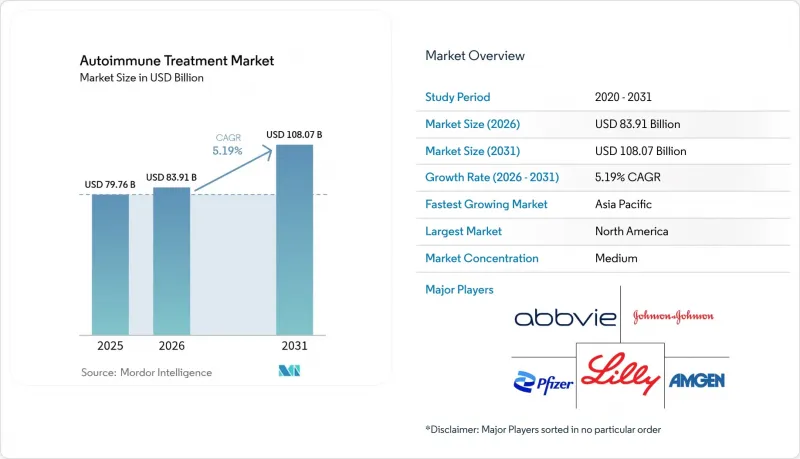
Mordor Intelligence에 의하면, 자가면역질환 치료 시장 규모는 2025년 797억 6,000만 달러로 평가되었습니다. 2026년에는 839억 1,000만 달러로 확대되어 2026년부터 2031년에 걸쳐 CAGR 5.19%로 성장을 지속하여, 2031년까지 1,080억 7,000만 달러에 이를 것으로 예측됩니다.
본 보고서는 치료법별(약제 분류별 (항염증제, 혈당강하제, 인터페론 등), 외과 수술 (인공관절 치환술, 관절 고정술 등)), 적응증별(류마티스성 질환, 1형 당뇨병, 다발성 경화증, 염증성 장질환 등), 지역별(북미, 유럽, 아시아태평양 등)로 분류되어 있습니다. 시장 예측은 금액(달러) 기준으로 제시되어 있습니다.
세계의 자가면역질환 치료 시장 동향 및 인사이트
조기 발병 자가면역질환 발생률의 연령 조정 후 증가
15-39세 연령대에서 류마티스 관절염, 염증성 장 질환, 다발성 경화증의 유병률이 증가하고 있으며, 이에 따라 평생에 걸친 치료 수요가 확대되고, 보다 안전한 만성 질환 치료 요법의 장기적인 가치가 높아지고 있습니다. 현재 선별 검진 프로그램은 청소년을 대상으로 하고 있는 반면, 보험사는 효과가 장기간 지속되는 것으로 입증된 치료법을 우선적으로 채택하고 있습니다. 저독성 작용기전을 가진 제약 기업들은 환자들이 조기에 치료를 시작함에 따라 누적 수익을 확대되고 있습니다. 이러한 추세로 인해 차세대 생물학적 제제 및 세포 치료의 대상 환자층이 확대되고 있으며, 자가면역 질환 치료 시장은 장기적으로 판매량이 더욱 증가할 전망입니다.
치료비 장벽을 낮추는 바이오시밀러의 물결
아달리무브의 바이오시밀러는 출시 후 18개월 이내에 처방량의 85%를 차지하며, 2025년까지 384억 달러의 의료비가 절감되었습니다. 이러한 절감으로 인해 보험사 측의 예산에 여유가 생겨, 이중 특이성 항체나 CAR-T 요법과 같은 신규 치료제에 대한 투자가 가능해집니다. 이에 반해, 오리지널 제약사는 부가가치가 높은 제제나 서비스 패키지로 대응하고 있어 경쟁이 격화되고 있습니다. 과거 스테로이드에 의존하던 신흥 시장에서도 현재는 첨단 생물학적 제제가 도입되고 있으며, 이에 따라 자가면역 치료 시장의 전 세계적 보급 범위가 확대되고 있습니다.
암 치료용 바이오의약품 지출에 따른 지불 주체의 예산 압박
종양학 분야의 CAR-T 요법 청구 가격 중앙값은 1코스당 40만 달러를 초과하여, 만성 자가면역 질환 치료 분야의 자금을 잠식하고 있습니다. 미국 및 EU의 처방약 목록에서는 고비용 바이오의약품에 대한 사전 승인 기준이 엄격해졌으며, 도입을 지연시키는 단계적 치료 절차가 도입되었습니다. 제약사들은 치료 결과에 기반한 리베이트로 대응하고 있지만, 단기적인 판매량은 예측치를 밑돌 가능성이 있어 자가면역 질환 치료 시장의 성장을 둔화시킬 우려가 있습니다.
부문별 분석
TNF 억제제, IL-6 길항제, JAK 억제제를 포함한 항염증 요법은 2025년 전 세계 매출의 37.02%를 차지했습니다. 관절, 피부, 장의 염증에 대해 폭넓은 효능을 나타내므로, 1차 선택 약제로서의 입지가 확고해졌습니다. 고정 용량의 피하 주사용 펜형 제제나 1일 1회 투여하는 경구 정제는 복약 순응도를 높여, 기존 제품을 바이오시밀러에 의한 즉각적인 시장 잠식으로부터 보호하고 있습니다. 한편, 인터페론은 피부근염 및 루푸스 파이프라인에 새로운 페그화 제제 및 경구 제제가 진입함에 따라, 2031년까지 연평균 성장률(CAGR)이 8.69%를 나타낼 것으로 전망됩니다. 차세대 인터페론은 내약성이 향상되어 실제 임상에서 치료 지속 기간을 연장하고 있습니다. 인터페론 기반 치료법에 의한 자가면역 질환 치료 시장 규모는 적응증 확대를 반영하여 2031년까지 97억 4,000만 달러에 달할 것으로 예측됩니다.
동시에 이중 경로 억제제로서 이중 특이성 항체가 부상하고 있으며, 블록버스터급의 평가액을 기록하고 있습니다. 머크(Merck)는 2024년, 큐론(Curon)사의 B세포 제거제 ‘CN201’을 7억 달러에 인수했습니다. 파이프라인의 다양화에는 만성적인 억제가 아닌 면역 균형의 재설정을 목표로 하는 면역 관용 유도형 세포 치료법도 포함되어 있습니다. 1형 당뇨병 분야의 퍼스트-인-클래스 후보 약물은 β세포 기능 유지를 목표로 하며, 자가면역 질환 치료 시장에 예방적 접근 방식을 도입하는 것입니다. 아직 초기 단계이긴 하지만, 이러한 치료법은 예측 기간을 넘어 약물 분류별 구성을 완전히 바꿀 가능성이 있습니다.
지역별 분석
북미는 2025년, 혁신적인 작용기전의 급속한 보급, 유리한 보험 환급 제도, 그리고 탄탄한 임상시험 생태계에 힘입어 전 세계 매출의 42.35%를 차지했습니다. 이 지역의 유연하고 신속한 승인 체계 덕분에 지난 2년 동안 9개의 자가면역 질환용 바이오의약품이 시장에 출시되어 선점자 우위가 확고해졌습니다. 획기적인 CAR-T 프로그램은 FDA의 패스트 트랙(Fast Track) 지정에 따라 빠르게 진전되고 있으며, 차세대 면역 조절 요법에 대한 투자 자금의 유입을 촉진하고 있습니다. 디지털 헬스 관련 보험 환급 균등화법은 행동 변화 앱의 병용 처방을 장려하여, 약물 복용 순응도를 강화하고 재발과 관련된 비용을 절감하고 있습니다.
유럽에서는 가격·수량 협정이 치료의 집중화로 인한 비용 상승을 상쇄하고 있어 균형 잡힌 성장을 유지하고 있습니다. 유럽의약품청(EMA)의 PRIME 패스웨이는 이중 특이성 항체 등 수요가 높은 의약품의 승인 기간을 단축하고 있지만, 각국의 의료 제도에서는 여전히 예산 상한선이 부과되어 있어 접근권 협상에 시간이 소요되고 있습니다. 바이오시밀러의 보급이 지출을 억제하고, 첨단 치료 옵션에 대한 여지를 만들어내고 있습니다. 현재, 국경을 초월한 컨소시엄이 틈새 자가면역 질환 적응증에 대한 수요를 집약함으로써 협상력을 높이고 공급의 지속성을 확보하고 있습니다.
아시아태평양은 인구 증가, 도시화, 규제 조화에 힘입어 2031년까지 연평균 성장률(CAGR)이 8.46%로 두드러지게 높습니다. 중국의 수량 기준 조달 제도는 생물학적 제제의 가격을 대폭 낮추고 있지만, 오리지널 제약사에 실세계 데이터 제공을 의무화하는 조항이 마련되어 있어 근거 기반의 도입이 촉진되고 있습니다. 일본에서는 세포 처리 기준이 조기에 도입된 것이 종양학 이외의 분야에서 지역적 CAR-T 임상시험의 기반이 되고 있습니다. 인도 및 동남아시아에서는 환급 제도의 불균형으로 인해 진전이 더딘 편이지만, 민관 파트너십을 통해 바이오의약품 제조 단지에 대한 투자가 진행되고 있어 현지 공급의 안정성이 기대되고 있습니다. 2031년까지 아시아태평양의 자가면역 질환 치료 시장은 301억 2,000만 달러에 달할 것으로 예측되며, 성숙한 지역에 대한 중요한 균형추 역할을 할 것입니다.
남미, 중동 및 아프리카의 매출 기여도는 작지만, 의료 예산의 꾸준한 증가와 진료 지침의 현대화에 힘입어 바이오시밀러 및 일부 오리지널 바이오의약품의 도입이 진행되고 있습니다. 의약품 공급과 의사 대상 교육 프로그램을 결합한 전략은 가격에 민감한 이들 지역에서의 보급을 가속화하고 있습니다. 그 결과, 전 세계 자가면역질환 치료 시장은 지리적으로 더욱 균형 잡힌 상태를 이루게 되었으며, 단일 지역에 대한 의존도가 낮아지고 있습니다.
기타 혜택 :
- 엑셀 형식 시장 예측(ME) 시트
- 3개월간의 애널리스트 지원
자주 묻는 질문
목차
제1장 서론
제2장 조사 방법
제3장 개요
제4장 시장 구도
제5장 시장 규모 및 성장 예측
제6장 경쟁 구도
제7장 시장 기회 및 향후 전망
KTH 26.08.31According to Mordor Intelligence, the autoimmune treatment market size is expected to grow from USD 79.76 billion in 2025 to USD 83.91 billion in 2026 and is forecast to reach USD 108.07 billion by 2031 at 5.19% CAGR over 2026-2031.
This report is Segmented by Treatment Type (Drug Class {Anti-Inflammatory, Anti-Hyperglycemics, Interferons, and More} Surgery {Joint Replacement, Arthrodesis, and More}), Indication (Rheumatic Disease, Type 1 Diabetes, Multiple Sclerosis, Inflammatory Bowel Disease, and More), and Geography (North America, Europe, Asia-Pacific, and More). The Market Forecasts are Provided in Terms of Value (USD).
Global Autoimmune Treatment Market Trends and Insights
Age-standardised rise in early-onset autoimmune incidence
Incidence among individuals aged 15-39 has climbed across rheumatoid arthritis, inflammatory bowel disease, and multiple sclerosis, extending lifetime therapy needs and magnifying the long-run value of safer chronic regimens. Screening programs now target adolescents, while payers prioritise treatments with proven durability. Manufacturers positioned with low-toxicity mechanisms gain larger cumulative revenue because patients initiate therapy earlier. The trend enlarges the addressable population for next-generation biologics and cell therapies, pushing the autoimmune treatment market toward higher long-term volumes.
Biosimilar wave lowering therapy cost-barriers
Adalimumab biosimilars seized 85% of dispensed volume within 18 months of launch, yielding projected system savings of USD 38.4 billion through 2025. Savings free payer budgets for novel assets such as bispecific antibodies or CAR-T constructs. Originators respond with value-added formulations and service packages, raising competitive intensity. Emerging markets that once relied on steroids are now integrating advanced biologics, thereby widening the global penetration of the autoimmune treatment market.
Payer budget fatigue amid oncology biologic spend
Median oncology CAR-T invoice prices exceed USD 400,000 per course, diverting funds from chronic autoimmune lines. The US and EU formularies are tightening prior-authorization criteria for high-cost biologics, introducing step-therapy hurdles that slow uptake. Manufacturers counter with outcomes-based rebates, but near-term volume can lag forecasts, shaving growth from the autoimmune treatment market.
Other drivers and restraints analyzed in the detailed report include:
- Oral biologics achieving Phase III read-outs
- Digital-therapeutic-plus-drug adherence programs
- Slow guideline updates for novel MOAs in emerging markets
For complete list of drivers and restraints, kindly check the Table Of Contents.
Segment Analysis
Anti-inflammatory modalities, including TNF blockers, IL-6 antagonists, and JAK inhibitors, accounted for 37.02% of the 2025 global sales. Their broad efficacy across joint, skin, and bowel inflammation cements first-line placement. Fixed-dose subcutaneous pens and once-daily oral tablets reinforce adherence, protecting incumbents from immediate biosimilar cannibalisation. Interferons, however, register an 8.69% CAGR through 2031, driven by novel pegylated and oral formulations entering dermatomyositis and lupus pipelines. New-generation interferons exhibit improved tolerability, extending real-world persistence. The autoimmune treatment market size for interferon-based regimens is expected to climb to USD 9.74 billion by 2031, mirroring label expansions.
Concurrently, bispecific antibodies are emerging as dual-pathway suppressors, attracting blockbuster valuations; Merck paid USD 700 million for Curon's B-cell depleter, CN201, in 2024. Pipeline diversity now includes tolerogenic cell therapies aimed at resetting immune balance instead of chronic suppression. First-in-class candidates in Type 1 diabetes aim to preserve beta-cell function, introducing a preventative approach within the autoimmune treatment market. Although early-stage, these modalities could reshape drug-class mix beyond the forecast window.
Complete Report Scope:
- By Treatment Type
- Drug Class
- Anti-Inflammatory
- Anti-Hyperglycemics
- NSAIDs
- Interferons
- Other Drugs
- Surgery
- Joint Replacement (Arthroplasty)
- Arthrodesis (Joint Fusion)
- Tendon Reconstruction
- Drug Class
- By Indication
- Rheumatic Disease
- Proctocolectomy / Colectomy
- Type 1 Diabetes
- Thyroidectomy
- Multiple Sclerosis
- Others
- Inflammatory Bowel Disease
- Other Indications
- Rheumatic Disease
- Geography
- North America
- United States
- Canada
- Mexico
- Europe
- Germany
- United Kingdom
- France
- Italy
- Spain
- Rest of Europe
- Asia-Pacific
- China
- Japan
- India
- South Korea
- Australia
- Rest of Asia-Pacific
- Middle East and Africa
- GCC
- South Africa
- Rest of Middle East and Africa
- South America
- Brazil
- Argentina
- Rest of South America
- North America
Geography Analysis
North America delivered 42.35% of global revenue in 2025, supported by rapid diffusion of innovative modes of action, favourable reimbursement, and a dense clinical-trial ecosystem. The region's flexible accelerated-approval frameworks placed nine autoimmune biologics on the market in the past two years, cementing first-mover advantage. Breakthrough CAR-T programs progress swiftly under FDA Fast Track designations, catalysing investor capital toward next-wave immunomodulation. Digital-health reimbursement parity laws encourage co-prescription of behaviour-change apps, reinforcing medication adherence and lowering relapse-associated costs.
Europe maintains balanced growth as price-volume agreements offset rising treatment intensity. The European Medicines Agency's PRIME pathway shortens approval timelines for high-need assets such as bispecific antibodies, yet national health systems still impose budget caps that lengthen access negotiations. Biosimilar penetration tempers spending, freeing capacity for advanced options. Cross-country consortiums now aggregate demand for niche autoimmune indications, enhancing negotiating leverage and smoothing supply continuity.
Asia-Pacific stands out with an 8.46% CAGR through 2031, driven by demographic expansion, urbanisation, and regulatory harmonisation. China's volume-based procurement slashes biologic prices, yet adds clauses for originators to supply real-world data, fostering evidence-led adoption. Japan's early implementation of cell-processing standards underpins regional CAR-T trials beyond oncology. India and South-East Asia progress slower due to reimbursement fragmentation, but public-private partnerships invest in biologic manufacturing parks that promise local supply resilience. By 2031 the autoimmune treatment market in Asia-Pacific is forecast to reach USD 30.12 billion, providing a vital counterweight to mature regions.
South America and the Middle East & Africa contribute smaller revenue, yet steady health-budget growth and guideline modernisation improve uptake of biosimilars and select originator biologics. Strategies that bundle drug supply with physician-training modules accelerate diffusion in these price-sensitive settings. As a result, the global autoimmune treatment market achieves broader geographic balance, lowering dependence on single-region performance.
- Abbvie
- Amgen
- Johnson & Johnson
- Eli Lilly and Company
- Pfizer
- Roche
- AstraZeneca
- Bristol-Myers Squibb
- Lupin
- GlaxoSmithKline
- Novartis Inc
- Sanofi
- Biocon
- CSL Behring
- Grifols
- Takeda Pharmaceuticals
- UCB
- Regeneron
- Incyte
- Horizon Therapeutics
- Zimmer Biomet
- Stryker
- Smiths Group
- Medtronic
- NewMed Instruments
Additional Benefits:
- The market estimate (ME) sheet in Excel format
- 3 months of analyst support
TABLE OF CONTENTS
1 Introduction
- 1.1 Study Assumptions & Market Definition
- 1.2 Scope of the Study
2 Research Methodology
3 Executive Summary
4 Market Landscape
- 4.1 Market Overview
- 4.2 Market Drivers
- 4.2.1 Age-Standardised Rise In Early-Onset Autoimmune Incidence
- 4.2.2 Biosimilar Wave Lowering Therapy Cost-Barriers
- 4.2.3 Oral Biologics Achieving Phase III Read-Outs
- 4.2.4 Digital-Therapeutic-Plus-Drug Adherence Programs
- 4.2.5 Bispecific Antibody Approvals For Multi-Pathway Control
- 4.3 Market Restraints
- 4.3.1 Payer Budget Fatigue Amid Oncology Biologic Spend
- 4.3.2 Slow Guideline Updates For Novel Moas In Emerging Markets
- 4.3.3 Biomanufacturing Capacity Crunch For Cell-Based Therapies
- 4.4 Porter's Five Forces
- 4.4.1 Threat of New Entrants
- 4.4.2 Bargaining Power of Buyers/Consumers
- 4.4.3 Bargaining Power of Suppliers
- 4.4.4 Threat of Substitute Products
- 4.4.5 Intensity of Competitive Rivalry
5 Market Size & Growth Forecasts (Value, USD)
- 5.1 By Treatment Type
- 5.1.1 Drug Class
- 5.1.1.1 Anti-Inflammatory
- 5.1.1.2 Anti-Hyperglycemics
- 5.1.1.3 NSAIDs
- 5.1.1.4 Interferons
- 5.1.1.5 Other Drugs
- 5.1.2 Surgery
- 5.1.2.1 Joint Replacement (Arthroplasty)
- 5.1.2.2 Arthrodesis (Joint Fusion)
- 5.1.2.3 Tendon Reconstruction
- 5.1.1 Drug Class
- 5.2 By Indication
- 5.2.1 Rheumatic Disease
- 5.2.1.1 Proctocolectomy / Colectomy
- 5.2.2 Type 1 Diabetes
- 5.2.2.1 Thyroidectomy
- 5.2.3 Multiple Sclerosis
- 5.2.3.1 Others
- 5.2.4 Inflammatory Bowel Disease
- 5.2.5 Other Indications
- 5.2.1 Rheumatic Disease
- 5.3 Geography
- 5.3.1 North America
- 5.3.1.1 United States
- 5.3.1.2 Canada
- 5.3.1.3 Mexico
- 5.3.2 Europe
- 5.3.2.1 Germany
- 5.3.2.2 United Kingdom
- 5.3.2.3 France
- 5.3.2.4 Italy
- 5.3.2.5 Spain
- 5.3.2.6 Rest of Europe
- 5.3.3 Asia-Pacific
- 5.3.3.1 China
- 5.3.3.2 Japan
- 5.3.3.3 India
- 5.3.3.4 South Korea
- 5.3.3.5 Australia
- 5.3.3.6 Rest of Asia-Pacific
- 5.3.4 Middle East and Africa
- 5.3.4.1 GCC
- 5.3.4.2 South Africa
- 5.3.4.3 Rest of Middle East and Africa
- 5.3.5 South America
- 5.3.5.1 Brazil
- 5.3.5.2 Argentina
- 5.3.5.3 Rest of South America
- 5.3.1 North America
6 Competitive Landscape
- 6.1 Market Concentration
- 6.2 Market Share Analysis
- 6.3 Company Profiles (includes Global level Overview, Market level overview, Core Segments, Financials as available, Strategic Information, Market Rank/Share for key companies, Products & Services, and Recent Developments)
- 6.3.1 AbbVie Inc
- 6.3.2 Amgen Inc
- 6.3.3 Johnson & Johnson (Janssen)
- 6.3.4 Eli Lilly & Co.
- 6.3.5 Pfizer Inc
- 6.3.6 F. Hoffmann-La Roche
- 6.3.7 AstraZeneca plc
- 6.3.8 Bristol-Myers Squibb
- 6.3.9 Lupin Ltd
- 6.3.10 GSK plc
- 6.3.11 Novartis Inc
- 6.3.12 Sanofi SA
- 6.3.13 Biocon
- 6.3.14 CSL Behring
- 6.3.15 Grifols
- 6.3.16 Takeda
- 6.3.17 UCB Pharma
- 6.3.18 Regeneron
- 6.3.19 Incyte
- 6.3.20 Horizon Therapeutics
- 6.3.21 Zimmer Biomet
- 6.3.22 Stryker
- 6.3.23 Smith & Nephew
- 6.3.24 Medtronic
- 6.3.25 NewMed Instruments
7 Market Opportunities & Future Outlook
- 7.1 White-space & Unmet-Need Assessment


