

|
시장보고서
상품코드
2114535
실험실 숙련도 시험 시장 : 점유율 분석, 업계 동향과 통계, 성장 예측(2026-2031년)Laboratory Proficiency Testing - Market Share Analysis, Industry Trends & Statistics, Growth Forecasts (2026 - 2031) |
||||||
 Mordor Intelligence
Mordor Intelligence에 의하면, 실험실 숙련도 시험 시장 규모는 2025년 15억 8,000만 달러에서 2026년에는 16억 8,000만 달러로 확대되어 2026년부터 2031년까지 CAGR 6.18%로 성장을 지속하여, 2031년에는 22억 6,000만 달러에 이를 것으로 예측됩니다.
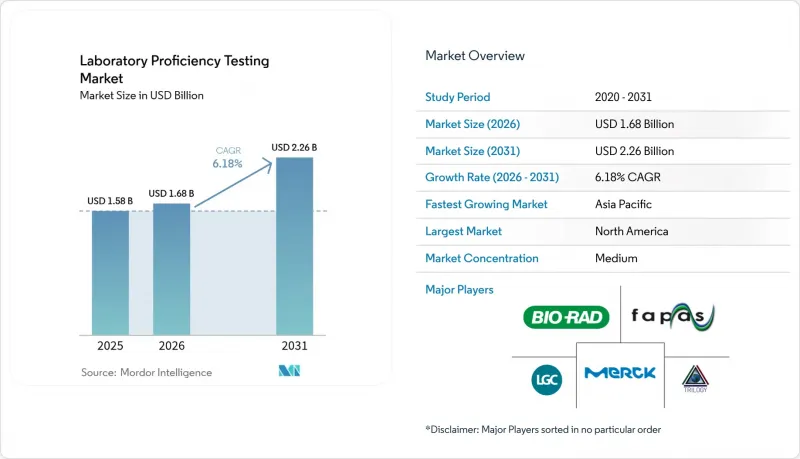
본 보고서는 산업별(임상 진단, 미생물학, 의약품·생물학적 제제 등), 기술별(크로마토그래피, 분광광도법, 면역측정법 등), 제공업체별(독립형/제3자 제공업체, 장비 제조업체의 프로그램 등), 지역별(북미, 유럽 등)로 구분되어 있습니다. 시장 전망은 금액(달러) 기준으로 제시되어 있습니다.
전 세계 실험실 숙련도 시험 시장 동향 및 인사이트
ISO/IEC 17025 및 17043 인증 요건의 강화
ISO/IEC 17025:2017 및 ISO/IEC 17043의 2023년 개정판에 대한 전 세계적인 조화를 통해, 검사 기관은 절차 준수가 아닌 정량적인 역량을 입증해야 합니다. 홍콩의 HKAS는 2024년 11월에 새로운 17043 표준을 채택했으며, 캐나다 표준 위원회도 2024년 5월에 유사한 개정을 실시했습니다. 인증 기관은 기준에 부합하지 않는 검사 기관의 인증을 일시 정지할 권한을 가지고 있으며, 이로 인해 업계 재편이 진행되고 통계적으로 신뢰할 수 있는 외부 품질 평가에 대한 수요가 높아지고 있습니다. ISO 규격의 통합이 신흥 시장으로 확대됨에 따라, 인증 갱신과 연계된 참여 의무 조항을 통해 실험실 숙련도 시험 시장은 탄력을 받고 있습니다.
만성 질환의 부담 증가에 따른 임상 진단 검사량 확대
당뇨병, 심혈관 질환 및 종양학 검사의 발생률 증가로 인해 미국 내 검사 기관 1곳당 평균 검사 항목 수가 증가했으며, 차세대 염기서열 분석 패널에 대한 참여도 확대되고 있습니다. CLIA 규정에서는 중·고 난이도의 모든 검사 기관에 대해 승인된 프로그램 참여가 의무화되어 있으며, CMS는 2025년을 목표로 새로운 세포진단 체계를 승인했습니다. 퀘스트 다이아그노스틱스(Quest Diagnostics)와 같은 대규모 네트워크는 2023년에 93억 달러의 매출을 기록했으며, 이는 규모 확대가 여러 거점에서의 기술 시험 가입자 수를 얼마나 증가시키는지를 여실히 보여줍니다. 따라서 실험실 숙련도 평가 시장은 특히 고도의 분자 검사와 같이 개별적인 외부 품질 평가가 요구되는 경우, 진단 검사량 증가에 비례하여 확대될 것입니다.
중소규모 검사 기관의 고액 참가 비용
공중보건 검사실 협회(Association of Public Health Laboratories)의 독립 조사에 따르면, 검사 건수가 적은 검사실의 경우 연간 능력 시험 지출이 총 수익의 3%를 초과하는 경우가 있으며, 이는 특히 개발도상국에서 참여를 제약하는 요인이 되고 있습니다. 2023년 8월 USP 제도의 종료는 전환 비용을 상승시켰으며, 시장 철수가 소규모 시설에 미치는 가격 상승 압력이 얼마나 큰지를 여실히 드러냈습니다.
부문 분석
2025년, 임상 진단 분야는 실험실 숙련도 시험 시장 점유율의 38.21%를 차지했습니다. 이는 CLIA(임상검사법) 요건에 더해 만성 질환 검사 건수 증가로 인해 프로그램 참여가 유지되었기 때문입니다. 검사 기관은 혈액학, 생화학, 감염병 검사 각 패널의 능력 시험 시장 규모를 여러 공급자에게 분산하여 위탁하는 것이 일반적이며, 이를 통해 예측 가능한 갱신 수익을 확보하고 있습니다. 한편, 의약품·생물제제 분야는 단일클론 항체의 효능 및 mRNA 백신 출하에 관한 엄격한 분석법의 검증에 힘입어 7.32%라는 가장 높은 연평균 성장률(CAGR)을 기록했습니다.
실험실 숙련도 시험 업계에서는 식품 안전 검사실과 임상 세균학 검사실의 이중 수요에 힘입어 미생물학 분야에서의 도입이 꾸준히 진행되고 있습니다. 화장품 및 퍼스널케어 분야의 문의는 2024년 7월 FDA의 MoCRA 시행일 이후 증가하여, 중금속 및 미생물 챌린지 시험에 관한 새로운 계획의 도입을 촉진했습니다. 대마초 및 환각제 검사 라운드를 통해 적용 범위가 확대된 것은 신흥 틈새 시장에서 차별화된 외부 품질 평가가 공식적인 규제 명령에 앞서 이루어질 가능성이 있음을 시사합니다.
지역별 분석
북미는 2025년 매출의 41.98%를 차지하며, 그 기반에는 CLIA에 따른 26만 개 이상의 미국 검사실의 의무적 참여와 캐나다의 조화로운 인증 제도가 있습니다. 이 지역의 실험실 숙련도 시험 시장은 주 차원의 합법화가 진행됨에 따라 대마초 검사 분야의 틈새 수요로부터도 혜택을 받고 있습니다. Labcorp 및 BioReference와 같은 상업용 슈퍼 네트워크 간의 통합은 단가 협상이 진행 중인 상황에서도 처리량의 견조함을 뒷받침하고 있습니다.
아시아태평양은 2031년까지 7.96%라는 가장 높은 연평균 성장률(CAGR)을 기록하고 있으며, 이는 중국의 CNAS 인증 요건, 일본의 식품위생법에 따른 검사 의무, 그리고 인도의 확대되는 바이오 제조 회랑을 반영한 것입니다. APAC(아시아태평양)의 상호 인정 협정에 따라 국경을 초월한 검사 결과 수용이 더욱 확대되고, 중복 검사 비용이 절감되는 동시에, 고도화된 외부 품질 관리 도입이 진행되고 있습니다. 동남아시아의 일부 지역에서는 물류상의 제약이 여전히 걸림돌이 되고 있지만, 디지털 보고 플랫폼이 물리적 유통의 격차를 부분적으로 보완하고 있습니다.
유럽에서는 EN ISO/IEC 17025의 시행과 2024년 7월 유럽 약전(European Pharmacopoeia)에 대마 꽃이 추가되는 등 규격의 진화에 따라 성숙하면서도 꾸준한 성장을 유지하고 있습니다. 브렉시트로 인한 복잡한 상황으로 인해 관리상의 부담이 소폭 증가하고 있지만, 상호인정협정이 유지되고 있어 실험실 숙련도 시험 시장에 미치는 영향은 제한적입니다. 라틴아메리카, 중동 및 아프리카는 콜드체인 및 통관상의 병목 현상이 해소된다면 장기적인 성장이 예상됩니다. 이미 각 지역 정부는 ISO 규격 준수를 표명하고 있습니다.
기타 혜택:
- 엑셀 형식 시장 예측(ME) 시트
- 3개월간의 애널리스트 지원
자주 묻는 질문
목차
제1장 서론
제2장 조사 방법
제3장 주요 요약
제4장 시장 구도
제5장 시장 규모와 성장 예측
제6장 경쟁 구도
제7장 시장 기회와 향후 전망
JHS 26.09.03According to Mordor Intelligence, the laboratory proficiency testing market size is expected to grow from USD 1.58 billion in 2025 to USD 1.68 billion in 2026 and is forecast to reach USD 2.26 billion by 2031 at 6.18% CAGR over 2026-2031.
This report is Segmented by Industry Type (Clinical Diagnostics, Microbiology, Pharmaceutical & Biologics and More), by Technology (Chromatography, Spectrophotometry, Immunoassays and More), by Provider Type (Independent / Third-Party Providers, Instrument-Manufacturer Programs, and More) and Geography (North- America, Europe and More). The Market Forecasts are Provided in Terms of Value (USD).
Global Laboratory Proficiency Testing Market Trends and Insights
Stricter ISO/IEC 17025 & 17043 Accreditation Mandates
Global alignment toward ISO/IEC 17025:2017 and the 2023 update of ISO/IEC 17043 pushes laboratories to demonstrate quantitative competence instead of procedural compliance. Hong Kong's HKAS adopted the new 17043 criteria in November 2024, while Canada's Standards Council enforced parallel upgrades in May 2024. Accreditation bodies may suspend non-conforming labs, spurring consolidation and increasing demand for statistically robust external quality assessment. As ISO convergence expands to emerging markets, the laboratory proficiency testing market gains momentum through mandatory participation clauses tied to accreditation renewals.
Growing Clinical Diagnostics Volume Amid Chronic Disease Burden
Rising incidence of diabetes, cardiovascular disease and oncology testing has increased the average test menu per U.S. laboratory and extended participation to next-generation sequencing panels. CLIA rules obligate all moderate- and high-complexity labs to enroll in approved programs, and CMS authorized new cytology schemes for 2025. Large networks such as Quest Diagnostics reported USD 9.3 billion revenue in 2023, highlighting how scale multiplies proficiency testing subscriptions across multiple sites. The laboratory proficiency testing market therefore scales directly with diagnostic volume, particularly where advanced molecular assays require tailored external quality assessment.
High Subscription Costs for Small & Mid-Size Laboratories
Independent studies by the Association of Public Health Laboratories indicate that annual proficiency testing outlays can exceed 3% of gross revenue for low-volume labs, constraining participation particularly in developing economies. The termination of the USP scheme in August 2023 raised switching costs, underscoring how market exits can inflate pricing pressure on smaller facilities .
Other drivers and restraints analyzed in the detailed report include:
- Tightening Food & Water-Safety Regulations Worldwide
- Biologics Manufacturing Boom Demanding Validated Analytical Methods
- Sample Logistics & Stability Hurdles in Emerging Regions
For complete list of drivers and restraints, kindly check the Table Of Contents.
Segment Analysis
Clinical Diagnostics held 38.21% of laboratory proficiency testing market share in 2025 as CLIA mandates coupled with rising chronic disease testing volumes sustained program enrollment. Laboratories routinely parcel the laboratory proficiency testing market size for hematology, chemistry and infectious disease panels across multiple providers, reinforcing predictable renewal revenue. Meanwhile, Pharmaceutical & Biologics posted the quickest 7.32% CAGR, propelled by stringent analytical method validation in monoclonal antibody potency and mRNA vaccine release.
The laboratory proficiency testing industry is also witnessing consistent microbiology uptake driven by dual demand from food safety and clinical bacteriology labs. Cosmetics & Personal Care inquiries grew after the FDA's MoCRA enforcement date in July 2024, prompting new schemes for heavy metals and microbial challenge. Cannabis and psychedelics testing rounds widened the application base, indicating that differentiated external quality assessment can precede formal regulatory edicts in emerging niches.
Complete Report Scope:
- By Industry
- Clinical Diagnostics
- Microbiology
- Pharmaceutical & Biologics
- Food & Animal Feed
- Water & Environmental
- Commercial Beverages
- Cosmetics & Personal Care
- Others
- By Technology
- Chromatography
- Spectrophotometry
- Immunoassays
- PCR & Molecular Methods
- Cell Culture-based Assays
- Other Emerging Techniques
- By Provider Type
- Independent / Third-party Providers
- Instrument-Manufacturer Programs
- Government & Accreditation-body Schemes
- By Geography
- North America
- United States
- Canada
- Mexico
- Europe
- United Kingdom
- Germany
- France
- Italy
- Spain
- Rest of Europe
- Asia-Pacific
- China
- India
- Japan
- South Korea
- Australia
- Rest of Asia-Pacific
- South America
- Brazil
- Argentina
- Rest of South America
- Middle East and Africa
- GCC
- South Africa
- Rest of Middle East and Africa
- North America
Geography Analysis
North America generated 41.98% of 2025 revenues, anchored by CLIA-based compulsory enrollment of more than 260,000 U.S. laboratories and by Canada's harmonized accreditation system. The region's laboratory proficiency testing market also benefits from niche demand in cannabis testing as state-level legalization continues. Consolidation among commercial super-networks such as Labcorp and BioReference supports volume robustness even as unit pricing comes under negotiation.
Asia-Pacific records the fastest 7.96% CAGR to 2031, reflecting China's CNAS accreditation requirements, Japan's Food Sanitation Act testing obligations and India's expanding bio-manufacturing corridor. APAC mutual recognition arrangements further enlarge cross-border acceptance, lowering redundant test costs and raising adoption of sophisticated external quality controls. Logistics constraints remain a drag in parts of South-East Asia, yet digital reporting platforms partially offset physical distribution gaps.
Europe sustains mature albeit steady growth under EN ISO/IEC 17025 implementation and evolving monographs such as the European Pharmacopoeia's cannabis flower inclusion in July 2024. Brexit complexities marginally elevate administrative overhead but have not dampened the laboratory proficiency testing market given maintained mutual recognition agreements. Latin America and the Middle East & Africa represent long-term upside once cold-chain and customs bottlenecks resolve, with regional governments already signaling alignment with ISO norms.
- College of American Pathologists (CAP)
- LGC Group
- Bio-Rad Laboratories
- Randox Laboratories
- AOAC International
- American Proficiency Institute
- Waters ERA (Waters Corp.)
- UK NEQAS
- Fera Science (Fapas)
- Proficiency Testing Australia
- QACS Labs
- QSE GmbH
- European Proficiency Testing Service (EPTIS)
- AAFCO Proficiency Testing Program
- Inpas SL
- Bipea
- NSI Lab Solutions
- Global Proficiency Ltd.
- Phenova
- Absolute Standards Inc.
- FSS Proficiency Testing
Additional Benefits:
- The market estimate (ME) sheet in Excel format
- 3 months of analyst support
TABLE OF CONTENTS
1 Introduction
- 1.1 Study Assumptions & Market Definition
- 1.2 Scope of the Study
2 Research Methodology
3 Executive Summary
4 Market Landscape
- 4.1 Market Overview
- 4.2 Market Drivers
- 4.2.1 Stricter ISO/IEC 17025 & 17043 Accreditation Mandates
- 4.2.2 Growing Clinical Diagnostics Volume Amid Chronic Disease Burden
- 4.2.3 Tightening Food & Water-Safety Regulations Worldwide
- 4.2.4 Biologics Manufacturing Boom Demanding Validated Analytical Methods
- 4.2.5 Legalization Of Cannabis & Psychedelics Spurring Niche PT Schemes
- 4.2.6 Rise Of Remote / At-Home Testing Creating Digital PT Opportunities
- 4.3 Market Restraints
- 4.3.1 High Subscription Costs For Small & Mid-Size Laboratories
- 4.3.2 Sample Logistics & Stability Hurdles In Emerging Regions
- 4.3.3 Consolidation-Driven Discontinuation Of Key PT Programs
- 4.3.4 Data-Privacy Rules Limiting Inter-Lab Data Sharing Analytics
- 4.4 Value-Chain Analysis
- 4.5 Regulatory Landscape
- 4.6 Technological Outlook
- 4.7 Porter's Five Forces Analysis
- 4.7.1 Threat of New Entrants
- 4.7.2 Threat of Substitutes
- 4.7.3 Bargaining Power of Buyers
- 4.7.4 Bargaining Power of Suppliers
- 4.7.5 Competitive Rivalry
5 Market Size & Growth Forecasts (Value)
- 5.1 By Industry
- 5.1.1 Clinical Diagnostics
- 5.1.2 Microbiology
- 5.1.3 Pharmaceutical & Biologics
- 5.1.4 Food & Animal Feed
- 5.1.5 Water & Environmental
- 5.1.6 Commercial Beverages
- 5.1.7 Cosmetics & Personal Care
- 5.1.8 Others
- 5.2 By Technology
- 5.2.1 Chromatography
- 5.2.2 Spectrophotometry
- 5.2.3 Immunoassays
- 5.2.4 PCR & Molecular Methods
- 5.2.5 Cell Culture-based Assays
- 5.2.6 Other Emerging Techniques
- 5.3 By Provider Type
- 5.3.1 Independent / Third-party Providers
- 5.3.2 Instrument-Manufacturer Programs
- 5.3.3 Government & Accreditation-body Schemes
- 5.4 By Geography
- 5.4.1 North America
- 5.4.1.1 United States
- 5.4.1.2 Canada
- 5.4.1.3 Mexico
- 5.4.2 Europe
- 5.4.2.1 United Kingdom
- 5.4.2.2 Germany
- 5.4.2.3 France
- 5.4.2.4 Italy
- 5.4.2.5 Spain
- 5.4.2.6 Rest of Europe
- 5.4.3 Asia-Pacific
- 5.4.3.1 China
- 5.4.3.2 India
- 5.4.3.3 Japan
- 5.4.3.4 South Korea
- 5.4.3.5 Australia
- 5.4.3.6 Rest of Asia-Pacific
- 5.4.4 South America
- 5.4.4.1 Brazil
- 5.4.4.2 Argentina
- 5.4.4.3 Rest of South America
- 5.4.5 Middle East and Africa
- 5.4.5.1 GCC
- 5.4.5.2 South Africa
- 5.4.5.3 Rest of Middle East and Africa
- 5.4.1 North America
6 Competitive Landscape
- 6.1 Market Concentration
- 6.2 Market Share Analysis
- 6.3 Company Profiles (includes Global level Overview, Market level overview, Core Segments, Financials as available, Strategic Information, Market Rank/Share for key companies, Products & Services, and Recent Developments)
- 6.3.1 College of American Pathologists (CAP)
- 6.3.2 LGC Limited
- 6.3.3 Bio-Rad Laboratories
- 6.3.4 Randox Laboratories
- 6.3.5 AOAC International
- 6.3.6 American Proficiency Institute
- 6.3.7 Waters ERA (Waters Corp.)
- 6.3.8 UK NEQAS
- 6.3.9 Fera Science (Fapas)
- 6.3.10 Proficiency Testing Australia
- 6.3.11 QACS Labs
- 6.3.12 QSE GmbH
- 6.3.13 European Proficiency Testing Service (EPTIS)
- 6.3.14 AAFCO Proficiency Testing Program
- 6.3.15 Inpas SL
- 6.3.16 Bipea
- 6.3.17 NSI Lab Solutions
- 6.3.18 Global Proficiency Ltd.
- 6.3.19 Phenova
- 6.3.20 Absolute Standards Inc.
- 6.3.21 FSS Proficiency Testing
7 Market Opportunities & Future Outlook
- 7.1 White-space & Unmet-need Assessment


