|
시장보고서
상품코드
2114544
혈액 가스 및 전해질 분석기 시장 : 점유율 분석, 업계 동향과 통계, 성장 예측(2026-2031년)Blood Gas And Electrolyte Analyzer - Market Share Analysis, Industry Trends & Statistics, Growth Forecasts (2026 - 2031) |
||||||
 Mordor Intelligence
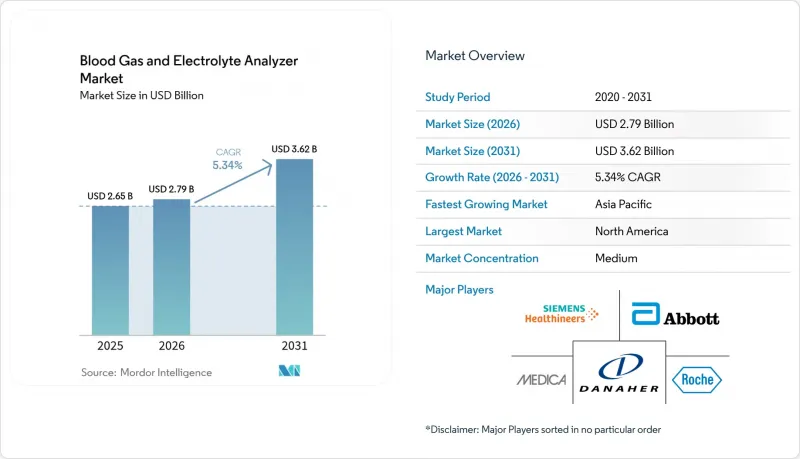
Mordor Intelligence에 의하면, 세계의 혈액 가스 및 전해질 분석기 시장 규모는 2025년에 26억 5,000만 달러로 평가되었고 2026년 27억 9,000만 달러에서 2031년까지 36억 2,000만 달러에 이를 것으로 예측되며, 예측 기간(2026-2031년) CAGR은 5.34%를 나타낼 전망입니다.
본 보고서는 제품 유형(기기(혈액 가스 분석기 등) 및 소모품), 모달리티 유형(벤치탑형 시스템, 휴대용/핸드헬드형 시스템), 기술(카트리지식, 전기화학 센서 등), 최종 사용자(병원 중앙 검사실 등), 지역(북미, 유럽 등)별로 세분화되어 있습니다. 시장 전망은 금액(미 달러) 기준으로 제시되어 있습니다.
전 세계 혈액 가스 및 전해질 분석기 시장 동향과 인사이트
중환자 치료에서의 포인트-오브-케어 검사 도입 확대
현재, 병상 분석기는 동맥 pH, PaO₂, PaCO₂, 전해질, 젖산의 측정 결과를 1분 이내에 제공하여, 패혈증 치료 프로토콜, 인공호흡기 조정, 외상 소생 시 의사결정 주기를 단축하고 있습니다. epoc 혈액 분석 시스템과 같은 장비는 Wi-Fi 모듈을 통합하고 있어 데이터가 전자 차트에 직접 전송되므로, 수기 전사로 인한 오류가 배제되고 검사실의 업무 부담이 경감됩니다. 검사 결과 보고 시간 단축은 입증된 비용 절감으로 이어집니다. 한 소아 중환자실(ICU)에서는 포인트 오브 케어 혈액 가스 분석기에 대한 적정 사용 프로토콜을 도입한 결과, 일일 검사 빈도를 53% 줄여 연간 1만 9,068달러의 비용 절감을 실현했습니다. 응급실에서도 유사한 이점을 얻고 있으며, 60초 만에 결과를 확인할 수 있어 방사선과에서의 확인 전에도 신속한 뇌졸중 감별이 가능해졌습니다.
대도시에서 COPD 및 천식으로 인한 입원 급증
대기 오염, 고령화, 높은 흡연율로 인해 COPD의 부담은 저·중소득 국가로 이동하고 있으며, 현재 COPD로 인한 사망의 90%는 이러한 지역에서 발생하고 있습니다. 급성 악화 환자의 급증에 직면한 대도시권 병원에서는 산소 요법 및 비침습적 인공호흡 조절을 위해 병원 내 혈액 가스 분석 능력이 요구되고 있습니다. 각 제조업체는 안정적인 전력 공급을 확보하기 어려운 2차 의료기관을 위해 배터리 백업 기능과 내후성 센서를 갖춘 견고한 분석 장비를 출시하고 있습니다. 활용 기회가 확대됨에 따라 트리아지 정확도가 향상되고, 응급실 체류 시간이 단축되며, 호흡기 치료 진료 경로와 관련된 재입원 벌금 부과를 억제하는 데 기여합니다.
설비 투자 예산의 제약
팬데믹에 따른 조달 수요 급증 이후 발생한 자금 부족으로 인해, 병원들은 분석기의 교체 주기를 연기할 수밖에 없는 상황입니다. 미국 보건복지부는 중요한 의료기기의 가격이 급등했다고 보고하고 있으며, 이로 인해 예산이 압박받으면서 초기 비용의 장벽을 제거하는 시약 렌탈 계약이나 검사별 지불 계약으로의 전환이 진행되고 있습니다. 이에 대응하여 각 벤더사는 서비스, 품질 관리(QC) 카트리지, 분석 대시보드를 운영비 모델에 결합하여 제공함으로써, 예측 가능한 월간 현금 흐름을 중시하는 재무 부서의 의향에 부합하는 형태를 갖추고 있습니다.
부문 분석
2025년, 혈액 가스 및 전해질 분석기 시장에서 소모품이 58.12%를 차지하고 있으며, 이는 공급업체의 수익 안정성을 뒷받침하는 ‘면도기와 면도날’ 모델을 입증하고 있습니다. 동맥 또는 정맥 검체 1건당 일회용 카트리지, 전극 팩 또는 시약 앰플이 각각 1개씩 사용되므로, 중환자실에서 빈번하게 이루어지는 검사가 지속적인 현금 흐름으로 이어집니다. 마시모(Masimo)사는 이 모델의 대표적인 사례입니다. 이 회사의 의료 분야 매출의 89%는 소모품과 서비스에서 발생하며, 이 수익은 차세대 플랫폼 개발을 뒷받침하는 연구개발(R&D) 주기에 재투자되고 있습니다. 또한, 시약과 품질 관리(QC)가 일체화된 파우치는 재고 관리의 복잡성과 환경에 미치는 영향을 줄이고, 보관 기간을 연장합니다. 이는 자원이 제한된 시설에 매력적인 특징입니다.
외래 만성 질환 클리닉, 투석 센터, 스포츠 의학 프로그램에서는 나트륨, 칼륨, 염화물, 이온화 칼슘 및 포도당을 2분 이내에 측정할 수 있는 소형 장비가 요구되고 있으며, 전해질 분석기는 2031년까지 연평균 성장률(CAGR) 5.82%를 나타낼 것으로 전망됩니다. 이 부문은 가스, 대사산물, CO 산소포화도, 전해질을 하나의 플랫폼에 통합한 복합 분석기의 성장과 맞물려 채혈량을 줄이고 있습니다. 이는 신생아 병동에 있어 결정적인 요소입니다. Nova Biomedical사의 마이크로 샘플 모드는 마이크로플루이딕스 기술과 지능형 유체 공학을 통해 11개 항목의 검사 패널을 90µL에 담을 수 있음을 입증했으며, 이는 임상적 이점과 총 소유 비용 절감을 동시에 실현하고 있습니다(news-medical.net). 그 결과, 전해질에 특화된 기기 중 혈액 가스 및 전해질 분석기 시장 규모는 향후 10년 동안 시장 점유율이 대폭 확대될 것으로 전망됩니다.
벤치탑형 분석기는 처리 능력, 폭넓은 검사 항목, 그리고 중앙 검사실에서 요구하는 미들웨어 연동 기능 덕분에 2025년에도 전 세계 매출의 50.35%를 계속 차지하고 있습니다. 다크 랩 아키텍처는 이러한 분석기를 이송 시스템 및 로봇 팔과 통합하여 무인 야간 운영을 새로운 차원으로 끌어올리고 있습니다(mlo-online.com). 병원 측은 검사 1회당 비용을 안정화시키는 장기 시약 계약 및 통합된 품질 관리 체제를 중시하고 있습니다.
한편, 휴대용 및 핸드헬드형 플랫폼은 연평균 성장률(CAGR) 7.12%로 증가하고 있습니다. 구급대원들은 제세동기와 함께 배터리 구동식 분석 장비를 배치하여, 외상 센터로 이송하는 도중에 pH 값이나 젖산 수치를 측정함으로써 의사가 대규모 수혈 프로토콜을 사전에 발동할 수 있도록 하고 있습니다. 수술실에서는 마취과 의사가 흉부 수술 중 환기를 미세 조정하기 위해 손바닥 크기의 장치를 기구대에 설치하고 있습니다. 이러한 휴대용 기기는 블루투스나 병원 Wi-Fi를 통해 결과를 업로드하므로, 별도의 행정 업무 없이 검사 보고서에 통합되며, 혈액 가스 및 전해질 분석기 시장을 휩쓸고 있는 분산화 추세에서 매우 중요한 역할을 하고 있습니다.
지역별 분석
북미는 2025년에 전 세계 매출의 38.12%를 차지하며, 이는 중환자실(ICU) 병상 수의 많음, 호흡기 진단에 대한 보험 환급, 그리고 광범위한 의료 제공업체 네트워크에 의해 뒷받침되고 있습니다. BD가 에드워즈 라이프사이언시스(Edwards Lifesciences)의 중환자 치료(Critical Care) 부문을 42억 달러에 인수한 것을 대표로 하는 업계 재편을 통해 기업 포트폴리오에 커넥티드 케어 기능이 추가됨에 따라, 해당 지역의 혈액 가스 및 전해질 분석기 시장 규모는 견조한 추세를 보이고 있습니다. 그러나 검사실 폐쇄의 물결이 처리 능력을 위협하고 있습니다. 혈액은행 관련 시설의 18.9%에 달하는 공실률이 중환자실 검사실까지 파급되면서, 의료 시스템은 무인 운전이 가능한 분석 장비를 선호하는 추세입니다.
아시아태평양은 2031년까지 연평균 성장률(CAGR) 7.14%를 나타낼 것으로 예측되며, 공립 병원 확장, 민간 부문 정비, 그리고 지방 도시를 위한 진단 기기 지원 정부 프로그램을 통해 타 지역과의 격차가 점차 줄어들 것으로 전망됩니다. 도시 지역의 스모그로 인해 만성폐쇄성폐질환(COPD) 환자 수가 증가하면서 동맥혈 가스 분석 수요가 확대되고 있습니다. 국내 제조 노력에 힘입어 카트리지 및 센서의 현지 생산이 촉진되고, 수입 관세가 인하됨과 동시에 공급 탄력성이 강화되고 있습니다. 그 결과, 아시아태평양의 혈액 가스 및 전해질 분석기 시장은 수입 의존형에서 하이브리드형 공급망으로 전환되고 있으며, 유럽 및 미국 시장과의 가격 수준 격차 축소가 가속화되고 있습니다.
유럽에서는 기술의 조기 도입, 엄격한 품질 관리 기준, 그리고 시약 대량 조달을 협상하는 집중 조달 체제 덕분에 견실한 수익 기반을 유지하고 있습니다. 성장률은 신흥 지역만큼 빠르지는 않지만, 범유럽 응급 의료 서비스 지침에 따라 구급차 대열에서 휴대용 분석기의 도입이 진행되고 있는 점이 호재로 작용하고 있습니다.
라틴아메리카 및 중동 및 아프리카는 혈액 가스 및 전해질 분석기 시장에서 규모는 작지만 성장이 가속화되고 있는 지역입니다. 걸프 국가에서는 석유 수입의 잉여분을 3차 의료시설에 투자하고 있으며, 이러한 시설에서는 아랍어 사용자 인터페이스를 갖춘 분석기가 요구되고 있습니다. 한편, 브라질의 민간 병원 체인에서는 증가하는 심혈관 질환 부담에 대응하기 위해 검사실 설비를 업그레이드하고 있습니다. 공급업체 간의 차별화는 교육 거점 구축, 현지 언어 지원 소프트웨어, 그리고 35°C 이상의 환경에서도 성능을 유지할 수 있는 내열성 카트리지 제공에 점점 더 의존하고 있습니다.
기타 혜택:
- 엑셀 형식 시장 예측(ME) 시트
- 3개월간의 애널리스트 지원
자주 묻는 질문
목차
제1장 서론
제2장 조사 방법
제3장 주요 요약
제4장 시장 구도
제5장 시장 규모와 성장 예측
제6장 경쟁 구도
제7장 시장 기회와 향후 전망
JHS 26.09.03According to Mordor Intelligence, the global blood gas and electrolyte analyzer market size was valued at USD 2.65 billion in 2025 and estimated to grow from USD 2.79 billion in 2026 to reach USD 3.62 billion by 2031, at a CAGR of 5.34% during the forecast period (2026-2031).
This report is Segmented by Product Type (Instruments [Blood Gas Analyzer, and More] and Consumables), Modality Type (Benchtop Systems, Portable /Hand-Held Systems), Technology (Cartridge-Based, Electrochemical Sensor and More), End User (Hospital Central Laboratories, and Others), and Geography (North America, Europe, and More). The Market Forecasts are Provided in Terms of Value (USD).
Global Blood Gas And Electrolyte Analyzer Market Trends and Insights
Growing Adoption of Critical-Care Point-of-Care Testing
Bedside analyzers now deliver arterial pH, PaO2, PaCO2, electrolytes, and lactate results in under a minute, compressing decision cycles for sepsis bundles, ventilator adjustments, and trauma resuscitation. Systems such as the epoc Blood Analysis System integrate Wi-Fi modules so data flows directly into electronic medical records, eliminating manual transcription errors and cutting laboratory workload.Lower turnaround times translate into documented cost avoidance: a pediatric ICU reduced daily test frequency by 53% and saved USD 19,068 annually after deploying stewardship protocols around point-of-care blood-gas devices journals. Emergency departments also benefit, where 60-second results support prompt stroke differentiation before radiology confirmation.
Rapid Rise in COPD & Asthma Admissions in Megacities
Ambient air pollution, aging populations, and high smoking prevalence are driving COPD burdens toward low- and middle-income economies; 90% of COPD deaths now arise in those settings . Metropolitan hospitals facing surges of acute exacerbations require on-site blood-gas capacity to titrate oxygen therapy and non-invasive ventilation. Manufacturers are releasing ruggedized analyzers with battery backup and climate-tolerant sensors for secondary-level facilities lacking stable power. Expanded access improves triage accuracy, shortens emergency room dwell time, and can curb readmission penalties tied to respiratory care pathways.
Capital-Budget Constraints
Capital scarcity after pandemic procurement spikes forces hospitals to defer analyzer refresh cycles. The U.S. Department of Health and Human Services documented sharp price surges for critical devices, squeezing budgets and shifting preference to reagent-rental or pay-per-test contracts that lift upfront cost barriers. Vendors respond by bundling service, QC cartridges, and analytics dashboards under operating-expense models, aligning with finance teams that favor predictable monthly cash flows.
Other drivers and restraints analyzed in the detailed report include:
- Integration of IoT-Enabled Benchtop Analyzers Accelerating Lab Automation
- Technological Advancements in Blood Gas and Electrolyte Analyzers
- Issues Regarding Regulation and Reimbursement of ABG Tests
For complete list of drivers and restraints, kindly check the Table Of Contents.
Segment Analysis
Consumables contributed 58.12% to the blood gas and electrolyte analyzer market in 2025, underlining the razor-razorblade model that anchors vendor revenue stability. Each arterial or venous sample draws a single-use cartridge, electrode pack, or reagent ampoule, turning high test frequency in critical-care beds into recurring cash flow. Masimo demonstrates the model: 89% of its healthcare revenue comes from consumables and services, financing R&D cycles that feed next-generation platforms. Integrated reagent-QC pouches also reduce inventory complexity and environmental exposure, lifting shelf life-an attractive feature for resource-limited facilities.
Electrolyte analyzers display a 5.82% CAGR through 2031 as outpatient chronic-disease clinics, dialysis centers, and sports-medicine programs seek compact devices that report sodium, potassium, chloride, ionized calcium, and glucose within two minutes. The segment overlays growth of combined analyzers that merge gases, metabolites, CO-oximetry, and electrolytes in one platform, shrinking blood draw volumes-a decisive point for neonatal wards. Nova Biomedical's micro-sample mode demonstrates how microfluidics and intelligent fluidics engineering can fit an 11-test panel into 90 µL, linking clinical benefit to lower total cost of ownership news-medical.net. As a result, the blood gas and electrolyte analyzer market size for electrolyte-focused devices is forecast to command material share gains over the decade.
Benchtop analyzers retained 50.35% of global revenue in 2025 thanks to throughput, extended menus, and middleware hooks that central labs require. Dark-lab architecture integrates these analyzers with track systems and robotic arms, pushing unattended overnight operation to new levels mlo-online.com. Hospitals value long-term reagent contracts and consolidated QC regimes that stabilize per-test economics.
Portable and handheld platforms, however, are increasing at a 7.12% CAGR. Ambulance crews deploy battery-powered analyzers alongside defibrillators, capturing pH and lactate en-route to trauma centers, enabling physicians to pre-activate massive transfusion protocols. In operating rooms, anesthesiologists place palm-sized devices on the instrument table to fine-tune ventilation during thoracic surgery. Because these handhelds upload results via Bluetooth or hospital Wi-Fi, they integrate into lab reports without extra clerical work, making them pivotal to the decentralization wave sweeping the blood gas and electrolyte analyzer market.
Complete Report Scope:
- By Product Type (Value)
- Instruments
- Blood Gas Analyzer
- Electrolyte Analyzer
- Combined Blood Gas & Electrolyte Analyzer
- Consumables (Cartridges, Reagents & Sensor Strips)
- Instruments
- By Modality (Value)
- Benchtop Systems
- Portable / Hand-Held Systems
- By Technology (Value)
- Cartridge-Based
- Electrochemical Sensor
- Optical / Optode
- Others (Ion-Selective Electrode, Fluorescent)
- By End-User (Value)
- Hospital Central Laboratories
- Point-of-Care Testing within Hospitals
- Ambulance & Emergency Medical Services
- Diagnostic Laboratories & Clinics
- Home Healthcare Settings
- By Geography (Value)
- North America
- United States
- Canada
- Mexico
- Europe
- Germany
- United Kingdom
- France
- Italy
- Spain
- Rest of Europe
- Asia-Pacific
- China
- Japan
- India
- South Korea
- Australia
- Rest of Asia- Pacific
- Middle East and Africa
- GCC
- South Africa
- Rest of Middle East and Africa
- South America
- Brazil
- Argentina
- Rest of South America
- North America
Geography Analysis
North America generated 38.12% of global revenue in 2025, anchored by dense ICU bed stock, reimbursement for respiratory diagnostics, and extensive provider networks. The blood gas and electrolyte analyzer market size for the region stays buoyant as consolidation, exemplified by BD's USD 4.2 billion purchase of Edwards Lifesciences' Critical Care Unit, adds connected-care capabilities to corporate portfolios. Nevertheless, laboratory retirement waves threaten capacity; 18.9% vacancy in blood-bank brethren spills over to critical-care labs, prompting health systems to favor analyzers with walk-away operation.
Asia-Pacific is forecast to post a 7.14% CAGR to 2031, narrowing the gap through public hospital expansion, private sector build-out, and government programs that subsidize diagnostic equipment for lower-tier cities. Urban smog adds to COPD caseloads, swelling arterial blood-gas demand. Domestic manufacturing initiatives encourage localization of cartridges and sensors, trimming import duties and strengthening supply resilience. As a result, the blood gas and electrolyte analyzer market in Asia-Pacific is transitioning from import-dependent to hybrid supply chains, accelerating price-point convergence with Western markets.
Europe retains a solid revenue base thanks to early technology uptake, stringent QC standards, and centralized procurement that negotiates large reagent volumes. Growth is steadier than in emerging regions but benefits from rising adoption of handheld analyzers in ambulance fleets aligned with pan-European emergency-medical-services guidelines.
Latin America and the Middle East & Africa together represent modest but accelerating slices of the blood gas and electrolyte analyzer market. Gulf countries channel oil surpluses into tertiary-care complexes that specify analyzers with Arabic user interfaces, while Brazilian private chains upgrade labs to manage a growing cardiovascular burden. Vendor differentiation increasingly depends on training hubs, local-language software, and heat-tolerant cartridges that sustain performance above 35 °C.
- Radiometer Medical ApS (Danaher)
- Siemens Healthineers
- Abbott Laboratories
- F. Hoffmann-La Roche AG (Roche Diagnostics)
- Nova Biomedical
- Medica Corporation
- Sensa Core
- Nihon Kohden
- Eschweiler GmbH
- Grifols
- Arkray
- OPTI Medical (IDEXX)
- Convergent Technologies
- EKF Diagnostics
- PHC Holdings (Ascensia)
- WerfenLife Diagnostics China
- Terumo Cardiovascular
- Edan Instruments
- Sphere Medical
- Brolis Sensor Technology
- Balio Diagnostics
- Trinity Biotech plc
Additional Benefits:
- The market estimate (ME) sheet in Excel format
- 3 months of analyst support
TABLE OF CONTENTS
1 Introduction
- 1.1 Study Assumptions & Market Definition
- 1.2 Scope of the Study
2 Research Methodology
3 Executive Summary
4 Market Landscape
- 4.1 Market Overview
- 4.2 Market Drivers
- 4.2.1 Growing Adoption of Critical-Care POC Testing
- 4.2.2 Rapid Rise in COPD & Asthma Admissions in Megacities
- 4.2.3 Increasing Neonatal ICU Births Requiring Frequent Arterial Blood-Gas Monitoring
- 4.2.4 Integration of IoT-Enabled Benchtop Analyzers Accelerating Lab Automation
- 4.2.5 Technological Advancements in Blood Gas & Electrolyte Analyzers
- 4.3 Market Restraints
- 4.3.1 Capital-Budget Constraints in Public & Small-Size Hospitals
- 4.3.2 Issues Regarding Regulation and Reimbursement of ABG Tests
- 4.3.3 Skilled-Operator Shortage Hindering Adoption of Combined Systems
- 4.3.4 Accuracy Concerns with Disposable Sensor Strips in Low-Cost Devices
- 4.4 Supply-Chain Analysis
- 4.5 Regulatory Outlook
- 4.6 Technological Outlook
- 4.7 Porter's Five Forces
- 4.7.1 Threat of New Entrants
- 4.7.2 Bargaining Power of Suppliers
- 4.7.3 Bargaining Power of Buyers
- 4.7.4 Threat of Substitutes
- 4.7.5 Competitive Rivalry
5 Market Size & Growth Forecasts
- 5.1 By Product Type (Value)
- 5.1.1 Instruments
- 5.1.1.1 Blood Gas Analyzer
- 5.1.1.2 Electrolyte Analyzer
- 5.1.1.3 Combined Blood Gas & Electrolyte Analyzer
- 5.1.2 Consumables (Cartridges, Reagents & Sensor Strips)
- 5.1.1 Instruments
- 5.2 By Modality (Value)
- 5.2.1 Benchtop Systems
- 5.2.2 Portable / Hand-Held Systems
- 5.3 By Technology (Value)
- 5.3.1 Cartridge-Based
- 5.3.2 Electrochemical Sensor
- 5.3.3 Optical / Optode
- 5.3.4 Others (Ion-Selective Electrode, Fluorescent)
- 5.4 By End-User (Value)
- 5.4.1 Hospital Central Laboratories
- 5.4.2 Point-of-Care Testing within Hospitals
- 5.4.3 Ambulance & Emergency Medical Services
- 5.4.4 Diagnostic Laboratories & Clinics
- 5.4.5 Home Healthcare Settings
- 5.5 By Geography (Value)
- 5.5.1 North America
- 5.5.1.1 United States
- 5.5.1.2 Canada
- 5.5.1.3 Mexico
- 5.5.2 Europe
- 5.5.2.1 Germany
- 5.5.2.2 United Kingdom
- 5.5.2.3 France
- 5.5.2.4 Italy
- 5.5.2.5 Spain
- 5.5.2.6 Rest of Europe
- 5.5.3 Asia-Pacific
- 5.5.3.1 China
- 5.5.3.2 Japan
- 5.5.3.3 India
- 5.5.3.4 South Korea
- 5.5.3.5 Australia
- 5.5.3.6 Rest of Asia- Pacific
- 5.5.4 Middle East and Africa
- 5.5.4.1 GCC
- 5.5.4.2 South Africa
- 5.5.4.3 Rest of Middle East and Africa
- 5.5.5 South America
- 5.5.5.1 Brazil
- 5.5.5.2 Argentina
- 5.5.5.3 Rest of South America
- 5.5.1 North America
6 Competitive Landscape
- 6.1 Market Concentration
- 6.2 Market Share Analysis
- 6.3 Company Profiles (includes Global level Overview, Market level overview, Core Segments, Financials as available, Strategic Information, Market Rank/Share for key companies, Products & Services, and Recent Developments)
- 6.3.1 Radiometer Medical ApS (Danaher)
- 6.3.2 Siemens Healthineers AG
- 6.3.3 Abbott Laboratories
- 6.3.4 F. Hoffmann-La Roche AG (Roche Diagnostics)
- 6.3.5 Nova Biomedical
- 6.3.6 Medica Corporation
- 6.3.7 Sensa Core
- 6.3.8 Nihon Kohden
- 6.3.9 Eschweiler GmbH
- 6.3.10 Grifols
- 6.3.11 ARKRAY Inc.
- 6.3.12 OPTI Medical (IDEXX)
- 6.3.13 Convergent Technologies
- 6.3.14 EKF Diagnostics
- 6.3.15 PHC Holdings (Ascensia)
- 6.3.16 WerfenLife Diagnostics China
- 6.3.17 Terumo Cardiovascular
- 6.3.18 Edan Instruments
- 6.3.19 Sphere Medical
- 6.3.20 Brolis Sensor Technology
- 6.3.21 Balio Diagnostics
- 6.3.22 Trinity Biotech plc
7 Market Opportunities & Future Outlook
- 7.1 White-Space & Unmet-Need Assessment