|
시장보고서
상품코드
2114546
혈장 프로테아제 C1 억제제 시장 : 점유율 분석, 업계 동향과 통계, 성장 예측(2026-2031년)Plasma Protease C1-inhibitor - Market Share Analysis, Industry Trends & Statistics, Growth Forecasts (2026 - 2031) |
||||||
 Mordor Intelligence
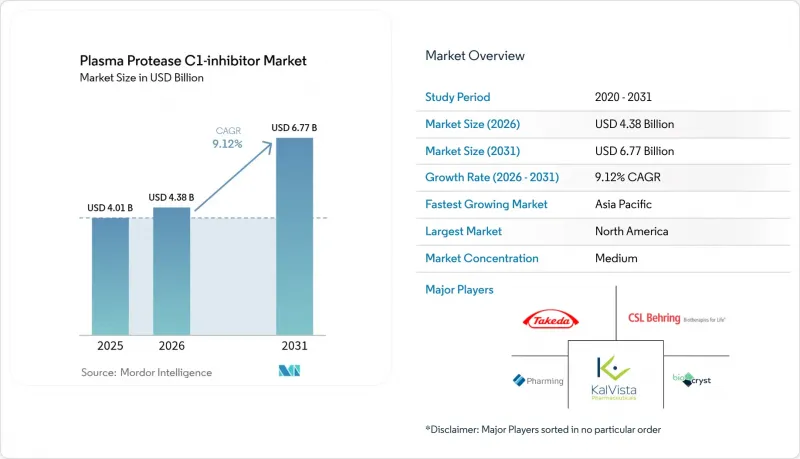
Mordor Intelligence에 의하면, 혈장 프로테아제 C1 억제제 시장 규모는 2025년 40억 1,000만 달러에서 2026년에는 43억 8,000만 달러로 확대되어 2026년부터 2031년까지 CAGR 9.12%로 성장을 지속하여, 2031년에는 67억 7,000만 달러에 이를 것으로 예측됩니다.
본 보고서는 약제 유형(혈장 유래 C1 억제제 등), 제형(동결건조 분말 및 액상 주사제), 투여 경로(정맥 내 투여 등), 적응증(장기 예방 등), 유통 채널(병원 약국 등), 지역(북미, 유럽 등)별로 분류되어 있습니다. 시장 예측은 금액(달러) 기준으로 제시되어 있습니다.
전 세계 혈장 프로테아제 C1 억제제 시장 동향 및 인사이트
희귀 유전성 질환의 전 세계적 부담 증가
역학적 감시 체계의 개선으로 인해, 미국의 HAE 유병률은 10만 명당 2.67명으로 추정되며, 이는 2024년까지 9,559건의 진단 사례에 해당하여, 과거 진단 누락으로 인한 격차가 점차 줄어들고 있습니다. 각 환자가 직면하는 연간 직접·간접 비용의 합계는 4만 2,000달러에 육박하지만, 의료 제도에서는 예방 요법을 통해 이 비용을 절감하고자 하고 있습니다. 조기 예방 요법이 응급 개입을 줄인다는 인식이 의료 시스템 전반에 확산되고 있는 것이 체계적인 도입 프로그램을 뒷받침하고 있습니다. 의료비 절감에 더해, 의사 교육의 확충과 환자 지원 활동의 활성화로 인해 가족의 선별 검사 수진율이 향상되고 있으며, 혈장 프로테아제 C1 억제제 시장의 치료 대상 인구가 확대되고 있습니다. 그 결과, 보험사들은 예방 요법을 장기적으로 예산 중립적인 조치로 간주하고 있으며, 이는 고부가가치 제품에 대한 수요를 촉진하고 있습니다.
희귀질환 치료제 지정 및 인센티브 확대
2024년, 미국 FDA는 여러 보체 매개 질환 치료용 생물학적 제제를 승인하고, 실세계 데이터와 환자 보고 결과를 통합하여 심사 주기를 단축하는 ‘희귀질환 혁신 허브(Rare Disease Innovation Hub)’를 출범시켰습니다. 유럽에서 갈라다시맙에 대한 긍정적인 과학적 견해는 미충족 의료 수요가 해결될 경우 신속한 접근이 우선시된다는 점에서 유사한 입장을 반영하고 있습니다. 우선 심사 바우처, 세액 공제 및 시장 독점권 연장은 중견 개발 기업과 대형 제약사 모두를 끌어들이고 있으며, 2030년까지 혈장 프로테아제 C1 억제제 시장을 형성할 탄탄한 파이프라인을 유지하고 있습니다. 지불 기관들은 보다 명확한 결과 데이터를 목격함에 따라, 특히 자가 투여가 가능한 치료법의 경우 응급실 방문을 낮은 수준으로 억제하는 프리미엄 가격 책정에 대해 더 큰 관용을 보이고 있습니다.
고액의 치료비와 보험 지급 관련 과제
최근 지불자 조사에 따르면, 만성 희귀질환 치료제의 공정 가격 중앙값은 연간 25만 6,000달러로 나타났습니다. UnitedHealthcare와 같은 보험사의 사전 승인 절차는 의사가 HAE의 발병 빈도나 과거 치료 실패 사례를 문서화해야 하기 때문에 치료 시작을 지연시키는 경우가 많습니다. 희귀질환 체계가 아직 정비 중인 시장에서는 본인 부담금이 여전히 고액이어서, 임상 지침이 있음에도 불구하고 치료의 보급을 제한하고 있습니다. 미국의 ‘인플레이션 억제법’은 가격 협상에 추가적인 복잡성을 더하고, 장기적인 연구개발 의지를 저해할 가능성이 있습니다. 이러한 과제들이 합쳐져 혈장 프로테아제 C1 억제제 시장의 성장 궤도에 큰 부담으로 작용하고 있습니다.
부문 분석
혈장 유래 C1 억제제 요법은 오랜 임상 실적과 확립된 투여 알고리즘 덕분에 2025년 혈장 프로테아제 C1 억제제 시장 매출의 55.12%를 차지했습니다. ‘베리나트’나 ‘신라이즈’와 같은 브랜드는 대부분의 병원 처방집에서 급성기 치료 및 예방 치료의 기본 선택지로 계속 자리 잡고 있습니다. 이러한 제품들은 확고한 안전성 데이터가 축적되어 있어, 엄격한 모니터링이 필요한 소아 및 임산부 치료 시 처방 의사에게 안심감을 주고 있습니다. 이러한 기존 제품의 우위에도 불구하고, 개발 파이프라인의 동향을 살펴보면 경구용 칼리크레인 억제제는 주사에 대한 불안을 해소하고 원격의료 모델에 적합하기 때문에 2031년까지 연평균 성장률(CAGR) 11.02%로 시장을 확대해 나갈 전망입니다. BioCryst사의 ‘ORLADEYO’는 2025년 1분기에 1억 3,420만 달러의 매출을 기록하며 전년 동기 대비 51% 증가했습니다. 이는 삼킬 수 있는 치료법에 대한 소비자 수요가 높음을 입증하는 것입니다. 만약 세베트랄스타트가 2025년 중반에 FDA 승인을 획득한다면, 두 번째 경구용 제품이 등장함으로써 비침습적 치료가 더욱 보편화되고, 주사를 꺼리는 사춘기 환자층을 확보할 수 있을 것으로 기대됩니다. 경쟁이 격화됨에 따라, 경구용 혈장 프로테아제 C1 억제제 시장 규모는 2031년에 13억 3,000만 달러를 넘어설 가능성이 있으며, 특정 환자군을 여전히 포괄하고 있는 혈장 유래 기존 제품을 완전히 대체하지는 않더라도 수익 분배가 재편될 것입니다.
개발 파이프라인의 다각화는 칼리크레인 억제에 그치지 않습니다. 재조합 C1 억제제는 현재 상업적 가격 책정이 가능한 규모에 도달했으며, 바이러스 불활성화라는 장점이 있어 기증자에 대한 의존을 피할 수 있습니다. 각 개발사는 또한 브라디키닌의 방출을 근원에서 억제하는 유전자 침묵 요법에 대한 임상시험도 진행하고 있으나, 상용화 시기는 2030년 이후가 될 것으로 예측됩니다. 이러한 접근 방식들이 종합적으로 장기적인 혈장 수요 증가를 억제하게 되겠지만, 경쟁상의 이익률은 제조 비용 구조에 따라 결정될 것입니다. 2025-2030년 제품의 포지셔닝은 투여 빈도, 기기의 편의성, 그리고 발작당 지출보다 예측 가능한 월별 지출을 중시하는 지불 주체와의 계약에 좌우될 것입니다.
2025년 혈장 프로테아제 C1 억제제 시장에서 동결건조 분말이 매출의 53.70%를 차지했습니다. 이는 동결건조를 통해 보존 기간이 연장되고, 외딴 지역의 진료소로 운송하는 동안 안정성이 확보되기 때문입니다. 병원 측은 콜드체인 관리 부담이 경감되고, 응급실을 위한 전략적 비축분을 확보할 수 있다는 점을 높이 평가했습니다. 그러나 재구성 절차로 인해 투여 시간이 길어지므로, 특히 신속한 대응이 요구되는 후두 발작 시에는 문제가 됩니다. CSL사의 액상 안정형 제품 ‘HAEGARDA’는 재택 피하 투여용 프리필드 주사기를 제공함으로써 이러한 격차를 해소하고, 조제 시간을 수 분으로 단축했습니다. 오토인젝터와 상온 보관이 가능한 바이알이 보급됨에 따라, 액상 제제는 연평균 성장률(CAGR) 9.86%를 기록하며 분말 제제 시장 점유율을 서서히 잠식할 것으로 예측됩니다.
동결건조 제제 제조업체들은 워크플로우를 효율화하기 위해 바늘 상 혼합 장치나 단일 바이알 포장을 도입하여 대응하고 있습니다. 또한, 분무 건조 및 진공 유도형 나노 다공성 매트릭스 기술의 병행적인 발전으로 재구성 시간을 15초 미만으로 단축하여 경쟁력을 회복할 가능성이 있습니다. 그렇긴 하지만, 예방 투여의 경우 환자의 편의성이 여전히 도입의 결정적인 기준이며, 제제 개발자들은 가능한 한 액상 제제로의 전환을 추진하고 있습니다. 예측 기간 동안, 액상 제제를 통한 혈장 프로테아제 C1 억제제 시장 규모 확대는 5억 8,000만 달러에 달할 것으로 전망되지만, 분말 제제는 인도적 지원용 비축이나 자원이 부족한 환경에서 여전히 중요한 역할을 계속할 것입니다.
지역별 분석
2025년, 북미는 혈장 프로테아제 C1 억제제 시장에서 44.21%의 점유율을 차지하며 시장을 주도했습니다. 미국은 희귀질환 치료제(오펀 드럭)에 대한 독점권 인센티브, 광범위한 보험 적용, 그리고 전 세계 원혈장의 70%를 공급하는 타의 추종을 불허하는 혈장 수집 능력 덕분에 판매량을 견인하고 있습니다. 메디케어는 ORLADEYO 대상 환자의 89%를 보장하고 있으며, 민간 보험사들도 진단 기준을 충족하는 경우 예방 요법과 구제 요법 모두에 대해 비용을 상환하고 있습니다. 캐나다는 전국적인 구매 연합을 활용하여 주 전체에 걸친 접근성 확보를 협상하고 있는 반면, 멕시코의 세구로 포풀라르(Seguro Popular)는 주 정부 공동 자금 조달 제도를 통해 고비용 생물학적 제제에 대한 보험 적용을 시범적으로 도입하고 있습니다.
유럽은 여전히 두 번째로 큰 규모를 자랑하는 지역이지만, 200만 명의 기증자에 해당하는 혈장 자급 부족에 직면해 있어 각국 정부는 국내 채혈을 촉진하기 위한 인센티브를 도입할 수밖에 없는 상황입니다. EMA의 갈라다시맙에 대한 롤링 리뷰는 혈장 수요를 완화할 가능성이 있는 대체 불가능한 치료법에 대한 유럽연합의 수용성을 보여줍니다. 독일과 영국은 전문적인 HAE 참조 센터와 활발한 환자 네트워크 덕분에 1인당 사용량이 가장 많습니다. 보험 급여는 응급실 방문을 줄이고 삶의 질을 향상시키는 것을 평가하는 의료 기술 평가 결과와 점점 더 밀접하게 연계되고 있으며, 예방적 전략이 우선시되고 있습니다.
아시아태평양은 연평균 성장률(CAGR) 10.11%로 가장 빠르게 성장하는 지역이며, 혈장 프로테아제 C1 억제제 시장에서 이 지역의 점유율은 2030년까지 두 자릿수에 도달할 것으로 예측됩니다. 중국에서는 개정된 희귀질환 프레임워크인 CARE 프로그램과 필수 의약품 목록의 확대로 승인이 가속화되고 있는 한편, 현지 제조업체들은 공급을 확보하기 위해 분획 기술에 대한 투자를 진행하고 있습니다(trea.com). 일본은 엄격한 임상 증거 요건을 통해 프리미엄 가격을 유지하고 있지만, 소아 희귀질환 적응증에 대한 신속 승인 제도로 인해 도입이 가속화되고 있습니다. 호주의 의약품 급여 제도(PBS)는 2025년에 예방용 C1 억제제의 급여 기준을 확대하고, 본인 부담금을 인하하여 복약 순응도를 향상시켰습니다. 인도에서는 ‘희귀질환 국가 정책’의 지원 하에 특정 환자를 위한 수입에 자금을 지원하는 한편, 주 정부가 수입 의존도 감소를 목적으로 분획 공장에 공동 투자하고 있습니다. 동남아시아 전역에서는 지원 단체가 원격의료 플랫폼과 연계하여 지방 환자들이 전문의의 진료를 받을 수 있도록 함으로써, 혈장 프로테아제 C1 억제제 시장의 지역 수요를 뒷받침하는 진단 파이프라인을 확대되고 있습니다.
남미에서는 성장 양상이 지역마다 다릅니다. 브라질의 통합 보건 시스템(SUS)은 사법 명령에 따라 급성기 치료 비용을 부담하고 있지만, 예방 요법은 여전히 민간 보험으로 한정되어 있습니다. 아르헨티나의 ANMAT는 2024년 말에 2개의 피하 투여 제제를 신속 승인했으며, 칠레의 ‘리카르테 소토법’에 따라 현재 중증 질환 치료비를 최대 100%까지 환급하게 되어 판매량이 점진적으로 증가할 것으로 예측됩니다. 중동 및 아프리카는 걸프협력회의(GCC) 회원국들이 희귀질환 치료제를 중앙 집중형 입찰 제도에 포함시키고, 남아프리카공화국이 희귀질환에 대한 자금 배분을 명시하도록 국민건강보험법을 개정한 덕분에, 수익 기여도는 작지만 증가 추세를 보이고 있습니다.
기타 혜택:
- 엑셀 형식 시장 예측(ME) 시트
- 3개월간의 애널리스트 지원
목차
제1장 서론
제2장 조사 방법
제3장 주요 요약
제4장 시장 구도
제5장 시장 규모와 성장 예측
제6장 경쟁 구도
제7장 시장 기회와 향후 전망
JHSAccording to Mordor Intelligence, the plasma protease C1-inhibitor market size is expected to grow from USD 4.01 billion in 2025 to USD 4.38 billion in 2026 and is forecast to reach USD 6.77 billion by 2031 at 9.12% CAGR over 2026-2031.
This report is Segmented by Drug Type (Plasma-Derived C1-Inhibitor, and More), Dosage Form (Lyophilised Powder and Liquid Injectable), Route of Administration (Intravenous, and More), Indication (Long-Term Prophylaxis, and More), Distribution Channel (Hospital Pharmacies, and More), Geography (North America, Europe, and More). The Market Forecasts are Provided in Terms of Value (USD).
Global Plasma Protease C1-inhibitor Market Trends and Insights
Growing Global Burden of Rare Genetic Disorders
Better epidemiological surveillance indicates HAE prevalence of 2.67 per 100,000 in the United States, translating to 9,559 diagnosed cases by 2024 and narrowing historic under-diagnosis gaps. Each patient faces combined direct and indirect annual costs nearing USD 42,000, a figure that health systems aim to cut through preventive therapies. System-wide acceptance that early prophylaxis lowers emergency interventions is propelling systematic adoption programs. Alongside medical cost containment, improved physician education and patient advocacy are raising screening uptake in family members, expanding the treatable population for the plasma protease C1-inhibitor market. Insurers consequently view prophylactics as budget-neutral over time, reinforcing demand for high-value products.
Increasing Orphan Drug Designations and Incentives
In 2024 the US FDA cleared multiple complement-mediated disorder biologics and launched a Rare Disease Innovation Hub that unifies real-world evidence with patient-reported outcomes, shortening review cycles. Europe's positive scientific opinion for garadacimab reflects similar alignment on expedited access when an unmet need is addressed. Priority review vouchers, tax credits, and extended market exclusivity draw mid-cap developers and large pharma alike, sustaining a thick pipeline that will shape the plasma protease C1-inhibitor market through 2030. Payers, seeing clearer outcomes data, show greater tolerance for premium pricing that keeps emergency-department visits low, particularly when treatments can be self-administered.
High Treatment Costs and Reimbursement Challenges
Median fair pricing for chronic orphan drugs runs at USD 256,000 annually according to recent payer surveys. Prior authorization hurdles at insurers such as UnitedHealthcare often slow therapy initiation because physicians must document HAE frequency and prior therapy failure. In markets still building rare-disease frameworks, co-pays remain daunting, limiting uptake despite clinical guidelines. The US Inflation Reduction Act adds an extra layer of pricing negotiations that could dampen longer-term R&D appetite. These friction points collectively weigh on the growth trajectory of the plasma protease C1-inhibitor market.
Other drivers and restraints analyzed in the detailed report include:
- Rising Healthcare Expenditure in Emerging Economies
- Expansion of Plasma Fractionation Infrastructure in Asia
- Limited Plasma Supply and Collection Bottlenecks
For complete list of drivers and restraints, kindly check the Table Of Contents.
Segment Analysis
Plasma-derived C1-inhibitor therapies held 55.12% of 2025 revenues in the plasma protease C1-inhibitor market thanks to long clinical track records and familiar dosing algorithms. Brands such as Berinert and Cinryze remain the default choice for acute and prophylactic care in most hospital formularies. Their robust safety archives reassure prescribers when treating children or pregnant women, two cohorts under close watch. Despite this incumbency, pipeline visibility shows that oral kallikrein inhibitors will expand at an 11.02% CAGR through 2031 as they remove injection anxiety and fit telehealth models. BioCryst's ORLADEYO posted USD 134.2 million in Q1 2025 sales, a rise of 51% year-over-year that validates consumer appetite for swallowable options. Should sebetralstat secure FDA clearance in mid-2025, a second oral product will further normalize non-invasive treatment, likely capturing adolescents who resist needles. As competition widens, plasma protease C1-inhibitor market size for oral drugs could exceed USD 1.33 billion in 2031, reshaping revenue splits without fully displacing plasma-derived incumbents that still cover special populations.
Pipeline diversification extends beyond kallikrein inhibition. Recombinant C1-inhibitors now reach scale sufficient for commercial pricing, offering virus-inactivation advantages and sidestepping donor reliance. Developers also test gene-silencing modalities that curb bradykinin release upstream, though commercial timing sits beyond 2030. Collectively, these approaches temper long-term plasma demand growth, but manufacturing cost structures will determine competitive margins. Between 2025 and 2030, product positioning will hinge on dosing frequency, device convenience, and payer contracts that favor predictable monthly outlays over per-attack spending.
Lyophilized powder secured 53.70% of 2025 revenues in the plasma protease C1-inhibitor market because freeze-drying extends shelf life and assures stability during shipping to remote clinics. Hospitals value the lower cold-chain burden and the option to stock strategic reserves for emergency departments. However, reconstitution steps lengthen administration time, especially during laryngeal attacks that demand speed. CSL's liquid-stable HAEGARDA answered that gap by offering prefilled syringes for at-home subcutaneous use, trimming preparation to minutes. As autoinjectors and room-temperature vials proliferate, liquid forms are forecast to record a 9.86% CAGR, chipping at powder share.
Manufacturers of lyophilized presentations respond by integrating on-needle mixing devices and single-vial packaging to streamline workflows. Parallel advances in spray-drying and vacuum-induced nano-porous matrices may shorten reconstitution to under 15 seconds and restore competitive footing. Nonetheless, patient convenience remains the decisive adoption criterion in prophylaxis, nudging formulators to liquid solutions where possible. Over the forecast horizon the plasma protease C1-inhibitor market size gain from liquid products could add USD 580 million, while powders maintain relevance in humanitarian stockpiles and low-resource settings.
Complete Report Scope:
- By Drug Type
- Plasma-Derived C1-Inhibitor
- Recombinant C1-Inhibitor
- Kallikrein Inhibitors
- Bradykinin B2 Receptor Antagonists
- Emerging Oral Plasma-Kallikrein Inhibitors
- By Dosage Form
- Lyophilised Powder
- Liquid Injectable
- By Route Of Administration
- Intravenous
- Subcutaneous
- Oral
- By Indication
- Long-Term Prophylaxis
- On-Demand (Acute) Treatment
- By Distribution Channel
- Hospital Pharmacies
- Specialty Clinics
- Online Pharmacies
- Geography
- North America
- United States
- Canada
- Mexico
- Europe
- Germany
- United Kingdom
- France
- Italy
- Spain
- Rest of Europe
- Asia-Pacific
- China
- Japan
- India
- Australia
- South Korea
- Rest of Asia-Pacific
- Middle East & Africa
- GCC
- South Africa
- Rest of Middle East & Africa
- South America
- Brazil
- Argentina
- Rest of South America
- North America
Geography Analysis
North America led the plasma protease C1-inhibitor market with a 44.21% share in 2025. The United States drives volume due to orphan-drug exclusivity incentives, broad insurance coverage, and unmatched plasma collection capacity supplying 70% of the world's source plasma. Medicare covers 89% of eligible patients for ORLADEYO, and private payers reimburse both prophylactic and rescue regimens when diagnostic criteria are met. Canada leverages pan-Canadian buying alliances to negotiate province-wide access, while Mexico's Seguro Popular pilots reimbursement for high-cost biologics through state co-funding schemes.
Europe remains the second-largest region but contends with plasma self-sufficiency shortfalls estimated at two million donors, pushing governments to incentivize domestic collection. EMA's rolling review of garadacimab exemplifies the bloc's openness to non-replacement modalities that could lighten plasma demand. Germany and the United Kingdom top per-capita usage thanks to specialized HAE reference centers and active patient networks. Reimbursement is increasingly tied to health-technology-assessment outcomes that weigh emergency-department avoidance and quality-of-life gains, favoring prophylactic strategies.
Asia-Pacific is the fastest-growing territory at 10.11% CAGR, and its share of the plasma protease C1-inhibitor market is expected to reach double digits by 2030. China's revised rare-disease framework, the CARE program, and expanding Essential Drugs List accelerate approvals, while local manufacturers invest in fractionation to secure supply fortrea.com. Japan maintains premium pricing through stringent clinical evidence requirements, yet fast-track schemes for pediatric orphanindications speed uptake. Australia's Pharmaceutical Benefits Scheme widened its reimbursement criteria for prophylactic C1-inhibitors in 2025, lowering co-payments and lifting adherence. India, aided by its National Policy for Rare Diseases, is financing named-patient imports while state governments co-invest in fractionation plants aimed at reducing import dependency. Across Southeast Asia, advocacy groups cooperate with telemedicine platforms so rural patients can secure specialist consultations, expanding diagnosis pipelines that feed regional demand in the plasma protease C1-inhibitor market.
South America shows heterogeneous growth. Brazil's Unified Health System funds acute therapies through judicial mandates, but prophylaxis remains limited to private insurance. Argentina's ANMAT fast-tracked two subcutaneous products in late 2024, and Chile's Ricarte Soto Law now reimburses up to 100% of treatment costs for catastrophic diseases, opening incremental volumes. The Middle East and Africa contribute small but rising revenues as Gulf Cooperation Council states integrate orphan drugs into centralized tender systems and South Africa revises its National Health Insurance bill to earmark funds for rare conditions.
- Takeda Pharmaceuticals
- CSL Limited (CSL Behring)
- Pharming Group N.V.
- BioCryst Pharmaceuticals
- KalVista Pharmaceuticals
- Grifols
- Octapharma
- ADMA Biologics
- Kamada Ltd.
- Bio Products Laboratory (BPL)
- LFB S.A.
- Sanofi (Pharvaris Collaboration)
- Fresenius
- Ionis Pharmaceuticals
- Orladeyo Therapeutics
- CSL Seqirus (Plasma Operations)
- Sino Biological
Additional Benefits:
- The market estimate (ME) sheet in Excel format
- 3 months of analyst support
TABLE OF CONTENTS
1 Introduction
- 1.1 Study Assumptions & Market Definition
- 1.2 Scope of the Study
2 Research Methodology
3 Executive Summary
4 Market Landscape
- 4.1 Market Overview
- 4.2 Market Drivers
- 4.2.1 Growing Global Burden of Rare Genetic Disorders
- 4.2.2 Increasing Orphan Drug Designations and Incentives
- 4.2.3 Rising Healthcare Expenditure In Emerging Economies
- 4.2.4 Expansion of Plasma Fractionation Infrastructure In Asia
- 4.2.5 Technological Advancements In Biologic Drug Delivery
- 4.2.6 Strategic Collaborations and M&A Activities Among Biopharma Companies
- 4.3 Market Restraints
- 4.3.1 High Treatment Costs and Reimbursement Challenges
- 4.3.2 Limited Plasma Supply and Collection Bottlenecks
- 4.3.3 Stringent Regulatory Requirements For Plasma-Derived Products
- 4.3.4 Low Disease Awareness and Diagnostic Delays
- 4.4 Regulatory Landscape
- 4.5 Porter's Five Forces Analysis
- 4.5.1 Threat Of New Entrants
- 4.5.2 Bargaining Power Of Buyers
- 4.5.3 Bargaining Power Of Suppliers
- 4.5.4 Threat Of Substitutes
- 4.5.5 Intensity Of Competitive Rivalry
5 Market Size & Growth Forecasts (Value, USD)
- 5.1 By Drug Type
- 5.1.1 Plasma-Derived C1-Inhibitor
- 5.1.2 Recombinant C1-Inhibitor
- 5.1.3 Kallikrein Inhibitors
- 5.1.4 Bradykinin B2 Receptor Antagonists
- 5.1.5 Emerging Oral Plasma-Kallikrein Inhibitors
- 5.2 By Dosage Form
- 5.2.1 Lyophilised Powder
- 5.2.2 Liquid Injectable
- 5.3 By Route Of Administration
- 5.3.1 Intravenous
- 5.3.2 Subcutaneous
- 5.3.3 Oral
- 5.4 By Indication
- 5.4.1 Long-Term Prophylaxis
- 5.4.2 On-Demand (Acute) Treatment
- 5.5 By Distribution Channel
- 5.5.1 Hospital Pharmacies
- 5.5.2 Specialty Clinics
- 5.5.3 Online Pharmacies
- 5.6 Geography
- 5.6.1 North America
- 5.6.1.1 United States
- 5.6.1.2 Canada
- 5.6.1.3 Mexico
- 5.6.2 Europe
- 5.6.2.1 Germany
- 5.6.2.2 United Kingdom
- 5.6.2.3 France
- 5.6.2.4 Italy
- 5.6.2.5 Spain
- 5.6.2.6 Rest of Europe
- 5.6.3 Asia-Pacific
- 5.6.3.1 China
- 5.6.3.2 Japan
- 5.6.3.3 India
- 5.6.3.4 Australia
- 5.6.3.5 South Korea
- 5.6.3.6 Rest of Asia-Pacific
- 5.6.4 Middle East & Africa
- 5.6.4.1 GCC
- 5.6.4.2 South Africa
- 5.6.4.3 Rest of Middle East & Africa
- 5.6.5 South America
- 5.6.5.1 Brazil
- 5.6.5.2 Argentina
- 5.6.5.3 Rest of South America
- 5.6.1 North America
6 Competitive Landscape
- 6.1 Market Concentration
- 6.2 Market Share Analysis
- 6.3 Company Profiles (includes Global level Overview, Market level overview, Core Business Segments, Financials, Headcount, Key Information, Market Rank, Market Share, Products and Services, and analysis of Recent Developments)
- 6.3.1 Takeda Pharmaceutical Company Limited
- 6.3.2 CSL Limited (CSL Behring)
- 6.3.3 Pharming Group N.V.
- 6.3.4 BioCryst Pharmaceuticals
- 6.3.5 KalVista Pharmaceuticals, Inc.
- 6.3.6 Grifols S.A.
- 6.3.7 Octapharma AG
- 6.3.8 ADMA Biologics, Inc.
- 6.3.9 Kamada Ltd.
- 6.3.10 Bio Products Laboratory (BPL)
- 6.3.11 LFB S.A.
- 6.3.12 Sanofi (Pharvaris Collaboration)
- 6.3.13 Fresenius Kabi
- 6.3.14 Ionis Pharmaceuticals, Inc.
- 6.3.15 Orladeyo Therapeutics
- 6.3.16 CSL Seqirus (Plasma Operations)
- 6.3.17 Sino Biological Inc.
7 Market Opportunities & Future Outlook
- 7.1 White-Space & Unmet-Need Assessment