

|
시장보고서
상품코드
2114649
산업용 대기오염제어 솔루션 : 시장 점유율 분석, 업계 동향 및 통계, 성장 예측(2026-2031년)Industrial Air Pollution Control Solutions - Market Share Analysis, Industry Trends & Statistics, Growth Forecasts (2026 - 2031) |
||||||
 Mordor Intelligence
산업용 대기오염제어 솔루션 시장 규모는 2025년 834억 1,000만 달러에서 2026년에는 881억 8,000만 달러에 이르고, 2026-2031년 CAGR5.72%로 성장을 지속하여 2031년에는 1,164억 6,000만 달러에 달할 것으로 예측됩니다.
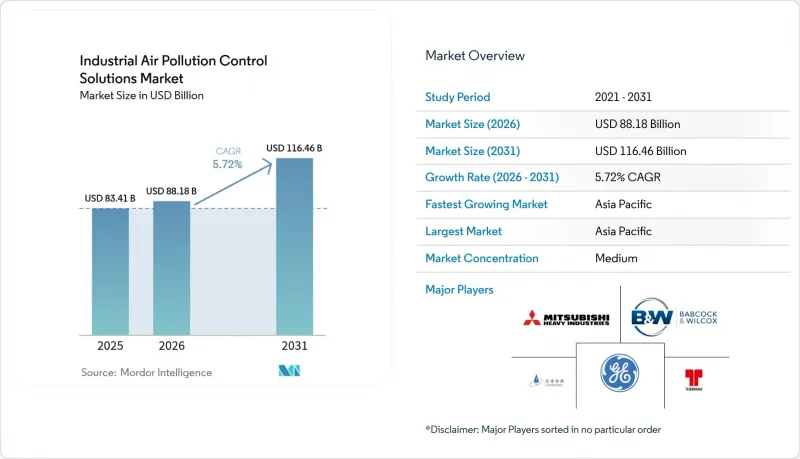
본 보고서는 유형별(정전기 집진 장치, 선택적 촉매 환원 및 탈질, 천 필터, 배연 탈황 등),용도(발전, 폐기물 소각 및 바이오매스, 시멘트 및 석회, 화학 및 석유화학, 기타), 그리고 지역(북미, 유럽, 아시아태평양, 남미, 중동 및 아프리카)별로 분류되어 있습니다.
전 세계 산업용 대기 오염 방지 솔루션 시장 동향 및 인사이트
다양한 분야의 배출 규제 강화
유럽연합(EU)의 개정된 ‘산업 배출 지침’이 2024년 8월에 발효되어, 산업 시설에 대해 주요 오염 물질을 2020년 대비 최대 40% 감축할 의무가 부과되었습니다. 이와 병행하여 미국에서도 규제가 강화되어 신규 고정식 터빈의 NOx 배출량을 더욱 줄여야 하며, 2032년까지 연간 2,659톤의 NOx를 감축하는 규정안이 마련되었습니다. EU와 미국의 기준치가 수렴됨에 따라 사실상 전 세계적인 규정 준수 최저 기준이 형성되었으며, 이는 고선택성 SCR 반응기, 습식 ESP 시스템 및 하이브리드 모듈의 선행 수주를 뒷받침하고 있습니다. 아시아에서도 유사한 규제 강화가 나타나고 있습니다. 한국의 허가 제도가 확대되어 대상 산업 시설이 4년 전 400곳에서 1,013곳으로 증가했으며, 이는 2024년 국내 PM2.5 농도가 사상 최저치를 기록한 요인 중 하나가 되었습니다. 이에 대응하여 시멘트 및 철강 업체들은 황, 질소, 분진 배출 대책을 하나의 EPC 계약으로 통합하여 대응하고 있으며, 이는 단편적인 개보수에서 명확히 벗어나려는 움직임을 보여줍니다. 이러한 조치들이 맞물려 대상 설비의 총수가 증가하고, 지출이 예측 기간의 초기 단계로 앞당겨지게 될 것입니다.
신흥국에서의 공중보건 의식 고조
인도의 ‘국가 청정 공기 프로그램’은 2026년까지 100개 이상의 도시에서 미세먼지 배출량을 40% 감축하는 것을 목표로 하고 있으며, 이 목표를 뒷받침하는 것은 230억 달러 규모로 연평균 7.5% 성장하고 있는 환경 기술 시장입니다. 태국도 이에 뒤이어 2024년에 내각 차원에서 대기질 관리에 관한 전용 법안을 승인했습니다. 중국의 의료경제학 연구에 따르면, 미세먼지 규제를 강화함으로써 2030년까지 21만 8,000명의 조기 사망을 예방할 수 있는 것으로 나타났으며, 이는 배출 말단 대책에 대한 투자의 현지 지지를 뒷받침하고 있습니다. 기업의 구매자들에게도 생산성 측면에서 구체적인 이점이 나타나고 있습니다. 산업 단지 전체에 설치된 센서 데이터에 따르면, PM2.5가 10µg/m³ 감소하면 근로자의 생산성이 향상되고 공장 차원의 수익성이 1% 개선되는 것으로 나타났습니다. 이러한 연구 결과를 바탕으로 경영진의 논의는 규정 준수 리스크에서 이익률 향상으로 전환되고 있습니다. 싱가포르와 인도네시아의 탄소 가격 제도에서는 이러한 건강상의 이점이 배출권 거래제의 균형에 반영되어, 더 깨끗한 공기가 거래 가능한 자산이 됨으로써 산업용 대기 오염 방지 솔루션 시장을 더욱 확대되고 있습니다.
첨단 대기 오염 방지 설비 도입에 따른 높은 설비 투자(Capex) 및 운영비(Opex)
종합적인 개보수 공사에는 1개 사업장당 5,000만-2억 달러의 비용이 들 수 있으며, 흡착제, 시약, 전력비 지출로 인해 연간 운영 비용이 10-15% 증가합니다. 디지털 트윈 소프트웨어를 통합한 고급 SCR 스택은 기존 장비보다 30-40% 더 비싸며, 많은 중견 제련소나 세라믹 공장에게는 감당하기 어려운 가격입니다. 그 결과, 개발도상국의 자금 조달 격차로 인해 설비 교체 주기가 장기화되고 있습니다. 이 업계는 모듈식 스키드 및 임대·운영·양도(LOT) 모델로 전환되고 있지만, 자금 조달의 마찰로 인해 본래 달성 가능한 연평균 성장률(CAGR)에서 여전히 1.5% 가까이 감소하고 있습니다. 미국 에너지부의 7,700만 달러 규모 ‘프로젝트 툰드라(Project Tundra)’ 패키지와 같은 민관 협력형 대출 보증은 대규모 유틸리티 계약 체결을 뒷받침하고 있지만, 중소기업에 대한 지원은 여전히 부족합니다. 자산 담보 대출이 보편화되기 전까지는 비용에 민감한 지역에서 산업용 대기 오염 방지 솔루션 시장이 이론상 수요 잠재력을 따라가지 못하는 상황이 지속될 것입니다.
부문 분석
2025년, 정전기 집진 장치는 산업용 대기 오염 방지 솔루션 시장에서 34.62%의 점유율을 차지하며, 미세먼지 제거의 주력 기술로서의 입지를 확고히 했습니다. 고주파 전원 및 스위치드 통합 정류기의 업데이트를 통해 기존 설비는 최신 상태로 유지되고 있지만, 성장의 초점은 SCR 시스템으로 이동하고 있으며, 중국, EU 및 미국의 일부 주에서 NOx 배출 상한선이 하향 조정됨에 따라 연평균 성장률(CAGR) 7.79%로 확대되고 있습니다. 각 공급업체들은 더 높은 황 및 분진 부하를 견디고, 암모니아 슬립과 유지보수 주기를 줄이는 개선된 바나듐·티타니아 배합 기술을 통해 차별화를 꾀하고 있습니다. 습식 전기 집진(ESP) 단계의 업스트림에 SCR 반응기를 결합한 하이브리드 유닛은 설치 면적을 최대 25%까지 줄일 수 있어, 여유 공간이 부족한 플랜트에서 결정적인 이점이 됩니다. 5 mg/Nm3 미만의 입자상 물질 배출 제한을 목표로 하는 시멘트 가마나 2차 납 제련소에서는 패브릭 필터의 점유율이 계속해서 확대되고 있습니다. 한편, 노후화된 석탄 연소 굴뚝에서는 배연 탈황(FGD) 개조가 여전히 필수적입니다. 한 번의 통과로 분진, SO₂, NOx를 처리할 수 있는 첨단 촉매 필터는 통합형 설계로 향하는 시장의 흐름을 상징하며, 메가와트당 평균 가격 상승을 뒷받침하는 요인이 되고 있습니다.
SCR 설비만을 대상으로 하는 산업용 대기오염 방지 솔루션 시장 규모는 2026년 252억 2,000만 달러에서 2031년까지 366억 9,000만 달러로 확대될 것으로 예측되며,이는 발전소 및 석유화학 정제소의 신규 건설 수요와 수명 만료에 따른 교체 수요를 모두 반영한 것입니다. 동시에, 활성탄 주입 및 건식 흡착제 투여 시스템은 수은 대책 개조 공사에서 낮은 수준이긴 하지만 다시 채택이 확대되고 있습니다. 플라즈마 및 UV 산화 장치는 여전히 틈새 시장에 머물러 있지만, 기존의 열산화 장치로는 제품 오염 위험이 발생하는 반도체 공장이나 특수한 VOC 배출원에서 그 수요가 확대되고 있습니다. 이러한 기술 동향은 전반적으로 단일 오염 물질의 최적화에서 종합적인 배출 감축으로의 전환을 부각시키고 있으며, 폭넓은 제품 포트폴리오를 보유한 공급업체가 전체 고객 계정에서 우수한 시장 점유율을 확보할 수 있는 입지에 있습니다.
지역별 분석
아시아태평양은 2025년 산업용 대기 오염 방지 솔루션 시장 매출의 48.70%를 차지하며, 2031년까지 연평균 성장률(CAGR) 6.18%라는 가장 급격한 성장 궤도를 유지하고 있습니다. 2027년까지 석탄 배출 강도를 50% 감축하겠다는 베이징시의 재정적 인센티브, 연간 7.5%의 속도로 성장하는 인도 230억 달러 규모의 환경 기술 부문, 그리고 한국의 PM2.5 대책 성공이 총 수요를 견인하고 있습니다. 일본의 ‘그린 트랜스포메이션’ 로드맵은 철강, 화학, 시멘트 업계의 설비 개보수에 자본을 유도하고 있는 반면, 아세안(ASEAN)의 탄소 가격 책정 체계는 배출 제한을 산업 사업자가 신속한 설비 갱신을 통해 헤지해야 하는 재무적 부채로 전환시키고 있습니다. 또한, 이 지역에는 신규 폐기물 발전 시설 계획이 가장 많이 존재하며, 통합형 하이브리드 시스템에 대한 수요가 증가하고 있습니다.
북미는 설비 업그레이드 및 라이프사이클 서비스 계약에 초점을 맞춘, 성숙하기는 하지만 수익성이 높은 시장입니다. 터빈에 대한 연방 NOx 기준안과 석탄에서 가스로의 대규모 전환으로 인해 SCR, 백하우스, 습식 스크러버에 대한 수주가 지속적으로 예상됩니다. 7,700만 달러 규모의 ‘프로젝트 툰드라’와 같은 대규모 CCUS 개조 사업은 통합 솔루션의 적용 범위를 더욱 확대되고 있습니다. 캐나다의 탄소 포집 세액 공제 제도에 따라 시멘트 공장 및 비료 공장에서는 대용량 습식 전기 집진 장치(ESP)와 하이브리드 촉매 필터의 도입이 진행되고 있습니다. 멕시코에서는 산업 회랑의 확대에 따라 비용 대비 효과가 높은 건식 흡착제 주입 패키지에 대한 수요가 국지적으로 나타나고 있습니다.
유럽은 2024년 ‘산업 배출 지침’을 통해 정책의 선도적 역할을 유지하고 있으며, 그 적용 범위를 금속 광업 및 배터리 생산까지 확대되고 있습니다. 95%의 CO2 포집 장치를 시범 도입하고 있는 독일의 시멘트 공장, 전체 유량 CO2 포집을 사양으로 하고 있는 핀란드의 폐기물 발전 플랜트는 이 지역에서 최첨단 하이브리드 솔루션에 대한 강력한 수요를 여실히 보여주고 있습니다. 남미에서는 브라질의 철강 및 시멘트 제조업체로부터의 수주가 점차 늘어나고 있는 반면, 중동 및 아프리카 수요는 정유시설나 가스 처리 시설을 위한 배기가스 처리에 집중되어 있으며, 그 예로 남아프리카공화국의 두바 발전소에서 진행 중인 CO2 스크러버 개보수 공사를 들 수 있습니다.
기타 혜택:
- 엑셀 형식 시장 예측(ME) 시트
- 3개월간의 애널리스트 지원
자주 묻는 질문
목차
제1장 서론
제2장 조사 방법
제3장 주요 요약
제4장 시장 구도
제5장 시장 규모와 성장 예측
제6장 경쟁 구도
제7장 시장 기회와 향후 전망
LSH 26.08.26According to Mordor Intelligence, the industrial air pollution control solutions market size market is expected to grow from USD 83.41 billion in 2025 to USD 88.18 billion in 2026 and is forecast to reach USD 116.46 billion by 2031 at 5.72% CAGR over 2026-2031.
This report is Segmented by Type (Electrostatic Precipitators, Selective Catalytic Reduction and Denitrification, Fabric Filters, Flue-Gas Desulfurization, and More), Application (Power Generation, Waste Incineration and Biomass, Cement and Lime, Chemicals and Petrochemicals, and More), and Geography (North America, Europe, Asia-Pacific, South America, and Middle East and Africa).
Global Industrial Air Pollution Control Solutions Market Trends and Insights
Stricter Multi-Sector Emission Regulations
The European Union's revised Industrial Emissions Directive entered into force in August 2024, obliging industrial sites to trim key pollutants by up to 40% versus 2020 levels. Parallel tightening in the United States now targets deeper NOx cuts from new stationary turbines, with draft rules slated to eliminate 2,659 tons of NOx annually by 2032. Convergence between EU and U.S. thresholds creates a de facto global compliance floor that drives advance orders for high-selectivity SCR reactors, wet ESP systems, and hybrid modules. Enforcement is equally visible in Asia: South Korea's expanded permitting regime now covers 1,013 industrial facilities, versus 400 four years earlier, contributing to record-low national PM2.5 readings in 2024. Cement and steel operators have responded by bundling sulfur, nitrogen, and dust controls into single EPC contracts, signaling a clear shift away from piecemeal retrofits. Collectively, these measures raise the addressable pool of installations and pull forward spending into the early part of the forecast window.
Rising Public-Health Awareness in Emerging Economies
India's National Clean Air Programme now seeks 40% particulate reductions across more than 100 cities by 2026, a target backed by an environmental-technology market worth USD 23 billion and expanding at 7.5% annually. Thailand followed with cabinet-level approval of a dedicated air-quality management bill in 2024. Health-economics studies in China suggest stricter particulate controls could avert 218,000 premature deaths by 2030, fuelling local support for end-of-pipe investments. Corporate buyers also capture tangible productivity benefits; sensors installed across industrial zones indicate that a 10 µg/m3 drop in PM2.5 lifts worker output enough to add 1% to plant-level profitability, a finding that has moved boardroom discussions from compliance risk to margin enhancement. Carbon-pricing schemes in Singapore and Indonesia embed these health benefits into cap-and-trade balances, turning cleaner air into a tradable asset, further enlarging the industrial air pollution control solution market.
High Capex & Opex of Advanced APC Installations
Comprehensive retrofits can command USD 50-200 million per site, with sorbent, reagent, and electricity outlays lifting annual operating costs 10-15%. Premium SCR stacks that integrate digital-twin software price 30-40% above legacy units, putting them out of reach for many mid-tier smelters and ceramics plants. Financing gaps in developing countries thus prolong equipment replacement cycles. The sector is pivoting to modular skids and lease-operate-transfer models, but capital frictions still shave nearly 1.5 percentage points off the otherwise addressable CAGR. Public-private loan guarantees, such as the U.S. Department of Energy's USD 77 million Project Tundra package, help close large utility deals, yet smaller enterprises remain underserved. Until asset-based financing becomes commonplace, the industrial air pollution control solution market will trail its theoretical demand potential in cost-sensitive regions.
Other drivers and restraints analyzed in the detailed report include:
- Efficiency Gains from Next-Gen Catalysts & Digital Twins
- Continued Build-Out of Coal-to-Gas & Waste-to-Energy Plants in APAC
- Retirement of Coal-Fired Assets in OECD Markets
For complete list of drivers and restraints, kindly check the Table Of Contents.
Segment Analysis
Electrostatic precipitators commanded a 34.62% industrial air pollution control solution market share in 2025, confirming their status as the workhorse for particulate removal. While replacement activity for high-frequency power supplies and switched-integrated rectifiers keeps the installed base current, the growth spotlight has shifted to SCR systems, which are advancing at a 7.79% CAGR in response to NOx ceiling reductions in China, the EU, and several U.S. states. Suppliers differentiate through improved vanadium-titania formulations that withstand higher sulfur and dust loads, reducing ammonia slip and maintenance cycles. Hybrid units that couple SCR reactors upstream of wet ESP stages shrink total footprint by up to 25%, a decisive advantage in plants with little spare space. Fabric filters continue to gain share in cement kilns and secondary lead smelters seeking sub-5 mg/Nm3 particulate limits, while flue-gas desulfurization retrofits remain indispensable for aging coal stacks. Advanced catalytic filtration, capable of tackling dust, SO2, and NOx in one pass, exemplifies the market's march toward integrated designs and underpins the rising average price per megawatt capacity.
The industrial air pollution control solution market size for SCR equipment alone is projected to climb from USD 25.22 billion in 2026 to USD 36.69 billion by 2031, reflecting both new-build demand and end-of-life replacement at utilities and petrochemical refineries. Concurrently, activated-carbon injection and dry-sorbent dosing systems see renewed uptake in mercury-control retrofits, albeit from a lower base. Plasma and UV oxidizers remain niche but grow in semiconductor fabs and specialized VOC streams where conventional thermal oxidizers would risk product contamination. Collectively, these technology trends underscore a shift from single-pollutant optimization toward holistic abatement, positioning vendors with broad portfolios for superior wallet share across customer accounts.
Complete Report Scope:
- By Type
- Electrostatic Precipitators (Dry and Wet)
- Flue-Gas Desulfurization (Wet, Dry, Semi-Dry)
- Selective Catalytic Reduction (SCR) and Denitrification
- Fabric Filters (Baghouse, Cartridge)
- Hybrid and Multi-pollutant Systems
- Activated Carbon and Sorbent Injection
- Others (Oxidizers, UV, Plasma)
- By Application
- Power Generation
- Cement and Lime
- Iron and Steel
- Chemicals and Petrochemicals
- Waste Incineration and Biomass
- Pulp and Paper
- Others (Pharmaceuticals, Food and Beverage)
- By Geography
- North America
- United States
- Canada
- Mexico
- Europe
- Germany
- France
- United Kingdom
- Italy
- Russia
- Rest of Europe
- Asia Pacific
- China
- India
- Japan
- South Korea
- ASEAN Countries
- Rest of Asia Pacific
- South America
- Brazil
- Argentina
- Rest of South America
- Middle East and Africa
- Saudi Arabia
- United Arab Emirates
- South Africa
- Rest of Middle East and Africa
- North America
Geography Analysis
Asia-Pacific claims 48.70% of the industrial air pollution control solution market revenue in 2025 and sustains the steepest trajectory at a 6.18% CAGR through 2031. Beijing's fiscal incentives for 50% coal-emission-intensity cuts by 2027, India's USD 23 billion environmental-tech sector expanding 7.5% annually, and South Korea's successful PM2.5 crackdown drive aggregate demand. Japan's Green-Transformation road map funnels capital toward steel, chemicals, and cement retrofits, while ASEAN carbon-pricing frameworks turn emission limits into financial liabilities that industrial operators must hedge via rapid equipment upgrades. The region also hosts the largest pipeline of new waste-to-energy facilities, intensifying demand for integrated hybrid systems.
North America represents a mature but profitable arena focused on equipment upgrades and lifecycle-service contracts. Proposed federal NOx standards for turbines and substantial coal-to-gas conversions sustain a stream of SCR, baghouses, and wet-scrubber orders. Large CCUS retrofits, such as the USD 77 million Project Tundra undertaking, further enlarge the scope of integrated solutions. Canada's carbon-capture tax credits push cement and fertilizer plants toward high-capacity wet ESP and hybrid catalytic filters. Mexico's growing industrial corridors present pockets of demand for cost-effective dry-sorbent injection packages.
Europe keeps the policy vanguard through the 2024 Industrial Emissions Directive, extending coverage to metal mining and battery production. German cement plants piloting 95% CO2 capture units and Finnish waste-to-energy plants specifying full-stream carbon capture highlight the region's appetite for cutting-edge hybrid solutions. South America sees budding orders from Brazilian steel and cement producers, while the Middle East & Africa demand centers on flue-gas conditioning for refinery and gas-processing facilities, including South Africa's CO2-scrubber retrofit at Duvha Power Station.
- Mitsubishi Heavy Industries - Power & Env.
- General Electric Company
- Babcock & Wilcox Enterprises Inc.
- Thermax Ltd.
- Fujian Longking Co. Ltd.
- Hamon Group
- Andritz AG
- John Wood Group PLC
- GEA Bischoff GmbH
- Pure Air Solutions Inc.
- Tri-Mer Corporation
- Ducon Technologies Inc.
- Horiba Ltd.
- Calgon Carbon Corporation
- Esco International Holding
- Siemens Energy
- Donaldson Company Inc.
- Valmet Oyj
- Camfil AB
- AAF International
- CECO Environmental
- Durr Systems AG
- Anguil Environmental Systems
- SLY Inc.
- Albarrie Canada Ltd.
Additional Benefits:
- The market estimate (ME) sheet in Excel format
- 3 months of analyst support
TABLE OF CONTENTS
1 Introduction
- 1.1 Study Assumptions & Market Definition
- 1.2 Scope of the Study
- 1.2.1 Scope of the Study
2 Research Methodology
3 Executive Summary
4 Market Landscape
- 4.1 Market Overview
- 4.2 Market Drivers
- 4.2.1 Stricter multi-sector emission regulations
- 4.2.2 Rising public-health awareness in emerging economies
- 4.2.3 Efficiency gains from next-gen catalysts & digital twins
- 4.2.4 Continued build-out of coal-to-gas & waste-to-energy plants in APAC
- 4.2.5 AI-enabled predictive maintenance lowers compliance risk
- 4.2.6 Net-zero industrial clusters adopting modular APC packages
- 4.3 Market Restraints
- 4.3.1 High capex & opex of advanced APC installations
- 4.3.2 Retirement of coal-fired assets in OECD markets
- 4.3.3 Supply-chain volatility for vanadium & other catalyst materials
- 4.3.4 Shift toward in-process abatement (oxy-fuel, low-NOx burners) cuts end-of-pipe demand
- 4.4 Supply-Chain Analysis
- 4.5 Regulatory Landscape
- 4.6 Technological Outlook
- 4.7 Porter's Five Forces
- 4.7.1 Bargaining Power of Suppliers
- 4.7.2 Bargaining Power of Consumers
- 4.7.3 Threat of New Entrants
- 4.7.4 Threat of Substitute Products & Services
- 4.7.5 Intensity of Competitive Rivalry
5 Market Size & Growth Forecasts
- 5.1 By Type
- 5.1.1 Electrostatic Precipitators (Dry and Wet)
- 5.1.2 Flue-Gas Desulfurization (Wet, Dry, Semi-Dry)
- 5.1.3 Selective Catalytic Reduction (SCR) and Denitrification
- 5.1.4 Fabric Filters (Baghouse, Cartridge)
- 5.1.5 Hybrid and Multi-pollutant Systems
- 5.1.6 Activated Carbon and Sorbent Injection
- 5.1.7 Others (Oxidizers, UV, Plasma)
- 5.2 By Application
- 5.2.1 Power Generation
- 5.2.2 Cement and Lime
- 5.2.3 Iron and Steel
- 5.2.4 Chemicals and Petrochemicals
- 5.2.5 Waste Incineration and Biomass
- 5.2.6 Pulp and Paper
- 5.2.7 Others (Pharmaceuticals, Food and Beverage)
- 5.3 By Geography
- 5.3.1 North America
- 5.3.1.1 United States
- 5.3.1.2 Canada
- 5.3.1.3 Mexico
- 5.3.2 Europe
- 5.3.2.1 Germany
- 5.3.2.2 France
- 5.3.2.3 United Kingdom
- 5.3.2.4 Italy
- 5.3.2.5 Russia
- 5.3.2.6 Rest of Europe
- 5.3.3 Asia Pacific
- 5.3.3.1 China
- 5.3.3.2 India
- 5.3.3.3 Japan
- 5.3.3.4 South Korea
- 5.3.3.5 ASEAN Countries
- 5.3.3.6 Rest of Asia Pacific
- 5.3.4 South America
- 5.3.4.1 Brazil
- 5.3.4.2 Argentina
- 5.3.4.3 Rest of South America
- 5.3.5 Middle East and Africa
- 5.3.5.1 Saudi Arabia
- 5.3.5.2 United Arab Emirates
- 5.3.5.3 South Africa
- 5.3.5.4 Rest of Middle East and Africa
- 5.3.1 North America
6 Competitive Landscape
- 6.1 Market Concentration
- 6.2 Strategic Moves (M&A, Partnerships, PPAs)
- 6.3 Market Share Analysis (Market Rank/Share for key companies)
- 6.4 Company Profiles (includes Global level Overview, Market level overview, Core Segments, Financials as available, Strategic Information, Products & Services, and Recent Developments)
- 6.4.1 Mitsubishi Heavy Industries - Power & Env.
- 6.4.2 General Electric Company
- 6.4.3 Babcock & Wilcox Enterprises Inc.
- 6.4.4 Thermax Ltd.
- 6.4.5 Fujian Longking Co. Ltd.
- 6.4.6 Hamon Group
- 6.4.7 Andritz AG
- 6.4.8 John Wood Group PLC
- 6.4.9 GEA Bischoff GmbH
- 6.4.10 Pure Air Solutions Inc.
- 6.4.11 Tri-Mer Corporation
- 6.4.12 Ducon Technologies Inc.
- 6.4.13 Horiba Ltd.
- 6.4.14 Calgon Carbon Corporation
- 6.4.15 Esco International Holding
- 6.4.16 Siemens Energy
- 6.4.17 Donaldson Company Inc.
- 6.4.18 Valmet Oyj
- 6.4.19 Camfil AB
- 6.4.20 AAF International
- 6.4.21 CECO Environmental
- 6.4.22 Durr Systems AG
- 6.4.23 Anguil Environmental Systems
- 6.4.24 SLY Inc.
- 6.4.25 Albarrie Canada Ltd.
7 Market Opportunities & Future Outlook
- 7.1 White-space & Unmet-need Assessment


