|
시장보고서
상품코드
2114670
수면무호흡증 임플란트 : 시장 점유율 분석, 산업 동향 및 통계 데이터, 성장 예측(2026-2031년)Sleep Apnea Implant - Market Share Analysis, Industry Trends & Statistics, Growth Forecasts (2026 - 2031) |
||||||
 Mordor Intelligence
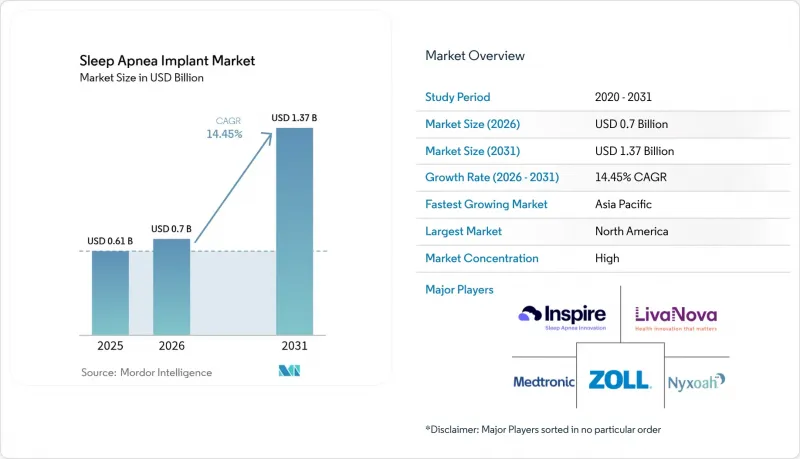
Mordor Intelligence에 의하면, 수면무호흡증 임플란트 시장 규모는 2025년 6억 1,000만 달러에서 2026년에는 7억 달러에 이르고, 2026-2031년 CAGR 14.45%로 성장을 지속하여 2031년에는 13억 7,000만 달러에 달할 것으로 예측됩니다.
본 보고서는 제품 유형(설하 신경 자극 장치 등), 적응증(폐쇄성 수면 무호흡증 등), 이식 방법(완전 이식형 시스템, 부분 이식형 시스템), 최종 사용자(병원 등), 지역(북미, 유럽, 아시아태평양, 중동 및 아프리카, 남미)별로 분류되어 있습니다. 시장 예측은 금액(달러) 기준으로 제시되어 있습니다.
전 세계 수면무호흡증 임플란트 시장 동향 및 인사이트
수면무호흡증의 유병률 및 진단률 증가
차세대 재택 수면 검사에서는 스마트폰에 대한 의존도를 배제하고, 의심 단계에서 확정 진단까지의 시간을 단축함으로써 암호화된 데이터를 임상 의사에게 직접 전송할 수 있게 되었기 때문에 전 세계적으로 진단된 환자 수는 분기마다 증가하고 있습니다. AI 알고리즘이 탑재된 웨어러블 기기는 일상적인 건강 관리 추적 과정에서 소비자를 선별하고, 비정상적인 호흡을 감지하여 정식 수면 검사를 받도록 안내하고 있습니다. 조기 진단으로 인해 수술 건수가 증가함에 따라, 수면무호흡증 임플란트 시장에서 수술 건수가 두 자릿수 성장률을 유지하고 있습니다. 병원 측은 수면 다원 검사, 약물 유도 내시경 검사 및 당일 적격성 평가를 결합한 원스톱 진료소를 개설하여 이러한 수요에 대응하고 있습니다. 보험사 측은 조기 개입을 통해 하류 단계인 심혈관 질환에 대한 보험 청구 건수가 감소한다는 점을 인식하고 있으며, 마스크 요법이 실패할 경우 임플란트 치료를 논리적인 다음 단계로 간주하는 급여 정책을 강화하고 있습니다.
CPAP 미준수 증가에 따른 대체 요법 수요 발생
사용자 10명 중 4명은 주로 마스크의 불편함, 소음, 동거인의 수면 방해를 이유로 1년 이내에 지속 양압 호흡 요법(CPAP)을 중단하고 있습니다. 설하 신경 자극 요법에서는 매일 밤 81%의 준수율이 달성되고 있으며, 이를 통해 무호흡·저호흡 지수 및 주간 졸음이 대폭 감소하고 있습니다. 의사들이 CPAP 불내성이 확인된 직후 임플란트 치료를 제안하는 사례가 늘어나고 있으며, 이로 인해 수면무호흡증 임플란트 시장이 확대되어 치료 지속 과정의 초기 단계에서 질환의 부담을 줄일 수 있게 되었습니다. 보험사는 초기 기기 비용이 높지만, 고혈압이나 부정맥으로 인한 응급실 방문을 줄일 수 있기 때문에 예측 가능한 순응도 곡선을 선호합니다. 원격 모니터링 포털을 통해 임상의는 내원 없이도 사용 상황을 확인하고, 기술적 문제를 발견하며, 진폭을 조정할 수 있어 실생활에서의 순응도를 더욱 지원하고 있습니다.
고액의 시술비와 기기비가 환자의 경제적 부담을 가중
보험 가입률이 낮거나 본인 부담 상한선이 엄격하게 설정된 의료 제도에서는 총비용이 높기 때문에 임플란트 치료가 부담스러운 경우가 많습니다. 보험 적용 범위가 넓은 시장이라 하더라도 공동 부담액은 종종 몇 달 치의 소득 중앙값에 해당합니다. 각 제조업체는 대량 생산과 부품 통합을 통해 제품 원가 절감을 위해 노력하고 있지만, 첨단 전자 기술 및 규제 준수에 드는 비용으로 인해 가격 책정의 유연성은 제한되고 있습니다. 합리적인 가격의 금융 프로그램이나 성과 연계형 계약이 부분적인 해결책으로 대두되고 있지만, 경제적 격차는 여전히 라틴아메리카, 아프리카, 동남아시아의 일부 지역에서 수면무호흡증 임플란트 시장의 보급을 저해하고 있습니다.
부문 분석
2025년, 설하 신경 자극 요법은 수면 무호흡증 임플란트 시장에서 60.55%의 점유율을 차지했습니다. 누적 9만 명 이상의 환자에서 무호흡·저호흡 지수(AHI)의 대폭적인 감소, 심한 코골이의 감소, 그리고 QOL 점수의 향상이 확인되었습니다. Inspire Medical Systems사의 최신 펄스 발생기는 배터리 수명을 11년으로 연장하여 평생 재수술 위험을 줄이고 있습니다. Medtronic사와 LivaNova사는 멀티 컨택트 전극을 추가하는 파일럿 프로그램을 전개하고 있으며, 향후 제품 출시를 위한 체제를 갖추고 있습니다. 구개 임플란트는 경증 사례에 대응하고 있지만, 유효성에 편차가 있고 보험 적용 범위도 제한적이기 때문에 시장 기여도는 여전히 미미한 수준입니다.
3차신경 자극 장치는 연평균 성장률(CAGR) 20.12%로 성장할 전망입니다. 턱 아래에 이식함으로써 가슴 부위의 주머니를 피할 수 있어, 외모를 신경 쓰는 환자에게 매력적입니다. 초기 임상 연구에서는 수면 구조의 선택적 조절과 높은 안전성이 입증되어, 이 분야는 벤처 캐피탈의 주목을 받고 있습니다. 경쟁의 향방은 소형화, 직관적인 앱 인터페이스, 그리고 MRI 호환 기능에 달려 있습니다. 이러한 추세가 지속된다면, 3차신경 자극 장치는 2020년대 후반까지 수면무호흡증 임플란트 시장에서 상당한 점유율을 확보할 가능성이 있습니다.
2025년 시점에서 폐쇄성 수면무호흡증이 수면무호흡증용 임플란트 시장 규모의 78.35%를 차지했습니다. 약물 유도 수면 내시경 검사는 외과의사가 치료 효과가 기대되는 환자를 예측하는 데 도움이 되며, 여러 전향적 코호트 연구에서 수술 성공률을 75% 이상으로 높이고 있습니다. 심장 전문의와 수면 전문의가 협력하여 해부학적 요인에 의한 폐쇄를 조기에 파악함으로써, 동반 질환이 악화되기 전에 환자를 임플란트 치료 프로그램으로 유도하고 있습니다.
횡격막 신경 자극 요법이 적응형 서보 환기 요법을 견디지 못하는 심부전 환자들 사이에서 보급됨에 따라, 중추성 수면 무호흡증 사례 수는 연평균 16.55%의 속도로 증가할 것으로 전망됩니다. 2024년에 MRI 호환 인증을 획득함에 따라, 영상 검사를 빈번히 받는 이 환자군에서 이식 수술의 장벽이 제거되었습니다(aasm.org). 복합형 수면무호흡증후군은 여전히 점유율이 가장 낮고, 미충족 수요가 매우 크며, 약물 요법, 체위 요법, 신경 자극 요법을 결합한 하이브리드 치료법의 여지가 있습니다.
지역별 분석
북미는 2025년에 전 세계 매출의 45.80%를 차지하며, 수면무호흡증 임플란트 시장의 중심축으로 자리매김하고 있습니다. 미국에서는 1,400곳 이상의 인증 시설이 메디케어·메디케이드 서비스 센터(CMS)의 명확한 코딩에 따라 설하 신경 자극 장치 이식 수술을 시행하고 있습니다. 민간 보험사는 심혈관 질환으로 인한 입원 감소가 확인된 실세계 데이터를 근거로 보험 적용 방침을 신속하게 조정했습니다. 확대되는 비만 유행으로 인해 적격 환자층이 유지되고 있는 한편, 캐나다에서는 4개 주에서 공적 보험에 의한 환급이 시범적으로 도입되어 더 광범위한 채택이 예상됩니다.
매출액 기준으로는 유럽이 2위를 차지하고 있습니다. 독일, 프랑스, 영국은 조기 CE 마크 획득, 지원적인 보험 규정, 그리고 견고한 임상 연구 네트워크를 통해 시술 건수를 주도하고 있습니다. 유럽투자은행(EIB)이 Nyxoah사에 제공한 3,750만 유로의 대출은 양측용 기기의 규모 확대를 뒷받침하고 있습니다. 벨기에 레지스트리에 따르면, 12개월 후 추적 조사에서 수술 성공률은 76%였으며, 1박당 평균 치료 시간은 7시간을 초과했습니다. 남유럽 및 동유럽 시장은 아직 발전 단계에 있지만, 국경을 초월한 환자 소개 프로그램과 외과 의사 연수 컨소시엄의 혜택을 받고 있습니다.
아시아태평양은 가장 빠르게 성장하고 있으며, 2031년까지의 연평균 성장률(CAGR)은 15.20%로 예측됩니다. 일본은 사실상 국민건강보험 제도가 잘 갖춰져 있고 기술 조기 도입이 진행되고 있어, 임플란트 도입 대수가 꾸준히 증가할 것으로 기대됩니다. 중국에서는 이미 FDA 승인을 받은 의료기기에 대해 우선 심사 절차가 마련되어 있어, 시장 출시까지의 기간이 단축되고 있습니다. 현지 유통업체은 수술 기술 격차 해소를 위해 베이징, 상하이, 광저우에 교육 거점을 설립하고 있습니다. 인도의 도시 지역 중산층에서는 인식이 높아지고 있는 것으로 보이지만, 높은 본인 부담금이 보급을 저해하고 있습니다. 저소득층을 대상으로 한 첨단 치료를 지원하는 정부의 시책은 잠재 수요를 자극하여, 수면무호흡증 임플란트 시장의 추가 확대를 촉진할 가능성이 있습니다.
남미 및 중동 및 아프리카은 합쳐서 전 세계 매출의 10% 미만을 차지할 뿐이지만, 회복의 조짐이 보입니다. 브라질의 민간 병원에서는 종합적인 체중 감량 프로그램에 임플란트를 포함시키고 있으며, 보험사는 CPAP 치료가 효과를 보이지 않는 경우 비용을 상환하고 있습니다. 걸프협력회의(GCC) 회원국 병원들은 고품질 의료 서비스를 찾는 외국인 환자를 유치하기 위해 해외 전문 지식 도입에 투자하고 있습니다. 환율 변동과 수입 관세가 가격 전략의 과제로 작용하고 있지만, 경제 다각화와 의료비 증가에 따라 장기적인 전망은 여전히 밝습니다.
기타 혜택:
- Excel 형식 시장 예측(ME) 시트
- 3개월간 애널리스트 지원
자주 묻는 질문
목차
제1장 서론
제2장 분석 방법
제3장 주요 요약
제4장 시장 구도
제5장 시장 규모·성장률 예측
제6장 경쟁 구도
제7장 시장 기회와 향후 전망
LSH 26.08.26According to Mordor Intelligence, the sleep apnea implant market size is expected to grow from USD 0.61 billion in 2025 to USD 0.7 billion in 2026 and is forecast to reach USD 1.37 billion by 2031 at 14.45% CAGR over 2026-2031.
This report is Segmented by Product Type (Hypoglossal Neurostimulation Devices, and More), Indication (Obstructive Sleep Apnea, and More), Implant Approach (Fully Implantable Systems and Partially Implantable Systems), End User (Hospitals, and More), Geography (North America, Europe, Asia-Pacific, The Middle East and Africa, and South America). The Market Forecasts are Provided in Terms of Value (USD).
Global Sleep Apnea Implant Market Trends and Insights
Increasing Prevalence and Diagnosis Rates of Sleep Apnea Disorders
The world's diagnosed patient pool rises every quarter as next-generation home sleep tests route encrypted data directly to clinicians, bypassing smartphone dependency and cutting time from suspicion to confirmation. Wearable devices with AI algorithms now screen consumers during routine wellness tracking, flagging abnormal respiration and guiding them toward formal sleep studies. Earlier diagnosis feeds the surgical pipeline, driving consistent double-digit procedure growth inside the sleep apnea implant market. Hospitals answer demand by creating one-stop clinics that combine polysomnography, drug-induced endoscopy, and same-day eligibility assessment. Payers see value when early intervention lessens downstream cardiovascular claims, reinforcing reimbursement policies that treat implants as a logical step once mask therapy fails.
Growing CPAP Non-Compliance Creating Demand for Alternative Therapies
Four in ten users abandon continuous positive airway pressure within a year, mainly due to mask discomfort, noise, and disrupted bed-partner sleep. Hypoglossal neurostimulation achieves 81% nightly adherence, translating into larger reductions in apnea-hypopnea index and daytime sleepiness. Physicians increasingly position implants immediately after documented CPAP intolerance, broadening the sleep apnea implant market and bringing down disease burden earlier in the care continuum. Payers prefer the predictable compliance curve despite higher up-front device cost because it cuts emergency visits for hypertension and arrhythmia. Remote monitoring portals let clinicians verify usage data, spot technical issues, and adjust amplitude without clinic visits, further supporting real-world adherence.
High Procedure and Device Costs Limiting Patient Affordability
Total expenses place implants beyond reach in health systems where insurance penetration is low or copay ceilings are strict. Even in markets with coverage, coinsurance often equals several months of median income. Manufacturers strive to lower cost of goods through scale manufacturing and component consolidation, but pricing flexibility is constrained by advanced electronics and regulatory compliance costs. Affordable financing programs and outcomes-based contracting emerge as partial solutions, yet economic disparity still caps penetration of the sleep apnea implant market in parts of Latin America, Africa, and Southeast Asia.
Other drivers and restraints analyzed in the detailed report include:
- Product Approvals and Favorable Reimbursement for Implantable Therapies
- Advancements in Neurostimulation Technology Improving Therapy Efficacy
- Limited Long-Term Clinical Evidence and Post-Market Follow-Up Data
For complete list of drivers and restraints, kindly check the Table Of Contents.
Segment Analysis
Hypoglossal neurostimulation delivered 60.55% sleep apnea implant market share in 2025. More than 90,000 cumulative patients show substantial apnea-hypopnea index reduction, loud snoring decline, and improved quality-of-life scores. Inspire Medical Systems' newest pulse generator extends battery life to 11 years, cutting lifetime revision risk. Medtronic and LivaNova have pilot programs that add multi-contact electrodes, positioning themselves for future launches. Palatal implants address mild cases but suffer from variable efficacy and limited coverage, keeping their contribution minor.
Trigeminal stimulators are poised to grow at 20.12% CAGR. Submental placement avoids a chest pocket, appealing to appearance-sensitive patients. Early clinical work indicates selective modulation of sleep architecture and high safety margins, making this category a magnet for venture capital. Competitive dynamics hinge on miniaturization, intuitive app interfaces, and MRI safety features. Strong momentum suggests trigeminal devices could capture a meaningful slice of the sleep apnea implant market by late decade.
Obstructive cases accounted for 78.35% of the sleep apnea implant market size in 2025. Drug-induced sleep endoscopy helps surgeons predict responders, improving surgical success rates above 75% in several prospective cohorts. Cardiologists and sleep specialists collaborate to identify anatomically driven obstruction earlier, funneling patients to implant programs before comorbidities escalate.
Central sleep apnea volumes will grow 16.55% annually as phrenic nerve stimulation gains traction for heart-failure patients who cannot tolerate adaptive servo-ventilation. MRI-conditional status granted in 2024 removes an obstacle to implantation in this high-imaging group aasm.org. Complex sleep apnea syndrome remains the smallest share but offers significant unmet need, providing room for hybrid solutions that combine pharmacology, positional therapy, and neurostimulation.
Complete Report Scope:
- By Product Type
- Hypoglossal Neurostimulation Devices
- Phrenic Nerve Stimulators
- Palatal Implants
- Trigeminal Nerve Stimulation Systems
- By Indication
- Obstructive Sleep Apnea
- Central Sleep Apnea
- Complex Sleep Apnea Syndrome
- By Implant Approach
- Fully Implantable Systems
- Partially Implantable Systems
- By End User
- Hospitals
- Ambulatory Surgical Centers
- Other End Users
- Geography
- North America
- United States
- Canada
- Mexico
- Europe
- Germany
- United Kingdom
- France
- Italy
- Spain
- Rest of Europe
- Asia-Pacific
- China
- Japan
- India
- Australia
- South Korea
- Rest of Asia-Pacific
- Middle East & Africa
- GCC
- South Africa
- Rest of Middle East & Africa
- South America
- Brazil
- Argentina
- Rest of South America
- North America
Geography Analysis
North America held 45.80% of global revenue in 2025 and remains the anchor of the sleep apnea implant market. More than 1,400 certified U.S. facilities perform hypoglossal implantation under clear Centers for Medicare & Medicaid Services coding. Commercial payers rapidly aligned policies, citing real-world data showing reduced cardiovascular hospitalizations. The expanding obesity epidemic sustains a large eligible pool, while Canada pilots public reimbursement in four provinces, signaling broader adoption.
Europe ranks second by revenue. Germany, France, and the United Kingdom drive procedure counts through early CE-mark access, supportive insurance codes, and robust clinical research networks. The European Investment Bank's EUR 37.5 million loan to Nyxoah underpins scale-up of bilateral devices. Belgian registries report 76% surgical success at twelve-month follow-up with mean nightly therapy use exceeding seven hours. Southern and Eastern European markets, although nascent, benefit from cross-border referral programs and surgeon training consortia.
Asia Pacific is the fastest climber with a projected 15.20% CAGR through 2031. Japan enjoys near-universal health coverage and early technology adoption, facilitating steady implant volumes. China uses a priority review channel for devices already cleared by the FDA, shortening time to market. Local distributors establish training hubs in Beijing, Shanghai, and Guangzhou to address the surgical skill gap. India's urban middle class shows heightened awareness, yet high out-of-pocket burden tempers penetration. Government schemes that subsidize advanced therapies for low-income groups could unlock latent demand, fostering further expansion of the sleep apnea implant market.
South America and the Middle East & Africa jointly account for less than 10% of global revenue but exhibit green shoots. Brazilian private hospitals integrate implants into comprehensive weight-loss programs, and insurance companies reimburse when CPAP fails. Gulf Cooperation Council hospitals invest in imported expertise to attract expatriate patients seeking premium care. Currency volatility and import tariffs challenge pricing strategies, but the long-term outlook remains positive as economies diversify and healthcare spending rises.
- Medtronic
- ZOLL Medical (Respicardia)
- Nyxoah
- LivaNova
- Siesta Medical
- LinguaFlex
- Avery Biomedical Devices
- Lazzaro Medical
- Aura MEDICAL (Aura6000)
- Sibel Health (pipeline)
- Neurotech LLC
- Nuvaira Inc.
- AcuPebble Neuro
- ImThera Medical
- AtAir Medical
- ResMed-Nyxoah JV
Additional Benefits:
- The market estimate (ME) sheet in Excel format
- 3 months of analyst support
TABLE OF CONTENTS
1 Introduction
- 1.1 Study Assumptions & Market Definition
- 1.2 Scope of the Study
2 Research Methodology
3 Executive Summary
4 Market Landscape
- 4.1 Market Overview
- 4.2 Market Drivers
- 4.2.1 Increasing Prevalence and Diagnosis Rates of Sleep Apnea Disorders
- 4.2.2 Growing CPAP Non-Compliance Creating Demand for Alternative Therapies
- 4.2.3 Product Approvals and Favorable Reimbursement for Implantable Therapies
- 4.2.4 Advancements in Neurostimulation Technology Improving Therapy Efficacy
- 4.2.5 Expanding ENT Surgical Infrastructure in Outpatient Settings Worldwide
- 4.2.6 Rising Healthcare Expenditure and Sleep-Health Awareness Campaigns
- 4.3 Market Restraints
- 4.3.1 High Procedure and Device Costs Limiting Patient Affordability
- 4.3.2 Limited Long-Term Clinical Evidence and Post-Market Follow-Up Data
- 4.3.3 Surgical Expertise Gap and Associated Learning Curve For HGNS
- 4.3.4 Stringent Regulatory Approval Pathways and Heterogeneous Coverage
- 4.4 Regulatory & Technological Outlook
- 4.5 Porter's Five Forces Analysis
- 4.5.1 Threat of New Entrants
- 4.5.2 Bargaining Power of Buyers / Consumers
- 4.5.3 Bargaining Power of Suppliers
- 4.5.4 Threat of Substitute Products
- 4.5.5 Intensity of Competitive Rivalry
5 Market Size & Growth Forecasts (Value, USD)
- 5.1 By Product Type
- 5.1.1 Hypoglossal Neurostimulation Devices
- 5.1.2 Phrenic Nerve Stimulators
- 5.1.3 Palatal Implants
- 5.1.4 Trigeminal Nerve Stimulation Systems
- 5.2 By Indication
- 5.2.1 Obstructive Sleep Apnea
- 5.2.2 Central Sleep Apnea
- 5.2.3 Complex Sleep Apnea Syndrome
- 5.3 By Implant Approach
- 5.3.1 Fully Implantable Systems
- 5.3.2 Partially Implantable Systems
- 5.4 By End User
- 5.4.1 Hospitals
- 5.4.2 Ambulatory Surgical Centers
- 5.4.3 Other End Users
- 5.5 Geography
- 5.5.1 North America
- 5.5.1.1 United States
- 5.5.1.2 Canada
- 5.5.1.3 Mexico
- 5.5.2 Europe
- 5.5.2.1 Germany
- 5.5.2.2 United Kingdom
- 5.5.2.3 France
- 5.5.2.4 Italy
- 5.5.2.5 Spain
- 5.5.2.6 Rest of Europe
- 5.5.3 Asia-Pacific
- 5.5.3.1 China
- 5.5.3.2 Japan
- 5.5.3.3 India
- 5.5.3.4 Australia
- 5.5.3.5 South Korea
- 5.5.3.6 Rest of Asia-Pacific
- 5.5.4 Middle East & Africa
- 5.5.4.1 GCC
- 5.5.4.2 South Africa
- 5.5.4.3 Rest of Middle East & Africa
- 5.5.5 South America
- 5.5.5.1 Brazil
- 5.5.5.2 Argentina
- 5.5.5.3 Rest of South America
- 5.5.1 North America
6 Competitive Landscape
- 6.1 Strategic Moves
- 6.2 Market Share Analysis
- 6.3 Company Profiles (includes Global level Overview, Market level overview, Core Business Segments, Financials, Headcount, Key Information, Market Rank, Market Share, Products and Services, and analysis of Recent Developments)
- 6.3.1 Medtronic PLC
- 6.3.2 ZOLL Medical (Respicardia)
- 6.3.3 Nyxoah SA
- 6.3.4 LivaNova PLC
- 6.3.5 Siesta Medical Inc.
- 6.3.6 LinguaFlex
- 6.3.7 Avery Biomedical Devices
- 6.3.8 Lazzaro Medical
- 6.3.9 Aura MEDICAL (Aura6000)
- 6.3.10 Sibel Health (pipeline)
- 6.3.11 Neurotech LLC
- 6.3.12 Nuvaira Inc.
- 6.3.13 AcuPebble Neuro
- 6.3.14 ImThera Medical
- 6.3.15 AtAir Medical
- 6.3.16 ResMed-Nyxoah JV
7 Market Opportunities & Future Outlook
- 7.1 White-space & Unmet-Need Assessment