

|
시장보고서
상품코드
2114678
암치료용 유전체학 : 시장 점유율 분석, 산업 동향 및 통계 데이터, 성장 예측(2026-2031년)Genomics In Cancer Care - Market Share Analysis, Industry Trends & Statistics, Growth Forecasts (2026 - 2031) |
||||||
 Mordor Intelligence
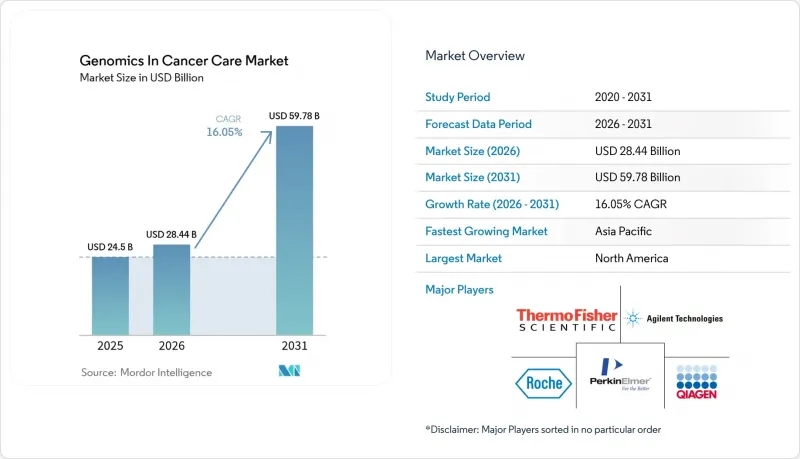
Mordor Intelligence에 의하면, 2026년 암치료용 유전체학 시장 규모는 284억 4,000만 달러로 추정되고 있으며, 2025년 245억 달러에서 2031년에는 597억 8,000만 달러에 달할 것으로 예측됩니다.
또한, 2026년부터 2031년까지의 연평균 성장률(CAGR)은 16.05%를 나타낼 전망입니다.
본 보고서는 제품 유형(장비, 소모품, 서비스), 기술(PCR, 마이크로어레이, 유전체 시퀀싱 등), 용도(진단, 신약 개발 및 임상시험용 유전체학 등), 최종 사용자(병원·암 센터 등), 지역(북미, 유럽, 아시아태평양 등)별로 분류되어 있습니다. 시장 규모 및 전망은 금액(달러) 기준으로 제시되어 있습니다.
전 세계 암 치료용 유전체학 시장 동향 및 인사이트
암 부담 증가와 조기 검진 프로그램 확대
세계 암 발병률이 급격히 증가함에 따라, 의료 시스템 기획 담당자들은 예방적 유전체 스크리닝으로 자원을 전환할 수밖에 없는 상황입니다. 라틴아메리카만 해도 2040년까지 암 환자 수가 66% 증가할 것으로 예측되어, 무증상 단계에서 악성 종양을 발견해야 한다는 압박이 커지고 있습니다. 미국 규제 당국은 FDA가 Guardant Health사의 ‘Shield’ 검사를 45세 이상 성인을 대상으로 한 대장암 선별 검사로 승인한 것을 계기로, 혈액을 이용한 검출법을 채택하여 비침습적 검사의 선례를 확립했습니다. 미국 국립암연구소(NCI)의 ‘뱅가드(Vanguard)’ 연구와 같은 대규모 집단 임상시험에서는 동일한 플랫폼을 사용하여 다양한 코호트에서 여러 암의 검출을 검증하고 있습니다. 이러한 진전은 장기적인 보험 급여의 길을 마련하고, 보험사의 신뢰를 높이며, 검사 개발자에게 지속적인 수익원을 강화하는 동시에, 후속 치료 비용을 절감하는 결과로 이어집니다.
NGS 기반의 종합적인 유전체 프로파일링의 보급 확대
종양학 진료 현장에서는 순차적인 단일 유전자 검사에서 한 번의 분석으로 수백 개의 유전자좌를 분석하는 광범위한 패널 검사로의 전환이 진행되고 있습니다. GOZILA 임상시험 결과에 따르면, Guardant360 CDx 액체 생검을 기반으로 한 치료를 받은 환자의 전체 생존 기간 중앙값은 18.6개월이었던 반면, 표준 치료를 받은 환자는 9.9개월이었습니다. 일루미나(Illumina)사의 ‘TruSight Oncology Comprehensive’는 모든 암을 대상으로 하는 동반진단의 적응증을 내세운, FDA 승인을 받은 최초의 키트가 되었습니다. AI 분석과 결합함으로써 검사 기관은 현재 며칠 이내에 임상적으로 활용 가능한 보고서를 제공할 수 있게 되었으며, 미국의 메디케어도 반복적인 검사보다 광범위한 패널 검사에 대한 보험 적용을 확대하고 있어 주류로 확산되는 속도가 가속화되고 있습니다.
인증된 분자병리학 전문의의 부족
멀티오믹스 데이터를 임상적 조치로 전환할 수 있는 전문가에 대한 전 세계적 수요는 공급을 훨씬 초과하고 있습니다. 교육 요건에는 분자생물학, 생물정보학 및 종양학의 세부 전문 분야가 포함되어 있으며, 이는 기존의 병리학 교육 과정을 뛰어넘는 역량을 요구합니다. 신흥 경제국에서는 인력이 고소득 지역으로 유출되고 있어 더 큰 과제에 직면해 있습니다. AI 도구는 일상적인 소견 해석의 부담을 덜어주지만, 규제상 최종 승인에는 여전히 인증 의사의 감독이 필요합니다. 단기 인증 프로그램이 개발 중이지만, 인력 확충은 향후 몇 년간 시장 성장 속도를 따라잡지 못할 전망입니다.
부문 분석
2025년, 암 치료용 유전체학 시장에서 장비가 최대 수익원이 되어 37.80%의 점유율을 차지했습니다. 수요는 사용자들이 기존 시퀀서에서 더 높은 처리량과 롱 리드를 지원하는 시스템으로 전환함에 따라 지속적인 플랫폼 업데이트 주기를 반영했습니다. 소모품 매출은 검사 건수 증가에 따라 확대된 반면, 포인트 오브 케어용 카트리지는 새로운 분산형 채널을 개척했습니다.
서비스 분야는 연평균 성장률(CAGR) 18.35%로 확대되고 있으며, 데이터 분석, 클라우드 분석, 통합 임상 보고서로 전환되는 추세가 두드러집니다. 2024년 Guardant Health의 매출이 31% 증가한 7억 3,700만 달러를 기록한 것은 정기 검사 수수료와 바이오인포매틱스 요금이 성장의 원동력임을 보여줍니다. 병원에서는 인력 부족을 완화하기 위해 바이오정보학 업무의 외주가 증가하고 있으며, 현재는 검체 물류, 시퀀싱, 분석, 의사결정 지원 업데이트 등을 종합적으로 다루는 종단간 서비스 계약이 일반화되고 있습니다. 이러한 진화를 통해 서비스 제공업체들은 암 치료 분야의 유전체 의료 시장에서 단순한 거래상공급업체가 아닌 전략적 파트너로서의 입지를 확고히 하고 있습니다.
쇼트 리드 NGS 기반의 유전체 시퀀싱 플랫폼은 확립된 실험실 워크플로우와 광범위한 임상적 근거에 힘입어 2025년에 45.70%의 시장 점유율을 확보했습니다. 그러나 종양 전문의들이 숏 리드로는 얻을 수 없는 반복 서열이 풍부한 영역의 구조적 변이 규명 및 메틸화 층 분석을 요구함에 따라, 단일 분자 실시간 시퀀싱은 연평균 성장률(CAGR) 22.85%라는 놀라운 속도로 확대되고 있습니다.
옥스포드 나노포어(Oxford Nanopore)사의 최신 화학 기술을 통해 완전한 염색체 조립과 후성유전학적 지도의 동시 생성이 실현되었으며, 롱 리드 기법의 임상 적용 준비가 완료되었음이 입증되었습니다. 한편, 로슈(Roche)사의 ‘시퀀싱 바이 익스팬션(Sequencing by Expansion)’ 프로토타입은 롱 리드와 하이 스루풋의 융합을 약속하며, 제품 교체 주기를 혁신할 가능성이 있습니다. PCR 기반 키트는 저플렉스 동반 진단이나 EGFR·KRAS 신속 검사에서 여전히 가치를 유지하고 있지만, 시퀀싱 가격이 비슷한 수준에 가까워짐에 따라 마이크로어레이는 점유율을 내주고 있습니다. 기술의 다양성 덕분에 검사실은 암 치료 분야의 유전체 분석 시장에서 특정 종양학적 이용 사례에 맞추어 플랫폼을 선택할 수 있게 되었습니다.
지역별 분석
2025년에는 광범위한 보험 적용, 성숙한 임상시험 네트워크, 그리고 엄격하지만 예측 가능한 규제 감독에 힘입어 북미가 36.60%의 시장 점유율로 1위를 차지했습니다. 2024년 5월 FDA가 공표한 ‘실험실 개발 검사(LDT)’에 관한 최종 규정에 따라 상업 검사 기관과 학술 검사 기관의 품질 요건이 통일되었습니다. 이와 병행하여, 메디케어의 결정에 따라 액체 생검 기반의 MRD(미세 잔류 병변) 모니터링에 대한 보험 적용이 확대되어 상당한 규모의 지속적인 검사 수요가 창출되었습니다. 업계 전반에 걸친 협력을 통해 연구 분야의 혁신이 신속하게 일선 임상 현장에 도입되어, 암 치료용 유전체학 시장에서 이 지역의 리더십이 확고해졌습니다.
아시아태평양은 2031년까지 14.55%라는 지역별 최고 연평균 성장률(CAGR)을 기록하고 있습니다. 중국, 일본, 싱가포르, 아랍에미리트(UAE)의 국가 유전체 프로그램은 대규모 시퀀싱 인프라를 뒷받침하며, 조기 선별 검사를 위한 시범 사업의 비옥한 토대를 마련하고 있습니다. 사우디아라비아의 정밀의료 회랑에 대한 지속적인 투자와 아랍에미리트의 규제 절차 간소화가 맞물려 다국적 진단 기업들이 지역 허브를 설립하도록 유도하고 있습니다. 암 발병률 증가와 보험 적용 범위 확대가 수요를 가속화하는 한편, 현지 제조 제휴를 통해 소모품 비용이 절감되어 접근성이 향상되고 있습니다.
유럽은 규제 및 가치 평가 체계의 조정을 통해 전 세계적 확산의 중요한 축으로 자리 잡고 있습니다. 유럽 집행위원회가 일루미나(Illumina)사의 GRAIL 매각 계획을 조건부로 승인함에 따라 법적 교착 상태가 해소되고, 경쟁 균형이 회복되어 유럽 전역에 걸친 다중 암 선별 검사 시범 사업이 진행될 수 있게 되었습니다. 한편, EU의 체외진단용 의료기기 규정은 엄격한 임상적 근거 요건을 부과함으로써 의사와 보험사 간의 신뢰를 높이고 있습니다. 유럽 체액 생검 학회(ELBS)와 같은 표준화 기관은 검사실 간의 재현성을 촉진하는 통일된 프로토콜을 발표하고 있습니다. 이러한 조치들이 결합되어, 인프라가 성숙해졌음에도 불구하고 건전한 성장이 유지되고 있습니다.
기타 혜택:
- Excel 형식 시장 예측(ME) 시트
- 3개월간의 애널리스트 지원
자주 묻는 질문
목차
제1장 서론
제2장 분석 방법
제3장 주요 요약
제4장 시장 구도
제5장 시장 규모·성장률 예측
제6장 경쟁 구도
제7장 시장 기회와 향후 전망
LSH 26.08.26According to Mordor Intelligence, genomics in the cancer care market size in 2026 is estimated at USD 28.44 billion, growing from 2025 value of USD 24.5 billion with 2031 projections showing USD 59.78 billion, growing at 16.05% CAGR over 2026-2031.
This report is Segmented by Product Type (Instruments, Consumables, and Services), Technology (PCR, Microarrays, Genome Sequencing, and More), Application (Diagnostics, Drug Discovery & Clinical Trials Genomics, and More), End-User (Hospitals and Cancer Centres, and More), and Geography (North America, Europe, Asia-Pacific, and More). The Market Sizes and Forecasts are Provided in Terms of Value (USD).
Global Genomics In Cancer Care Market Trends and Insights
Growing Burden of Cancer & Earlier Screening Programs
Robust growth in global cancer incidence is compelling health-system planners to shift resources toward preventive genomic screening. Latin America alone projects a 66% rise in cancer cases by 2040, intensifying pressure to catch malignancies at sub-clinical stages. U.S. agencies embraced blood-based detection when the FDA cleared Guardant Health's Shield test for colorectal screening in adults aged 45 and older, setting a precedent for non-invasive assays. Large population trials such as the National Cancer Institute's Vanguard study employ the same platform to test multi-cancer detection across diverse cohorts. These developments create long-term reimbursement pathways, foster payer confidence, and bolster recurring revenue streams for test developers while lowering downstream treatment costs.
Increasing Adoption Of NGS-Based Comprehensive Genomic Profiling
Oncology practices are migrating from sequential single-gene tests toward expansive panels that interrogate hundreds of loci in one run. Evidence from the GOZILA trial showed patients guided by the Guardant360 CDx liquid biopsy achieved a median overall survival of 18.6 months compared with 9.9 months under standard care. Illumina's TruSight Oncology Comprehensive became the first FDA-cleared kit with pan-cancer companion-diagnostic claims. Coupled with AI analytics, laboratories now deliver clinically actionable reports within days, and U.S. Medicare increasingly reimburses broad panels over iterative assays, accelerating mainstream uptake.
Shortage Of Accredited Molecular Pathologists
Worldwide demand for professionals who can translate multi-omic data into clinical action far exceeds supply. Training requirements encompass molecular biology, bioinformatics, and oncology subspecialties, competencies that extend beyond legacy pathology curricula. Emerging economies face added challenges as talent migrates to higher-income regions. AI tools lighten routine interpretation workloads, yet regulations still require board-certified oversight for final sign-off. Fast-track certification programs are under development, but workforce expansion will lag market growth for several years.
Other drivers and restraints analyzed in the detailed report include:
- Rapid Cost Decline of Sequencing & Digital PCR Reagents
- Scaling Liquid-Biopsy Pipelines for Minimal-Residual-Disease (MRD) Monitoring
- Persistently High Total-Cost-Of-Ownership for WGS Platforms
For complete list of drivers and restraints, kindly check the Table Of Contents.
Segment Analysis
Instruments represented the largest revenue pool, holding 37.80% share of the genomics in the cancer care market in 2025. Demand reflected ongoing platform refresh cycles as users swapped legacy sequencers for higher-throughput, longer-read systems. Consumables sales expanded in line with test-volume growth, while point-of-care cartridges opened new, decentralized channels.
Services are accelerating at an 18.35% CAGR, underscoring a shift toward data interpretation, cloud analytics, and integrated clinical reporting. Guardant Health's 31% revenue jump to USD 737 million during 2024 shows the pull of recurring testing and bioinformatics fees. Hospitals increasingly outsource bioinformatics to mitigate staffing shortages, and bundled, end-to-end service contracts now cover sample logistics, sequencing, interpretation, and decision-support updates. This evolution positions service providers as strategic partners rather than transactional suppliers within the genomics in cancer care market.
Genome sequencing platforms based on short-read NGS secured 45.70% market share in 2025, supported by established laboratory workflows and extensive clinical evidence. Yet single-molecule, real-time sequencing is expanding at a startling 22.85% CAGR as oncologists seek structural-variant resolution in repeat-rich regions and methylation layers unavailable from short reads.
Oxford Nanopore's latest chemistry generated complete chromosome assemblies and simultaneous epigenetic maps, demonstrating the clinical readiness of long-read approaches. Meanwhile, Roche's sequencing-by-expansion prototypes promise to merge long reads with high throughput, threatening to redraw product-replacement cycles. PCR-based kits retain value for low-plex companion diagnostics and rapid EGFR or KRAS checks, yet microarrays are ceding ground as sequencing prices near parity. Technology diversity ensures that laboratories can align platform choice with specific oncology use cases inside the genomics in cancer care market.
Complete Report Scope:
- By Product Type
- Instruments
- Consumables
- Services
- By Technology
- Genome Sequencing
- PCR
- Microarrays &
- Others
- By Application
- Diagnostics
- Drug Discovery & Clinical Trials Genomics
- Personalized / Precision Oncology
- Others
- By End-user
- Hospitals & Cancer Centres
- Reference & Clinical Laboratories
- Pharmaceutical & Biotech Companies
- Academic & Research Institutes
- By Geography
- North America
- United States
- Canada
- Mexico
- Europe
- Germany
- United Kingdom
- France
- Italy
- Spain
- Rest of Europe
- Asia Pacific
- China
- Japan
- India
- South Korea
- Australia
- Rest of Asia Pacific
- Middle East and Africa
- GCC
- South Africa
- Rest of Middle East and Africa
- South America
- Brazil
- Argentina
- Rest of South America
- North America
Geography Analysis
North America led with 36.60% market share in 2025, supported by broad payer coverage, a mature clinical-trial network, and stringent but predictable regulatory oversight. The FDA's May 2024 Laboratory Developed Tests final rule aligned quality requirements across commercial and academic laboratories. Parallel Medicare decisions extended reimbursement to liquid-biopsy-based MRD surveillance, unlocking sizable, recurring test volumes. Cross-industry collaborations ensure rapid migration of research innovations into front-line clinical practice, consolidating the region's leadership in the genomics in cancer care market.
Asia Pacific records the fastest regional CAGR at 14.55% to 2031. National genome programs in China, Japan, Singapore, and the United Arab Emirates underpin large-scale sequencing infrastructure and create fertile ground for early screening pilots. Ongoing investment in Saudi Arabia's precision-medicine corridor, combined with streamlined regulatory pathways in the United Arab Emirates, attracts multinational diagnostics firms to establish regional hubs. Rising cancer incidence and widening insurance coverage accelerate demand, while local manufacturing partnerships drive down consumables' costs, improving accessibility.
Europe remains a critical pillar of global adoption through coordinated regulatory and value-assessment frameworks. The European Commission's conditional approval of Illumina's divestment plan for GRAIL removed a legal logjam, restoring competitive balance and allowing pan-European multi-cancer screening pilots to proceed. Meanwhile, the EU In Vitro Diagnostic Regulation enforces stringent clinical-evidence requirements, boosting confidence among physicians and payers. Standard-setting bodies such as the European Liquid Biopsy Society publish harmonized protocols that foster reproducibility across laboratories. In combination, these measures sustain healthy growth despite mature infrastructure.
- Illumina
- Thermo Fisher Scientific
- Roche
- Agilent Technologies
- QIAGEN
- Pacific Bioscience
- Guardant Health
- Exact Sciences
- Foundation Medicine Inc.
- Oxford Nanopore Technologies plc
- Myriad Genetics
- Bio-Rad Laboratories
- GE HealthCare Technologies Inc.
- PerkinElmer
- BGI Genomics Co. Ltd.
- Adaptive Biotechnologies Corp.
- Personalis Inc.
- Invitae
- 10x Genomics Inc.
- Burning Rock Biotech Ltd.
- Natera
Additional Benefits:
- The market estimate (ME) sheet in Excel format
- 3 months of analyst support
TABLE OF CONTENTS
1 Introduction
- 1.1 Study Assumptions & Market Definition
- 1.2 Scope of the Study
2 Research Methodology
3 Executive Summary
4 Market Landscape
- 4.1 Market Overview
- 4.2 Market Drivers
- 4.2.1 Growing Burden Of Cancer & Earlier Screening Programs
- 4.2.2 Increasing Adoption Of NGS-Based Comprehensive Genomic Profiling
- 4.2.3 Rapid Cost Decline Of Sequencing & Digital PCR Reagents
- 4.2.4 Scaling Liquid-Biopsy Pipelines For Minimal-Residual-Disease (MRD) Monitoring
- 4.2.5 AI-Powered Multi-Omic Decision-Support Tools For Oncologists
- 4.2.6 Rise Of Reimbursement For Tumor-Agnostic Companion Diagnostics
- 4.3 Market Restraints
- 4.3.1 Shortage Of Accredited Molecular Pathologists
- 4.3.2 Persistently High Total-Cost-Of-Ownership For WGS Platforms
- 4.3.3 Cyber-Security & Genomic-Data-Sovereignty Regulation
- 4.3.4 Limited Clinical-Utility Evidence For Emerging MRD Assays
- 4.4 Value Chain Analysis
- 4.5 Regulatory Landscape
- 4.6 Technological Outlook
- 4.7 Porter's Five Forces Analysis
- 4.7.1 Threat of New Entrants
- 4.7.2 Bargaining Power of Buyers
- 4.7.3 Bargaining Power of Suppliers
- 4.7.4 Threat of Substitutes
- 4.7.5 Intensity of Competitive Rivalry
5 Market Size & Growth Forecasts (Value)
- 5.1 By Product Type
- 5.1.1 Instruments
- 5.1.2 Consumables
- 5.1.3 Services
- 5.2 By Technology
- 5.2.1 Genome Sequencing
- 5.2.2 PCR
- 5.2.3 Microarrays &
- 5.2.4 Others
- 5.3 By Application
- 5.3.1 Diagnostics
- 5.3.2 Drug Discovery & Clinical Trials Genomics
- 5.3.3 Personalized / Precision Oncology
- 5.3.4 Others
- 5.4 By End-user
- 5.4.1 Hospitals & Cancer Centres
- 5.4.2 Reference & Clinical Laboratories
- 5.4.3 Pharmaceutical & Biotech Companies
- 5.4.4 Academic & Research Institutes
- 5.5 By Geography
- 5.5.1 North America
- 5.5.1.1 United States
- 5.5.1.2 Canada
- 5.5.1.3 Mexico
- 5.5.2 Europe
- 5.5.2.1 Germany
- 5.5.2.2 United Kingdom
- 5.5.2.3 France
- 5.5.2.4 Italy
- 5.5.2.5 Spain
- 5.5.2.6 Rest of Europe
- 5.5.3 Asia Pacific
- 5.5.3.1 China
- 5.5.3.2 Japan
- 5.5.3.3 India
- 5.5.3.4 South Korea
- 5.5.3.5 Australia
- 5.5.3.6 Rest of Asia Pacific
- 5.5.4 Middle East and Africa
- 5.5.4.1 GCC
- 5.5.4.2 South Africa
- 5.5.4.3 Rest of Middle East and Africa
- 5.5.5 South America
- 5.5.5.1 Brazil
- 5.5.5.2 Argentina
- 5.5.5.3 Rest of South America
- 5.5.1 North America
6 Competitive Landscape
- 6.1 Market Concentration
- 6.2 Market Share Analysis
- 6.3 Company Profiles (includes Global level Overview, Market level overview, Core Segments, Financials as available, Strategic Information, Market Rank/Share for key companies, Products & Services, and Recent Developments)
- 6.3.1 Illumina Inc.
- 6.3.2 Thermo Fisher Scientific Inc.
- 6.3.3 F. Hoffmann-La Roche AG
- 6.3.4 Agilent Technologies Inc.
- 6.3.5 QIAGEN NV
- 6.3.6 Pacific Biosciences of California Inc.
- 6.3.7 Guardant Health Inc.
- 6.3.8 Exact Sciences Corporation
- 6.3.9 Foundation Medicine Inc.
- 6.3.10 Oxford Nanopore Technologies plc
- 6.3.11 Myriad Genetics Inc.
- 6.3.12 Bio-Rad Laboratories Inc.
- 6.3.13 GE HealthCare Technologies Inc.
- 6.3.14 PerkinElmer Inc.
- 6.3.15 BGI Genomics Co. Ltd.
- 6.3.16 Adaptive Biotechnologies Corp.
- 6.3.17 Personalis Inc.
- 6.3.18 Invitae Corporation
- 6.3.19 10x Genomics Inc.
- 6.3.20 Burning Rock Biotech Ltd.
- 6.3.21 Natera Inc.
7 Market Opportunities & Future Outlook
- 7.1 White-space & Unmet-need Assessment


