|
시장보고서
상품코드
2114709
수두증 션트 : 시장 점유율 분석, 업계 동향 및 통계, 성장 예측(2026-2031년)Hydrocephalus Shunts - Market Share Analysis, Industry Trends & Statistics, Growth Forecasts (2026 - 2031) |
||||||
 Mordor Intelligence
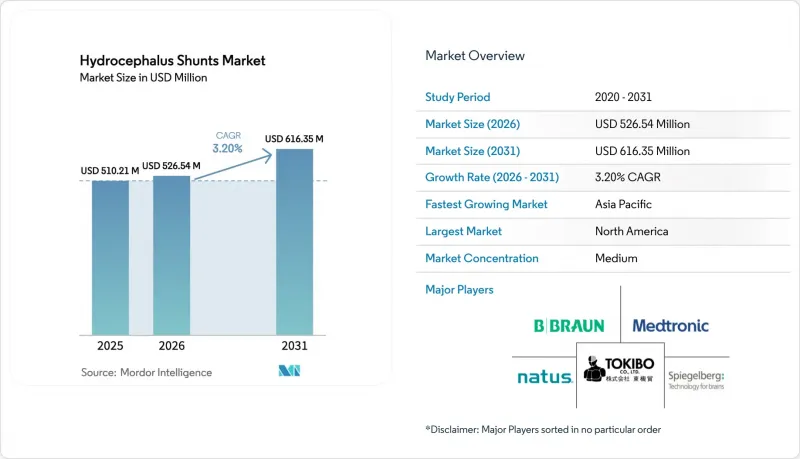
Mordor Intelligence에 의하면, 수두증 션트 시장 규모는 2025년에 5억 1,021만 달러로 평가되었습니다. 2026년 5억 2,654만 달러에서 2031년까지 6억 1,635만 달러에 이를 것으로 예상되며, 예측 기간(2026-2031년) CAGR은 3.20%를 나타낼 전망입니다.
본 보고서는 제품 유형(조절식 및 고정식 밸브를 포함한 뇌수종용 밸브, 뇌수종용 카테터, 션트 시스템), 연령대(소아, 성인), 최종 사용자(병원 및 진료소, 외래수술센터(ASC), 기타 최종 사용자), 지역(북미, 유럽 등)별로 분류되어 있습니다. 시장 전망은 금액(달러) 기준으로 제시됩니다.
세계의 수두증 션트 시장 동향 및 인사이트
수두증 및 관련 신경 질환의 유병률 증가
중간 소득 국가에서 산전 초음파 검사가 일상화됨에 따라 선천성 뇌수종 검출률이 증가하고 있는 반면, 65세 이상 성인에서 비압박성 뇌수종(NPH)의 유병률은 상승하고 있으며, 이 연령층의 인구는 2050년까지 16억 명에 달할 것으로 예측됩니다. 미국신경학회(AAN)의 개정 지침에서는 보행 장애와 인지 기능 저하가 동반된 경우 요추 천자를 권장하게 되어, 그동안 오진되었던 치매 환자들이 샛길 치료로 이어지게 되었습니다. 또한 신생아 집중 치료 수용 능력이 감염 관리 인프라를 초과하는 지역에서는 출혈 후 및 감염 후 사례도 증가하고 있습니다. 이러한 이중의 역학적 요인으로 인해 수술 건수는 인구 증가의 기준선을 상회하는 수준으로 유지되고 있습니다. 의료기기 제조업체들은 이러한 동향을 확실한 수요의 원동력으로 보고 있습니다. 왜냐하면 새로운 임플란트 삽입 1건당 수년에 걸친 수정 및 교체에 따른 수익원이 확보되기 때문입니다. 그러나 의료 시스템 기획 담당자들은 신경외과 예산을 배분할 때 장기적인 경과 관찰에 따른 부담도 고려하고 있습니다.
고령 인구의 급속한 증가
65세 이상 고령 인구는 2050년까지 16억 명으로 거의 2배 증가할 전망이며, 이러한 급증의 주된 원동력은 동아시아와 남유럽입니다. 이 연령대의 NPH 유병률은 0.2%에서 2.9% 사이로, 이는 수백만 명의 잠재적 수술 대상자에 해당합니다. 일본에서는 2020년부터 2024년에 걸쳐 NPH로 인한 입원 환자 수가 이미 23% 증가했습니다. 미국에서는 메디케어가 2025년에 션트 삽입술에 대한 ASC(외래수술센터(ASC)) 지급액을 4.2% 인상했습니다. 이는 합병증이 없는 성인 환자를 비용이 높은 입원 병동에서 ASC로 전환하려는 지급 기관의 의도를 보여줍니다. 신흥 경제국에서도 평균 수명이 늘어남에 따라 유사한 환자 수가 급증할 것으로 예상되지만, 외과 의사 부족으로 인해 대기 기간이 길어질 위험이 있습니다. 이에 따라 각 제조업체들은 제품 라인업을 조정하고 있으며, 상태가 안정된 성인 환자를 위해 고정 압력 밸브를 제공하고, 소아의 성장에 따른 압력 변화에 대응하는 프리미엄 프로그래밍 가능 모델은 소아 환자를 위해 확보하고 있습니다.
션트의 기능 부전, 재수술, 감염 발생률의 높음
소아용 션트의 약 40%는 2년 이내에 기능 부전에 빠지며, 무균 기술이 불충분한 시설에서는 감염률이 15%에 달할 전망입니다. 응급 영상 진단 및 집중 치료를 포함하면 재수술 1건당 비용은 첫 이식 수술에 비해 최대 50% 더 비쌉니다. 기능 부전의 60%는 기계적 폐색이 원인이며, 나머지는 밸브 결함이나 튜브 탈락에 기인합니다. 항생제 함침 카테터는 감염 위험을 약 30% 낮추지만, 1대당 200-400달러의 추가 비용이 들기 때문에 공적 의료 제도에서의 도입이 제한되고 있습니다. 이러한 신뢰성 격차는 높은 재수술률에 페널티를 부과하고, 지속적인 개통성을 보이는 의료기기에 보상을 제공하는 성과 연동형 상환 계약의 도입을 뒷받침하는 근거가 되고 있습니다.
부문별 분석
2025년 시점에서 수두증용 밸브는 수두증 션트 시장 점유율의 83.81%를 차지했으며, 2031년까지 연평균 성장률(CAGR) 4.12%로 확대될 것으로 예측됩니다. 북미와 유럽에서는 재수술률 감소로 인해 프로그래밍 가능한 유형이 탄력을 받고 있는 반면, 신흥 시장에서는 비용 중심의 입찰에서 고정 압력 모델이 주류를 이루고 있습니다. 외과의사가 복잡한 해부학적 구조에 맞추어 구성을 맞춤화하는 경우에는 단일 카테터의 판매가 증가하고 있지만, 재고 관리의 간소화라는 관점에서는 번들형 션트 시스템이 여전히 매력적입니다. 원격 측정 기술이 기존 하드웨어에 새로운 가치 제안을 가져옴에 따라, 수두증 션트 시장 내 밸브 시장 규모는 확대될 전망입니다. 임상 평가 중인 센서 탑재 모델은 수익원을 데이터 서비스로 전환할 가능성이 있지만, 규제 승인 절차의 장기화로 인해 기존 기업들에게는 시장 점유율을 지킬 시간이 주어지고 있습니다.
나머지 수익은 카테터와 완전한 시스템이 나눠 가지고 있습니다. 항생제 함침 튜브는 중증도가 높은 소아 의료 센터에서 보급이 확대되고 있지만, 높은 가격 때문에 공립 병원에서의 도입이 지연되고 있습니다. 고정형 션트 키트는 맞춤 제작보다 속도를 우선시하는 외래수술센터(ASC)에서 선호되고 있습니다. FDA 510(k) 승인까지 소요되는 기간이 9개월 미만이기 때문에 신속한 반복 개선이 가능하지만, 센서 통합형 플랫폼은 더 긴 기간이 소요되는 시판 전 승인(PMA) 절차를 거쳐야 합니다. 두 경로를 균형 있게 활용하는 제조업체는 일정을 분산시키고 제품 포트폴리오의 폭을 유지할 수 있습니다.
지역별 분석
북미는 높은 환급금과 프로그래밍 가능형 및 원격 측정형 밸브의 급속한 보급에 힘입어 2025년 매출의 42.23%를 차지했습니다. 메디케어에 의한 2025년 외래 진료 보수 인상과 FDA의 획기적 치료 기기 지정에 힘입어, 이 지역은 계속해서 신규 의료기기 출시의 거점으로서의 지위를 유지하고 있습니다. 캐나다에서는 주 정부 의료 제도를 통해 프로그래밍 가능 임플란트 비용이 지원되지만, 비용 절감을 위한 시범 사업에 따라 지급액은 2년간의 재수술 결과와 연동됩니다. 멕시코의 양극화된 시장에서는 민간 의료기관이 고급 수입 제품을 채택하는 반면, 공립 병원은 저비용 고정 압력 밸브에 의존하고 있습니다.
아시아태평양은 중국과 인도가 보험 적용 품목과 병원 인프라를 확충하고 있어, 2031년까지 연평균 성장률(CAGR) 4.52%로 가장 빠르게 성장하는 지역입니다. 다국적 의료기기 제조업체들의 국내 조립은 관세를 회피하고 소매 가격을 낮춰 보급을 가속화하고 있습니다. 일본과 한국에서는 고령화에 따른 수요 증가가 예상되는 반면, 뇌신경외과 의사 부족으로 인해 대기 기간이 장기화되는 과제에 직면해 있습니다. 현재 수용 능력 확대를 위한 시범 사업의 일환으로, 일반외과의를 대상으로 션트 삽입 기초 훈련이 진행되고 있습니다. 동남아시아의 성장은 도시 지역의 의료 거점에 집중되어 있는 반면, 지방 지역에서는 여전히 의료 서비스가 충분히 제공되지 못하고 있습니다.
유럽에서는 꾸준한 성장세를 보이고 있으나 성장률은 둔화되고 있습니다. 독일에서는 프로그래밍 가능한 밸브가 보험 적용 대상이 된 반면, 영국의 국민보건서비스(NHS)는 의료기기 예산을 절감하기 위해 고정 압력형 모델을 우선적으로 채택하고 있습니다. 이 지역의 ‘순환형 경제 지침’에 따라 제조업체들은 2028년까지 재활용성을 확보할 수 있도록 폴리머 부품을 재설계해야 하며, 이로 인한 규정 준수 비용 증가가 의료기기 가격 상승으로 이어질 가능성이 있습니다. 남유럽에서는 팬데믹 이후 조달세가 회복되고 있으나, 입찰에서의 가격 경쟁은 여전히 치열합니다.
중동 및 아프리카에서는 지역에 따라 실적에 편차가 보입니다. 걸프협력회의(GCC) 회원국에서는 석유 수입이 고급 프로그래밍 가능 밸브를 지정하는 3차 신경외과 센터에 배정되고 있습니다. 한편, 사하라 이남 아프리카의 성장은 기부금에 의한 민관 협력(PPP)에 의존하고 있지만, 재정적 우선순위가 변화하면 그 진전이 정체될 가능성이 있습니다. 남미는 브라질이 중심이 되고 있으나, 이 나라에서는 보험 급여 지연으로 인해 병원의 현금 흐름에 압박이 가해지고 있습니다. 또한 아르헨티나에서는 통화 변동으로 인해 수입이 제한되고 있어, 외과의사들은 현지에서 조달 가능한 대체품을 채택할 수밖에 없는 상황에 처해 있습니다.
기타 혜택 :
- 엑셀 형식 시장 예측(ME) 시트
- 3개월간 애널리스트 지원
자주 묻는 질문
목차
제1장 서론
제2장 조사 방법
제3장 주요 요약
제4장 시장 구도
제5장 시장 규모 및 성장 예측
제6장 경쟁 구도
제7장 시장 기회 및 향후 전망
KTHAccording to Mordor Intelligence, the hydrocephalus shunts market size was valued at USD 510.21 million in 2025 and is estimated to grow from USD 526.54 million in 2026 to reach USD 616.35 million by 2031, at a CAGR of 3.20% during the forecast period (2026-2031).
This report is Segmented by Product Type (Hydrocephalus Valves Including Adjustable-Pressure and Fixed-Pressure Valves, Hydrocephalus Catheters, Shunt Systems), Age Group (Pediatric, Adult), End User (Hospitals and Clinics, Ambulatory Surgical Centers, Other End Users), and Geography (North America, Europe, and More). The Market Forecasts are Provided in Terms of Value (USD).
Global Hydrocephalus Shunts Market Trends and Insights
Rising Prevalence of Hydrocephalus and Related Neurological Disorders
Congenital detection is climbing as prenatal ultrasound becomes routine in middle-income countries, while NPH prevalence grows among adults over 65, a cohort expected to reach 1.6 billion by 2050. Revised American Academy of Neurology guidelines now recommend lumbar puncture when gait disturbance and cognitive decline coexist, redirecting previously misdiagnosed dementia patients toward shunt therapy. Post-hemorrhagic and post-infectious cases also expand where neonatal intensive-care capacity outpaces infection-control infrastructure. This dual epidemiological pressure sustains procedure volumes beyond baseline population growth. Device makers view these trends as reliable demand drivers because each new implant anchors a multiyear revision-replacement revenue stream. Health-system planners, however, weigh the long-term follow-up burden when allocating neurosurgery budgets.
Rapid Growth of the Geriatric Population
Individuals aged 65 and older will nearly double to 1.6 billion by 2050, with East Asia and Southern Europe leading the surge. NPH prevalence in this cohort ranges from 0.2% to 2.9%, translating into millions of potential recipients. Japan already recorded a 23% jump in NPH admissions from 2020 to 2024. In the United States, Medicare raised ASC payments for shunt placement by 4.2% in 2025, signaling payer intent to shift uncomplicated adult cases away from higher-cost inpatient wards. As longevity extends in emerging economies, similar volume waves are anticipated, although surgeon shortages risk lengthening wait times. Manufacturers are therefore adapting product mixes, offering fixed-pressure valves for stable adult cases and reserving premium programmable models for pediatric growth-related pressure changes.
High Rates of Shunt Malfunction, Revision and Infection
Roughly 40% of pediatric shunts fail within two years, and infection rates reach 15% in facilities with suboptimal sterile technique. Each revision costs up to 50% more than the initial implantation when emergency imaging and intensive care are included. Mechanical obstruction drives 60% of failures, while valve defects and tubing disconnections account for the rest. Antibiotic-impregnated catheters cut infection risk by about 30% but add USD 200-400 per device, limiting adoption in public systems. The reliability gap strengthens the case for outcome-based reimbursement contracts that penalize high revision rates and reward devices demonstrating sustained patency.
Other drivers and restraints analyzed in the detailed report include:
- Accelerating Adoption of Programmable Valves
- Emergence of Telemetric "Smart" Shunts
- Growing Uptake of Shunt-Free Alternatives
For complete list of drivers and restraints, kindly check the Table Of Contents.
Segment Analysis
Hydrocephalus valves held 83.81% of the hydrocephalus shunts market share in 2025 and are forecast to compound at 4.12% through 2031. Programmable versions gain momentum in North America and Europe due to reduced revision rates, whereas fixed-pressure models dominate cost-sensitive tenders in emerging markets. Standalone catheter sales grow where surgeons custom-build configurations for complex anatomies, yet bundled shunt systems remain attractive for inventory simplicity. The hydrocephalus shunts market size for valves is set to expand as telemetry layers new value propositions onto existing hardware. Sensor-enabled models under clinical evaluation could redirect profit pools toward data services, but extended regulatory pathways afford incumbents time to defend share.
Catheters and complete systems split the remaining revenue. Antibiotic-impregnated tubing gains traction in high-acuity pediatric centers, yet price premiums slow uptake in public hospitals. Fixed-package shunt kits appeal to ASCs that prioritize speed over customization. FDA 510(k) clearance timelines of under nine months enable quick iterative improvements, whereas sensor-integrated platforms must navigate the lengthier Premarket Approval route. Makers balancing both paths can hedge timelines and sustain portfolio breadth.
Complete Report Scope:
- By Product Type
- Hydrocephalus Valves
- Adjustable-Pressure Valves
- Fixed-Pressure Valves
- Hydrocephalus Catheters
- Shunt Systems
- Hydrocephalus Valves
- By Age Group
- Pediatric
- Adult
- By End User
- Hospitals and Clinics
- Ambulatory Surgical Centers
- Other End Users
- By Geography
- North America
- United States
- Canada
- Mexico
- Europe
- Germany
- United Kingdom
- France
- Italy
- Spain
- Rest of Europe
- Asia-Pacific
- China
- Japan
- India
- Australia
- South Korea
- Rest of Asia-Pacific
- Middle East and Africa
- GCC
- South Africa
- Rest of Middle East and Africa
- South America
- Brazil
- Argentina
- Rest of South America
- North America
Geography Analysis
North America generated 42.23% of 2025 revenue, driven by high reimbursement and rapid adoption of programmable and telemetric valves. Medicare's 2025 outpatient payment uplift and FDA breakthrough designations ensure the region remains the launchpad for novel devices. Canada funds programmable implants through provincial systems, though cost-containment pilots tie payment to two-year revision outcomes. Mexico's dual-track market sees private institutions adopt premium imports while public hospitals rely on lower-cost fixed-pressure valves.
Asia-Pacific is the fastest-growing geography at a 4.52% CAGR through 2031 as China and India expand reimbursement catalogs and hospital infrastructure. Domestic assembly by multinational device makers sidesteps tariffs, cutting retail prices and accelerating uptake. Japan and South Korea face aging-driven volume growth yet grapple with neurosurgeon shortages that lengthen wait times; capacity pilots now train general surgeons in basic shunt placement. Southeast Asian growth concentrates in urban medical hubs, while rural areas remain underserved.
Europe shows steady but slower expansion. Programmable valves enjoy reimbursement in Germany, whereas the United Kingdom's National Health Service favors fixed-pressure models to curb device budgets. The region's Circular Economy directive forces manufacturers to redesign polymer components for recyclability by 2028, raising compliance costs that likely translate into higher device prices. Southern Europe regains procurement momentum post-pandemic, though tenders remain intensely price-competitive.
The Middle East and Africa record uneven performance. Gulf Cooperation Council nations allocate oil revenues to tertiary neurosurgery centers that specify premium programmable valves, while sub-Saharan growth depends on donor-funded PPPs that can stall when fiscal priorities shift. South America is anchored by Brazil, where reimbursement delays pressure hospital cash flows, and Argentina, where currency volatility curtails imports, prompting surgeons to adopt locally sourced alternatives.
- Anuncia Medical Inc.
- B. Braun
- BIcakcIlar A.S.
- Delta Surgical Ltd.
- Dispomedica GmbH
- Fuji Systems Corp.
- G. Surgiwear Ltd.
- Integra LifeSciences Corp.
- Johnson & Johnson (DePuy Synthes Codman)
- Kaneka Medix Corp.
- Longeviti Neuro Solutions
- Medtronic
- MicroPort Scientific Corp.
- Moller Medical GmbH
- Natus Medical
- Phoenix Biomedical Corp.
- Raumedic
- Sophysa SA
- Spiegelberg
- Tokibo Co. Ltd (Sophysa Japan)
Additional Benefits:
- The market estimate (ME) sheet in Excel format
- 3 months of analyst support
TABLE OF CONTENTS
1 Introduction
- 1.1 Study Assumptions & Market Definition
- 1.2 Scope of the Study
2 Research Methodology
3 Executive Summary
4 Market Landscape
- 4.1 Market Overview
- 4.2 Market Drivers
- 4.2.1 Rising prevalence of hydrocephalus & related neurological disorders
- 4.2.2 Rapid growth of the geriatric population
- 4.2.3 Accelerating adoption of programmable/adjustable-pressure valves
- 4.2.4 Emergence of telemetric, sensor-enabled "smart" shunts
- 4.2.5 PPP-funded neurosurgical capacity build-out in emerging markets
- 4.2.6 Regulatory fast-track paths for novel shunts
- 4.3 Market Restraints
- 4.3.1 High rates of shunt malfunction, revision & infection
- 4.3.2 Growing uptake of shunt-free alternatives
- 4.3.3 Magnetic-field-induced valve reprogramming risk
- 4.3.4 EU circular-economy rules raising compliance costs for polymer shunts
- 4.4 Value / Supply-Chain Analysis
- 4.5 Regulatory Landscape
- 4.6 Technological Outlook
- 4.7 Porter's Five Forces Analysis
- 4.7.1 Threat of New Entrants
- 4.7.2 Bargaining Power of Buyers/Consumers
- 4.7.3 Bargaining Power of Suppliers
- 4.7.4 Threat of Substitute Products
- 4.7.5 Intensity of Competitive Rivalry
5 Market Size & Growth Forecasts (Value, USD)
- 5.1 By Product Type
- 5.1.1 Hydrocephalus Valves
- 5.1.1.1 Adjustable-Pressure Valves
- 5.1.1.2 Fixed-Pressure Valves
- 5.1.2 Hydrocephalus Catheters
- 5.1.3 Shunt Systems
- 5.1.1 Hydrocephalus Valves
- 5.2 By Age Group
- 5.2.1 Pediatric
- 5.2.2 Adult
- 5.3 By End User
- 5.3.1 Hospitals and Clinics
- 5.3.2 Ambulatory Surgical Centers
- 5.3.3 Other End Users
- 5.4 By Geography
- 5.4.1 North America
- 5.4.1.1 United States
- 5.4.1.2 Canada
- 5.4.1.3 Mexico
- 5.4.2 Europe
- 5.4.2.1 Germany
- 5.4.2.2 United Kingdom
- 5.4.2.3 France
- 5.4.2.4 Italy
- 5.4.2.5 Spain
- 5.4.2.6 Rest of Europe
- 5.4.3 Asia-Pacific
- 5.4.3.1 China
- 5.4.3.2 Japan
- 5.4.3.3 India
- 5.4.3.4 Australia
- 5.4.3.5 South Korea
- 5.4.3.6 Rest of Asia-Pacific
- 5.4.4 Middle East and Africa
- 5.4.4.1 GCC
- 5.4.4.2 South Africa
- 5.4.4.3 Rest of Middle East and Africa
- 5.4.5 South America
- 5.4.5.1 Brazil
- 5.4.5.2 Argentina
- 5.4.5.3 Rest of South America
- 5.4.1 North America
6 Competitive Landscape
- 6.1 Market Concentration
- 6.2 Market Share Analysis
- 6.3 Company Profiles (includes Global level Overview, Market level overview, Core Segments, Financials as available, Strategic Information, Market Rank/Share for key companies, Products & Services, and Recent Developments)
- 6.3.1 Anuncia Medical Inc.
- 6.3.2 B. Braun SE
- 6.3.3 BIcakcIlar A.S.
- 6.3.4 Delta Surgical Ltd.
- 6.3.5 Dispomedica GmbH
- 6.3.6 Fuji Systems Corp.
- 6.3.7 G. Surgiwear Ltd.
- 6.3.8 Integra LifeSciences Corp.
- 6.3.9 Johnson & Johnson (DePuy Synthes Codman)
- 6.3.10 Kaneka Medix Corp.
- 6.3.11 Longeviti Neuro Solutions
- 6.3.12 Medtronic plc
- 6.3.13 MicroPort Scientific Corp.
- 6.3.14 Moller Medical GmbH
- 6.3.15 Natus Medical Inc.
- 6.3.16 Phoenix Biomedical Corp.
- 6.3.17 Raumedic AG
- 6.3.18 Sophysa SA
- 6.3.19 Spiegelberg GmbH & Co. KG
- 6.3.20 Tokibo Co. Ltd (Sophysa Japan)
7 Market Opportunities & Future Outlook
- 7.1 White-Space & Unmet-Need Assessment