

|
시장보고서
상품코드
2114714
생분해성 고분자 코팅 NPK : 시장 점유율 분석, 업계 동향 및 통계, 성장 예측(2026-2031년)Bio-degradable Polymer Coated NPK - Market Share Analysis, Industry Trends & Statistics, Growth Forecasts (2026 - 2031) |
||||||
 Mordor Intelligence
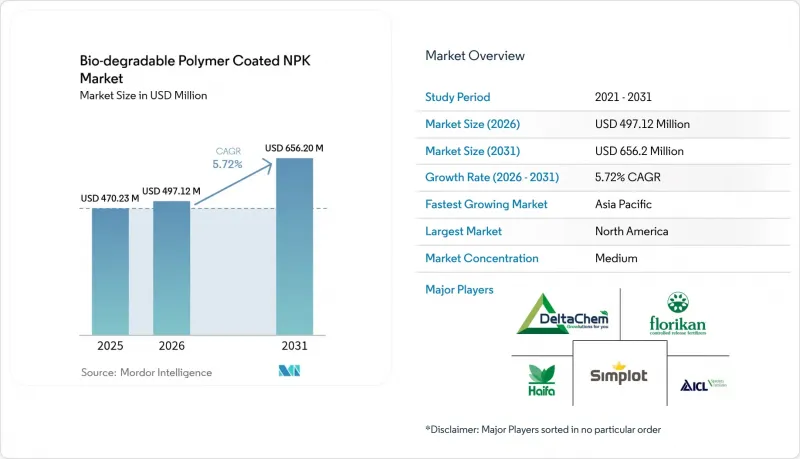
Mordor Intelligence에 의하면, 2026년 생분해성 고분자 코팅 NPK 시장 규모는 4억 9,712만 달러로 추정되고 2025년 4억 7,023만 달러에서 확대해, 2031년에는 6억 5,620만 달러에 이를 것으로 예측됩니다.
2026년부터 2031년까지의 연평균 성장률(CAGR)은 5.72%를 나타낼 전망입니다.
본 보고서는 유형별(곡물, 콩류·유지종자, 상업 작물, 과일 및 채소, 잔디 및 관상용 식물) 및 지역별(북미, 유럽, 아시아태평양, 기타)로 분류되어 있습니다. 시장 전망은 금액(달러) 및 수량(미터톤)으로 제시되어 있습니다.
세계의 생분해성 고분자 코팅 NPK 시장 동향 및 인사이트
비료 유출 규제가 강화됨에 따라 영양소 이용 효율 향상이 요구되고 있습니다.
질소 및 인 배출 제한이 엄격해지는 가운데, 생산자들은 영양소의 방출 시기를 작물의 흡수 시기와 일치시켜야 할 필요성에 직면해 있습니다. 미국 환경보호청(EPA)은 중서부 일대의 일련의 유역에서 ‘일일 최대 총부하량(TMDL)’ 할당량을 엄격화하여, 옥수수 및 대두 생산자들에게 침출수를 줄이거나 그렇지 않으면 제재를 받을 것 중 하나를 선택하도록 압박하고 있습니다. 생분해성 고분자 코팅 NPK는 영양소의 방출 기간을 최대 180일까지 연장하므로, 수확량을 저해하지 않으면서 비료 사용량을 15-25% 줄일 수 있습니다. 유럽연합(EU)의 ‘질산염 지침’에 따른 유사한 규제로 인해 독일, 프랑스,네덜란드에서는 이러한 전환이 가속화되고 있으며, CEN/TS 17700에 따른 검증을 통해 서방출 성능이 확인되었습니다. 그 결과, 자발적인 노력이라기보다는 제도적 압력에 의해 집약적 생산 시스템에서의 도입이 진행되고 있습니다.
카본스마트 및 정밀 영양에 대한 정부의 인센티브
공적 자금을 통해 코팅된 NPK 구매에 대한 생산자의 투자 회수 기간이 단축되고 있습니다. 미국 농무부는 서방형 자재를 포함한 기후 친화적 농산물 시범 사업에 자금을 배정했습니다. 대만에서는 생산자가 배출 감축 실적을 입증할 경우, 농장 출하 가격의 최대 30%를 보조하고 있습니다. 워싱턴주에서는 기준을 충족하는 제품에 대해 1에이커당 50달러를 환급하고 있으며, 이를 통해 특산 작물의 비료 시비에서 생분해성 코팅으로의 전환이 촉진되고 있습니다. 이러한 인센티브 덕분에 생산자의 투자 회수 기간이 단축되었으며, 탄소 크레딧이나 지속가능성 프리미엄을 활용할 수 있는 지역에서는 생분해성 코팅 NPK의 경제성이 기존 대안과 경쟁할 수 있는 수준에 이르렀습니다. 전략적 측면에서 볼 때, 강력한 공공 지원이 있는 시장에서는 보급률이 급속히 높아지는 반면, 보조금 제도가 정비되지 않은 지역에서는 규모의 경제에 따라 코팅 비용이 낮아질 때까지 보급이 지연될 것입니다.
기존 NPK와의 가격 차이
생분해성 고분자 코팅 NPK는 일반적으로 기존 입상 비료에 비해 20-40%의 가격 프리미엄이 책정되어 있어, 가격에 민감한 시장에서는 도입 장벽이 되고 있습니다. 이익률이 극히 낮고, 대출 접근성도 제한적인 남아시아나 사하라 이남 아프리카의 소규모 농가들에게는 장기적인 효율성 향상보다 초기 비용을 우선시할 수밖에 없는 상황입니다. 국제비료개발센터(IFDC)가 2024년에 실시한 조사에 따르면, 케냐의 소규모 옥수수 농가 중, 보급 지도원이 수확량 효과를 입증한 경우라도 서방형 제품에 대해 15%를 초과하는 추가 비용을 지불할 의사가 있는 농가는 고작 12%에 그쳤습니다. 생산량이 증가하고 원자재 비용이 낮아질 때까지는 도입이 대규모 농장이나 고부가가치 작물에 편중되는 경향이 있습니다.
부문별 분석
곡물 및 시리얼은 2025년 매출의 44.30%를 차지하며, 생분해성 고분자 코팅 NPK 시장의 핵심 소비 기반으로서 입지를 확고히 했습니다. 밀, 쌀, 옥수수를 대상으로 한 대학의 대규모 포장 실험에서는 동등한 수확량에서 15-25%의 질소 사용량 감축이 입증되어, 고가의 자재 도입의 정당성이 뒷받침되고 있습니다. 대규모 농업 기업에서는 코팅된 NPK를 가변 시비율 대응 파종기와 함께 사용함으로써, 추비 작업 횟수를 줄이고 미세 입자의 유출을 억제하고 있습니다. 또한 곡물 분야에서는 영양 관리 실적을 증명하는 것을 작물 보험의 조건으로 삼는 정책의 혜택을 받고 있으며, 규정 준수가 수익 보호 전략으로 자리 잡고 있습니다. 콩류와 유지종자는 곡물에 비해 뒤처져 있지만, 대두와 병아리콩의 수출처가 영양 관리 감사를 요구하고 있어 꾸준히 시장 점유율을 확대되고 있습니다. 사탕수수, 커피, 면화 등의 상업 작물에서는 코팅된 NPK가 활용되고 있으며, 이를 통해 농장은 비용을 상각하고 인증 프리미엄 획득을 위한 토양 건전성 개선 실적을 문서화할 수 있게 되었습니다.
잔디 및 관상용 식물은 현재 시장 규모가 작지만, 연평균 성장률(CAGR) 7.45%를 기록하며 각 부문 중 가장 높은 성장 궤도에 올라 있습니다. 지자체는 유출이 적은 조경을 의무화하고 있으며, 전문 시공업체는 1회의 시비만으로 생육기 전체를 커버할 수 있기 때문에 인건비 절감을 대가로 가격 프리미엄을 흡수하고 있습니다. 스포츠 시설, 골프 코스, 대학의 녹지 관리 부문에서는 ISO 14001 환경 경영 규격에 따라 인증된 제품의 지정이 증가하고 있어, 수요의 탄력성을 높이고 기술 혁신을 가속화하고 있습니다. 과일 및 채소는 여전히 틈새 시장 수준에 머물러 있습니다. 도입은 영양분의 정밀한 관리가 품질과 저장 기간에 직접적인 영향을 미치는 통제된 환경에 집중되어 있습니다.
지역별 분석
북미는 2025년 생분해성 고분자 코팅 NPK 시장에서 33.40%의 점유율을 차지했습니다. 이는 EPA(미국 환경보호청)의 유출 규제와 규정을 준수하는 자재에 대해 보상을 제공하는 인센티브 제도의 뒷받침을 받은 결과입니다. 평균 400헥타르를 초과하는 규모의 미국 옥수수 및 대두 농장에서는 인건비와 연료비 절감을 통해 가격 프리미엄을 상쇄하고 있습니다. 캐나다에서는 연방 정부의 온실가스 감축 지원금을 바탕으로 카놀라 윤작에서의 도입이 확대되고 있습니다. 멕시코에서의 사용은 구매자가 잔류물 제로 인증을 요구하는 수출용 온실 채소 재배에 집중되어 있습니다.
아시아태평양은 2031년까지 연평균 성장률(CAGR) 8.07%를 나타낼 것으로 예측되어, 지역별로는 가장 빠른 성장 속도를 보일 전망입니다. 일본에서는 작물 과학에 대한 보조금과 엄격한 재활용 문화로 인해 벼와 온실 채소 분야에서 생분해성 코팅으로의 전환이 진행되고 있습니다. 중국의 ‘제14차 5개년 계획’에 따른 장쑤성과 산둥성에서의 시범 사업에서는 과도한 질소 사용에 대해 벌칙이 부과되고 있으며, 이에 따라 밀과 옥수수 생산자들이 규정을 준수하는 혼합 비료로 전환하고 있습니다. 호주에서는 산호초 유역으로의 침출을 억제하기 위해 원예 및 잔디 재배에 코팅된 NPK 비료가 사용되고 있지만, 동남아시아에서는 보관 기간에 대한 우려와 보급 지원 체계의 제한된 범위가 도입을 저해하고 있습니다.
유럽에서는 규정 2019/1009에 따라 2028년을 생분해성 기한으로 설정함에 따라 도입이 가속화되고 있습니다. 독일, 프랑스, 네덜란드에서는 집약적인 채소 및 감자 농장에서 코팅 비료가 도입되고 있지만, 러시아에서는 규제 집행이 미흡하고 바이오폴리머 공급도 부족하여 도입이 지연되고 있습니다. 남미에서는 선택적인 이용이 나타나고 있으며, 브라질의 사탕수수 및 대두 농장에서는 노동력 절감을 위해 피복 NPK를 활용하고 있지만, 아르헨티나에서는 거시경제의 변동으로 인해 투자가 주춤하고 있습니다. 중동 및 아프리카는 여전히 신흥 시장이며, 이스라엘, 튀르키예, 남아프리카공화국의 고부가가치 수출용 원예 농업이 일부 지역의 도입을 주도하고 있습니다. 이 지역에서는 물 부족으로 인해 영양분의 정밀한 관리 필요성이 높아지고 있습니다.
기타 혜택 :
- 엑셀 형식 시장 예측(ME) 시트
- 3개월간의 애널리스트 지원
자주 묻는 질문
목차
제1장 서론
제2장 조사 방법
제3장 주요 요약
제4장 시장 구도
제5장 시장 규모 및 성장 예측
제6장 경쟁 구도
제7장 시장 기회 및 향후 전망
KTH 26.08.28According to Mordor Intelligence, the bio-degradable polymer coated NPK market size in 2026 is estimated at USD 497.12 million, growing from 2025 value of USD 470.23 million with 2031 projections showing USD 656.2 million, growing at 5.72% CAGR over 2026-2031.
This report is Segmented by Type (Grains and Cereals, Pulses and Oilseeds, Commercial Crops, Fruits and Vegetables, and Turfs and Ornamentals), and Geography (North America, Europe, Asia-Pacific, and More). The Market Forecasts are Provided in Terms of Value (USD) and Volume in (Metric Tons).
Global Bio-degradable Polymer Coated NPK Market Trends and Insights
Need to Raise Nutrient-Use Efficiency Amid Fertilizer-Runoff Caps
Escalating nitrogen and phosphorus discharge limits compel growers to match nutrient release with crop uptake windows. The United States Environmental Protection Agency has tightened Total Maximum Daily Load allocations across Midwestern watersheds, prompting corn and soybean producers to cut leaching or face penalties . Bio-degradable polymer coatings lengthen release to as much as 180 days, allowing 15-25% fertilizer rate reductions without yield loss. Comparable rules under the European Union Nitrates Directive accelerate the switch in Germany, France, and the Netherlands, where CEN/TS 17700 verification confirms controlled-release performance. Consequently, institutional pressure, rather than voluntary stewardship, now drives adoption in intensive production systems.
Government Incentives for Carbon-Smart and Precision Nutrition
Public funding lowers growers' payback periods on coated NPK purchases. The United States Department of Agriculture earmarked funds for climate-smart commodity pilots that include controlled-release inputs. Taiwan covers up to 30% of the farm-gate cost when growers document emission cuts . Washington State reimburses USD 50 per acre for compliant products, pushing specialty-crop nutrition toward biodegradable coatings. These incentives compress payback periods for growers, making the economics of bio-degradable coated NPK competitive with conventional options in regions where carbon credits or sustainability premiums are accessible. The strategic implication is that markets with robust public support will see faster penetration rates, while regions lacking subsidy frameworks will lag until coating costs decline through scale economies.
Premium Pricing Versus Conventional NPK
Bio-degradable polymer coated NPK typically commands a 20 to 40% price premium over conventional granular fertilizers, creating an adoption barrier in price-sensitive markets. Smallholder farmers in South Asia and sub-Saharan Africa, who operate on razor-thin margins and lack access to credit, prioritize upfront cost over long-term efficiency gains. A 2024 survey by the International Fertilizer Development Center found that only 12% of smallholder maize growers in Kenya were willing to pay more than a 15% premium for controlled-release products, even when extension agents demonstrated yield benefits. Until production volumes rise and raw material costs fall, adoption tends to skew toward large operations and high-value crops.
Other drivers and restraints analyzed in the detailed report include:
- Regulatory Bans on Micro-Plastic Coatings
- Cost Optimization via Reduced Application Rounds
- Limited Farmer Awareness in Smallholder Systems
For complete list of drivers and restraints, kindly check the Table Of Contents.
Segment Analysis
Grains and cereals generated 44.30% of 2025 revenue, confirming their status as the core consumption base for the bio-degradable polymer coated NPK market. Extensive university field trials on wheat, rice, and corn validate 15-25% nitrogen savings at parity yields, strengthening the case for premium inputs. Large agribusinesses integrate coated NPK with variable-rate seeders to reduce the number of side-dress passes and mitigate runoff fines. Grains also benefit from policies that peg crop insurance to documented nutrient stewardship, turning compliance into a revenue-protection tactic. Pulses and oilseeds are trailing grains but are moving steadily upward as export buyers require stewardship audits on soybeans and chickpeas. Commercial crops, such as sugarcane, coffee, and cotton, utilize coated NPK, enabling estates to amortize costs and document soil health improvements for certification premiums.
Turf and ornamentals represent a smaller value pool today but are on track for a 7.45% CAGR, the highest among segments. Municipalities mandate low-runoff landscaping, and professional contractors absorb price premiums in exchange for labor savings, as one application can cover an entire growing season. Sports venues, golf courses, and campus grounds departments are increasingly specifying products verified under ISO 14001 environmental management, reinforcing demand elasticity and accelerating technological turnover. Fruits and vegetables remain niche users. Uptake is concentrated in controlled environments where nutrient precision has a direct influence on grade and shelf life.
Complete Report Scope:
- By Crop Type
- Grains and Cereals
- Pulses and Oilseeds
- Commercial Crops
- Fruits and Vegetables
- Turf and Ornamentals
- By Geography
- North America
- United States
- Canada
- Mexico
- Rest of North America
- South America
- Brazil
- Argentina
- Rest of South America
- Europe
- Germany
- United Kingdom
- France
- Netherlands
- Russia
- Rest of Europe
- Asia-Pacific
- China
- Japan
- Australia
- Rest of Asia-Pacific
- Middle East
- Turkey
- Saudi Arabia
- Rest of Middle East
- Africa
- South Africa
- Rest of Africa
- North America
Geography Analysis
North America held a 33.40% share of the bio-degradable polymer coated NPK market in 2025, underpinned by EPA runoff regulation and incentive schemes that reimburse compliant inputs. United States corn and soybean farms averaging over 400 hectares amortize price premiums through lower labor and fuel outlays. Canada scales adoption in canola rotations, supported by federal greenhouse-gas reduction payments. Mexico's use centers on export-oriented greenhouse vegetables whose buyers demand residue-free certifications.
The Asia-Pacific region is projected to post an 8.07% CAGR through 2031, the fastest regional pace. Japan's crop-science subsidies and strict recycling culture push rice and greenhouse vegetables toward bio-degradable coatings. China's 14th Five-Year Plan pilots in Jiangsu and Shandong penalize excess nitrogen, prompting wheat and corn growers to switch to compliant blends. Australia applies coated NPK in horticulture and turf to curb leaching into reef catchments, whereas concerns over shelf life and limited extension reach hinder the uptake in Southeast Asia.
Europe accelerates because Regulation 2019/1009 sets a 2028 biodegradability deadline. Germany, France, and the Netherlands deploy coated fertilizers in intensive vegetable and potato farms, whereas Russia lags due to weaker enforcement and a scarce supply of bio-polymer. South America sees selective use, Brazilian sugarcane and soy estates leverage coated NPK for labor savings, whereas Argentina's macro volatility slows investment. The Middle East and Africa remain emergent, with high-value export horticulture in Israel, Turkey, and South Africa driving pocket adoption, where water scarcity elevates the need for nutrient precision.
- Haifa Group
- ICL Group Ltd.
- J.R. Simplot Company
- Nutrien Ltd.
- DeltaChem GmbH
- Florikan ESA LLC
- Yara International ASA
- Koch Industries Inc.
- Pursell Agritech, LLC
- Knox Fertilizer Company, Inc.
- Grupa Azoty S.A.
- Kingenta Ecological Engineering Co., Ltd.
- The Mosaic Company
- Lebanon Seaboard Corporation
- GreenBest Ltd.
Additional Benefits:
- The market estimate (ME) sheet in Excel format
- 3 months of analyst support
TABLE OF CONTENTS
1 Introduction
- 1.1 Study Assumptions and Market Definition
- 1.2 Scope of the Study
2 Research Methodology
3 Executive Summary
4 Market Landscape
- 4.1 Market Overview
- 4.2 Market Drivers
- 4.2.1 Need to raise nutrient-use efficiency amid fertilizer-runoff caps
- 4.2.2 Government incentives for carbon-smart and precision nutrition
- 4.2.3 Regulatory bans on micro-plastic coatings
- 4.2.4 Cost-optimization via reduced application rounds
- 4.2.5 Integration with sensor-enabled smart fertilization systems
- 4.2.6 Shift toward regenerative farming and soil-health KPIs
- 4.3 Market Restraints
- 4.3.1 Premium pricing versus conventional NPK
- 4.3.2 Limited farmer awareness in smallholder systems
- 4.3.3 Shorter shelf-life of bio-based coatings in humid tropics
- 4.3.4 Scale-up challenges for bio-polymer supply chains
- 4.4 Regulatory Landscape
- 4.5 Technological Outlook
- 4.6 Porter's Five Forces Analysis
- 4.6.1 Bargaining Power of Suppliers
- 4.6.2 Bargaining Power of Buyers
- 4.6.3 Threat of New Entrants
- 4.6.4 Threat of Substitutes
- 4.6.5 Intensity of Competitive Rivalry
5 Market Size and Growth Forecasts
- 5.1 By Crop Type
- 5.1.1 Grains and Cereals
- 5.1.2 Pulses and Oilseeds
- 5.1.3 Commercial Crops
- 5.1.4 Fruits and Vegetables
- 5.1.5 Turf and Ornamentals
- 5.2 By Geography
- 5.2.1 North America
- 5.2.1.1 United States
- 5.2.1.2 Canada
- 5.2.1.3 Mexico
- 5.2.1.4 Rest of North America
- 5.2.2 South America
- 5.2.2.1 Brazil
- 5.2.2.2 Argentina
- 5.2.2.3 Rest of South America
- 5.2.3 Europe
- 5.2.3.1 Germany
- 5.2.3.2 United Kingdom
- 5.2.3.3 France
- 5.2.3.4 Netherlands
- 5.2.3.5 Russia
- 5.2.3.6 Rest of Europe
- 5.2.4 Asia-Pacific
- 5.2.4.1 China
- 5.2.4.2 Japan
- 5.2.4.3 Australia
- 5.2.4.4 Rest of Asia-Pacific
- 5.2.5 Middle East
- 5.2.5.1 Turkey
- 5.2.5.2 Saudi Arabia
- 5.2.5.3 Rest of Middle East
- 5.2.6 Africa
- 5.2.6.1 South Africa
- 5.2.6.2 Rest of Africa
- 5.2.1 North America
6 Competitive Landscape
- 6.1 Market Concentration
- 6.2 Strategic Moves
- 6.3 Market Share Analysis
- 6.4 Company Profiles (Includes Global Level Overview, Market Level Overview, Core Segments, Financials as Available, Strategic Information, Market Rank/Share for Key Companies, Products and Services, and Recent Developments)
- 6.4.1 Haifa Group
- 6.4.2 ICL Group Ltd.
- 6.4.3 J.R. Simplot Company
- 6.4.4 Nutrien Ltd.
- 6.4.5 DeltaChem GmbH
- 6.4.6 Florikan ESA LLC
- 6.4.7 Yara International ASA
- 6.4.8 Koch Industries Inc.
- 6.4.9 Pursell Agritech, LLC
- 6.4.10 Knox Fertilizer Company, Inc.
- 6.4.11 Grupa Azoty S.A.
- 6.4.12 Kingenta Ecological Engineering Co., Ltd.
- 6.4.13 The Mosaic Company
- 6.4.14 Lebanon Seaboard Corporation
- 6.4.15 GreenBest Ltd.


