

|
시장보고서
상품코드
2114728
무좀 치료 시장 : 점유율 분석, 업계 동향과 통계, 성장 예측(2026-2031년)Tinea Pedis Treatment - Market Share Analysis, Industry Trends & Statistics, Growth Forecasts (2026 - 2031) |
||||||
 Mordor Intelligence
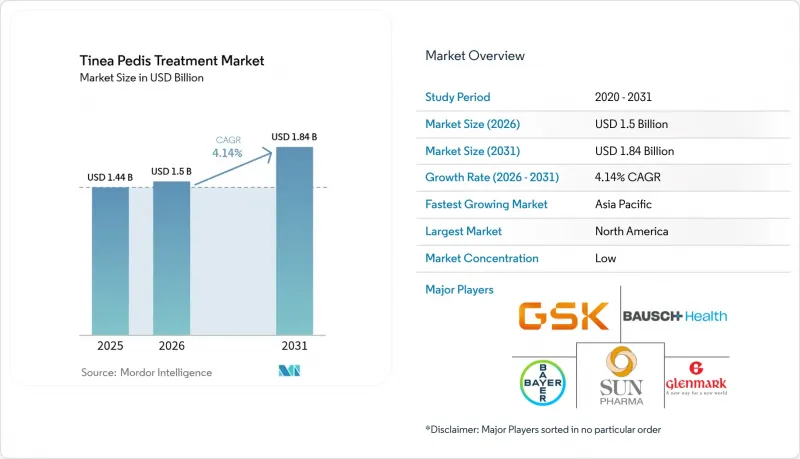
Mordor Intelligence에 의하면, 무좀 치료 시장 규모는 2025년에 14억 4,000만 달러로 평가되었고 2026년 15억 달러에서 2031년까지 18억 4,000만 달러에 이를 것으로 예측되며, 예측 기간(2026-2031년) CAGR은 4.14%를 나타낼 전망입니다.
본 보고서는 약물 분류별(아졸계, 알릴아민계/벤질아민계 등), 질환 유형별(지간형 발무좀, 발바닥형, 수포성/염증성),투여 경로(경구, 외용), 유통 채널(병원 약국 등), 지역(북미, 유럽, 아시아태평양, 중동 및 아프리카, 남미)별로 분류되어 있습니다. 시장 예측은 금액(달러) 기준으로 제시되어 있습니다.
전 세계 무좀 치료 시장 동향 및 인사이트
표재성 진균 감염의 유병률 증가
세계 피부사상균 감염증의 유병률은 20-25%로 여전히 높은 수준을 유지하고 있으며, 이는 공중보건상의 과제가 뿌리 깊게 남아 있음을 보여줍니다. 균종의 분포 변화, 특히 트리코피톤 인도티네아(Trichophyton indotineae)의 지리적 확산은 진단의 복잡성을 가중시키고, 보다 광범위한 진균학적 검사를 필요로 하고 있습니다. 도시 지역의 인구 밀도 증가로 인해 주거 공간의 습도가 상승하여 병원체에게 거의 이상적인 증식 환경이 조성되고 있습니다. 암 치료나 이식 요법에 따른 면역 억제 현상의 확대는 감염 위험이 높은 인구 집단을 더욱 넓히고 있습니다. 비치발리볼 선수들 사이에서 보고된 집단 감염 사례는 생활 습관에 따른 노출이 감염 경로에 새로운 요인을 더하고 있음을 보여줍니다. 이 질환의 기본 발생률이 높기 때문에 무좀 치료 시장의 모든 치료제 범주에서 지속적인 수요가 예상됩니다.
고령자 및 당뇨병 환자 증가
당뇨병은 혈관 장애나 면역 감시 기능 저하로 인해 무좀 발병 위험을 3배나 높입니다. 마찬가지로 고령자도 피부 건강이 악화되고 표피의 재생 주기가 느려지기 때문에 진균의 정착이 촉진됩니다. 당뇨병성 족부 궤양의 직접 비용은 5만 달러를 초과하기도 하여, 내분비과 클리닉에서는 조기 예방적 항진균제 사용이 권장되고 있습니다. 장기 요양 시설은 병원체의 급속한 확산을 가능하게 하는 고밀도 접촉 환경을 조성하고 있으며, 이로 인해 광범위 스펙트럼의 외용제가 약제 목록에서 우선적으로 채택되는 경향이 강해지고 있습니다. 그 결과, 무좀 치료 시장에서는 일상적인 만성 질환 관리의 일환으로 발 위생 관리에 관한 환자 교육 프로그램이 점점 더 많이 도입되고 있습니다.
환자의 복약 순응도 저하와 높은 재감염률
실제 연구에 따르면, 클로트리마졸·베타메타손 제제의 처방 건수 중 진균 감염이 확정 진단된 사례에 해당하는 것은 불과 3분의 1에 불과하여, 진단 지연 문제가 두드러지게 나타나고 있습니다. 표준 치료법에서는 2-4주간의 추가 도포가 권장되고 있음에도 불구하고, 가려움증이 가라앉으면 치료를 중단하는 것이 일반적입니다. 처리되지 않은 신발 안에서는 재감염이 쉽게 확산되며, 따뜻하고 습한 신발 내부에서는 곰팡이 포자가 수개월 동안 생존합니다. 경제적 제약으로 인해 환자들은 효능이 낮은 제네릭 의약품을 선택할 수밖에 없으며, 그 결과 병원체 보유 기간이 장기화되고 있습니다. 미국 내 항진균제 처방의 40%를 차지하는 1차 진료 의사들은 대개 피부 진균학에 관한 전문 교육을 받지 않았습니다. 이러한 치료상의 격차가 지속됨에 따라 무좀 치료 시장의 매출 성장세가 둔화되고 있습니다.
부문 분석
아졸계 약물의 출하량은 2025년에 무좀 치료 시장의 49.02%를 차지할 것으로 전망됩니다. 특정 균주에서 돌연변이 핫스팟으로 인해 감수성이 저하되었음에도 불구하고, 의사들 사이에서 확고하게 자리 잡은 인지도와 우수한 경구 생체이용률이 아졸계 약물의 역할을 뒷받침하고 있습니다. 테르비나핀을 필두로 한 알릴아민계 및 벤질아민계 약물은 치료 기간 단축과 높은 진균학적 치유율에 힘입어 2031년까지 연평균 성장률(CAGR) 7.39%로 가장 빠르게 성장하는 그룹입니다. 폴리엔 계열 약물은 난치성 사례에서 틈새 용도로 채택되고 있으며, 새로운 지질계 유도체는 효능과 신독성의 균형을 맞추는 것을 목표로 하고 있습니다. 광범위 항진균제와 병용되는 외용 스테로이드 병용 요법은 동반되는 염증을 치료하고, 복약 순응도를 향상시킵니다. 향후 전망을 살펴보면, 에키노칸진 유사 분자나 하이드록시피리돈 유도체가 초기 파이프라인에 많이 나타나고 있어, 무좀 치료 시장의 추가적인 다각화가 예상됩니다.
2세대 아졸계 약제는 1세대 동종 약제보다 새롭게 발생하는 내성을 더 효과적으로 방지하며, 체외(in vitro)에서 T. indotineae에 대한 효능을 유지하고 있습니다. 한편, 포비돈 요오드 10%는 이중 맹검 시험에서 68.4%의 치유율을 입증하여 최근 FDA의 카테고리 I 지정을 획득했습니다. 또한, 각 개발사는 각질층 내의 약물 농도를 높이기 위해 아졸계 약물과 침투 촉진제를 조합하는 시도도 진행하고 있습니다. 이러한 발전으로 인해 이 부문은 절대 매출액 측면에서 계속해서 1위를 유지하고 있지만, 처방 의사가 병원체의 신속한 근절을 요구하는 가운데 성장세 차이는 알릴아민계 약물에 분명히 유리하게 작용하고 있습니다.
2025년에는 발가락 사이의 증상이 무좀 치료 시장 매출의 36.35%를 차지하고, 이는 통기성이 나쁜 신발이나 공공장소의 표면에 일상적으로 노출되어 있는 실정을 반영합니다. 임상의들은 일반적으로 이러한 증상을 저비용의 국소 치료제로 관리하고 있기 때문에 이 카테고리는 판매량은 많지만 매출액은 중간 수준에 그치고 있습니다. 그러나 수포성 또는 염증성 유형의 경우, 수포가 군집을 이루거나 심한 가려움증이 나타나기 때문에 전신 치료가 필요한 경우가 많으며, 그 결과 환자 1인당 의료비가 높아집니다. 수포성 부문은 진단 플랫폼의 향상으로 인해 지금까지 간과되었던 사례가 드러남에 따라, 질환의 아형 중 가장 빠른 연평균 성장률(CAGR) 9.12%를 기록할 전망입니다.
족저형이나 모카신형에서는 족저에 과각화가 발생하며, 특히 당뇨병 환자의 경우 각질 용해제를 이용한 사전 치료에 더해 장기간의 항진균 치료가 필요합니다. 1차 진료에서 국소 스테로이드의 오용이 증가하고 있는 것이 ‘위장 백선(tinea incognito)’의 원인 중 하나입니다. 이는 전형적인 특징이 불분명해져 정확한 진단이 지연되는 증상입니다. 또한, T. mentagrophytes 유전자형 VII에 기인하는 성병으로서의 피부사상균증 사례도 보고되고 있어, 성 건강 검진에 이를 보다 광범위하게 통합할 필요가 있습니다. 이러한 동향으로 인해 치료상 미묘한 차이가 발생하고 있으며, 약물 채택 위원회는 보다 폭넓은 전신 요법 선택지를 비축할 것을 권고받고 있습니다.
지역별 분석
북미는 지역별 매출액에서 가장 큰 비중을 차지하여, 2025년 무좀 치료 시장 규모의 37.29%를 차지했습니다. 우려스러운 점은 2024년 뉴욕시에서 테르비나핀 내성 T. mentagrophytes 유전자형 VII의 미국 내 첫 사례가 확인되었으며, 이에 따라 진료 지침 업데이트와 검사실에서의 정밀 검사 강화가 진행되고 있습니다. 또한, 이 지역은 ACNU의 디지털 자가 선택 포털을 가장 먼저 도입하여 OTC 전환율을 더욱 높일 가능성이 있습니다.
아시아태평양은 2031년까지 연평균 성장률(CAGR)이 9.74%로 예측되어 가장 빠르게 성장하는 시장으로 두각을 나타내고 있습니다. 스마트폰의 폭발적인 보급과 가처분 소득 증가가 맞물려 온라인 약국의 확장을 뒷받침할 것입니다. 인도에서는 테르비나핀 염산염의 수출 급증에 힘입어 2024년 4월 제약 부문의 성장이 기록되었습니다. 그러나 이 지역은 집중된 API(활성 성분) 제조 거점에 대한 의존도가 높기 때문에 환경적 또는 규제적 충격이 생산 클러스터에 타격을 줄 때마다 공급 차질 위험이 발생합니다.
유럽은 성숙한 보험 환급 제도를 갖추고 있으며, 유럽의약품청(EMA) 하에서 일관된 의약품 안전성 감시의 혜택을 받고 있습니다. 2023년 12월 레자푼진의 승인은 정책 입안자들이 진균학 분야의 혁신을 신속하게 추진할 의향이 있음을 보여줍니다. 춥고 습한 겨울은 특히 북유럽에서 치료의 계절성을 장기화시킵니다. 그 밖의 지역에서는 중동 및 아프리카 및 남미에서 피부과 의료 서비스의 보급과 건강보험 가입률 확대에 따라 수요가 완만하지만 증가하는 추세에 있습니다. 내성 트리코피톤속 균의 전 세계적 확산으로 인해, 경험적 치료 지침 수립을 위한 지역 간 균주 모니터링의 필요성이 더욱 높아지고 있습니다.
기타 혜택:
- 엑셀 형식 시장 예측(ME) 시트
- 3개월간의 애널리스트 지원
자주 묻는 질문
목차
제1장 서론
제2장 조사 방법
제3장 주요 요약
제4장 시장 구도
제5장 시장 규모와 성장 예측
제6장 경쟁 구도
제7장 시장 기회와 향후 전망
JHS 26.08.26According to Mordor Intelligence, the tinea pedis treatment market size was valued at USD 1.44 billion in 2025 and estimated to grow from USD 1.5 billion in 2026 to reach USD 1.84 billion by 2031, at a CAGR of 4.14% during the forecast period (2026-2031).
This report is Segmented by Drug Class (Azoles, Allylamines/Benzylamines, and More), Disease Type (Interdigital Tinea Pedis, Plantar, Vesicular/Inflammatory), Route of Administration (Oral, Topical), Distribution Channel (Hospital Pharmacies, and More), and Geography (North America, Europe, Asia-Pacific, Middle East & Africa, South America). The Market Forecasts are Provided in Terms of Value (USD).
Global Tinea Pedis Treatment Market Trends and Insights
Growing Prevalence of Superficial Fungal Infections
Global dermatophyte infection rates remain stubbornly high at 20-25%, underlining an enduring public-health challenge. Shifts in species distribution, most notably the geographic spread of Trichophyton indotineae, heighten diagnostic complexity and necessitate broader mycological testing. Urban densification raises humidity in living quarters, creating near-perfect growth conditions for pathogens. Wider immunosuppression from oncologic and transplant therapies further expands the vulnerable population. Documented infection clusters among beach volleyball athletes show how lifestyle exposure adds another transmission layer. Higher baseline disease incidence ensures sustained demand across every therapeutic class in the Tinea pedis treatment market.
Expanding Geriatric & Diabetic Populations
Diabetes mellitus triples the odds of foot mycoses, driven by vascular impairment and reduced immune vigilance. Older adults likewise experience diminished skin integrity and slower epidermal turnover, supporting fungal colonization. Diabetic foot-ulcer episodes can exceed USD 50,000 in direct costs, spurring early prophylactic antifungal use in endocrinology clinics. Long-term care facilities create high-density contact environments that enable rapid organism spread, reinforcing formulary preference for broad-spectrum topicals. Consequently, the Tinea pedis treatment market increasingly integrates patient-education modules on foot hygiene within routine chronic-disease management.
Low Patient Adherence & High Reinfection Rates
Real-world studies reveal barely one-third of clotrimazole-betamethasone prescriptions correspond to confirmed fungal cases, underscoring diagnostic inertia. Therapy cessation typically occurs once itching subsides, even though standard regimens advise 2-4 additional weeks of application. Reinfection thrives in untreated footwear; fungal spores survive for months in warm, moist shoe interiors. Financial constraints steer patients toward lower-potency generics, prolonging pathogen carriage. Primary-care practitioners, who write 40% of antifungal scripts in the United States, often lack specialized dermatomycology training. Persistent treatment gaps dampen volume growth in the Tinea pedis treatment market.
Other drivers and restraints analyzed in the detailed report include:
- OTC Switch-Friendly Regulatory Stance in US & EU
- Wider E-Commerce Access to Antifungals
- Stringent Approval Timelines for Novel Systemic Agents
For complete list of drivers and restraints, kindly check the Table Of Contents.
Segment Analysis
Azoles delivered, translating to 49.02% slice of the Tinea pedis treatment market in 2025. Durable physician familiarity and favorable oral bioavailability sustain their role, despite mutational hotspots diminishing sensitivity in select strains. Allylamines and benzylamines, anchored by terbinafine, are the fastest-advancing cohort at a 7.39% CAGR through 2031, buoyed by shorter therapy windows and high mycological cure rates. Polyenes attract niche adoption for refractory cases, with new lipid-based derivatives aiming to balance potency and nephrotoxicity. Combination topical steroids integrated with broad-spectrum antifungals address concomitant inflammation, improving adherence. Looking ahead, echinocandin-like molecules and hydroxy-pyridone derivatives populate early pipelines, signalling additional diversification within the Tinea pedis treatment market.
Second-generation azoles fend off emerging resistance better than first-generation cousins, retaining efficacy against T. indotineae in vitro. Meanwhile, povidone-iodine 10% recently secured Category I FDA status after demonstrating 68.4% cure rates in double-blind trials. Developers are also pairing azoles with penetration enhancers to elevate stratum corneum drug concentrations. Collectively, these developments keep the segment ahead in absolute revenue, yet the differential growth momentum clearly favors allylamines as prescribers seek high-speed pathogen eradication.
Interdigital presentations generated 36.35% of the tinea pedis treatment market turnover in 2025, reflecting everyday exposure to occlusive footwear and communal surfaces. Clinicians usually manage these with low-cost topicals, making the category volume-rich but value-moderate. Vesicular or inflammatory forms, however, manifest blister clusters and intense pruritus, frequently requiring systemic intervention and thereby fetching higher per-patient spend. The vesicular segment is on course for a 9.12% CAGR, the fastest among disease subtypes, as enhanced diagnostic platforms spotlight previously under-recognized cases.
Plantaris or moccasin variants produce hyperkeratotic soles, demanding keratolytic pre-treatment plus long-haul antifungal regimens, particularly in diabetics. Rising misuse of topical steroids in primary care contributes to tinea incognito, a presentation that blurs classical features and delays correct diagnosis. Furthermore, sexually transmitted dermatophytosis cases attributable to T. mentagrophytes genotype VII have surfaced, necessitating wider sexual-health screening integration. These dynamics introduce therapeutic nuance, prompting formulary committees to stock a broader array of systemic options.
Complete Report Scope:
- By Drug Class
- Azoles
- Allylamines/-Benzylamines
- Polyenes
- Others (Echinocandins, Steroid Combos, Novel Agents)
- By Disease Type
- Interdigital Tinea Pedis
- Plantar (Moccasin)
- Vesicular/Inflammatory
- By Route of Administration
- Oral
- Topical
- By Distribution Channel
- Hospital Pharmacies
- Retail Pharmacies
- E-commerce
- By Geography
- North America
- United States
- Canada
- Mexico
- Europe
- Germany
- United Kingdom
- France
- Italy
- Spain
- Rest of Europe
- Asia-Pacific
- China
- Japan
- India
- Australia
- South Korea
- Rest of Asia-Pacific
- Middle East & Africa
- GCC
- South Africa
- Rest of Middle East & Africa
- South America
- Brazil
- Argentina
- Rest of South America
- North America
Geography Analysis
North America generated the highest regional revenue, capturing 37.29% of the Tinea pedis treatment market size in 2025. Worryingly, the first US cases of terbinafine-resistant T. mentagrophytes genotype VII emerged in New York City in 2024, prompting guideline updates and heightened laboratory scrutiny. The region is also the first to operationalize ACNU digital self-selection portals, potentially widening OTC conversion rates.
Asia-Pacific stands out as the fastest-growing arena, projected at a 9.74% CAGR through 2031. Explosive smartphone adoption, combined with rising disposable incomes, will fuel e-pharmacy expansion. India recorded pharmaceutical sector growth in April 2024, helped by surging terbinafine hydrochloride exports. Yet the region's reliance on a concentrated API manufacturing base introduces supply-disruption risk whenever environmental or regulatory shocks hit production clusters.
Europe commands mature reimbursement systems and benefits from cohesive pharmacovigilance under the EMA. Rezafungin's December 2023 approval signals policymakers' willingness to fast-track mycology innovation. Cold, damp winters extend therapeutic seasonality, particularly in Northern Europe. Elsewhere, Middle East-Africa and South America register modest but rising demand as dermatology services proliferate and health-insurance penetration widens. The global migration of resistant Trichophyton species reinforces the need for cross-regional strain monitoring to inform empiric therapy.
- GlaxoSmithKline
- Pfizer
- Bayer
- Bausch Health
- Sun Pharmaceuticals Industries
- Glenmark Pharmaceuticals
- Teva Pharmaceutical Industries
- Amneal Pharmaceuticals
- Viatris
- Sebela Pharmaceuticals
- Advantice Health (Kerasal)
- Johnson & Johnson (Kenvue OTC)
- Novartis AG (former Lamisil IP)
- Perrigo Company
- Zydus Group
- Cipla
- Almirall S.A.
- Astellas Pharma
- Lupin
- Mankind Pharma Ltd
Additional Benefits:
- The market estimate (ME) sheet in Excel format
- 3 months of analyst support
TABLE OF CONTENTS
1 Introduction
- 1.1 Study Assumptions & Market Definition
- 1.2 Scope of the Study
2 Research Methodology
3 Executive Summary
4 Market Landscape
- 4.1 Market Overview
- 4.2 Market Drivers
- 4.2.1 Growing Prevalence of Superficial Fungal Infections
- 4.2.2 Expanding Geriatric & Diabetic Populations
- 4.2.3 OTC Switch-Friendly Regulatory Stance in US & EU
- 4.2.4 Wider E-Commerce Access to Antifungals
- 4.2.5 Military & Athletic Communal Facility Hygiene Mandates
- 4.2.6 Rise of Copper-Oxide Textile Integrations in Socks & Footwear
- 4.3 Market Restraints
- 4.3.1 Low Patient Adherence & High Reinfection Rates
- 4.3.2 Stringent Approval Timelines for Novel Systemic Agents
- 4.3.3 Increasing Counterfeit Topical Formulations Online
- 4.3.4 Emerging Triazole Resistance in Trichophyton Species
- 4.4 Regulatory Landscape
- 4.5 Porter's Five Forces Analysis
- 4.5.1 Threat of New Entrants
- 4.5.2 Bargaining Power of Buyers/Consumers
- 4.5.3 Bargaining Power of Suppliers
- 4.5.4 Threat of Substitute Products
- 4.5.5 Intensity of Competitive Rivalry
5 Market Size & Growth Forecasts (Value in USD)
- 5.1 By Drug Class
- 5.1.1 Azoles
- 5.1.2 Allylamines/-Benzylamines
- 5.1.3 Polyenes
- 5.1.4 Others (Echinocandins, Steroid Combos, Novel Agents)
- 5.2 By Disease Type
- 5.2.1 Interdigital Tinea Pedis
- 5.2.2 Plantar (Moccasin)
- 5.2.3 Vesicular/Inflammatory
- 5.3 By Route of Administration
- 5.3.1 Oral
- 5.3.2 Topical
- 5.4 By Distribution Channel
- 5.4.1 Hospital Pharmacies
- 5.4.2 Retail Pharmacies
- 5.4.3 E-commerce
- 5.5 By Geography
- 5.5.1 North America
- 5.5.1.1 United States
- 5.5.1.2 Canada
- 5.5.1.3 Mexico
- 5.5.2 Europe
- 5.5.2.1 Germany
- 5.5.2.2 United Kingdom
- 5.5.2.3 France
- 5.5.2.4 Italy
- 5.5.2.5 Spain
- 5.5.2.6 Rest of Europe
- 5.5.3 Asia-Pacific
- 5.5.3.1 China
- 5.5.3.2 Japan
- 5.5.3.3 India
- 5.5.3.4 Australia
- 5.5.3.5 South Korea
- 5.5.3.6 Rest of Asia-Pacific
- 5.5.4 Middle East & Africa
- 5.5.4.1 GCC
- 5.5.4.2 South Africa
- 5.5.4.3 Rest of Middle East & Africa
- 5.5.5 South America
- 5.5.5.1 Brazil
- 5.5.5.2 Argentina
- 5.5.5.3 Rest of South America
- 5.5.1 North America
6 Competitive Landscape
- 6.1 Market Concentration
- 6.2 Market Share Analysis
- 6.3 Company Profiles (includes Global level Overview, Market level overview, Core Segments, Financials as available, Strategic Information, Market Rank/Share for key companies, Products & Services, and Recent Developments)
- 6.3.1 GlaxoSmithKline plc
- 6.3.2 Pfizer Inc.
- 6.3.3 Bayer AG
- 6.3.4 Bausch Health Companies Inc.
- 6.3.5 Sun Pharmaceutical Industries Ltd
- 6.3.6 Glenmark Pharmaceuticals Ltd
- 6.3.7 Teva Pharmaceutical Industries Ltd
- 6.3.8 Amneal Pharmaceuticals Inc.
- 6.3.9 Viatris Inc.
- 6.3.10 Sebela Pharmaceuticals Holdings Inc.
- 6.3.11 Advantice Health (Kerasal)
- 6.3.12 Johnson & Johnson (Kenvue OTC)
- 6.3.13 Novartis AG (former Lamisil IP)
- 6.3.14 Perrigo Company plc
- 6.3.15 Cadila Healthcare Ltd
- 6.3.16 Cipla Ltd
- 6.3.17 Almirall S.A.
- 6.3.18 Astellas Pharma Inc.
- 6.3.19 Lupin Ltd
- 6.3.20 Mankind Pharma Ltd
7 Market Opportunities & Future Outlook
- 7.1 White-space & Unmet-Need Assessment


