

|
시장보고서
상품코드
2114745
페놀 시장 : 점유율 분석, 업계 동향과 통계, 성장 예측(2026-2031년)Phenol - Market Share Analysis, Industry Trends & Statistics, Growth Forecasts (2026 - 2031) |
||||||
 Mordor Intelligence
Mordor Intelligence에 의하면, 페놀 시장 규모는 2025년 1,246만 톤에서 2026년에는 1,285만 톤으로 확대되어 2026년부터 2031년까지 CAGR 3.16%로 성장을 지속하여, 2031년에는 1,501만 톤에 이를 것으로 예측됩니다.
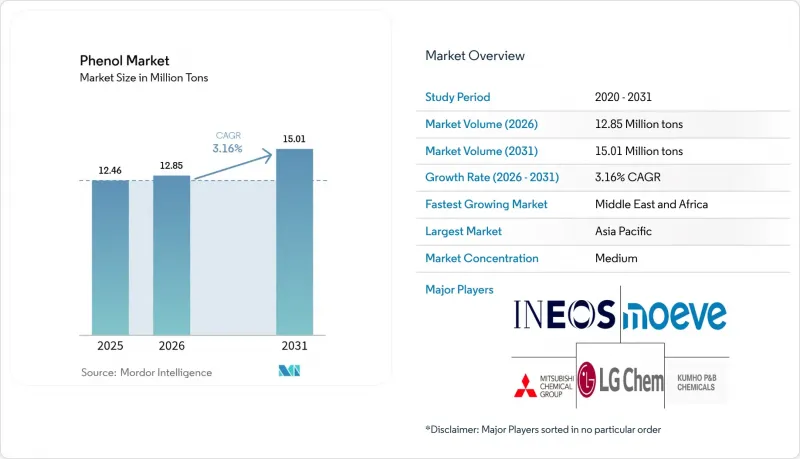
본 보고서는 제품 유형(비스페놀 A, 페놀 수지, 카프로락탐, 기타), 최종 사용자 산업(자동차, 건설, 제약, 가구, 기타) 및 지역(아시아태평양, 북미, 유럽, 남미, 중동 및 아프리카)별로 분류되어 있습니다. 시장 전망은 수량(톤) 단위로 제시되어 있습니다.
세계 페놀 시장 동향 및 인사이트
폴리카보네이트 및 에폭시 수지에서의 비스페놀 A 수요 증가
비스페놀 A는 투명성과 충격 강도가 필수적인 전자기기 케이스, 자동차 유리, 의료기기에 사용되는 폴리카보네이트 및 에폭시 수지의 핵심 단량체로 계속해서 자리 잡고 있습니다. 현재 전기자동차 배터리 하우징에는 난연성 폴리카보네이트 블렌드의 사용이 규정되어 있으며, 최근 유럽에서 식품 포장에 대한 사용이 금지된 이후에도 BPA 출하량은 더욱 증가하고 있습니다. 중국과 인도에서는 대량의 폴리카보네이트 시트가 필요한 활발한 전자기기 제조 및 인프라 프로젝트로 인해 유럽 수요 감소를 상쇄하고 있습니다. 생산자들은 동남아시아의 가공업체와 북미의 위탁 성형 업체로 출하처를 전환함으로써 설비 가동률을 유지하고 있습니다. 중기적으로는 BPA 수요 증가로 인해 가동률이 85% 전후로 유지될 것으로 예상되며, 지역적인 규제가 있음에도 불구하고 페놀 시장 전체를 지탱할 것으로 보입니다.
자동차용 경량 페놀 복합재료의 성장
각 자동차 제조업체는 브레이크 부스터나 클러치 플레이트 외에도 페놀계 복합재료의 채택을 검토하고 있으며, BMW의 양산 공장에서는 구조용 흡기 매니폴드 및 공기 관리 부품에서의 실용성이 이미 입증되었습니다. 이 소재는 140°C에서도 치수 안정성을 유지하면서 질량을 20% 가까이 줄일 수 있어, 엄격한 배기가스 규제와 주행 거리 목표 달성에 기여합니다. 전기차(EV) 플랫폼은 열 폭주 시의 화염 전파 성능과 기계적 무결성이 극히 중요한 배터리 모듈 하우징을 위해 페놀 유도체에 대한 수요를 더욱 부추기고 있습니다. 순정 부품 공급업체(OES)는 15년간의 내구성 사이클과 일관된 충돌 저항 성능을 보고하고 있으며, 이에 따라 유럽과 미국의 1차 복합재 가공 제조업체들은 장기 공급 계약을 체결하고 있습니다. 이러한 동향으로 인해 가격 탄력성이 낮은 고부가가치 엔지니어링 용도로 수요가 이동하면서 페놀 시장이 활성화되고 있습니다.
식품 접촉 용도에서의 BPA 규제
유럽연합 집행위원회의 2024년 규제로 인해 캔 코팅 및 재사용 가능한 식품 용기에서 BPA가 배제되면서, 지역 수요의 약 5분의 1이 감소했습니다. 허용된 이행 기간에 따라 포장 제조업체들은 18개월 이내에 자재 재인증을 받아야만 했으며, 이로 인해 조달 파이프라인이 혼란에 빠지고 에폭시 수지 제조업체에서는 재고 감소가 발생하고 있습니다. 캐나다와 미국의 일부 주에서도 유사한 규제안이 제출되어 2027년까지 하방 리스크가 높아지고 있습니다. 산업용 수요는 여전히 견조하지만, 내분비 교란 물질에 대한 공중보건적 관심이 높아짐에 따라 투자자들의 신뢰가 훼손될 가능성이 있으며, 페놀 시장의 참여 기업들은 논란이 적은 파생 제품 포트폴리오로 다각화를 모색해야 할 수도 있습니다.
부문 분석
비스페놀 A(BPA)는 유럽의 식품 접촉 금지 조치에도 불구하고, 확고히 자리 잡은 폴리카보네이트 생산량이 뒷받침되어 2025년에도 페놀 시장에서 44.35%의 점유율을 유지했습니다. BPA와 관련된 페놀 시장 규모는 2031년까지 연평균 2.22%의 성장에 그칠 것으로 예상되는 반면, 카프로락탐은 4.86%의 성장이 예상됩니다. 중국과 중동에 자산을 보유한 생산자들은 유럽과 미국 수요 감소를 상쇄하기 위해 가동률을 높이고 있으며, 규제상의 병목 현상을 피하기 위한 새로운 공급망을 구축하고 있습니다. 두 번째로 큰 용도인 페놀 수지는 건설 활동의 회복, 특히 저발연성 단열 보드가 선호되는 상업시설의 리모델링 공사의 혜택을 받고 있습니다. 카프로락탐 부문의 연평균 성장률(CAGR) 4.86%는 산업용 섬유 및 경량 자동차 부품용 나일론 6 섬유의 확대에 힘입은 것입니다. 알킬페놀 등의 특수 중간체는 계면활성제로 사용되며, 크실레놀은 최근 공중보건 위기를 계기로 확대된 소독제 시장에 공급되고 있습니다. 알칼리 가수분해 기술의 발전으로 산업 규모의 나일론 재활용이 가능해졌으며, 폐기물을 카프로락탐 합성에 재순환시켜 페놀 시장의 순환형 경제를 뒷받침할 가능성이 있습니다.
일반 페놀 시장에서는 공급 과잉과 벤젠 가격 변동으로 인해 이익률 압박에 직면하고 있어, 제품 구성 전환을 통해 이익률이 높은 파생 제품의 우선순위가 높아지고 있습니다. 따라서 유럽의 투자 흐름은 신규 BPA 플랜트 건설보다는 카프로락탐 및 고순도 페놀 수지 생산 라인의 병목 현상 해소에 중점을 두고 있습니다. 예측 기간 동안 기술 라이선스 제공업체들은 개조 주기마다 1.5%의 에너지 효율 향상을 예상하고 있으며, 이를 통해 추가적인 비용 절감이 가능할 것으로 기대됩니다. 환경·사회·지배구조(ESG) 지표가 고객의 조달 결정에 영향을 미치고 있어, 생산자들은 검증된 탄소 집약도 데이터가 동반될 경우 가격 프리미엄을 얻을 수 있는 바이오 페놀 제품 및 재생 페놀 수지로의 전환을 요구받고 있습니다.
지역별 분석
아시아태평양은 2025년에도 페놀 시장 규모의 53.94%를 계속 차지했습니다. 이는 기존 정유시설 라인의 15-20%에 비해 40%의 화학물질 수율을 달성하는 중국의 대규모 석유화학 복합 단지에 힘입은 결과입니다. 인도의 11억 달러 규모 구자라트주 프로젝트는 2027년까지 페놀, 아세톤, BPA의 생산 능력을 확대할 예정이며, 이는 화학제품의 자급자족을 목표로 하는 인도의 ‘메이크 인 인디아(Make in India)’ 전략에 부합하는 것입니다. 일본과 한국은 특히 광학 등급 폴리카보네이트나 전자기기용 고내열 페놀 화합물과 같은 고급 하류 파생 제품을 공급하는 반면, 아세안(ASEAN) 국가들은 급성장하는 건설·가구 부문에 제품을 공급하고 있습니다. 이러한 시장 역학에 따라 아시아태평양은 계속해서 주요 수요 및 공급 거점으로 남을 것으로 확실시되고 있습니다.
북미는 원료 가격 변동에 직면해 있지만, 풍부한 셰일 가스에 힘입어 아세톤의 제품별 가격은 경쟁력을 유지하고 있습니다. 그러나 정유시설의 가동 중단으로 인해 프로파일렌 공급이 부족해지고 마진이 압박받고 있어, 스플릿 피드 쿠멘 설비의 위탁 생산 계약에 관한 협의가 진행되고 있습니다. 미국의 관세 정책이나 반덤핑 관세는 급증하는 아시아산 수입에 대한 일시적인 완화책이 될 수 있지만, 지속적인 경쟁력을 유지하기 위해서는 에너지 효율 향상을 위한 투자와 바이오프로파일렌 관련 제휴 가능성이 핵심이 될 것입니다.
유럽의 페놀 생산자들은 높은 에너지 비용과 환경 규제로 어려움을 겪고 있으며, 리오넬바셀의 6개 자산 재검토 등 업계 재편 움직임이 가속화되고 있습니다. 유럽 대륙 수요 전망은 BPA 규제와 바이오 유래 대체품을 우선시하는 적극적인 기후 목표로 인해 더욱 불투명해지고 있습니다. 중동 및 아프리카는 연평균 성장률(CAGR) 5.42%로 가장 빠르게 성장하는 지역이며, 그 원동력은 사우디아라비아와 아랍에미리트(UAE)에 위치한 통합 정유시설 및 석유화학 단지에 있습니다. 이들은 유리한 원료 비용과 아시아 수입 허브와의 근접성을 활용하고 있습니다. 남미는 비교적 소규모이긴 하지만 안정적인 모습을 보이고 있으며, 브라질이 자동차용 브레이크 부품 및 건설용 단열 보드용 페놀의 대부분을 소비하고 있습니다. 아르헨티나의 경제 개혁으로 인해 소폭이지만 상승 여지가 생길 가능성은 있으나, 환율 변동은 여전히 단기적인 위험 요인으로 남아 있습니다. 전반적으로, 지역 간 재균형이 세계 페놀 시장을 강화하는 다양한 성장 요인을 뒷받침하고 있습니다.
기타 혜택:
- 엑셀 형식 시장 예측(ME) 시트
- 3개월간의 애널리스트 지원
자주 묻는 질문
목차
제1장 서론
제2장 조사 방법
제3장 주요 요약
제4장 시장 구도
제5장 시장 규모와 성장 예측
제6장 경쟁 구도
제7장 시장 기회와 향후 전망
JHS 26.08.26According to Mordor Intelligence, the phenol market size is expected to grow from 12.46 Million tons in 2025 to 12.85 Million tons in 2026 and is forecast to reach 15.01 Million tons by 2031 at 3.16% CAGR over 2026-2031.
This report is Segmented by Product Type (Bisphenol-A, Phenolic Resins, Caprolactam, and Others), End-User Industry (Automotive, Construction, Pharmaceuticals, Furniture, and Others), and Geography (Asia-Pacific, North America, Europe, South America, and Middle East and Africa). The Market Forecasts are Provided in Terms of Volume (Tons).
Global Phenol Market Trends and Insights
High Demand for Bisphenol-A in Polycarbonates and Epoxy Resins
Bisphenol-A continues to be the backbone monomer for polycarbonate and epoxy resins used in electronics housings, automotive glazing, and medical devices where clarity and impact strength are non-negotiable. Battery enclosures in electric vehicles now specify flame-retardant polycarbonate blends, further lifting BPA volumes even after Europe's recent bans in food packaging. China and India are offsetting those European losses through aggressive electronics manufacturing and infrastructure projects that deploy large polycarbonate sheet volumes. Producers are maintaining capacity utilization by diverting cargoes to Southeast Asian converters and North American contract molders. Over the medium term, incremental BPA growth should keep operating rates near 85%, supporting the broader phenol market despite localized restrictions.
Growth in Lightweight Automotive Phenolic Composites
Automakers are validating phenolic composites beyond brake boosters and clutch plates, with structural intake manifolds and air-management components already proven at BMW's series plants. The material's ability to maintain dimensional stability at 140 °C while reducing mass by nearly 20% aligns with stringent emissions and range targets. Electric-vehicle platforms add another pull on phenol derivatives for battery module housings where flame-spread performance and mechanical integrity under thermal runaway are critical. Original equipment suppliers (OES) report 15-year durability cycles and consistent crash-resistance metrics, prompting tier-one composite processors in Europe and the United States to enter long-term offtake contracts. These developments elevate the phenol market by shifting demand toward high-value engineering applications with price-inelastic characteristics.
BPA Restrictions in Food-Contact Applications
The European Commission's 2024 regulation eliminated BPA from can coatings and reusable food containers, removing nearly one-fifth of regional demand. Allowed transition windows force packagers to requalify materials inside 18 months, disrupting procurement pipelines and triggering inventory run-downs at epoxy resin producers. Similar draft proposals in Canada and several U.S. states add downside risk through 2027. Although industrial uses remain intact, the public-health spotlight on endocrine disruptors may dampen investor confidence, compelling phenol market participants to diversify toward less contentious derivative portfolios.
Other drivers and restraints analyzed in the detailed report include:
- Construction-Sector Uptake of Phenolic Insulation Boards
- Sustainable Cumene Routes Using Bio/Green Propylene
- Feedstock (Benzene and Propylene) Price Volatility
For complete list of drivers and restraints, kindly check the Table Of Contents.
Segment Analysis
Bisphenol-A retained a 44.35% phenol market share in 2025, underpinned by entrenched polycarbonate volumes despite Europe's food-contact ban . The phenol market size attached to BPA is now projected to grow at just 2.22% annually through 2031, compared with 4.86% for caprolactam. Producers with Chinese or Middle-Eastern assets are lifting utilization to offset Western demand erosion, driving new supply chains that circumvent regulatory bottlenecks. Phenolic resins, the second-largest application, benefit from rebounding construction activity, especially in commercial retrofits that favor low-smoke insulation boards. The caprolactam segment's 4.86% CAGR rests on nylon 6 fiber expansion for technical textiles and lightweight automotive parts. Specialty intermediates such as alkylphenols serve surfactants, while xylenols feed disinfectant markets that expanded after recent public health crises. Advances in alkaline hydrolysis enable nylon recycling at industrial scale, looping waste back into caprolactam synthesis and potentially supporting a circular phenol market.
Shifting product mix now prioritizes higher-margin derivatives as commodity phenol contracts face margin compression from oversupply and volatile benzene pricing. As such, investment flows favor debottlenecking caprolactam and high-purity phenolic resin lines rather than greenfield BPA in Europe. Over the forecast horizon, technology licensors expect 1.5% energy-efficiency gains per retrofit cycle, unlocking incremental cost reductions. Environmental, social and governance (ESG) metrics are influencing customer procurement decisions, nudging producers toward bio-based phenol streams and recycled phenolic resins that command price premiums when accompanied by verified carbon intensity data.
Complete Report Scope:
- By Product Type
- Bisphenol-A
- Phenolic Resins
- Caprolactam
- Others
- By End-user Industry
- Automotive
- Construction
- Pharmaceuticals
- Furniture
- Others
- By Geography
- Asia-Pacific
- China
- India
- Japan
- South Korea
- ASEAN Countries
- Rest of Asia-Pacific
- North America
- United States
- Canada
- Mexico
- Europe
- Germany
- United Kingdom
- France
- Italy
- Russia
- NORDIC Countries
- Rest of Europe
- South America
- Brazil
- Argentina
- Rest of South America
- Middle East and Africa
- Saudi Arabia
- South Africa
- Rest of Middle East and Africa
- Asia-Pacific
Geography Analysis
Asia-Pacific retained 53.94% of phenol market size in 2025, buoyed by China's massive oil-to-chemicals complexes that achieve 40% chemical yield versus traditional 15-20% refinery lines. India's USD 1.1 billion Gujarat project will add phenol, acetone, and BPA capacity by 2027, aligning with the country's "Make in India" strategy for chemical self-sufficiency. Japan and South Korea supply high-end downstream derivatives, especially optical-grade polycarbonate and high-heat phenolic compounds for electronics, while ASEAN nations feed rising construction and furniture sectors. These market dynamics ensure Asia-Pacific remains the principal demand and supply node.
North America faces feedstock-induced volatility yet benefits from abundant shale gas that supports competitive acetone co-product pricing. However, refinery shutdowns have tightened propylene supply, compressing margins and prompting talks of tolling arrangements for split-feed cumene units. U.S. tariff policies and anti-dumping duties could offer temporary relief against surging Asian imports, although sustained competitiveness will depend on energy-efficiency investments and potential bio-propylene partnerships.
Europe's phenol producers grapple with high energy costs and environmental regulations, prompting consolidation efforts such as LyondellBasell's review of six assets. The continent's demand outlook is further clouded by BPA restrictions and aggressive climate targets that favor bio-based alternatives. Middle East and Africa represent the fastest-growing region at a 5.42% CAGR, anchored by integrated refinery-petrochemical complexes in Saudi Arabia and the UAE that exploit favorable feedstock economics and proximity to Asian import hubs. South America is comparatively small but stable, with Brazil absorbing most phenol for automotive brake components and construction insulation boards. Economic reforms in Argentina could unlock modest upside, yet currency volatility remains a near-term risk. Collectively, geographic rebalancing underpins diverse growth vectors that reinforce a global phenol market.
- AdvanSix Inc.
- Altivia
- Chang Chun Group
- Deepak Nitrite Ltd
- Domo Chemicals GmbH
- Formosa Chemicals and Fibre Corp.
- INEOS Group
- Kumho P&B Chemicals Inc.
- LG Chem
- LyondellBasell Industries N.V.
- Mitsubishi Chemical Group Corporation
- Mitsui Chemicals Inc.
- Moeve
- PTT Phenol Company Limited
- SABIC
- Solvay
Additional Benefits:
- The market estimate (ME) sheet in Excel format
- 3 months of analyst support
TABLE OF CONTENTS
1 Introduction
- 1.1 Study Assumptions and Market Definition
- 1.2 Scope of the Study
2 Research Methodology
3 Executive Summary
4 Market Landscape
- 4.1 Market Overview
- 4.2 Market Drivers
- 4.2.1 High Demand for Bisphenol-A in Polycarbonates and Epoxy Resins
- 4.2.2 Growth in Lightweight Automotive Phenolic Composites
- 4.2.3 Construction-Sector Uptake of Phenolic Insulation Boards
- 4.2.4 Sustainable Cumene Routes Using Bio/Green Propylene
- 4.2.5 Integration of Phenol Units with On-Purpose PO/SM Complexes
- 4.3 Market Restraints
- 4.3.1 BPA Restrictions in Food-Contact Applications
- 4.3.2 Feedstock (Benzene and Propylene) Price Volatility
- 4.3.3 Rise of Bio-Based Phenolic Alternatives
- 4.4 Value Chain Analysis
- 4.5 Regulatory Landscape
- 4.6 Porter's Five Forces
- 4.6.1 Bargaining Power of Suppliers
- 4.6.2 Bargaining Power of Buyers
- 4.6.3 Threat of New Entrants
- 4.6.4 Threat of Substitutes
- 4.6.5 Degree of Competition
5 Market Size and Growth Forecasts (Value and Volume)
- 5.1 By Product Type
- 5.1.1 Bisphenol-A
- 5.1.2 Phenolic Resins
- 5.1.3 Caprolactam
- 5.1.4 Others
- 5.2 By End-user Industry
- 5.2.1 Automotive
- 5.2.2 Construction
- 5.2.3 Pharmaceuticals
- 5.2.4 Furniture
- 5.2.5 Others
- 5.3 By Geography
- 5.3.1 Asia-Pacific
- 5.3.1.1 China
- 5.3.1.2 India
- 5.3.1.3 Japan
- 5.3.1.4 South Korea
- 5.3.1.5 ASEAN Countries
- 5.3.1.6 Rest of Asia-Pacific
- 5.3.2 North America
- 5.3.2.1 United States
- 5.3.2.2 Canada
- 5.3.2.3 Mexico
- 5.3.3 Europe
- 5.3.3.1 Germany
- 5.3.3.2 United Kingdom
- 5.3.3.3 France
- 5.3.3.4 Italy
- 5.3.3.5 Russia
- 5.3.3.6 NORDIC Countries
- 5.3.3.7 Rest of Europe
- 5.3.4 South America
- 5.3.4.1 Brazil
- 5.3.4.2 Argentina
- 5.3.4.3 Rest of South America
- 5.3.5 Middle East and Africa
- 5.3.5.1 Saudi Arabia
- 5.3.5.2 South Africa
- 5.3.5.3 Rest of Middle East and Africa
- 5.3.1 Asia-Pacific
6 Competitive Landscape
- 6.1 Market Concentration
- 6.2 Strategic Moves
- 6.3 Market Share/ Ranking Analysis
- 6.4 Company Profiles (includes Global level Overview, Market level overview, Core Segments, Financials as available, Strategic Information, Market Rank/Share, Products and Services, Recent Developments)
- 6.4.1 AdvanSix Inc.
- 6.4.2 Altivia
- 6.4.3 Chang Chun Group
- 6.4.4 Deepak Nitrite Ltd
- 6.4.5 Domo Chemicals GmbH
- 6.4.6 Formosa Chemicals and Fibre Corp.
- 6.4.7 INEOS Group
- 6.4.8 Kumho P&B Chemicals Inc.
- 6.4.9 LG Chem
- 6.4.10 LyondellBasell Industries N.V.
- 6.4.11 Mitsubishi Chemical Group Corporation
- 6.4.12 Mitsui Chemicals Inc.
- 6.4.13 Moeve
- 6.4.14 PTT Phenol Company Limited
- 6.4.15 SABIC
- 6.4.16 Solvay
7 Market Opportunities and Future Outlook
- 7.1 White-space and Unmet-need Assessment


