
|
시장보고서
상품코드
2114768
거즈 붕대 롤 시장 : 점유율 분석, 업계 동향과 통계, 성장 예측(2026-2031년)Gauze Bandage Rolls - Market Share Analysis, Industry Trends & Statistics, Growth Forecasts (2026 - 2031) |
||||||
 Mordor Intelligence
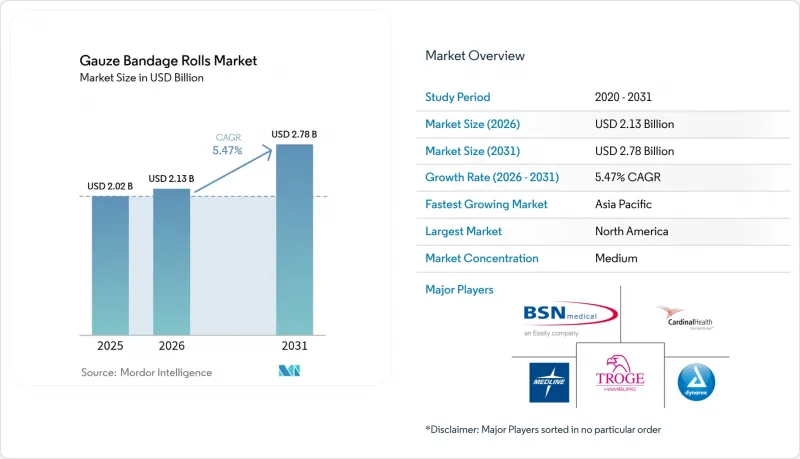
Mordor Intelligence에 의하면, 거즈 붕대 롤 시장 규모는 2025년에 20억 2,000만 달러로 평가되었고 2026년 21억 3,000만 달러에서 2031년까지 27억 8,000만 달러에 이를 것으로 예측되며, 예측 기간(2026-2031년) CAGR은 5.47%를 나타낼 전망입니다.
본 보고서는 소재 유형(면 거즈 롤, 직물 거즈 롤, 탄성 거즈 롤 등), 용도(외과적 상처, 만성 상처 등), 최종 사용자(병원, 외래수술센터(ASC) 등), 유통 채널(직접 입찰 및 GPO, 소매 약국 등), 지역(북미 등)별로 분류되어 있습니다. 시장 예측은 금액(미 달러) 기준으로 제시되어 있습니다.
전 세계 거즈 붕대 롤 시장 동향 및 인사이트
최소 침습 수술 및 로봇 보조 수술의 급증
로봇 보조 수술에서는 작은 절개가 이루어지기 때문에 정밀한 수술 부위를 보호하기 위해 섬유 탈락이 적고 흡수성이 높은 거즈가 요구됩니다. 방사선 불투과성 실을 사용함으로써 외과의사나 AI 기반 영상 진단 시스템이 봉합 전에 거즈 제거 여부를 확인할 수 있게 되어, 거즈 잔류 사고 발생률이 감소합니다. 현재 병원 자재 관리 담당자들은 첨단 거즈를 규제 대상 의료기기로 취급하며, 구매 전에 검증된 성능 데이터를 요구하고 있습니다. 로봇 수술 사례가 외래 진료 센터로 이동함에 따라, 조달 팀은 제한된 임상 감독 하에서도 회복을 촉진하는 고품질 제품을 선호하게 되었습니다. 그 결과, 수술 기술 자체가 더욱 고도화되는 가운데에서도 거즈 붕대 롤 시장 전체에서 특수 제품에 대한 수요가 지속되고 있습니다.
외래 및 ASC에서의 상처 봉합 급속한 확대
외래수술센터(ASC)에서는 수술 후 내원 횟수를 줄이고 환자의 자가 관리를 가능하게 하는 드레싱을 우선시하고 있습니다. 따라서 구매 가격이 아닌 ‘총 치료비’가 구매 판단 기준이 되는 경우, 장시간 착용 및 습기 관리에 배려하여 설계된 거즈가 계약을 따내고 있습니다. 임상 책임자들은 쾌적성 평가를 유지하고 예정에 없던 내원을 줄이는 능력을 바탕으로 드레싱을 평가하는 경향이 강해지고 있으며, 거즈는 단순한 범용 제품에서 품질 평가 지표로 그 위상이 변화하고 있습니다. 현재 많은 ASC가 인증 감사에 드레싱 성능을 포함하고 있기 때문에 치료 성과 데이터를 제시할 수 있는 제조업체는 거즈 붕대 롤 시장에서 우위를 점하고 있습니다.
첨단 하이드로콜로이드 및 폼 드레싱을 통한 대체
폼 드레싱은 뛰어난 수분 균형을 실현하고 교체 빈도를 줄여주기 때문에 기존의 거즈에 비해 치유 기간을 단축하는 경우가 많습니다. 간호 인건비를 고려하면 단가가 높더라도 총비용 측면에서 폼 드레싱이 유리할 수 있어, 만성 상처 클리닉에서는 처방 목록 전환이 진행되고 있습니다. 거즈 제조업체들은 항균 코팅이나 하이드로겔 층을 추가하는 방식으로 대응하고 있지만, 삼출액이 많은 상처의 경우 여전히 성능 격차가 해소되지 않고 있습니다. 그 결과, 가치 기반 보상 제도로의 전환에 따라 거즈 붕대 롤 시장의 판매량 확대는 완만한 양상을 보이고 있습니다.
부문 분석
2025년 매출액 중 면 롤이 46.02%를 차지하고 있으며, 이는 임상 현장에서 확고히 자리 잡은 수용도와 낮은 단가가 뒷받침하고 있습니다. 항균성 및 함침 거즈(은 PHMB, 꿀 등을 배합한 제품)는 9.05%의 연평균 성장률(CAGR)로 가장 빠르게 시장 점유율을 확대하고 있으며, 이는 급성기 및 급성기 후 관리에서 감염 관리의 의무화를 반영한 것입니다. 이러한 기능성 향상 제품을 포함한 거즈 붕대 롤 시장 규모는 2030년까지 2배 이상으로 증가하고, 이는 연구 개발(R&D) 투자를 촉진하고 있습니다. 부직포의 비스코스 및 폴리에스터 혼방 제품은 섬유 탈락이 적고 육아종 형성 위험을 줄여주기 때문에 정형외과 수술실에서 보급이 확대되고 있습니다. 탄성 붕대 롤은 압박 요법 분야에서 틈새 수요를 유지하고 있으며, X선 가시화 가능한 제품은 여전히 외과 수술의 표준으로 자리 잡고 있습니다.
현재 경쟁사와의 차별화는 단순한 실의 개수가 아니라, 흡수 동태, 살균 특성 및 영상 진단과의 호환성에 초점이 맞추어져 있습니다. 이에 따라 규제 요건도 엄격해지고 있으며, 제조업체는 미국 내 510(k) 승인이나 유럽 내 CE 마크 획득을 위해 시험대 및 생체 내 데이터를 제공해야 합니다. 중소기업은 신속한 사업 확장을 위해 코팅 기술을 라이선싱하는 경우가 많은 반면, 다국적 기업은 원자재 리스크를 줄이기 위해 면 공급을 수직 통합하고 있습니다. 그 결과, 거즈 붕대 롤 시장에서는 섬유 공학과 제약 분야의 노하우가 융합되고 있습니다.
외과적 상처는 전 세계 수술실에서 표준적으로 사용됨에 따라 2025년 매출의 51.12%를 차지했습니다. 치밀한 계수 절차와 방사선 불투과성 마커의 필요성으로 인해 건당 거즈 소비량이 증가하여 높은 기준선 판매량을 유지하고 있습니다. 한편, 만성 상처(당뇨병성 족부 궤양, 정맥성 하지 궤양, 욕창)는 인구 고령화와 당뇨병 유병률 증가에 따라 연평균 성장률(CAGR) 7.42%로 가장 빠른 성장세를 보이고 있습니다. 만성 질환 치료 용도의 거즈 붕대 롤 시장 규모는 재택치료의 확대에 힘입어 성장하고 있습니다. 재택치료 현장에서는 간병인들이 항균제가 함유된, 사용에 익숙한 저비용 드레싱을 선호하는 경향이 있습니다.
외상 및 화상 치료 부문에서는 특수한 드레싱을 적용하기 전 삼출물을 신속하게 관리하기 위해 여전히 고흡수성 거즈에 의존하고 있습니다. 치과 및 이비인후과 클리닉에서는 치아 충치 모양에 딱 맞는 소형 지혈용 스폰지가 요구되고 있으며, 이러한 마이크로 틈새 시장 형태가 주문 생산을 촉진하고 있습니다. 수의사들 사이에서는 반려동수처리에 인간용 등급의 거즈를 채택하는 경향이 강해지고 있으며, 이것이 판매량의 점진적인 증가에 기여하고 있습니다. 모든 용도에서 보험사의 철저한 심사를 통해 임상의는 상처 치유 기간에 대한 드레싱의 영향을 문서화해야 하며, 이로 인해 거즈 붕대 롤 시장에서 발표된 증거의 중요성이 높아지고 있습니다.
지역별 분석
북미는 2025년 매출의 37.25%를 차지하고 있으며, 이는 견조한 수술 건수, 로봇 시스템의 조기 도입, 그리고 혁신적인 드레싱에 대한 높은 보험 환급을 반영합니다. 팬데믹 이후 국내 생산을 장려하는 정책으로 인해 미국 공장에는 가격 프리미엄이 적용되어, 임금 상승을 부분적으로 상쇄하고 있습니다. 캐나다의 단일 지불자 제도에서는 조달이 일원화되어 있어, 공급업체는 경쟁력 있는 가격 외에도 품질 지표를 제시해야 합니다. 한편, 멕시코의 의료 개혁으로 인해 비용 효율성이 뛰어난 면 기반 제품을 우선시하는 새로운 병원 건설이 촉진되고 있습니다. 이러한 동향들이 맞물리면서, 이 지역은 거즈 붕대 롤 시장에서 중심적인 역할을 유지하고 있습니다.
아시아태평양은 중국과 인도가 국민건강보험을 확대하고 있는 만큼, 2031년까지 연평균 성장률(CAGR) 10.1%로 성장을 주도할 것으로 예측됩니다. 중국의 수량·가격 연동형 조달 계약에서는 항균 기준이 표준화되어 있어, 중가대 제품 카테고리의 규모 확대를 촉진하고 있습니다. 인도의 주 정부 입찰도 유사한 접근 방식을 취하고 있으나, 가격대가 구분되어 있어 공공기관과 민간 기업 구매자를 위한 별도의 SKU가 마련되어 있습니다. 일본이나 한국 등의 성숙한 시장에서는 규제 준수 및 친환경 포장의 의무화가 중시되고 있어, 공급업체들은 생애주기 평가(LCA)에 대한 투자를 촉진하고 있습니다. 한편, 아세안 국가에서는 합리적인 가격이 우선시되어, 세계 대기업과 기동력 있는 국내 기업 모두에게 이익을 가져다주는 양극화된 거즈 붕대 롤 시장이 형성되고 있습니다.
유럽에서는 지속가능성에 관한 규제를 기반으로 꾸준한 확대가 나타나고 있습니다. 조만간 시행될 EU의 ‘포장 및 포장 폐기물 규정’에 따라, 거즈 제조업체는 2026년까지 재생 소재를 혼합하고 재활용 가능한 포장을 설계해야 할 의무가 부과됩니다. 독일과 영국은 증거 기반 지침을 활용하여 만성 상처 치료용 첨단 드레싱의 도입을 주도하고 있습니다. 한편, 더 엄격한 재정 제약 하에서 운영되는 남유럽 국가들에서는 저비용 면 롤이 계속해서 우선시되고 있으며, 이는 거즈 붕대 롤 시장의 판매량을 뒷받침하고 있습니다. 동유럽 국가들의 EU 가입에 따른 자금 지원으로 병원 인프라가 정비되면서 수요가 서서히 증가하고 있습니다. 이에 대응하여 세계 및 지역 공급업체들은 합작 공장을 통해 이러한 수요를 흡수하고자 하고 있습니다.
기타 혜택:
- 엑셀 형식 시장 예측(ME) 시트
- 3개월간의 애널리스트 지원
자주 묻는 질문
목차
제1장 서론
제2장 조사 방법
제3장 주요 요약
제4장 시장 구도
제5장 시장 규모와 성장 예측
제6장 경쟁 구도
제7장 시장 기회와 향후 전망
JHS 26.08.26According to Mordor Intelligence, the gauze bandage rolls was valued at USD 2.02 billion in 2025 and estimated to grow from USD 2.13 billion in 2026 to reach USD 2.78 billion by 2031, at a CAGR of 5.47% during the forecast period (2026-2031). This report is Segmented by Material Type (Cotton Gauze Rolls, Woven Gauze Rolls, Elastic Gauze Rolls, and More), Application (Surgical Wounds, Chronic Wounds, and More), End User (Hospitals, Ambulatory Surgical Centers, and More), Distribution Channel (Direct Tenders & GPOs, Retail Pharmacies, and More), and Geography (North America, and More). The Market Forecasts are Provided in Terms of Value (USD).
Global Gauze Bandage Rolls Market Trends and Insights
Surging Volume of Minimally-Invasive & Robotic Surgeries
Robot-assisted procedures create small incisions that demand gauze with low fiber-shedding and heightened absorption to protect precision surgical fields. Radiopaque yarns enable surgeons and AI-driven imaging systems to confirm removal before closure, lowering retained-sponge events. Hospital supply managers now treat advanced gauze as a regulated device, requiring validated performance data before purchase. As more robotic cases migrate to outpatient centers, procurement teams favor premium formulations that accelerate recovery under limited clinical supervision. The result is sustained demand for specialty products across the Gauze Bandage Rolls market, even as surgical technology itself becomes more sophisticated.
Rapid Growth of Outpatient/ASC Wound Closures
Ambulatory surgical centers (ASCs) prioritize dressings that limit post-op visits and empower patient self-management. Gauze engineered for extended wear and moisture control therefore wins contracts when total cost of care-rather than acquisition price-guides purchasing. Clinical directors increasingly evaluate dressings on their ability to maintain comfort scores and reduce unplanned consultations, shifting gauze from a commodity to a quality-metric lever. Manufacturers that supply outcome data gain an edge in the Gauze Bandage Rolls market because many ASCs now include dressing performance in accreditation audits.
Substitution by Advanced Hydrocolloid & Foam Dressings
Foam dressings achieve superior moisture balance and reduce change frequency, often shortening healing time versus traditional gauze. When nursing labor is accounted for, total cost can favor foam even at higher unit prices, prompting formulary switches in chronic-wound clinics. Manufacturers of gauze respond by adding antimicrobial coatings or hydrogel layers, yet the performance gap persists in heavily exuding wounds. Institutional shift toward value-based reimbursement therefore moderates volume expansion in the Gauze Bandage Rolls market.
Other drivers and restraints analyzed in the detailed report include:
- Government Bulk-Buy Programs in China & India Driving Tender Sizes
- Re-Shoring of U.S./EU Medical-Textile Supply Chains Post-COVID
- Cotton Price Volatility Squeezing Margins
For complete list of drivers and restraints, kindly check the Table Of Contents.
Segment Analysis
Cotton rolls held 46.02% of 2025 revenue, validating their entrenched clinical acceptance and low unit cost. Antimicrobial and impregnated gauze-often carrying silver, PHMB, or honey-are scaling fastest at 9.05% CAGR, reflecting infection-control mandates in acute and post-acute care. The Gauze Bandage Rolls market size for these enhanced products is expected to more than double by 2030, encouraging R&D investment. Non-woven viscose and polyester blends gain traction in orthopedic theaters because they shed fewer fibers, lowering risk of granuloma formation. Elastic rolls sustain niche demand in compression therapy, while X-ray detectable variants remain surgical staples.
Competitive differentiation now centers on absorption kinetics, bacterial-kill profiles, and imaging compatibility rather than mere thread count. Regulatory pathways have tightened accordingly: manufacturers must supply bench and in-vivo data to secure 510(k) clearances in the United States or CE marking in Europe. Smaller firms often out-license coating technologies to scale quickly, while multinationals vertically integrate cotton supply to mitigate raw-material risk. As a result, the Gauze Bandage Rolls market witnesses a convergence of textile engineering and pharmaceutical know-how.
Surgical wounds generated 51.12% of 2025 revenue, maintained by standardized use across operating rooms worldwide. Meticulous count protocols and the need for radiopaque markers reinforce gauze consumption per procedure, sustaining high baseline volumes. Yet chronic wounds-diabetic foot ulcers, venous leg ulcers, pressure injuries-show the quickest expansion at 7.42% CAGR, as population aging and diabetes prevalence climb. The Gauze Bandage Rolls market size for chronic-care applications benefits from home-health expansion, where caregivers favor familiar, low-cost dressings augmented with antimicrobial agents.
Trauma and burn units continue to rely on high-absorbency gauze for rapid exudate management before specialized dressings are applied. Dental and ENT clinics require smaller, hemophilic sponges that conform to cavity shapes; these micro-niche formats spur custom manufacturing runs. Veterinary practitioners increasingly adopt human-grade gauze to treat companion animals, contributing incremental volume. Across applications, payer scrutiny pressures clinicians to document dressing impact on healing timelines, elevating the importance of published evidence within the Gauze Bandage Rolls market.
Complete Report Scope:
- By Material Type
- Cotton Gauze Rolls
- Non-woven Viscose/Poly Gauze Rolls
- Woven Gauze Rolls
- Elastic Gauze Rolls
- Antimicrobial/Impregnated Gauze Rolls
- X-ray Detectable Gauze Rolls
- By Application
- Surgical Wounds
- Chronic Wounds
- Trauma & Burns
- Dental & ENT Procedures
- Veterinary Care
- By End User
- Hospitals
- Ambulatory Surgical Centers
- Clinics & Specialty Centres
- Home Healthcare
- Veterinary Facilities
- Military & Field Hospitals
- By Distribution Channel
- Direct Tenders & GPOs
- Distributor / Wholesaler
- Retail Pharmacies
- Online Pharmacies
- Geography
- North America
- United States
- Canada
- Mexico
- Europe
- Germany
- United Kingdom
- France
- Italy
- Spain
- Rest of Europe
- Asia-Pacific
- China
- Japan
- India
- South Korea
- Australia
- Rest of Asia-Pacific
- Middle East and Africa
- GCC
- South Africa
- Rest of Middle East and Africa
- South America
- Brazil
- Argentina
- Rest of South America
- North America
Geography Analysis
North America held 37.25% of 2025 revenue, reflecting robust surgical volumes, early adoption of robotic systems, and premium reimbursement for innovative dressings. Post-pandemic policies rewarding domestic production grant price premiums to U.S. plants, partially offsetting higher wages. Canada's single-payer framework centralizes purchasing, pushing suppliers to show quality metrics alongside competitive pricing, while Mexico's healthcare reform fosters new hospital builds that favor cost-efficient cotton-based products. Altogether these dynamics preserve the region's central role in the Gauze Bandage Rolls market.
Asia-Pacific leads growth at a projected 10.1% CAGR to 2031 as China and India expand universal health coverage. China's volume-price procurement contracts standardize antimicrobial criteria, driving scale in mid-tier product categories. Indian state tenders mirror the approach, but segment pricing tiers encourage separate SKUs for public and private buyers. Mature markets such as Japan and South Korea emphasize regulatory compliance and environmental packaging mandates, encouraging suppliers to invest in lifecycle assessments. ASEAN nations, meanwhile, prioritize affordability, creating a bifurcated Gauze Bandage Rolls market that rewards both global giants and agile domestic firms.
Europe records steady expansion anchored in sustainability mandates. The forthcoming EU Packaging and Packaging Waste Regulation compels gauze producers to incorporate recycled content and design recyclable wraps by 2026. Germany and the United Kingdom spearhead adoption of advanced dressings for chronic wounds, leveraging evidence-based guidelines. Southern European countries, operating under tighter fiscal constraints, continue to prioritize low-cost cotton rolls, sustaining volume in the Gauze Bandage Rolls market. East-European accession funds upgrade hospital infrastructure, producing incremental demand that global and regional suppliers court through joint-venture plants.
- Solventum Corporation
- Cardinal Health
- Medline Industries
- BSN medical (Essity)
- Johnson & Johnson
- Smiths Group
- Molnlycke Health Care
- McKesson Medical-Surgical
- Hartmann Group
- Dynarex Corp.
- Convatec
- Deroyal Industries
- Lohmann & Rauscher
- Winner Medical
- TROGE Medical
- Kuteks
- Integrity Medical Devices
- Neomedic Ltd.
- Fazzini
- Shandong Yuyun Sanhe
- Zhende Medical
Additional Benefits:
- The market estimate (ME) sheet in Excel format
- 3 months of analyst support
TABLE OF CONTENTS
1 Introduction
- 1.1 Study Assumptions & Market Definition
- 1.2 Scope of the Study
2 Research Methodology
3 Executive Summary
4 Market Landscape
- 4.1 Market Overview
- 4.2 Market Drivers
- 4.2.1 Surging Volume Of Minimally-Invasive & Robotic Surgeries
- 4.2.2 Rapid Growth Of Outpatient/ASC Wound Closures
- 4.2.3 Government Bulk-Buy Programs In China & India Driving Tender Sizes
- 4.2.4 Re-Shoring Of U.S./EU Medical-Textile Supply Chains Post-COVID
- 4.2.5 Emergence Of Radiopaque Gauze Rolls For AI-Enabled Post-Op Imaging
- 4.2.6 Increasing Battlefield Trauma Kits Across NATO & QUAD Forces
- 4.3 Market Restraints
- 4.3.1 Substitution By Advanced Hydrocolloid & Foam Dressings
- 4.3.2 Cotton Price Volatility Squeezing Margins
- 4.3.3 Single-Use-Plastic Clamp Downs Hitting Synthetic Woven Gauze Adoption
- 4.3.4 Decentralised 3-D Printed Dressings In Large Idns (Integrated-Delivery-Networks)
- 4.4 Porter's Five Forces
- 4.4.1 Threat of New Entrants
- 4.4.2 Bargaining Power of Buyers
- 4.4.3 Bargaining Power of Suppliers
- 4.4.4 Threat of Substitute Products
- 4.4.5 Intensity of Competitive Rivalry
5 Market Size & Growth Forecasts (Value, USD)
- 5.1 By Material Type
- 5.1.1 Cotton Gauze Rolls
- 5.1.2 Non-woven Viscose/Poly Gauze Rolls
- 5.1.3 Woven Gauze Rolls
- 5.1.4 Elastic Gauze Rolls
- 5.1.5 Antimicrobial/Impregnated Gauze Rolls
- 5.1.6 X-ray Detectable Gauze Rolls
- 5.2 By Application
- 5.2.1 Surgical Wounds
- 5.2.2 Chronic Wounds
- 5.2.3 Trauma & Burns
- 5.2.4 Dental & ENT Procedures
- 5.2.5 Veterinary Care
- 5.3 By End User
- 5.3.1 Hospitals
- 5.3.2 Ambulatory Surgical Centers
- 5.3.3 Clinics & Specialty Centres
- 5.3.4 Home Healthcare
- 5.3.5 Veterinary Facilities
- 5.3.6 Military & Field Hospitals
- 5.4 By Distribution Channel
- 5.4.1 Direct Tenders & GPOs
- 5.4.2 Distributor / Wholesaler
- 5.4.3 Retail Pharmacies
- 5.4.4 Online Pharmacies
- 5.5 Geography
- 5.5.1 North America
- 5.5.1.1 United States
- 5.5.1.2 Canada
- 5.5.1.3 Mexico
- 5.5.2 Europe
- 5.5.2.1 Germany
- 5.5.2.2 United Kingdom
- 5.5.2.3 France
- 5.5.2.4 Italy
- 5.5.2.5 Spain
- 5.5.2.6 Rest of Europe
- 5.5.3 Asia-Pacific
- 5.5.3.1 China
- 5.5.3.2 Japan
- 5.5.3.3 India
- 5.5.3.4 South Korea
- 5.5.3.5 Australia
- 5.5.3.6 Rest of Asia-Pacific
- 5.5.4 Middle East and Africa
- 5.5.4.1 GCC
- 5.5.4.2 South Africa
- 5.5.4.3 Rest of Middle East and Africa
- 5.5.5 South America
- 5.5.5.1 Brazil
- 5.5.5.2 Argentina
- 5.5.5.3 Rest of South America
- 5.5.1 North America
6 Competitive Landscape
- 6.1 Market Concentration
- 6.2 Market Share Analysis
- 6.3 Company Profiles (includes Global level Overview, Market level overview, Core Segments, Financials as available, Strategic Information, Market Rank/Share for key companies, Products & Services, and Recent Developments)
- 6.3.1 Solventum Corporation
- 6.3.2 Cardinal Health
- 6.3.3 Medline Industries
- 6.3.4 BSN medical (Essity)
- 6.3.5 Johnson & Johnson (Ethicon)
- 6.3.6 Smith & Nephew
- 6.3.7 Molnlycke Health Care
- 6.3.8 McKesson Medical-Surgical
- 6.3.9 Hartmann Group
- 6.3.10 Dynarex Corp.
- 6.3.11 ConvaTec Group
- 6.3.12 Deroyal Industries
- 6.3.13 Lohmann & Rauscher
- 6.3.14 Winner Medical
- 6.3.15 TROGE Medical
- 6.3.16 Kuteks AS
- 6.3.17 Integrity Medical Devices
- 6.3.18 Neomedic Ltd.
- 6.3.19 Fazzini Srl
- 6.3.20 Shandong Yuyun Sanhe
- 6.3.21 Zhende Medical
7 Market Opportunities & Future Outlook
- 7.1 White-space & Unmet-need Assessment