

|
시장보고서
상품코드
2123279
의료용 테이프 및 붕대 시장 : 점유율 분석, 업계 동향과 통계, 성장 예측(2026-2031년)Medical Tapes And Bandages - Market Share Analysis, Industry Trends & Statistics, Growth Forecasts (2026 - 2031) |
||||||
 Mordor Intelligence
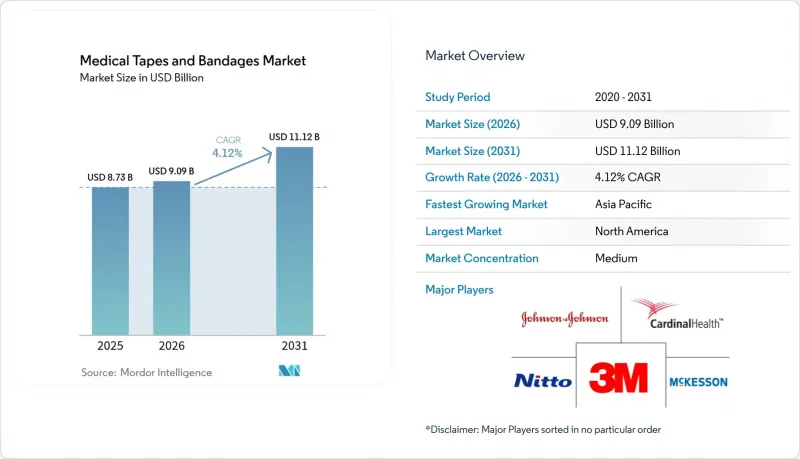
의료용 테이프 및 붕대 시장 규모는 2026년에 90억 9,000만 달러로 추정되고 있어 2025년 87억 3,000만 달러에서 확대해, 2031년에는 111억 2,000만 달러에 이를 것으로 예측됩니다.
2026년부터 2031년까지 연평균 성장률(CAGR) 4.12%로 성장할 것으로 전망됩니다.
본 보고서에서는 업계를 제품 유형(붕대, 테이프), 용도(외과적 상처 치료, 외상성 상처 치료, 궤양 치료 등), 최종 사용자(병원, 진료소, 외래수술센터(ASC) 등), 지역(북미, 유럽, 아시아태평양, 중동 및 아프리카, 남미)별로 분류하고 있습니다. 시장 전망은 금액(달러) 기준으로 제시되어 있습니다.
전 세계 의료용 테이프 및 붕대 시장 동향과 인사이트
전 세계 수술 건수 증가가 수술 후 상처 피복재 수요를 끌어올리고 있습니다.
세계적으로 연간 3억 건 이상의 수술이 이루어지고 있으며, 고령 환자를 대상으로 한 정형외과, 심혈관 및 최소 침습 수술이 증가하고 있습니다. 이러한 수술에는 견고한 수술 전후 드레싱이 필요합니다. 복잡한 절개가 수반되는 경우, 수술 후 치료 비용은 하루에 6,000달러를 초과할 수도 있어, 병원 측에서는 교체 빈도의 과도한 증가를 피하기 위해 최대 7일간 밀봉성을 유지할 수 있는 장기 착용형 테이프를 지정하고 있습니다. 일일 수술센터에서는 탄력 압박 기능을 갖추고 피부를 손상시키지 않고 제거할 수 있는 붕대가 현재 선호되고 있습니다. 당일 퇴원을 실현하기 위해서는 환자의 편안함과 피부 박리가 없어야 하기 때문입니다. 그 결과, 조달 담당자들은 접착력의 지속성과 저알레르기성을 평가 기준의 최우선 순위로 두고 있습니다. 이러한 요건으로 인해 의료용 테이프 및 붕대 시장은 계속해서 확대되고 있습니다.
당뇨병성 족부 궤양 및 욕창을 포함한 만성 상처 유병률 증가
미국에서는 약 670만 명이 치유되지 않는 궤양을 앓으며 생활하고 있으며, 당뇨병성 족부 궤양만 해도 당뇨병 환자의 평생 동안 최대 25%가 이 질환을 앓는 것으로 알려져 있습니다. 만성 상처로 인한 연간 치료비는 미국에서 500억 달러에 달하며, 이는 생물막 형성을 억제하는 은 및 구리 나노 입자가 함유되어 수분 균형을 조절하는 붕대에 대한 수요를 견인하고 있습니다. 임상시험에 따르면, 구리 드레싱을 사용했을 때의 상처 면적 감소율은 87.35%인 반면, 기존의 은 폼을 사용했을 때는 37.02%에 그쳤습니다. 또한, 임상의들은 pH와 온도를 조절하여 미세 환경을 제어하고 육아 조직의 양호한 형성을 가능하게 하는 다층 복합 테이프를 지지하고 있습니다. 이러한 혁신 기술은 측정 가능한 임상 효과를 입증함으로써 의료용 테이프 및 붕대 시장을 뒷받침하고 있습니다.
첨단 드레싱 재료 및 실리콘계 접착 테이프의 높은 비용
스마트 드레싱은 일반 거즈에 비해 단위당 비용이 5-10배 더 비쌀 수 있습니다. 임상 연구에 따르면 폼 드레싱이 치유 기간을 단축함으로써 주당 재료비를 58.6% 절감할 수 있는 것으로 밝혀졌지만(lww.com), 구매 결정 시에는 종종 표시 가격에 중점을 두는 경향이 있습니다. 스페인 한 지역의 감사에 따르면, 3년 동안 1차 의료에서 발생한 상처 치료비는 3,499만 유로(4,016만 달러)에 달했으며, 그중 846만 유로(974만 달러)가 테이프와 붕대에 지출되었습니다(sciencedirect.com). 보상 제도가 제한적인 신흥 시장에서는 이러한 가격 차이를 흡수하기 어려워 도입이 지연되고 있으며, 자원이 부족한 지역의 의료용 테이프 및 붕대 시장 성장이 둔화되고 있습니다. 향후 2년 동안 가치 기반 조달로의 전환이 확산된다면 이러한 제약은 완화될 가능성이 있습니다.
부문 분석
붕대는 2025년 의료용 테이프 및 붕대 시장 매출의 58.72%를 계속 차지하고 있으며, 수술 상처, 열상, 만성 궤양에 대한 일상적인 상처 처치의 기초가 되고 있습니다. 몸에 밀착되는 거즈 롤부터 고압축성 탄성 붕대에 이르기까지, 그 형태적 유연성 덕분에 임상의는 상처의 각 단계에 따라 압박력, 흡수성, 통기성을 조절할 수 있습니다. 기존의 면 거즈는 조달에 있어 익숙한 제품이기 때문에 여전히 널리 보급되어 있지만, 사지 궤양의 삼출액 관리에 있어서는 비스코스나 탄성 필라멘트를 사용한 다층 응집성 드레싱이 주목을 받고 있습니다. 탄성 붕대에 내장된 하이드로겔 함침 패드는 자가 용해성 데브리드먼트에 필수적인 습윤 환경을 유지함으로써 드레싱 교체 빈도를 줄여줍니다. 그 결과, 의료용 테이프 및 붕대 시장에서는 응급, 입원, 재택 치료 등 각 상황에서 붕대가 계속해서 핵심 제품군으로 활용되고 있습니다.
종이 테이프는 매출 비중은 작지만, 저알레르기성 셀룰로오스 섬유와 표피 박리를 최소화하는 순하고 재부착이 가능한 접착제 덕분에 6.02%라는 가장 높은 연평균 성장률(CAGR)을 기록하고 있습니다. 외과 의사들은 피부 손상 위험이 높은 섬세한 안면 절개, 소아의 수액 고정 및 안과용 드레싱에 이 종이 테이프를 선호하여 사용하고 있습니다. 또한, 항균 코팅이 적용된 종이 기판에는 인장 강도를 저하시키지 않으면서 은염이 배합되어, 이 하위 부문은 감염 위험이 높은 병동에서 프리미엄 제품으로서의 입지를 확고히 하고 있습니다. 천 테이프는 정형외과 분야와 같이 통기성보다 인장 강도나 기계적 내구성이 중시되는 상황에서 여전히 중요한 역할을 하고 있습니다. 플라스틱 테이프는 샤워 중에도 사용할 수 있는 오스토미나 카테터 부위와 같이 방수성이 요구되는 틈새 수요를 충족시키고 있습니다. 각 카테고리에서 3M사가 2025년에 출시한 무용제 아크릴계 제품은 제조업체가 지속가능성과 높은 접착력을 어떻게 조화시키고 있는지를 보여주며, 의료용 테이프 및 붕대 시장에서 제품 라인의 차별화를 강화하고 있습니다.
지역별 분석
2025년, 북미는 의료용 테이프 및 붕대 시장을 주도하며 매출 점유율 33.05%를 차지했습니다. 이는 선진적인 보험 환급 제도, 복합 드레싱에 대한 임상의들의 폭넓은 수용, 그리고 신소재를 신속하게 검증하는 견고한 임상시험 인프라에 힘입은 결과입니다. 병원에서는 전자 차트에 실시간 데이터를 전송하는 디지털 드레싱에 대한 시험이 일상적으로 이루어지고 있어, 커넥티드 테이프의 조기 도입이 촉진되고 있습니다. 그러나 자재 부족 및 수지 가격 변동으로 인해 공급망 리스크를 완화하기 위한 현지 생산 노력이 진행되고 있습니다.
유럽은 공적 의료 제도가 친환경 라벨 및 재활용성을 중시하는 입찰 절차를 의무화하고 있어, 신뢰할 수 있는 성장 속도는 여전히 완만한 지역으로 남아 있습니다. 유럽 의료기기 규정(MDR)과 같은 규제 체계는 광범위한 시판 후 조사를 의무화하고 있어, 기업들은 더욱 탄탄한 임상 증거를 제시해야 하는 압박을 받고 있습니다. 그럼에도 불구하고 고령화와 하지 정맥성 궤양의 높은 유병률로 인해 압박 붕대 시스템의 소비는 견조한 추세를 보이고 있습니다. 따라서 제조업체들은 유럽 전역의 입찰에서 승리하고 의료용 테이프 및 붕대 시장에서의 점유율을 유지하기 위해, 지속가능성에 대한 메시지와 입증된 치유 효과를 결합해야 합니다.
연평균 성장률(CAGR) 4.83%를 나타낼 것으로 예측되는 아시아태평양에서는 인프라의 급속한 현대화, 만성 질환 부담 증가, 그리고 국내 의료 기술 제조에 대한 정부의 장려 정책이 나타나고 있습니다. 중국은 현지 조달 할당량을 늘리고 있어, 다국적 브랜드와 지역 의료기기 제조업체 간의 합작 투자가 촉진되고 있습니다. 2025년에 발표된 인도의 전국 상처 관리 지침에서는 당뇨병성 궤양에 대한 저외상성 접착제 및 항균 드레싱이 강조되고 있으며, 공립 병원 전반에 걸쳐 대량 발주 계약이 체결될 전망입니다. 한편, 동남아시아 국가들에서는 외딴 섬의 의료 접근성을 확보하기 위해 원격 의료용 상처 관리 플랫폼이 도입되고 있으며, 저대역폭 네트워크를 통해 데이터를 전송할 수 있는 센서 탑재 테이프에 대한 수요가 확대되고 있습니다. 정책 지원과 제조 역량의 결합으로 아시아태평양은 의료용 테이프 및 붕대 시장의 장기적인 성장 중심지가 되고 있습니다.
기타 혜택:
- 엑셀 형식 시장 예측(ME) 시트
- 3개월간의 애널리스트 지원
자주 묻는 질문
목차
제1장 서론
제2장 조사 방법
제3장 주요 요약
제4장 시장 구도
제5장 시장 규모와 성장 예측
제6장 경쟁 구도
제7장 시장 기회와 향후 전망
JHS 26.09.09According to Mordor Intelligence, medical tapes and bandages market size in 2026 is estimated at USD 9.09 billion, growing from 2025 value of USD 8.73 billion with 2031 projections showing USD 11.12 billion, growing at 4.12% CAGR over 2026-2031.

This report Segments the Industry Into by Product Type (Bandages, Tapes), Application (Surgical Wound Treatment, Traumatic Wound Treatment, Ulcer Treatment, and More), End User (Hospitals, Clinics, Ambulatory Surgical Centers, and More), and Geography (North America, Europe, Asia-Pacific, Middle East and Africa, South America). The Market Forecasts are Provided in Terms of Value (USD).
Global Medical Tapes And Bandages Market Trends and Insights
Rising Global Surgical Volumes Increasing Demand for Post-Operative Wound Dressings
Over 300 million procedures are performed worldwide each year, and aging patients increasingly undergo orthopedic, cardiovascular, and minimally invasive surgeries that require robust peri-operative dressings. Post-operative care can cost more than USD 6,000 per day for complex incisions, prompting hospitals to specify longer-wear tapes that maintain seal integrity for up to seven days to avoid excessive change frequency. Bandages with elastic compression and atraumatic removal are now preferred in ambulatory surgery centers, where same-day discharge hinges on patient comfort and the absence of skin stripping. Consequently, procurement teams place adhesion longevity and hypoallergenic performance at the top of evaluation criteria. These imperatives continue to enlarge the medical tapes and bandages market.
Growing Prevalence of Chronic Wounds, Including Diabetic Foot Ulcers and Pressure Ulcers
Roughly 6.7 million Americans live with non-healing ulcers; diabetic foot ulcers alone will affect up to 25% of diabetes patients during their lifetime. Chronic wounds generate USD 50 billion in annual treatment expenditures in the United States, driving demand for moisture-balancing bandages infused with silver or copper nanoparticles that curb biofilm formation. Clinical trials report 87.35% wound-area reduction from copper dressings versus 37.02% for conventional silver foams. Clinicians also favor layered composite tapes that modulate pH and temperature, enabling micro-environmental control and better granulation tissue development. These innovations bolster the medical tapes and bandages market by demonstrating measurable clinical payoff.
High Cost of Advanced Dressings and Silicone-Based Adhesive Tapes
Smart dressings can cost 5-10 times more per unit than plain gauze. Although clinical studies reveal 58.6% weekly material-cost savings when foam dressings shorten healing time lww.com, purchasing decisions often focus on sticker price. A Spanish regional audit recorded EUR 34.99 (USD 40.16) million in primary-care wound spending across three years, with EUR 8.46 (USD 9.74) million tied to tapes and bandages sciencedirect.com. Emerging markets with limited reimbursement struggle to absorb these premiums, delaying adoption and slowing the medical tapes and bandages market in low-resource settings. Wider transition to value-based procurement may temper this restraint over the next two years.
Other drivers and restraints analyzed in the detailed report include:
- Expansion of Home-Based Wound Care Supported by Telehealth and Self-Care Kits
- Integration of Antimicrobial Agents in Tapes and Bandages
- Clinical Concerns over Medical Adhesive-Related Skin Injury (MARSI)
For complete list of drivers and restraints, kindly check the Table Of Contents.
Segment Analysis
Bandages retained 58.72% of the 2025 medical tapes and bandages market share by revenue and continue to underpin routine wound protocols for surgical sites, lacerations, and chronic ulcers. Their configuration flexibility from conformable gauze rolls to high-compression elastic wraps allows clinicians to tailor pressure, absorbency, and breathability for each wound stage. Traditional cotton gauze remains ubiquitous due to procurement familiarity, but multi-layer cohesive dressings with viscose and elastic filaments are gaining traction for exudate control in limb ulcers. Hydrogel-impregnated pads embedded within elastic bandages reduce dressing change frequency by maintaining moist environments, vital for autolytic debridement. Consequently, the medical tapes and bandages market continues to leverage bandages as the baseline product family across emergency, inpatient, and home settings.
Paper tapes, though accounting for a smaller revenue base, register the strongest 6.02% CAGR thanks to their hypoallergenic cellulose fibers and gentle, repositionable adhesives that minimize epidermal stripping. Surgeons prefer them for delicate facial incisions, pediatric IV fixation, and ophthalmic dressings where skin trauma risk is elevated. Moreover, antimicrobial-coated paper substrates now incorporate silver salts without compromising tensile strength, positioning the sub-segment as a premium offering in infection-prone wards. Fabric tapes maintain relevance where tensile support and mechanical durability trump breathability, as in orthopedics. Plastic tapes fill waterproof niche demands for shower-safe ostomy and catheter sites. Across categories, solvent-free acrylic chemistries launched by 3M in 2025 illustrate how manufacturers are blending sustainability with high adhesion, reinforcing product-line differentiation inside the medical tapes and bandages market.
Complete Report Scope:
- By Product Type
- Bandages
- Gauze Bandages
- Elastic / Compression Bandages
- Cohesive Bandages
- Adhesive Bandages
- Other Specialized Bandages
- Tapes
- Fabric Tapes
- Paper Tapes
- Plastic (PVC/PE) Tapes
- Silicone & Low-Trauma Tapes
- Hydrocolloid & Specialty Tapes
- Bandages
- By Application
- Surgical Wound Treatment
- Traumatic Wound Treatment
- Ulcer Treatment
- Burn Injury Treatment
- Sports Injury Treatment
- Others
- By End User
- Hospitals
- Clinics
- Ambulatory Surgical Centers
- Home Care Settings
- Others
- By Geography
- North America
- United States
- Canada
- Mexico
- Europe
- Germany
- United Kingdom
- France
- Italy
- Spain
- Rest of Europe
- Asia-Pacific
- China
- Japan
- India
- Australia
- South Korea
- Rest of Asia-Pacific
- Middle East & Africa
- GCC
- South Africa
- Rest of Middle East & Africa
- South America
- Brazil
- Argentina
- Rest of South America
- North America
Geography Analysis
North America led the medical tapes and bandages market with 33.05% revenue share in 2025, fueled by advanced reimbursement mechanisms, broad clinician acceptance of composite dressings, and robust clinical-trial infrastructure that validates new materials quickly. Hospitals routinely test digital dressings that send real-time data to electronic medical records, fostering early adoption of connected tapes. Material shortages and fluctuating resin prices, however, have prompted local production initiatives to de-risk supply chains.
Europe remained a dependable yet slower-growing region, with public health systems mandating tender processes emphasizing eco-labels and recyclability. Regulatory frameworks such as the European Medical Device Regulation impose extensive post-market surveillance, pushing companies toward thicker clinical evidence packages. Regardless, aging demographics and high prevalence of venous leg ulcers sustain steady consumption of compression bandage systems. Manufacturers must therefore align sustainability narratives with proven healing benefits to win pan-European tenders, maintaining their share of the medical tapes and bandages market.
Asia-Pacific, projected to advance at a 4.83% CAGR, witnesses rapid infrastructure modernization, rising chronic-disease burden, and government incentives for domestic med-tech manufacturing. China boosts local procurement quotas, prompting joint ventures between multinational brands and provincial device makers. India's national wound-care guidelines published in 2025 emphasize low-trauma adhesives and antimicrobial dressings for diabetic ulcers, opening volume contracts across public hospitals. Southeast Asian nations, meanwhile, adopt telehealth wound platforms to reach remote islands, expanding demand for sensor-enabled tapes capable of transmitting data over low-bandwidth networks. The convergence of policy support and manufacturing capacity places Asia-Pacific at the center of long-term expansion for the medical tapes and bandages market.
List of Companies Covered in this Report:
- 3M
- Johnson & Johnson
- Smiths Group
- Cardinal Health
- Coloplast
- B. Braun
- Nitto Denko
- Hartmann Group
- Henkel
- Mckesson
- BenQ Materials
- Triage Meditech Pvt. Ltd.
- Medline Industries
- Molnlycke Health Care
- Essity
- Derma Sciences
- Winner Medical Co. Ltd.
- Dynarex
- Lohmann & Rauscher
- Avery Dennison Medical
Additional Benefits:
- The market estimate (ME) sheet in Excel format
- 3 months of analyst support
TABLE OF CONTENTS
1 Introduction
- 1.1 Study Assumptions & Market Definition
- 1.2 Scope of the Study
2 Research Methodology
3 Executive Summary
4 Market Landscape
- 4.1 Market Overview
- 4.2 Market Drivers
- 4.2.1 Rising Global Surgical Volumes Increasing Demand for Post-Operative Wound Dressings
- 4.2.2 Growing Prevalence oof Chronic Wounds, Including Diabetic Foot Ulcers and Pressure Ulcers
- 4.2.3 Expansion of Home-Based Wound Care Supported by Telehealth and Self-Care Kits
- 4.2.4 Integration of Antimicrobial Agents in Tapes and Bandages
- 4.2.5 Expansion of Aging Population Worldwide
- 4.2.6 Emergence of Smart, Sensor-Embedded Tapes Enabling Remote Wound Monitoring
- 4.3 Market Restraints
- 4.3.1 High Cost of Advanced Dressings and Silicone-Based Adhesive Tapes
- 4.3.2 Clinical Concerns over Medical Adhesive-Related Skin Injury (MARSI)
- 4.3.3 Increasing Competition from Advanced Wound-Care Products
- 4.3.4 Environmental Sustainability Pressures on Single-Use, and Non-Biodegradable Materials
- 4.4 Porter's Five Forces Analysis
- 4.4.1 Threat of New Entrants
- 4.4.2 Bargaining Power of Buyers
- 4.4.3 Bargaining Power of Suppliers
- 4.4.4 Threat of Substitutes
- 4.4.5 Intensity of Competitive Rivalry
5 Market Size & Growth Forecasts (Value in USD)
- 5.1 By Product Type
- 5.1.1 Bandages
- 5.1.1.1 Gauze Bandages
- 5.1.1.2 Elastic / Compression Bandages
- 5.1.1.3 Cohesive Bandages
- 5.1.1.4 Adhesive Bandages
- 5.1.1.5 Other Specialized Bandages
- 5.1.2 Tapes
- 5.1.2.1 Fabric Tapes
- 5.1.2.2 Paper Tapes
- 5.1.2.3 Plastic (PVC/PE) Tapes
- 5.1.2.4 Silicone & Low-Trauma Tapes
- 5.1.2.5 Hydrocolloid & Specialty Tapes
- 5.1.1 Bandages
- 5.2 By Application
- 5.2.1 Surgical Wound Treatment
- 5.2.2 Traumatic Wound Treatment
- 5.2.3 Ulcer Treatment
- 5.2.4 Burn Injury Treatment
- 5.2.5 Sports Injury Treatment
- 5.2.6 Others
- 5.3 By End User
- 5.3.1 Hospitals
- 5.3.2 Clinics
- 5.3.3 Ambulatory Surgical Centers
- 5.3.4 Home Care Settings
- 5.3.5 Others
- 5.4 By Geography
- 5.4.1 North America
- 5.4.1.1 United States
- 5.4.1.2 Canada
- 5.4.1.3 Mexico
- 5.4.2 Europe
- 5.4.2.1 Germany
- 5.4.2.2 United Kingdom
- 5.4.2.3 France
- 5.4.2.4 Italy
- 5.4.2.5 Spain
- 5.4.2.6 Rest of Europe
- 5.4.3 Asia-Pacific
- 5.4.3.1 China
- 5.4.3.2 Japan
- 5.4.3.3 India
- 5.4.3.4 Australia
- 5.4.3.5 South Korea
- 5.4.3.6 Rest of Asia-Pacific
- 5.4.4 Middle East & Africa
- 5.4.4.1 GCC
- 5.4.4.2 South Africa
- 5.4.4.3 Rest of Middle East & Africa
- 5.4.5 South America
- 5.4.5.1 Brazil
- 5.4.5.2 Argentina
- 5.4.5.3 Rest of South America
- 5.4.1 North America
6 Competitive Landscape
- 6.1 Market Concentration
- 6.2 Market Share Analysis
- 6.3 Company Profiles (includes Global level Overview, Market level overview, Core Segments, Financials as available, Strategic Information, Market Rank/Share for key companies, Products & Services, and Recent Developments)
- 6.3.1 3M
- 6.3.2 Johnson & Johnson Services Inc.
- 6.3.3 Smith & Nephew plc
- 6.3.4 Cardinal Health Inc.
- 6.3.5 Coloplast A/S
- 6.3.6 B. Braun SE
- 6.3.7 Nitto Denko Corporation
- 6.3.8 Paul Hartmann AG
- 6.3.9 Henkel AG & Co. KGaA
- 6.3.10 McKesson Corporation
- 6.3.11 BenQ Materials Corporation
- 6.3.12 Triage Meditech Pvt. Ltd.
- 6.3.13 Medline Industries Inc.
- 6.3.14 Molnlycke Health Care AB
- 6.3.15 Essity AB
- 6.3.16 Derma Sciences
- 6.3.17 Winner Medical Co. Ltd.
- 6.3.18 Dynarex Corporation
- 6.3.19 Lohmann & Rauscher GmbH & Co. KG
- 6.3.20 Avery Dennison Medical
7 Market Opportunities & Future Outlook
- 7.1 White-space & Unmet-Need Assessment


