

|
시장보고서
상품코드
2114780
유전자 전달 시스템 시장 : 점유율 분석, 업계 동향과 통계, 성장 예측(2026-2031년)Global Gene Delivery Systems - Market Share Analysis, Industry Trends & Statistics, Growth Forecasts (2026 - 2031) |
||||||
 Mordor Intelligence
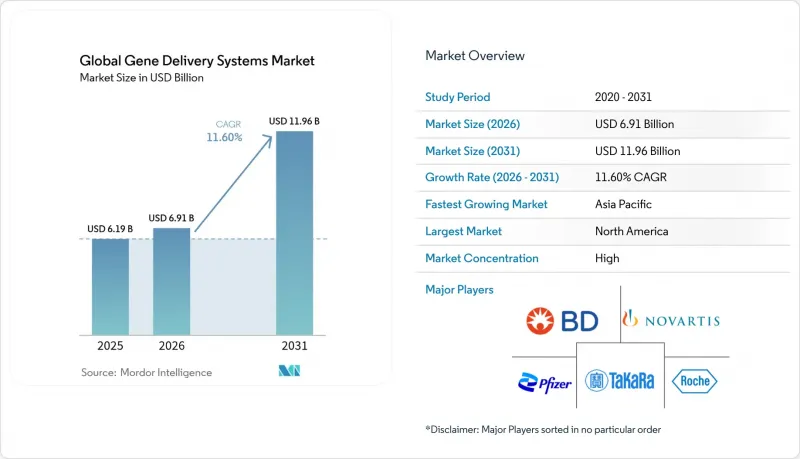
Mordor Intelligence에 의하면, 유전자 전달 시스템 시장 규모는 2025년 61억 9,000만 달러에서 2026년에는 69억 1,000만 달러로 확대되어 2026년부터 2031년까지 CAGR 11.60%로 성장을 지속하여, 2031년에는 119억 6,000만 달러에 이를 것으로 예측됩니다.
본 보고서는 전달 시스템(바이러스성 유전자 전달 시스템 등), 용도(종양학, 감염증 등), 투여 경로(주사제, 경구제 등), 최종 사용자(바이오의약품·유전자 치료 개발 기업 등), 지역(북미, 유럽, 아시아태평양, 중동 및 아프리카, 남미)별로 분류되어 있습니다. 시장 예측은 금액(미 달러) 기준으로 제시되어 있습니다.
전 세계 유전자 전달 시스템 시장 동향 및 인사이트
만성 질환 및 생활습관병의 부담 증가
유전성 질환 및 만성 질환의 유병률 증가로 인해, 평생에 걸친 증상 관리 대신 단 한 번의 분자 수준 교정을 통해 완치를 목표로 하는 근치적 유전자 치료에 대한 수요가 높아지고 있습니다. 겸상 적혈구증은 10만 명의 미국인에게 영향을 미치고 있으며, B형 혈우병은 전 세계 남성 4만 명 중 1명의 비율로 발병하고 있어, 개발 기업들은 지속 가능한 치료법 확립에 주력하고 있습니다. CASGEVY의 주요 임상시험에서는 피험자의 96.7%가 최소 1년 동안 혈관 폐색 위기를 보이지 않은 것으로 나타나, 보다 광범위한 도입을 위한 임상적 및 경제적 근거가 뒷받침되었습니다. 혈액 질환 적응증에서의 성공에 힘입어, 기존 약물 요법으로는 장기적인 효과가 제한적인 심혈관 질환, 대사성 질환, 신경퇴행성 질환에 대한 연구가 가속화되고 있습니다.
바이오의약품 기업의 연구 개발 급속한 진전
주요 제약 그룹들은 로슈와 포세이다의 제휴, 노바티스의 신경계 질환 분야로의 사업 확장 등 각각 10억 달러를 넘는 인수 및 제휴를 통해 유전자 치료 파이프라인을 강화하고 있습니다. AI를 활용한 설계를 통해 벡터 최적화 주기가 단축됨에 따라, 리제네론, 아스트라제네카, CRISPR 테라퓨틱스 등 각사는 여러 생체 내 프로그램을 동시에 추진할 수 있게 되었습니다. 이러한 연구 개발 속도는 CDMO의 확충과 연동되어, 후기 단계 자산에 대한 생산 확장성을 확보하고 있습니다.
고액의 치료비 및 상환 비용
렌멜디의 가격은 425만 달러, CASGEVY는 220만 달러에 달하며, 평생에 걸친 의료경제적 이점이 있음에도 불구하고 지불 주체의 예산을 초과하고 있어 보급이 더딘 상황입니다. 성과 연동형 계약이나 분할 납부 모델은 부담 경감으로 이어지지만, 도입 현황에 편차가 있어 특히 저·중소득 국가에서 접근성 격차가 발생하고 있습니다.
부문 분석
바이러스 기반 플랫폼은 최근 승인을 통해 유효성이 입증된 AAV 벡터를 필두로 2025년 매출의 61.55%를 차지했습니다. 렌티바이러스 기반 시스템은 제조의 복잡성에도 불구하고 체외(ex-vivo) 암 치료 및 헤모글로빈 질환 분야에서 성장하고 있습니다. 비바이러스성 접근법은 90-100%의 포입 효율로 CRISPR 페이로드를 전달하는 지질 나노입자에 힘입어 연평균 성장률(CAGR) 12.98%로 확대되고 있습니다. 바이러스의 정밀도와 합성 소재를 융합한 하이브리드 기술은 제조의 용이성과 규제상의 유연성을 약속합니다. 이러한 동향들이 결합되어 유전자 전달 시스템 시장은 다양한 모달리티로의 전환을 계속하고 있습니다.
제조 능력은 여전히 병목 현상으로 남아 있으며, 업계 조사에 따르면 추가적인 규모 확대가 이루어지지 않는 한 렌티바이러스 계열에서 공급 부족이 발생할 가능성이 있습니다. 이에 대응하여 각 CDMO 기업들은 대용량 일회용 바이오리액터와 사이클 타임을 30% 단축하는 연속 흐름 정제 기술을 도입하여, 바이러스계와 비바이러스계 옵션 간의 비용 격차를 줄이고 있습니다.
2025년 매출액 중 암 분야가 47.62%를 차지하고 있으며, 이는 생존 기간 연장이 입증된 CAR-T 요법과 고형암 유전자 치료가 주도하고 있습니다. 감염병 프로그램은 HIV, 헤르페스, B형 간염에 대한 획기적인 진전으로 연평균 성장률(CAGR) 12.42%로 성장을 지속하고, 있습니다. 심혈관 분야 후보 약물은 cBIN1이 대형 동물 모델에서 30%의 기능 개선을 보임에 따라 개발이 진전되고 있습니다. 당뇨병 및 호흡기 분야 파이프라인에서는 오랜 기간 과제로 남아 있던 약물 전달 문제를 해결하기 위해 흡입형 및 조직 특이적 벡터를 활용하고 있습니다. 희귀질환 포트폴리오는 심사 절차의 신속화 혜택을 받아 다양한 희귀질환에 대한 승인을 촉진하고 있습니다.
지역별 분석
북미는 2025년에 43.21%의 시장 점유율로 1위를 차지하며, 2024년 한 해에만 12건의 FDA 승인을 받았고, 풍부한 벤처 캐피털 자금 및 클러스터에 집적된 인적 자원의 지원을 받고 있습니다. GenScript사의 뉴저지주 2억 2,400만 달러 규모의 ProBio 공장과 후지필름 디오신스사의 노스캐롤라이나주 12억 달러 규모의 거점 등 생산 능력 확충이 국내 제조의 탄력성을 뒷받침하고 있습니다. 유럽은 EMA의 강력한 감독 체제에 힘입어 이를 뒤따르고 있습니다. 론자(Lonza)의 헤렌 공장은 전 세계 CASGEVY 수요를 충족하고 있으며, 승인된 ATMP의 88%가 추가 모니터링 하에 운영되어 시판 후 안전성이 확보되고 있습니다.
아시아태평양은 2031년까지 연평균 성장률(CAGR) 13.46%라는 최고 수준을 기록할 전망입니다. 이는 삼성바이오로직스가 78만 4,000리터의 벡터 생산 능력 확보를 위해 14억 6,000만 달러를 투자하고 있으며, 중국의 바이오의약품 매출액이 2029년까지 1조 4,000억 위안을 넘어설 가능성이 있기 때문입니다. 규제 조화와 현지 투자 우대 조치는 다국적 기업의 임상시험 유치를 촉진하는 동시에 국내 혁신을 촉진하고 있습니다.
중동 및 아프리카 및 남미 지역은 벡터 비용의 하락과 기술 이전의 확대에 따라, 여전히 시장 침투율은 낮지만 장래성은 높은 것으로 평가됩니다. 현재 저·중소득 국가(LMICs)에서 이용 가능한 승인된 치료법은 32건 중 불과 5건에 그치고 있어, 치료의 형평성을 확대하기 위해서는 공동 자금 조달 및 현지 생산의 필요성이 부각되고 있습니다.
기타 혜택:
- 엑셀 형식 시장 예측(ME) 시트
- 3개월간의 애널리스트 지원
자주 묻는 질문
목차
제1장 서론
제2장 조사 방법
제3장 주요 요약
제4장 시장 구도
제5장 시장 규모와 성장 예측
제6장 경쟁 구도
제7장 시장 기회와 향후 전망
JHS 26.08.26According to Mordor Intelligence, the gene delivery systems market size is expected to grow from USD 6.19 billion in 2025 to USD 6.91 billion in 2026 and is forecast to reach USD 11.96 billion by 2031 at 11.60% CAGR over 2026-2031.
This report is Segmented by Delivery Systems (Viral Gene Delivery Systems, and More), Application (Oncology, Infectious Diseases, and More), Route of Administration (Injectable, Oral, and More), End User (Biopharma & Gene-Therapy Developers, and More), and Geography (North America, Europe, Asia-Pacific, Middle East & Africa, South America). The Market Forecasts are Provided in Terms of Value (USD).
Global Gene Delivery Systems Market Trends and Insights
Growing Burden of Chronic & Lifestyle Diseases
Rising prevalence of genetic and chronic disorders fuels demand for curative gene therapies that replace lifelong symptom management with one-time molecular correction. Sickle cell disease affects 100,000 Americans, and hemophilia B impacts 1 in 40,000 males worldwide, motivating developers to pursue durable treatments. CASGEVY's pivotal trial showed 96.7% of recipients free of vaso-occlusive crises for at least one year, validating the clinical and economic rationale for broader deployment. Success in hematologic indications accelerates exploration in cardiovascular, metabolic, and neurodegenerative diseases where conventional pharmacology offers limited long-term benefit.
Rapid R&D Advances by Biopharma Companies
Large pharmaceutical groups intensify gene-therapy pipelines through acquisitions and partnerships exceeding USD 1 billion each, such as Roche-Poseida and Novartis expansions in nervous-system disorders. AI-guided design shortens vector optimization cycles, enabling Regeneron, AstraZeneca, and CRISPR Therapeutics to progress multiple in-vivo programs simultaneously. This R&D velocity aligns with CDMO build-outs, ensuring production scalability for late-stage assets.
High Treatment & Reimbursement Costs
Pricing peaks at USD 4.25 million for Lenmeldy and USD 2.2 million for CASGEVY, out-stripping payer budgets and slowing uptake despite lifetime health-economic benefits. Outcomes-based agreements and installment models offer relief but remain inconsistently adopted, creating access disparities, particularly in low- and middle-income countries.
Other drivers and restraints analyzed in the detailed report include:
- Rising Approvals of Vector-Based Gene Therapies
- Venture and Strategic Funding Inflows
- AI-Driven Vector Design Tools
- Regional CDMO Build-Out of Plasmid Capacity
- Safety / Immune-Response Concerns for Viral Vectors
For complete list of drivers and restraints, kindly check the Table Of Contents.
Segment Analysis
Viral platforms captured 61.55% of 2025 revenue, led by AAV vectors validated in recent approvals. Lentiviral systems grow in ex-vivo oncology and hemoglobinopathies despite production complexity. Non-viral approaches expand at 12.98% CAGR, propelled by lipid nanoparticles delivering CRISPR payloads with 90-100% encapsulation efficiency. Hybrid technologies blending viral precision with synthetic materials promise manufacturability and regulatory flexibility. Collectively, these dynamics sustain the gene delivery systems market's transition toward diversified modalities.
Manufacturing capacity remains a pinch-point; industry surveys reveal potential lentiviral shortfalls without further scale-up. CDMOs respond with large-volume single-use bioreactors and continuous-flow purification that cut cycle times by 30%, narrowing the cost gap between viral and non-viral options.
Oncology held 47.62% of 2025 revenue, driven by CAR-T and solid-tumor gene therapies that demonstrably extend survival. Infectious-disease programs exhibit 12.42% CAGR through breakthroughs against HIV, herpes, and hepatitis B. Cardiovascular candidates advance with cBIN1 showing 30% functional improvement in large-animal models. Diabetes and pulmonary pipelines leverage inhaled and tissue-specific vectors that address longstanding delivery challenges. Orphan-disease portfolios benefit from accelerated review pathways, supporting a diverse set of rare-condition approvals.
Complete Report Scope:
- By Delivery Systems
- Viral Gene Delivery Systems
- Adenoviral Vectors
- Lentiviral Vectors
- Retroviral Vectors
- Other Viral Vectors (AAV, HSV, etc.)
- Non-viral Gene Delivery
- Combined / Hybrid Delivery Systems
- Viral Gene Delivery Systems
- By Application
- Oncology
- Infectious Diseases
- Cardiovascular Disorders
- Diabetes
- Pulmonary Disorders
- Other Applications
- By Route of Administration
- Injectable
- Oral
- Nasal
- Transdermal / Topical
- Other Routes
- By End User
- Biopharma & Gene-therapy Developers
- Contract Manufacturing & CDMOs
- Academic & Research Institutes
- Hospitals & Specialty Clinics
- By Geography
- North America
- United States
- Canada
- Mexico
- Europe
- Germany
- United Kingdom
- France
- Italy
- Spain
- Rest of Europe
- Asia-Pacific
- China
- Japan
- India
- Australia
- South Korea
- Rest of Asia-Pacific
- Middle East & Africa
- GCC
- South Africa
- Rest of Middle East & Africa
- South America
- Brazil
- Argentina
- Rest of South America
- North America
Geography Analysis
North America led with 43.21% market share in 2025, backed by 12 FDA approvals in 2024 alone, deep venture capital pools, and cluster-based talent. Capacity additions like GenScript's USD 224 million ProBio plant in New Jersey and Fujifilm Diosynth's USD 1.2 billion North Carolina site underpin domestic manufacturing resilience. Europe follows with strong EMA oversight; Lonza's Geleen facility supplies global CASGEVY demand, and 88% of approved ATMPs operate under additional monitoring, ensuring post-marketing safety.
Asia-Pacific posts the highest 13.46% CAGR to 2031 as Samsung Biologics invests USD 1.46 billion for 784,000 L of vector capacity and China's biopharmaceutical sales could top 1.4 trillion yuan by 2029. Regulatory harmonization and local investment incentives attract multinational trials while fostering indigenous innovation.
Middle East & Africa and South America remain under-penetrated yet promising as vector costs fall and technology transfers expand. Only 5 of 32 approved therapies are currently accessible in LMICs, underscoring a need for collaborative financing and localized manufacturing to broaden treatment equity.
- Pfizer
- Novartis
- Roche
- Bayer
- Amgen
- Takara Bio
- Beckton Dickinson
- Thermo Fisher Scientific
- Lonza Group
- Catalent
- SIRION Biotech
- Genscript
- Genezen LLC
- Oxford Biomedica plc
- uniQure N.V.
- 4D Molecular Therapeutics
- Sarepta Therapeutics
- Spark Therapeutics
Additional Benefits:
- The market estimate (ME) sheet in Excel format
- 3 months of analyst support
TABLE OF CONTENTS
1 Introduction
- 1.1 Study Assumptions & Market Definition
- 1.2 Scope of the Study
2 Research Methodology
3 Executive Summary
4 Market Landscape
- 4.1 Market Overview
- 4.2 Market Drivers
- 4.2.1 Growing Burden Of Chronic & Lifestyle Diseases
- 4.2.2 Rapid R&D Advances By Biopharma Companies
- 4.2.3 Rising Approvals Of Vector-Based Gene Therapies
- 4.2.4 Surge In Venture & Strategic Funding Inflows
- 4.2.5 Ai-Driven Vector Design & Screening Tools
- 4.2.6 Regional Cdmo Build-Out Of Plasmid Capacity
- 4.3 Market Restraints
- 4.3.1 High Treatment & Reimbursement Costs
- 4.3.2 Safety / Immune-Response Concerns For Viral Vectors
- 4.3.3 Complex Multi-Jurisdiction Regulatory Pathways
- 4.3.4 Scarcity Of GMP-Grade Plasmid Manufacturing Slots
- 4.4 Value / Supply-Chain Analysis
- 4.5 Regulatory Landscape
- 4.6 Technological Outlook
- 4.7 Porter's Five Forces Analysis
- 4.7.1 Threat of New Entrants
- 4.7.2 Bargaining Power of Buyers
- 4.7.3 Bargaining Power of Suppliers
- 4.7.4 Threat of Substitutes
- 4.7.5 Intensity of Competitive Rivalry
5 Market Size & Growth Forecasts (Value)
- 5.1 By Delivery Systems
- 5.1.1 Viral Gene Delivery Systems
- 5.1.1.1 Adenoviral Vectors
- 5.1.1.2 Lentiviral Vectors
- 5.1.1.3 Retroviral Vectors
- 5.1.1.4 Other Viral Vectors (AAV, HSV, etc.)
- 5.1.2 Non-viral Gene Delivery
- 5.1.3 Combined / Hybrid Delivery Systems
- 5.1.1 Viral Gene Delivery Systems
- 5.2 By Application
- 5.2.1 Oncology
- 5.2.2 Infectious Diseases
- 5.2.3 Cardiovascular Disorders
- 5.2.4 Diabetes
- 5.2.5 Pulmonary Disorders
- 5.2.6 Other Applications
- 5.3 By Route of Administration
- 5.3.1 Injectable
- 5.3.2 Oral
- 5.3.3 Nasal
- 5.3.4 Transdermal / Topical
- 5.3.5 Other Routes
- 5.4 By End User
- 5.4.1 Biopharma & Gene-therapy Developers
- 5.4.2 Contract Manufacturing & CDMOs
- 5.4.3 Academic & Research Institutes
- 5.4.4 Hospitals & Specialty Clinics
- 5.5 By Geography
- 5.5.1 North America
- 5.5.1.1 United States
- 5.5.1.2 Canada
- 5.5.1.3 Mexico
- 5.5.2 Europe
- 5.5.2.1 Germany
- 5.5.2.2 United Kingdom
- 5.5.2.3 France
- 5.5.2.4 Italy
- 5.5.2.5 Spain
- 5.5.2.6 Rest of Europe
- 5.5.3 Asia-Pacific
- 5.5.3.1 China
- 5.5.3.2 Japan
- 5.5.3.3 India
- 5.5.3.4 Australia
- 5.5.3.5 South Korea
- 5.5.3.6 Rest of Asia-Pacific
- 5.5.4 Middle East & Africa
- 5.5.4.1 GCC
- 5.5.4.2 South Africa
- 5.5.4.3 Rest of Middle East & Africa
- 5.5.5 South America
- 5.5.5.1 Brazil
- 5.5.5.2 Argentina
- 5.5.5.3 Rest of South America
- 5.5.1 North America
6 Competitive Landscape
- 6.1 Market Concentration
- 6.2 Market Share Analysis
- 6.3 Company Profiles (includes Global level Overview, Market level overview, Core Segments, Financials as available, Strategic Information, Market Rank/Share, Products & Services, Recent Developments)
- 6.3.1 Pfizer Inc.
- 6.3.2 Novartis AG
- 6.3.3 F. Hoffmann-La Roche AG
- 6.3.4 Bayer AG
- 6.3.5 Amgen Inc.
- 6.3.6 Takara Bio Inc.
- 6.3.7 Becton, Dickinson & Company
- 6.3.8 Thermo Fisher Scientific Inc.
- 6.3.9 Lonza Group AG
- 6.3.10 Catalent Inc.
- 6.3.11 Sirion-Biotech GmbH
- 6.3.12 GenScript ProBio
- 6.3.13 Genezen LLC
- 6.3.14 Oxford Biomedica plc
- 6.3.15 uniQure N.V.
- 6.3.16 4D Molecular Therapeutics
- 6.3.17 Sarepta Therapeutics
- 6.3.18 Spark Therapeutics
7 Market Opportunities & Future Outlook
- 7.1 White-space & Unmet-need Assessment


