|
시장보고서
상품코드
2114786
치간 세정 제품 : 시장 점유율 분석, 업계 동향 및 통계, 성장 예측(2026-2031년)Global Interdental Cleansing Products - Market Share Analysis, Industry Trends & Statistics, Growth Forecasts (2026 - 2031) |
||||||
 Mordor Intelligence
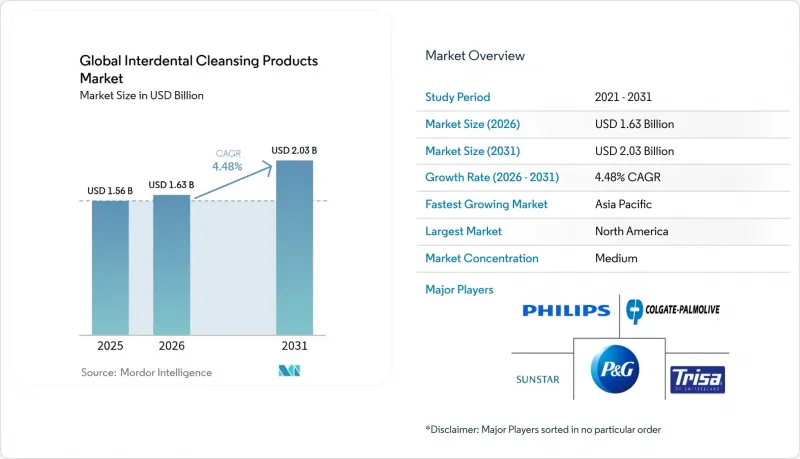
Mordor Intelligence에 의하면, 치간 세정 제품 시장 규모는 2025년 15억 6,000만 달러로 평가되었습니다. 2026년에는 16억 3,000만 달러로 확대되어 2026년부터 2031년에 걸쳐 CAGR 4.48%로 성장을 지속하여, 2031년에는 20억 3,000만 달러에 이를 것으로 예측됩니다.
본 보고서는 유형별(치실, 치간 칫솔, 치간 픽·스틱, 구강 세정기/워터플로서, 기타), 판매 채널별(슈퍼마켓 및 하이퍼마켓, 약국 및 드럭스토어, 기타),지역별(북미, 유럽, 아시아태평양, 남미, 중동 및 아프리카)로 분류되어 있습니다. 시장 예측은 금액(미 달러) 및 수량(단위)으로 제시되어 있습니다.
세계의 치간 세정 제품 시장 동향 및 인사이트
치과 질환 및 치주질환 유병률 증가
세계적으로 볼 때, 충치, 치은염, 치주염 및 치태 축적은 가장 흔한 구강 건강 문제로 꼽힙니다. 2024년 미국 질병통제예방센터(CDC) 보고서에 따르면, 미국 20세에서 64세 성인 중 약 21%가 1개 이상의 영구치에 치료되지 않은 충치를 가지고 있었습니다. 이러한 문제는 대개 불충분한 구강 위생에서 기인하며, 예방 관리,특히 치간 세정의 중요성이 강조되고 있습니다. 진단 건수가 증가함에 따라, 특히 치간 등 일반적인 칫솔질로는 닿지 않는 부위의 청소를 포함한 종합적인 구강 위생의 필요성에 대한 인식이 높아지고 있습니다. 치주병은 현재 가장 광범위하게 유행하는 만성 질환 중 하나로 인식되고 있습니다. 남아시아에서는 그 부담이 가장 크며, 예방 솔루션을 위한 미개척 시장으로 부상하고 있습니다. 치주염과 심혈관 질환 간의 연관성을 보여주는 새로운 과학적 증거가 제시되고 있으며, 이에 따라 의료 시스템은 치간 세정을 단순한 심미적 선택이 아닌, 비용 대비 효과가 높은 예방 조치로 우선시하고 있습니다. 중국에서는 공중보건 프로그램의 일환으로 이미 치실과 치간 칫솔이 국가 구강 보건 캠페인에 포함되었으며, 정책 주도 수요 증가가 두드러지고 있습니다.
전신 건강에서 구강 위생이 차지하는 역할에 대한 소비자의 인식 제고
구강 건강 문제는 전 세계 인구의 거의 절반에 영향을 미치고 있으며, 구강 관리 제품의 잠재적 사용자층을 확대시키고 있습니다. 『2025년 구강 건강 보고서』에 따르면, 세계보건기구(WHO)는 전 세계적으로 약 37억 명이 구강 질환으로 고통받고 있다고 추산하고 있습니다. 소비자 인식 제고 캠페인을 통해 보건 당국은 치간 세정을 구강 관리의 중요한 요소로 정착시키고 있습니다. WHO의 『2023-2030년 세계 구강보건 행동 계획』은 구강보건을 비전염성 질환 예방을 위한 종합적인 전략에 통합함으로써 이러한 변화를 더욱 뒷받침하고 있습니다. 이러한 전략적 접근 방식 덕분에 치간 관리 제품 시장 위상이 높아졌으며, 예방 관리를 중요한 라이프스타일 투자로 인식하는 건강 지향적 소비자들의 관심을 불러일으키고 있습니다. 구강 건강과 당뇨병, 심장병 등 전신 질환 간의 연관성에 대한 인식이 높아짐에 따라, 그동안 관심이 적었던 계층에서도 전문적인 구강 관리 제품의 사용을 촉진하고 있습니다. 치과의사회가 종합적인 구강 건강을 실현하기 위한 치간 세정의 중요성을 강조하는 등, 전문가들의 지지도 이러한 인식을 더욱 강화하고 있습니다. 또한, 의료비 지출이 치료 중심에서 예방 중심으로 지속적으로 전환되고 있는 점도 예방적 구강 관리 카테고리의 성장을 뒷받침하고 있습니다.
고급 치간 세정 기구 및 제품의 높은 가격
전동 치실이나 전용 칫솔 등 첨단 기술이 적용된 프리미엄 제품은 일반적으로 고가대로 책정되어 있습니다. 이러한 높은 가격대는 인구의 상당 부분, 특히 예산이 제한적이거나 가처분 소득이 낮은 지역에 거주하는 사람들에게 장벽이 될 수 있습니다. 그 결과, 이러한 제품의 보급은 여전히 제한적인 수준에 머물러 있습니다. 예를 들어, 50-150달러 가격대의 워터 플로서는 5달러 미만의 기본 치실 제품과 직접 경쟁하고 있습니다. 이러한 현저한 가격 차이는 특히 저소득 국가에서 이러한 제품이 필수품이 아닌 사치품으로 간주되는 경향이 있기 때문에 접근성 측면에서 뚜렷한 문제를 야기하고 있습니다. 그 결과, 이러한 첨단 제품의 임상적 이점이 충분히 입증되었음에도 불구하고, 가격 책정의 불일치가 조기 보급을 저해하고 있습니다. 제한적인 스마트 기능을 탑재한 중가대 모델들이 이러한 가격 격차 해소에 나서기 시작했지만, 제조업체 입장에서는 혁신 파이프라인이 종합적이며 소비자의 경제적 다양성에 대응할 수 있도록 하는 것이 필수적입니다. 그렇게 함으로써 더 폭넓은 이용 기회를 창출하고, 다양한 소득 계층에서의 보급을 촉진할 수 있을 것입니다.
부문별 분석
워터 플로서는 2031년까지 연평균 성장률(CAGR) 6.05%를 달성할 것으로 예측되며, 치간 세정 제품 시장에서 가장 빠르게 성장하는 카테고리로 부상하고 있습니다. 치실은 2025년 매출의 37.02%를 차지했지만, 소비자들이 더 부드럽고 효과적인 치태 제거를 실현하는 첨단 기기를 점점 더 많이 채택함에 따라 그 성장은 정체되고 있습니다. 대조 시험에 따르면, 워터픽 ‘소닉 퓨전’은 수동 칫솔질과 치실을 병행한 경우와 비교하여 2배 더 효율적으로 치태를 제거할 수 있음이 입증되었으며, 이는 건강을 중시하는 소비자층에서 해당 제품의 높은 가격 책정을 뒷받침하고 있습니다. 임플란트나 교정 치료 후 관리에 중요한 역할을 하는 치간 칫솔은 계속해서 안정적인 수요를 유지하고 있는 반면, 생분해성 치간 세정 용품은 일회용 플라스틱 소비를 최소화하고자 하는 환경 의식이 높은 소비자들로부터 지지를 받고 있습니다.
2세대 워터 플로서에는 잇몸의 형태를 매핑하고 최적의 각도를 확보하기 위한 촉각 피드백을 제공할 수 있는 AI 칩이 탑재되었습니다. 또한 연동 앱이 매일의 사용을 게임화함으로써 지속적인 이용을 촉진하고 있습니다. 이러한 혁신을 통해 구매 빈도가 증가하고 브랜드 충성도가 강화되며, 데이터에 기반한 제품 개선의 선순환이 형성되고 있습니다. 한편, 히알루론산이 함유된 칫솔이나 마이크로폼 픽 등을 포함하는 ‘기타’ 카테고리는 임상 적용에서 측정 가능한 치주질환 개선 효과를 보이는 특정 증상에 특화된 혁신적인 제품에 대한 시장 수요를 반영하고 있습니다.
지역별 분석
2025년, 북미는 전 세계 매출의 35.12%를 차지하며 시장 내 리더십 위치를 공고히 했습니다. 이러한 우위는 광범위한 치과 보험 적용 범위와 치간 관리 도구 사용을 빈번히 권장하는 적극적인 임상의 문화에 의해 뒷받침되고 있습니다. 이 지역은 엄격하면서도 지원적인 FDA 지침으로부터 큰 혜택을 받고 있으며, 이를 통해 혁신 기업들은 신제품의 개량판에 대한 510(k) 신청 절차를 신속하게 진행할 수 있어, 북미가 경쟁력 있는 얼리 어답터로서의 우위를 점할 수 있게 되었습니다. 또한, 인구 고령화가 진행되고 있으며, 그중 70%가 치주질환을 앓고 있기 때문에 치료용 치실기와 구강 세정기는 단순한 라이프스타일 제품이라는 위치에서 필수적인 건강 관리 도구로 그 위상을 높이고 있습니다.
아시아태평양은 2031년까지 7.18%라는 지역별 최고 연평균 성장률(CAGR)을 달성할 것으로 예측됩니다. 중국에서는 정부 주도의 ‘건강 중국(Healthy China)’ 이니셔티브에 따라 공중보건 교육 과정에 치실 사용 지침이 포함된 것을 배경으로, 워터 플로서 부문이 상당한 성장을 보일 것으로 전망됩니다. 마찬가지로 인도도 예방 의료 솔루션에 대한 투자를 늘리고 있는 중산층의 확대에 힘입어 유사한 성장 궤도를 밟고 있습니다. 또한, 이 지역의 높은 스마트폰 보급률 덕분에 각 브랜드는 소비자 직접 판매형 전자상거래 플랫폼을 활용하여 기존 소매 인프라를 효과적으로 우회하고, 소비자에게 더 효율적으로 접근할 수 있게 되었습니다.
유럽은 성숙한 북미 시장과 아시아태평양에서 나타나는 강력한 성장의 중간 지점에 위치해 있습니다. 이 지역의 엄격한 환경 규제로 인해 생분해성 소모품의 채택이 가속화되고 있으며, 환경 의식이 높은 혁신 기업들에게는 규제 측면의 지원을 통해 경쟁 우위를 확보할 기회가 생기고 있습니다. 통일된 CE 마크 기준 덕분에 해당 지역 내 여러 국가에서 제품을 출시하는 과정이 간소화되었습니다. 그러나 회원국 간의 경제 상황이 다양하기 때문에 소비자의 구매력 차이에 대응하기 위해 단계적인 가격 전략을 시행해야 합니다. 대조적으로, 남미 및 중동 및 아프리카는 현재 시장 발전 측면에서 뒤처져 있지만, 도시 지역에서는 잠재력을 보이고 있습니다. 이 지역들에서는 치과 진료소의 밀도가 높아지고 있으며, 인식 제고 캠페인이 실시되고 있어, 이러한 요인들이 점차 시장 성장을 뒷받침하고 있습니다.
기타 혜택 :
- 엑셀 형식 시장 예측(ME) 시트
- 3개월간의 애널리스트 지원
자주 묻는 질문
목차
제1장 서론
제2장 조사 방법
제3장 주요 요약
제4장 시장 구도
제5장 시장 규모 및 성장 예측
제6장 경쟁 구도
제7장 시장 기회 및 향후 전망
KTH 26.08.28According to Mordor Intelligence, the interdental cleansing products market size is expected to grow from USD 1.56 billion in 2025 to USD 1.63 billion in 2026 and is forecast to reach USD 2.03 billion by 2031 at 4.48% CAGR over 2026-2031.
This report is Segmented by Type (Dental Floss, Interdental Brushes, Interdental Picks and Sticks, Oral Irrigators/Water Flossers, and Other), Distribution Channel (Supermarkets/Hypermarkets, Pharmacy and Drug Stores, and More), and by Geography (North America, Europe, Asia-Pacific, South America, and Middle East and Africa). The Market Forecasts are Provided in Terms of Value (USD) and Volume (Units).
Global Interdental Cleansing Products Market Trends and Insights
Increasing prevalence of dental disorders and periodontal diseases
Globally, dental caries (cavities), gingivitis, periodontitis, and plaque buildup are among the most common oral health issues. In 2024, the Centers for Disease Control and Prevention reported that approximately 21% of adults aged 20-64 in the United States had untreated decay in one or more permanent teeth. These issues often result from inadequate oral hygiene, emphasizing the importance of preventive care, particularly interdental cleaning. With an increasing number of diagnoses, there is growing awareness of the need for comprehensive oral hygiene, especially for cleaning areas that regular brushing cannot reach, such as between teeth. Periodontal disease is now recognized as one of the most widespread chronic conditions. South Asia experiences the highest burden, making it a largely untapped market for preventive solutions. Emerging scientific evidence links periodontal inflammation to cardiovascular diseases, prompting healthcare systems to prioritize interdental cleaning as a cost-effective preventive measure rather than a cosmetic option. In China, public health programs have already incorporated flossing and interdental brushes into national oral health campaigns, highlighting policy-driven growth in demand.
Growing consumer awareness of oral hygiene's role in overall health
Oral health issues affect nearly half the global population, broadening the potential user base for oral care products. As per the Oral Health Report 2025, the World Health Organization estimates that around 3.7 billion people worldwide grapple with oral diseases. Through consumer education campaigns, health authorities have established interdental cleaning as a critical component of oral care. The WHO's Global Oral Health Action Plan 2023-2030 reinforces this shift by integrating oral health into comprehensive strategies for noncommunicable disease prevention. This strategic approach elevates the market positioning of interdental products, driving interest among health-conscious consumers who now perceive preventive care as a key lifestyle investment. Growing awareness of the connection between oral health and systemic conditions, such as diabetes and heart disease, has spurred adoption of specialized oral care products, even among previously uninterested demographic groups. Professional endorsements further strengthen this awareness, with dental associations emphasizing the importance of interdental cleaning in achieving comprehensive oral health. Additionally, the ongoing transition in healthcare spending from treatment-focused to prevention-focused practices continues to support growth in preventive oral care categories.
High cost of premium interdental cleaning devices and products
Premium products, which often incorporate advanced technologies such as powered flossers and specialized brushes, are typically priced at a premium. This higher price point can act as a barrier for a significant portion of the population, particularly for individuals with constrained budgets or those living in regions characterized by lower disposable incomes. As a result, the widespread adoption of these products remains limited. For instance, water flossers priced in the range of USD 50-150 face direct competition from basic floss options that cost less than USD 5. This stark price disparity creates notable affordability challenges, particularly in low-income economies, where such products may be perceived as a luxury rather than a necessity. Consequently, this mismatch in pricing limits early adoption, even when the clinical benefits of these advanced products are well-documented. Although mid-tier models with a limited set of smart features have started to address this affordability gap, it is imperative for manufacturers to ensure that their innovation pipelines are inclusive and cater to the economic diversity of their consumer base. By doing so, they can foster broader accessibility and drive adoption across various income segments.
Other drivers and restraints analyzed in the detailed report include:
- Heightened emphasis on aesthetic oral care and cosmetic dentistry
- Rising demand for sustainable and eco-friendly interdental products
- Limited dental visits for product education
For complete list of drivers and restraints, kindly check the Table Of Contents.
Segment Analysis
Water flossers are projected to achieve a 6.05% CAGR through 2031, emerging as the fastest-growing category within the interdental cleansing products market. Although dental floss accounts for 37.02% of 2025 sales, its growth is leveling off as consumers increasingly adopt advanced devices that offer gentler and more effective plaque removal. Controlled trials demonstrate that the Waterpik Sonic-Fusion removes plaque twice as efficiently as manual brushing combined with string flossing, supporting its premium pricing among health-focused consumers. Interdental brushes, valued for their role in implant and orthodontic after-care, continue to experience stable demand, while biodegradable floss options appeal to environmentally-conscious shoppers aiming to minimize single-use plastic consumption.
Second-generation water flossers now feature AI chips capable of mapping gum topography and delivering haptic feedback to ensure optimal angulation, while companion apps gamify daily usage to enhance compliance. This innovation drives higher purchase frequency and strengthens brand loyalty, fostering a cycle of data-driven product improvements. Meanwhile, the "others" category, which includes hyaluronic-acid brushes and micro-foam picks, reflects the market's demand for condition-specific innovations that demonstrate measurable periodontal benefits in clinical applications.
Complete Report Scope:
- By Product Type
- Dental Floss
- Interdental Brushes
- Interdental Picks and Sticks
- Oral Irrigators/Water Flossers
- Others
- By Distribution Channel
- Supermarkets/Hypermarkets
- Pharmacy and Drug Stores
- Online Retail Stores
- Dental Clinics and Specialty Stores
- Others
- By Geography
- North America
- United States
- Canada
- Mexico
- Rest of North America
- Europe
- United Kingdom
- Germany
- Spain
- France
- Italy
- Russia
- Rest of Europe
- Asia-Pacific
- China
- India
- Japan
- Australia
- Rest of Asia-Pacific
- South America
- Brazil
- Argentina
- Rest of South America
- Middle East and Africa
- Saudi Arabia
- South Africa
- Rest of Middle East and Africa
- North America
Geography Analysis
In 2025, North America contributed 35.12% of global revenue, firmly establishing its leadership position in the market. This dominance is driven by extensive dental insurance coverage and a proactive clinician culture that frequently recommends the use of interdental tools. The region benefits significantly from stringent yet supportive FDA guidelines, which enable innovators to expedite 510(k) submissions for new device iterations, providing North America with a competitive early-adopter advantage. Additionally, the ageing population, of which 70% is affected by periodontal disease, has elevated the status of therapeutic flossers and irrigators from optional lifestyle products to indispensable healthcare tools.
The Asia-Pacific region is projected to achieve the fastest regional CAGR of 7.18% through 2031. In China, the water-flosser category is expected to experience substantial growth, supported by government-led "Healthy China" initiatives that integrate flossing education into public health curricula. Similarly, India is following a comparable trajectory, driven by a growing middle class that is increasingly investing in preventive healthcare solutions. Furthermore, the high penetration of smartphones in the region enables brands to leverage direct-to-consumer e-commerce platforms, effectively bypassing traditional retail infrastructure and reaching consumers more efficiently.
Europe occupies a middle ground between the mature North American market and the dynamic growth observed in Asia-Pacific. The region's stringent environmental regulations are accelerating the adoption of biodegradable consumables, creating opportunities for eco-conscious innovators to gain a competitive edge through regulatory support. Unified CE-mark protocols simplify the process of launching products across multiple countries within the region. However, the economic diversity among member states necessitates the implementation of tiered pricing strategies to address varying consumer purchasing power. In contrast, South America and the Middle East and Africa, while currently trailing in market development, are showing potential in urban centers. These areas are witnessing increased dental clinic density and the implementation of awareness campaigns, which are gradually driving market growth.
- Procter & Gamble Company
- Colgate-Palmolive Company
- Koninklijke Philips N.V.
- Sunstar Americas, Inc.
- TRISA AG
- DENTALPRO Co., Ltd.
- TePe Munhygienprodukter AB
- CURADEN AG
- DenTek Oral Care, Inc.
- Tandex A/S
- Prestige Consumer Healthcare Inc.
- Erskine Products Pty Limited
- Ebnat AG
- Peri-dent Ltd.
- Lion Corporation
- SangA E-clean Co., Ltd.
- M+C Schiffer GmbH
- Sanderson MacLeod, Inc.
- Schaefer Dental Group
- Venture Life Group plc
Additional Benefits:
- The market estimate (ME) sheet in Excel format
- 3 months of analyst support
TABLE OF CONTENTS
1 INTRODUCTION
- 1.1 Study Assumptions and Market Definition
- 1.2 Scope of the Study
2 RESEARCH METHODOLOGY
3 EXECUTIVE SUMMARY
4 MARKET LANDSCAPE
- 4.1 Market Overview
- 4.2 Market Drivers
- 4.2.1 Increasing prevalence of dental disorders and periodontal diseases
- 4.2.2 Growing consumer awareness of oral hygienes role in overall health
- 4.2.3 Heightened emphasis on aesthetic oral care and cosmetic dentistry
- 4.2.4 Rising demand for sustainable and eco-friendly interdental products
- 4.2.5 Endorsements from dental professionals promoting interdental cleaning
- 4.2.6 Technological advancements in interdental cleaning devices and flossers
- 4.3 Market Restraints
- 4.3.1 High cost of premium interdental cleaning devices and products
- 4.3.2 Limited dental visits for product education
- 4.3.3 Inconsistent product standardization across interdental cleaning tools
- 4.3.4 Competition from low-cost traditional and generic interdental alternatives
- 4.4 Supply Chain Analysis
- 4.5 Regulatory Outlook
- 4.6 Porters Five Forces
- 4.6.1 Threat of New Entrants
- 4.6.2 Bargaining Power of Buyers/Consumers
- 4.6.3 Bargaining Power of Suppliers
- 4.6.4 Threat of Substitute Products
- 4.6.5 Intensity of Competitive Rivalry
5 MARKET SIZE AND GROWTH FORECASTS (VALUE)
- 5.1 By Product Type
- 5.1.1 Dental Floss
- 5.1.2 Interdental Brushes
- 5.1.3 Interdental Picks and Sticks
- 5.1.4 Oral Irrigators/Water Flossers
- 5.1.5 Others
- 5.2 By Distribution Channel
- 5.2.1 Supermarkets/Hypermarkets
- 5.2.2 Pharmacy and Drug Stores
- 5.2.3 Online Retail Stores
- 5.2.4 Dental Clinics and Specialty Stores
- 5.2.5 Others
- 5.3 By Geography
- 5.3.1 North America
- 5.3.1.1 United States
- 5.3.1.2 Canada
- 5.3.1.3 Mexico
- 5.3.1.4 Rest of North America
- 5.3.2 Europe
- 5.3.2.1 United Kingdom
- 5.3.2.2 Germany
- 5.3.2.3 Spain
- 5.3.2.4 France
- 5.3.2.5 Italy
- 5.3.2.6 Russia
- 5.3.2.7 Rest of Europe
- 5.3.3 Asia-Pacific
- 5.3.3.1 China
- 5.3.3.2 India
- 5.3.3.3 Japan
- 5.3.3.4 Australia
- 5.3.3.5 Rest of Asia-Pacific
- 5.3.4 South America
- 5.3.4.1 Brazil
- 5.3.4.2 Argentina
- 5.3.4.3 Rest of South America
- 5.3.5 Middle East and Africa
- 5.3.5.1 Saudi Arabia
- 5.3.5.2 South Africa
- 5.3.5.3 Rest of Middle East and Africa
- 5.3.1 North America
6 COMPETITIVE LANDSCAPE
- 6.1 Market Concentration
- 6.2 Strategic Moves
- 6.3 Market Ranking Analysis
- 6.4 Company Profiles (includes Global-level Overview, Market-level Overview, Core Segments, Financials (if available), Strategic Information, Market Rank/Share, Products and Services, Recent Developments)
- 6.4.1 Procter & Gamble Company
- 6.4.2 Colgate-Palmolive Company
- 6.4.3 Koninklijke Philips N.V.
- 6.4.4 Sunstar Americas, Inc.
- 6.4.5 TRISA AG
- 6.4.6 DENTALPRO Co., Ltd.
- 6.4.7 TePe Munhygienprodukter AB
- 6.4.8 CURADEN AG
- 6.4.9 DenTek Oral Care, Inc.
- 6.4.10 Tandex A/S
- 6.4.11 Prestige Consumer Healthcare Inc.
- 6.4.12 Erskine Products Pty Limited
- 6.4.13 Ebnat AG
- 6.4.14 Peri-dent Ltd.
- 6.4.15 Lion Corporation
- 6.4.16 SangA E-clean Co., Ltd.
- 6.4.17 M+C Schiffer GmbH
- 6.4.18 Sanderson MacLeod, Inc.
- 6.4.19 Schaefer Dental Group
- 6.4.20 Venture Life Group plc