|
시장보고서
상품코드
2114809
카페시타빈 시장 : 점유율 분석, 업계 동향과 통계, 성장 예측(2026-2031년)Capecitabine - Market Share Analysis, Industry Trends & Statistics, Growth Forecasts (2026 - 2031) |
||||||
 Mordor Intelligence
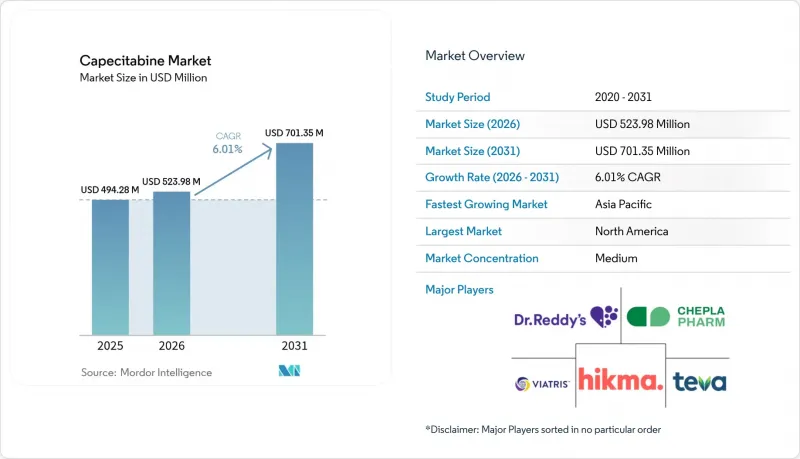
Mordor Intelligence에 의하면, 카페시타빈 시장 규모는 2025년 4억 9,428만 달러에서 2026년에는 5억 2,398만 달러로 확대되어 2026년부터 2031년까지 CAGR 6.01%로 성장을 지속하여, 2031년에는 7억 135만 달러에 이를 것으로 예측됩니다.
본 보고서는 적응증(유방암, 대장암, 위암 등), 유통 채널(병원, 소매 및 온라인 약국 등), 제형(150mg 정, 500mg 정), 제제 형태(브랜드 의약품 및 제네릭), 지역(북미, 유럽, 아시아태평양 등)별로 분류되어 있습니다. 시장 예측은 금액(미 달러) 기준으로 제시되어 있습니다.
전 세계 카페시타빈 시장 동향 및 인사이트
전 세계적으로 증가하는 암 발병률
세계보건기구(WHO) 보고서에 따르면, 전 세계 암 환자 수는 2050년까지 3,500만 명에 달하여 현재 수준보다 77% 증가할 것으로 예측됩니다. 카페시타빈의 주요 적응증인 대장암 및 유방암은 이러한 증가 추세에서 상당한 비중을 차지하고 있으며, 경구용 플루오로피리미딘 계열 약물의 치료 대상 범위를 확대되고 있습니다. 저·중소득 국가에서는 의료기관의 39%가 여전히 종합적인 종양학 서비스를 갖추고 있지 않지만, 물류 측면에서의 편의성과 낮은 인프라 요건 덕분에 경구 요법은 정맥 주사 요법의 실용적인 대안으로 간주되고 있습니다. 또한, 선진국에서의 고령화 진행도 삶의 질(QOL)을 유지할 수 있는 저독성 외래 치료법의 채택을 뒷받침하고 있습니다. 이러한 역학적 요인들이 결합되어 카페시타빈 시장은 장기적으로 꾸준한 성장을 이루고 있습니다.
정부의 암 대책 강화
정부 지출을 통해 공중보건상의 우선 과제로서 암 대책의 중요성이 계속해서 높아지고 있습니다. 미국에서는 의회 주도 의학 연구 프로그램(Congressionally Directed Medical Research Program)이 2025년에 암 연구에 6억 5,000만 달러를 배정하여 기초 연구와 접근성 지원책 모두에 자금을 제공합니다. 유럽의 유사한 노력은 공급 보장을 위한 핵심 원료의약품(API)의 국내 생산 복귀를 뒷받침하고 있습니다. 경구용 항암제에 대한 보조금과 원격 암 진료의 확대가 맞물려, 선진국 및 신흥 시장 모두에서 재택 치료가 확산되고 있습니다. 이러한 정책들은 보험 급여의 확실성을 높이고, 급성기 의료 현장을 넘어선 유통 경로를 촉진함으로써 카페시타빈 시장에 유리한 환경을 조성하고 있습니다.
다주기 카페시타빈의 높은 총 치료 비용
제네릭 의약품이 시장에 진입한 후에도 수개월에 걸친 누적 치료비는 보험 미가입 환자나 공적 보험 가입자에게 부담이 될 수 있습니다. 많은 의료 제도에서 경구용 약물과 정맥 주사약의 보험 적용에 여전히 격차가 존재하여, 임상적 동등성이 입증되었음에도 불구하고 그 보급을 제한하고 있습니다. 메디케어 파트 D의 본인 부담금 상한을 설정하는 최근 미국 법에 따라 이러한 균형은 변화할 가능성이 있으나, 중기적인 전망은 여전히 각국의 보험 지급 제도 개혁의 영향을 받기 쉬운 상황입니다.
부문 분석
2025년, 대장암은 카페시타빈 시장 규모의 45.02%를 차지하고, 보조 요법 및 전이성 질환 모두에서 가이드라인에서 권장하는 CAPOX 프로토콜에 힘입고 있습니다. 지속적인 5-플루오로우라실 정맥 주입과의 임상적 동등성에 더해, 편의성 면에서의 우위가 지속적인 수요를 뒷받침하고 있습니다. 췌장암은 현재로서는 절대적인 규모가 작지만, 외과적 절제술 후 젬시타빈-카페시타빈 병용 요법 등에서 카페시타빈의 유효성을 뒷받침하는 증거가 증가하고 있어, 2031년까지 연평균 성장률(CAGR) 7.22%를 기록할 전망입니다.
면역요법을 병용한 치료 전략에 대한 관심이 높아짐에 따라, 카페시타빈은 대장암의 1차 치료제라는 범위를 넘어 틈새 시장의 확대가 예상됩니다. 연구자 주도 임상시험에서는 식도암 및 담도암에 대한 적용도 검토되고 있어, 카페시타빈 시장의 추가적인 확대를 시사하고 있습니다. 이러한 새로운 적응증에 대해 규제 당국의 승인을 받게 되면, 다중 적응증으로서의 입지가 더욱 공고해질 것입니다.
2025년에는 3차 의료기관에 병설된 종양 클리닉 덕분에 병원이 카페시타빈 시장 점유율의 52.90%를 차지했습니다. 의사와 약국의 협력을 통해 병원 내 조제 및 복약 순응도를 면밀히 모니터링할 수 있게 되어, 의료기관의 우위가 더욱 강화되고 있습니다. 그러나 의료 시스템이 재처방 시 편의성과 지리적 서비스 범위를 개선하는 옴니채널 전략을 추진함에 따라, 소매 약국 및 온라인 약국의 점유율은 연평균 8.33%씩 증가할 것으로 전망됩니다.
의료 시스템 내의 의료와 통합된 조제 모델은 외부 약국에 비해 고가의 경구용 항암제 환자 부담 비용을 낮게 억제하는 것으로 나타났습니다. 전문 약국은 상담 및 재정 지원을 통해 환자 지원을 더욱 강화하고 있습니다. 그 결과, 판매 채널의 다양화는 중복성을 가져와, 국지적인 공급 부족 시에도 카페시타빈 시장 전체의 회복력을 높이고 있습니다.
지역별 분석
북미에서는 의료와 통합된 조제 체계를 포함한 확립된 암 의료 인프라 덕분에 카페시타빈의 안정적인 확보와 보험 환급이 보장되고 있습니다. 이 지역의 높은 대장암 유병률은 수요를 안정화시키고 있는 반면, 고령의 췌장암 환자들 사이에서 메트로노믹 요법의 보급 확대는 수요가 더욱 증가할 가능성을 시사하고 있습니다. 국내 공급 부족에 대비한 제약사들은 계약 개발·제조 기관(CDMO)과 제휴하여 완충 재고를 유지하고 있습니다.
아시아태평양의 성장세는 진단 능력과 일반 대중의 인식이 급속히 향상된 데 기인합니다. 대규모 검진 캠페인을 통해 대장암과 위암이 조기에 발견되고 있으며, 환자들은 치료상 편의성을 제공하는 경구 요법 치료 경로로 유도되고 있습니다. 현지 원료의약품(API) 공장에 대한 설비 투자 비용을 보전해 주는 정부의 보조금은 외부 공급 충격에 대한 취약성을 완화하고, 카페시타빈 시장의 지속적인 성장을 가속하고 있습니다.
유럽의 국민건강보험 제도는 공평한 접근을 촉진하고 있지만, 엄격한 의약품 안전성 감시 기준으로 인해 치료 시작 전 유전자형 분석 및 치료제 모니터링이 요구되어 치료 과정이 다소 장기화되고 있습니다. 지역 제조업체들은 유럽연합(EU)의 지속가능성 목표에 부합하기 위해 제조 공정의 집약화와 친환경 화학(그린 케미스트리) 노력에 투자하고 있으며, 이러한 노력은 장기적으로 수출 경쟁력 강화로 이어질 가능성이 있습니다.
기타 혜택:
- 엑셀 형식 시장 예측(ME) 시트
- 3개월간의 애널리스트 지원
자주 묻는 질문
목차
제1장 서론
제2장 조사 방법
제3장 주요 요약
제4장 시장 구도
제5장 시장 규모와 성장 예측
제6장 경쟁 구도
제7장 시장 기회와 향후 전망
JHSAccording to Mordor Intelligence, the capecitabine market size is expected to grow from USD 494.28 million in 2025 to USD 523.98 million in 2026 and is forecast to reach USD 701.35 million by 2031 at 6.01% CAGR over 2026-2031.
This report is Segmented by Indication (Breast Cancer, Colorectal Cancer, Gastric Cancer, and More), Distribution Channel (Hospitals, Retail & Online Pharmacies, and More), Dosage Strength (150 Mg Tablets and 500 Mg Tablets), Formulation (Branded and Generic), and Geography (North America, Europe, Asia-Pacific, and More). The Market Forecasts are Provided in Terms of Value (USD).
Global Capecitabine Market Trends and Insights
Escalating Global Cancer Incidence
The World Health Organization reports that worldwide cancer cases will reach 35 million by 2050, a 77% jump over current levels. Colorectal and breast cancers-two leading uses of capecitabine-feature prominently in this uptrend, widening the treatment pool for oral fluoropyrimidines. Low- and middle-income countries, where 39% of facilities still lack comprehensive oncology services, view oral regimens as practical substitutes for infusion therapy thanks to simpler logistics and lower infrastructure demands. Ageing demographics in industrialised nations also favour less-toxic outpatient modalities that permit quality-of-life preservation. These converging epidemiological factors steadily support long-term capecitabine market growth.
Intensifying Government Oncology Initiatives
Government spending continues to elevate oncology on public-health agendas. In the United States, the Congressionally Directed Medical Research Program allocated USD 650 million to cancer research in 2025, funding both discovery and access schemes. Similar commitments in Europe underpin reshoring of critical APIs to safeguard supply. Subsidies for oral chemotherapy, coupled with tele-oncology expansion, expand home-based treatment footprints in both developed and emerging markets. These policies create a supportive environment for the capecitabine market by boosting reimbursement certainty and promoting distribution channels beyond acute-care settings.
High Total Treatment Cost of Multi-Cycle Capecitabine
Even after generic entry, cumulative therapy costs over several months can burden uninsured patients and public payers. Coverage disparities between oral and infusion drugs persist in many systems, limiting uptake despite documented clinical parity. Recent US legislation capping Medicare Part D out-of-pocket spending may shift that balance, yet the mid-term outlook remains sensitive to national reimbursement reforms.
Other drivers and restraints analyzed in the detailed report include:
- Rapid Generic Penetration Post-Xeloda Patent Expiry
- Patient Preference for Oral & Home-Based Chemotherapy
- Hand-Foot Syndrome Limiting Adherence & Dosage
For complete list of drivers and restraints, kindly check the Table Of Contents.
Segment Analysis
Colorectal cancer generated 45.02% of capecitabine market size in 2025, sustained by guideline-endorsed CAPOX protocols across adjuvant and metastatic settings. Clinical parity with continuous 5-fluorouracil infusions and superior convenience underpin durable demand. Pancreatic malignancies, though currently smaller in absolute terms, are set to log a 7.22% CAGR through 2031 as evidence mounts for capecitabine's benefit in combination regimens such as gemcitabine-capecitabine following surgical resection.
Growing interest in immunotherapy-augmented strategies positions capecitabine for niche expansion beyond first-line colorectal applications. Investigator-initiated studies are also exploring esophageal and biliary cancers, signalling incremental broadening of the capecitabine market. Regulatory approvals in these additional disease states would reinforce its multi-indication footprint.
Hospitals captured 52.90% of capecitabine market share in 2025 thanks to oncology clinics embedded in tertiary centres. Physician-pharmacy integration allows on-site dispensing and close adherence monitoring, reinforcing institutional dominance. Nevertheless, retail and online pharmacies are set to rise 8.33% annually as health-systems pursue omni-channel strategies that improve refill convenience and geographic reach.
Medically integrated dispensing models inside health-systems have been shown to offer lower out-of-pocket prices on high-cost oral oncology drugs compared with external stores. Specialty pharmacies further bolster patient support through counselling and financing assistance. Consequently, channel diversification provides redundancy that strengthens overall capecitabine market resilience during localised shortages.
Complete Report Scope:
- By Indication
- Colorectal Cancer
- Breast Cancer
- Gastric Cancer
- Pancreatic Cancer
- Other Cancers
- By Distribution Channel
- Hospitals
- Oncology Clinics / Clinical Laboratories
- Retail & Online Pharmacies
- Others
- By Dosage Strength
- 150 mg Tablets
- 500 mg Tablets
- By Formulation
- Branded
- Generic
- Geography
- North America
- United States
- Canada
- Mexico
- Europe
- Germany
- United Kingdom
- France
- Italy
- Spain
- Rest of Europe
- Asia-Pacific
- China
- Japan
- India
- South Korea
- Australia
- Rest of Asia-Pacific
- Middle East and Africa
- GCC
- South Africa
- Rest of Middle East and Africa
- South America
- Brazil
- Argentina
- Rest of South America
- North America
Geography Analysis
North America's entrenched oncology infrastructure, complete with medically integrated dispensing, ensures dependable access and reimbursement for capecitabine. The region's high prevalence of colorectal cancer keeps demand stable, while expanding use of metronomic dosing in elderly pancreatic-cancer patients outlines incremental upside. Manufacturers hedging against domestic shortages are partnering with contract development and manufacturing organisations to maintain buffer inventory.
Asia-Pacific's momentum stems from rapid improvements in diagnostic capacity and public awareness. Large-scale screening campaigns are identifying colorectal and gastric cancers earlier, bringing patients into treatment corridors where oral regimens offer logistical convenience. Government grants that offset capital costs for local API plants reduce vulnerability to external supply shocks, fostering sustainable growth in the capecitabine market.
Europe's universal health systems facilitate equitable access, yet stringent pharmacovigilance standards demand upfront genotyping and therapeutic-drug-monitoring, slightly lengthening the treatment pathway. Regional manufacturers are investing in process intensification and green-chemistry initiatives to align with European Union sustainability goals, actions that may translate into competitive export positions over the long term.
- CHEPLAPHARM Arzneimittel GmbH
- Teva Pharmaceutical Industries
- Viatris (Mylan)
- Hikma Pharmaceuticals
- Cipla
- Dr Reddy's Laboratories
- Fresenius
- Intas Pharmaceuticals
- Sun Pharmaceuticals Industries
- Armas Pharmaceuticals
- Accord Healthcare
- Aurobindo Pharma
- Apotex
- Lupin
- Sandoz Group
- Glenmark Pharma
- Torrent Pharmaceuticals
- Zydus Lifesciences
- Strides Pharma
- Polpharma
Additional Benefits:
- The market estimate (ME) sheet in Excel format
- 3 months of analyst support
TABLE OF CONTENTS
1 Introduction
- 1.1 Study Assumptions & Market Definition
- 1.2 Scope of the Study
2 Research Methodology
3 Executive Summary
4 Market Landscape
- 4.1 Market Overview
- 4.2 Market Drivers
- 4.2.1 Escalating Global Cancer Incidence
- 4.2.2 Intensifying Government Oncology Initiatives
- 4.2.3 Rapid Generic Penetration Post-Xeloda Patent Expiry
- 4.2.4 Patient Preference For Oral & Home-Based Chemotherapy
- 4.2.5 Uptake In Immunotherapy Combination Regimens (MSI-H)
- 4.2.6 Emerging Metronomic Dosing Adoption In LMIC Palliative Care
- 4.3 Market Restraints
- 4.3.1 High Total Treatment Cost Of Multi-Cycle Capecitabine
- 4.3.2 Hand-Foot Syndrome Limiting Adherence & Dosage
- 4.3.3 API Supply Shortages & Manufacturing Disruptions
- 4.3.4 Mandatory DPD-Deficiency Genetic Testing Delays
- 4.4 Supply-Chain Analysis
- 4.5 Porter's Five Forces Analysis
- 4.5.1 Threat of New Entrants
- 4.5.2 Bargaining Power of Buyers
- 4.5.3 Bargaining Power of Suppliers
- 4.5.4 Threat of Substitutes
- 4.5.5 Intensity of Competitive Rivalry
5 Market Size & Growth Forecasts (Value, USD)
- 5.1 By Indication
- 5.1.1 Colorectal Cancer
- 5.1.2 Breast Cancer
- 5.1.3 Gastric Cancer
- 5.1.4 Pancreatic Cancer
- 5.1.5 Other Cancers
- 5.2 By Distribution Channel
- 5.2.1 Hospitals
- 5.2.2 Oncology Clinics / Clinical Laboratories
- 5.2.3 Retail & Online Pharmacies
- 5.2.4 Others
- 5.3 By Dosage Strength
- 5.3.1 150 mg Tablets
- 5.3.2 500 mg Tablets
- 5.4 By Formulation
- 5.4.1 Branded
- 5.4.2 Generic
- 5.5 Geography
- 5.5.1 North America
- 5.5.1.1 United States
- 5.5.1.2 Canada
- 5.5.1.3 Mexico
- 5.5.2 Europe
- 5.5.2.1 Germany
- 5.5.2.2 United Kingdom
- 5.5.2.3 France
- 5.5.2.4 Italy
- 5.5.2.5 Spain
- 5.5.2.6 Rest of Europe
- 5.5.3 Asia-Pacific
- 5.5.3.1 China
- 5.5.3.2 Japan
- 5.5.3.3 India
- 5.5.3.4 South Korea
- 5.5.3.5 Australia
- 5.5.3.6 Rest of Asia-Pacific
- 5.5.4 Middle East and Africa
- 5.5.4.1 GCC
- 5.5.4.2 South Africa
- 5.5.4.3 Rest of Middle East and Africa
- 5.5.5 South America
- 5.5.5.1 Brazil
- 5.5.5.2 Argentina
- 5.5.5.3 Rest of South America
- 5.5.1 North America
6 Competitive Landscape
- 6.1 Market Concentration
- 6.2 Market Share Analysis
- 6.3 Company Profiles (includes Global level Overview, Market level overview, Core Segments, Financials as available, Strategic Information, Market Rank/Share for key companies, Products & Services, and Recent Developments)
- 6.3.1 CHEPLAPHARM Arzneimittel GmbH
- 6.3.2 Teva Pharmaceuticals
- 6.3.3 Viatris (Mylan)
- 6.3.4 Hikma Pharmaceuticals
- 6.3.5 Cipla Ltd
- 6.3.6 Dr Reddy's Laboratories
- 6.3.7 Fresenius Kabi
- 6.3.8 Intas Pharmaceuticals
- 6.3.9 Sun Pharma
- 6.3.10 Armas Pharmaceuticals
- 6.3.11 Accord Healthcare
- 6.3.12 Aurobindo Pharma
- 6.3.13 Apotex
- 6.3.14 Lupin Ltd
- 6.3.15 Sandoz AG
- 6.3.16 Glenmark Pharma
- 6.3.17 Torrent Pharma
- 6.3.18 Zydus Lifesciences
- 6.3.19 Strides Pharma
- 6.3.20 Polpharma
7 Market Opportunities & Future Outlook
- 7.1 White-space & Unmet-Need Assessment