
|
시장보고서
상품코드
2114844
히알루론산 원료 시장 : 점유율 분석, 업계 동향과 통계, 성장 예측(2026-2031년)Hyaluronic Acid Raw Material - Market Share Analysis, Industry Trends & Statistics, Growth Forecasts (2026 - 2031) |
||||||
 Mordor Intelligence
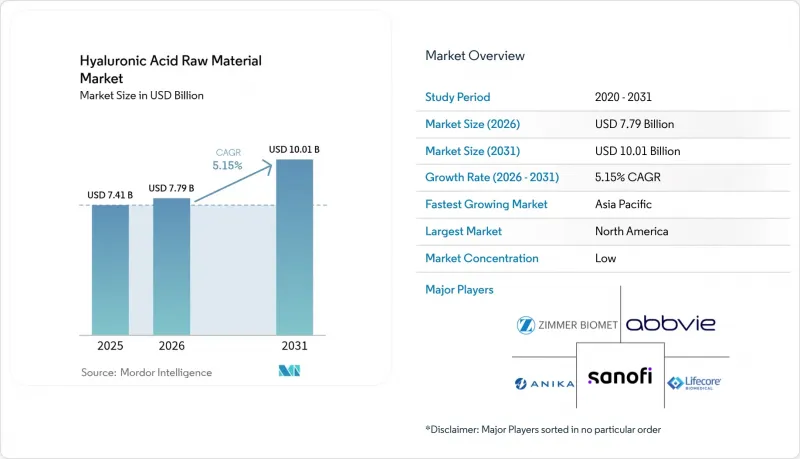
Mordor Intelligence에 의하면, 히알루론산 원료 시장 규모는 2025년에 74억 1,000만 달러로 평가되었고 2026년 77억 9,000만 달러에서 2031년까지 100억 1,000만 달러에 이를 것으로 예측되며, 예측 기간(2026-2031년) CAGR은 5.15%를 나타낼 전망입니다.
본 보고서는 용도별(정형외과, 안과, 약물 전달, 피부과/피부 필러, 기타 용도), 최종 사용자별(병원, 미용 클리닉, 기타 최종 사용자), 원료원별(동물 유래, 미생물 발효), 지역별(북미, 유럽,아시아태평양, 중동 및 아프리카, 남미)로 분류되어 있습니다. 시장 예측은 금액(달러) 기준으로 제시되어 있습니다.
전 세계 히알루론산 원료 시장 동향 및 인사이트
노화 방지 및 저침습 미용 솔루션에 대한 수요 증가
예방적 미용 시술이 소비 패턴을 변화시키고 있으며, 2024년에는 25-35세 환자가 신규 필러 시술의 3분의 1을 차지하여 2019년 수준의 거의 2배에 달하고 있습니다. JUVEDERM VOLUMA XC를 이용한 관자놀이의 볼륨 업 등, 적용 부위의 확대에 따라 시술 대상 영역이 넓어지고, 환자 1인당 연간 필러 사용량도 증가하고 있습니다. 고도의 가교 기술로 제품의 지속 기간이 연장됨에 따라, 내원 빈도 감소를 상쇄할 수 있는 프리미엄 가격 책정이 가능해졌습니다. 소셜 미디어를 통해 은근한 미용 시술이 ‘당연한 일’로 받아들여지게 되면서 편견이 줄어들었고, 금융, 기술, 의료 분야 전문가들 사이에서 시술이 널리 보급되고 있습니다. 그 결과, 젊은 층을 중심으로 한 재방문 고객층이 형성되어 계절에 따른 수익 변동이 완화되었으며, 히알루론산 원료 시장에 있어 예측 가능한 성장 기반이 강화되고 있습니다.
퇴행성 무릎 관절염 치료에서 점탄성 보충 요법의 급속한 확대
현재 점탄성 보충 요법은 인공 슬관절 전치환술을 약 12개월 정도 늦추는 비용 절감의 가교 역할을 하여, 이를 통해 의료비를 절감하고 있습니다. 고분자량 단일 주사는 저용량 다회 투여법에 비해 비열등성이 입증되어, 병원 방문 부담을 줄이고 치료 순응도를 높이고 있습니다. 보험 적용 범위 확대로 인해, 특히 고령화에 따라 퇴행성 관절염 유병률이 높아지고 있는 아시아태평양에서 고정 소득을 가진 고령자들도 이 치료를 받기 쉬워지고 있습니다. 히알루론산에 폴리뉴클레오티드나 나이아신아마이드를 조합한 신규 제제는 뛰어난 진통 효과를 발휘하며, 범용 점탄성 보충제에서 프리미엄 제품으로의 전환을 시사하고 있습니다. 초음파 유도 프로토콜의 보급으로 주입의 정확성과 안전성이 향상되어, 일반 정형외과 의사나 류마티스 전문의가 전문 의료기관으로의 의뢰 없이도 주사를 시행할 수 있게 되었습니다.
의약품 등급 히알루론산(HA)의 높은 비용과 가격 변동
의료용 히알루론산의 원재료 가격은 분자량 및 엔도톡신 한계치에 따라 1kg당 2,000달러에서 6만 달러 범위 내에서 변동하고 있습니다. 초고분자량 제품 생산을 위한 발효 능력이 제한적이어서 수급 불균형이 발생하며, 분기 내에 25% 이상의 현물 가격의 급등이 관찰됩니다. 엔도톡신, 단백질, 핵산 측정을 포함한 품질 보증 시험은 화장품 등급에 비해 제조 비용을 15-20% 가중시키고 있습니다. 특정 치료법의 경우 동물 조직을 이중으로 조달해야 하지만, 높은 가격 책정으로 인해 중복된 공급망을 유지해야 하는 제조업체의 원자재 비용이 상승하고 있습니다. 중소규모 기업은 장기 계약을 체결할 구매력이 부족한 경우가 많아 가격 변동에 취약하며, 그 결과 이익 마진이 압박받고 연구 개발 투자가 저해되고 있습니다.
부문 분석
제제 제조업체들이 CD44 수용체 표적화를 활용하여 항암제의 유효 성분 농도를 높임에 따라, 약물 전달 시스템은 2031년까지 5.72%라는 가장 높은 연평균 성장률(CAGR)을 기록했습니다. 이러한 모멘텀에 힘입어 히알루론산 원료 시장은 제품 개발 주기가 길고 규제 장벽이 높은 전문 치료제로 방향을 전환하고 있습니다. 피부과 및 진피 필러는 2025년 매출의 37.12%를 차지하며, 적응증 확대와 안전성 향상 속에서 이 부문의 견조한 성장세를 보여주고 있습니다.
피부과 분야는 여전히 소비자 인식 측면에서 중심적인 위치를 차지하고 있지만, 종양학, 정형외과, 안과 적응증에 대한 지속적인 투자로 매출 구성이 다양화되고 있습니다. 정형외과 분야의 점탄성 보충 요법은 1회 주사형으로 전환되고 있으며, 이는 편의성 향상과 내원 횟수 감소에 대한 수요가 증가하고 있음을 보여줍니다. 안과 분야의 파이프라인에는 고액의 보험 급여가 인정되는 구조적 치료법이 추가되었습니다. 약물 방출형 젤에서 재생의학용 스캐폴드에 이르기까지, 치료 영역을 아우르는 시너지 효과가 가격 결정력을 뒷받침하고 제품의 수명 주기를 연장하고 있으며, 이를 통해 제조업체는 연구 개발비를 여러 적응증에 걸쳐 상각할 수 있게 되었습니다.
지역별 분석
2025년에는 북미가 매출의 43.10%를 차지하며 1위를 차지했습니다. 이는 점탄성 보충 요법에 대한 확립된 보험 급여 체계와 프리미엄 필러의 높은 보급률에 힘입은 결과입니다. FDA의 우호적인 승인 절차 덕분에 새로운 안과 및 정형외과용 의료기기의 신속한 시장 확대가 촉진되고 있습니다.
아시아태평양은 규제 당국의 기준 조화와 중산층 소비자들의 저침습 미용 시술에 대한 수용도가 높아짐에 따라 2031년까지 연평균 성장률(CAGR) 6.28%로 가장 높은 성장률을 기록할 전망입니다. 2024년 중국 국가약품감독관리국(NMPA)이 필러 ‘Algeness VL’을 승인한 것은 차별화된 제제에 대한 규제 당국의 개방적인 태도를 보여줍니다. 일본에서는 점탄성 보충 요법이 국민건강보험 적용 대상이 됨에 따라 치료 대상층이 더욱 확대되고 있습니다.
유럽은 여전히 지속가능성의 선구자이며, 비건 인증과 용매 미사용 제조 공정이 높이 평가받고 있습니다. 엄격한 MDR(의료기기 규정) 체제는 성숙한 품질 관리 시스템을 갖춘 기존 기업에 유리하게 작용하여 경쟁 우위를 강화하고 있습니다. 남미에서는 경제 안정화에 따라 수요가 상승 추세를 보이고 있으며, 중동 시장에서는 의료 관광이 활기를 띠고 있습니다. 아프리카에서는 도시 지역의 클리닉들이 콜드체인 문제를 피할 수 있는 비용 대비 효과가 높은 드라이 파우더 필러를 채택함에 따라, 싹트기 시작한 수요가 탄력을 받고 있습니다.
기타 혜택:
- 엑셀 형식 시장 예측(ME) 시트
- 3개월간의 애널리스트 지원
자주 묻는 질문
목차
제1장 목차-세계의 히알루론산 원료 시장
제2장 서론
제3장 조사 방법
제4장 주요 요약
제5장 시장 구도
제6장 시장 규모와 성장 예측
제7장 경쟁 구도
제8장 시장 기회와 향후 전망
JHS 26.08.26According to Mordor Intelligence, the hyaluronic acid raw material market size was valued at USD 7.41 billion in 2025 and estimated to grow from USD 7.79 billion in 2026 to reach USD 10.01 billion by 2031, at a CAGR of 5.15% during the forecast period (2026-2031).
This report is Segmented by Application (Orthopedics, Ophthalmology, Drug Delivery, Dermatology/Dermal Fillers, Other Applications), End User (Hospitals, Cosmetic Clinics, Other End Users), Source (Animal-Derived, Microbial Fermentation), and Geography (North America, Europe, Asia-Pacific, Middle East & Africa, South America). The Market Forecasts are Provided in Terms of Value (USD).
Global Hyaluronic Acid Raw Material Market Trends and Insights
Rising Demand for Anti-Ageing and Minimally-Invasive Aesthetic Solutions
Preventative aesthetics have reshaped consumption patterns, with patients aged 25-35 accounting for one-third of new filler procedures in 2024, nearly double the 2019 level . Broader anatomical approvals such as temple augmentation with JUVEDERM VOLUMA XC increase treatment zones and elevate annual filler volumes per patient . Advanced cross-linking prolongs product residence time, permitting premium pricing that offsets reduced visit frequency. Social-media normalization of subtle refinements reduces stigma and drives procedural uptake among professionals in finance, technology, and healthcare. The net effect is a younger, recurring client base that lessens seasonal revenue swings, reinforcing a predictable growth foundation for the hyaluronic acid raw material market.
Rapid Growth of Viscosupplementation in Knee-Osteoarthritis Therapy
Viscosupplementation now serves as a cost-saving bridge delaying total knee arthroplasty by roughly 12 months, thereby lowering healthcare expenditures. Single high-molecular-weight injections have demonstrated non-inferiority to multiple low-dose regimens, cutting visit burden and boosting adherence. Expanded insurance coverage makes therapy accessible to seniors on fixed incomes, particularly in Asia-Pacific where aging demographics lift osteoarthritis prevalence. Novel formulations that combine hyaluronic acid with polynucleotides or niacinamide deliver superior pain relief, signaling a premium shift from commodity viscosupplements. Widespread adoption of ultrasound-guided protocols enhances placement precision and safety, enabling general orthopedists and rheumatologists to offer injections without referral to specialized centers.
High Product Cost and Price Volatility of Pharmaceutical-Grade HA
Medical-grade hyaluronic acid commands raw-material prices ranging from USD 2,000 to USD 60,000 per kg, depending on molecular weight and endotoxin limits. Limited fermentation capacity for ultra-high-molecular-weight streams leads to supply-demand imbalances and spot price spikes exceeding 25% within a quarter. Quality-assurance testing-including endotoxin, protein, and nucleic-acid assays-adds 15-20% to production expenses relative to cosmetic grades. Dual sourcing from animal tissues remains necessary for certain therapies, but premium pricing elevates input cost for manufacturers that must maintain redundant supply chains. Small-to-mid-size firms often lack the purchasing power to secure long-term contracts, amplifying exposure to price swings that compress margins and inhibit R&D investment.
Other drivers and restraints analyzed in the detailed report include:
- Expanding Ophthalmic Applications
- Shift Toward Fermentation-Based, Vegan-Certified Production
- Emergence of Cross-Linked Dry-Powder HA for Improved Shelf-Life
- Adverse Reactions and Regulatory Scrutiny on Injectable Fillers
For complete list of drivers and restraints, kindly check the Table Of Contents.
Segment Analysis
Drug-delivery systems generated the fastest 5.72% CAGR through 2031 as formulators exploit CD44 receptor targeting to enhance chemotherapeutic payload concentration. This momentum steers the hyaluronic acid raw material market toward specialized therapeutics with longer product-development cycles and higher regulatory barriers. Dermatology and dermal fillers retained 37.12% of 2025 revenue, demonstrating the segment's resilience amid broadening anatomic indications and safety upgrades.
Dermatology remains central to consumer awareness; however, sustained investments in oncologic, orthopedic, and ophthalmic indications diversify the revenue mix. Orthopedic viscosupplementation shifts toward single-injection formats, illustrating demand for convenience and reduced clinic visits. Ophthalmic pipelines add structural treatments that command premium reimbursement. Cross-therapeutic synergies-from drug-eluting gels to regenerative scaffolds-support pricing power and lengthen product life cycles, enabling manufacturers to amortize R&D costs across multiple indications.
Complete Report Scope:
- By Application
- Orthopedics (Viscosupplements)
- Ophthalmology
- Drug Delivery
- Dermatology / Dermal Fillers
- Other Applications
- By End User
- Hospitals
- Cosmetic Clinics
- Other End Users
- By Source
- Animal-derived
- Microbial Fermentation
- By Geography
- North America
- United States
- Canada
- Mexico
- Europe
- Germany
- United Kingdom
- France
- Italy
- Spain
- Rest of Europe
- Asia-Pacific
- China
- Japan
- India
- Australia
- South Korea
- Rest of Asia-Pacific
- Middle East & Africa
- GCC
- South Africa
- Rest of Middle East & Africa
- South America
- Brazil
- Argentina
- Rest of South America
- North America
Geography Analysis
North America led with 43.10% revenue in 2025, supported by entrenched reimbursement frameworks for viscosupplementation and high adoption of premium fillers. Favorable FDA pathways encourage quick scaling of novel ophthalmic and orthopedic devices.
Asia-Pacific will post the fastest 6.28% CAGR through 2031 as regulators harmonize standards and middle-class consumers embrace minimally invasive aesthetics. China's NMPA approval of the Algeness VL filler in 2024 illustrates regulatory openness to differentiated formulations . Japan's universal healthcare coverage of viscosupplementation further enlarges the therapeutic base.
Europe remains a sustainability vanguard, rewarding vegan-certified and solvent-free manufacturing. Strict MDR regimes favor incumbents with mature quality systems, reinforcing competitive moats. South America shows upticks linked to economic stabilization, while Middle Eastern markets leverage medical tourism. Africa's nascent demand gains momentum as urban clinics adopt cost-effective dry-powder fillers that circumvent cold-chain gaps.
- Bloomage Biotechnology Corp. Ltd.
- Kewpie Corporation
- FocusChem Biotech Co. Ltd.
- Contipro a.s.
- Seikagaku
- Abbvie
- Anika Therapeutics
- Sanofi
- Roche
- Bausch Health
- Zimmer Biomet
- Smiths Group
- Galderma
- Lifecore Biomedical
- LG Life Sciences
- Fidia Farmaceutici
- Huaxi Biotech
- Alcon
Additional Benefits:
- The market estimate (ME) sheet in Excel format
- 3 months of analyst support
TABLE OF CONTENTS
1 Table of Contents - Global Hyaluronic Acid Raw Material Market
2 Introduction
- 2.1 Study Assumptions & Market Definition
- 2.2 Scope of the Study
3 Research Methodology
4 Executive Summary
5 Market Landscape
- 5.1 Market Overview
- 5.2 Market Drivers
- 5.2.1 Rising Demand For Anti-Ageing & Minimally-Invasive Aesthetic Solutions
- 5.2.2 Rapid Growth Of Viscosupplementation In Knee-Osteoarthritis Therapy
- 5.2.3 Expanding Ophthalmic Applications
- 5.2.4 Shift Toward Fermentation-Based, Vegan-Certified Production
- 5.2.5 Emergence Of Cross-Linked Dry-Powder HA For Improved Shelf-Life
- 5.2.6 Use Of HA As Bio-Scaffold In 3-D Bioprinting & Tissue Engineering
- 5.3 Market Restraints
- 5.3.1 High Product Cost & Price Volatility Of Pharmaceutical-Grade HA
- 5.3.2 Adverse Reactions And Regulatory Scrutiny On Injectable Fillers
- 5.3.3 Supply-Chain Risk From Limited Fermentation Capacity In China
- 5.3.4 Environmental Concerns Over Solvent-Intensive Cross-Linking Processes
- 5.4 Value / Supply-Chain Analysis
- 5.5 Regulatory Landscape
- 5.6 Technological Outlook
- 5.7 Porter's Five Forces
- 5.7.1 Threat of New Entrants
- 5.7.2 Bargaining Power of Buyers
- 5.7.3 Bargaining Power of Suppliers
- 5.7.4 Threat of Substitutes
- 5.7.5 Intensity of Competitive Rivalry
6 Market Size & Growth Forecasts (Value)
- 6.1 By Application
- 6.1.1 Orthopedics (Viscosupplements)
- 6.1.2 Ophthalmology
- 6.1.3 Drug Delivery
- 6.1.4 Dermatology / Dermal Fillers
- 6.1.5 Other Applications
- 6.2 By End User
- 6.2.1 Hospitals
- 6.2.2 Cosmetic Clinics
- 6.2.3 Other End Users
- 6.3 By Source
- 6.3.1 Animal-derived
- 6.3.2 Microbial Fermentation
- 6.4 By Geography
- 6.4.1 North America
- 6.4.1.1 United States
- 6.4.1.2 Canada
- 6.4.1.3 Mexico
- 6.4.2 Europe
- 6.4.2.1 Germany
- 6.4.2.2 United Kingdom
- 6.4.2.3 France
- 6.4.2.4 Italy
- 6.4.2.5 Spain
- 6.4.2.6 Rest of Europe
- 6.4.3 Asia-Pacific
- 6.4.3.1 China
- 6.4.3.2 Japan
- 6.4.3.3 India
- 6.4.3.4 Australia
- 6.4.3.5 South Korea
- 6.4.3.6 Rest of Asia-Pacific
- 6.4.4 Middle East & Africa
- 6.4.4.1 GCC
- 6.4.4.2 South Africa
- 6.4.4.3 Rest of Middle East & Africa
- 6.4.5 South America
- 6.4.5.1 Brazil
- 6.4.5.2 Argentina
- 6.4.5.3 Rest of South America
- 6.4.1 North America
7 Competitive Landscape
- 7.1 Market Concentration
- 7.2 Market Share Analysis
- 7.3 Company Profiles (includes Global level Overview, Market level overview, Core Segments, Financials as available, Strategic Information, Market Rank/Share for key companies, Products & Services, and Recent Developments)
- 7.3.1 Bloomage Biotechnology Corp. Ltd.
- 7.3.2 Kewpie Corporation
- 7.3.3 FocusChem Biotech Co. Ltd.
- 7.3.4 Contipro a.s.
- 7.3.5 Seikagaku Corporation
- 7.3.6 AbbVie Inc. (Allergan)
- 7.3.7 Anika Therapeutics Inc.
- 7.3.8 Sanofi (Genzyme)
- 7.3.9 F. Hoffmann-La Roche Ltd.
- 7.3.10 Bausch Health Companies Inc.
- 7.3.11 Zimmer Biomet
- 7.3.12 Smith & Nephew PLC
- 7.3.13 Galderma SA
- 7.3.14 Lifecore Biomedical LLC
- 7.3.15 LG Life Sciences
- 7.3.16 Fidia Farmaceutici S.p.A.
- 7.3.17 Huaxi Biotech
- 7.3.18 Alcon Inc.
8 Market Opportunities & Future Outlook
- 8.1 White-space & Unmet-Need Assessment