|
시장보고서
상품코드
2114867
압축기 오일 시장 : 시장 점유율 분석, 업계 동향 및 통계, 성장 예측(2026-2031년)Compressor Oil - Market Share Analysis, Industry Trends & Statistics, Growth Forecasts (2026 - 2031) |
||||||
 Mordor Intelligence
Mordor Intelligence에 의하면, 압축기 오일 시장 규모는 2025년에 4억 7,413만 리터로 평가되었고, 2026년 4억 9,438만 리터에서 2031년까지 6억 933만 리터에 이를 것으로 예측되며, 예측 기간(2026-2031년) CAGR은 4.27%를 나타낼 전망입니다.
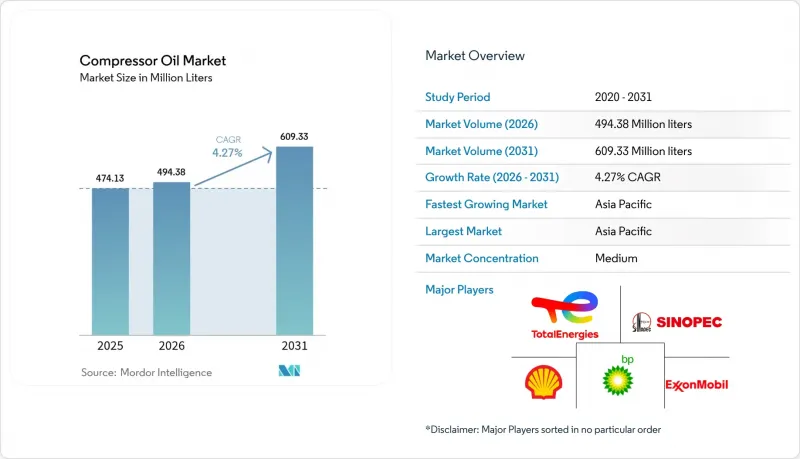
본 보고서는 기유별(합성유, 광물유, 기타 기유), 압축기 유형별(용적식, 동적), 최종 사용자 산업별(제조업, 석유 및 가스, 광업, 기타), 용도별(공기 압축기, 가스 압축기), 지역별(아시아태평양, 북미, 유럽, 남미, 중동 및 아프리카)로 분류되어 있습니다. 시장 예측은 수량(리터) 기준으로 제시되어 있습니다.
세계의 압축기 오일 시장 동향 및 인사이트
제조업 호황이 압축 공기 시스템 수요를 견인
세계적인 산업 자동화의 확산에 따라, 특히 아시아의 생산 거점에서 에너지 소비를 줄이면서 유지보수 비용을 대폭 절감하는 가변 속도 구동 압축기에 대한 수요가 증가하고 있습니다. 2025년 1월에 발효되는 미국 에너지부의 새로운 회전식 공기 압축기 효율 규정에 따라, OEM(원래 장비 제조업체)은 등엔트로피 효율 향상을 의무화받고 있으며, 이는 간접적으로 윤활유의 성능 요건을 높이고 있습니다. IoT(사물 인터넷) 모니터링 플랫폼을 도입한 공장에서는 부하 변동 상황에서도 안정적인 점도와 피막 강도를 유지할 수 있는 오일이 요구되고 있으며, 이로 인해 고품질 합성유로의 전환이 촉진되고 있습니다. 확대될 것으로 예상되는 공기 압축기 판매 대수는 윤활유 소비량과 밀접한 상관관계가 있습니다. 특히, 제조업에 대한 설비 투자가 여전히 견조한 아시아태평양에서는 이러한 경향이 두드러집니다. 압축기 스테이션에서 열회수 모듈의 활용이 확대됨에 따라 윤활유의 평균 온도가 상승하고 있으므로, 장비의 수명을 유지하기 위해 내산화성이 뛰어난 배합이 요구되고 있습니다.
에너지 절약 및 고온 운전을 위한 합성유로의 전환
폴리알파올레핀(PAO)이나 에스테르계 윤활유는 구매 가격은 비싸지만, 오일 교환 주기를 연장함으로써 가동 중지 시간을 단축할 수 있어 주목받고 있습니다. ExxonMobil의 싱가포르 레지드 업그레이드 프로젝트에서는 2025년에 EHC 340 MAX 기유의 가동을 시작할 예정이며, 이를 통해 프리미엄 등급 합성유의 전 세계 공급 안정성이 강화될 것입니다. 로터리 스크류 유닛에서 텅스텐 디설파이드 나노 첨가제를 테스트한 결과, 5%를 초과하는 비에너지 절감 효과가 기록되었으며, 이 성과는 산업 사용자에게 스코프 1 배출량 감축으로 직접 이어집니다. 유럽의 화학물질 등록, 평가, 허가 및 제한에 관한 규정(REACH)은 고황 함량 방향족 성분을 규제하고 있어, 이에 따라 블렌더 각사는 대기질 규제를 충족하는 더 깨끗한 합성 화학물질로 전환해야 하는 상황에 처해 있습니다. 풀러렌 함량이 50ppm 이하인 하이브리드 첨가제 제품이 출시되었으며, 냉매 및 공정용 가스 압축기에서 현저한 마찰 저감 효과가 입증되었습니다. 이에 따라 압축기 오일 시장에서 합성유에 대한 선호도가 더욱 가속화되고 있습니다.
오일 프리 압축기 기술의 보급 확대
제약 및 식품 공장에서는 국제표준화기구(ISO) 8573-1 클래스 0 공기 사양을 충족하고 모든 오염 경로를 배제하기 위해 오일 프리 제품의 도입을 가속화하고 있습니다. 가변 속도 구동 장치와 능동형 자기 베어링을 통해 드라이식 압축기의 신뢰성이 향상되어, 과거에는 윤활식 설계가 주류를 이루던 부문에서도 새로운 전망이 열리고 있습니다. 미쓰비시 전기는 2027년까지 연간 100만 대 생산을 목표로 하는 켄튀르키예주의 히트펌프용 압축기 공장에 1억 4,350만 달러를 투자함으로써, 오일리스 스크롤식 및 로터리식 모델의 규모 확대 가능성을 부각시켰습니다. 철도 화물 운송에서의 검사 운영을 통해 기술적 실현 가능성은 확인되었으나, 이동 중 가동 주기에 따른 열충격이라는 과제가 존재하기 때문에 기관차에서는 여전히 윤활식 유닛이 중요한 역할을 하고 있습니다. 각 사업자들은 높은 설비 투자액과 필터 교체 및 오일 구매 비용 절감을 통한 수명 주기 비용 절감을 저울질하고 있으며, 이는 컴프레서용 오일 시장 규모 성장에 대해 완만하지만 꾸준한 억제요인으로 작용하고 있습니다.
부문 분석
합성유와 관련된 압축기 오일 시장 규모는 2025년 총 물량의 40.92%를 차지했습니다. 이는 뛰어난 내산화성 덕분에 오일 교환 주기가 연장되고, 예기치 못한 가동 중단 시간이 줄어들기 때문입니다. 비용 중심의 환경에서는 광물유가 여전히 수량의 대부분을 차지하고 있지만, 수명 주기 비용의 관점에서 합성유가 우위를 점함에 따라 그 점유율은 축소되고 있습니다. 세미 합성 혼합유는 중간적인 대안으로서, 초기 예산 제약이 여전히 엄격한 반면 신뢰성에 대한 요구가 높아지고 있는 지역에서 수요가 있습니다. 바이오 제품은 생분해성이 의무화된 부문에서 틈새 시장을 확보하고 있지만, 저온 유동성의 한계로 인해 광범위한 대체재로는 자리 잡지 못하고 있습니다.
최종 사용자가 폴리알파올레핀계 기유에 대해 갖는 신뢰는 140 전후로 안정된 점도 지수에서 비롯되며, 자동화 생산 라인에서 흔히 볼 수 있는 115°C의 배기 온도에서도 베어링 막을 보호합니다. 이황화 텅스텐 및 그래핀 플레이트릿을 사용한 나노 첨가제는 열전도율을 향상시켜, 스트레스 테스트 중 섀프 온도를 3°C 낮추고, 정밀 점검 간격(MTBF) 연장 목표를 직접적으로 지원합니다. 엑슨모빌의 싱가포르 확장 계획은 프리미엄 기유 생산 능력을 2만 bpd(일일 배럴) 증대하는 것으로, 합성유 수요가 확대되는 가운데 가격을 안정화하기 위한 공급에 대한 의지를 보여줍니다. 기타 기유 카테고리, 특히 고급 에스테르계 기유는 환경 규제로 인해 차량의 휘발성 유기 화합물(VOC) 배출량 감축이 요구됨에 따라 연평균 성장률(CAGR) 5.18%를 나타낼 것으로 예측됩니다.
로터리 스크류 및 왕복동식 등 용적식 기계는 변동하는 가동 주기 하에서 작동하는 공장의 압축 공기 루프에 널리 보급되어 있어, 2025년 출하량의 64.05%를 차지했습니다. 이러한 시스템에서는 내부의 로터, 기어, 씰을 보호하기 위해 강력한 내마모성과 유화 분리성을 갖춘 윤활유가 필요합니다. 왕복동식 압축기는 스플래시 윤활 또는 압력 윤활 방식으로 작동하며, 크로스헤드 부위의 고온을 견뎌야 하기 때문에 탄소 침전물을 줄이기 위해서는 첨가제의 안정성이 매우 중요합니다.
석유화학 및 액화천연가스(LNG) 분야에서 처리되는 공정 가스의 양이 방대하다는 점을 감안할 때, 주로 원심식 유닛으로 구성된 동적 압축기가 연평균 성장률(CAGR) 5.32%로 가장 빠르게 성장할 것으로 전망됩니다. 유체 동압 베어링의 경우, 연속적인 전부하 운전 조건에서 낮은 발포성과 높은 윤활막 강도가 요구됩니다. 하이브리드형 ‘일체형 기어’ 구조는 용적식 압축기의 특성과 동적 스테이징을 융합하여, 사업자가 턴다운 비율을 확대할 수 있게 해줍니다. 오일 프리 원심식 모델은 윤활유 소비를 완전히 줄여주지만, 많은 고압 라인에서는 고속 운전 조건에서 바니스 발생을 방지하기 위해 특수 배합의 합성유를 사용한 침유 베어링이 채택되고 있습니다.
지역별 분석
아시아태평양은 2025년 전 세계 총 출하량의 37.86%를 차지했으며, 중국의 자동화 추진과 인도의 870억 달러 규모의 석유화학 설비 투자 계획에 힘입어 5.03%라는 가장 높은 연평균 성장률(CAGR)이 예상됩니다. BASF의 100억 유로 규모의 잔장(湛江) 복합 시설이나 SABIC의 64억 달러 규모의 푸젠성 합작 사업 등 현재 진행 중인 메가 프로젝트는 24시간 가동 주기에 대응하기 위한 합성 윤활유에 대한 지속적인 수요를 창출하고 있습니다.
북미에서는 Philips 66(Phillips 66)의 아이언 메사(Iron Mesa) 공장이나 타가 리소시스(Targa Resources)의 퍼미안 분지 통합 네트워크와 같은 셰일가스 처리 시설의 개발로 인해 소비가 크게 증가하고 있습니다. 미국 에너지부(DOE)의 압축기 가이드라인 개정 및 환경보호청(EPA)의 배출량 상한 규제와 같은 규제적 압력으로 인해 합성 윤활유의 채택이 가속화되어, 해당 지역의 압축기 오일 시장을 견인하고 있습니다. 미쓰비시 전기가 켄튀르키예주에 건설 예정인 공장은 오일리스형 히트펌프용 스크롤 유닛의 국내 공급을 확대될 전망이지만, 중공업 부문에서는 여전히 윤활유를 사용하는 산업용 제품이 주류를 차지하고 있습니다.
유럽은 여전히 기술적으로 선진적이며, 엄격한 REACH 규제와 취화 저항성을 갖춘 윤활제의 화학 성분을 규정한 그린 수소 로드맵을 활용하고 있습니다. 푸크스(FUCHS) 등의 제조업체는 바르셀로나에 있는 혼합 설비의 업그레이드와 특수 제품 포트폴리오를 확대하기 위한 인수에 투자하고 있습니다. 남미와 중동 및 아프리카는 공급량 면에서는 뒤처져 있지만, 광업의 확대와 신규 석유화학 사업이 본격화되고 있어 큰 성장 여지가 있습니다. 다만, 단기적으로는 광물유 수요를 유지하기 위한 엄격한 가격 규율 하에 있다는 점은 유의해야 합니다.
기타 혜택
- 엑셀 형식 시장 예측(ME) 시트
- 3개월간의 애널리스트 지원
자주 묻는 질문
목차
제1장 서론
제2장 조사 방법
제3장 주요 요약
제4장 시장 구도
제5장 시장 규모 및 성장 예측
제6장 경쟁 구도
제7장 시장 기회 및 향후 전망
AJY 26.08.28According to Mordor Intelligence, the compressor oil market size was valued at 474.13 Million liters in 2025 and estimated to grow from 494.38 Million liters in 2026 to reach 609.33 Million liters by 2031, at a CAGR of 4.27% during the forecast period (2026-2031).
This report is Segmented by Base Oil (Synthetic, Mineral, and Other Base Oils), Compressor Type (Positive Displacement, and Dynamic), End-User Industry (Manufacturing, Oil and Gas, Mining, and More), Application (Air Compressors and Gas Compressors), and Geography (Asia-Pacific, North America, Europe, South America, and Middle East and Africa). The Market Forecasts are Provided in Terms of Volume (Liters).
Global Compressor Oil Market Trends and Insights
Manufacturing Boom Boosting Compressed-air Systems
Global industrial automation programs lift demand for variable-speed drive compressors that cut energy use while slashing maintenance costs, particularly across Asian production corridors. The United States Department of Energy's new rotary air-compressor efficiency rule, effective January 2025, compels original equipment manufacturers (OEMs) to lift isentropic efficiency, indirectly raising lubricant performance requirements . Factories deploying Internet of Things (IoT) monitoring platforms want oils with viscosity and film strength under fluctuating loads, encouraging migration to premium synthetics. Air compressor sales, forecast to escalate, have a one-to-one correlation with lubricant consumption, especially in the Internet of Things (APAC), where capital investment in manufacturing remains robust. The growing use of heat-recovery modules in compressor stations pushes bulk oil temperatures higher, necessitating oxidation-resistant formulations that preserve equipment life.
Shift to Synthetic Oils for Energy-efficient, High-temperature Operations
Polyalphaolefin (PAO) and ester fluids are gaining traction because longer drain intervals shrink downtime, even though the acquisition price is higher. ExxonMobil's Singapore Resid Upgrade Project will commission EHC 340 MAX basestock in 2025, bolstering global supply security for premium-grade synthetics. Trials of tungsten-disulfide nano-additives in rotary screw units have recorded specific-energy cuts exceeding 5%, a gain that translates directly to lower Scope-1 emissions for industrial users. European Registration, Evaluation, Authorization, and Restriction of Chemicals (REACH) rules restrict high-sulfur aromatic constituents, nudging blenders toward cleaner synthetic chemistries that satisfy air-quality mandates. Hybrid additive packages with fullerene doses below 50 ppm are emerging, demonstrating marked friction reduction in refrigerant and process-gas compressors, which further accelerates the compressor oils market preference for synthetics.
Rising Adoption of Oil-free Compressor Technology
Pharmaceutical and food plants accelerate oil-free purchases to meet International Organization for Standardization (ISO) 8573-1 Class 0 air specs, eliminating any contamination pathway. Variable-speed drives and active-magnetic bearings have lifted the reliability of dry machines, opening prospects in segments once dominated by lubricated designs. Mitsubishi Electric earmarked USD 143.5 million for a Kentucky heat-pump compressor factory targeting 1 million units per year by 2027, underscoring the scale potential for oil-less scroll and rotary models . Rail-freight trials validate technical feasibility, yet mobile duty cycles present thermal-shock hurdles that keep lubricated units relevant in locomotives. Operators weigh higher capex against lifetime savings from filter replacements and oil purchase avoidance, creating a measured but steady drag on volumetric growth in the compressor oils market.
Other drivers and restraints analyzed in the detailed report include:
- Expansion of Oil and Gas Mid-stream Compression Capacity
- Hydrogen Compression Projects Needing Embrittlement-resistant Lubricants
- Crude-linked Volatility in Base-oil Prices
For complete list of drivers and restraints, kindly check the Table Of Contents.
Segment Analysis
The Compressor Oil market size tied to synthetic fluids accounted for 40.92% of the 2025 volume, owing to superior oxidation resistance that extends drain schedules and lowers unscheduled downtime. Mineral oils still hold bulk-volume leadership in cost-sensitive settings, yet their share erodes as lifecycle economics favor synthetics. Semi-synthetic blends offer a midway option and appeal in regions where upfront budget constraints remain acute but reliability demands are rising. Bio-based entrants achieve niche traction where biodegradability mandates exist, although cold-flow limitations restrict widespread substitution.
End-user trust in polyalphaolefin chains stems from consistent viscosity index near 140, safeguarding bearing films at 115°C discharge temperatures common in manufacturing automation lines. Nano-additive work with tungsten-disulfide and graphene platelets enhances thermal conductivity, shaving sump temperatures by 3°C during stress tests, directly supporting higher mean-time-between-overhaul targets. ExxonMobil's Singapore expansion, adding 20,000 bpd (barrels per day) of premium basestock, signals a supply commitment that should stabilize pricing as synthetic demand scales. Other base-oil categories, especially advanced esters, are projected to record a 5.18% CAGR because environmental legislation steers fleets toward lower volatile organic compound (VOC) profiles.
Positive displacement machines, such as rotary screws and reciprocating designs, held 64.05% of 2025 shipments due to ubiquity in factory compressed-air loops that operate under fluctuating duty cycles. These systems require oils with robust anti-wear and demulsibility properties to protect internal rotors, gears, and seals. Reciprocating variants run on splash or pressure feed and endure elevated cross-head temperatures, making additive stability crucial to mitigate carbon deposits.
Given large process-gas volumes in petrochemical and liquefied natural gas (LNG) applications, dynamic compressors, predominantly centrifugal units, will grow the fastest at a 5.32% CAGR. Hydrodynamic bearings demand low foaming potential and high film strength under continuous full-load operation. Hybrid "integrally geared" architectures marry displacement attributes with dynamic staging, enabling operators to broaden turn-down ratios. Although oil-free centrifugal models cut lubricant consumption altogether, many high-pressure lines use flooded bearings where formulated synthetics guard against varnish under high-speed conditions.
Complete Report Scope:
- By Base Oil
- Synthetic
- Mineral
- Other Base Oils (Semi-synthetic, Bio-based, etc.)
- By Compressor Type
- Positive Displacement
- Dynamic
- By Application
- Air Compressors
- Gas Compressors
- By End-user Industry
- Manufacturing
- Chemical and Petrochemical
- Oil and Gas
- Mining
- End-user Industry (HVAC and Refrigeration, etc.)
- By Geography
- Asia-Pacific
- China
- Japan
- India
- South Korea
- ASEAN Countries
- Rest of Asia-Pacific
- North America
- United States
- Canada
- Mexico
- Europe
- Germany
- United Kingdom
- France
- Italy
- Spain
- Russia
- NORDIC Countries
- Rest of Europe
- South America
- Brazil
- Argentina
- Rest of South America
- Middle East and Africa
- Saudi Arabia
- South Africa
- Rest of Middle East and Africa
- Asia-Pacific
Geography Analysis
Asia-Pacific commanded 37.86% of global 2025 volume and is forecast for the highest 5.03% CAGR owing to China's automation push and India's USD 87 billion petrochemical capex pipeline. Ongoing mega-projects such as BASF's EUR 10 billion Zhanjiang complex and SABIC's USD 6.4 billion Fujian venture inject sustained demand for synthetic lubricants to manage 24-hour duty cycles.
North America anchors substantial consumption owing to shale-gas processing developments like Phillips 66's Iron Mesa plant and Targa Resources' integrated Permian Basin network. Regulatory pressure from updated Department of Energy (DOE) compressor guidelines and Environmental Protection Agency (EPA) emissions caps accelerates synthetic adoption and supports the compressor oils market in this region. Mitsubishi Electric's forthcoming Kentucky plant will lift the domestic supply of oil-less heat-pump scroll units, yet lubricated industrial lines still dominate heavy manufacturing.
Europe remains technologically progressive, leveraging stringent REACH limits and a green hydrogen roadmap that specifies embrittlement-resistant lubricant chemistry. Producers like FUCHS invest in Barcelona blending upgrades and acquisitions that broaden specialty portfolios. South America and the Middle East & Africa trail on volume but offer high upside where mining expansion and grassroots petrochemical ventures are ramping, albeit under tighter price discipline that preserves mineral-oil demand in the near term.
- AMSOIL INC.
- BP p.l.c.
- Chevron Corporation
- ENEOS Corporation
- Eurol
- Exxon Mobil Corporation
- FUCHS
- Idemitsu Kosan Co., Ltd.
- LUKOIL
- Petro-Canada Lubricants LLC
- PETRONAS Lubricants International
- Phillips 66 Company
- Quaker Chemical Corporation
- RCS Bio Solutions
- Sasol
- Shell Plc
- Sinopec Lubricant Company
- TotalEnergies
- Valvoline Global Operations
Additional Benefits:
- The market estimate (ME) sheet in Excel format
- 3 months of analyst support
TABLE OF CONTENTS
1 Introduction
- 1.1 Study Assumptions and Market Definition
- 1.2 Scope of the Study
2 Research Methodology
3 Executive Summary
4 Market Landscape
- 4.1 Market Overview
- 4.2 Market Drivers
- 4.2.1 Manufacturing Boom Boosting Compressed-air Systems
- 4.2.2 Shift to Synthetic Oils for Energy-efficient, High-temperature Operations
- 4.2.3 Expansion of Oil and Gas Mid-stream Compression Capacity
- 4.2.4 Hydrogen Compression Projects Needing Embrittlement-Resistant Lubricants
- 4.2.5 Ultra-low-viscosity Polyalphaolefin (PAO) Blends for EV Thermal-management Compressors
- 4.3 Market Restraints
- 4.3.1 Rising Adoption of Oil-free Compressor Technology
- 4.3.2 Crude-linked Volatility in Base-oil Prices
- 4.3.3 Longer Drain-Interval Programs Lowering Lubricant Consumption Intensity
- 4.4 Value Chain Analysis
- 4.5 Porter's Five Forces Analysis
- 4.5.1 Threat of New Entrants
- 4.5.2 Bargaining Power of Buyers
- 4.5.3 Bargaining Power of Suppliers
- 4.5.4 Threat of Substitute Products
- 4.5.5 Degree of Competition
5 Market Size and Growth Forecasts (Volume)
- 5.1 By Base Oil
- 5.1.1 Synthetic
- 5.1.2 Mineral
- 5.1.3 Other Base Oils (Semi-synthetic, Bio-based, etc.)
- 5.2 By Compressor Type
- 5.2.1 Positive Displacement
- 5.2.2 Dynamic
- 5.3 By Application
- 5.3.1 Air Compressors
- 5.3.2 Gas Compressors
- 5.4 By End-user Industry
- 5.4.1 Manufacturing
- 5.4.2 Chemical and Petrochemical
- 5.4.3 Oil and Gas
- 5.4.4 Mining
- 5.4.5 End-user Industry (HVAC and Refrigeration, etc.)
- 5.5 By Geography
- 5.5.1 Asia-Pacific
- 5.5.1.1 China
- 5.5.1.2 Japan
- 5.5.1.3 India
- 5.5.1.4 South Korea
- 5.5.1.5 ASEAN Countries
- 5.5.1.6 Rest of Asia-Pacific
- 5.5.2 North America
- 5.5.2.1 United States
- 5.5.2.2 Canada
- 5.5.2.3 Mexico
- 5.5.3 Europe
- 5.5.3.1 Germany
- 5.5.3.2 United Kingdom
- 5.5.3.3 France
- 5.5.3.4 Italy
- 5.5.3.5 Spain
- 5.5.3.6 Russia
- 5.5.3.7 NORDIC Countries
- 5.5.3.8 Rest of Europe
- 5.5.4 South America
- 5.5.4.1 Brazil
- 5.5.4.2 Argentina
- 5.5.4.3 Rest of South America
- 5.5.5 Middle East and Africa
- 5.5.5.1 Saudi Arabia
- 5.5.5.2 South Africa
- 5.5.5.3 Rest of Middle East and Africa
- 5.5.1 Asia-Pacific
6 Competitive Landscape
- 6.1 Market Concentration
- 6.2 Strategic Moves
- 6.3 Market Share(%)/Ranking Analysis
- 6.4 Company Profiles (includes Global-level Overview, Market-level Overview, Core Segments, Financials as available, Strategic Information, Market Rank/Share, Products and Services, Recent Developments)
- 6.4.1 AMSOIL INC.
- 6.4.2 BP p.l.c.
- 6.4.3 Chevron Corporation
- 6.4.4 ENEOS Corporation
- 6.4.5 Eurol
- 6.4.6 Exxon Mobil Corporation
- 6.4.7 FUCHS
- 6.4.8 Idemitsu Kosan Co., Ltd.
- 6.4.9 LUKOIL
- 6.4.10 Petro-Canada Lubricants LLC
- 6.4.11 PETRONAS Lubricants International
- 6.4.12 Phillips 66 Company
- 6.4.13 Quaker Chemical Corporation
- 6.4.14 RCS Bio Solutions
- 6.4.15 Sasol
- 6.4.16 Shell Plc
- 6.4.17 Sinopec Lubricant Company
- 6.4.18 TotalEnergies
- 6.4.19 Valvoline Global Operations
7 Market Opportunities and Future Outlook
- 7.1 White-space and Unmet-need Assessment
- 7.2 Nano-additives equipped Compressor Oils