

|
시장보고서
상품코드
2114868
철근 시장 : 시장 점유율 분석, 업계 동향 및 통계, 성장 예측(2026-2031년)Steel Rebar - Market Share Analysis, Industry Trends & Statistics, Growth Forecasts (2026 - 2031) |
||||||
 Mordor Intelligence
Mordor Intelligence에 의하면, 철근 시장 규모는 2025년에 1억 4,475만 톤으로 평가되었고, 2026년 1억 5,296만 톤에서 2031년까지 2억 156만 톤에 이를 것으로 예측되며, 예측 기간(2026-2031년) CAGR은 5.67%를 나타낼 전망입니다.
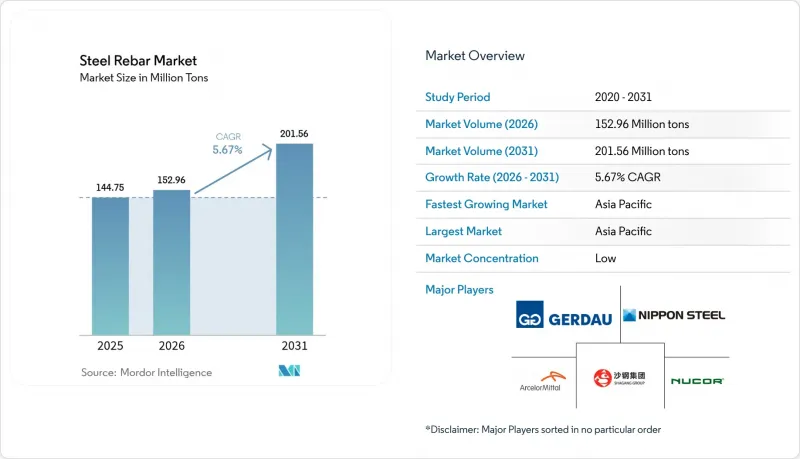
본 보고서는 유형별(이형 철근, 일반 철근), 직경별(10mm 이하, 10-20mm, 20-32mm, 32mm 초과), 제조 공정별(전기 아크로, 기본 산소로, 유도로), 최종 사용자 산업별(주택, 비주거용), 지역별(아시아태평양, 북미, 유럽, 남미, 중동 및 아프리카)로 분류되어 있습니다. 시장 예측은 수량(톤) 기준으로 제시되어 있습니다.
세계의 철근 시장 동향 및 인사이트
주택 건설에 따른 수요 급증
인구 통계학적 압력과 주택 지원 재정 정책으로 인해 주요 경제권 전반에서 철근 소비량이 증가하고 있습니다. 2024년 4월, CHIPS 법안 및 인플레이션 억제법과 관련된 연방 정부의 우대 조치가 단독주택 착공을 촉진한 결과, 미국의 주택 관련 지출은 전년 동월 대비 10.9% 증가했습니다. 브라질의 ‘Minha Casa Minha Vida’ 계획에 따라 2025년 1분기 시멘트 사용량은 5.9% 증가했으며, 이는 철근을 많이 사용하는 콘크리트 타설이 마찬가지로 증가하고 있음을 시사합니다. 인도에서는 정부 보조금을 통한 주택 건설 및 도시 지역 지하철 건설을 배경으로, 2024년 철강 사용량이 1억 1,250만 톤에 달했습니다. 지진이 빈번한 지역의 건축 기준에 따라 더 높은 강도의 철근이 요구되면서, 주택 1세대당 사용량이 증가하고 있습니다. 또한, 2019년 이후 156% 증가한 제조 공장 건설은 산업 회랑 주변에 새로운 근로자 주택이 집중됨에 따라 간접적인 주택 수요를 창출하고 있습니다.
개보수 공사에서 재건축 증가
유럽과 북미에서는 탄소 중립 및 안전 목표를 달성하기 위해 내진 보강이 가속화되고 있습니다. 영국은 2050년 기후 목표에 부합하기 위해 내진 보강률을 현재의 3배인 연 3%로 끌어올려야 하며, 이로 인해 장기적인 철근 수요가 확고해질 것입니다. 캘리포니아주와 일본에서는 내구성을 높이기 위해 스테인리스 스틸 또는 에폭시 코팅 철근을 지정하는 내진 보강에 자금이 투입되고 있어, 프로젝트당 사용 톤수가 증가하고 있습니다. 2022년 건축안전법에 따른 그렌펠 화재 이후의 규제로 인해, 영국의 중층 주택 전체에 걸쳐 구조적 개보수가 진행되고 있습니다. 특수 합금이나 특주 직경의 철근에는 프리미엄 가격이 적용되어, 성숙한 시장에서 생산량 변동으로부터 제철소의 이익을 보호하고 있습니다.
철광석·고철 가격 변동으로 인한 제철소의 이익률 압박
중국의 선철 생산이 둔화됨에 따라 철광석 현물 가격은 2024년 1월 톤당 144달러에서 9월까지 91.28달러로 하락하여 일체형 제철 업체에 압박을 가하고 있습니다. 시만도 광산이 연간 1억 2,000만 톤의 생산 체제를 확대함에 따라, 장기 전망에서는 2034년까지 톤당 78달러까지 하락할 것으로 예측됩니다. 스크랩 프리미엄은 지역에 따라 다르며, 양질의 산업용 스크랩 부족은 전기로(EAF)의 투입 비용을 급등시켜 가동률을 저하시킬 가능성이 있습니다. 중국의 보조금(OECD 평균의 10배)은 전 세계 이익률을 더욱 왜곡시키고 있어, 보조금이 적은 제철소에게는 과제가 되고 있습니다.
부문별 분석
2025년, 이형봉강은 뛰어난 접착 성능과 내진 기준 의무화로 인해 철근 시장에서 70.10%라는 압도적인 점유율을 유지했습니다. 고위험 지역의 건축 기준에서는 하중 전달 효율을 높이기 위해 이형 단면이 규정되어 있어, 주요 구조 부재로서의 역할이 정착되어 있습니다. 연강 등급은 연평균 성장률(CAGR) 5.96%로 확대되고 있습니다. 이는 개보수 공사나 선박 건설 도급업체들이 굽힘 용이성과 방청 코팅을 중시하며, 이를 통해 밀집된 철근 배치를 간소화하기 때문입니다. 디지털 모델링을 통해 변형 봉강의 일률적인 사용이 억제되고, 응력이 허용되는 부위에는 연강 등급이 지정되게 되어, 그 결과 생산량이 재분배되고 있습니다. JSW 스틸이 2030년까지 장형 제품의 생산량을 35%로 늘릴 계획인 것은 이러한 특수 분야의 성장과 전략적으로 부합함을 보여줍니다.
부두, 선착장, 노후화된 교량의 보수 공사에서 아연 도금 및 에폭시 코팅이 적용된 연강 봉강에 대한 수요가 증가하고 있습니다. 표면 처리를 통해 내구 연한이 연장되어 스테인리스품과의 초기 비용 차이가 상쇄됩니다. 미량 합금화 기술의 발전으로 항복 강도가 향상되어, 이형 철근과의 기계적 성능 차이가 줄어들고 있습니다. 그 결과, 코팅 라인과 소량 생산에 정통한 제조업체들이 수익성이 높은 보수 공사 계약에서 시장 점유율을 확대되고 있습니다.
2025년에는 10-20mm 범위의 봉강이 철근 시장 규모의 45.30%를 차지한 것으로 평가되었으며, 이는 주택 슬래브 및 중층 상업 빌딩의 골조 수요에 힘입은 것입니다. 건설업체들은 표준 스터랩 케이지 및 콘크리트 피복 지침과의 호환성이 높기 때문에 이 직경을 선호하여 채택하고 있습니다. 32mm를 초과하는 철근을 사용하는 프로젝트는 연평균 성장률(CAGR) 6.05%로 확대되고 있습니다. 이는 더 높은 단면 계수로 인해 조립 개수를 줄일 수 있는 해상 풍력 발전의 모노파일 및 초장스팬 교량이 주도하고 있습니다. ‘일대일로’ 철도 회랑의 메가 기초 타설 역시 대구경 철근의 취급량을 증가시키고, 철강 1단위당 노동 시간을 최적화하고 있습니다.
10mm 이하의 소경 봉강은 프리캐스트 패널이나 건축용 파사드에 사용되고 있으며, 모듈식 주택의 검사 도입이 진행됨에 따라 수요는 안정적입니다. 20-32mm의 봉강은 병원이나 공항 등 공공 인프라 분야에서 수요가 확대되고 있으며, 이러한 시설에서는 활하중 기준이 주택 기준을 상회합니다. 폭넓은 직경의 제품을 공급하는 제철소는 생산 일정의 유연성을 높여, 다양한 부문에 걸친 수주를 확보하고 있습니다.
지역별 분석
아시아태평양은 2025년에 세계 소비량의 38.90%를 차지했으며, 2031년까지 연평균 성장률(CAGR) 5.86%로 1위 자리를 유지할 전망입니다. 2023년 중국의 조강 수요 9억 1,100만 톤은 주거용 고층 빌딩보다 철도, 기계, 재생에너지 설비를 중심으로 증가하여 강종 및 직경 구성에 변화를 가져왔습니다. 인도의 연간 수요는 14.5% 증가하고 있으며, 지하철, 공항, 고속도로 계획이 본격화됨에 따라 2025년에는 8-10%의 성장이 예상됩니다. 말레이시아를 중심으로 한 아세안(ASEAN) 주요 도시에서는 20-32mm 철근 케이지가 필요한 데이터센터 단지에 외국인 직접 투자(FDI)가 유입되고 있습니다.
북미는 제조업의 국내 복귀 혜택을 받고 있으며, 미국의 건설 부문이 국내 철강 소비량의 절반 이상을 차지하고 있습니다. CHIPS법에 힘입은 반도체 공장에 더해, 재생 에너지 관련 부품 공장이 고강도 봉강 수주를 뒷받침하고 있습니다. 캐나다에서는 2024년 비주거용 착공 건수가 5.8% 증가하여 주택 시장의 둔화를 상쇄했습니다. 멕시코에서는 에너지 및 모빌리티 부문에 걸친 8,590억 멕시코 페소 규모의 인프라 계획으로 인해 북미 대륙의 철강 유통 경로가 확대되고 있습니다.
유럽에서는 에너지 비용과 지정학적 리스크가 신규 프로젝트를 억제하고 있어 수요가 둔화되었으며, 2024년 철강 표면 소비량은 2.3% 감소했습니다. 그러나 개보수 의무와 해상 풍력 발전에 대한 투자로 인해 특수 봉강 소비는 유지되고 있습니다. 중동에서는 수요가 급증하고 있으며, 사우디아라비아의 경우 2028년까지 건설 지출이 1,815억 달러를 넘어설 것으로 예측되어, 현지 제철소의 확장이 이를 따라잡을 때까지 장형 제품의 수입이 지속될 것으로 보입니다. 남미에서는 성장에 편차가 나타나고 있습니다. 브라질에서는 부동산 경기 부양책으로 시멘트 수요가 증가했고, 이에 따라 철근 출하량도 증가했으나, 인프라 부족은 향후 대규모 프로젝트 계획이 예정되어 있음을 시사하고 있습니다.
기타 혜택
- 엑셀 형식 시장 예측(ME) 시트
- 3개월간 애널리스트 지원
자주 묻는 질문
목차
제1장 서론
제2장 조사 방법
제3장 주요 요약
제4장 시장 구도
제5장 시장 규모 및 성장 예측
제6장 경쟁 구도
제7장 시장 기회 및 향후 전망
AJY 26.08.28According to Mordor Intelligence, the steel rebar market size was valued at 144.75 Million tons in 2025 and estimated to grow from 152.96 Million tons in 2026 to reach 201.56 Million tons by 2031, at a CAGR of 5.67% during the forecast period (2026-2031).
This report is Segmented by Type (Deformed, Mild), Diameter (Less Than Equal To 10 Mm, 10-20 Mm, 20-32 Mm, Greater Than 32 Mm), Production Process (Electric-Arc Furnace, Basic Oxygen Furnace, Induction Furnace), End-User Industry (Residential, Non-Residential), and Geography (Asia-Pacific, North America, Europe, South America, Middle East and Africa). The Market Forecasts are Provided in Terms of Volume (Tons).
Global Steel Rebar Market Trends and Insights
Rapid Demand from Residential Construction
Demographic pressure and pro-housing fiscal programs heighten rebar consumption across key economies. US residential spending rose 10.9% year-on-year in April 2024 as federal incentives linked to the CHIPS and Inflation Reduction Acts spurred single-family starts. Brazil's Minha Casa Minha Vida scheme lifted cement sales 5.9% in Q1 2025, signaling a parallel uptick in rebar-rich concrete pours. India's steel use reached 112.5 million tons in 2024 on the back of state-subsidized housing and urban metro construction. Seismic-zone building codes now request higher-strength bar, boosting tonnage per dwelling. Manufacturing plant construction-up 156% since 2019-adds indirect residential demand as new workforce housing clusters around industrial corridors.
Increasing Reconstruction in Retrofitting Activities
Europe and North America accelerate retrofits to meet net-zero and safety targets. The UK must triple retrofit rates to 3% annually to align with 2050 climate goals, locking in long-run rebar demand. California and Japan fund seismic upgrades that specify stainless or epoxy-coated bar for longevity, raising per-project tonnage. Post-Grenfell rules under the 2022 Building Safety Act fuel structural overhauls across the UK's mid-rise housing stock. Specialized alloys and customized diameters command premiums that cushion mills from volume volatility in mature markets.
Volatile Iron-Ore and Scrap Prices Squeezing Mills' Margins
Spot iron-ore fell from USD 144/ton in January 2024 to USD 91.28 by September as Chinese pig-iron output weakened, pressuring integrated producers. Long-range forecasts point to USD 78/ton by 2034 as Simandou ramps up 120 million tons annually. Scrap premiums vary by region; shortages of clean industrial scrap can spike EAF input costs and curb run rates. Chinese subsidies-ten times OECD averages-further distort global margins, challenging less-subsidized mills.
Other drivers and restraints analyzed in the detailed report include:
- Belt-and-Road Mega-Infrastructure Pipeline Revival
- Prevalence of Reinforced Concrete in Construction
- Accelerating Adoption of Fibre-Reinforced Polymer Bars in Coastal Projects
For complete list of drivers and restraints, kindly check the Table Of Contents.
Segment Analysis
Deformed bar held a commanding 70.10% of steel rebar market share in 2025 thanks to superior bond performance and seismic code mandates. Building codes in high-risk geographies stipulate deformed profiles for load-transfer efficiency, anchoring their role in primary structural elements. Mild-steel grades expand at a 5.96% CAGR as retrofit and marine contractors prize bendability and corrosion coatings that simplify congested reinforcement zones. Digital modeling tempers blanket deformed use, specifying mild grades where stresses allow, thus reallocating tonnage. JSW Steel's plan to lift long-product output to 35% by 2030 illustrates strategic alignment with specialized segment growth.
Demand for galvanized and epoxy-coated mild bar rises in piers, quays, and refurbishment of aging bridges. Surface treatments extend service life and offset initial cost gaps versus stainless options. Advances in micro-alloying elevate yield strength, closing mechanical gaps with deformed varieties. As a result, producers that master coating lines and small heat batches gain share in higher-margin retrofitting contracts.
Bar in the 10-20 mm range represented 45.30% of steel rebar market size in 2025, fueled by residential slabs and mid-rise commercial frames. Contractors favor this diameter for ready compatibility with standard stirrup cages and concrete cover guidelines. Projects exceeding 32 mm bar accelerate at 6.05% CAGR, propelled by offshore wind monopiles and extra-long span bridges where higher section modulus curbs assembly count. Mega-foundation pours on Belt-and-Road rail corridors likewise lift large-bar tonnage and optimize labor hours per unit steel.
Lower diameters <=10 mm cater to precast panels and architectural fascias; demand stays stable amid modular housing trials. The 20-32 mm bracket grows in civic infrastructure such as hospitals and airports where live-load criteria surpass residential norms. Mills that supply wider diameter mixes enhance mill scheduling flexibility and capture cross-segment orders.
Complete Report Scope:
- By Type
- Deformed
- Mild
- By Diameter
- Less than equal to10 mm
- 10-20 mm
- 20-32 mm
- Geater than 32 mm
- By Production Process
- Electric-Arc Furnace (EAF)
- Basic Oxygen Furnace (BOF)
- Induction Furnace
- By End-user Industry
- Residential
- Non-Residential
- Commercial
- Infrastructure
- Institutional
- By Geography
- Asia-Pacific
- China
- Japan
- India
- South Korea
- ASEAN Countries
- Rest of Asia-Pacific
- North America
- United States
- Canada
- Mexico
- Europe
- Germany
- United Kingdom
- France
- Italy
- Spain
- Russia
- NORDIC Countries
- Rest of Europe
- South America
- Brazil
- Argentina
- Rest of South America
- Middle East and Africa
- Saudi Arabia
- South Africa
- Rest of Middle East and Africa
- Asia-Pacific
Geography Analysis
Asia-Pacific retained 38.90% of global consumption in 2025 and is poised for a leading 5.86% CAGR through 2031. China's crude-steel pull of 911 million tons in 2023 centered on rail, machinery, and renewable capacity rather than residential high-rise, altering grade and diameter mix. India recorded 14.5% yearly demand growth and expects 8-10% gains in 2025 as metro, airport, and highway schemes mature. ASEAN hubs, led by Malaysia, channel FDI into data-center campuses that favor 20-32 mm bar cages.
North America benefits from reshored manufacturing, with the US construction sector accounting for more than half of domestic steel uptake. CHIPS-driven semiconductor plants, plus renewable component factories, sustain high-strength bar orders. Canada posted a 5.8% rise in non-residential starts during 2024, offsetting a slowdown in housing. Mexico's MXN 859 billion infrastructure program across energy and mobility widens continental steel corridors.
Europe faces tempered demand as energy costs and geopolitical risk curb fresh projects; apparent steel use slipped 2.3% in 2024. Yet retrofit mandates and offshore wind investments uphold specialty bar consumption. The Middle East surges, with Saudi Arabia projected to eclipse USD 181.5 billion in construction outlays by 2028, funneling long-product imports until local melt-shop expansions catch up. South America shows patchy growth; Brazil's real-estate stimulus lifted cement and by extension rebar volumes, while infrastructural deficits hint at future mega-project pipelines.
- ArcelorMittal
- CMC (Commercial Metals Company )
- Daido Steel Co., Ltd.
- EMSTEEL
- Gerdau S/A
- Hybar LLC
- Hyundai Steel
- JFE Steel Corporation
- Jiangsu Shagang Group Su
- JSW
- Kobe Steel, Ltd.
- NIPPON STEEL CORPORATION
- Nucor Corporation
- POSCO
- SAIL
- Sohar Steel LLC
- Stecol International Pvt. Ltd.
- Steel Dynamics
- Tata Steel
Additional Benefits:
- The market estimate (ME) sheet in Excel format
- 3 months of analyst support
TABLE OF CONTENTS
1 Introduction
- 1.1 Study Assumptions and Market Definition
- 1.2 Scope of the Study
2 Research Methodology
3 Executive Summary
4 Market Landscape
- 4.1 Market Overview
- 4.2 Market Drivers
- 4.2.1 Rapid demand from residentional construction
- 4.2.2 Increasing reconstruction in retrofitting activities
- 4.2.3 Belt-and-Road mega-infrastructure pipeline revival
- 4.2.4 Prevalence of Reinforced Concrete in Construction
- 4.2.5 Maritime wind-farm foundations demanding corrosion-resistant rebar
- 4.3 Market Restraints
- 4.3.1 Volatile iron-ore and scrap prices squeezing mills' margins
- 4.3.2 Accelerating adoption of fibre-reinforced polymer bars in coastal projects
- 4.3.3 Rising cement-concrete 3-D printing that bypasses traditional rebar
- 4.4 Value Chain Analysis
- 4.5 Porter's Five Forces
- 4.5.1 Bargaining Power of Suppliers
- 4.5.2 Bargaining Power of Buyers
- 4.5.3 Threat of New Entrants
- 4.5.4 Threat of Substitute Products and Services
- 4.5.5 Degree of Competition
5 Market Size and Growth Forecasts (Volume)
- 5.1 By Type
- 5.1.1 Deformed
- 5.1.2 Mild
- 5.2 By Diameter
- 5.2.1 Less than equal to10 mm
- 5.2.2 10-20 mm
- 5.2.3 20-32 mm
- 5.2.4 Geater than 32 mm
- 5.3 By Production Process
- 5.3.1 Electric-Arc Furnace (EAF)
- 5.3.2 Basic Oxygen Furnace (BOF)
- 5.3.3 Induction Furnace
- 5.4 By End-user Industry
- 5.4.1 Residential
- 5.4.2 Non-Residential
- 5.4.2.1 Commercial
- 5.4.2.2 Infrastructure
- 5.4.2.3 Institutional
- 5.5 By Geography
- 5.5.1 Asia-Pacific
- 5.5.1.1 China
- 5.5.1.2 Japan
- 5.5.1.3 India
- 5.5.1.4 South Korea
- 5.5.1.5 ASEAN Countries
- 5.5.1.6 Rest of Asia-Pacific
- 5.5.2 North America
- 5.5.2.1 United States
- 5.5.2.2 Canada
- 5.5.2.3 Mexico
- 5.5.3 Europe
- 5.5.3.1 Germany
- 5.5.3.2 United Kingdom
- 5.5.3.3 France
- 5.5.3.4 Italy
- 5.5.3.5 Spain
- 5.5.3.6 Russia
- 5.5.3.7 NORDIC Countries
- 5.5.3.8 Rest of Europe
- 5.5.4 South America
- 5.5.4.1 Brazil
- 5.5.4.2 Argentina
- 5.5.4.3 Rest of South America
- 5.5.5 Middle East and Africa
- 5.5.5.1 Saudi Arabia
- 5.5.5.2 South Africa
- 5.5.5.3 Rest of Middle East and Africa
- 5.5.1 Asia-Pacific
6 Competitive Landscape
- 6.1 Market Concentration
- 6.2 Strategic Moves
- 6.3 Market Share(%)/Ranking Analysis
- 6.4 Company Profiles (includes Global level overview, market level overview, core segments, financials, strategic information, market rank/share, products and services, recent developments)
- 6.4.1 ArcelorMittal
- 6.4.2 CMC (Commercial Metals Company )
- 6.4.3 Daido Steel Co., Ltd.
- 6.4.4 EMSTEEL
- 6.4.5 Gerdau S/A
- 6.4.6 Hybar LLC
- 6.4.7 Hyundai Steel
- 6.4.8 JFE Steel Corporation
- 6.4.9 Jiangsu Shagang Group Su
- 6.4.10 JSW
- 6.4.11 Kobe Steel, Ltd.
- 6.4.12 NIPPON STEEL CORPORATION
- 6.4.13 Nucor Corporation
- 6.4.14 POSCO
- 6.4.15 SAIL
- 6.4.16 Sohar Steel LLC
- 6.4.17 Stecol International Pvt. Ltd.
- 6.4.18 Steel Dynamics
- 6.4.19 Tata Steel
7 Market Opportunities and Future Outlook
- 7.1 White-space and Unmet-Need Assessment


