

|
시장보고서
상품코드
2114872
안과 성형 수술 시장 : 시장 점유율 분석, 업계 동향 및 통계, 성장 예측(2026-2031년)Oculoplastic Surgery - Market Share Analysis, Industry Trends & Statistics, Growth Forecasts (2026 - 2031) |
||||||
 Mordor Intelligence
Mordor Intelligence에 의하면, 안과 성형 수술 시장 규모는 2025년 108억 8,000만 달러로 평가되었고, 2026년에는 116억 1,000만 달러로 추정되고, 2026-2031년 CAGR 6.72%로 성장을 지속할 전망이며, 2031년에는 160억 7,000만 달러에 이를 것으로 예측됩니다.
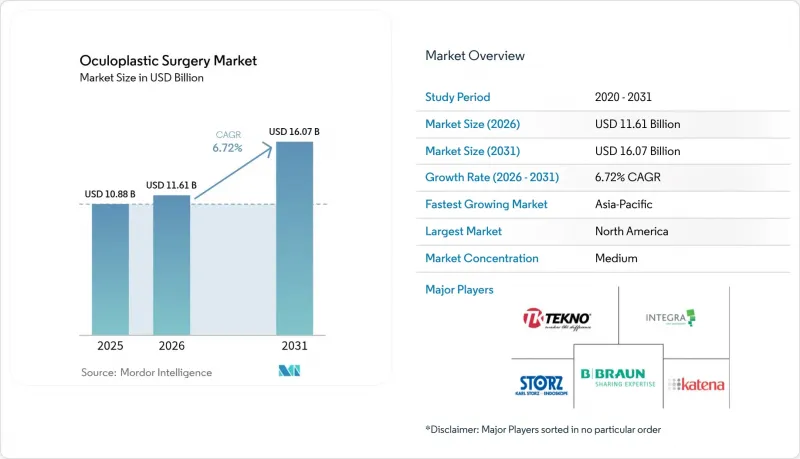
본 보고서는 시술 유형별(안검 수술, 눈썹·이마 리프트, 안면 리프트에 수반되는 안성형술, 누관·안와 감압술, 소아 안과 성형 수술, 기타 시술 유형), 최종 사용자별(병원, 외래수술센터(ASC), 기타), 지역별(북미, 유럽, 아시아태평양, 중동 및 아프리카, 남미)로 분류되어 있습니다. 시장 예측은 금액(달러) 기준으로 제시되어 있습니다.
세계의 안과 성형 수술 시장 동향 및 인사이트
기능적·미적 측면에서 눈꺼풀에 대한 우려를 가진 고령 인구 증가
65세 이상 고령 인구의 급증으로 인해, 기능적인 눈꺼풀 복원이나 미용적 개선을 원하는 잠재적 환자가 수백만 명이나 증가하고 있습니다. 미국에서만 해도 이 인구는 2020년 5,610만 명에서 2030년까지 7,310만 명으로 증가할 것으로 예상되며, 상방 시야 회복 및 얼굴의 조화를 되찾기 위해 안검 성형술을 원하는 주요 환자층이 확대될 것입니다. 저침습 눈꺼풀 리프트와 같은 수술법은 안와 지방을 보존하고 흉터를 최소화함으로써, 임상적 결과를 고령층의 회복 기대와 일치시킬 수 있습니다. 메디케어는 기록된 시야 결손이 개선된 경우 기능적 안검 성형술 비용을 상환하기 때문에 외과의사는 진료 보수 체계의 압박에도 불구하고 수술의 정당성을 설명할 수 있습니다. 평균 수명의 연장으로 인해 환자들이 선명한 시력과 젊어 보이는 외모를 기대하는 기간이 더욱 길어지면서, 재수술이나 부수적인 치료를 통한 재방문 수요가 발생하고 있습니다. 수술 전 안구 표면의 최적화와 수술 후 안구건조증 관리를 통합한 진료 체계를 구축한 의료 기관이야말로 이러한 인구 통계학적 호재를 최대한 활용할 수 있는 입장에 있습니다.
갑상선 안증·안와 종양 발생률 증가
갑상선 안증의 치료에는 현재 염증을 진정시키는 표적형 생물학적 제제가 활용되고 있어, 조직의 취약성이 감소하고 수술 후 결과를 더 예측하기 쉬워진 시점에 수술을 시행할 수 있게 되었습니다. 생물학적 제제 투여 후 시행하는 감압술은 3.5-7.6mm의 안구 돌출을 완화할 수 있고, 복시의 발생률도 낮기 때문에 외과의사의 자신감을 높이고 환자의 만족도를 향상시킵니다. 갑상선 안증의 경우, 많은 경우 단계적인 안검, 사시, 안와 수술이 필요하며, 이로 인해 1건당 수익은 증가하는 반면, 비전문의에게는 진입 장벽이 됩니다. 안와 종양은 발생 빈도는 낮지만, 대형 의료기기 제조업체가 통합 플랫폼에 포함시킨 고해상도 영상 장치나 내비게이션 시스템이 필요합니다. 내분비과와 안과 성형 수술의 상담을 당일 내에 제공할 수 있는 의료기관은 지역 내분비 전문의나 1차 진료 의사로부터 환자를 유치할 수 있습니다. 요오드 섭취량의 지역적 차이는 질환의 집중 분포에 영향을 미치며, 유럽, 동아시아, 일부 걸프 국가에서 브랜드화된 ‘탁월한 의료 센터’ 설립의 기회를 창출하고 있습니다.
높은 시술 비용·제한된 보험 환급
2024년 메디케어 환산 계수가 5.4% 삭감됨에 따라, 미국의 안과 성형 수술 클리닉은 진료 건수를 늘려야 하거나, 자비 부담 미용 수술로 사업을 전환할 수밖에 없는 상황에 처해 있습니다. 유럽에서도 유사한 동향이 나타나고 있으며, 진단 관련 그룹(DRG)에 따른 결제가 인플레이션을 따라가지 못하고 있습니다. 이에 대해 병원 측은 저위험 사례를 외래 센터로 이관하는 방식으로 대응하고 있으며, 이를 통해 외과의를 확보하는 동시에 입원 환자에게 드는 간접비를 절감하고 있습니다. 아시아태평양 및 라틴아메리카에서는 보험 적용이 제한적이어서 많은 환자가 본인 부담을 감수해야 하며, 이로 인해 여러 단계에 걸친 재건 수술을 받는 것을 주저하게 만들고 있습니다. 가격 격차는 비용에 민감한 환자들을 튀르키예, 태국, 콜롬비아의 의료시설로 유도하는 ‘의료 관광’의 흐름을 가속화하고 있습니다. 수술 비용이 모두 포함된 패키지 요금을 제시하는 디지털 플랫폼은 국경을 넘어 수요를 이동시킴으로써 경쟁의 경계를 바꾸고 있습니다.
부문 분석
2025년, 안검 수술은 안과 성형 수술 시장 규모의 39.02%를 차지했으며, 기능적 필요성과 미용적 수요가 융합된 오랜 우위를 입증하고 있습니다. 시야 검사에서 시야 장애가 확인된 경우, 상안검 성형술은 많은 보험사에서 계속해서 보장 대상에 포함되어 있어, 이를 통해 안정적인 보상원이 유지되고 있습니다. 외과 의사들은 자연스러운 주름 아래에 절개 위치를 정확하게 설정하는 기술을 정교화하고 있으며, 지방 보존이라는 개념이 과거 미적 측면을 해치던 함몰 현상을 억제하고 있습니다. 동시에 레이저를 이용한 피부 탄력 개선 시술이 보급되면서, 추가 절개 없이도 수술 후 결과를 개선하고 있습니다.
눈썹·이마 리프트 부문은 2031년까지 연평균 성장률(CAGR) 8.64%로 확대될 전망이며, 안과 성형 수술 시장 내에서 가장 빠르게 성장하는 부문이 되었습니다. 내시경 플랫폼의 도입으로 현재는 1cm의 헤어라인 절개를 통해 흡수성 나사를 사용하여 눈썹을 고정할 수 있게 되었으며, 회복 기간은 10일 이하로 단축되었습니다. 젊은 환자층은 보톡스를 통한 유지 요법과 결합된 자연스러운 눈썹 리프팅을 원하고 있으며, 향후 외과 수술로 이어지는 파이프라인이 형성되고 있습니다. 외과의가 한 번의 시술로 상안검과 눈썹 시술을 병행함으로써 교차 판매 기회가 생겨나며, 이는 수술 시간 최적화와 1건당 수익 증대로 이어집니다. 이러한 추세로 인해 안검 수술이 주도적인 위치를 유지하는 한편, 눈썹 수술은 상당한 성장 점유율을 확보할 전망입니다.
지역별 분석
북미는 2025년 안과 성형 수술 시장의 36.25%를 차지했으며, 탄탄한 펠로우십 파이프라인, 높은 인지도, 정교한 보험사 네트워크의 혜택을 지속적으로 누리고 있습니다. 2024년 전환율 하락으로 인해 의료기관은 비급여 미용 눈 주변 수술이나 눈썹 리프트를 추가하게 되어 수익 변동이 완화될 것입니다. 2023년 1분기 수술 건수의 2.2%를 차지하는 클리닉 내 수술실은 과거 병원이 얻던 시설 사용료를 외과 의사에게 가져다주며, 지역 내 주도적 지위를 강화하고 있습니다. 사모펀드의 지원을 받는 통합 기업들은 여러 주에 걸친 네트워크를 확장하고, 대규모 조달 계약을 협상하는 한편, AI 영상 기술에 투자하여 잠재 환자를 유치하고 있습니다.
아시아태평양은 확대되는 중산층이 직장이나 사교 모임에서 외모를 중요시함에 따라, 2031년까지 연평균 성장률(CAGR)이 7.55%로 이 지역 내에서 가장 높은 성장세를 보이고 있습니다. 한국과 일본의 정부 지원 국민건강보험 제도에서는 기능적인 안검 성형술 비용이 보상되는 반면, 미용 목적의 추가 시술은 민간 보험으로 충당되고 있습니다. 알콘(Alcon) 등 의료기기 대기업들은 2023년에 8억 2,800만 달러를 연구개발(R&D)에 투자하여, 아시아인의 해부학적 구조에 맞춘 렌즈 및 영상 제품 개발에 주력하고 있으며, 장기적인 노력을 보여주고 있습니다. 반면, 중국 국가의약품감독관리국은 의료기기 승인 절차를 강화하고 있어, 품질 확보에는 도움이 되는 반면 시장 진입을 위한 계획 주기를 장기화시키고 있습니다.
유럽에서는 국민건강보험 제도와 견고한 임상 거버넌스를 배경으로 완만한 성장을 유지하고 있습니다. 고령화에 따라 기능적 안검 성형술이나 눈썹 리프트에 대한 수요는 증가하고 있지만, 재정 긴축 정책으로 인해 보험 급여액 증가세는 억제되고 있습니다. 영국에서 조사 대상이었던 외과 의사의 66%는 전방 안검하수 교정술과 같은 혁신적인 기술을 여전히 선호하고 있습니다. 중동 및 아프리카와 남미는 시장 점유율 면에서 뒤처져 있지만, 급속히 보급이 진행되는 지역도 곳곳에서 발견됩니다. 브라질의 외과의사들은 결막의 가시성을 향상시키는 현미경 일체형 광간섭 단층 촬영(OCT)을 선구적으로 도입하여, 해당 지역이 첨단 도구를 활용해 비약적인 발전을 이룰 수 있는 능력을 입증하고 있습니다.
기타 혜택
- 엑셀 형식 시장 예측(ME) 시트
- 3개월간의 애널리스트 지원
자주 묻는 질문
목차
제1장 서론
제2장 조사 방법
제3장 주요 요약
제4장 시장 구도
제5장 시장 규모 및 성장 예측
제6장 경쟁 구도
제7장 시장 기회 및 향후 전망
AJY 26.08.28According to Mordor Intelligence, the oculoplastic surgery market size is expected to grow from USD 10.88 billion in 2025 to USD 11.61 billion in 2026 and is forecast to reach USD 16.07 billion by 2031 at 6.72% CAGR over 2026-2031.
This report is Segmented by Procedure Type (Eyelid Surgery, Brow & Forehead Lift, Facelift Adjacent Oculoplastic, Lacrimal & Orbital Decompression, Pediatric Oculoplastic, Others Procedure Type), End User (Hospitals, Ambulatory Surgical Centers, and More), and Geography (North America, Europe, Asia-Pacific, Middle East and Africa, South America). The Market Forecasts are Provided in Terms of Value (USD).
Global Oculoplastic Surgery Market Trends and Insights
Rising Geriatric Population with Functional & Aesthetic Eye-Lid Concerns
The surge in individuals aged 65 and above adds millions of potential candidates for functional eyelid repair and cosmetic enhancement. In the United States alone, this population will grow from 56.1 million in 2020 to 73.1 million by 2030, expanding the core patient base that seeks blepharoplasty to restore superior visual fields and facial harmony. Techniques such as the minimally invasive eyelid lift preserve orbital fat and minimize bruising, aligning clinical outcomes with the recovery expectations of older adults. Because Medicare reimburses functional blepharoplasty when documented visual field loss is improved, surgeons can justify intervention despite fee-schedule pressure. Longer life expectancy further extends the window during which patients expect clear vision and a refreshed appearance, generating repeat business for touch-up procedures and adjunct treatments. Practices that integrate pre-surgical ocular surface optimization and post-operative dry-eye management are best placed to capture this demographic tailwind.
Growing Incidence of Thyroid Eye Disease & Orbital Tumors
Thyroid eye disease now benefits from targeted biologics that calm inflammation, allowing surgery to be timed when tissue is less friable and results are more predictable. Post-biologic decompressions remove 3.5-7.6 mm of proptosis with lower diplopia rates, reinforcing surgeon confidence and raising patient satisfaction. TED often requires staged lid, strabismus, and orbital work, which lifts revenue per case while creating barriers to entry for non-specialists. Orbital tumors, although less common, demand high-resolution imaging and navigation systems that large device firms bundle into integrated platforms. Centers that can provide same-day endocrine and oculoplastic consultation capture referrals from community endocrinologists and primary-care physicians. Regional variations in iodine sufficiency shape disease clustering and create opportunities for branded centers of excellence in Europe, East Asia, and parts of the Gulf states.
High Procedure Cost & Limited Reimbursement
The 5.4% cut to the 2024 Medicare conversion factor forces U.S. oculoplastic practices to chase volume or pivot toward cash-pay cosmetic work. Similar dynamics occur in Europe where diagnosis-related-group payments lag inflation. Hospitals respond by moving lower-risk cases into ambulatory centers, thus retaining surgeons while shedding inpatient overhead. In Asia Pacific and Latin America, partial insurance coverage leaves many patients self-funding, which suppresses uptake of multi-step reconstructions. Price disparities have fueled a medical-tourism circuit that routes cost-sensitive patients to centers in Turkey, Thailand, and Colombia. Digital platforms that quote all-inclusive surgical packages are altering competitive boundaries by shifting demand across borders.
Other drivers and restraints analyzed in the detailed report include:
- Rapid Uptake of Minimally Invasive Blepharoplasty & Brow-Pexy Techniques
- AI-Assisted Pre-Operative Planning Improving Surgical Outcomes
- Shortage of Fellowship-Trained Oculoplastic Surgeons in Low-Income Regions
For complete list of drivers and restraints, kindly check the Table Of Contents.
Segment Analysis
Eyelid Surgery accounted for 39.02% of oculoplastic surgery market size in 2025, confirming longstanding dominance that blends functional necessity with cosmetic demand. Upper-lid blepharoplasty remains covered by many payors when visual-field testing proves obstruction, which preserves a reliable reimbursement stream. Surgeons have refined incision placement beneath natural folds, while fat-preservation philosophies limit hollowing that once compromised aesthetics. Concurrently, rising uptake of laser skin tightening enhances results without added incisions.
The brow & forehead lift category is expanding at 8.64% CAGR toward 2031, making it the fastest segment inside the oculoplastic surgery market. Endoscopic platforms now permit 1 cm hairline incisions that anchor the brow on absorbable screws, cutting convalescence to under 10 days. Younger patients seek subtle brow elevation paired with toxin maintenance, building a pipeline for eventual surgical conversion. Cross-selling opportunities emerge when surgeons coordinate upper-lid and brow work in a single sitting, optimizing theatre time and improving per-case revenue. These dynamics maintain eyelid dominance yet position brow procedures to capture an outsized growth share.
Complete Report Scope:
- By Procedure Type
- Eyelid Surgery
- Brow & Forehead Lift
- Facelift Adjacent Oculoplastic
- Lacrimal & Orbital Decompression
- Pediatric Oculoplastic
- Others Procedure Type
- By End User
- Hospitals
- Ambulatory Surgical Centers
- Specialty Eye Clinics
- Cosmetic Surgery Centers
- By Geography
- North America
- United States
- Canada
- Mexico
- Europe
- Germany
- United Kingdom
- France
- Italy
- Spain
- Rest of Europe
- Asia-Pacific
- China
- Japan
- India
- Australia
- South Korea
- Rest of Asia-Pacific
- Middle East & Africa
- GCC
- South Africa
- Rest of Middle East & Africa
- South America
- Brazil
- Argentina
- Rest of South America
- North America
Geography Analysis
North America commands 36.25% of the oculoplastic surgery market share in 2025 and continues to benefit from strong fellowship pipelines, high awareness, and sophisticated payor networks. Conversion-factor cuts in 2024 encourage practices to add cash-pay cosmetic lids and brow lifts, smoothing revenue volatility. Office-based surgery suites, representing 2.2% of procedures in Q1 2023, provide surgeons with facility fees once captured by hospitals, reinforcing regional leadership. Consolidators backed by private equity expand multi-state networks that negotiate supply contracts at scale and invest in AI imaging to lure referrals.
Asia Pacific registers the fastest regional CAGR at 7.55% through 2031 as expanding middle classes prioritize appearance in professional and social contexts. Government-supported universal health schemes in South Korea and Japan reimburse functional blepharoplasty, while private payment covers cosmetic add-ons. Device leaders such as Alcon dedicate USD 828 million in 2023 R&D toward lens and imaging products tuned to Asian anatomy, signaling a long-term commitment. Meanwhile, China's National Medical Products Administration tightens device approval timelines, ensuring quality but lengthening market-entry planning cycles.
Europe maintains moderate growth based on universal coverage and strong clinical governance. Aging demographics push functional lids and brow lifts upward, yet austerity measures cap reimbursement growth. Innovative techniques like anterior ptosis repair remain favored by 66% of surgeons surveyed in the United Kingdom. The Middle East & Africa and South America trail in share yet display pockets of rapid adoption. Brazilian surgeons pioneer microscope-integrated optical coherence tomography that improves macular visualization and demonstrates the region's capacity to leapfrog with advanced tools.
- Tekno-Medical Optik-Chirurgie
- Zimmer Biomet
- Integra LifeSciences
- B. Braun
- Katena Products
- Karl Storz
- Bolton Surgical
- Alcon
- Johnson & Johnson
- Carl Zeiss
- Allergan Aesthetics
- Bausch Health
- Glaukos
- EssilorLuxottica
- Stryker
- Medtronic
- Smiths Group
- AmbioDisk LLC
Additional Benefits:
- The market estimate (ME) sheet in Excel format
- 3 months of analyst support
TABLE OF CONTENTS
1 Introduction
- 1.1 Study Assumptions & Market Definition
- 1.2 Scope of the Study
2 Research Methodology
3 Executive Summary
4 Market Landscape
- 4.1 Market Overview
- 4.2 Market Drivers
- 4.2.1 Rising Geriatric Population with Functional & Aesthetic Eye-Lid Concerns
- 4.2.2 Growing Incidence of Thyroid Eye Disease & Orbital Tumors
- 4.2.3 Rapid Uptake of Minimally Invasive Blepharoplasty & Brow-Pexy Techniques
- 4.2.4 AI-Assisted Pre-Operative Planning Improving Surgical Outcomes
- 4.2.5 Adoption of Human Umbilical-Cord Amniotic Grafts Lowering Revision Rates
- 4.2.6 Surge in Social-Media Driven Cosmetic Demand in Emerging Economies
- 4.3 Market Restraints
- 4.3.1 High Procedure Cost & Limited Reimbursement
- 4.3.2 Shortage of Fellowship-Trained Oculoplastic Surgeons in Low-Income Regions
- 4.3.3 Peri-Operative Infection Risk Amplifying Defensive-Medicine Costs
- 4.3.4 Competition from Nonsurgical Neurotoxin/Filler Alternatives
- 4.4 Technological Outlook
- 4.5 Porter's Five Forces Analysis
- 4.5.1 Threat of New Entrants
- 4.5.2 Bargaining Power of Buyers
- 4.5.3 Bargaining Power of Suppliers
- 4.5.4 Threat of Substitutes
- 4.5.5 Intensity of Competitive Rivalry
5 Market Size & Growth Forecasts (Value in USD)
- 5.1 By Procedure Type
- 5.1.1 Eyelid Surgery
- 5.1.2 Brow & Forehead Lift
- 5.1.3 Facelift Adjacent Oculoplastic
- 5.1.4 Lacrimal & Orbital Decompression
- 5.1.5 Pediatric Oculoplastic
- 5.1.6 Others Procedure Type
- 5.2 By End User
- 5.2.1 Hospitals
- 5.2.2 Ambulatory Surgical Centers
- 5.2.3 Specialty Eye Clinics
- 5.2.4 Cosmetic Surgery Centers
- 5.3 By Geography
- 5.3.1 North America
- 5.3.1.1 United States
- 5.3.1.2 Canada
- 5.3.1.3 Mexico
- 5.3.2 Europe
- 5.3.2.1 Germany
- 5.3.2.2 United Kingdom
- 5.3.2.3 France
- 5.3.2.4 Italy
- 5.3.2.5 Spain
- 5.3.2.6 Rest of Europe
- 5.3.3 Asia-Pacific
- 5.3.3.1 China
- 5.3.3.2 Japan
- 5.3.3.3 India
- 5.3.3.4 Australia
- 5.3.3.5 South Korea
- 5.3.3.6 Rest of Asia-Pacific
- 5.3.4 Middle East & Africa
- 5.3.4.1 GCC
- 5.3.4.2 South Africa
- 5.3.4.3 Rest of Middle East & Africa
- 5.3.5 South America
- 5.3.5.1 Brazil
- 5.3.5.2 Argentina
- 5.3.5.3 Rest of South America
- 5.3.1 North America
6 Competitive Landscape
- 6.1 Market Concentration
- 6.2 Market Share Analysis
- 6.3 Company Profiles (includes Global level Overview, Market level overview, Core Segments, Financials as available, Strategic Information, Market Rank/Share for key companies, Products & Services, and Recent Developments)
- 6.3.1 TEKNO-MEDICAL Optik-Chirurgie GmbH
- 6.3.2 Zimmer Biomet Holdings Inc.
- 6.3.3 Integra LifeSciences Holdings Corporation
- 6.3.4 B. Braun Melsungen AG
- 6.3.5 Katena (Blink Medical Ltd.)
- 6.3.6 Karl Storz SE & Co. KG
- 6.3.7 Bolton Surgical Ltd
- 6.3.8 Alcon Inc.
- 6.3.9 Johnson & Johnson Vision Care Inc.
- 6.3.10 Carl Zeiss Meditec AG
- 6.3.11 Allergan Aesthetics
- 6.3.12 Bausch & Lomb Inc.
- 6.3.13 Glaukos Corporation
- 6.3.14 EssilorLuxottica SA
- 6.3.15 Stryker Corporation
- 6.3.16 Medtronic
- 6.3.17 Smith & Nephew plc
- 6.3.18 AmbioDisk LLC
7 Market Opportunities & Future Outlook
- 7.1 White-space & Unmet-Need Assessment


