

|
시장보고서
상품코드
2114891
항공우주용 플라스틱용 난연제 시장 : 시장 점유율 분석, 업계 동향 및 통계, 성장 예측(2026-2031년)Flame Retardants For Aerospace Plastics - Market Share Analysis, Industry Trends & Statistics, Growth Forecasts (2026 - 2031) |
||||||
 Mordor Intelligence
Mordor Intelligence에 의하면, 항공우주용 플라스틱용 난연제 시장 규모는 2025년에 3,365만 달러로 평가되었고, 2026년 3,471만 달러에서 2031년까지 4,052만 달러에 이를 것으로 추정되며, 예측 기간(2026-2031년) CAGR은 3.14%를 나타낼 전망입니다.
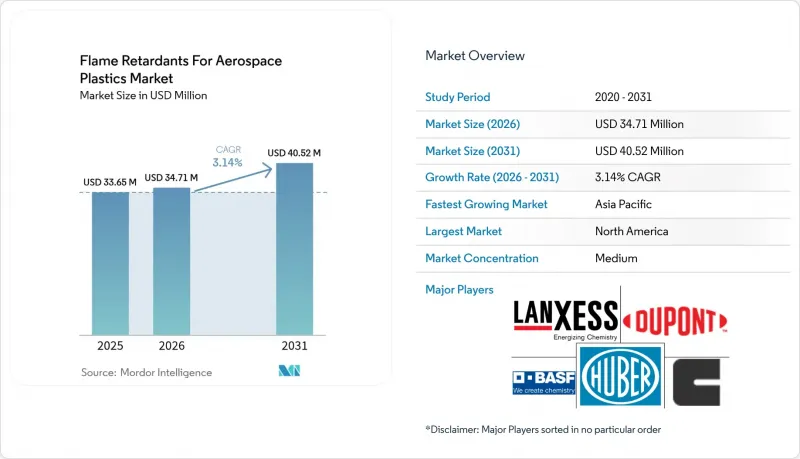
본 보고서는 제품 유형별(산화 안티몬, 알루미늄 삼수화물, 수산화 마그네슘, 기타), 폴리머 유형별(탄소섬유 강화 폴리머, 폴리카보네이트, 열경화성 폴리이미드, 기타), 항공기 부품별(내장 패널 및 바닥재, 배선, 케이블 및 커넥터, 기타), 지역별(아시아태평양, 북미, 유럽, 기타)로 분류되어 있습니다.
세계의 항공우주용 플라스틱용 난연제 시장 동향 및 인사이트
객실 및 구조용 플라스틱에 대한 엄격한 방화 규제
항공 당국은 FAR 25.853을 초과하는 재료 수준의 검사 요건을 강화했습니다. 2024년, FAA는 좌석 수 20석 이상의 운송용 항공기에 대해 더욱 엄격한 발열량 기준을 도입했습니다. 한편, EASA의 2025년 할로겐화물 대체 지침에 따라 2025년 12월까지 소화기 교체가 의무화되어, 간접적으로 내장재용 플라스틱에 대한 진입 장벽이 높아지고 있습니다. 지역 간 규제 격차가 해소되고 있기 때문에 각 OEM 업체들은 현재 세계에서 가장 엄격한 규제 기준에 따라 설계를 진행하고 있습니다. A321neo XLR 등의 항공기에서 볼 수 있는 새로운 연료 탱크 배치와 관련된 특별한 조건은 새로운 설계가 새로운 방화 조항을 초래할 수 있음을 여실히 보여주고 있습니다. 운항 중인 기체에 대한 개조 의무와 신규 도입 기체에 대한 요건이 맞물리면서, 항공우주용 플라스틱용 난연제는 기존 프로그램과 차세대 프로그램 모두에 의해 수요가 지속적으로 뒷받침되고 있습니다.
항공기 생산 증가 및 기체 교체 프로그램
보잉사의 5,600대 이상의 수주 잔고는 향후 수년에 걸친 생산 증가의 기반이 되고 있으며, 2025년 1분기 실적 전망에서는 737 기종의 월 38대 생산이 확인된 반면, 787 기종의 생산은월7대로 증가할 것으로 예측됩니다. 신규로 생산되는 항공기 1대당 구형 기종보다 더 많은 복합재료가 사용되기 때문에 난연제 소비량은 기체 수 증가율을 웃도는 속도로 증가하고 있습니다. 연료 절약을 목적으로 한 기단 갱신 요구에 따라 복합재료를 많이 사용한 협폭기 수주가 확대되고 있으며, 더불어 방위 부문의 현대화 프로그램에서도 유사한 화학물질이 채택됨에 따라 대상 시장 규모는 더욱 확대되고 있습니다. 이러한 생산 주도형 수요는 항공우주용 플라스틱용 난연제에 내재된 인증 관련 제약을 상쇄하고 있습니다.
중국의 산화안티몬 가격 변동 및 공급 집중
중국이 전 세계 생산 능력의 약 3분의 2를 공급하고 있는 가운데, 2024년 9월의 수출 규제로 인해 점유율 37.28%를 차지하는 최대 제품 부문인 삼산화 안티모니공급 안정성이 훼손되었습니다. 미국의 수입 의존도는 60%를 초과하고 있으며, 타지키스탄이나 호주의 대체 공급원에 대해서는 항공우주 부문에서 인증을 획득하는 데 18-24개월이 소요될 전망입니다. 현물 가격은 100-200% 급등했으며, 각 신규 첨가제가 통과해야 할 철저한 검사 매트릭스가 있음에도 불구하고, OEM 각사는 삼수산화알루미늄이나 인계 시스템 개발을 서둘러 진행하지 않을 수 없게 되었습니다. 따라서 대체 화학물질이 완전한 인증을 획득할 때까지 단기적인 가격 변동이 항공우주용 플라스틱용 난연제에 부정적인 영향을 미칠 것입니다.
부문 분석
2025년 시점에서 산화 안티몬은 항공우주용 플라스틱용 난연제 시장에서 36.62%의 점유율을 차지하며 가장 큰 점유율을 자랑했습니다. 그러나 중국의 수출 규제로 인해 이러한 주도적 지위는 불안정해졌으며, 2년에 걸친 가격 변동을 초래하는 한편, 각 OEM 기업들은 흡열적으로 물을 방출하고 연기 독성을 낮추면서 탄화를 촉진하는 삼수산화알루미늄과 수산화마그네슘 혼합물의 인증 획득을 서두르고 있습니다. 이러한 대체품 외에도 차세대 인계 화합물을 접목한 기타 제품 유형은 2031년까지 연평균 성장률(CAGR) 3.99%를 나타낼 것으로 예측되며, 이는 전체 카테고리 중 가장 높은 성장률입니다. 인증 획득의 격차를 메울 수 있는 폭넓은 제품 포트폴리오를 보유한 공급업체들은 안티몬 중심의 제품 라인이 공급 부족에 직면한 가운데 시장 점유율을 확대할 태세를 갖추고 있습니다. 특히, 폴리머 사슬에 그래프트 결합하는 일부 유기인 화합물은 첨가제의 이동을 억제하여 사용 중의 방화 성능을 장기간 유지할 수 있기 때문에 채택이 확대되고 있습니다.
이러한 대체 경쟁으로 인해 OEM 각사가 여러 화학 물질을 아우를 수 있는 단일 공급업체를 찾는 가운데, 조달 계층의 재편이 진행되고 있습니다. 붕소·질소 하이브리드 소재 개발을 추진하는 스타트업 기업들은 난연성과 발연 억제를 동시에 달성하는 것을 목표로 하고 있지만, 인증 취득 지연으로 인해 항공우주 부문에서 실적을 보유한 기존 공급업체들이 여전히 구매 결정권을 쥐고 있습니다. 그 결과, 항공우주용 플라스틱용 난연제 시장은 다각화를 위한 명확한 인센티브가 있음에도 불구하고, 당분간은 기존 공급업체가 주도하는 시장으로 남아 있을 전망입니다.
지역별 분석
북미는 보잉(Boeing)사의 워싱턴주 및 사우스캐롤라이나주 클러스터와 신속한 소재 인증이 가능한 견고한 공급업체 생태계에 힘입어 2025년 35.28%의 점유율로 시장을 독점했습니다. FAA(연방항공청)의 자문 회람은 투명성이 높은 인증 절차를 제공하여 신규 첨가제의 조기 채택을 촉진하고 있습니다. 국방 예산은 민간 프로젝트에 더해 수요를 더욱 끌어올리며, 해당 지역의 생산량을 더욱 뒷받침하고 있습니다. 따라서 항공우주용 플라스틱용 난연제는 미국 내 민간 및 군사 부문의 생산량 증가라는 이중 호재를 누리고 있습니다.
아시아태평양은 규모는 작지만 2031년까지 연평균 성장률(CAGR)이 3.94%로 가장 빠르게 성장할 전망입니다. 중국, 인도, 일본의 OEM 프로그램에서는 자재 공급의 현지화가 진행되고 있으며, 유럽 및 미국공급업체들에게 더 낮은 비용으로 동등한 품질 기준을 충족하는 합작 투자를 설립할 인센티브가 주어지고 있습니다. 중국의 민간 항공 개발 계획부터 인도의 생산 연계형 지원책에 이르기까지 정부의 우대 조치로 인해, 이 지역은 새로운 난연제 제조 거점으로 매력적인 시장이 되고 있습니다. 최종 시장의 성장은 지역 항공사들이 협폭기 기단을 확대하고 있는 데에도 기인하며, 이는 항공기 1대당 복합재료 사용량 증가로 이어지고, 결과적으로 첨가제 사용량 증가를 초래하고 있습니다.
유럽에서는 환경 규제의 강화가 주목받고 있습니다. REACH 등록 및 EASA에 의한 할론 대체 기한 설정으로 인해, 각 OEM 기업들은 무할로겐, 나아가 바이오 솔루션으로 전환하고 있습니다. 이에 따라 공급업체들은 규정 준수를 보장한다는 이유로 프리미엄 가격을 책정할 수 있게 되었습니다. 순환형 경제 시범 사업, 특히 복합재료 재활용에 관한 노력은 새로운 난연제 배합이 재료 회수를 방해하지 않고 오히려 촉진해야 함을 의미합니다. 그 결과, 유럽 수요는 고부가가치 첨가제 시스템에 쏠리고 있으며, 이는 항공우주용 플라스틱용 난연제 세계 시장에서 이익률 향상을 가져오고 있습니다.
기타 혜택
- 엑셀 형식 시장 예측(ME) 시트
- 3개월간의 애널리스트 지원
자주 묻는 질문
목차
제1장 서론
제2장 조사 방법
제3장 주요 요약
제4장 시장 구도
제5장 시장 규모 및 성장 예측
제6장 경쟁 구도
제7장 시장 기회 및 향후 전망
AJY 26.08.28According to Mordor Intelligence, the flame retardants for aerospace plastics market size was valued at USD 33.65 million in 2025 and estimated to grow from USD 34.71 million in 2026 to reach USD 40.52 million by 2031, at a CAGR of 3.14% during the forecast period (2026-2031).
This report is Segmented by Product Type (Antimony Oxide, Aluminum Trihydrate, Magnesium Hydroxide, and More), Polymer Type (Carbon-Fibre-Reinforced Polymer, Polycarbonate, Thermoset Polyimides, and More), Aircraft Component (Interior Panels and Floorings, Wiring, Cables and Connectors, and More), and Geography (Asia-Pacific, North America, Europe, and More).
Global Flame Retardants For Aerospace Plastics Market Trends and Insights
Stringent Fire-Safety Regulations for Cabin and Structural Plastics
Aviation authorities have tightened material-level tests beyond FAR 25.853. In 2024, the FAA introduced more rigorous heat-release criteria for transport-category aircraft with over 20 seats, while EASA's 2025 halon-replacement guide requires extinguisher conversion by December 2025, indirectly raising barriers for interior plastics. OEMs now design to the most demanding global rule set because regional arbitrage is vanishing. Special conditions tied to novel fuel-tank layouts on aircraft such as the A321neo XLR highlight how new designs can trigger fresh fire-protection clauses. Retrofit mandates on in-service fleets combine with forward-fit requirements, ensuring that the flame retardants for the aerospace plastics market remain buoyed by both legacy and next-generation programs.
Rising Aircraft Production and Fleet Renewal Programmes
Boeing's backlog of more than 5,600 jets underpins a multi-year production climb, and its Q1 2025 guidance confirms 38 monthly 737 builds while projecting a step-up in 787 output to 7 per month. Each incremental aircraft contains more composite content than the platform it replaces, so flame-retardant consumption grows faster than airframe counts. Fleet-renewal imperatives aimed at fuel savings advance orders for high-composite narrow-body variants, and defense modernisation programs borrow identical chemistries, further expanding addressable volumes. This production-driven pull offsets the certification drag embedded in the flame retardants for the aerospace plastics market.
Volatile Antimony-Oxide Pricing and Supply Concentration in China
With China supplying around two-thirds of global capacity, the September 2024 export control shattered the security of supply for antimony trioxide, the single largest product segment at 37.28% share. U.S. import dependence exceeds 60%, and replacement sources in Tajikistan or Australia face 18-24-month aerospace qualification windows. Spot prices have jumped 100-200%, compelling OEMs to fast-track aluminum trihydrate and phosphorus systems despite the exhaustive test matrix each new additive must clear. Near-term volatility therefore drags on the flame retardants for the aerospace plastics market until alternative chemistries gain full certification.
Other drivers and restraints analyzed in the detailed report include:
- Shift Toward Lightweight Non-Metallic Airframes
- Transition to Halogen-Free Flame-Retardant Chemistries
- Toxicological Scrutiny of Legacy Brominated Systems
For complete list of drivers and restraints, kindly check the Table Of Contents.
Segment Analysis
Antimony oxide commands the largest slice of the flame retardants for the aerospace plastics market at 36.62% in 2025. However, China's export restrictions have made this leadership fragile, sparking 2-year price swings and spurring OEMs to certify aluminum trihydrate and magnesium hydroxide blends that release water endothermically and promote char at lower smoke toxicity. Other product types, which encapsulate these alternatives plus next-generation phosphorus compounds, are expected to clock a 3.99% CAGR through 2031-the fastest among all categories. Suppliers with broad portfolios capable of bridging the qualification gap are positioned to absorb share as antimony-centric lines confront scarcity. Notably, some organophosphorus compounds that graft onto polymer chains are being adopted because they curb additive migration and therefore prolong in-service fire performance.
The substitution race reshapes procurement hierarchies as OEMs seek single-source partners that can deliver multi-chemistry coverage. Start-ups advancing boron-nitrogen hybrids aim to combine flame suppression with smoke reduction, but certification inertia means incumbent suppliers with aerospace pedigrees still own the buying centre. Consequently, the flame retardants for aerospace plastics market remains an incumbent's game for now, albeit with clear incentive for diversification.
Complete Report Scope:
- By Product Type
- Antimony Oxide
- Aluminum Trihydrate (ATH)
- Magnesium Hydroxide
- Boron and Boron-Nitrogen Compounds
- Other Product Types (Phosphorus-based, etc.)
- By Polymer Type
- Carbon-Fibre-Reinforced Polymer (CFRP)
- Polycarbonate
- Thermoset Polyimides
- Polyether-ether-ketone (PEEK)
- Other Polymer Type (Polyether-ketone-ketone (PEKK), etc.)
- By Aircraft Component
- Interior Panels and Floorings
- Wiring, Cables and Connectors
- Structural Composites and Panels
- Seals, Gaskets and Ducting
- Coatings and Adhesives
- By Geography
- Asia-Pacific
- China
- Japan
- India
- South Korea
- ASEAN Countries
- Rest of Asia-Pacific
- North America
- United States
- Canada
- Mexico
- Europe
- Germany
- United Kingdom
- France
- Italy
- Spain
- Russia
- NORDIC Countries
- Rest of Europe
- South America
- Brazil
- Argentina
- Rest of South America
- Middle East and Africa
- Saudi Arabia
- South Africa
- Rest of Middle East and Africa
- Asia-Pacific
Geography Analysis
North America dominates with a 35.28% 2025 share, anchored by Boeing's Washington and South Carolina clusters and a robust supplier ecosystem capable of rapid material qualification. FAA advisory circulars offer transparent certification pathways, fostering early adoption of novel additives. Defense budgets layer incremental demand on top of commercial projects, further buttressing regional volumes. The flame retardants for the aerospace plastics market thus enjoy a dual-channel lift across civil and military build rates in the United States.
Asia-Pacific, though smaller, is the quickest-rising at 3.94% CAGR out to 2031. Chinese, Indian, and Japanese OEM programs are localising material supply, incentivising Western suppliers to form joint ventures that meet identical quality thresholds at a lower cost base. Government incentives-from China's commercial aviation development plan to India's production-linked schemes-make the region a magnet for new flame retardant manufacturing footprints. End-market growth also stems from regional carriers expanding narrow-body fleets, which translates into higher composite content per airframe and therefore higher additive intensity.
Europe brings environmental stringency to the fore. REACH registration and EASA halon-replacement deadlines are pushing OEMs toward halogen-free and even bio-based solutions, permitting suppliers to price at a premium for compliance assurance. Circular-economy pilots, especially around composite recycling, mean that any new flame retardant package must enable-not obstruct-material recovery. Consequently, European demand skews toward high-value additive systems, providing margin uplift within the global flame retardants for aerospace plastics market.
- ADEKA Corporation
- BASF SE
- Clariant
- DuPont
- Evonik Industries AG
- HUBER CORPORATION
- ICL
- Italmatch Chemicals S.p.A
- LANXESS
- Marshall Additive Technologies
- Nabaltec AG
- RTP Company
- SABIC
- Solvay
Additional Benefits:
- The market estimate (ME) sheet in Excel format
- 3 months of analyst support
TABLE OF CONTENTS
1 Introduction
- 1.1 Study Assumptions and Market Definition
- 1.2 Scope of the Study
2 Research Methodology
3 Executive Summary
4 Market Landscape
- 4.1 Market Overview
- 4.2 Market Drivers
- 4.2.1 Stringent fire-safety regulations for cabin and structural plastics
- 4.2.2 Rising aircraft production and fleet renewal programmes
- 4.2.3 Shift toward lightweight non-metallic airframes
- 4.2.4 Transition to halogen-free flame retardant chemistries
- 4.2.5 Expanded Use of 3D-Printed Aerospace Parts requiring flame retardants
- 4.3 Market Restraints
- 4.3.1 Volatile antimony-oxide pricing and supply concentration in China
- 4.3.2 Toxicological scrutiny of legacy brominated systems
- 4.3.3 Avaiability of alternatives like phenolic composites
- 4.4 Value Chain Analysis
- 4.5 Porter's Five Forces
- 4.5.1 Bargaining Power of Suppliers
- 4.5.2 Bargaining Power of Buyers
- 4.5.3 Threat of New Entrants
- 4.5.4 Threat of Substitutes
- 4.5.5 Degree of Competition
5 Market Size and Growth Forecasts (Value)
- 5.1 By Product Type
- 5.1.1 Antimony Oxide
- 5.1.2 Aluminum Trihydrate (ATH)
- 5.1.3 Magnesium Hydroxide
- 5.1.4 Boron and Boron-Nitrogen Compounds
- 5.1.5 Other Product Types (Phosphorus-based, etc.)
- 5.2 By Polymer Type
- 5.2.1 Carbon-Fibre-Reinforced Polymer (CFRP)
- 5.2.2 Polycarbonate
- 5.2.3 Thermoset Polyimides
- 5.2.4 Polyether-ether-ketone (PEEK)
- 5.2.5 Other Polymer Type (Polyether-ketone-ketone (PEKK), etc.)
- 5.3 By Aircraft Component
- 5.3.1 Interior Panels and Floorings
- 5.3.2 Wiring, Cables and Connectors
- 5.3.3 Structural Composites and Panels
- 5.3.4 Seals, Gaskets and Ducting
- 5.3.5 Coatings and Adhesives
- 5.4 By Geography
- 5.4.1 Asia-Pacific
- 5.4.1.1 China
- 5.4.1.2 Japan
- 5.4.1.3 India
- 5.4.1.4 South Korea
- 5.4.1.5 ASEAN Countries
- 5.4.1.6 Rest of Asia-Pacific
- 5.4.2 North America
- 5.4.2.1 United States
- 5.4.2.2 Canada
- 5.4.2.3 Mexico
- 5.4.3 Europe
- 5.4.3.1 Germany
- 5.4.3.2 United Kingdom
- 5.4.3.3 France
- 5.4.3.4 Italy
- 5.4.3.5 Spain
- 5.4.3.6 Russia
- 5.4.3.7 NORDIC Countries
- 5.4.3.8 Rest of Europe
- 5.4.4 South America
- 5.4.4.1 Brazil
- 5.4.4.2 Argentina
- 5.4.4.3 Rest of South America
- 5.4.5 Middle East and Africa
- 5.4.5.1 Saudi Arabia
- 5.4.5.2 South Africa
- 5.4.5.3 Rest of Middle East and Africa
- 5.4.1 Asia-Pacific
6 Competitive Landscape
- 6.1 Market Concentration
- 6.2 Strategic Moves
- 6.3 Market Share(%)/Ranking Analysis
- 6.4 Company Profiles (includes Global level Overview, Market level overview, Core Segments, Financials as available, Strategic Information, Market Rank/Share for key companies, Products and Services, and Recent Developments)
- 6.4.1 ADEKA Corporation
- 6.4.2 BASF SE
- 6.4.3 Clariant
- 6.4.4 DuPont
- 6.4.5 Evonik Industries AG
- 6.4.6 HUBER CORPORATION
- 6.4.7 ICL
- 6.4.8 Italmatch Chemicals S.p.A
- 6.4.9 LANXESS
- 6.4.10 Marshall Additive Technologies
- 6.4.11 Nabaltec AG
- 6.4.12 RTP Company
- 6.4.13 SABIC
- 6.4.14 Solvay
7 Market Opportunities and Future Outlook
- 7.1 White-space and Unmet-need Assessment


