

|
시장보고서
상품코드
2121984
난연성 화학제품 시장 : 점유율 분석, 업계 동향과 통계, 성장 예측(2026-2031년)Flame Retardant Chemicals - Market Share Analysis, Industry Trends & Statistics, Growth Forecasts (2026 - 2031) |
||||||
 Mordor Intelligence
Mordor Intelligence에 의하면, 난연성 화학제품 시장 규모는 2025년 92억 6,000만 달러에서 2026년에는 97억 2,000만 달러로 확대되어 2026년부터 2031년까지 CAGR 4.94%로 성장을 지속하여, 2031년에는 123억 7,000만 달러에 이를 것으로 예측됩니다.
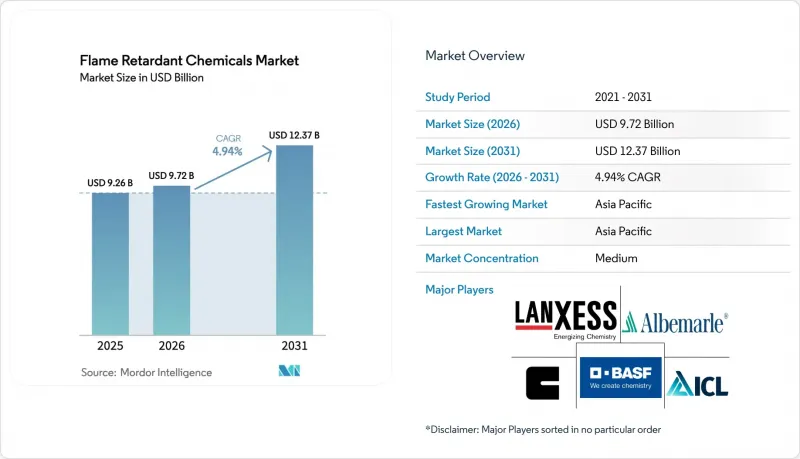
본 보고서는 제품 유형(비할로겐계 및 할로겐계), 용도(폴리올레핀, PVC, 에폭시 수지 등), 최종 사용자 산업(전기 및 전자, 건축 및 건설, 운송, 섬유·가구), 지역(아시아태평양, 유럽, 북미, 남미, 중동 및 아프리카)별로 분류되어 있습니다. 시장 예측은 금액(달러) 기준으로 제시되어 있습니다.
전 세계 난연성 화학제품 시장 동향 및 인사이트
건축 및 건설 분야의 엄격한 방화 규제
2024년판 ‘국제 방화 규정(International Fire Code)’에서는 허용되는 화염 전파 지수 및 발연 지수가 하향 조정됨에 따라, 설계자들은 경질 폴리우레탄 단열 보드에 팽창성 도료나 무할로겐 첨가제를 채택할 수밖에 없게 되었습니다. 영국의 ‘승인 문서 B(Approved Document B)’에 따라 2025년 6월부터 높이 11미터를 초과하는 가연성 외장재의 사용이 금지됨에 따라, 수요는 삼수산화알루미늄을 충전한 페놀계 발포체로 이동했습니다. 일본 건축기준법 개정에 따라 다층 목조 건축용 내화 등급이 추가되면서, JIS A 1321의 최대 발열량 제한을 충족하는 난연 처리 주문이 가속화되고 있습니다. 한국도 2024년 12월에 이에 발맞추어 ISO 5660-1을 준수함으로써 건축용 보드에서 기존의 할로겐계 첨가물을 배제했습니다. 이러한 규제 변경으로 인해 인증 절차가 세분화되었으며, 각 지역의 시험 프로토콜을 능숙하게 활용할 수 있는 공급업체가 유리한 입지를 점하고 있는 상황입니다.
아시아태평양의 급속한 인프라 확충
중국은 2024년 철도, 지하철, 주택 프로젝트에 17조 8,000억 위안(2조 5,000억 달러)을 배정하여 210만 톤의 무할로겐 폴리올레핀 케이블 컴파운드를 소비했습니다. 인도의 ‘국가 인프라 파이프라인’에서는 2025년까지 1조 4,000억 달러를 책정하고 있으며, 케이블 및 도관의 사양에 있어 IS 1554에 기반한 저연기·무할로겐 설계를 의무화하고 있습니다. 인도네시아에서는 2025년에 400억 달러 규모의 공항 및 항만 건설이 추가되었으며, ASTM E84 클래스 A를 충족하는 무할로겐계 에폭시 강재용 코팅이 채택되었습니다. 베트남에서는 2024년에 지하철 및 철도 예산을 22% 증액함에 따라 IEC 60332 규격을 준수하는 케이블에 대한 수요가 증가했습니다. 이러한 프로젝트들은 유럽과 미국의 건설 주기보다 빠른 속도로 진행되어 북미의 착공 둔화를 상쇄했습니다.
브롬계 및 할로겐계 화학 물질에 대한 규제 제한
EU의 POPs 규제에 따라 2024년에 재생 폴리머 내 HBCD 허용치가 10분의 1로 낮아져, 사실상 기존의 EPS 단열재가 순환 루프에서 배제되었습니다. EPA의 2025년 3월 TSCA 규정에 따르면, 항공우주 분야를 제외하고 2027년 1월 이후 데카-BDE의 제조가 금지됩니다. 캐나다는 TBBPA를 스케줄 1에 추가하고, PCB 라미네이트에 대한 24개월간의 단계적 폐지를 시작했습니다. 2024년 말에는 재고 확보를 위한 선행 구매로 인해 브롬의 현물 가격이 9% 하락했습니다. 한편, 일본의 염소화 파라핀 규제로 인해 4,200톤이 인계 대체품으로 전환되었습니다.
부문별 분석
2025년, 무할로겐 시스템은 난연성 화학제품 시장 전체의 65.08%를 차지하며, 이 점유율은 2031년까지 연평균 성장률(CAGR) 5.15%로 성장할 전망입니다. 수산화 알루미늄은 여전히 수요의 주축을 이루고 있으며, 180-200°C에서 흡열 분해되어 열을 흡수하는 동시에 수증기를 방출합니다. 후버(Huber)사의 ‘Martinal OL-107’은 2024년에 케이블에서 IEC 60754-2의 산성 가스 방출량을 0.5% 미만으로 억제하는 것을 가능하게 했습니다. 수산화마그네슘은 고온용 폴리올레핀에 대응하며, 마틴 마리에타(Martin Marietta)사의 ‘MagShield 95’는 입자 직경 중앙값 1.8µm으로 충격 특성과 난연 특성의 균형을 이루고 있습니다.
비할로겐계 난연성 화학제품 시장 규모는 그린빌딩 인증에 부합하는 저독성 소재에 대한 고객의 선호도를 반영하고 있습니다. 공급업체들은 폴리머 매트릭스와의 호환성을 높이는 표면 처리에 주력하는 한편, 수직 통합형 중국 제조업체들은 보크사이트나 인산염과 같은 원자재를 관리함으로써 가격 경쟁력을 높이고 있습니다. 지적 재산권 출원은 전기차(EV)용 배터리 팩을 위한 인-규소 하이브리드 소재에 집중되어 있으며, 리그닌 유래 페놀 수지를 사용한 초기 파일럿 시험에서는 유럽의 수명 주기 규제가 요구하는 매립 탄소량의 30% 감축이 입증되었습니다.
지역별 분석
아시아태평양은 2025년 매출의 50.65%를 차지하며, 연평균 성장률(CAGR) 5.69%를 나타낼 것으로 예측됩니다. 중국의 배터리 규정 ‘GB 31241’에 따라 기기 외장용 무할로겐 폴리카보네이트 수요가 22% 증가했으며, 인도의 규격 ‘IS 17156’ 도입으로 3대 대도시권의 지하철 배선 수요가 촉진되었습니다. 일본의 목조 건축용 방화 기준에 따라 팽창성 도료의 매출이 확대되었으며, 한국의 ISO 5660 준수에 따라 할로겐계 기판 첨가제가 대체되었습니다. 2024년을 목표로 총 42GW의 신규 생산 능력을 확충한 베트남, 인도네시아, 태국에서는 산업 플랜트 전반에 걸쳐 IEC 60332 준수 케이블에 대한 수요가 증가했습니다.
유럽에서는 PFAS 금지로 인해 발포재의 배합 변경이 불가피했고, 데카-BDE 규제가 PCB 라미네이트 시장에 혼란을 초래하여 성장이 둔화되었습니다. 독일에서는 HBCD를 포함한 재생 폴리스티렌의 소각 처분만을 의무화함으로써, 비할로겐계 버진 소재로의 대체가 촉진되었습니다. 한편, 영국의 외장재 금지 조치로 인해 14,000t의 페놀 폼 수요가 ATH 충전 등급으로 전환되었습니다. 프랑스의 수명 주기 규제와 이탈리아의 ‘슈퍼 보너스’ 세액 공제 제도에 따라 바이오 난연제가 활용되고 있으며, 리그닌·페놀계 소재의 혁신이 주목받고 있습니다.
북미에서는 2025년에 매출이 대폭 증가하며, 미국의 데이터센터 및 전기차(EV) 생산 확대에 따라 커넥터용 알루미늄 디에틸포스피네이트 수요가 급증하고 있습니다. EPA의 데카-BDE 금지 조치로 인해 각 OEM 업체들은 인계 난연제로의 전환을 강요받고 있으며, 캐나다의 개정판 ‘국가건축기준법’에서는 가연성 외벽 자재가 제한되고, 멕시코에서는 12GW 규모의 재생에너지 도입 계획에 따라,IEC 60332-3 규격에 부합하는 케이블이 요구되고 있습니다. 남미,중동 및 아프리카도 성장에 기여하고 있으며, 그 중심이 된 것은 ABNT NBR 17240에 기반한 브라질의 연기 감지기 하우징 업그레이드와, SASO 2663을 준수하는 실내 마감재를 규정하는 사우디아라비아의 ‘비전 2030’ 건설 프로그램입니다.
기타 혜택:
- 엑셀 형식 시장 예측(ME) 시트
- 3개월간의 애널리스트 지원
자주 묻는 질문
목차
제1장 서론
제2장 조사 방법
제3장 주요 요약
제4장 시장 구도
제5장 시장 규모와 성장 예측
제6장 경쟁 구도
제7장 시장 기회와 향후 전망
JHS 26.09.11According to Mordor Intelligence, the flame retardant chemicals market size is expected to grow from USD 9.26 billion in 2025 to USD 9.72 billion in 2026 and is forecast to reach USD 12.37 billion by 2031 at 4.94% CAGR over 2026-2031.
This report is Segmented by Product Type (Non-Halogenated and Halogenated), Application (Polyolefins, PVC, Epoxy Resins, and More), End-User Industry (Electrical and Electronics, Building and Construction, Transportation, and Textiles and Furniture), and Geography (Asia-Pacific, Europe, North America, South America, and Middle East and Africa). Market Forecasts are Provided in Terms of Value (USD).
Global Flame Retardant Chemicals Market Trends and Insights
Stringent Fire-Safety Regulations in Building and Construction
The 2024 International Fire Code lowered permissible flame-spread and smoke-development indices, compelling specifiers to adopt intumescent coatings and halogen-free additives in rigid polyurethane insulation boards. The United Kingdom's Approved Document B ban on combustible cladding above 11 meters, effective June 2025, shifted demand toward aluminum-trihydrate-filled phenolic foams. Japan's Building Standard Law revision added a fire-resistance class for multistory timber, accelerating orders for flame-retardant treatments that meet JIS A 1321 peak heat-release limits. South Korea followed in December 2024 by aligning with ISO 5660-1, removing legacy halogenated additives from building boards. Collectively, the rule changes fragmented certification pathways and rewarded suppliers adept at navigating local test protocols.
Rapid Infrastructure Build-Out Across Asia-Pacific
China allocated CNY 17.8 trillion (USD 2.5 trillion) to rail, metro, and housing projects in 2024, consuming 2.1 million t of halogen-free polyolefin cable compounds. India's National Infrastructure Pipeline earmarked USD 1.4 trillion through 2025, with cable and conduit specs mandating low-smoke zero-halogen designs under IS 1554. Indonesia added airport and seaport builds worth USD 40 billion in 2025, adopting non-halogenated epoxy steel coatings that pass ASTM E84 Class A. Vietnam boosted metro-rail budgets by 22% in 2024, raising IEC 60332 cable demand. These projects outstripped Western construction cycles, offsetting slower North American starts.
Regulatory Curbs on Brominated and Halogenated Chemistries
The EU's POPs Regulation cut allowable HBCD in recycled polymers tenfold in 2024, effectively removing legacy EPS insulation from circular loops. EPA's March 2025 TSCA rule bans deca-BDE manufacture after January 2027, except in aerospace. Canada added TBBPA to Schedule 1, initiating a 24-month PCB laminate phase-out. Inventory pre-buys depressed bromine spot prices 9% in late-2024, while Japanese controls on chlorinated paraffins diverted 4,200 t toward phosphorus alternatives.
Other drivers and restraints analyzed in the detailed report include:
- Rising Output of Consumer Electronics and Electrical Goods
- Shift Toward Non-Halogenated Solutions for ESG Compliance
- Raw-Material Cost Volatility
For complete list of drivers and restraints, kindly check the Table Of Contents.
Segment Analysis
Non-halogenated systems commanded 65.08% of the flame retardant chemicals market in 2025, and this share will expand at a 5.15% CAGR through 2031. Aluminum hydroxide remains the volume backbone, decomposing endothermically at 180-200°C to quench heat while releasing water vapor; Huber's Martinal OL-107 enabled IEC 60754-2 acid-gas emissions below 0.5% for cables in 2024. Magnesium hydroxide covers higher-temperature polyolefins, with Martin Marietta's MagShield 95 balancing impact and flame properties at 1.8 µm median size.
The flame retardant chemicals market size for non-halogenated products is reflecting customer preference for lower-toxicity materials that support green-building certifications. Suppliers focus on surface treatments that boost polymer-matrix compatibility, while vertically integrated Chinese producers sharpen price competition by controlling bauxite and phosphate feedstocks. Intellectual-property filings concentrate on phosphorus-silicon hybrids for EV battery packs, and early pilots for lignin-derived phenolics demonstrate 30% embodied-carbon cuts sought under Europe's life-cycle mandates.
Complete Report Scope:
- By Product Type
- Non-Halogenated Flame Retardants
- Inorganic
- Aluminum Hydroxide
- Magnesium Hydroxide
- Boron Compounds
- Phosphorus
- Nitrogen
- Other Product Types
- Inorganic
- Halogenated Flame Retardants
- Brominated Compounds
- Chlorinated Compounds
- Non-Halogenated Flame Retardants
- By Application
- Polyolefins
- PVC
- Epoxy Resins
- Engineering Thermoplastics (PA, PBT, PEEK, etc.)
- Unsaturated Polyester Resins
- Polyurethane
- By End-User Industry
- Electrical and Electronics
- Building and Construction
- Transportation
- Textiles and Furniture
- By Geography
- Asia-Pacific
- China
- India
- Japan
- South Korea
- Rest of Asia-Pacific
- Europe
- Germany
- United Kingdom
- France
- Italy
- Rest of Europe
- North America
- United States
- Canada
- Mexico
- South America
- Brazil
- Argentina
- Rest of South America
- Middle East and Africa
- Saudi Arabia
- South Africa
- Rest of Middle East and Africa
- Asia-Pacific
Geography Analysis
Asia-Pacific generated 50.65% of 2025 revenue and is forecast to grow at a 5.69% CAGR. China's GB 31241 battery regulations boosted halogen-free polycarbonate by 22% for device housings, and India's IS 17156 unlocked metro-rail wiring demand across three megacities. Japan's timber-building fire codes expanded intumescent-coating sales, and South Korea's ISO 5660 alignment displaced halogenated board additives. Vietnam, Indonesia, and Thailand, which together added 42 GW of new manufacturing in 2024, intensified the need for IEC 60332-compliant cables across industrial plants.
Europe lagged in growth as PFAS bans forced foam reformulations and deca-BDE restrictions disrupted PCB laminates. Germany directed HBCD-laden recycled polystyrene to incineration only, spurring virgin non-halogenated replacements, while the UK cladding ban steered 14,000 t of phenolic-foam demand to ATH-filled grades. France's life-cycle mandates and Italy's Superbonus tax credits mobilized bio-based flame retardants, pointing toward lignin-phenol innovations.
North America delivered a significant 2025 turnover, with U.S. data-center and EV ramps soaking up aluminum diethylphosphinate for connectors. EPA's deca-BDE ban pushes OEMs toward phosphorus solutions, Canada's updated National Building Code limits combustible cladding and Mexico's 12 GW of renewables requests IEC 60332-3 cables. South America and the Middle East & Africa also contributed, led by Brazil's smoke-detector housing upgrades under ABNT NBR 17240 and Saudi Arabia's Vision 2030 construction program that specifies SASO 2663-compliant interiors.
- Adeka Corporation
- Albemarle Corporation
- Avient Corporation
- BASF
- Clariant AG
- DIC Corporation
- Dow Inc.
- Eti Maden
- ICL Group
- Italmatch Chemicals SpA
- J.M. Huber Corp. (Huber Engineered Materials)
- LANXESS AG
- Martin Marietta
- MPI Chemie BV
- Nabaltec AG
- Nyacol Nano Technologies Inc.
- RIN KAGAKU KOGYO Co. Ltd
- RTP Company
- Sanwa Chemical Co. Ltd
- Showa Denko K.K.
- Sibelco NV (Specialty Alumina)
- Thor Group
- Tosoh Corporation
- UFP Industries Inc.
Additional Benefits:
- The market estimate (ME) sheet in Excel format
- 3 months of analyst support
TABLE OF CONTENTS
1 Introduction
- 1.1 Study Assumptions & Market Definition
- 1.2 Scope of the Study
2 Research Methodology
3 Executive Summary
4 Market Landscape
- 4.1 Market Overview
- 4.2 Market Drivers
- 4.2.1 Stringent fire-safety regulations in building and construction
- 4.2.2 Rapid infrastructure build-out across Asia-Pacific
- 4.2.3 Rising output of consumer electronics and electrical goods
- 4.2.4 Shift toward non-halogenated solutions for ESG compliance
- 4.2.5 EV-battery enclosure fire-performance standards
- 4.3 Market Restraints
- 4.3.1 Regulatory curbs on brominated / halogenated chemistries
- 4.3.2 Raw-material cost volatility
- 4.3.3 Emerging toxicity scrutiny on nano-metal hydroxides
- 4.4 Value Chain Analysis
- 4.5 Technological Outlook
- 4.6 Porter's Five Forces
- 4.6.1 Bargaining Power of Suppliers
- 4.6.2 Bargaining Power of Buyers
- 4.6.3 Threat of New Entrants
- 4.6.4 Threat of Substitutes
- 4.6.5 Degree of Competition
5 Market Size & Growth Forecasts (Value)
- 5.1 By Product Type
- 5.1.1 Non-Halogenated Flame Retardants
- 5.1.1.1 Inorganic
- 5.1.1.1.1 Aluminum Hydroxide
- 5.1.1.1.2 Magnesium Hydroxide
- 5.1.1.1.3 Boron Compounds
- 5.1.1.2 Phosphorus
- 5.1.1.3 Nitrogen
- 5.1.1.4 Other Product Types
- 5.1.1.1 Inorganic
- 5.1.2 Halogenated Flame Retardants
- 5.1.2.1 Brominated Compounds
- 5.1.2.2 Chlorinated Compounds
- 5.1.1 Non-Halogenated Flame Retardants
- 5.2 By Application
- 5.2.1 Polyolefins
- 5.2.2 PVC
- 5.2.3 Epoxy Resins
- 5.2.4 Engineering Thermoplastics (PA, PBT, PEEK, etc.)
- 5.2.5 Unsaturated Polyester Resins
- 5.2.6 Polyurethane
- 5.3 By End-User Industry
- 5.3.1 Electrical and Electronics
- 5.3.2 Building and Construction
- 5.3.3 Transportation
- 5.3.4 Textiles and Furniture
- 5.4 By Geography
- 5.4.1 Asia-Pacific
- 5.4.1.1 China
- 5.4.1.2 India
- 5.4.1.3 Japan
- 5.4.1.4 South Korea
- 5.4.1.5 Rest of Asia-Pacific
- 5.4.2 Europe
- 5.4.2.1 Germany
- 5.4.2.2 United Kingdom
- 5.4.2.3 France
- 5.4.2.4 Italy
- 5.4.2.5 Rest of Europe
- 5.4.3 North America
- 5.4.3.1 United States
- 5.4.3.2 Canada
- 5.4.3.3 Mexico
- 5.4.4 South America
- 5.4.4.1 Brazil
- 5.4.4.2 Argentina
- 5.4.4.3 Rest of South America
- 5.4.5 Middle East and Africa
- 5.4.5.1 Saudi Arabia
- 5.4.5.2 South Africa
- 5.4.5.3 Rest of Middle East and Africa
- 5.4.1 Asia-Pacific
6 Competitive Landscape
- 6.1 Market Concentration
- 6.2 Strategic Moves
- 6.3 Market Share(%)/Ranking Analysis
- 6.4 Company Profiles (includes Global level Overview, Market level overview, Core Segments, Financials as available, Strategic Information, Market Rank/Share for key companies, Products & Services, and Recent Developments)
- 6.4.1 Adeka Corporation
- 6.4.2 Albemarle Corporation
- 6.4.3 Avient Corporation
- 6.4.4 BASF
- 6.4.5 Clariant AG
- 6.4.6 DIC Corporation
- 6.4.7 Dow Inc.
- 6.4.8 Eti Maden
- 6.4.9 ICL Group
- 6.4.10 Italmatch Chemicals SpA
- 6.4.11 J.M. Huber Corp. (Huber Engineered Materials)
- 6.4.12 LANXESS AG
- 6.4.13 Martin Marietta
- 6.4.14 MPI Chemie BV
- 6.4.15 Nabaltec AG
- 6.4.16 Nyacol Nano Technologies Inc.
- 6.4.17 RIN KAGAKU KOGYO Co. Ltd
- 6.4.18 RTP Company
- 6.4.19 Sanwa Chemical Co. Ltd
- 6.4.20 Showa Denko K.K.
- 6.4.21 Sibelco NV (Specialty Alumina)
- 6.4.22 Thor Group
- 6.4.23 Tosoh Corporation
- 6.4.24 UFP Industries Inc.
7 Market Opportunities & Future Outlook
- 7.1 White-space & Unmet-need Assessment
- 7.2 Active R&D into Non-halogenated Flame Retardants


