

|
시장보고서
상품코드
2114920
종이 코팅 재료 시장 : 시장 점유율 분석, 업계 동향 및 통계, 성장 예측(2026-2031년)Paper Coating Material - Market Share Analysis, Industry Trends & Statistics, Growth Forecasts (2026 - 2031) |
||||||
 Mordor Intelligence
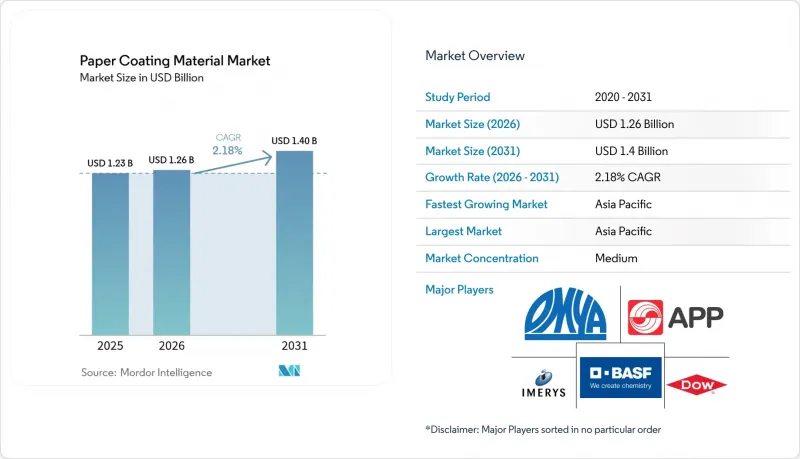
Mordor Intelligence에 의하면, 종이 코팅 재료 시장 규모는 2025년 12억 3,000만 달러로 평가되었고, 2026년에는 12억 6,000만 달러로 추정되고, 2026-2031년 CAGR 2.18%로 성장을 지속할 전망이며, 2031년에는 14억 달러에 이를 것으로 예측됩니다.
본 보고서는 코팅 재료별(클레이, 탄산칼슘, 전분,탈크, 이산화티타늄, 왁스, 폴리머, 기타 코팅 재료), 용도별(포장, 제본, 인쇄, 골판지 상자, 기타 용도), 지역별(아시아태평양, 북미, 유럽, 남미, 중동 및 아프리카)로 분류되어 있습니다. 시장 전망은 금액(달러) 기준으로 제시되어 있습니다.
세계의 용종이 코팅 재료 시장 동향 및 인사이트
인쇄 및 포장 산업 수요 증가
각국 정부가 일회용 플라스틱을 규제하는 가운데, 브랜드 소유자들은 지속 가능한 포장으로 전환하고 있으며, 이로 인해 차단성, 인쇄 적합성, 미적 특성을 제공하기 위해 코팅된 종이 기판에 대한 전반적인 수요가 증가하고 있습니다. 2024년에는 전자상거래 처리량이 12.3% 증가했으며, 이에 따라 골판지 상자 출하량이 사상 최고 수준에 도달했고, 출하되는 골판지 상자 1,000개당 코팅 소비량도 증가했습니다. 고급 럭셔리 포장 분야에서는 고광택 마감을 구현하는 다층 코팅이 채택되어, 대량 인쇄 처리량이 감소하는 상황에서도 이익률 확대를 뒷받침하고 있습니다. 공급망 이해관계자들은 냉동 식품 및 즉석식사 포장 분야에서 필름을 종이로 대체할 수 있게 해주는 특수한 화학 성분을 공동 개발하는 움직임을 강화하고 있습니다. 이러한 수요 동향으로 인해 인쇄량의 구조적 감소에도 불구하고 제지 공장의 가동률은 높은 수준을 유지하고 있습니다.
일회용 플라스틱에 대한 규제 및 금지 조치가 종이로의 대체를 촉진하고 있습니다.
유럽연합(EU)이 2025년까지 포장재 재활용률 65%를 의무화함에 따라, 식품 접촉 및 재활용 가능성 기준을 충족하는 코팅지 솔루션으로의 전환이 가속화되고 있습니다. 북미와 유럽에서의 PFAS 단계적 폐지 조치로 인해 불소계 코팅 옵션이 배제되면서, 엄격한 전환 기준을 준수하는 탄산칼슘 및 폴리머 기반 대체재에 대한 수요가 발생하고 있습니다. EN 13432 및 ISO 12625와 같은 규격은 공급업체의 생분해성 코팅 개발을 촉진하고 있습니다. 확대 생산자 책임(EPR) 법에 따라 브랜드들은 매립 처분 비용을 피할 수 있는 포장을 채택해야 하는 압박을 받고 있으며, 그 결과 코팅지가 설계 결정의 중심에 자리 잡고 있습니다. 지역 간 규제의 조화로 인해 전 세계적으로 통일된 코팅 등급의 상품화 주기가 단축되고 있습니다.
디지털 미디어에 의한 인쇄물 수요의 잠식
디지털 미디어의 소비 패턴이 영구적으로 전자 형태로 전환됨에 따라, 기존 인쇄 용도는 구조적인 감소를 겪고 있으며, 코팅 인쇄용지 수요가 감소하고 있습니다. 상업 인쇄의 인쇄량은 2020년 이후 연평균 4.2% 감소하고 있으며, 특히 신문 및 잡지 부문에서 가장 급격한 축소가 나타나고 있습니다. 도서 인쇄는 비교적 안정적인 상태를 유지하고 있지만, 교육 출판의 디지털화로 인해 선진국 시장에서 교과서용 코팅지 수요는 감소하고 있습니다. 이러한 전환으로 인해 인쇄용 코팅지 생산에 과잉 생산 능력이 발생하여 이익률을 압박하는 동시에, 공급업체들이 포장 용도로 전환할 수밖에 없게 만들고 있습니다. 인쇄 용도에 최적화된 기존 코팅지 배합은 포장 성능 요건을 충족하기 위해 재배합이 필요한 경우가 많아, 그 결과 전환 비용 및 기술적 과제가 발생하고 있습니다.
부문 분석
2025년, 탄산칼슘은 제종이 코팅 재료 시장에서 41.92%의 점유율을 차지했으며, 같은 해 제종이 코팅 재료 시장 전체 규모에서 가장 큰 기여 요인이 되었습니다. 그러나 식품 포장에는 광물성 재료만으로는 제공할 수 없는 방습 및 방유성이 요구되기 때문에 폴리머계 코팅은 연평균 성장률(CAGR) 3.07%로 가장 빠른 성장세를 보이고 있습니다.
전분계 화학제품은 재생 가능성과 경쟁 경제성을 겸비하고 있어, 퇴비화 가능한 스낵 포장재 분야에서 브랜드들의 지지를 얻고 있습니다. 탈크와 이산화티타늄은 광택과 매끄러움 측면에서 틈새 역할을 하고 있지만, 비용이 높기 때문에 그 보급은 프리미엄 등급으로 제한되어 있습니다. 왁스 배합은 신선 식품 및 냉동 식품의 수분 관리에 있어 여전히 주류를 이루고 있지만, 바이오 폴리머 기술이 성숙해짐에 따라 그 점유율은 축소되는 추세입니다. 각 공급업체들은 CaCO3의 산란 효율과 폴리머의 밀봉성을 결합하여 성능과 가격의 균형을 맞춘 광물과 폴리머의 하이브리드 시스템을 점점 더 적극적으로 추진하고 있습니다.
지역별 분석
아시아태평양은 2025년에 전 세계 소비량의 46.88%를 차지했으며, 연평균 성장률(CAGR) 3.39%로 확대될 것으로 예측되어, 제종이 코팅 재료 시장 전망 수요 규모와 구성을 형성하는 데 중심적인 역할을 하고 있음이 부각되고 있습니다. 중국의 생산량 7.2% 증가에 더해 인도의 포장 제품 생산량 급증까지 맞물리면서 생산량 증가세가 지속되고 있습니다. 비용 경쟁력이 있는 노동력, 밀집된 원료 네트워크, 정부 지원에 의한 인프라가 지역 공급망의 기반이 되어 선순환을 창출하는 제조 거점 형성을 촉진하고 있습니다.
북미에서는 규모는 크지만 성숙한 수요가 유지되고 있으며, 단순한 양보다 혁신이 더 중시되고 있습니다. FDA의 이행 규정에 부합하는 식품 등급 분산 배리어는 프리미엄 가격을 형성하고 있으며, 제지 제조업체들은 이러한 추세에 맞추어 재활용 가능한 컵 원지를 공급하기 위해 커튼 코터 개조를 점점 더 적극적으로 추진하고 있습니다. 유럽에서는 순환 경제 목표에 부합하는 정책에 따라 구매자들이 생분해성 코팅으로 전환하고 있으며, 2025년까지 65%의 재활용 목표가 설정됨에 따라 새로운 화학 성분의 인증 절차가 가속화되고 있습니다.
남미와 중동 및 아프리카는 아직 발전 단계에 있지만, 도시화와 소매업의 확장으로 인해 1인당 포장재 사용량은 증가하고 있습니다. 브라질에서는 GDP 성장세가 회복되며 골판지 출하량이 회복되고 있는 반면, 사우디아라비아의 ‘비전 2030’에 따른 현지화 인센티브가 다국적 제지 제조업체들의 코팅 라인 투자를 유도하고 있습니다. 공급망 리스크, 환율 변동, 정치적 불확실성이 성장 속도를 둔화시키고 있지만, 선구적인 공급업체들은 합작 투자 및 현지 기술 서비스 센터를 통해 기반을 다지고 있습니다.
기타 혜택
- 엑셀 형식 시장 예측(ME) 시트
- 3개월간의 애널리스트 지원
자주 묻는 질문
목차
제1장 서론
제2장 조사 방법
제3장 주요 요약
제4장 시장 구도
제5장 시장 규모 및 성장 예측
제6장 경쟁 구도
제7장 시장 기회 및 향후 전망
AJY 26.08.28According to Mordor Intelligence, the paper coating material market size is expected to grow from USD 1.23 billion in 2025 to USD 1.26 billion in 2026 and is forecast to reach USD 1.4 billion by 2031 at 2.18% CAGR over 2026-2031.
This report is Segmented by Coating Material (Clay, Calcium Carbonate, Starch, Talc, Titanium Dioxide, Wax, Polymer, and Other Coating Materials), Application (Packaging, Binding, Printing, Corrugated Boxes, and Other Applications), and Geography (Asia-Pacific, North America, Europe, South America, and Middle-East and Africa). The Market Forecasts are Provided in Terms of Value (USD).
Global Paper Coating Material Market Trends and Insights
Growing Demand From Printing and Packaging Industry
Brand owners pivot toward sustainable packaging as governments restrict single-use plastics, lifting overall demand for paper substrates coated to provide barrier, printability, and aesthetic attributes. E-commerce volumes climbed 12.3% in 2024, driving unprecedented corrugated-box throughput and elevating coating consumption per thousand boxes shipped. Premium luxury packaging uses multilayer coatings that deliver high-gloss finishes, supporting margin expansion even as mass-print volumes taper. Supply-chain stakeholders increasingly co-develop specialized chemistries that enable paper to replace film in frozen-food and ready-meal packaging. This demand profile maintains high mill utilization despite structural declines in print volumes.
Regulatory Bans on Single-Use Plastics Boosting Paper Substitution
The European Union's 65% recycling mandate for packaging by 2025 accelerates migration toward coated paper solutions that meet food-contact and recyclability benchmarks. PFAS phase-outs in North America and Europe eliminate fluorinated options, creating space for calcium-carbonate- and polymer-based alternatives that comply with stringent migration limits. Standards such as EN 13432 and ISO 12625 encourage suppliers to engineer biodegradable coatings. Extended producer responsibility laws pressure brands to adopt packaging that avoids landfill fees, placing coated paper formats at the center of design decisions. Regulatory alignment across regions shortens commercialization cycles for globally uniform coating grades.
Digital Media Cannibalising Print Volumes
Traditional print applications are facing a structural decline as digital media consumption patterns shift permanently toward electronic formats, reducing demand for coated printing papers. Commercial printing volumes declined 4.2% annually since 2020, with newspaper and magazine segments experiencing the steepest contractions. Book printing maintains relative stability, but the digital transformation of educational publishing reduces demand for textbook coating in developed markets. The transition creates overcapacity in print-grade coating production, which pressures margins and forces suppliers to pivot toward packaging applications. Legacy coating formulations optimized for print applications often require reformulation to meet packaging performance requirements, resulting in transition costs and technical challenges.
Other drivers and restraints analyzed in the detailed report include:
- E-Commerce-Led Surge in Corrugated and Flexible Paper Packaging
- Cost-Effective Optical Performance of Calcium-Carbonate-Rich Coatings
- Volatile Prices of Pulp, Minerals and Latex Binders
For complete list of drivers and restraints, kindly check the Table Of Contents.
Segment Analysis
Calcium carbonate held 41.92% of the paper coating materials market share in 2025, translating into the single largest contributor to the total paper coating materials market size that year. Polymer coatings, however, exhibit the fastest growth at a 3.07% CAGR because food packaging requires moisture and grease barriers that minerals alone cannot provide.
Starch-based chemistries win brand favor in compostable snack packs, merging renewability with competitive economics. Talc and titanium dioxide serve niche roles in terms of brightness or smoothness, yet their higher cost limits their penetration to premium grades. Wax formulations remain a staple for controlling moisture in produce and frozen foods, although their share is shrinking as bio-based polymers mature. Suppliers are increasingly promoting hybrid mineral-polymer systems that combine the scattering efficiency of CaCO3 with polymeric sealing to balance performance and price.
Complete Report Scope:
- By Coating Material
- Clay
- Calcium Carbonate
- Starch
- Talc
- Titanium Dioxide
- Wax
- Polymer
- Other Coating Materials
- By Application
- Packaging
- Binding
- Printing
- Corrugated Boxes
- Other Applications
- Other Applications
- By Geography
- Asia-Pacific
- China
- India
- Japan
- South Korea
- Malaysia
- Thailand
- Indonesia
- Vietnam
- Rest of Asia-Pacific
- North America
- United States
- Canada
- Mexico
- Europe
- Germany
- United Kingdom
- France
- Italy
- Spain
- Turkey
- Russia
- NORDICS Countries
- Rest of Europe
- South America
- Brazil
- Argentina
- Colombia
- Rest of South America
- Middle-East and Africa
- Saudi Arabia
- Qatar
- South Africa
- United Arab Emirates
- Egypt
- Rest of Middle-East and Africa
- Asia-Pacific
Geography Analysis
The Asia-Pacific region represented 46.88% of global consumption in 2025 and is projected to advance at a 3.39% CAGR, underscoring its central role in shaping the future scale and mix of paper coating materials market demand. China's 7.2% production increase, combined with India's surging packaged-goods output, sustains incremental tonnage. Cost-competitive labor, dense raw-material networks, and government-supported infrastructure foster a self-reinforcing manufacturing hub that anchors regional supply chains.
North America sustains a sizable but mature demand where innovation carries more weight than sheer volume. Food-grade dispersion barriers compliant with FDA migration rules command premium pricing, and mills increasingly retrofit curtain coaters to deliver on-trend recyclable cupstock. Europe's policy alignment with circular-economy goals moves buyers toward biodegradable coatings, and the 65% recycling target by 2025 accelerates qualification cycles for new chemistries.
South America and the Middle East & Africa evolve from nascent baselines, but urbanization and retail expansion raise per-capita packaging use. Brazil's return to GDP growth revives corrugated shipments, while Saudi Arabia's Vision 2030 localization incentives attract coating-line investments from multinational paper producers. Supply-chain risk, currency volatility, and political uncertainty temper pace, yet first-mover suppliers secure footholds through joint ventures and in-country technical-service centers.
- APP Group
- BASF
- Burgo Group SpA
- Celanese Corporation
- CLARIANT
- Dow
- Eastman Chemical Company
- Imerys
- Ingredion
- JK Paper
- Michelman Inc.
- Minerals Technologies Inc.
- Mondi
- NIPPON PAPER INDUSTRIES CO., LTD.
- OMNOVA North America Inc.
- Omya International AG
- Sappi Ltd
- Stora Enso Oyj
- Twin Rivers Paper Company.
- UPM-Kymmene Oyj
Additional Benefits:
- The market estimate (ME) sheet in Excel format
- 3 months of analyst support
TABLE OF CONTENTS
1 Introduction
- 1.1 Study Assumptions & Market Definition
- 1.2 Scope of the Study
2 Research Methodology
3 Executive Summary
4 Market Landscape
- 4.1 Market Overview
- 4.2 Market Drivers
- 4.2.1 Growing demand from printing and packaging industry
- 4.2.2 Regulatory bans on single-use plastics boosting paper substitution
- 4.2.3 E-commerce-led surge in corrugated and flexible paper packaging
- 4.2.4 Cost-effective optical performance of calcium-carbonate-rich coatings
- 4.2.5 Mill-scale barrier-coating lines coming online post-2025
- 4.3 Market Restraints
- 4.3.1 Digital media cannibalising print volumes
- 4.3.2 Volatile prices of pulp, minerals and latex binders
- 4.3.3 Rising compliance costs for VOC and wastewater emissions
- 4.4 Value Chain Analysis
- 4.5 Porter's Five Forces
- 4.5.1 Bargaining Power of Suppliers
- 4.5.2 Bargaining Power of Buyers
- 4.5.3 Threat of New Entrants
- 4.5.4 Threat of Substitutes
- 4.5.5 Degree of Competition
5 Market Size & Growth Forecasts (Value)
- 5.1 By Coating Material
- 5.1.1 Clay
- 5.1.2 Calcium Carbonate
- 5.1.3 Starch
- 5.1.4 Talc
- 5.1.5 Titanium Dioxide
- 5.1.6 Wax
- 5.1.7 Polymer
- 5.1.8 Other Coating Materials
- 5.2 By Application
- 5.2.1 Packaging
- 5.2.2 Binding
- 5.2.3 Printing
- 5.2.4 Corrugated Boxes
- 5.2.5 Other Applications
- 5.2.6 Other Applications
- 5.3 By Geography
- 5.3.1 Asia-Pacific
- 5.3.1.1 China
- 5.3.1.2 India
- 5.3.1.3 Japan
- 5.3.1.4 South Korea
- 5.3.1.5 Malaysia
- 5.3.1.6 Thailand
- 5.3.1.7 Indonesia
- 5.3.1.8 Vietnam
- 5.3.1.9 Rest of Asia-Pacific
- 5.3.2 North America
- 5.3.2.1 United States
- 5.3.2.2 Canada
- 5.3.2.3 Mexico
- 5.3.3 Europe
- 5.3.3.1 Germany
- 5.3.3.2 United Kingdom
- 5.3.3.3 France
- 5.3.3.4 Italy
- 5.3.3.5 Spain
- 5.3.3.6 Turkey
- 5.3.3.7 Russia
- 5.3.3.8 NORDICS Countries
- 5.3.3.9 Rest of Europe
- 5.3.4 South America
- 5.3.4.1 Brazil
- 5.3.4.2 Argentina
- 5.3.4.3 Colombia
- 5.3.4.4 Rest of South America
- 5.3.5 Middle-East and Africa
- 5.3.5.1 Saudi Arabia
- 5.3.5.2 Qatar
- 5.3.5.3 South Africa
- 5.3.5.4 United Arab Emirates
- 5.3.5.5 Egypt
- 5.3.5.6 Rest of Middle-East and Africa
- 5.3.1 Asia-Pacific
6 Competitive Landscape
- 6.1 Market Concentration
- 6.2 Strategic Moves
- 6.3 Market Share/Ranking Analysis
- 6.4 Company Profiles (includes Global level Overview, Market level overview, Core Segments, Financials as available, Strategic Information, Market Rank/Share for key companies, Products & Services, and Recent Developments)
- 6.4.1 APP Group
- 6.4.2 BASF
- 6.4.3 Burgo Group SpA
- 6.4.4 Celanese Corporation
- 6.4.5 CLARIANT
- 6.4.6 Dow
- 6.4.7 Eastman Chemical Company
- 6.4.8 Imerys
- 6.4.9 Ingredion
- 6.4.10 JK Paper
- 6.4.11 Michelman Inc.
- 6.4.12 Minerals Technologies Inc.
- 6.4.13 Mondi
- 6.4.14 NIPPON PAPER INDUSTRIES CO., LTD.
- 6.4.15 OMNOVA North America Inc.
- 6.4.16 Omya International AG
- 6.4.17 Sappi Ltd
- 6.4.18 Stora Enso Oyj
- 6.4.19 Twin Rivers Paper Company.
- 6.4.20 UPM-Kymmene Oyj
7 Market Opportunities & Future Outlook
- 7.1 White-space and Unmet-Need Assessment


