

|
시장보고서
상품코드
2114921
폼 테이프 시장 : 점유율 분석, 업계 동향과 통계, 성장 예측(2026-2031년)Foam Tape - Market Share Analysis, Industry Trends & Statistics, Growth Forecasts (2026 - 2031) |
||||||
 Mordor Intelligence
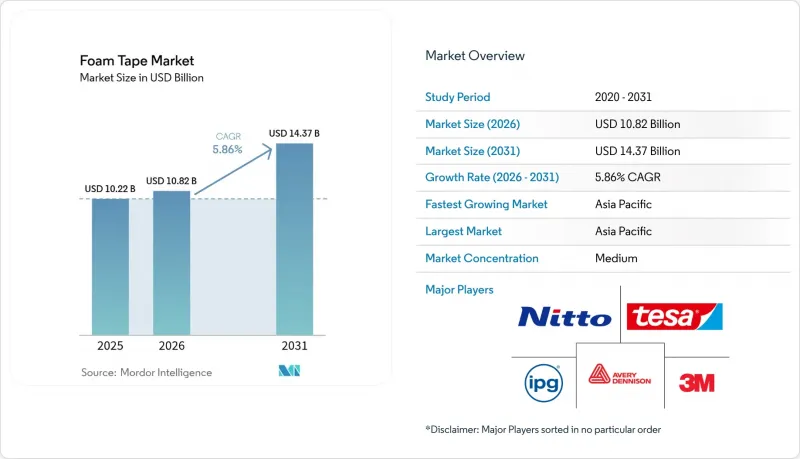
Mordor Intelligence에 의하면, 폼 테이프 시장 규모는 2025년에 102억 2,000만 달러로 평가되었고 2026년 108억 2,000만 달러에서 2031년까지 143억 7,000만 달러에 이를 것으로 예측되며, 예측 기간(2026-2031년) CAGR은 5.86%를 나타낼 전망입니다.
본 보고서에서는 업계를 폼의 유형(폴리에틸렌, 폴리우레탄, 네오프렌, 아크릴 등), 테이프의 유형(단면 폼 테이프, 양면 폼 테이프), 수지의 유형(고무, 실리콘,아크릴, EVA 등), 기술(용제계, 수계 등), 최종 사용자 산업(자동차, 건설, 전기 및 전자, 기타), 지역(아시아태평양, 북미, 기타)별로 분류하고 있습니다.
세계 폼 테이프 시장 동향 및 인사이트
급증하는 개보수 공사 수요
리모델링 프로그램은 20년 동안 미국 건축물의 배출량을 73% 감축하는 것을 목표로 하고 있으며, 폼 테이프는 구조적 하중을 추가하지 않고 열교를 차단하는 데 도움이 됩니다. ‘인플레이션 억제법’에서는 저소득층을 위한 리모델링 프로젝트에 90억 달러가 배정되어, 고객 기반이 상업 부문을 넘어 확대되고 있습니다. 2024년에 개정된 국제 건축 기준(IBC) 규정에서는 파사드 자재에 대해 더 엄격한 화염 전파 지수 기준을 충족할 것을 요구하고 있어, 내화 성능을 갖춘 폼 테이프에 대한 수요가 증가하고 있습니다. EU의 ‘포장 및 포장 폐기물 규정’에서도 유사한 추세가 나타나고 있으며, 해체 시 깨끗한 분리 수거가 가능한 재활용 가능한 단열 시스템이 권장되고 있습니다. 이러한 정책적 지원이 더해지면서, 리모델링 공사는 에너지 절약, 안전성, 순환 경제가 융합된 급성장 분야로 자리매김하고 있습니다.
전자상거래 포장 분야에서의 폼 테이프로의 급속한 전환
자동화된 풀필먼트 센터에서는 높은 라인 속도로 가동되기 때문에 기계식 밀봉 방식보다 접착식 솔루션이 유리합니다. 전 세계 씰링 테이프 및 스트랩 테이프 시장은 2024년에 253억 6,000만 달러에 달하고, 폼 테이프는 소포 네트워크의 파손률을 낮춤으로써 시장 점유율을 확대되고 있습니다. 알스트롬(Arstrom)사의 재활용 가능한 기판은 소매업체가 요구하는 ‘가정 쓰레기로 재활용 가능한 포장재’라는 요건을 충족합니다. 공기 주입식 완충재에 비해 뛰어난 완충 성능으로 온도 변동 속에서도 상품을 확실하게 보호합니다. 이는 물류 혼란으로 인해 서비스 수준 위반에 따른 벌금이 증가하고 있는 상황에서 결정적인 요인이 됩니다. 각 브랜드사가 공급망의 불확실성에 대한 헤지 수단으로 포장의 신뢰성을 중시함에 따라, 이러한 전환은 더욱 가속화되고 있으며, 고품질 폼 테이프의 꾸준한 보급을 뒷받침하고 있습니다.
이소시아네이트 및 석유계 원자재 가격 변동
2024년 초, MDI 및 TDI 비용이 급등하여 폴리우레탄 수지 가격을 끌어올렸고, 현물 구매에 의존하는 테이프 가공업체의 이익률을 압박했습니다. 같은 분기, 자동차 업계 수요가 25% 감소함에 따라 원자재 할증료와 판매량 감소가 겹치며 이익률 압박이 더욱 심화되었습니다. 장기 공급 계약을 체결하지 않은 중소규모 컨버터들은 현금 유동성난에 직면했고, 규모의 경제 효과를 추구하는 대기업들의 인수가 잇따랐습니다. 원료 공급업체와의 제휴나 비이소시아네이트계 폴리우레탄의 연구 개발이 진행되고 있지만, 이러한 해결책에는 수년에 걸친 검증이 필요하기 때문에 단기적으로는 가격 변동이 우려 요인으로 남아 있습니다.
부문별 분석
폴리에틸렌은 건설 및 포장 수요를 충족하는 성숙한 공급망과 저렴한 비용 덕분에 2025년에는 38.72%의 점유율을 차지하며 부문을 주도했습니다. 폴리에틸렌 폼 테이프 시장 규모는 2025년에 39억 6,000만 달러에 달할 것으로 예상되지만, 규제로 인해 사용자들이 보다 친환경적인 화학 물질로 전환함에 따라 성장세는 둔화되고 있습니다. 바이오 및 특수 배합을 포함한 기타 폼 테이프는 연평균 성장률(CAGR) 6.83%로 확대되고 있으며, 이는 전체 부문 중 가장 높은 수치입니다. 폴리우레탄계 제품은 EU의 디이소시아네이트 규제로 인해 역풍에 직면하고 있으며, 이러한 제약으로 인해 본질적으로 위험성이 낮은 아크릴계 및 실리콘계 제품으로 수요가 이동하고 있습니다.
옥수수나 피마자유 원료를 사용하는 바이오 폴리우레탄은 탄소 발자국을 30-50% 줄일 수 있으며, Wanhua사의 폴리에테르 폴리올은 현재 압축 영구 변형 및 전단에 관한 자동차 업계의 기준을 충족하고 있습니다. 프라운호퍼 연구소의 FOIM 기술은 라미네이팅 공정 중에 얇은 폴리우레탄 박이 발포함으로써 제조 시 이소시아네이트에 대한 노출을 제거하는 동시에 운송량을 줄이고 있습니다. 미네소타주의 한 학술 연구소에서는 접착 강도는 동등하면서도 온화한 퇴비화 조건에서 분해되는 캐슈넛 껍질 유래 트리블록 공중합체의 양산화를 추진하고 있습니다. 이러한 획기적인 진전은 가까운 미래의 전환을 예감하게 하지만, 비용 중심의 용도에서는 여전히 규모 확대의 경제성 측면에서 기존의 PE가 유리한 상황입니다.
단면 테이프는 개스킷, 틈새 충전, 웨더스트립 등에서의 범용성을 무기로 2025년에는 매출의 61.68%를 차지했습니다. 폼 테이프의 단면 유형 시장 점유율은 견조한 추세를 보이고 있는데, 이는 건설업체와 OEM이 익숙한 시공 방법과 폭넓은 공급업체 선택지를 중시하기 때문입니다. 양면 테이프는 규모는 작지만, EV용 배터리 모듈, 파사드 패널 및 전자기기 베젤 접착과 같은 분야에서 양면 접착을 통해 조립 공정을 줄일 수 있는 강점을 활용하여 2031년까지 연평균 성장률(CAGR) 7.02%를 나타낼 것으로 예측됩니다.
에이버리 데니슨(Avery Dennison)은 EVB 테이프를 구조 부품 고정용 리벳의 대체품으로 포지셔닝하여, 차량 1대당 5-10달러의 부가가치를 창출하는 설계를 채택하고 있습니다. 테사(Tesa)사의 ‘Debonding on Demand’ 시리즈는 저열 공구로 박리할 수 있어 디바이스 수리가 가능하며, 소비자용 전자기기의 순환형 설계 지침을 충족합니다. 범용 단면 제품은 여전히 가격 주도형 시장이지만, OEM 인증 주기에 따라 프리미엄 양면 테이프 제품 라인은 안정적인 입지를 확보하고 있어, 절대적인 판매 수량 감소를 보다 건전한 기여 이익률로 상쇄하고 있습니다.
지역별 분석
아시아태평양은 2025년에 매출 점유율 41.63%를 차지하며 시장을 독점하고, 2031년까지 연평균 성장률(CAGR) 6.72%로 선두 자리를 유지할 전망입니다. 중국은 전기차 및 가전제품 생산 거점으로서 최대 점유율을 차지하고 있는 반면, 인도는 ‘생산 연계 인센티브(PLI) 제도’에 힘입어 전자 분야에서 두 자릿수 성장을 달성하고 있습니다. 한국과 일본은 반도체 및 첨단 소재 분야의 프리미엄 수요를 주도하고 있습니다. 중국의 자동차 내장재에 대한 VOC 규제로 인해 초저배출 테이프의 채택이 가속화되고 있으며, 이러한 기준이 수출 시장에도 파급되고 있어 전 세계 공급업체들은 우선 중국의 기준을 충족하는 인증을 취득할 수밖에 없는 상황입니다.
북미에서는 ‘인플레이션 억제법’과 관련된 90억 달러 규모의 개보수 자금을 바탕으로 꾸준한 성장이 나타나고 있습니다. 폼 테이프는 창문 방수 처리, 파사드 접합부 및 HVAC 덕트 개보수에 적합하며, 중장비를 필요로 하지 않아 신속한 프로젝트 진행이 가능합니다. 소노코(Sonoco)사는 올랜도에서 접착제 포장 생산 능력 확대에 3,000만 달러를 투자하고 있으며, 이는 해당 지역 수요에 대한 자신감을 보여줍니다. 니어쇼어링의 진전에 따라 멕시코는 폴리우레탄 소비량에서 세계 4위를 차지하며, 미국 자동차 공장에 대한 단거리 공급을 실현하고 있습니다. 북미 대륙에서는 지자체 허가 취득 절차를 신속화하는 UL 및 NFPA 인증을 획득한 공급업체가 우대받고 있습니다.
유럽에서는 엄격한 환경 규제 준수와 소재 혁신 간의 균형이 맞추어지고 있습니다. 2023년에 시행된 디이소시아네이트 관련 규제로 인해 사용자들은 아크릴계 및 실리콘계 시스템으로 전환하는 경향을 보이고 있습니다. 생고뱅이 FOSROC사를 10억 2,500만 달러에 인수한 것은 건설용 화학제품 포트폴리오 강화를 목적으로 한 업계 재편의 한 예입니다. 독일의 OEM 기업들은 경량 차체 패널에 난연성 접착제 사용을 지정하고 있는 반면, 프랑스의 항공우주 부문에서는 객실 내장재용으로 FST 인증을 받은 발포재가 요구되고 있습니다. EU의 순환 경제 정책은 재활용 가능성을 의무화하고 있어, 단일 소재 구조에 대한 연구 개발이 촉진되고 있습니다. 이러한 지속 가능한 솔루션을 다른 대륙으로 수출하는 것은 유럽 본사의 수익 다각화를 뒷받침하고 있습니다.
기타 혜택:
- 엑셀 형식 시장 예측(ME) 시트
- 3개월간의 애널리스트 지원
자주 묻는 질문
목차
제1장 서론
제2장 조사 방법
제3장 주요 요약
제4장 시장 구도
제5장 시장 규모와 성장 예측
제6장 경쟁 구도
제7장 시장 기회와 향후 전망
JHS 26.08.26According to Mordor Intelligence, the foam tape market size was valued at USD 10.22 billion in 2025 and estimated to grow from USD 10.82 billion in 2026 to reach USD 14.37 billion by 2031, at a CAGR of 5.86% during the forecast period (2026-2031).
This report Segments the Industry Into Foam Type (Polyethylene, Polyurethane, Neoprene, Acrylic, and More), Tape Type (Single Sided Foam Tape, Double Sided Foam Tape), Resin Type (Rubber, Silicone, Acrylic, EVA, and More), Technology (Solvent-Based, Water-Based, and More), End-User Industry (Automotive, Construction, Electrical and Electronics, and More), and Geography (Asia-Pacific, North America, and More).
Global Foam Tape Market Trends and Insights
Booming Retrofit Construction Demand
Retrofit programs aim for a 73% emission cut in US buildings over twenty years, and foam tapes help close thermal bridges without adding structural load. The Inflation Reduction Act allocates USD 9 billion to low-income retrofit projects, broadening the customer base beyond commercial segments. Updated 2024 International Building Code provisions require facade materials to meet tougher flame-spread indices, lifting demand for fire-rated foam tapes. Similar direction in the EU Packaging and Packaging Waste Regulation promotes recyclable insulation systems that enable clean separation during deconstruction. The combined policy push positions retrofit as a fast-growing avenue where energy savings, safety, and circularity converge.
Rapid E-commerce Packaging Shift to Foam Tape
Automated fulfillment centers run at high line speeds that reward adhesive solutions over mechanical closures. The global sealing and strapping tapes market reached USD 25.36 billion in 2024, and foam tapes capture share by lowering damage rates in parcel networks. Ahlstrom's recyclable backings answer retailer mandates for curb-side-recyclable packaging. Superior cushioning versus air-filled dunnage keeps goods secure across temperature swings, a decisive factor while logistics disruptions elevate service-level penalties. The shift is amplified as brands adopt packaging reliability as a hedge against supply chain unpredictability, driving steady uptake of premium foam tapes.
Volatile Isocyanate & Petro-feedstock Prices
MDI and TDI costs spiked in early 2024, pushing polyurethane resin prices higher and eroding margins for tape converters reliant on spot purchasing. Automotive demand dropped 25% the same quarter, magnifying margin strain as raw material surcharges met falling volumes. Smaller converters without long-term supply contracts faced cash-flow stress, triggering acquisitions by larger players seeking scale economies. Alliances with feedstock suppliers and R&D into non-isocyanate polyurethanes are under way, but these solutions need multi-year validation, keeping volatility a near-term concern.
Other drivers and restraints analyzed in the detailed report include:
- Lightweighting Push in EV Battery Pack Assembly
- High-speed Automated Die-cutting Adoption
- Stringent VOC Emissions Limits on Solvent Lines
For complete list of drivers and restraints, kindly check the Table Of Contents.
Segment Analysis
Polyethylene led the segment with 38.72% share in 2025 thanks to mature supply chains and low cost that satisfy construction and packaging demand. The foam tapes market size for polyethylene equates to USD 3.96 billion in 2025, but growth moderates as regulations drive users toward greener chemistries. Other foam types that include bio-based and specialty formulations expand at a 6.83% CAGR, the highest in the segment mix. Polyurethane variants face headwinds from EU diisocyanate training rules, and this constraint diverts volume into acrylic and silicone options that offer inherently lower hazard profiles.
Bio-based polyurethane derived from corn and castor oil delivers 30-50% lower carbon footprints, and Wanhua's polyether polyols now meet automotive standards for compression set and shear. Fraunhofer's FOIM technology, where thin polyurethane foil puffs into foam during lamination, removes isocyanate exposure during production while cutting shipping volume. Academic labs in Minnesota are scaling cashew-shell triblock copolymers that match adhesion strength yet degrade under mild composting conditions. These breakthroughs signal an impending shift, although scale-up economics still favor conventional PE in cost-sensitive jobs.
Single-sided tapes commanded 61.68% revenue in 2025 relying on their versatility for gasketing, gap filling, and weather stripping. The foam tapes market share for single-sided stands resilient as contractors and OEMs value familiar installation and broad supplier choice. Double-sided tapes, while smaller, post 7.02% CAGR through 2031 on the strength of EV battery modules, facade panels, and electronic bezel bonding where two-way adhesion cuts assembly steps.
Avery Dennison has positioned its EVB tapes to replace rivets in structural attachments, winning design-ins that add USD 5-10 per vehicle. tesa's Debonding on Demand series allows device repair by releasing with low-heat tools, meeting circular-design guidelines in consumer electronics. Commodity single-sided products remain a price-driven arena, but OEM qualification cycles provide stickiness for premium double-sided lines, offsetting lower absolute volumes with healthier contribution margins.
Complete Report Scope:
- By Foam Type
- Polyethylene (PE)
- Polyurethane (PU)
- Acrylic
- Neoprene
- Other Foam Types (Bio-based, etc.)
- By Tape Type
- Single-Sided
- Double-Sided
- By Resin Type
- Acrylic
- Rubber
- Silicone
- Ethyl Vinyl Acetate (EVA)
- Other Resin Types (Epoxy, Bio-based, etc,)
- By Technology
- Solvent-Based
- Water-Based
- Hot-Melt
- By End-User Industry
- Construction
- Automotive
- Electrical and Electronics
- Aerospace
- Packaging
- Other End-user Industries (Food and Beverage, etc.)
- By Geography
- Asia-Pacific
- China
- Japan
- India
- South Korea
- ASEAN Countries
- Rest of Asia-Pacific
- North America
- United States
- Canada
- Mexico
- Europe
- Germany
- United Kingdom
- France
- Italy
- Spain
- Russia
- NORDIC Countries
- Rest of Europe
- South America
- Brazil
- Argentina
- Rest of South America
- Middle East and Africa
- Saudi Arabia
- South Africa
- Rest of Middle East and Africa
- Asia-Pacific
Geography Analysis
Asia-Pacific dominated with 41.63% revenue share in 2025 and leads at a 6.72% CAGR to 2031. China accounts for the largest slice through its EV and consumer electronics production hubs, while India supplies double-digit electronics growth supported by the Production Linked Incentive scheme. South Korea and Japan push premium demand in semiconductors and advanced materials. VOC rules in Chinese car interiors accelerated adoption of ultra-low-emission tapes, and these standards ripple into export markets, compelling global suppliers to certify to Chinese thresholds first.
North America shows steady growth underpinned by USD 9 billion in retrofit funding tied to the Inflation Reduction Act. Foam tapes fit window flashing, facade joints, and HVAC ducting upgrades, enabling fast project cycles without heavy gear. Sonoco invests USD 30 million to scale adhesive packaging capacity in Orlando, signaling confidence in regional demand. Near-shoring pushes Mexico to become the fourth-largest polyurethane consumer, offering short-haul supply for US automotive plants. The continent rewards suppliers with UL and NFPA approvals that speed municipal permitting.
Europe balances strict environmental compliance with materials innovation. The diisocyanate training regulation effective in 2023 nudged users toward acrylic and silicone systems. Saint-Gobain's USD 1.025 billion FOSROC acquisition illustrates consolidation aimed at strengthening construction chemistry portfolios. Germany's OEMs specify flame-retardant adhesives in lightweight body panels, while France's aerospace sector demands FST-rated foams for cabin interiors. EU circularity policies enforce recyclability, prompting R&D into mono-material architectures. Export of these sustainable solutions to other continents supports revenue diversification for European headquarters.
- 3F GmbH Klebe- & Kaschiertechnik.
- 3M
- AVERY DENNISON CORPORATION
- Berry Global Inc.
- CCL Design
- HALCO
- IPG (Intertape Polymer Group)
- LAMATEK, Inc.
- LINTEC Corporation.
- Lohmann
- Lynvale Ltd
- Nitto Denko Corporation.
- Rogers Corporation
- RPM International Inc
- Saint-Gobain
- Shurtape Technologies, LLC
- Teraoka Seisakusho co.,Ltd.
- tesa Tapes (India) Private Limited
- Wuxi Canaan Adhesive Technology Co., Ltd
Additional Benefits:
- The market estimate (ME) sheet in Excel format
- 3 months of analyst support
TABLE OF CONTENTS
1 Introduction
- 1.1 Study Assumptions & Market Definition
- 1.2 Scope of the Study
2 Research Methodology
3 Executive Summary
4 Market Landscape
- 4.1 Market Overview
- 4.2 Market Drivers
- 4.2.1 Booming retrofit construction demand
- 4.2.2 Rapid e-commerce packaging shift to foam tape
- 4.2.3 Lightweighting push in EV battery pack assembly
- 4.2.4 High-speed automated die-cutting adoption
- 4.2.5 Building-code fire-safety upgrades for facades
- 4.3 Market Restraints
- 4.3.1 Volatile isocyanate & petro-feedstock prices
- 4.3.2 Stringent VOC emissions limits on solvent lines
- 4.3.3 Recycling-unfriendly multi-layer foam composites
- 4.4 Value Chain Analysis
- 4.5 Porter's Five Forces
- 4.5.1 Bargaining Power of Suppliers
- 4.5.2 Bargaining Power of Buyers
- 4.5.3 Threat of New Entrants
- 4.5.4 Threat of Substitutes
- 4.5.5 Degree of Competition
5 Market Size & Growth Forecasts (Value)
- 5.1 By Foam Type
- 5.1.1 Polyethylene (PE)
- 5.1.2 Polyurethane (PU)
- 5.1.3 Acrylic
- 5.1.4 Neoprene
- 5.1.5 Other Foam Types (Bio-based, etc.)
- 5.2 By Tape Type
- 5.2.1 Single-Sided
- 5.2.2 Double-Sided
- 5.3 By Resin Type
- 5.3.1 Acrylic
- 5.3.2 Rubber
- 5.3.3 Silicone
- 5.3.4 Ethyl Vinyl Acetate (EVA)
- 5.3.5 Other Resin Types (Epoxy, Bio-based, etc,)
- 5.4 By Technology
- 5.4.1 Solvent-Based
- 5.4.2 Water-Based
- 5.4.3 Hot-Melt
- 5.5 By End-User Industry
- 5.5.1 Construction
- 5.5.2 Automotive
- 5.5.3 Electrical and Electronics
- 5.5.4 Aerospace
- 5.5.5 Packaging
- 5.5.6 Other End-user Industries (Food and Beverage, etc.)
- 5.6 By Geography
- 5.6.1 Asia-Pacific
- 5.6.1.1 China
- 5.6.1.2 Japan
- 5.6.1.3 India
- 5.6.1.4 South Korea
- 5.6.1.5 ASEAN Countries
- 5.6.1.6 Rest of Asia-Pacific
- 5.6.2 North America
- 5.6.2.1 United States
- 5.6.2.2 Canada
- 5.6.2.3 Mexico
- 5.6.3 Europe
- 5.6.3.1 Germany
- 5.6.3.2 United Kingdom
- 5.6.3.3 France
- 5.6.3.4 Italy
- 5.6.3.5 Spain
- 5.6.3.6 Russia
- 5.6.3.7 NORDIC Countries
- 5.6.3.8 Rest of Europe
- 5.6.4 South America
- 5.6.4.1 Brazil
- 5.6.4.2 Argentina
- 5.6.4.3 Rest of South America
- 5.6.5 Middle East and Africa
- 5.6.5.1 Saudi Arabia
- 5.6.5.2 South Africa
- 5.6.5.3 Rest of Middle East and Africa
- 5.6.1 Asia-Pacific
6 Competitive Landscape
- 6.1 Market Concentration
- 6.2 Strategic Moves
- 6.3 Market Share(%)/Ranking Analysis
- 6.4 Company Profiles (includes Global level Overview, Market level overview, Core Segments, Financials as available, Strategic Information, Market Rank/Share, Products & Services, Recent Developments)
- 6.4.1 3F GmbH Klebe- & Kaschiertechnik.
- 6.4.2 3M
- 6.4.3 AVERY DENNISON CORPORATION
- 6.4.4 Berry Global Inc.
- 6.4.5 CCL Design
- 6.4.6 HALCO
- 6.4.7 IPG (Intertape Polymer Group)
- 6.4.8 LAMATEK, Inc.
- 6.4.9 LINTEC Corporation.
- 6.4.10 Lohmann
- 6.4.11 Lynvale Ltd
- 6.4.12 Nitto Denko Corporation.
- 6.4.13 Rogers Corporation
- 6.4.14 RPM International Inc
- 6.4.15 Saint-Gobain
- 6.4.16 Shurtape Technologies, LLC
- 6.4.17 Teraoka Seisakusho co.,Ltd.
- 6.4.18 tesa Tapes (India) Private Limited
- 6.4.19 Wuxi Canaan Adhesive Technology Co., Ltd
7 Market Opportunities & Future Outlook
- 7.1 White-Space & Unmet-Need Assessment


