

|
시장보고서
상품코드
2114922
포팅 컴파운드 시장 : 점유율 분석, 업계 동향과 통계, 성장 예측(2026-2031년)Potting Compound - Market Share Analysis, Industry Trends & Statistics, Growth Forecasts (2026 - 2031) |
||||||
 Mordor Intelligence
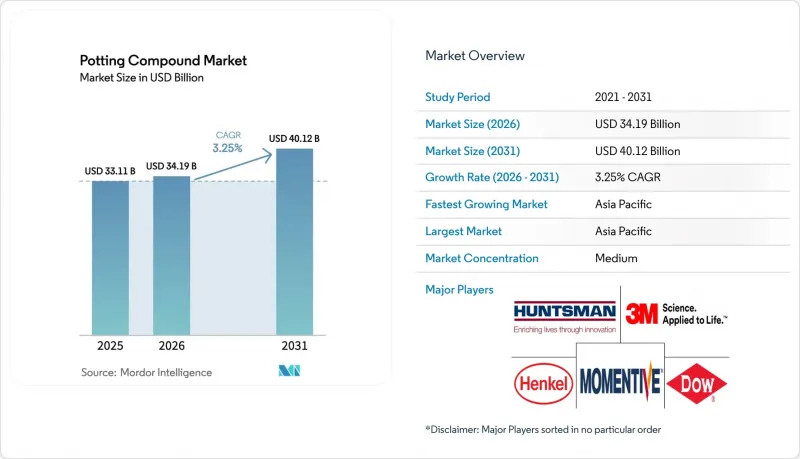
에 의하면, 포팅 컴파운드 시장 규모는 2025년 331억 1,000만 달러에서 2026년에는 341억 9,000만 달러로 확대되어 2026년부터 2031년까지 CAGR 3.25%로 성장을 지속하여, 2031년에는 401억 2,000만 달러에 이를 것으로 예측됩니다.
본 보고서는 수지 유형(에폭시, 폴리우레탄 등), 경화 기술(UV 경화, 열경화, 실온 경화), 최종 사용자 산업(전자, 자동차, 항공우주, 산업용, 기타 최종 사용자 산업), 지역(아시아태평양, 북미, 유럽, 남미, 중동 및 아프리카)별로 분류되어 있습니다. 시장 예측은 금액(달러) 기준으로 제시되어 있습니다.
세계 포팅 컴파운드 시장 동향 및 인사이트
아시아에서 고밀도 소비자용 전자기기의 소형화
스마트폰 및 웨어러블 기기 제조업체들은 현재 5mm3 미만의 공동을 설계하고 있으며, 이에 따라 컴파운드 제조업체들은 실온에서 기포를 남기지 않고 충전할 수 있는 100미크론 미만의 점도 프로파일을 구현해야 합니다. 삼성의 2025년형 폴더블 힌지에는 12mm×8mm×3mm의 부피 내에 47개의 부품이 내장되어 있으며, 플렉스 PCB의 뒤틀림을 방지하기 위해 에폭시 수지는 80°C 미만에서 경화시켜야 합니다. 애플의 A18 칩은 열 설계 전력 밀도를 15 W/cm² 이상으로 높였기 때문에 포팅 컴파운드에는 60 wt% 이상의 세라믹 필러가 배합되어 열을 알루미늄 프레임으로 전달하고 있습니다. 심천의 수탁 제조업체에 따르면, UV 경화형 아크릴레이트계 수지로 전환함으로써 사이클 타임이 45분에서 20분 미만으로 단축되어 오븐으로 인한 병목 현상이 해소되었다고 합니다. 또한, IPC-HDBK-830 규격에서는 수분 흡수율을 0.1% 이하로 억제할 것을 의무화하고 있어, 습도가 높은 기후에서도 습기에 민감한 부품을 보호하고 있습니다. 그 결과, 전자 분야는 이미 전 세계 수요의 44.74%를 차지하고 있으며, 2031년까지 그 선두를 더욱 확대해 나갈 전망입니다.
EV 배터리 팩에서 파워 일렉트로닉스의 급속한 보급
각 전기차 제조업체들은 배터리 하우징을 수동적인 구조에서 충돌 시 에너지 흡수 장치로도 기능하는 능동적인 열 관리 모듈로 전환하고 있습니다. 테슬라의 4680 셀 팩에서는 원통형 셀을 구조 패널에 접착하기 위해 3.5 W/m*K의 폴리우레탄 포팅 컴파운드를 채택하여, UL 94 V-0 난연성 규격을 충족하면서 차량의 경량화를 실현하고 있습니다. BYD의 ‘Blade Battery’는 열 폭주의 확산을 억제하기 위해 GB 38031을 준수하는 난연성 에폭시를 채택하고 있습니다. 유럽의 각 OEM 업체들은 -40°C에서 125°C까지 2,000회의 열 사이클 후에도 절연 내력이 20 kV/mm 이상을 유지하기 위해 800V 아키텍처에 실리콘 포팅재를 선호하여 채택하고 있습니다. 미국 에너지부(DOE)는 미세 균열 발생 후 절연성을 회복시키는 자가 복구형 포팅 컴파운드의 연구 개발에 1,200만 달러를 지원했습니다. 이는 보증 청구 건수를 30% 줄이는 것을 목표로 하고 있습니다. 6개월간의 가속 노화 시험에 기반한 ISO 26262 검증은 대규모 신뢰성 시험에 자금을 투자할 수 있는 대형 배합 제조업체에게 차별화 요소가 됩니다.
변동이 심한 원료 가격(BPA, 에피클로로히드린, 실리콘 모노머)
대만 페놀 공장의 불가항력 사정으로 인해 2025년 상반기에 아시아의 BPA 가격이 28% 급등했으나, 각 배합 제조업체들은 자동차용 계약을 지키기 위해 그 인상분의 60%를 흡수했습니다. 솔베이(Solvay)의 벨기에 사업장에서 발생한 화재로 인해 유럽의 에피클로로히드린 공급량이 절반으로 줄어들었고, 가격은 톤당 2,400유로로 두 배로 치솟았습니다. 중국의 야금용 실리콘 수출 제한으로 인해 전 세계 디메틸디클로로실란 공급량이 12% 감소하여, 실리콘 제품의 납기 기간이 12주로 늘어났습니다. 헌츠맨(Huntsman)은 2025년 3분기에 180베이시스포인트의 이익률 하락을 보고했으며, 이에 따라 저비용 폴리우레탄으로의 배합 변경이 진행되었습니다. 2025년에는 유럽의 중소기업 3곳이 시장에서 철수하면서, 시장 점유율이 대기업들 사이에 집중되었습니다.
부문별 분석
에폭시는 2025년 매출의 33.81%를 차지하고 있지만, 실리콘은 가장 빠르게 성장하는 카테고리가 될 것으로 예측되며, EV용 인버터나 해상 풍력 발전용 컨버터가 광범위한 온도 대응성과 낮은 탄성률을 필요로 하기 때문에 2031년까지 연평균 4.26%의 성장이 예상됩니다. 폴리우레탄은 이 둘 사이에 위치하며, 자동차용 센서나 실외용 LED 드라이버에서의 내충격성이 높이 평가되고 있습니다. 폴리에스테르는 저비용 소비재 시장에서 틈새 시장 점유율을 유지하고 있으며, 초기 바이오 제품은 지속가능성 요건을 충족하는 것을 목표로 하고 있습니다. 에폭시·실리콘 블렌드나 UV 경화형 아크릴레이트와 같은 하이브리드 화학 물질이 광학적으로 투명한 LED 봉지재로 등장하면서, 소재 수요의 다양화가 두드러지고 있습니다.
실리콘의 부상은 열 부하 증가와 궤를 같이 하고 있습니다. GE 리뉴어블 에너지(GE Renewable Energy)는 -60°C에서의 탄성 및 25년간의 가동 주기에 걸친 자외선 안정성을 이유로 자사의 풍력 터빈 ‘Haliade-X’에 실리콘을 채택했습니다. 모멘티브(Momentive)는 전기차(EV)용 트랙션 인버터 수요를 배경으로 2025년에 19%의 매출 성장을 기록했습니다. 에폭시 수지는 중국 공급업체들이 2025년 정가를 8% 인하하고 판매량을 유지하기 위해 이익률을 희생함에 따라 가격 압박에 직면해 있습니다. 레이더 모듈의 경우, 포트 라이프 10분의 2액형 시스템이 ISO 16750 요건을 충족함에 따라 폴리우레탄의 채택이 가속화되고 있습니다. REACH 규제로 인해 아민계 경화제의 선택지가 좁아지고, 원자재 비용이 5-10% 상승하는 등 규제 측면에서의 역풍이 거세지고 있습니다.
지역별 분석
아시아태평양은 2025년 매출의 42.77%를 차지하며, 3.96%의 연평균 성장률(CAGR)을 유지함으로써 2031년까지 포팅 컴파운드 시장에서 선두 자리를 지킬 것입니다. 중국은 광둥성, 장쑤성, 절강성에서 이루어지는 스마트폰 및 IoT 기기 조립(연간 생산 대수는 20억 대를 초과)에 힘입어 해당 지역 수요 대부분을 차지하고 있습니다. 일본 시장 규모는 작지만, 하이브리드차용 인버터 인증을 받은 나가세(Nagase) 및 레조낙(Resonac)의 실리콘 제품군이 뒷받침하는 고부가가치 시장입니다. 한국 수요는 반도체 패키징과 밀접한 관련이 있으며, 7nm 이하 노드에서는 300W/cm²의 열을 방출하는 고열전도성 에폭시 언더필이 사용되고 있습니다. 인도에서는 ‘생산 연계형 인센티브(PLI)’ 제도 하에서 시장이 가속화되고 있으며, 타타 일렉트로닉스는 2025년부터 국내에서 UV 경화형 포팅 재료를 조달하고 있습니다. 베트남에서는 각 브랜드가 중국 이외의 조립 거점을 다각화하는 가운데, 2025년 수입량이 41% 급증했습니다.
북미 역시 성숙한 전자 및 자동차 산업 기반을 바탕으로 성장하고 있습니다. 미국에서는 CHIPS법에 따른 자금 지원을 받은 패키징 라인의 가동에 따라 소비량이 증가하고 있으며, 인텔의 애리조나 공장은 2026년에 본격 가동되면 연간 1,200톤의 포팅재가 필요할 것으로 예측됩니다. 캐나다의 자동차 산업 클러스터는 스코프 3 배출량을 감축하기 위해 바이오 유래 에폭시 수지로의 전환을 추진하고 있습니다. 한편, 멕시코에서는 헨켈의 케레타로 기술 센터가 지원하는 니어쇼어형 전기차 조립 시설이 유치되고 있습니다. VOC(휘발성 유기 화합물) 상한 규제 및 프로포지션 65의 표시 의무로 인해 규정 준수 비용은 상승하고 있지만, 동시에 진입 장벽도 높아져 기존 대기업에 유리한 상황이 되고 있습니다.
유럽 수요는 독일의 전기차용 트랙션 인버터 및 산업용 드라이브에 의해 주도되고 있습니다. 영국은 항공우주 및 방위 분야에 의존하고 있으며, BAE 시스템즈는 항공전자기기 분야에서 열경화성 에폭시 수지의 표준화를 추진하고 있습니다. 프랑스에서는 토탈에너지(TotalEnergies)의 1GW 노르망디 프로젝트에서 볼 수 있듯이, 해상 풍력 발전 및 태양광 발전용 인버터를 통해 실리콘 사용량이 증가하고 있습니다. 북유럽 국가들의 조달 방침에서는 재활용 함유율이 20% 이상인 배합이 우선시되고 있어, 순환형 화학물질에 대한 연구 개발이 가속화되고 있습니다.
남미, 중동 및 아프리카의 합계 시장 점유율은 비교적 낮은 임베디드니다. 브라질의 자동차용 전자기기나 엠브라에르의 아비오닉스에서는 해외 공급업체로부터 열경화성 에폭시 수지를 조달하고 있습니다. 사우디아라비아와 아랍에미리트(UAE)는 기가와트 규모의 태양광 발전 복합 시설을 통해 지역 수요를 주도하고 있으며, 주변 온도 65℃에 대응하는 실리콘 포팅 재료를 지정하고 있습니다. 남아프리카에서는 에스콤(ESCOM)의 송전망 업그레이드 과정에서 스마트 계량기 도입에 포팅 기술을 활용하고 있으나, 현지 배합 기술력은 여전히 제한적입니다.
기타 혜택:
- 엑셀 형식 시장 예측(ME) 시트
- 3개월간의 애널리스트 지원
자주 묻는 질문
목차
제1장 서론
제2장 조사 방법
제3장 주요 요약
제4장 시장 구도
제5장 시장 규모와 성장 예측
제6장 경쟁 구도
제7장 시장 기회와 향후 전망
JHS 26.08.26According to Mordor Intelligence, the potting compound market size is expected to grow from USD 33.11 billion in 2025 to USD 34.19 billion in 2026 and is forecast to reach USD 40.12 billion by 2031 at 3.25% CAGR over 2026-2031.
This report is Segmented by Resin Type (Epoxy, Polyurethane, and More), Curing Technique (UV Curing, Thermal Curing, and Room-Temperature Curing), End-User Industry (Electronics, Automotive, Aerospace, Industrial, and Other End-User Industries), and Geography (Asia-Pacific, North America, Europe, South America, and Middle-East and Africa). The Market Forecasts are Provided in Terms of Value (USD).
Global Potting Compound Market Trends and Insights
Miniaturisation of High-Density Consumer Electronics in Asia
Smartphone and wearable brands now engineer cavities below 5 mm3, compelling formulators to deliver sub-100-micron viscosity profiles that fill void-free at room temperature. Samsung's 2025 foldable hinges embed 47 components in a 12 mm X 8 mm X 3 mm volume, forcing epoxies to cure below 80 °C to avoid flex-PCB warpage. Apple's A18 chip drives thermal-design-power densities past 15 W/cm2, so potting compounds carry more than 60 wt% ceramic filler to channel heat into an aluminum frame. Shenzhen contract manufacturers report cycle-time reductions from 45 minutes to less than 20 minutes after switching to UV-curable acrylate systems, which eliminate oven bottlenecks. IPC-HDBK-830 compliance further mandates <=0.1% water absorption, protecting moisture-sensitive components in humid climates. As a result, electronics already consume 44.74% of global demand and are on pace to widen that lead through 2031.
Rapid Adoption of Power Electronics in EV Battery Packs
EV manufacturers transition battery housings from passive structures to active thermal-management modules that double as crash-energy absorbers. Tesla's 4680 cell packs rely on a 3.5 W/m*K polyurethane potting compound to bond cylindrical cells into structural panels, meeting UL 94 V-0 flame rating while shaving vehicle mass. BYD's Blade Battery employs flame-retardant epoxy compliant with GB 38031 to control thermal-runaway propagation. European OEMs favor silicone potting for 800-volt architectures because dielectric strength remains more than 20 kV/mm after 2,000 thermal cycles from -40 °C to 125 °C. The U.S. DOE funded USD 12 million of R&D into self-healing potting compounds that restore isolation after micro-cracking, targeting 30% warranty-claim cuts. ISO 26262 validation under six-month accelerated aging adds differentiation for large formulators that can finance extensive reliability testing.
Volatile Feedstock Pricing (BPA, Epichlorohydrin, Silicone Monomers)
BPA prices in Asia spiked 28% in H1 2025 after a phenol-plant force majeure in Taiwan, and formulators absorbed 60% of the increase to protect automotive contracts. A fire at Solvay's Belgian unit halved European epichlorohydrin supply, doubling prices to EUR 2,400/ton. Chinese export limits on metallurgical silicon trimmed global dimethyldichlorosilane availability by 12%, stretching silicone lead times to 12 weeks. Huntsman reported a 180-basis-point margin erosion in Q3 2025, prompting reformulation toward lower-cost polyurethane. Three European SMEs exited the market in 2025, consolidating share among larger players.
Other drivers and restraints analyzed in the detailed report include:
- Aerospace Shift to More-Electric Aircraft Platforms in North America
- Investments in Offshore Wind-Turbine Power Electronics
- Stringent Global VOC and REACH Regulations
For complete list of drivers and restraints, kindly check the Table Of Contents.
Segment Analysis
Epoxy retains 33.81% of 2025 revenue, yet silicone is forecast to be the fastest-growing category, expanding 4.26% annually through 2031, as EV inverters and offshore wind converters demand wide-temperature flexibility and low modulus. Polyurethane sits between the two, valued for impact resistance in automotive sensors and outdoor LED drivers. Polyester retains niche share in low-cost consumer goods, and early bio-based variants aim to satisfy sustainability mandates. Hybrid chemistries - epoxy-silicone blends and UV-curable acrylates - emerge for optically clear LED encapsulation, underscoring the fragmentation of material needs.
Silicone's rise maps to escalating thermal loads. GE Renewable Energy specifies silicone for its Haliade-X wind turbine, citing elasticity at -60 °C and UV stability across a 25-year duty cycle. Momentive recorded 19% sales growth in 2025 on EV traction-inverter demand. Epoxy faces price pressure as Chinese suppliers cut 2025 list prices by 8%, sacrificing margins to defend volume. Polyurethane adoption accelerates in radar modules where 10-minute pot-life two-part systems meet ISO 16750 requirements. Regulatory headwinds intensify as REACH narrows amine hardener options, lifting raw-material costs 5-10%.
Complete Report Scope:
- By Resin Type
- Epoxy
- Polyurethane
- Silicone
- Polyester
- Other Resin Types
- By Curing Technique
- UV Curing
- Thermal Curing
- Room-Temperature Curing
- By End-user Industry
- Electronics
- Automotive
- Aerospace
- Industrial
- Other End-user Industries
- By Geography
- Asia-Pacific
- China
- India
- Japan
- South Korea
- ASEAN Countries
- Rest of Asia-Pacific
- North America
- United States
- Canada
- Mexico
- Europe
- Germany
- United Kingdom
- France
- Italy
- NORDIC Countries
- Rest of Europe
- South America
- Brazil
- Argentina
- Rest of South America
- Middle-East and Africa
- Saudi Arabia
- South Africa
- Rest of Middle-East and Africa
- Asia-Pacific
Geography Analysis
Asia-Pacific captures 42.77% of 2025 revenue, and its 3.96% CAGR keeps the region atop the potting compound market through 2031. China accounts for major regional demand, driven by smartphone and IoT assembly in Guangdong, Jiangsu, and Zhejiang, where annual output tops 2 billion units. Japan's market is smaller but premium, anchored by Nagase and Resonac silicone lines qualified for hybrid-vehicle inverters. South Korea's demand is tethered to semiconductor packaging; sub-7 nm nodes consume high-thermal-conductivity epoxy underfills that dissipate 300 W/cm2. India accelerates under the Production-Linked Incentive scheme, with Tata Electronics sourcing UV-curable potting domestically since 2025. Vietnam's imports jumped 41% in 2025 as brands diversify assembly beyond China.
North America is also growing amid mature electronics and automotive bases. U.S. consumption rises on CHIPS-funded packaging lines; Intel's Arizona plant will require 1,200 t/year of potting once fully operational in 2026. Canada's automotive cluster pivots to bio-based epoxies to trim Scope 3 emissions, while Mexico attracts near-shored EV assemblies served by Henkel's Queretaro technical center. VOC caps and Proposition 65 labeling elevate compliance costs but also raise entry barriers that favor established players.
Europe's demand is driven by Germany's EV traction inverters and industrial drives. The U.K. leans on aerospace and defense, with BAE Systems standardizing thermal-cure epoxy in avionics. France's silicone usage grows via offshore wind and solar inverters, as seen in TotalEnergies' 1-GW Normandy project. Nordic procurement policies prefer formulations with >=20% recycled content, accelerating R&D into circular chemistries.
South America and the Middle East and Africa jointly account for a lower market share. Brazil's automotive electronics and Embraer avionics are sourcing thermal-cure epoxy from overseas suppliers. Saudi Arabia and the UAE spur regional demand through gigawatt-scale solar complexes, specifying silicone potting rated for 65 °C ambient. South Africa leverages potting for smart-meter rollouts in Eskom's grid upgrade, though local formulation capabilities remain limited.
- 3M
- CHT Germany GmbH
- Dow
- Dymax Corporation
- EFI Polymers
- ELANTAS (ALTANA AG)
- Electrolube
- Epic Resins
- H.B. Fuller Company
- Henkel AG & Co. KGaA
- Huntsman International LLC
- Intertronics
- Master Bond Inc.
- MG Chemicals
- Momentive
- Nagase & Co., Ltd.
- Parker Hannifin Corp
- Permabond
- ResinLab LLC
- Resonac Holdings Corporation
- Techsil Ltd
- WEVO-CHEMIE GmbH
Additional Benefits:
- The market estimate (ME) sheet in Excel format
- 3 months of analyst support
TABLE OF CONTENTS
1 Introduction
- 1.1 Study Assumptions and Market Definition
- 1.2 Scope of the Study
2 Research Methodology
3 Executive Summary
4 Market Landscape
- 4.1 Market Overview
- 4.2 Market Drivers
- 4.2.1 Miniaturisation of High-Density Consumer Electronics in Asia
- 4.2.2 Rapid Adoption of Power Electronics in EV Battery Packs
- 4.2.3 Aerospace Shift to More-Electric Aircraft Platforms in North America
- 4.2.4 Investments in Offshore Wind-Turbine Power Electronics
- 4.2.5 Rise of Thermally-Conductive Formulations for SiC Traction Inverters
- 4.3 Market Restraints
- 4.3.1 Volatile Feedstock Pricing (BPA, Epichlorohydrin, Silicone Monomers)
- 4.3.2 Stringent Global VOC and REACH Regulations
- 4.3.3 Recycling Challenges for Multi-Component Potting Waste Streams
- 4.4 Value Chain Analysis
- 4.5 Porter's Five Forces
- 4.5.1 Threat of New Entrants
- 4.5.2 Bargaining Power of Buyers
- 4.5.3 Bargaining Power of Suppliers
- 4.5.4 Threat of Substitutes
- 4.5.5 Degree of Competition
5 Market Size and Growth Forecasts (Value)
- 5.1 By Resin Type
- 5.1.1 Epoxy
- 5.1.2 Polyurethane
- 5.1.3 Silicone
- 5.1.4 Polyester
- 5.1.5 Other Resin Types
- 5.2 By Curing Technique
- 5.2.1 UV Curing
- 5.2.2 Thermal Curing
- 5.2.3 Room-Temperature Curing
- 5.3 By End-user Industry
- 5.3.1 Electronics
- 5.3.2 Automotive
- 5.3.3 Aerospace
- 5.3.4 Industrial
- 5.3.5 Other End-user Industries
- 5.4 By Geography
- 5.4.1 Asia-Pacific
- 5.4.1.1 China
- 5.4.1.2 India
- 5.4.1.3 Japan
- 5.4.1.4 South Korea
- 5.4.1.5 ASEAN Countries
- 5.4.1.6 Rest of Asia-Pacific
- 5.4.2 North America
- 5.4.2.1 United States
- 5.4.2.2 Canada
- 5.4.2.3 Mexico
- 5.4.3 Europe
- 5.4.3.1 Germany
- 5.4.3.2 United Kingdom
- 5.4.3.3 France
- 5.4.3.4 Italy
- 5.4.3.5 NORDIC Countries
- 5.4.3.6 Rest of Europe
- 5.4.4 South America
- 5.4.4.1 Brazil
- 5.4.4.2 Argentina
- 5.4.4.3 Rest of South America
- 5.4.5 Middle-East and Africa
- 5.4.5.1 Saudi Arabia
- 5.4.5.2 South Africa
- 5.4.5.3 Rest of Middle-East and Africa
- 5.4.1 Asia-Pacific
6 Competitive Landscape
- 6.1 Market Concentration
- 6.2 Strategic Moves
- 6.3 Market Share(%)/Ranking Analysis
- 6.4 Company Profiles {(includes Global level Overview, Market level overview, Core Segments, Financials as available, Strategic Information, Products and Services, and Recent Developments)}
- 6.4.1 3M
- 6.4.2 CHT Germany GmbH
- 6.4.3 Dow
- 6.4.4 Dymax Corporation
- 6.4.5 EFI Polymers
- 6.4.6 ELANTAS (ALTANA AG)
- 6.4.7 Electrolube
- 6.4.8 Epic Resins
- 6.4.9 H.B. Fuller Company
- 6.4.10 Henkel AG & Co. KGaA
- 6.4.11 Huntsman International LLC
- 6.4.12 Intertronics
- 6.4.13 Master Bond Inc.
- 6.4.14 MG Chemicals
- 6.4.15 Momentive
- 6.4.16 Nagase & Co., Ltd.
- 6.4.17 Parker Hannifin Corp
- 6.4.18 Permabond
- 6.4.19 ResinLab LLC
- 6.4.20 Resonac Holdings Corporation
- 6.4.21 Techsil Ltd
- 6.4.22 WEVO-CHEMIE GmbH
7 Market Opportunities and Future Outlook
- 7.1 White-space and Unmet-Need Assessment


