

|
시장보고서
상품코드
2114926
이온 액체 시장 : 시장 점유율 분석, 업계 동향 및 통계, 성장 예측(2026-2031년)Ionic Liquid - Market Share Analysis, Industry Trends & Statistics, Growth Forecasts (2026 - 2031) |
||||||
 Mordor Intelligence
Mordor Intelligence에 의하면, 이온 액체 시장 규모는 2026년에 3,989만 달러로 추정되고, 예측 기간(2026-2031년) CAGR 8.45%로 확대될 것으로 예상되며, 2031년에는 5,984만 달러에 이를 전망입니다.
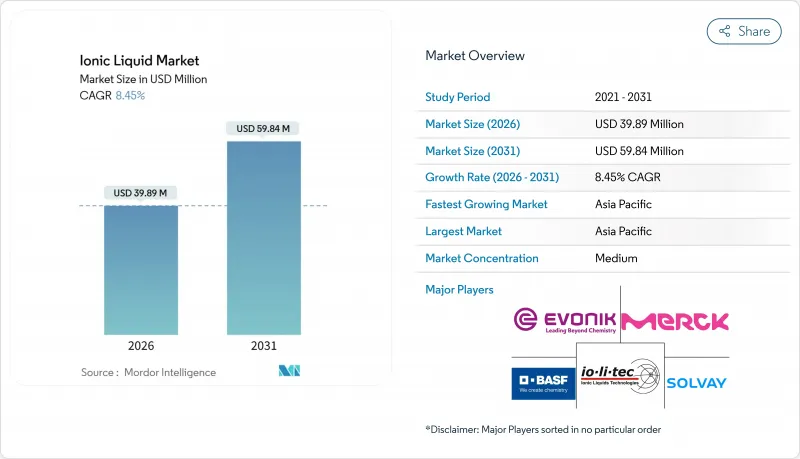
본 보고서는 용도별(용매·촉매, 공정·작동 유체, 기타), 유형별(양이온, 음이온), 기능별(공정용 화학물질, 기타), 최종 사용자 산업별(화학제품 및 석유화학제품, 에너지·발전, 기타), 지역별(아시아태평양, 북미, 유럽, 남미, 중동 및 아프리카)로 분류되어 있습니다. 시장 전망은 금액(달러) 기준으로 제시되어 있습니다.
세계의 이온 액체 시장 동향 및 인사이트
엄격한 VOC 배출 규제가 친환경 용매의 보급을 촉진
유럽연합(EU)은 2024년에 도장 공정에서 VOC 배출 허용치를 50g/m²로 하향 조정함에 따라, 배합 제조업체들은 이온 액체 등 증기압이 극히 낮은 용제로의 전환을 강요받고 있습니다. 증기압이 10 Pa 이하라면 휘발성 배출을 차단할 수 있어, 제조업체는 고비용의 산화제 도입을 피할 수 있습니다. 중국의 GB 37822-2019 규정에 따라 2025년부터 실내용 도료의 VOC 상한선이 80g/L로 낮아지면서, 국내 이온 액체 구매량이 22% 증가했습니다. 미국 환경보호청(EPA)은 2024년에 국가 배출 기준을 개정하여 기존 시설에 대해 2027년까지의 준수를 의무화하게 되었으며, 이로 인해 비휘발성 대체재에 대한 전 세계적 수요가 더욱 높아지고 있습니다. 자동차 수리 도장 및 산업용 유지보수 도료 분야에서는 현재, VOC를 포함하지 않으면서도 기판에 대한 밀착성과 속경화성을 확보할 수 있는 이온 액체의 사용이 지정되어 있습니다.
아시아 전기차 기가팩토리에서 고전압 전해액 수요 급증
2025년, 아시아태평양의 배터리 공장에서는 4.5V를 초과하는 전압에서 작동하는 고니켈 양극재를 사용한 리튬 이온 배터리를 1,200GWh 생산하여, 2024년 대비 28% 증가했습니다. 기존의 탄산염계 전해액은 이러한 전압에서 성능이 저하되지만, 피롤리디늄계 이온 액체와 불소화 설포닐이미드계 음이온을 조합한 것은 5.2V까지 안정성을 유지하며, 셀의 에너지 밀도를 15-20% 향상시킬 수 있습니다. CATL의 ‘Qilin’ 배터리 등 플랫폼에서 3C를 초과하는 급속 충전 프로그램에서는 리튬 도금을 억제하기 위해 이온 액체 공용매가 채택되고 있습니다. 한국은 2025년, 국내 이온 액체 생산을 강화하고 중국산 중간체에 대한 의존도를 낮추기 위해 450억 원(3,400만 달러)을 투자하기로 결정했습니다.
기존 용매에 비해 500달러/kg을 초과하는 제조 비용
이미다졸륨 비스(트리플루오로메틸설포닐)이미드의 원료는 정제 전 단계에서 1kg당 380-420달러가 들지만, N-메틸-2-피롤리돈의 평균 가격은 1kg당 2달러입니다. 다단계 재결정 공정을 통해 가공 비용이 12-18% 추가되며, 불소화 음이온 전구체의 거래 가격은 1kg당 85-110달러이고, 리드타임은 16주입니다. 2024년에 에보닉(Evonik)이 실증한 연속 유동식 플랜트에서는 단위 비용을 kg당 290-340달러로 절감했으나, 연간 100톤의 생산 능력을 확보하기 위한 설비 투자액은 1,800만 달러를 초과합니다. 연간 생산량이 500톤을 초과할 때까지는 플라스틱 및 윤활유 시장이 가격에 민감한 상태가 지속될 것입니다.
부문 분석
2025년에는 용매 및 촉매가 매출의 36.68%를 차지했으며, 연평균 성장률(CAGR) 8.58%로 성장할 전망입니다. 팔라듐 착물의 안정화이든, 바이오매스의 전처리이든, 이들은 이온 액체 시장 규모 측면에서 핵심을 이루고 있습니다. 에너지 저장 용도는 규모는 작지만, 레독스 흐름 전지나 하이브리드 슈퍼커패시터에서 보조 가열 없이 -40°C에서 +70°C 범위에서 작동하는 이온 액체 전해질이 채택됨에 따라, 상당한 연평균 성장률(CAGR)로 성장할 전망입니다. 열전달용, 유압용, 윤활용 등급 등의 공정 유체에 대해서는 가격이 한 자릿수 더 낮은 광물유와의 비용 경쟁에 직면해 있습니다. 플라스틱 부문에서의 채택은 주로 고부가가치 수지용 정전기 방지 첨가제로 제한되어 있으며, 엔지니어링 폴리머용 이온 액체 시장 규모는 현재 가격이 1kg당 500달러 수준으로 최저점에 근접해 있다는 점을 감안할 때 완만한 확대가 예상됩니다.
바이오리파이너리는 가장 빠르게 성장하는 틈새 시장으로 두각을 나타내고 있습니다. 특정 용도에 특화된 배합을 통해 리그노셀룰로오스계 바이오매스를 더 낮은 온도에서 용해시켜 당 수율을 최대 30% 향상시킴으로써, 셀룰로오스계 에탄올에 관한 미국 에너지부의 비용 목표를 달성하고 있습니다. 반면, 가스 분리막, 일렉트로크로믹 창, 액추에이터용 유체에 대해서는 모두 상용화까지 갈 길이 먼 상황입니다. 전반적으로, 지속가능성에 직접적인 이점을 제공하고 규제 측면에서의 지원이 있는 용도가 이온 액체 시장에서 가장 강력한 성장세를 보이고 있습니다.
2025년에는 실적이 입증된 이미다졸륨 및 피롤리디늄 계열 코어를 기반으로 하고, 승인을 용이하게 하는 광범위한 독성 데이터에 힘입어 양이온 계열 제품이 매출의 58.23%를 차지했습니다. 그러나 불소화 음이온이 전기화학적 범위를 확대하고 점도를 낮춤으로써, 음이온을 중심으로 한 혁신이 연평균 성장률(CAGR) 9.01%로 향후 성장을 주도하고 있습니다. 비스(트리플루오로메틸설포닐)이미드는 25°C에서 10mS/cm를 초과하는 리튬 이온 전도도를 실현하여, 전기차 배터리 팩의 충전 시간을 8-12% 단축합니다. 포스포늄 양이온은 시장 규모의 5% 이하에 그치지만, 이미다졸륨이 분해되는 200°C 이상의 용도에서 주목받고 있습니다. 각 공급업체는 현재 특성을 미세 조정하기 위한 모듈식 음이온 라이브러리를 판매하고 있으며, 이는 이온 액체 시장에서 양이온 주도의 표준화에서 음이온을 활용한 성능 차별화로 전환되고 있음을 보여줍니다.
지역별 분석
아시아태평양은 2025년 매출의 47.13%를 차지하며 주도적인 위치를 차지했으며, 2031년까지 연평균 성장률(CAGR) 10.12%를 기록할 전망입니다. 중국은 2025년에 620t의 이온 액체를 생산하여 생산량의 54%를 차지했습니다. 이는 생산 비용을 25-30% 절감하는 수직 통합형 공급망에 힘입은 결과입니다. 기가팩토리용 전해질, 반도체, 의약품 원료(API)에 대한 자금 지원을 실시하는 국내 정책으로 인해 수요 전망이 밝아지고 있습니다. 한국은 2025년 공급망 안전 확보를 위해 450억 원을 배정했으며, 일본의 생명과학 부문에서는 12유형의 시판 원료의약품 합성에 이온 액체를 채택하여 유해 폐기물을 28% 감축했습니다.
북미에서는 미국 수요가 에너지부의 바이오매스 프로젝트와 환경보호청(EPA)의 용제 규제의 혜택을 받고 있습니다. 2027년 가동이 예정된 옥시덴탈 케미컬(Occidental Chemical)의 HF(불화수소) 시설은 불소계 음이온공급 병목 현상을 완화하고, 해당 지역의 이온 액체 시장 규모를 확대할 것으로 보입니다. 캐나다의 오일샌드에서는 저온에서 비투멘을 추출하기 위해 용도 특화형 이온 액체가 채택되고 있는 반면, 멕시코의 전기차(EV) 공급망에서는 이온 액체를 이용한 열 인터페이스 재료의 인증이 진행되고 있습니다.
유럽에서는 독일, 프랑스, 영국이 도입을 주도하고 있으나, REACH 등록 제한으로 인해 신제품 출시는 제한적인 상황입니다. 2025년 프라운호퍼 연구소가 실증한 연속 흐름 합성 기술을 통해 유럽 내 비용은 1kg당 305-350달러까지 절감되었습니다. 브라질은 사탕수수 바가스를 이용한 바이오 정유 공정에 이온 액체를 통합함으로써 남미의 성장을 주도하고 있는 반면, 사우디아라비아에서는 천연가스 탈황을 위한 시범 사업이 진행되고 있습니다. 남미와 중동 및 아프리카는 각 지역의 시범 프로그램이 상업적 규모로 전환된다면 전반적으로 더 큰 성장 여지가 있습니다.
기타 혜택
- 엑셀 형식 시장 예측(ME) 시트
- 3개월간의 애널리스트 지원
자주 묻는 질문
목차
제1장 서론
제2장 조사 방법
제3장 주요 요약
제4장 시장 구도
제5장 시장 규모 및 성장 예측
제6장 경쟁 구도
제7장 시장 기회 및 향후 전망
AJY 26.08.28According to Mordor Intelligence, the ionic liquid market size is estimated at USD 39.89 million in 2026, and is expected to reach USD 59.84 million by 2031, at a CAGR of 8.45% during the forecast period (2026-2031).
This report is Segmented by Application (Solvents and Catalysts, Process and Operating Fluids, and More), Type (Cation and Anion), Function (Process Chemicals and More), End-User Industry (Chemicals and Petrochemicals, Energy and Power, and More), and Geography (Asia-Pacific, North America, Europe, South America, and Middle East and Africa). The Market Forecasts are Provided in Terms of Value (USD).
Global Ionic Liquid Market Trends and Insights
Stringent VOC-Emission Caps Catalyzing Green-Solvent Uptake
The European Union cut permissible VOC emissions from coating operations to 50 g m-2 in 2024, pushing formulators toward solvents with negligible vapor pressure, such as ionic liquids. Vapor pressures below 10-8 Pa eliminate fugitive emissions and help manufacturers sidestep costly oxidizers. China's GB 37822-2019 regulation enforced an 80 g L-1 VOC limit for interior paints in 2025, prompting a 22% rise in domestic ionic-liquid purchases. The US Environmental Protection Agency updated its National Emission Standards in 2024 and will oblige legacy facilities to comply by 2027, reinforcing global demand for non-volatile alternatives. Automotive refinishing and industrial-maintenance coatings now specify ionic liquids that ensure substrate adhesion and fast cures while remaining VOC-free.
Surging Demand for High-Voltage Electrolytes from Asian EV Gigafactories
Asia-Pacific battery plants produced 1,200 GWh of lithium-ion cells in 2025, a 28% jump over 2024, with high-nickel cathodes operating above 4.5 V. Conventional carbonate electrolytes degrade at such voltages, whereas pyrrolidinium ionic liquids paired with fluorinated sulfonyl-imide anions retain stability to 5.2 V and enable cell energy density gains of 15-20%. Fast-charge programs above 3C on platforms such as CATL's Qilin battery employ ionic-liquid co-solvents to suppress lithium plating. South Korea committed KRW 45 billion (USD 34 million) in 2025 to bolster domestic ionic-liquid output and curb reliance on Chinese intermediates.
Manufacturing Cost more than USD 500 kg-1 vs. Conventional Solvents
Raw materials for imidazolium-bis(trifluoromethylsulfonyl)imide cost USD 380-420 kg-1 before purification, whereas N-methyl-2-pyrrolidone averages USD 2 kg-1. Multistep recrystallization adds 12-18% to processing costs, and fluorinated-anion precursors trade at USD 85-110 kg-1 with 16-week lead times. Continuous-flow plants demonstrated by Evonik in 2024 cut unit costs to USD 290-340 kg-1, yet capital expenditure for 100-t yr-1 capacity tops USD 18 million. Until volumes scale past 500 t yr-1, plastics and lubricant markets remain price sensitive.
Other drivers and restraints analyzed in the detailed report include:
- Superior Thermal and Chemical Stability Enabling High-Performance Applications
- Electronics Sector Pull for Antistatic and Electro-Chemical Devices
- Limited Eco-Toxicity Data Delaying REACH Registrations
For complete list of drivers and restraints, kindly check the Table Of Contents.
Segment Analysis
Solvents and catalysts accounted for 36.68% revenue in 2025 and will grow at an 8.58% CAGR. Whether stabilizing palladium complexes or pretreating biomass, they form the volume backbone of the ionic liquids market. Energy storage applications, though smaller, will grow with a significant CAGR as redox-flow batteries and hybrid supercapacitors adopt ionic-liquid electrolytes that operate from -40°C to +70°C without auxiliary heating. Process fluids, such as heat-transfer, hydraulic, and lubricant grades, face cost competition from mineral oils priced an order of magnitude lower. Plastics uptake sits largely in antistatic additives for high-value resins, where the ionic liquids market size for engineering polymers is projected to expand modestly, given current price floors near USD 500 kg-1.
Bio-refineries stand out as the fastest-growing niche. Task-specific formulations dissolve lignocellulosic biomass at lower temperatures, raising sugar yields by up to 30% and meeting US Department of Energy cost targets for cellulosic ethanol. Gas-separation membranes, electrochromic windows, and actuator fluids together face lengthy commercialization paths. Overall, applications with direct sustainability benefits and regulatory pull show the strongest momentum within the ionic liquids market.
Cation-based products held 58.23% revenue in 2025, anchored by proven imidazolium and pyrrolidinium cores and extensive toxicity data easing approvals. Yet anion-centric innovation drives future growth at a 9.01% CAGR as fluorinated anions widen electrochemical windows and cut viscosity. Bis(trifluoromethylsulfonyl)imide enables lithium-ion conductivities above 10 mS cm-1 at 25 °C, facilitating 8-12% quicker charging in electric-vehicle packs. Phosphonium cations, though less than 5% of volume, are capturing attention for applications above 200 °C where imidazolium decomposes. Suppliers now market modular anion libraries to fine-tune properties, signaling a shift from cation-driven standardization to anion-enabled performance differentiation within the ionic liquids market.
Complete Report Scope:
- By Application
- Solvents and Catalysts
- Process and Operating Fluids
- Plastics
- Energy Storage
- Bio-refineries
- Others
- By Type
- Cation
- Anion
- By Function
- Process Chemicals
- Performance Chemicals (Task-specific Ionic Liquids)
- By End-user Industry
- Chemicals and Petrochemicals
- Energy and Power
- Pharmaceuticals and Healthcare
- Electronics and Semiconductors
- Automotive and Aerospace
- Metals and Mining
- Food and Beverage
- Cosmetics and Personal Care
- Others
- By Geography
- Asia-Pacific
- China
- India
- Japan
- South Korea
- Thailand
- Indonesia
- Malaysia
- Vietnam
- Rest of Asia-Pacific
- North America
- United States
- Canada
- Mexico
- Europe
- Germany
- United Kingdom
- France
- Italy
- Spain
- Russia
- Rest of Europe
- South America
- Brazil
- Argentina
- Colombia
- Rest of South America
- Middle East and Africa
- Saudi Arabia
- United Arab Emirates
- South Africa
- Qatar
- Nigeria
- Egypt
- Rest of Middle East and Africa
- Asia-Pacific
Geography Analysis
Asia-Pacific dominated revenue with 47.13% in 2025 and is on a 10.12% CAGR track through 2031. China produced 620 t of ionic liquids in 2025, representing 54% of output, underpinned by vertically integrated supply chains that shave 25-30% off production costs. Domestic policies funding gigafactory electrolytes, semiconductors, and pharmaceutical APIs strengthen demand visibility. South Korea earmarked KRW 45 billion for supply-chain security in 2025, while Japan's life-sciences sector adopted ionic liquids in 12 commercial active-pharmaceutical-ingredient syntheses, cutting hazardous waste by 28%.
In North America, the US demand benefits from Department of Energy biomass projects and Environmental Protection Agency solvent regulations. Occidental Chemical's HF facility, slated for 2027, will mitigate fluorinated-anion bottlenecks and shift the regional ionic liquids market size upward. Canada's oil sands employ task-specific variants for lower-temperature bitumen extraction, whereas Mexico's EV supply chain is qualifying ionic-liquid thermal-interface materials.
In Europe, Germany, France, and the United Kingdom lead adoption, although limited REACH registrations restrict new-product launches. Continuous-flow synthesis demonstrated by Fraunhofer in 2025 reduced European costs to USD 305-350 kg-1. Brazil anchors South American growth by integrating ionic liquids into sugarcane bagasse biorefineries, while Saudi Arabia pilots them for natural-gas sweetening. Collectively, South America and the Middle East & Africa offer headroom once regional pilot programs convert to commercial scale.
- 3M
- Ascensus
- BASF SE
- CoorsTek Inc.
- DuPont
- Evonik Industries AG
- GFS Chemicals, Inc.
- HENAN NEWBLUE CHEMICAL CO., LTD
- Iolitec Ionic Liquids Technologies GmbH
- KOEI CHEMICAL CO., LTD.
- Merck KGaA
- proionic GmbH
- Reinste Nano Ventures Pvt. Ltd.
- Solvay
- SOLVIONIC
Additional Benefits:
- The market estimate (ME) sheet in Excel format
- 3 months of analyst support
TABLE OF CONTENTS
1 Introduction
- 1.1 Study Assumptions and Market Definition
- 1.2 Scope of the Study
2 Research Methodology
3 Executive Summary
4 Market Landscape
- 4.1 Market Overview
- 4.2 Market Drivers
- 4.2.1 Stringent VOC-emission caps catalysing green-solvent uptake
- 4.2.2 Surging demand for high-voltage electrolytes from Asian EV gigafactories
- 4.2.3 Superior thermal and chemical stability enabling high-performance applications
- 4.2.4 Electronics sector pull for antistatic and electro-chemical devices
- 4.2.5 Green biorefinery process intensification with task-specific ILs
- 4.3 Market Restraints
- 4.3.1 Manufacturing cost > USD 500 kg-1 vs. conventional solvents
- 4.3.2 Limited eco-toxicity data delaying REACH registrations
- 4.3.3 HF-feedstock volatility constraining fluorinated-anion supply
- 4.4 Value Chain Analysis
- 4.5 Porter's Five Forces
- 4.5.1 Bargaining Power of Suppliers
- 4.5.2 Bargaining Power of Buyers
- 4.5.3 Threat of New Entrants
- 4.5.4 Threat of Substitutes
- 4.5.5 Degree of Competition
5 Market Size and Growth Forecasts (Value)
- 5.1 By Application
- 5.1.1 Solvents and Catalysts
- 5.1.2 Process and Operating Fluids
- 5.1.3 Plastics
- 5.1.4 Energy Storage
- 5.1.5 Bio-refineries
- 5.1.6 Others
- 5.2 By Type
- 5.2.1 Cation
- 5.2.2 Anion
- 5.3 By Function
- 5.3.1 Process Chemicals
- 5.3.2 Performance Chemicals (Task-specific Ionic Liquids)
- 5.4 By End-user Industry
- 5.4.1 Chemicals and Petrochemicals
- 5.4.2 Energy and Power
- 5.4.3 Pharmaceuticals and Healthcare
- 5.4.4 Electronics and Semiconductors
- 5.4.5 Automotive and Aerospace
- 5.4.6 Metals and Mining
- 5.4.7 Food and Beverage
- 5.4.8 Cosmetics and Personal Care
- 5.4.9 Others
- 5.5 By Geography
- 5.5.1 Asia-Pacific
- 5.5.1.1 China
- 5.5.1.2 India
- 5.5.1.3 Japan
- 5.5.1.4 South Korea
- 5.5.1.5 Thailand
- 5.5.1.6 Indonesia
- 5.5.1.7 Malaysia
- 5.5.1.8 Vietnam
- 5.5.1.9 Rest of Asia-Pacific
- 5.5.2 North America
- 5.5.2.1 United States
- 5.5.2.2 Canada
- 5.5.2.3 Mexico
- 5.5.3 Europe
- 5.5.3.1 Germany
- 5.5.3.2 United Kingdom
- 5.5.3.3 France
- 5.5.3.4 Italy
- 5.5.3.5 Spain
- 5.5.3.6 Russia
- 5.5.3.7 Rest of Europe
- 5.5.4 South America
- 5.5.4.1 Brazil
- 5.5.4.2 Argentina
- 5.5.4.3 Colombia
- 5.5.4.4 Rest of South America
- 5.5.5 Middle East and Africa
- 5.5.5.1 Saudi Arabia
- 5.5.5.2 United Arab Emirates
- 5.5.5.3 South Africa
- 5.5.5.4 Qatar
- 5.5.5.5 Nigeria
- 5.5.5.6 Egypt
- 5.5.5.7 Rest of Middle East and Africa
- 5.5.1 Asia-Pacific
6 Competitive Landscape
- 6.1 Market Concentration
- 6.2 Strategic Moves
- 6.3 Market Share/Ranking Analysis
- 6.4 Company Profiles (includes Global-level Overview, Market-level Overview, Core Segments, Financials as available, Strategic Information, Products and Services, and Recent Developments)
- 6.4.1 3M
- 6.4.2 Ascensus
- 6.4.3 BASF SE
- 6.4.4 CoorsTek Inc.
- 6.4.5 DuPont
- 6.4.6 Evonik Industries AG
- 6.4.7 GFS Chemicals, Inc.
- 6.4.8 HENAN NEWBLUE CHEMICAL CO., LTD
- 6.4.9 Iolitec Ionic Liquids Technologies GmbH
- 6.4.10 KOEI CHEMICAL CO., LTD.
- 6.4.11 Merck KGaA
- 6.4.12 proionic GmbH
- 6.4.13 Reinste Nano Ventures Pvt. Ltd.
- 6.4.14 Solvay
- 6.4.15 SOLVIONIC
7 Market Opportunities and Future Outlook
- 7.1 White-space and Unmet-Need Assessment


