

|
시장보고서
상품코드
2114939
단열 코팅 시장 : 점유율 분석, 업계 동향과 통계, 성장 예측(2026-2031년)Insulation Coating - Market Share Analysis, Industry Trends & Statistics, Growth Forecasts (2026 - 2031) |
||||||
 Mordor Intelligence
Mordor Intelligence에 의하면, 단열 코팅 시장 규모는 2025년 115억 달러에서 2026년에는 123억 1,000만 달러로 확대되어 2026년부터 2031년까지 CAGR 7.05%로 성장을 지속하여, 2031년에는 173억 1,000만 달러에 이를 것으로 예측됩니다.
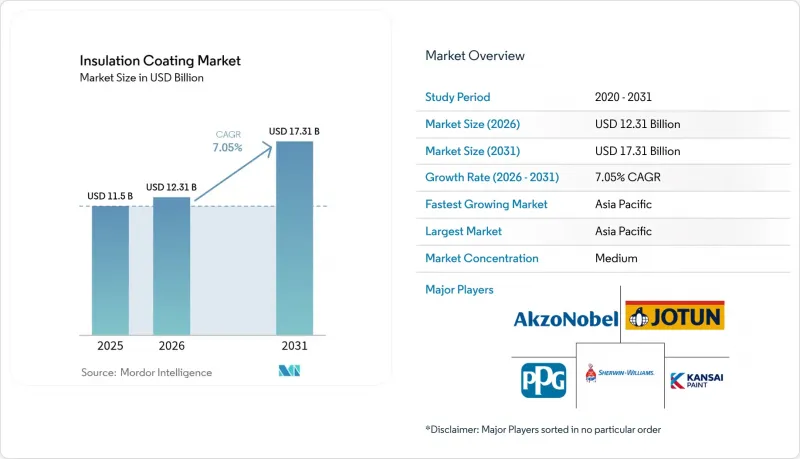
본 보고서에서는 업계를 제품 유형(아크릴, 에폭시 등), 최종 사용자 산업(석유 및 가스, 화학제품 및 석유화학제품, 건설 등), 지역(아시아태평양, 북미, 유럽 등)별로 분류하고 있습니다. 시장 예측은 금액(달러) 기준으로 제시되어 있습니다.
세계 단열 코팅 시장 동향 및 인사이트
산업용 LNG 액화 플랜트의 급속한 성장
대규모 LNG 프로젝트에서는 -162°C의 극저온 환경에서도 단열 성능을 유지할 수 있는 코팅이 요구됩니다. 미국 교통부의 개정 규정에 따르면, 탱크 단열재의 허용 열전도율은 60°F에서 0.225 Btu h-1ft-2°F-1로 제한되어 있으며, 이로 인해 고성능 폴리우레탄 및 에어로겔 시스템을 권장하는 세계적 기준이 사실상 확립되었습니다. 프로젝트 운영자들은 보일오프 가스를 최소화하고 유지보수 주기를 대폭 단축할 수 있는 코팅을 우선시하고 있으며, 그 결과 건설 및 유지보수 주기를 통해 공급업체에 대한 안정적인 수주량이 유지되고 있습니다. 카타르의 ‘노스 필드 사우스(North Field South)’에 건설되는 새로운 메가 트레인, 캐나다의 LNG 시설, 그리고 미국의 신규 액화 능력은 수요가 생산 거점 주변에 집중되어 있음을 보여줍니다. 더 많은 국가 주도의 LNG 생산자들이 수출 수입을 추구함에 따라, 단열 코팅 시장은 설계·조달·시공(EPC) 계약에 연계된 다년간의 수주 잔고의 혜택을 받고 있습니다. 사업자들이 총 설치 비용 목표를 달성하기 위해 더 얇은 코팅막과 더 낮은 열전도율을 추구함에 따라, 성능 면에서의 차별화는 더욱 치열해질 것으로 예측됩니다.
건축·에너지 기준의 강화
2024년판 ‘국제 에너지 절약 기준(IECC)’에서는 R-5에서 R-30 범위의 연속 단열 값을 의무화하고 있어, 복잡한 형태의 지붕이나 파사드에서 검증 가능한 R값 향상을 실현하는 코팅재에 대한 수요가 가속화되고 있습니다. 캘리포니아주의 R-30 지붕 규제나 워싱턴주의 기후대별 기준은 주 차원의 규제가 얼마나 즉각적으로 사양 변경을 촉진하는지를 보여줍니다. 이에 대응하여 제품 개발자들은 악소노벨(AkzoNobel)사의 ‘Interpon D1036 Low-E’ 시리즈와 같은 저방사율·고반사율 코팅으로 대응하고 있으며, 이 제품은 상업용 건물에서 최대 20%의 에너지 절약 효과를 보장합니다. 규제의 강화는 개보수 주기에도 영향을 미칩니다. 소유주가 한 번 에너지 절약 효과를 체감하면, 개보수 공사 시 유사한 코팅을 고려하게 되기 때문입니다. 아시아태평양(APAC)에서 성능 기준에 기반한 건축 기준이 채택됨에 따라, 다국적 제조업체들은 지역별 공장을 정비하여 현지에서 기준을 준수하는 시스템을 제공할 수 있는 체제를 구축하고, 리드타임 단축과 운송 비용 절감을 도모하고 있습니다. 이러한 시너지 효과로 인해, 공인된 제3자 기관의 시험을 통해 검증된 코팅 제품의 경우, 지속적인 판매량 증가와 시장 점유율 확대가 예상됩니다.
새로운 화학 조성에 따른 방화 인증 지연
첨단 에어로겔 및 팽창성 방화 시스템은 시장에 출시되기 전에 NFPA 275 및 EN 13381-8과 같은 엄격한 시험을 통과해야 합니다. UL Solutions에 따르면, 혁신적인 화학 조성에 대한 완전한 평가 주기는 특히 여러 가지 화재, 연기, 독성 평가 지표가 요구되는 경우 15개월 이상 소요될 수도 있습니다. 건축 당국은 ICC-ES 보고서를 중시하기 때문에 공급업체는 종합적인 화재 시험 데이터와 공학적 분석을 작성해야 하며, 이로 인해 시장 진입 비용이 상승하고 상용화까지의 기간이 연장되고 있습니다. 시험에 불합격할 경우, 배합을 재검토해야 하므로 수익 창출이 지연되고 선점 우위가 훼손됩니다. 따라서 기존 제품은 기득권에 따른 우위를 누리고 있으며, 프로젝트 소유자는 건설 일정을 맞추기 위해 구식 시스템을 기본으로 채택하는 경우가 있습니다. 이러한 병목 현상으로 인해, 뛰어난 열 성능을 보장하더라도 차세대 코팅의 보급이 지연되어 단열 코팅 시장의 단기적인 성장이 제한되고 있습니다.
부문 분석
아크릴계 배합은 2025년 단열 코팅 시장의 34.72%를 차지하고 있으며, 이는 수십 년에 걸친 규제 당국의 승인 및 경쟁력 있는 가격 책정을 통해 구축된 입지입니다. 이러한 수성 또는 용제형 시스템은 균형 잡힌 접착력, 자외선 저항성 및 시공성을 갖추고 있어 건축 및 경공업 분야에서 표준 제품으로 자리 잡았습니다. 아크릴계 단열 코팅 시장 규모는 2025년에 39억 9,000만 달러에 달하며 계속 확대되고 있지만, 가혹한 조건에서의 사용을 상정한 고기능성 대안이 검토됨에 따라 그 성장세는 완만해지고 있습니다. 그 다음으로 에폭시계 제품이 꼽히며, 석유 및 가스·석유화학 플랜트에서 내화학성과 기판에 대한 강력한 접착력이 높이 평가받고 있습니다. 폴리우레탄 기술은 열 사이클에 노출되는 기판에 유연성을 제공함으로써 아크릴계와 에폭시계 솔루션의 중간에 위치하며, 또한 지속가능성 요건을 충족하기 위해 바이오 등급이 시험 생산 단계에 접어들었습니다.
‘기타 제품 유형’ 카테고리는 에어로겔, 이트리아 안정화 지르코니아, 기타 세라믹 충전 컴파운드가 극저온 또는 초고온 환경에서의 사용에서 그 가치를 입증하고 있어 연평균 성장률(CAGR) 7.12%로 가장 강력한 성장 궤도를 보이고 있습니다. 이러한 첨단 소재는 열전도율을 0.01-0.03 W m?¹K?¹까지 낮추며, 기존 시스템에 비해 최대 50% 더 얇은 코팅을 실현합니다. 항공우주용 터빈 블레이드 및 집광형 태양열 발전(CSP) 수신기를 대상으로 한 시범 프로젝트는 기술 주도형 성장 경로를 보여주고 있는 반면, LNG 및 배터리 분야가 단기적인 수요를 견인하고 있습니다. 이트륨 안정화 지르코니아는 여전히 극한의 고온 환경에서 주류를 이루고 있으며, 미국 에너지부는 최근 1,300°C를 초과하는 환경에서의 사용을 위해 이트륨-알루미늄-가넷(IAG) 탑코트의 적합성을 인증했습니다. 비용이 낮아짐에 따라 산업용 분야에서 첨단 소재가 아크릴 수지 시장 점유율을 잠식할 가능성이 높지만, 비용 및 규격 준수가 성능 향상보다 우선시되는 분야에서는 아크릴 수지가 여전히 큰 존재감을 유지할 것입니다.
지역별 분석
아시아태평양은 2025년에 단열 코팅 시장의 46.88%를 차지하며 1위를 차지하고, 2031년까지 연평균 성장률(CAGR) 7.86%로 성장할 것으로 전망됩니다. 이 지역의 성장은 중국과 인도의 대규모 산업 프로젝트는 물론, 베트남, 인도네시아, 말레이시아의 제조 투자에 힘입고 있습니다. BPA에서 지르코니아 분말에 이르기까지, 중국 내 원자재 생산 능력은 현지 제조업체에 비용 면에서의 우위를 제공하며, 지역 내 판매 계약에서 환율 리스크를 완화하고 있습니다. 인도에서는 다헤지(Dahheji)의 CPVC 수지 생산 규모 확대에서 볼 수 있듯이 생산 능력 확충이 가속화되고 있으며, 이는 호환 가능한 코팅재에 대한 하류 수요를 뒷받침하고 있습니다. 동남아시아에서 정유시설 및 석유화학 플랜트 건설이 확대되는 것도 판매량 증대의 또 다른 기반이 되고 있습니다.
북미는 성숙해 가고 있지만 혁신이 풍부한 시장으로, 엄격한 건축 에너지 기준, 멕시코만 해양 플랫폼의 개보수, 그리고 기가팩토리 건설 가속화에 힘입어 성장하고 있습니다. 북미의 단열 코팅 시장 점유율은 규제 체계와 첨단 제품 라인업 간의 긴밀한 연계 덕분에 2025년에도 견조한 추세를 보였습니다. ‘인플레이션 억제법’에 따른 연방 정부의 장려책은 국내 배터리 공급망을 촉진하고 있으며, 이로 인해 열 폭주 제어용 코팅 수요가 증가하고 있습니다. 또한, 이 지역은 다른 지역에서 문제로 대두되고 있는 숙련된 시공자 부족을 완화하는 확립된 교육 네트워크의 혜택도 누리고 있습니다.
유럽은 매출액 기준으로 3위를 차지하고 있지만, 저VOC 및 바이오 배합을 우선시하는 지속가능성 관련 규제에서 주도적인 입지를 차지하고 있습니다. 수소 생산, 지역 난방 현대화, 해상 풍력 발전용 제조 야드에 대한 투자가 안정적인 수요 기반을 형성하고 있습니다. 남미에서는 브라질 연안의 프레솔트층 유전 개발에 힘입어 한 자릿수 중반대의 성장을 기록하고 있습니다. 한편, 중동 및 아프리카에서는 석유화학 산업의 확대와 인프라 현대화가 활동의 중심을 이루고 있습니다. 걸프협력회의(GCC) 회원국 내 신규 프로젝트를 위한 단열 코팅 시장 규모가 확대되고 있는데, 이는 개발업체들이 사막의 극심한 더위와 가혹한 해양 환경에 대처하기 위해 첨단 코팅을 지정하고 있기 때문입니다.
기타 혜택:
- 엑셀 형식 시장 예측(ME) 시트
- 3개월간의 애널리스트 지원
자주 묻는 질문
목차
제1장 서론
제2장 조사 방법
제3장 주요 요약
제4장 시장 구도
제5장 시장 규모와 성장 예측
제6장 경쟁 구도
제7장 시장 기회와 향후 전망
JHS 26.08.26According to Mordor Intelligence, the insulation coating market size is expected to grow from USD 11.50 billion in 2025 to USD 12.31 billion in 2026 and is forecast to reach USD 17.31 billion by 2031 at 7.05% CAGR over 2026-2031.
This report Segments the Industry by Product Type (Acrylic, Epoxy, and More), End-User Industry (Oil and Gas, Chemical and Petrochemical, Construction, and More), and Geography (Asia-Pacific, North America, Europe, and More). The Market Forecasts are Provided in Terms of Value (USD).
Global Insulation Coating Market Trends and Insights
Rapid Growth in Industrial LNG Liquefaction Trains
Large-scale LNG projects require coatings that keep insulation properties intact at cryogenic temperatures as low as -162 °C. Upgraded U.S. Department of Transportation rules now cap allowable thermal conductance at 0.225 Btu h-1 ft-2 °F-1 at 60 °F for tank insulation, effectively establishing a global benchmark that favors high-performance polyurethane and aerogel systems. Project operators prioritise coatings that minimise boil-off gas and slash maintenance intervals, which in turn sustains steady volumes for suppliers across construction and maintenance cycles. Emerging Qatar North Field South megatrains, Canadian LNG sites, and new liquefaction capacity in the United States illustrate how demand clusters near production hubs. As more sovereign LNG producers chase export revenue, the insulative coating market benefits from multi-year order backlogs tied to engineering, procurement, and construction contracts. Performance differentiation is expected to intensify as operators request thinner films and lower thermal conductivities to meet total installed cost targets.
Tightening Building-Energy Codes
The 2024 International Energy Conservation Code mandates continuous insulation values ranging from R-5 to R-30, accelerating demand for coatings that deliver verifiable R-value gains on complex roof and facade geometries. California's R-30 roof rule and Washington's climate-zone-specific standards show how state-level regulations drive immediate specification shifts. Product developers respond with low-emissivity and highly reflective coatings such as AkzoNobel's Interpon D1036 Low-E line, which promises up to 20% energy savings for commercial buildings. Code tightening cascades into renovation cycles, because once owners experience energy savings, similar coatings are considered during retrofit events. As APAC adopts performance-based codes, multinational manufacturers position their regional plants to deliver compliant systems locally, shortening lead-times and lowering landed costs. The compound effect is sustained volume growth and higher share for coatings validated through accredited third-party testing.
Fire-Safety Certification Delays for Novel Chemistries
Advanced aerogel or intumescent systems must clear stringent tests such as NFPA 275 and EN 13381-8 before market release. UL Solutions notes that full evaluation cycles for innovative chemistries can extend beyond 15 months, especially when multiple fire, smoke, and toxicity metrics are required. Because building authorities rely on ICC-ES reports, suppliers must generate exhaustive fire-test data and engineering analyses, which raises market-entry costs and lengthens commercialisation timelines. Any failed test forces a reformulation loop, delaying revenue and eroding first-mover advantage. Established products therefore enjoy an incumbency edge, and project owners sometimes default to older systems to meet construction schedules. The bottleneck slows diffusion of next-generation coatings even when they promise superior thermal performance, limiting near-term growth in the insulation coating market.
Other drivers and restraints analyzed in the detailed report include:
- Retro-fit Demand in Aging Offshore Platforms
- Surge in Battery-Gigafactory Construction
- Volatility in Epoxy & Isocyanate Feedstock Prices
For complete list of drivers and restraints, kindly check the Table Of Contents.
Segment Analysis
Acrylic formulations commanded 34.72% of the insulative coating market in 2025, a position earned through decades of regulatory acceptance and competitive pricing. These water-borne or solvent-borne systems deliver balanced adhesion, UV stability, and workability that make them staples in architectural and light-industrial settings. The insulation coating market size for acrylics equalled USD 3.99 billion in 2025 and is expanding, but growth is moderate as users weigh higher-performance options for demanding conditions. Epoxy-based products follow, prized for chemical resistance and strong substrate bonding in oil, gas, and petrochemical installations. Polyurethane technologies slot between acrylic and epoxy solutions by offering flexibility for substrates that experience thermal cycling, and bio-based grades are entering pilot production to meet sustainability mandates.
The "Other Product Types" cluster shows the strongest trajectory at a 7.12% CAGR as aerogel, yttria-stabilised zirconia, and other ceramic-filled formulations prove their value in cryogenic or ultra-high-temperature service. These advanced materials lower thermal conductivity to 0.01-0.03 W m-1 K-1 and enable coatings up to 50% thinner than legacy systems. Pilot projects on aerospace turbine blades and concentrated solar power receivers illustrate the technology-push pathway, while LNG and battery segments supply near-term volume. Yttria-stabilised zirconia continues to dominate extreme-heat environments, and the U.S. Department of Energy recently validated yttrium-aluminium-garnet topcoats for operation above 1 300 °C . As costs drop, advanced materials are likely to erode acrylic share in industrial applications, yet acrylics will maintain a sizeable presence where cost and code compliance outweigh performance gains.
Complete Report Scope:
- By Product Type
- Acrylic
- Epoxy
- Polyurethane
- Yttria-Stabilized Zirconia
- Other Product Types (Aerogel-based, etc.)
- By End-User Industry
- Oil and Gas
- Chemical and Petrochemical
- Construction
- Automotive
- Marine
- Aerospace
- Other End-User Industries (Power Generation, etc.)
- By Geography
- Asia-Pacific
- China
- Japan
- India
- South Korea
- Rest of Asia-Pacific
- North America
- United States
- Canada
- Mexico
- Europe
- Germany
- France
- United Kingdom
- Italy
- Rest of Europe
- South America
- Brazil
- Argentina
- Rest of South America
- Middle East and Africa
- Saudi Arabia
- South Africa
- Rest of Middle East and Africa
- Asia-Pacific
Geography Analysis
Asia-Pacific led with 46.88% of the insulative coating market in 2025 and is forecast to grow at an 7.86% CAGR through 2031. Regional expansion is backed by massive industrial projects in China and India alongside manufacturing investments in Vietnam, Indonesia, and Malaysia. China's domestic raw-material capacity, from BPA to zirconia powder, gives local producers cost leverage and reduces currency-exchange exposure for regional sales contracts. India accelerates capacity additions, as seen in the CPVC resin scale-up at Dahej, which spurs downstream demand for compatible coatings. Southeast Asia's refinery and petrochemical build-out further anchors volume.
North America represents a mature yet innovation-rich market driven by stringent building-energy codes, offshore platform refurbishments in the Gulf of Mexico, and accelerating gigafactory construction. The insulative coating market share for North America remained robust in 2025 owing to tight alignment between regulatory frameworks and advanced product offerings. Federal incentives under the Inflation Reduction Act foster domestic battery supply chains, which elevates coating demand for thermal-runaway control. The region also benefits from well-established training networks that mitigate skilled-applicator shortages experienced elsewhere.
Europe ranks third by revenue but leads in sustainability mandates that prioritise low-VOC and bio-based formulations. Investments in hydrogen production, district-heating upgrades, and offshore wind fabrication yards underpin stable demand. South America records mid-single-digit growth, boosted by pre-salt field developments off Brazil, while Middle East and Africa activity centres on petrochemical expansion and infrastructure modernisation. The insulation coating market size for emerging Gulf Cooperation Council projects is rising as developers specify advanced coatings to manage desert heat and aggressive marine atmospheres.
- Akzo Nobel N.V.
- Berger Paints India
- Carboline
- Hempel A/S
- Jotun
- Kansai Paint Co., Ltd.
- Mascoat
- Nanofan Industrial Coatings LLC
- Nippon Paint Holdings Co. Ltd.
- PPG Industries Inc.
- Sika AG
- SK Formulations India Pvt Ltd.
- The Sherwin-Williams Company
- Tnemec
- Ugam Chemicals
Additional Benefits:
- The market estimate (ME) sheet in Excel format
- 3 months of analyst support
TABLE OF CONTENTS
1 Introduction
- 1.1 Study Assumptions & Market Definition
- 1.2 Scope of the Study
2 Research Methodology
3 Executive Summary
4 Market Landscape
- 4.1 Market Overview
- 4.2 Market Drivers
- 4.2.1 Rapid growth in industrial LNG liquefaction trains
- 4.2.2 Tightening building-energy codes
- 4.2.3 Retro-fit demand in aging offshore platforms
- 4.2.4 Surge in battery-gigafactory construction
- 4.2.5 Super-insulative aerogel-filled top-coat launches
- 4.3 Market Restraints
- 4.3.1 Fire-safety certification delays for novel chemistries
- 4.3.2 Skilled-applicator shortage in emerging markets
- 4.3.3 Volatility in epoxy & isocyanate feedstock prices
- 4.4 Value Chain Analysis
- 4.5 Porter's Five Forces
- 4.5.1 Bargaining Power of Suppliers
- 4.5.2 Bargaining Power of Buyers
- 4.5.3 Threat of New Entrants
- 4.5.4 Threat of Substitutes
- 4.5.5 Degree of Competition
5 Market Size & Growth Forecasts (Value)
- 5.1 By Product Type
- 5.1.1 Acrylic
- 5.1.2 Epoxy
- 5.1.3 Polyurethane
- 5.1.4 Yttria-Stabilized Zirconia
- 5.1.5 Other Product Types (Aerogel-based, etc.)
- 5.2 By End-User Industry
- 5.2.1 Oil and Gas
- 5.2.2 Chemical and Petrochemical
- 5.2.3 Construction
- 5.2.4 Automotive
- 5.2.5 Marine
- 5.2.6 Aerospace
- 5.2.7 Other End-User Industries (Power Generation, etc.)
- 5.3 By Geography
- 5.3.1 Asia-Pacific
- 5.3.1.1 China
- 5.3.1.2 Japan
- 5.3.1.3 India
- 5.3.1.4 South Korea
- 5.3.1.5 Rest of Asia-Pacific
- 5.3.2 North America
- 5.3.2.1 United States
- 5.3.2.2 Canada
- 5.3.2.3 Mexico
- 5.3.3 Europe
- 5.3.3.1 Germany
- 5.3.3.2 France
- 5.3.3.3 United Kingdom
- 5.3.3.4 Italy
- 5.3.3.5 Rest of Europe
- 5.3.4 South America
- 5.3.4.1 Brazil
- 5.3.4.2 Argentina
- 5.3.4.3 Rest of South America
- 5.3.5 Middle East and Africa
- 5.3.5.1 Saudi Arabia
- 5.3.5.2 South Africa
- 5.3.5.3 Rest of Middle East and Africa
- 5.3.1 Asia-Pacific
6 Competitive Landscape
- 6.1 Market Concentration
- 6.2 Strategic Moves
- 6.3 Market Share(%)/Ranking Analysis
- 6.4 Company Profiles (includes Global level Overview, Market level overview, Core Segments, Financials as available, Strategic Information, Market Rank/Share, Products & Services, Recent Developments)
- 6.4.1 Akzo Nobel N.V.
- 6.4.2 Berger Paints India
- 6.4.3 Carboline
- 6.4.4 Hempel A/S
- 6.4.5 Jotun
- 6.4.6 Kansai Paint Co., Ltd.
- 6.4.7 Mascoat
- 6.4.8 Nanofan Industrial Coatings LLC
- 6.4.9 Nippon Paint Holdings Co. Ltd.
- 6.4.10 PPG Industries Inc.
- 6.4.11 Sika AG
- 6.4.12 SK Formulations India Pvt Ltd.
- 6.4.13 The Sherwin-Williams Company
- 6.4.14 Tnemec
- 6.4.15 Ugam Chemicals
7 Market Opportunities & Future Outlook
- 7.1 White-space & Unmet-Need Assessment


