

|
시장보고서
상품코드
2114987
상황 인식 시스템 시장 : 시장 점유율 분석, 업계 동향 및 통계, 성장 예측(2026-2031년)Situational Awareness Systems - Market Share Analysis, Industry Trends & Statistics, Growth Forecasts (2026 - 2031) |
||||||
 Mordor Intelligence
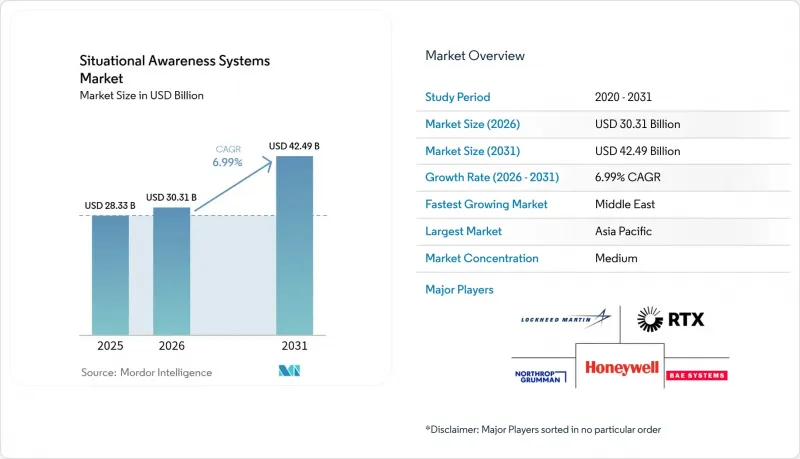
에 의하면, 상황 인식 시스템 시장 규모는 2025년에 283억 3,000만 달러로 평가되었고, 2026년 303억 1,000만 달러에서 2031년까지 424억 9,000만 달러에 이를 것으로 예측되며, 예측 기간(2026-2031년) CAGR은 6.99%를 나타낼 전망입니다.
본 보고서는 플랫폼별(항공, 육상, 해상, 우주), 유형별(지휘통제 시스템, 레이더, 소나, 기타), 구성 요소별(센서·안테나, 소프트웨어, 기타), 최종 사용자 산업별(방위 및 군사, 기타), 용도별(C4ISR·전투 관리, 기타), 지역별(북미, 유럽, 기타)로 분류되어 있습니다. 시장 예측은 금액(달러) 기준으로 제시되어 있습니다.
세계의 상황 인식 시스템 시장 동향 및 인사이트
방위 현대화 예산 확대
세계 조달 주기는 공·육·해·우주에서 수집된 데이터를 단일 플랫폼에 통합할 수 있는 시스템으로 전환되고 있습니다. 미국 국방부의 2025 회계연도 예산 요청에서는 AI 지원 지휘 노드에 대한 자금이 확충되는 한편, 아시아태평양 각국 정부는 해외 의존도를 낮추기 위한 국산 솔루션에 증가하는 예산을 투입하고 있습니다. 록히드 마틴은 미사일 및 사격 통제 프로그램에 통합된 통합 센서 패키지를 원동력으로 2025년 1분기에 180억 달러의 매출을 기록했습니다. 지출 증가는 각국의 역량 목표와 부합하며, 모듈식이며 업그레이드가 가능한 상황 인식 아키텍처에 대한 안정적인 수요를 창출하고 있습니다.
자율형 및 원격 조종형 플랫폼의 급증
육·해·공 3군에 의한 무인 항공기, 지상 차량, 해상 드론의 도입은 인간의 지속적인 모니터링 없이도 위협을 분류하고 우선순위를 매길 수 있는 탑재 처리 시스템에 대한 새로운 요구 사항을 만들어내고 있습니다. 보잉(Boeing)사의 ‘차세대 공중 우세(Next Generation Air Dominance)’ 프로그램 참여는 AI 기반의 자율성과 적응형 엔진을 핵심으로 하는 6세대 전투기 로드맵 개발을 뒷받침하고 있습니다. RTX는 기존 전투기에 인지적 위협 우선순위 지정 기능을 추가하는 머신러닝을 활용한 레이더 경보 수신기의 비행 시험에 성공했습니다. 이와 유사한 논리는 허니웰(Honeywell)의 모듈식 ‘Reveal and Intercept’ 패키지와 같은 대 UAS(무인 항공기 시스템) 솔루션의 기반이 되고 있으며, 이 시스템은 EO/IR 센서와 RF 감지기를 통합하여 드론 무리를 무력화합니다.
높은 조달 비용과 수명 주기 비용
총 소유 비용(TCO)은 초기 조달 비용을 훨씬 초과하며, 운영자 훈련, 국가 암호화 모듈, 소프트웨어 유지 관리, 수명 주기 중반의 센서 교체 등을 포함합니다. 국방 예산의 축소로 인해 구매가 연기되거나 공동 조달이 이루어지는 경우가 많으며, 그 결과 NATO 지원·조달 기관(NSPA) 협정 등 공동 프레임워크가 개발되고 있습니다. 소프트웨어 집약형 아키텍처에서는 20년의 사용 수명 기간 동안 하드웨어 지출을 초과할 가능성이 있는 지속적인 사이버 규정 준수 관련 비용이 발생합니다.
부문 분석
2025년, 지상 플랫폼은 이동식 지휘 센터와 장갑차용 전자 장비에 힘입어 상황 인식 시스템 시장 매출의 39.02%를 차지했습니다. 통합 전투 관리 네트워크는 지상 레이더, 음향 센서, 보병용 시스템의 정보를 통합하여 공통 작전 상황도(COP)를 구축합니다. 한편, 차세대 전투기 및 그룹 5 드론에서 파노라마식 센서 스위트의 표준화가 진행됨에 따라 항공 플랫폼은 연평균 성장률(CAGR) 8.05%로 향후 성장을 주도하고 있습니다. 항공 플랫폼용 상황 인식 시스템 시장 규모는 GPS 수신 상태가 악화된 공역 내에서의 운용 수요에 힘입어 급속히 확대될 것으로 예측됩니다. 큐브샛은 기존 시야 내 무선기(LOS 무선기)를 대체한 휴대형 단말기와 연동함으로써 지상 부대의 감지 범위를 점점 더 확대되고 있습니다.
우주 자산은 역사가 가장 짧지만, 가장 혁신적인 부문을 형성하고 있습니다. 지속적 저지구 궤도 콘스텔레이션은 전술 데이터를 엣지 프로세서로 직접 전송하여 ‘관측·상황 파악·의사 결정’의 루프를 수분에서 수초로 단축합니다. 해상 플랫폼에서는 수상함의 방공 센서에 대한 투자가 계속되고 있는 반면, 항만 경비 프로젝트에서는 자율 순찰을 위해 무인수상정이 채택되고 있습니다. 전반적으로, 다중 도메인 통합에서는 코어 코드를 재작성할 필요 없이 작전 지역을 넘나들며 센서를 재구성할 수 있는 개방형 미들웨어가 선호되고 있습니다. 독자적인 사양을 가진 수직적 시스템은 연합군 기획 담당자들이 요구하는 모듈식 플러그 앤 플레이 프레임워크에 그 자리를 내주고 있습니다.
지휘통제(C2) 허브는 2025년 매출의 29.05%를 차지했으며, 모든 센서 노드를 총괄하는 중추로서의 위상을 확고히 하고 있습니다. 이러한 시스템은 레이더 추적 데이터, AIS 선박 데이터, 전자 지원 조치(ESM) 등 다양한 입력을 실행 가능한 작업으로 변환합니다. 향후 5년 이내에 엣지 측에서 고도화된 알고리즘을 실행할 수 있게 된다면, C2 제품군을 위한 상황 인식 시스템 시장에서의 점유율은 더욱 확대될 것으로 예측됩니다.
옵트로닉스와 EO/IR 기술은 현재 규모는 작지만, 해상도, 야간 관측 거리, 열감도의 향상에 따라 연평균 성장률(CAGR) 7.86%로 확대되고 있습니다. RTX의 RAIVEN 시리즈는 하이퍼스펙트럼, 라이더, AI 필터링을 하나의 짐벌에 통합함으로써 감지 거리를 5배로 확대했습니다. 레이더는 전천후 감지에서 여전히 필수적이지만, 소프트웨어가 각종 정보를 통합함에 따라 무선 주파수 센싱과 광학 센싱 간의 격차는 점차 줄어들고 있습니다. 소나는 잠수함 추적 분야에서 독보적인 위치를 유지하고 있는 반면, 차량용 ADAS 키트는 군사 기술의 노하우를 접목하여 시야가 불량한 환경에서 차량 행렬의 자율 주행을 지원하고 있습니다. 상황 인식 시스템 시장에서는 현재 단일 모달리티의 우위보다는 센서의 다양성이 더욱 중요시되고 있습니다.
지역별 분석
2025년, 아시아태평양은 전 세계 매출의 38.12%를 차지했습니다. 이는 중국, 인도, 일본, 한국, 호주가 서로 겹치는 현대화 로드맵을 실행했기 때문입니다. 국산 센서 제조 프로그램에는 우대 대출이 적용되는 반면, 외국 공급업체들은 오프셋 및 기술 이전 조항을 통해 계약을 수주하고 있습니다. 인도의 ‘방위 조달 절차(DAP)’는 현지에서 조립되는 지휘 모듈에 탑재되는 수입 무선 주파수 칩의 승인 절차를 효율화하고 있습니다. 일본이 ‘세계 컴뱃 에어 프로그램(GCAP)’에 참여함에 따라, 일본의 차세대 전투기 조종석은 유럽의 인간-기계 인터페이스(HMI) 기준을 준수하게 되어 공통 공급망 구축이 가능해졌습니다.
중동은 2031년까지 연평균 성장률(CAGR) 10.18%를 나타낼 것으로 예측됩니다. 사우디아라비아의 ‘비전 2030’은 새로운 상황 인식 시스템에 대해 50%의 국내 조달률을 의무화하고 있어, 탈레스(Thales)사 등의 시스템 통합사업자들을 현지 합작 사업으로 이끌고 있습니다. 아랍에미리트 공군은 호르무즈 해협 상공의 해상 상황을 실시간으로 파악하기 위해 조종사의 헬멧에 큐브샛의 다운링크를 탑재하고 있습니다. 이스라엘은 소프트웨어 중심의 센서 퓨전 기술 수출을 지속하고 있으며, 대부분의 경우 열 클러터의 영향을 받기 쉬운 사막 환경에 특화되어 조정된 능동형 사이버 방어 계층과 함께 제공되고 있습니다.
북미는 미국 국방부의 지속적인 지출을 통해 기술적 리더십을 유지하고 있습니다. 미국 국방부의 ‘통합 전역 지휘통제(JADC2)’ 이니셔티브는 개방형 표준 미들웨어에 자금을 지원하고 있으며, 이를 통해 미국은 수출 계약 수주를 위한 체제를 갖추고 있습니다. 캐나다는 초초음속 활공체를 추적하기 위해 북극권의 감시 레이더를 업그레이드하고 있습니다. 유럽은 상호 운용성을 중시하고 있으며, EISNET 컨소시엄은 위협 라이브러리를 분류함으로써 독일, 프랑스, 이탈리아의 미사일 방어 담당자들이 센서에서 수집된 정보를 동일하게 해석할 수 있도록 하고 있습니다. 아프리카와 남미는 여전히 신흥 도입 지역이며, 콜롬비아의 해안 레이더 현대화나 나이지리아의 파이프라인 모니터링 드론 프로그램은 민간 및 치안 임무가 본격적인 국방 분야 도입에 선행하는 경우가 많음을 보여줍니다.
기타 혜택
- 엑셀 형식 시장 예측(ME) 시트
- 3개월간의 애널리스트 지원
자주 묻는 질문
목차
제1장 서론
제2장 조사 방법
제3장 주요 요약
제4장 시장 구도
제5장 시장 규모 및 성장 예측
제6장 경쟁 구도
제7장 시장 기회 및 향후 전망
AJY 26.08.28According to Mordor Intelligence, the situational awareness systems market size was valued at USD 28.33 billion in 2025 and estimated to grow from USD 30.31 billion in 2026 to reach USD 42.49 billion by 2031, at a CAGR of 6.99% during the forecast period (2026-2031).
This report is Segmented by Platform (Air, Land, Sea, and Space), Type (Command and Control, RADAR, SONAR, and More), Component (Sensors and Antennas, Software, and More), End-User Industry (Defense and Military, and More), Application (C4ISR and Battle Management, and More), and Geography (North America, Europe, and More). The Market Forecasts are Provided in Terms of Value (USD).
Global Situational Awareness Systems Market Trends and Insights
Escalating Defense Modernization Budgets
Global procurement cycles are shifting toward systems that can integrate data from air, land, sea, and space on a single platform. The US Department of Defense FY2025 request boosts funding for AI-enabled command nodes, while Asia-Pacific governments channel rising budgets into indigenous solutions that lessen foreign dependency. Lockheed Martin reported USD 18 billion in Q1 2025 sales, underpinned by integrated sensor packages embedded in missile and fire-control programs. Higher spending aligns with sovereign capability goals, creating consistent demand for modular, upgradeable situational awareness architectures.
Surge in Autonomous and Remotely-Piloted Platforms
The tri-service adoption of unmanned aircraft, ground vehicles, and maritime drones creates new requirements for onboard processing that can classify and prioritize threats without continuous human oversight. Boeing's involvement in the Next Generation Air Dominance program underscores the development of sixth-generation fighter roadmaps, which center on AI-driven autonomy and adaptive engines. RTX successfully flight-tested machine-learning radar-warning receivers that retrofit legacy fighters with cognitive threat prioritization. The same logic underpins counter-UAS solutions, such as Honeywell's modular Reveal and Intercept package, which integrates EO/IR sensors with RF detectors to neutralize drone swarms.
High Acquisition and Lifecycle Costs
The total cost of ownership extends well beyond initial procurement, encompassing operator training, sovereign crypto modules, software sustainment, and mid-life sensor refresh. Smaller defense budgets often defer or pool purchases, prompting the development of joint frameworks, such as NATO Support and Procurement Agency agreements. Software-intensive architectures incur recurring cyber-compliance expenses that can exceed hardware outlays over a 20-year lifespan.
Other drivers and restraints analyzed in the detailed report include:
- Dual-Use Demand from Critical Infrastructure and Smart-City Security
- NATO and QUAD Interoperability Mandates
- Cyber-Security Vulnerabilities in Network-Centric Operations
For complete list of drivers and restraints, kindly check the Table Of Contents.
Segment Analysis
Land platforms controlled 39.02% of situational awareness systems market revenue in 2025, underpinned by mobile command centers and armored vehicle electronics. Integrated battle-management networks fuse feeds from ground radars, acoustic sensors, and dismounted soldier systems into a common operating picture. However, air platforms are pacing future growth at an 8.05% CAGR as next-generation fighters and Group 5 drones standardize panoramic sensor suites. The market size of situational awareness systems for air platforms is expected to grow rapidly, driven by the need to operate within contested airspace with degraded GPS. CubeSats increasingly extend ground forces' horizons, tying into handheld terminals that have supplanted legacy line-of-sight radios.
Space assets form the youngest but most disruptive layer. Persistent low-earth-orbit constellations beam tactical data straight to edge processors, closing observe-orient-decide loops from minutes to seconds. Sea platforms continue to invest in surface-ship air-defense sensors, while harbor security projects adopt unmanned surface vessels for autonomous patrol. Collectively, multi-domain integration favors open middleware that allows operators to reconfigure sensors across theaters without requiring the rewriting of core code. Proprietary stovepipes are losing ground to modular plug-and-play frameworks demanded by coalition planners.
Command and control hubs generated 29.05% of 2025 revenue, underscoring their status as the orchestrating nerve center for every sensor node. These systems translate diverse inputs, such as radar tracks, AIS ship data, and electronic support measures, into actionable tasks. Running advanced algorithms at the edge within the next five years will lift their share of the situational awareness systems market size for C2 suites.
Optronics and EO/IR technologies, though smaller today, are expanding at an 7.86% CAGR as resolution, night-vision range, and thermal sensitivity improve. RTX's RAIVEN family achieves five-fold detection range gains by coupling hyperspectral, lidar, and AI filtering in one gimbal. Radar remains indispensable for all-weather detection, yet the gap between radio-frequency and optical sensing narrows as software combines cues. SONAR retains its niche in submarine tracking, whereas vehicle ADAS kits borrow military heritage to assist convoy autonomy in low-visibility environments. The situational awareness systems market now favors sensor diversity over single-modality supremacy.
Complete Report Scope:
- By Platform
- Air
- Land
- Sea
- Space
- By Type
- Command and Control Systems
- RADAR
- SONAR
- Optronics and EO/IR
- Vehicle SAS/ADAS
- By Component
- Sensors and Antennas
- Displays and HUDs
- Processing/Computing Units
- Communications and Networking Hardware
- Software
- By End-User Industry
- Defense and Military
- Homeland Security and Public Safety
- Aviation and Aerospace
- Maritime
- By Application
- C4ISR and Battle Management
- Security and Surveillance
- Disaster Response and Emergency Management
- Navigation and Traffic Control
- Environmental/Weather Monitoring
- Training and Simulation
- By Geography
- North America
- United States
- Canada
- Mexico
- Europe
- Germany
- United Kingdom
- France
- Rest of Europe
- Asia-Pacific
- China
- India
- Japan
- South Korea
- Australia
- Rest of Asia-Pacific
- South America
- Brazil
- Rest of South America
- Middle East and Africa
- Middle East
- Saudi Arabia
- United Arab Emirates
- Israel
- Rest of Middle East
- Africa
- South Africa
- Rest of Africa
- Middle East
- North America
Geography Analysis
The Asia-Pacific region held 38.12% of global revenue in 2025, as China, India, Japan, South Korea, and Australia executed overlapping modernization roadmaps. Indigenous sensor fabrication programs receive preferential financing, while foreign suppliers secure contracts through offset and technology-transfer clauses. India's Defense Acquisition Procedure streamlines approval for imported radio-frequency chips that feed into locally assembled command modules. Japanese participation in the Global Combat Air Programme aligns its next-generation fighter cockpit with European human-machine interface standards, enabling the establishment of shared supply chains.
The Middle East is forecasted to deliver a 10.18% CAGR to 2031. Saudi Arabia's Vision 2030 requires 50% domestic content in new situational awareness suites, steering integrators such as Thales toward local joint ventures. UAE air forces embed CubeSat downlinks into pilot helmets for real-time maritime situational pictures over the Strait of Hormuz. Israel continues to export software-centric sensor fusion, often bundled with active cyber-defense layers specifically tuned for desert environments that are susceptible to thermal clutter.
North America maintains technology leadership through sustained US DoD outlays. The Pentagon's Joint All-Domain Command and Control (JADC2) initiative finances open-standards middleware that primes the US for export wins. Canada upgrades Arctic surveillance radars to track hypersonic glide vehicles. Europe emphasizes interoperability: the EISNET consortium classifies threat libraries so that German, French, and Italian missile defense operators interpret sensor cues identically. Africa and South America remain emerging adopters; Colombia's coastal radar overhaul and Nigeria's pipeline-monitoring drone program illustrate how civil-security missions often precede full defense adoption.
- Honeywell International Inc.
- RTX Corporation
- BAE Systems plc
- General Dynamics Corporation
- Lockheed Martin Corporation
- Northrop Grumman Corporation
- Elbit Systems Ltd.
- Leonardo DRS, Inc.
- Thales Group
- Saab AB
- The Boeing Company
- L3Harris Technologies, Inc.
- Airbus Defence and Space SAS (Airbus SE)
- Safran SA
- Rheinmetall AG
- Indra Sistemas S.A.
- Kongsberg Gruppen ASA
- Israel Aerospace Industries Ltd.
- Cubic Corporation
Additional Benefits:
- The market estimate (ME) sheet in Excel format
- 3 months of analyst support
TABLE OF CONTENTS
1 INTRODUCTION
- 1.1 Study Assumptions and Market Definition
- 1.2 Scope of the Study
2 RESEARCH METHODOLOGY
3 EXECUTIVE SUMMARY
4 MARKET LANDSCAPE
- 4.1 Market Overview
- 4.2 Market Drivers
- 4.2.1 Escalating defense modernization budgets
- 4.2.2 Surge in autonomous and remotely-piloted platforms
- 4.2.3 Dual-use demand from critical infrastructure and smart-city security
- 4.2.4 NATO and QUAD interoperability mandates
- 4.2.5 Proliferation of CubeSat space-based sensing constellations
- 4.2.6 AI-driven sensor-fusion reducing operator cognitive load
- 4.3 Market Restraints
- 4.3.1 High acquisition and lifecycle costs
- 4.3.2 Cyber-security vulnerabilities in network-centric ops
- 4.3.3 RF-spectrum congestion causing sensor interference
- 4.3.4 Tightening export controls on advanced imaging sensors
- 4.4 Value Chain Analysis
- 4.5 Regulatory Landscape
- 4.6 Technological Outlook
- 4.7 Porter's Five Forces Analysis
- 4.7.1 Threat of New Entrants
- 4.7.2 Bargaining Power of Buyers
- 4.7.3 Bargaining Power of Suppliers
- 4.7.4 Threat of Substitutes
- 4.7.5 Intensity of Competitive Rivalry
5 MARKET SIZE AND GROWTH FORECASTS (VALUE)
- 5.1 By Platform
- 5.1.1 Air
- 5.1.2 Land
- 5.1.3 Sea
- 5.1.4 Space
- 5.2 By Type
- 5.2.1 Command and Control Systems
- 5.2.2 RADAR
- 5.2.3 SONAR
- 5.2.4 Optronics and EO/IR
- 5.2.5 Vehicle SAS/ADAS
- 5.3 By Component
- 5.3.1 Sensors and Antennas
- 5.3.2 Displays and HUDs
- 5.3.3 Processing/Computing Units
- 5.3.4 Communications and Networking Hardware
- 5.3.5 Software
- 5.4 By End-User Industry
- 5.4.1 Defense and Military
- 5.4.2 Homeland Security and Public Safety
- 5.4.3 Aviation and Aerospace
- 5.4.4 Maritime
- 5.5 By Application
- 5.5.1 C4ISR and Battle Management
- 5.5.2 Security and Surveillance
- 5.5.3 Disaster Response and Emergency Management
- 5.5.4 Navigation and Traffic Control
- 5.5.5 Environmental/Weather Monitoring
- 5.5.6 Training and Simulation
- 5.6 By Geography
- 5.6.1 North America
- 5.6.1.1 United States
- 5.6.1.2 Canada
- 5.6.1.3 Mexico
- 5.6.2 Europe
- 5.6.2.1 Germany
- 5.6.2.2 United Kingdom
- 5.6.2.3 France
- 5.6.2.4 Rest of Europe
- 5.6.3 Asia-Pacific
- 5.6.3.1 China
- 5.6.3.2 India
- 5.6.3.3 Japan
- 5.6.3.4 South Korea
- 5.6.3.5 Australia
- 5.6.3.6 Rest of Asia-Pacific
- 5.6.4 South America
- 5.6.4.1 Brazil
- 5.6.4.2 Rest of South America
- 5.6.5 Middle East and Africa
- 5.6.5.1 Middle East
- 5.6.5.1.1 Saudi Arabia
- 5.6.5.1.2 United Arab Emirates
- 5.6.5.1.3 Israel
- 5.6.5.1.4 Rest of Middle East
- 5.6.5.2 Africa
- 5.6.5.2.1 South Africa
- 5.6.5.2.2 Rest of Africa
- 5.6.5.1 Middle East
- 5.6.1 North America
6 COMPETITIVE LANDSCAPE
- 6.1 Market Concentration
- 6.2 Strategic Moves
- 6.3 Market Share Analysis
- 6.4 Company Profiles (includes Global-level overview, Market-level overview, Core segments, Financials, Strategic info, Rank/Share, Products and Services, Recent Developments)
- 6.4.1 Honeywell International Inc.
- 6.4.2 RTX Corporation
- 6.4.3 BAE Systems plc
- 6.4.4 General Dynamics Corporation
- 6.4.5 Lockheed Martin Corporation
- 6.4.6 Northrop Grumman Corporation
- 6.4.7 Elbit Systems Ltd.
- 6.4.8 Leonardo DRS, Inc.
- 6.4.9 Thales Group
- 6.4.10 Saab AB
- 6.4.11 The Boeing Company
- 6.4.12 L3Harris Technologies, Inc.
- 6.4.13 Airbus Defence and Space SAS (Airbus SE)
- 6.4.14 Safran SA
- 6.4.15 Rheinmetall AG
- 6.4.16 Indra Sistemas S.A.
- 6.4.17 Kongsberg Gruppen ASA
- 6.4.18 Israel Aerospace Industries Ltd.
- 6.4.19 Cubic Corporation
7 MARKET OPPORTUNITIES AND FUTURE OUTLOOK
- 7.1 White-space and Unmet-Need Assessment


