|
시장보고서
상품코드
2114990
자동차용 NVH 재료 시장 : 시장 점유율 분석, 업계 동향 및 통계, 성장 예측(2026-2031년)Automotive NVH Materials - Market Share Analysis, Industry Trends & Statistics, Growth Forecasts (2026 - 2031) |
||||||
 Mordor Intelligence
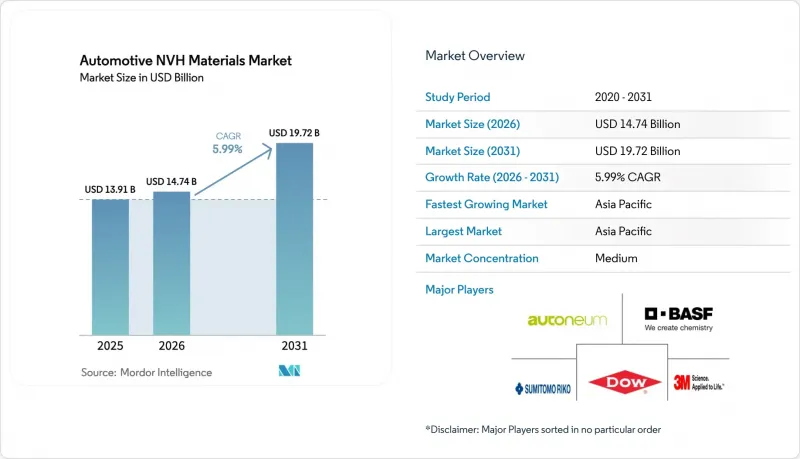
Mordor Intelligence에 의하면, 자동차용 NVH 재료 시장 규모는 2025년 139억 1,000만 달러로 평가되었고, 2026년에는 147억 4,000만 달러로 추정되고, 2026-2031년 CAGR 5.99%로 성장을 지속할 전망이며, 2031년에는 197억 2,000만 달러에 이를 것으로 예측됩니다.
본 보고서에서는 업계를 재료 유형별(고무, 수지 등), 차량 유형별(승용차, 소형 상용차 등), 추진 방식별(내연기관차(ICE), 하이브리드 전기차(HEV/PHEV) 등), 용도별(흡수, 감쇠 등), 지역별(아시아태평양, 북미 등)로 시장을 세분화하고 있습니다.
세계의 자동차용 NVH 재료 시장 동향 및 인사이트
엄격한 차량 실내 소음 규제와 높아지는 승차감에 대한 기대
유럽연합(EU) 규정 540/2014에 따라 허용되는 차량 외부 및 실내 소음 한계치가 상향 조정됨에 따라, 각 OEM 업체들은 불필요한 중량을 늘리지 않고도 적합성 시험을 통과할 수 있는 고성능 NVH 재료를 채택할 수밖에 없게 되었습니다. 또한, 정숙성이 뛰어난 차량 내부에 대한 소비자의 인식도 높아지면서, 혼다의 ‘액티브 노이즈 컨트롤(ANC)’ 시스템과 같은 기능이 주요 브랜드의 여러 모델 라인에 도입되고 있습니다. 따라서 공급업체들은 소음 시험에 불합격할 경우 벌금이나 브랜드 이미지 저하를 초래할 수 있기 때문에 거시경제의 경기 순환 영향에서 벗어나 피할 수 없는 수요를 목격하고 있습니다. 자동차 제조업체들은 현재 차량 내 음질을 브랜딩 수단으로 자리매김하고 있으며, BMW의 ‘Neue Klasse’ 전기차용 ‘HypersonX’ 프로그램은 맞춤형 음향 특성에 부여되는 마케팅적 중요성을 여실히 보여주고 있습니다. 규제와 고객의 기대가 맞물리면서, 첨단 흡음재, 진동 제어재, 차음재에 대한 향후 몇 년간의 성장 기반이 확고해지고 있습니다.
EV 및 하이브리드 차량의 생산 확대가 드러내는 고주파 NVH 과제
전기 모터에서는 기존의 고무로는 충분히 억제할 수 없었던 인버터의 날카로운 소리와 노면 및 타이어의 조화음이 두드러지게 나타납니다. 어센드 머티리얼즈(Ascend Materials)의 ‘Vydyne 방진 기술’은 차내 소음을 최대 84% 저감하며, 3kHz-4kHz 주파수 대역에서 엔지니어링 폴리아미드가 기존 폼 재료를 능가하는 성능을 발휘할 수 있음을 입증하고 있습니다. 현대자동차의 ‘로드 노이즈·액티브 노이즈 컨트롤’은 실시간 위상 반전을 통해 저주파 소음을 절반으로 줄여, 자동차 제조업체가 경량 패브릭과 전자적 대항파를 결합하여 세련된 승차감을 실현할 수 있도록 합니다. 아시아태평양의 공장들이 배터리식 전기차 생산을 가속화함에 따라, 고주파 NVH 특성에 맞춘 복합 매트 및 음향 메타물질에 대한 수요가 증가하고 있으며, 그 시급성도 커지고 있습니다. 그 결과, 자동차용 NVH 재료 시장에서는 새로운 EV 플랫폼을 위한 수주가 사상 가장 빠른 속도로 기록되고 있습니다.
석유계 고무 및 PU 폼 원자재 가격 변동
합성 고무 가격은 원유 유래 부타디엔공급 상황에 따라 변동합니다. 2024년에는 아시아 현물 시세가 톤당 3,000달러를 넘어설 전망이며, 이는 콘티넨탈과 굿이어가 타이어 가격을 인상하는 계기가 되어, NVH 공급업체들은 원가 전가를 하지 않는 한 이익률 하락을 피할 수 없게 되었습니다. 저가대 부문은 가격 급등을 흡수할 여력이 가장 낮기 때문에 일부 자동차 제조업체는 프리미엄 오디오 패키지를 축소하거나 출시를 연기하고 있습니다. 2024년 포드 공장의 가동 중단을 초래한 희토류 자석 부족 등 공급 차질은 전 세계 원자재 공급망의 취약성을 여실히 드러내고 있습니다. 따라서 자동차용 NVH 재료 시장은 헤지 및 현지 조달 전략이 성숙해질 때까지 단기적인 비용 압박에 직면하게 될 것입니다.
부문 분석
2025년, 자동차용 NVH 재료 시장에서 고무는 다재다능한 방진 성능과 성숙한 공급 기반 덕분에 32.74%라는 최고 점유율을 유지했습니다. 그러나 법규 및 각 OEM사의 탄소 배출 감축 목표로 인해 재료 대체가 진행되는 가운데, 바이오 및 재생 폴리머는 연평균 성장률(CAGR) 6.79%로 성장을 지속하고 있습니다. 바이오 및 재생 폴리머와 같은 기타 유형의 폴리머 재료를 포함한 자동차용 NVH 재료 시장 규모는 대량 생산되는 차량 프로그램이 탄소 발자국이 낮은 인테리어 채택을 결정하는 대로 급격히 확대될 것으로 예측됩니다. 헌츠맨(Huntsman)사의 ‘ACOUSTIFLEX HR BIO’ 폼은 기존 PU와 동등한 탄력성을 유지하면서 9% 이상의 바이오 함유율을 실현하여, 친환경 화학 기술과 승차감 향상을 동시에 달성했음을 입증하고 있습니다. LANXESS사는 구조용 인서트용으로 재생 가능한 원료를 80% 이상 함유한 ‘Tepex’ 복합재를 제공함으로써 이러한 변화를 뒷받침하고 있습니다.
천과 같은 부직포 시트는 경량화와 재활용 가능성이라는 목표에 따라 보급이 확대되고 있습니다. 밀리켄(Milliken)사의 50% 경량화된 텍스타일 라이너는 흡음 성능 면에서 경쟁사를 능가하며, 수명이 다한 후에는 폴리머 재활용 공정에 재투입할 수 있습니다. ScienceDirect에서 연구된 균사체 유래 흡음재는 1kHz의 차량 내부 주파수를 효과적으로 감쇠시키는 동시에 자연적으로 생분해됩니다. 예측 기간 동안, 고무 표피와 천연섬유 코어를 융합한 복합 적층재는 Tier 1 공급업체에게 비용 측면과 지속가능성 측면 모두에서 새로운 가치를 창출할 가능성이 있습니다. 이러한 기술이 보급됨에 따라, 자동차용 NVH 재료 시장은 석유 유래 재료를 다용도로 사용한 구성에서 하이브리드 및 재생 가능 재료를 활용한 배합으로 전환될 것입니다. 주기적인 공극을 가진 음향 메타물질은 질량을 늘리지 않고도 저주파의 윙윙거리는 소리를 2.0-2.3dB 저감시켜, 향후 더 무거운 ‘질량 법칙’에 기반한 해결책을 대체하여 기하학적 형상이 주류가 될 것임을 시사합니다. 이러한 다기능적 접근 방식에 따라 흡음, 감쇠, 차음이라는 기존의 경계가 모호해지고 있습니다.
2025년에는 승용차가 자동차용 NVH 재료 시장의 64.78% 점유율을 차지했으나, 2031년까지는 여전히 7.57%라는 가장 높은 연평균 성장률(CAGR)을 나타낼 전망입니다. 이러한 급증은 단순한 판매 대수 증가라기보다는 차량당 사용량 증가를 반영한 것으로, 소형 크로스오버 차량에는 판매 가격에 걸맞게 고급차 수준의 음향 패키지가 채택되고 있기 때문입니다. 소형 상용차는 배송용 차량의 전동화의 혜택을 받고 있습니다. 오토놈(Autonom)사의 신설된 상용차 부문은 도로 소음이 증폭되기 쉬운 저소음 전기 밴에 맞추어 조정된 플로어 시스템을 개발하고 있습니다. 대형 트럭의 경우, 장거리 운전자의 피로 및 안전 지침을 충족하기 위해 더 두꺼운 대시 매트가 채택되고 있습니다. 이륜차 및 마이크로모빌리티 부문에서는 도시 지역의 소음 규제가 강화됨에 따라 슬림한 방진 스트립의 채택이 확대되기 시작했습니다. 그 결과, 자동차용 NVH 재료 시장의 적용 범위는 더욱 확대되고 있으며, 공급업체는 크게 상이한 사용 조건에 맞추어 방음성, 내구성, 비용 특성을 최적화해야 합니다. 승용차 시장의 성장은 고급스러운 음향 성능이 더 이상 최고급 세단에 국한되지 않고 주류 쇼룸으로도 확산되고 있음을 뒷받침합니다.
지역별 분석
아시아태평양은 2025년에 자동차용 NVH 재료 시장의 46.78%를 차지한 것으로 평가되었으며, 중국, 일본, 한국을 주축으로 연평균 성장률(CAGR) 6.66%를 나타낼 것으로 전망됩니다. 중국의 각 OEM 업체들이 설계부터 생산까지의 주기 단축을 요구하는 가운데, 오토뉴움(Autonume)이 장쑤 화우(江蘇華宇)의 지분 과반수를 인수한 것은 현지 공급 체제를 강화하기 위한 조치입니다. 일본의 복합 기업들은 전기차(EV) 부품을 중심으로 사업 재편을 추진하고 있어, 배터리 관련 음향 특성을 파악하는 NVH 전문 기업들에게 새로운 비즈니스 기회가 생겨나고 있습니다. 도레이 등 한국의 재료 그룹은 흡음성 탄소섬유 시트의 생산 능력을 확대하고 있어, 지속적인 전문화를 시사하고 있습니다. 태국과 인도네시아에 신설된 조립 거점은 관세 없는 아세안(ASEAN) 시장 진출을 모색하는 일본 및 중국의 Tier 1 공급업체들을 유치하고 있습니다.
유럽은 엄격한 규제 체계와 고급차 생산 집중을 원동력으로 삼아 여전히 중요한 시장에서의 입지를 유지하고 있습니다. EU 규정 540/2014는 NVH 재료의 사양에 직접적인 영향을 미치는 종합적인 소음 배출 기준을 규정하고 있습니다. BMW의 ‘HypersonX’ 프로젝트가 보여주듯이, 독일의 OEM 기업들은 공급업체들에게 음향 분야에서의 브랜드화를 추진하고 있습니다. 규제는 재생 폴리머의 채택을 더욱 촉진하고 있지만, FMVSS를 준수하는 방화 기준이 그 대량 도입을 지연시키고 있습니다. 프로이덴베르크사가 4,200만 유로를 투자해 펀자브 주에 건설한 공장은 현지 생산을 통해 전 세계 수요에 대응하겠다는 유럽 기업의 전략을 여실히 보여주고 있습니다.
북미에서는 엄격한 방화 안전 기준인 FMVSS 302와 특수 고무용 공급 기반의 불균형 사이에서 균형이 이루어지고 있습니다. 포드의 자석 부족 사례는 지역적 공급 체계의 탄력성 확보가 얼마나 시급한 과제인지를 여실히 드러냈습니다. 아우렐리우스 프라이빗 에쿼티(Aurelius Private Equity)가 테이진 오토모티브 테크놀로지스(Teijin Automotive Technologies)를 10억 달러 규모로 인수함으로써, 국내 복합재료 생산 역량을 확대하고 인수 대상 기업을 전기차(EV)용 음향 분야 성장의 주역으로 자리매김하고 있습니다. 남미 및 중동 및 아프리카에서는 현지 조달 의무 강화에 따라 초기 단계의 비즈니스 기회가 창출되고 있습니다. 그러나 경제 변동과 인프라 부족으로 인해 당분간 생산량은 제한될 전망입니다.
기타 혜택 :
- 엑셀 형식 시장 예측(ME) 시트
- 3개월간의 애널리스트 지원
자주 묻는 질문
목차
제1장 서론
제2장 조사 방법
제3장 주요 요약
제4장 시장 구도
제5장 시장 규모 및 성장 예측
제6장 경쟁 구도
제7장 시장 기회 및 향후 전망
AJY 26.08.28According to Mordor Intelligence, the automotive NVH materials market size is expected to grow from USD 13.91 billion in 2025 to USD 14.74 billion in 2026 and is forecast to reach USD 19.72 billion by 2031 at 5.99% CAGR over 2026-2031.
This report Segments the Industry by Material Type (Rubber, Resins, and More), Vehicle Type (Passenger Cars, Light Commercial Vehicles, and More), Propulsion Type (Internal Combustion Engine (ICE) Vehicles, Hybrid Electric Vehicles (HEV/PHEV), and More), Application (Absorption, Damping, and More), and Geography (Asia-Pacific, North America, and More).
Global Automotive NVH Materials Market Trends and Insights
Stringent Cabin-Noise Legislation and Rising Comfort Expectations
European Union Regulation 540/2014 tightened permissible exterior and interior noise limits, forcing OEMs to adopt higher-performance NVH materials that can pass compliance tests without adding unwanted mass Consumer awareness of quiet cabins also matured, encouraging mainstream brands to roll out features such as Honda's Active Noise Control system across multiple model lines. Suppliers therefore observe non-discretionary demand that is insulated from macroeconomic cycles, since failing noise tests triggers financial penalties and brand damage. Automakers now frame interior sound quality as a branding device; BMW's HypersonX program for Neue Klasse electric cars underscores the marketing weight attached to tailor-made acoustic signatures. The overlap of regulation and customer expectation cements a multi-year growth runway for advanced absorption, damping and insulation media.
Booming EV and Hybrid Output Exposing High-Frequency NVH Gaps
Electric motors reveal inverter whine and road-tire harmonics that traditional rubbers suppress poorly. Ascend Materials' Vydyne Anti-Vibration Technology cuts cabin noise by up to 84%, proving that engineered polyamides can outperform legacy foams in the 3 kHz-4 kHz range. Hyundai's Road-Noise Active Noise Control halves low-frequency disturbance through real-time phase inversion, letting carmakers mix lighter fabrics with electronic counterwaves for a refined ride. The urgency grows as Asia-Pacific factories accelerate battery-electric production, amplifying the need for composite mats and acoustic metamaterials tailored to high-frequency NVH profiles. As a result, the Automotive NVH materials market records its quickest contract wins in new EV platforms.
Feed-Stock Price Volatility for Petro-Rubber and PU Foams
Synthetic rubber prices swing with crude-derived butadiene supply. Spot Asian quotes surpassed USD 3,000 per ton in 2024, prompting Continental and Goodyear to lift tire prices and forcing NVH suppliers to pass on cost or lose margin. Budget segments are least able to absorb spikes, so some automakers scale back premium acoustic packs or delay launches. Supply disruptions such as rare-earth magnet shortages that idled a Ford plant in 2024 reveal the vulnerability of global feed-stock chains. The Automotive NVH materials market thus faces near-term expense pressure until hedging and localized sourcing strategies mature.
Other drivers and restraints analyzed in the detailed report include:
- Light-Weighting Strategies Pivoting to Polymer and Composite NVH Media
- Premium and Luxury Vehicle Proliferation Demanding Acoustic Branding
- Fire-Safety Hurdles for Recycled Foams
For complete list of drivers and restraints, kindly check the Table Of Contents.
Segment Analysis
Rubber held the leading 32.74% share of the Automotive NVH materials market in 2025 because of its all-round vibration isolation performance and mature supply base. However, bio-based and recycled polymers clock a 6.79% CAGR as legislation and OEM carbon targets accelerate material substitution. The Automotive NVH materials market size for other types of polymer materials like bio-based and recycled polymers is projected to rise sharply once large-volume vehicle programs commit to lower-footprint interiors. Huntsman's ACOUSTIFLEX HR BIO foam provides over 9% bio content while matching legacy PU resilience, demonstrating parity between green chemistry and ride refinement. LANXESS complements this shift with Tepex composites boasting more than 80% renewable feedstock for structural inserts.
Fabric-like non-woven sheets grow along lightweighting and recyclability goals. Milliken's 50% lighter textile liner exceeds rivals in absorption and can reenter polymer streams at end of life. Mycelium-grown absorbers studied on ScienceDirect effectively damp 1 kHz cabin frequencies while biodegrading naturally. Over the forecast horizon, composite laminates that merge rubber skins with natural-fiber cores could unlock new cost-plus-sustainability value for Tier 1 suppliers. As those technologies scale, the Automotive NVH materials market will pivot from petro-heavy menus toward hybrid and renewable formulations. Acoustic metamaterials designed with periodic voids cancel 2.0-2.3 dB of low-frequency drone without mass, pointing to a future where geometry replaces heavier mass-law solutions. Such multifunctional approaches blur the historical lines between absorption, damping and insulation.
Passenger cars dominated the Automotive NVH materials market with 64.78% share in 2025 yet still deliver the highest 7.57% CAGR to 2031. The surge reflects rising per-unit content rather than sheer volume, as compact crossovers receive luxury-style acoustic packages to justify sticker prices. Light commercial vehicles benefit from parcel fleet electrification: Autoneum's new Commercial Vehicle unit develops floor systems tuned to silent e-vans that amplify road roar. Heavy trucks adopt thicker dash mats to meet fatigue and safety guidelines for long-haul drivers. Two-wheelers and micro-mobility categories begin to integrate slimline damping strips as urban sound rules tighten. Consequently, the Automotive NVH materials market records wider application breadth, and suppliers must tailor acoustic, durability and cost attributes to vastly different duty cycles. Passenger car growth confirms that premium-feel acoustics are no longer confined to top-end sedans but span the mainstream showroom.
Complete Report Scope:
- By Material Type
- Rubber
- Thermoplastic Polymers
- Resins
- Fabric-like Materials
- Other Material Types (Bio-based, Recycled, etc.)
- By Propulsion Type
- Internal Combustion Engine (ICE) Vehicles
- Hybrid Electric Vehicles (HEV/PHEV)
- Battery Electric Vehicles (BEV)
- Fuel-Cell Electric Vehicles (FCEV)
- By Vehicle Type
- Passenger Cars
- Light Commercial Vehicles
- Heavy Commercial Vehicles
- Two-Wheelers and Micro-Mobility
- By Application
- Absorption
- Damping
- Insulation
- Sound Proofing
- Other Applications (Anti squeak and rattle prevention, etc.)
- Geography
- Asia-Pacific
- China
- India
- Japan
- South Korea
- Rest of Asia-Pacific
- North America
- United States
- Canada
- Mexico
- Europe
- Germany
- United Kingdom
- France
- Italy
- Rest of Europe
- South America
- Brazil
- Argentina
- Rest of South America
- Middle East and Africa
- Saudi Arabia
- South Africa
- Rest of Middle-East and Africa
- Asia-Pacific
Geography Analysis
Asia-Pacific commanded 46.78% of the Automotive NVH materials market in 2025 and is forecast to grow at 6.66% CAGR, anchored by China, Japan and South Korea. Autoneum's majority buyout of Jiangsu Huanyu strengthens local supply depth as Chinese OEMs demand quicker design-to-production cycles. Japanese conglomerates reorganize around EV parts, opening white space for NVH specialists who grasp battery-related acoustic profiles. South Korean material groups like Toray ramp capacity for sound-absorbing carbon-fiber sheets, signaling continued specialization. New assembly hubs in Thailand and Indonesia attract Japanese and Chinese Tier 1s that want tariff-free ASEAN access.
Europe maintains significant market presence driven by stringent regulatory frameworks and premium vehicle manufacturing concentration, with EU Regulation 540/2014 establishing comprehensive noise emission standards that directly influence NVH material specifications . German OEMs push suppliers toward acoustic branding, as BMW's HypersonX project illustrates. Regulations further stimulate recycled polymer adoption, although FMVSS-equivalent fire standards slow mass uptake. Freudenberg's EUR 42 million Punjab plants underscore European players' strategy to serve global demand with localized output.
North America balances strict fire-safety code FMVSS 302 with a patchy supply base for specialty rubbers. Ford's magnet shortage episode highlighted the urgency of regional resilience. AURELIUS Private Equity's USD 1 billion acquisition of Teijin Automotive Technologies expands composite capabilities onshore, positioning the buyer for growth in EV acoustics. South America and the Middle East & Africa offer early-stage openings as local content mandates rise, yet economic swings and infrastructure gaps temper immediate volume.
- 3M
- Autoneum
- BASF
- Dow
- DuPont
- ElringKlinger AG
- FoamPartner (Recticel)
- Freudenberg SE
- Henkel AG and Co. KGaA
- Huntsman Corporation
- Saint Gobain
- Sumitomo Riko Company Limited
- Tenneco Inc.
- Wolverine Advanced Materials
Additional Benefits:
- The market estimate (ME) sheet in Excel format
- 3 months of analyst support
TABLE OF CONTENTS
1 Introduction
- 1.1 Study Assumptions and Market Definition
- 1.2 Scope of the Study
2 Research Methodology
3 Executive Summary
4 Market Landscape
- 4.1 Market Overview
- 4.2 Market Drivers
- 4.2.1 Stringent Cabin-Noise Legislation and Rising Comfort Expectations
- 4.2.2 Booming EV and Hybrid Output Exposing High-Frequency NVH Gaps
- 4.2.3 Light-Weighting Strategies Pivoting to Polymer and Composite NVH Media
- 4.2.4 Premium and Luxury Vehicle Proliferation Demanding Acoustic Branding
- 4.2.5 Increasing Usage of Automotive NVH Materials in Passenger Vehicles
- 4.3 Market Restraints
- 4.3.1 Threat of Substitutes from Alternative Technologies
- 4.3.2 Feed-Stock Price Volatility for Petro-Rubber and PU Foams
- 4.3.3 Fire-Safety Hurdles for Recycled Foams
- 4.4 Value Chain Analysis
- 4.5 Porter's Five Forces
- 4.5.1 Threat of New Entrants
- 4.5.2 Bargaining Power of Buyers
- 4.5.3 Bargaining Power of Suppliers
- 4.5.4 Threat of Substitutes
- 4.5.5 Degree of Competition
5 Market Size and Growth Forecasts (Value)
- 5.1 By Material Type
- 5.1.1 Rubber
- 5.1.2 Thermoplastic Polymers
- 5.1.3 Resins
- 5.1.4 Fabric-like Materials
- 5.1.5 Other Material Types (Bio-based, Recycled, etc.)
- 5.2 By Propulsion Type
- 5.2.1 Internal Combustion Engine (ICE) Vehicles
- 5.2.2 Hybrid Electric Vehicles (HEV/PHEV)
- 5.2.3 Battery Electric Vehicles (BEV)
- 5.2.4 Fuel-Cell Electric Vehicles (FCEV)
- 5.3 By Vehicle Type
- 5.3.1 Passenger Cars
- 5.3.2 Light Commercial Vehicles
- 5.3.3 Heavy Commercial Vehicles
- 5.3.4 Two-Wheelers and Micro-Mobility
- 5.4 By Application
- 5.4.1 Absorption
- 5.4.2 Damping
- 5.4.3 Insulation
- 5.4.4 Sound Proofing
- 5.4.5 Other Applications (Anti squeak and rattle prevention, etc.)
- 5.5 Geography
- 5.5.1 Asia-Pacific
- 5.5.1.1 China
- 5.5.1.2 India
- 5.5.1.3 Japan
- 5.5.1.4 South Korea
- 5.5.1.5 Rest of Asia-Pacific
- 5.5.2 North America
- 5.5.2.1 United States
- 5.5.2.2 Canada
- 5.5.2.3 Mexico
- 5.5.3 Europe
- 5.5.3.1 Germany
- 5.5.3.2 United Kingdom
- 5.5.3.3 France
- 5.5.3.4 Italy
- 5.5.3.5 Rest of Europe
- 5.5.4 South America
- 5.5.4.1 Brazil
- 5.5.4.2 Argentina
- 5.5.4.3 Rest of South America
- 5.5.5 Middle East and Africa
- 5.5.5.1 Saudi Arabia
- 5.5.5.2 South Africa
- 5.5.5.3 Rest of Middle-East and Africa
- 5.5.1 Asia-Pacific
6 Competitive Landscape
- 6.1 Market Concentration
- 6.2 Strategic Moves
- 6.3 Market Share(%)/Ranking Analysis
- 6.4 Company Profiles (includes Global level Overview, Market level overview, Core Segments, Financials as available, Strategic Information, Market Rank/Share for key companies, Products and Services, and Recent Developments)
- 6.4.1 3M
- 6.4.2 Autoneum
- 6.4.3 BASF
- 6.4.4 Dow
- 6.4.5 DuPont
- 6.4.6 ElringKlinger AG
- 6.4.7 FoamPartner (Recticel)
- 6.4.8 Freudenberg SE
- 6.4.9 Henkel AG and Co. KGaA
- 6.4.10 Huntsman Corporation
- 6.4.11 Saint Gobain
- 6.4.12 Sumitomo Riko Company Limited
- 6.4.13 Tenneco Inc.
- 6.4.14 Wolverine Advanced Materials
7 Market Opportunities and Future Outlook
- 7.1 White-space and Unmet-need Assessment