

|
시장보고서
상품코드
2114997
선박용 복합재료 시장 : 시장 점유율 분석, 업계 동향 및 통계, 성장 예측(2026-2031년)Marine Composites - Market Share Analysis, Industry Trends & Statistics, Growth Forecasts (2026 - 2031) |
||||||
 Mordor Intelligence
Mordor Intelligence에 의하면, 선박용 복합재료 시장 규모는 2025년에 50억 5,000만 달러로 평가되었고, 2026년 53억 5,000만 달러에서 2031년까지 71억 6,000만 달러에 이를 것으로 예측되며, 예측 기간(2026-2031년) CAGR은 5.98%를 나타낼 전망입니다.
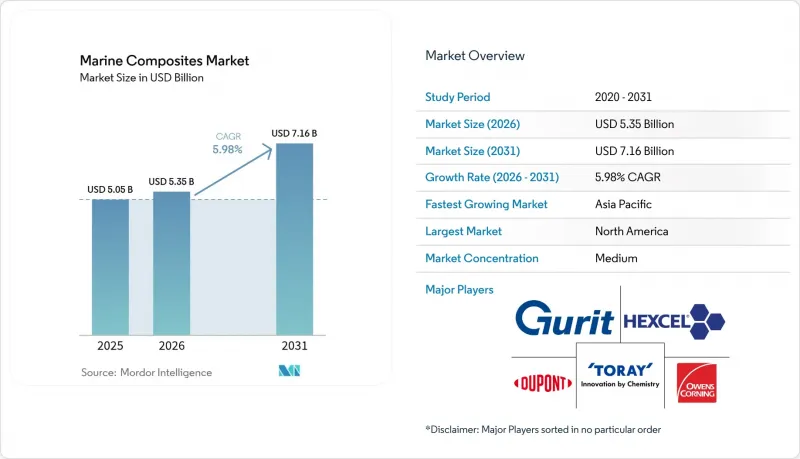
본 보고서는 복합재 유형별(금속 매트릭스 복합재, 폴리머 매트릭스 복합재, 세라믹 매트릭스 복합재), 수지 유형별(에폭시, 폴리에스테르, 기타), 선박 유형별(세일링 보트, 크루즈선·요트, 모터보트, 기타), 지역별(아시아태평양, 북미, 유럽, 남미, 중동 및 아프리카)별로 분류되어 있습니다. 시장 예측은 금액(달러) 기준으로 제시되어 있습니다.
세계의 선박용 복합재료 시장 동향 및 인사이트
레저 보트 및 크루즈선 생산 증가
고급 선박 및 고성능을 지향하는 조선업체들이 하이엔드 복합재료의 광범위한 채택을 위한 흐름을 주도하고 있습니다. 2024년 하반기 Cure Marine사가 출시한 55피트 모델과 같은 탄소섬유 카타마란은 풀 선체 인퓨전, 일체형 태양광 패널, 그리고 엄격한 중량 목표에 기반한 완전 전기식 선내 설비를 특징으로 합니다. 주요 OEM(주문자 상표 제조업체) 기업들은 5축 CNC(컴퓨터 수치 제어) 라우터와 대형 금형을 도입하여, 그 어느 때보다 대형인 일체형 데크 구조를 제조함으로써 2차 접착 작업을 줄이고 외관 품질을 향상시키고 있습니다. 국제선박산업협회협의회(ICMA)와 같은 단체들은 전동화 전략은 선박의 크기에 따라 다르지만, 항속 거리를 유지하기 위한 경량화라는 한 가지 점에서는 공통적이라고 지적하고 있습니다. 프리미엄 부문에서 주목할 만한 실증 사례는 중견 조선업체에 내구성과 재판매 가치에 대한 안도감을 주며, 금형의 상각이 진행됨에 따라 기술의 보급을 가속화하고 있습니다. 마리나가 육상 전력 인프라를 업그레이드함에 따라, 복합재 하드탑 및 수영 플랫폼의 애프터마켓 사후 개조도 탄력을 받고 있어 수요를 더욱 끌어올리고 있습니다.
엄격한 배기가스 규제가 경량화를 촉진
유럽연합(EU)의 ‘Fit for 55’ 패키지와 국제해사기구(IMO)의 탄소 강도 지표로 인해 조선소는 1kg이라도 경량화를 도모할 수밖에 없는 상황입니다. 크루즈선에 복합재 상부 구조를 채택함으로써 총 중량을 줄이고 무게 중심을 낮춤으로써, 더 소형인 엔진이나 더 대형인 배터리 팩을 탑재할 수 있게 됩니다. 연간 930억 달러 규모의 독일 해양 클러스터는 생애주기 평가(LCA) 기준을 충족하기 위해 바이오 매트릭스와 로봇을 활용한 적층 공정을 결합한 디지털 트윈 및 인더스트리 4.0 워크셀에 투자하고 있습니다. 오스트리아의 ‘Wood K plus’와 같은 연구센터는 목재-폴리머 복합재료를 1,400°C를 견디는 바이오 실리콘 카바이드 세라믹으로 변환함으로써 기술의 한계를 넓히고 있으며, 금속의 부식 문제를 피할 수 있는 미래의 배기 시스템 및 고온부 부품의 가능성을 시사하고 있습니다. 규제 장벽으로 인해 경량화는 단순한 비용 증가에서 사실상 규정 준수의 필수 요건으로 전환되었으며, 첨단 복합재료는 연료 소비, 유지보수, 재활용성 등 다각적인 요건을 충족하기 위한 현실적인 수단으로서의 입지를 확고히 하고 있습니다.
높은 재료비 및 가공 비용
선박용 복합재료는 풍력 발전용 블레이드나 자동차 차체 패널과 같은 대량 생산을 통한 규모의 경제를 거의 달성할 수 없어, 그 결과 1kg당 탄소 가격이 상승하고 있습니다. 전 세계 탄소섬유 생산 능력은 2030년까지 45만 톤으로 3배 확대될 전망이지만, 항공우주 및 풍력 발전 분야가 여전히 우선적으로 할당받고 있기 때문에 조선소는 현물 시장의 가격 급등에 취약한 상황에 놓여 있습니다. 맥클라린 컴포지트(McLaren Composites)가 엑슨모빌(ExxonMobil)과 제휴하여 Proxxima 폴리올레핀 시스템을 이용한 수지 전사 성형의 산업화를 추진하고 있는 것은 공급업체들이 인퓨전 성형을 자동화하고 타크트 타임을 자동차 업계 수준에 가깝게 맞추려고 하고 있음을 보여줍니다. 그러나 금형에 대한 초기 투자와 학습 곡선은 소규모 조선소에게 장벽이 되고 있습니다. 유리섬유와 탄소섬유를 조합한 하이브리드 적층재나 저온 경화형 에폭시 수지는 임시적인 해결책이기는 하지만, 신조선 건조를 검토 중인 어업자나 용선 사업자에게는 높은 가격이 여전히 큰 장벽으로 작용하고 있습니다.
부문 분석
폴리머 매트릭스 계열은 2025년 매출의 70.68%를 차지한 것으로 평가되었으며, 그 배경에는 심도 있는 공정 노하우와 광범위한 원자재 확보 가능성이 있습니다. 이 부문에서는 층간 전단 강도와 피로 수명 향상을 목표로 한 연구 자금이 지속적으로 투입되고 있으며, 진공 주입 및 프레스 성형 라인이 보급됨에 따라 폴리머 매트릭스 적층판의 선박용 복합재료 시장 규모는 착실하게 확대될 것으로 예측됩니다. 세라믹 매트릭스 복합재료는 현재로서는 틈새 시장이지만, 분명한 성장 분야이며, 폴리머가 연화되는 기관실 및 배기 시스템에서의 용도를 배경으로 2031년까지 연평균 성장률(CAGR) 6.55%를 나타낼 것으로 전망됩니다. 세라믹 매트릭스 등급의 해양용 복합재료 시장 점유율은 향후 10년 중반까지는 소폭에 그칠 전망이지만, 해군용 무인 잠수함 및 가스 터빈 하우징 분야의 생산량 증가는 해당 소재의 열적 안정성에 대한 신뢰가 높아지고 있음을 보여줍니다.
미국 국립에너지기술연구소(NETL)가 수소 연소를 위한 SiC/SiC(실리콘 카바이드) 접합부의 인증을 추진 중이며, 독일 세라믹 복합재료 네트워크가 산화물 섬유 생산량을 두 배로 늘리겠다는 계획을 세운 것은 공급 측면의 장벽이 점차 해소되고 있음을 시사합니다. 이에 반해, 폴리머 매트릭스 계열은 나노튜브나 그래핀을 첨가함으로써 두께 방향의 탄성률을 2자리 수 비율로 향상시켜 선체 및 갑판 구조에서 우위를 유지하고 있습니다. 금속 매트릭스 계열은 경량화보다 방열성이 우선시되는 프로펠러 허브나 샤프트 슬리브 등의 특수 용도에서 그 입지를 유지하고 있습니다. 전반적으로 각 분야 간의 상호 교류를 통해 개발 파이프라인이 충실해졌으며, 3가지 복합재료 카테고리 간의 경쟁이 활발하게 유지되고 있습니다.
지역별 분석
북미는 2025년 전 세계 매출의 40.05%를 차지했으며, 그 원동력은 미국의 레저용 선박군과 연안 전투함, 무인수상정, 보조정에 대한 연방 정부의 꾸준한 예산 배분입니다. 고위도 지역용 원정 요트라는 캐나다의 틈새 시장과 멕시코에서 성장을 거듭하고 있는 애프터마켓 개조 분야가 이 지역 수요를 끌어올리고 있습니다. 조선소가 숙련된 인력 부족을 보완하기 위해 디지털 트윈 및 자동 인퓨전으로의 전환을 추진함에 따라, 북미 선박용 복합재료 시장 규모는 견조한 속도로 확대될 전망입니다.
아시아태평양의 선박용 복합재료 수요는 2031년까지 연평균 성장률(CAGR) 6.93%로 확대될 것으로 예측됩니다. 초고강도 탄소섬유 선체를 갖춘 수심 6,000미터까지 대응 가능한 중국의 수중 드론은 국영 연구 기관이 기존 소재의 한계를 얼마나 비약적으로 뛰어넘을 수 있는지를 보여주고 있습니다. 1조 2,000억 달러 규모의 일본 국방 현대화 로드맵에는 섬 체인의 안보에 대응하기 위해 복합 소재를 다량으로 사용한 수륙 양용 자산이 포함되어 있습니다. 인도가 체결한 14척의 해안경비대 순시선에 관한 10억 7,000만 달러 규모의 계약에서는 흘수(draught)를 낮추고 연료 소비량을 줄이기 위해 복합재 상부 구조가 채택되었으며,이는 인도의 ‘아트마니르바르 바라트(Atmanirbhar Bharat)’라는 자급자족 추진 정책에 부합하는 것입니다. 인도네시아에서 베트남에 이르는 동남아시아 국가들에서는 군도 간 항로를 운항하기 위한 복합재 강 페리 도입이 검토되고 있으며, 수요 증가에 따라 현지 적층판 제조 공장이 잇달아 생겨날 것으로 예측됩니다. 유럽에서는 여전히 강력한 혁신의 발자취가 보이며, FIBRE4YARDS 컨소시엄은 참여 조선소 전체에서 77%의 복합재 사용률을 입증하고 있습니다. 또한 독일의 ‘인더스트리 4.0’ 전개에서는 CNC 키트화, RFID(무선 주파수 식별)를 통한 원단 추적, 그리고 수지 점도의 실시간 모니터링이 연계되어 있습니다. EU의 엄격한 배기가스 규제도 수요 촉진요인으로 작용하고 있습니다. 조선소는 규제 준수를 위해 현대화를 추진하고 있으며, 공급업체는 초기 단계의 보조금이나 세액 공제의 혜택을 받고 있습니다. 중동 및 남미의 틈새 시장에서는 승무원용 보트나 해상 풍력 발전 지원선에 복합재료가 활용되고 있으나, 미비한 인프라와 자금 조달의 장벽이 보급 가속화를 저해하고 있습니다.
기타 혜택 :
- 엑셀 형식 시장 예측(ME) 시트
- 3개월간의 애널리스트 지원
자주 묻는 질문
목차
제1장 서론
제2장 조사 방법
제3장 주요 요약
제4장 시장 구도
제5장 시장 규모 및 성장 예측
제6장 경쟁 구도
제7장 시장 기회 및 향후 전망
AJY 26.08.28According to Mordor Intelligence, the marine composites market size was valued at USD 5.05 billion in 2025 and estimated to grow from USD 5.35 billion in 2026 to reach USD 7.16 billion by 2031, at a CAGR of 5.98% during the forecast period (2026-2031).
This report is Segmented by Composite Type (Metal-Matrix Composites, Polymer-Matrix Composites, and Ceramic-Matrix Composites), Resin Type (Epoxy, Polyester, and Others), Vessel Type (Sailboats, Cruise Ships and Yachts, Power Boats, and Others), and Geography (Asia-Pacific, North America, Europe, South America, and Middle East and Africa). The Market Forecasts are Provided in Terms of Value (USD).
Global Marine Composites Market Trends and Insights
Increasing Production of Leisure Boats and Cruise Ships
Luxury and performance-oriented builders are setting the tone for broader adoption of high-end composites. Carbon fiber catamarans such as the 55-ft model launched by Cure Marine in late 2024 demonstrate full-hull infusion, integrated solar arrays, and all-electric hotel loads that depend on aggressive weight targets. Major original equipment manufacturers (OEMs) have installed five-axis Computer Numerical Control (CNC) routers and large-scale molds to execute ever-larger single-piece deck structures, reducing secondary bonding work and improving cosmetic quality. Associations such as the International Council of Marine Industry Associations note that electrification strategies vary by vessel size but converge on one requirement: mass reduction to preserve range. High-profile proof points in the premium segment reassure mid-tier builders about durability and resale value, accelerating technology diffusion as tooling amortizes. As marinas upgrade shore-power infrastructure, aftermarket retrofits of composite hardtops and swim platforms are also gaining pace, further lifting demand.
Stringent Emission Norms Drive Lightweighting
The European Union's "Fit for 55" package and the International Maritime Organization's Carbon Intensity Indicator compel shipyards to chase every kilogram saved. Composite superstructures on cruise ships cut top weight, lowering the center-of-gravity and permitting smaller engines or larger battery packs. Germany's maritime cluster, worth USD 93 Billion annually, invests in digital twins and Industry 4.0 work cells that pair bio-based matrices with robotized lay-up to meet life-cycle-assessment thresholds . Research centers like Austria's Wood K plus have pushed the envelope by converting wood polymer composites into bio-based silicon-carbide ceramics that tolerate 1,400°C, hinting at future exhaust or hot-section components that sidestep metal corrosion issues. The regulatory bar effectively converts lightweighting from a cost premium into a compliance necessity, positioning advanced composites as the pragmatic route to multi-criteria wins, fuel burn, maintenance, and recyclability.
High Material and Processing Costs
Marine laminates rarely achieve the volume economies of wind blades or automotive body panels, increasing per-kilo carbon prices. Even though worldwide carbon fiber capacity is set to triple to 450,000 tonnes by 2030, aerospace and wind still command priority allocations, leaving yards exposed to spot-market spikes. McClarin Composites' alliance with ExxonMobil to industrialize resin transfer molding using the Proxxima polyolefin system shows suppliers automating infusion to bring takt times closer to automotive levels. Yet upfront mold investment and the learning curve deter small shops. Hybrid glass-carbon stacks and low-temperature curing epoxies are interim answers, but sticker shock remains a gating factor for fishermen and charter operators evaluating new builds.
Other drivers and restraints analyzed in the detailed report include:
- Recreational Boating Boom in North America and Europe
- Naval Modernization Budgets
- Volatile Aramid/Specialty Fiber Supply
For complete list of drivers and restraints, kindly check the Table Of Contents.
Segment Analysis
Polymer-matrix systems generated 70.68% of 2025 revenues, underscoring deep process know-how and broad raw-material availability. The segment continues to receive research dollars aimed at improving interlaminar shear and fatigue life, with the marine composites market size for polymer-matrix laminates expected to expand steadily as vacuum infusion and press-molding lines proliferate. Ceramic-matrix composites, though presently niche, are the clear growth story and should post a 6.55% CAGR to 2031 on the strength of engine-room and exhaust applications where polymers soften. The Marine Composites market share of ceramic-matrix grades will remain modest through the midpoint of the decade, but volume ramp-ups in naval unmanned underwater vehicles and gas-turbine housings illustrate rising confidence in their thermal stability.
Efforts at the National Energy Technology Laboratory to qualify SiC/SiC (Silicon Carbide) joints for hydrogen combustion, combined with Germany's Ceramic Composites network plan to double oxide fiber output, suggest supply barriers are slowly eroding. Polymer matrices are responding with nanotube and graphene additives that lift through-thickness modulus by double-digit percentages, prolonging their reign in hull and deck structures. Metal-matrix formulations hold on to specialty roles such as propeller hubs and shaft sleeves where heat dissipation trumps weight savings. Overall, cross-pollination between sectors keeps the development pipeline full, ensuring competitive tension among the three composite categories.
Complete Report Scope:
- By Composite Type
- Metal-Matrix Composites
- Polymer-Matrix Composites
- Ceramic-Matrix Composites
- By Resin Type
- Epoxy
- Polyester
- Others
- By Vessel Type
- Sailboats
- Cruise Ships & Yachts
- Power Boats
- Others (Commercial Workboats and Defense vessels)
- By Geography
- Asia-Pacific
- China
- Japan
- India
- South Korea
- ASEAN Countries
- Rest of Asia-Pacific
- North America
- United States
- Canada
- Mexico
- Europe
- Germany
- United Kingdom
- France
- Italy
- Spain
- Russia
- NORDIC Countries
- Rest of Europe
- South America
- Brazil
- Argentina
- Rest of South America
- Middle East and Africa
- Saudi Arabia
- South Africa
- Rest of Middle East and Africa
- Asia-Pacific
Geography Analysis
North America accounted for 40.05% of 2025 global revenues, anchored by the United States recreational fleet and steady federal appropriations for littoral combat ships, unmanned surface vessels, and auxiliary craft. Canada's niche in high-latitude expedition yachts and Mexico's growing aftermarket refurbishment sector raise regional demand. The marine composites market size in North America will expand at a healthy clip as yards upgrade to digital twins and automated infusion to offset skilled-labor shortages.
Asia-Pacific's demand for marine composites is expected to grow at a 6.93% CAGR through 2031. China's 6,000-m-rated underwater drone featuring an ultra-strong carbon hull illustrates how state-run institutes can leapfrog traditional material limits. Japan's USD 1.2 Trillion defense modernization roadmap includes composite-rich amphibious assets that address island-chain security. India's USD 1.07 Billion contract for 14 coast-guard patrol vessels embeds composite superstructures to keep draft shallow and fuel burn low, aligning with its "Atmanirbhar Bharat" self-reliance push. Southeast Asian nations from Indonesia to Vietnam are exploring composite river ferries to serve archipelagic routes, suggesting that local laminate shops will sprout in parallel with demand. Europe retains a strong innovation footprint, with the FIBRE4YARDS consortium proving 77% composite content across participating shipyards and Germany's Industry 4.0 roll-outs linking CNC kitting, RFID (Radio Frequency Identification) cloth tracking, and real-time resin viscosity monitoring. Strict EU emission rules double as a demand catalyst; yards modernize to stay compliant, and suppliers benefit from early-stage grants and tax credits. Niche markets in the Middle East and South America are leveraging composites for crew boats and offshore wind support vessels, though infrastructure gaps and financing hurdles temper acceleration.
- Advanced Custom Manufacturing
- Airborne
- Arkema
- DSM Engineering Materials
- DuPont
- GMS Composites
- Gurit Services AG
- Hexcel Corporation
- Hyosung
- Hypetex Limited
- Mitsubishi Chemical
- nlcomp
- Owens Corning
- Premier Composite Technologies
- Solvay
- Toray Group (Zoltek)
Additional Benefits:
- The market estimate (ME) sheet in Excel format
- 3 months of analyst support
TABLE OF CONTENTS
1 Introduction
- 1.1 Study Assumptions & Market Definition
- 1.2 Scope of the Study
2 Research Methodology
3 Executive Summary
4 Market Landscape
- 4.1 Market Overview
- 4.2 Market Drivers
- 4.2.1 Increasing Production of Leisure Boats and Cruise Ships
- 4.2.2 Stringent Emission Norms Drive Lightweighting
- 4.2.3 Recreational-boating Boom in North America and Europe
- 4.2.4 Naval Modernization Budgets
- 4.2.5 3D Printed Composite Parts for Rapid Builds
- 4.3 Market Restraints
- 4.3.1 High Material and Processing Costs
- 4.3.2 Volatile Aramid/specialty Fiber Supply
- 4.3.3 Certification Bottlenecks for Novel Resins
- 4.4 Value Chain Analysis
- 4.5 Porter's Five Forces
- 4.5.1 Bargaining Power of Suppliers
- 4.5.2 Bargaining Power of Buyers
- 4.5.3 Threat of New Entrants
- 4.5.4 Threat of Substitutes
- 4.5.5 Degree of Competition
5 Market Size & Growth Forecasts (Value)
- 5.1 By Composite Type
- 5.1.1 Metal-Matrix Composites
- 5.1.2 Polymer-Matrix Composites
- 5.1.3 Ceramic-Matrix Composites
- 5.2 By Resin Type
- 5.2.1 Epoxy
- 5.2.2 Polyester
- 5.2.3 Others
- 5.3 By Vessel Type
- 5.3.1 Sailboats
- 5.3.2 Cruise Ships & Yachts
- 5.3.3 Power Boats
- 5.3.4 Others (Commercial Workboats and Defense vessels)
- 5.4 By Geography
- 5.4.1 Asia-Pacific
- 5.4.1.1 China
- 5.4.1.2 Japan
- 5.4.1.3 India
- 5.4.1.4 South Korea
- 5.4.1.5 ASEAN Countries
- 5.4.1.6 Rest of Asia-Pacific
- 5.4.2 North America
- 5.4.2.1 United States
- 5.4.2.2 Canada
- 5.4.2.3 Mexico
- 5.4.3 Europe
- 5.4.3.1 Germany
- 5.4.3.2 United Kingdom
- 5.4.3.3 France
- 5.4.3.4 Italy
- 5.4.3.5 Spain
- 5.4.3.6 Russia
- 5.4.3.7 NORDIC Countries
- 5.4.3.8 Rest of Europe
- 5.4.4 South America
- 5.4.4.1 Brazil
- 5.4.4.2 Argentina
- 5.4.4.3 Rest of South America
- 5.4.5 Middle East and Africa
- 5.4.5.1 Saudi Arabia
- 5.4.5.2 South Africa
- 5.4.5.3 Rest of Middle East and Africa
- 5.4.1 Asia-Pacific
6 Competitive Landscape
- 6.1 Market Concentration
- 6.2 Strategic Moves
- 6.3 Market Share(%)/Ranking Analysis
- 6.4 Company Profiles (includes Global level Overview, Market level overview, Core Segments, Financials, Strategic Info, Market Rank/Share, Products & Services, Recent Developments)
- 6.4.1 Advanced Custom Manufacturing
- 6.4.2 Airborne
- 6.4.3 Arkema
- 6.4.4 DSM Engineering Materials
- 6.4.5 DuPont
- 6.4.6 GMS Composites
- 6.4.7 Gurit Services AG
- 6.4.8 Hexcel Corporation
- 6.4.9 Hyosung
- 6.4.10 Hypetex Limited
- 6.4.11 Mitsubishi Chemical
- 6.4.12 nlcomp
- 6.4.13 Owens Corning
- 6.4.14 Premier Composite Technologies
- 6.4.15 Solvay
- 6.4.16 Toray Group (Zoltek)
7 Market Opportunities & Future Outlook
- 7.1 White-space & Unmet-Need Assessment
- 7.2 Growth in Recreational Boating


