|
시장보고서
상품코드
2115000
폴리염화알루미늄 시장 : 점유율 분석, 업계 동향과 통계, 성장 예측(2026-2031년)Poly Aluminum Chloride - Market Share Analysis, Industry Trends & Statistics, Growth Forecasts (2026 - 2031) |
||||||
 Mordor Intelligence
Mordor Intelligence에 의하면, 폴리염화알루미늄 시장 규모는 2025년에 20억 5,000만 달러로 평가되었고 2026년 21억 4,000만 달러에서 2031년까지 26억 2,000만 달러에 이를 것으로 예측되며, 예측 기간(2026-2031년) CAGR은 4.20%를 나타낼 전망입니다.
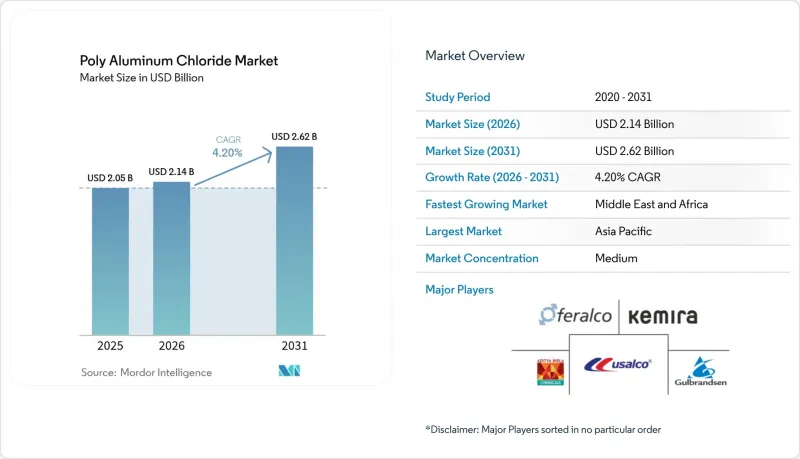
본 보고서는 형태(액체, 분말, 과립), 염기도 수준(낮음, 중간, 높음), 최종 사용자 산업(수처리, 제지 산업, 화장품 및 퍼스널케어, 석유 및 가스, 기타 최종 사용자 산업), 지역(아시아태평양, 북미, 유럽, 남미, 중동 및 아프리카)별로 분류되어 있습니다. 시장 전망은 금액(달러) 기준으로 제시되어 있습니다.
세계 폴리염화알루미늄 시장 동향 및 인사이트
배출 기준 강화가 첨단 응집제 채택을 촉진
유럽연합(EU), 미국 및 아시아태평양의 선진국 환경 당국은 화학적 산소 요구량(COD) 및 총 부유 물질(TSS)의 기준치를 더욱 엄격하게 설정하고 있으며, 이로 인해 사업자들은 고성능 응집제의 도입을 불가피하게 하고 있습니다. 2025년 하반기로 예정된 EU 도시 하수 처리 지침 개정에 따라 영양염 제거 목표가 공식적으로 강화됨에 따라, pH 적용 범위가 넓고 슬러지 발생량이 적어 다운스트림 공정 처리 비용을 절감할 수 있는 PAC에 대한 선호도가 더욱 높아지고 있습니다. 섬유 및 식품 가공 등 산업 분야에서는 여러 배출 기준을 동시에 충족하는 프리폴리머화 알루미늄계 응집제가 현재 선호되고 있으며, PAC의 범용성이 강조되고 있습니다. 이러한 규제 동향의 시너지 효과로 인해 EMEA 지역 처리 시설의 연간 화학약품 수요는 약 4,000만 유로 증가했으며, 상품 가격 변동에도 불구하고 안정적인 조달 계약을 뒷받침하고 있습니다.
APAC 지역의 해수 담수화 확대가 응집제 수요를 견인
아시아태평양의 각국 정부는 물 부족 문제에 대처하기 위해 대규모 해수 담수화 및 도시 용수 재이용 프로젝트를 계속 승인하고 있으며, 이 지역은 PAC의 최대 수요 거점으로서의 입지를 확고히 하고 있습니다. 중국의 산업용수 재사용 의무, 인도의 ‘스마트 시티’ 이니셔티브, 그리고 동남아시아의 인프라 정비 프로그램에서는 염분을 함유한 원수에서 안정적인 플록 형성을 실현하기 위해 고염기성 PAC가 필수적입니다. 말레이시아의 RAPID 복합 시설이나 인도네시아의 새로운 산업 회랑과 같은 메가 프로젝트에서는 전처리 단계에서 PAC 사용이 지정된 수처리 라인이 통합되어 있어, 하류 막 장치에 대한 원수 품질 요건 준수가 보장되고 있습니다. 이에 대응하여 각 공급업체들은 공급의 지속성을 확보하고 운송 비용을 절감하기 위해 지역 내 제조 거점을 확대되고 있습니다.
원자재 가격 변동이 이익률을 압박
2024년에 들어 기니의 수출 중단이 전 세계 보크사이트 공급에 영향을 미치면서, 중국의 알루미나 현물 가격은 연초 대비 35% 상승하여 2012년 이후 최대 규모의 비용 급등을 초래했습니다. 염산 가격도 정제소의 가동률에 연동되어 유사한 변동을 보였으며, PAC 제조업체들은 분기별 계약 재협상을 할 수밖에 없는 상황입니다. 대규모 일체형 생산을 하는 공급업체는 헤지 전략을 통해 그 영향을 일부 상쇄하고 있지만, 자체적으로 알루미나를 조달할 수 없는 소규모 지역 기업들은 이익률 압박에 직면하고 있어 업계 재편이 가속화될 가능성이 있습니다. 장기 프레임워크 계약을 체결한 고객사는 가격 안정성을 확보하고 있지만, 경쟁 입찰에서는 원자재 가격 변동을 반영하기 위해 원가 전가 조항이 점점 더 많이 포함되고 있습니다.
부문별 분석
이는 대규모 지자체 운영 플랜트가 현장에서의 취급 작업을 최소화하는 턴키 방식의 벌크 배송 인프라를 중시하고 있기 때문입니다. 이 부문의 확고한 입지는 수십 년에 걸친 조달 체계, 생산자와의 지리적 근접성, 그리고 저장 탱크 내 침전 위험을 피할 수 있는 즉용성에 기인합니다. 원자재 가격이 변동하더라도 장기 공급 계약을 체결한 유틸리티자는 안정적인 발주량을 유지하고 있으며, 이로 인해 액체 제품 생산 라인의 가동률이 안정적입니다.
한편, 분말 등급의 경우 운송 비용 상승과 수출업체들이 컨테이너당 부가가치 밀도를 높이는 것을 목표로 하고 있기 때문에 2031년까지 연평균 성장률(CAGR) 4.52%로 확대될 것으로 예측됩니다. 분무 건조 기술과 고결 방지 첨가제의 최근 발전으로 인해 보존 기간이 연장되고 내습성도 향상되어, 품질을 저하시키지 않고 내륙 시장의 깊은 곳까지 분말을 공급할 수 있게 되었습니다. 저장 능력이 제한적인 소규모 지역 공장 및 산업 사용자들은 특히 도로 인프라 제약으로 인해 탱크로리의 접근이 제한된 지역에서 필요에 따라 재구성할 수 있는 농축 분말을 점점 더 선호하고 있습니다. 그 결과, 전 세계 생산자들은 생산과 최종 시장의 지역적 조건을 분리하기 위해, 알루미나 공급원과 동일한 장소에 설치할 수 있는 모듈식 분말 공장에 투자하고 있습니다.
지역별 분석
아시아태평양은 중국, 인도, 동남아시아 전역에 걸친 유례없는 상수도 인프라 투자, 급속한 도시화, 그리고 밀집된 산업 기반을 배경으로 2025년 폴리염화알루미늄(PAC) 시장에서 49.10%라는 압도적인 점유율을 차지했습니다. 중국만으로도 전 세계 소비량의 40% 이상을 차지하고 있으며, 이는 대규모 도시 개발과 세계 최대 PAC 수출국으로서의 지위에 힘입은 결과입니다.
중동 및 아프리카는 탈염 기술이 열식에서 정밀한 응집 전처리가 필요한 막식 기술로 지속적으로 전환되고 있어, 2031년까지 4.38%라는 지역별 최고 연평균 성장률(CAGR)을 나타낼 전망입니다. 걸프협력회의(GCC) 회원국들은 사우디아라비아의 NEOM과 같은 스마트 시티 프로젝트에 투자하고 있으며, 각 프로젝트에는 대규모 처리 시설이 포함되어 있어 염분을 함유한 원수에는 고염기성 PAC가 선호되고 있습니다. 한편, 사하라 이남 아프리카 국가들은 세계은행의 자금을 도시 프로젝트에 투입하고 있으며, 이곳에서는 공급망이 수입 제품에 의존하고 있음에도 불구하고 PAC의 폭넓은 pH 대응 범위가 변동하는 원수의 화학적 특성으로부터 운영자를 보호하고 있습니다.
북미와 유럽에서는 인프라 개보수 및 규제 강화를 배경으로 완만하지만 꾸준한 성장이 나타나고 있습니다. 배관망의 노후화에 직면한 미국의 유틸리티자들은 개정된 ‘납·구리 규제(Lead and Copper Rule)’ 지침을 충족하기 위해 디지털 센서를 활용한 PAC 투여량 최적화를 추진하고 있습니다. 한편, 유럽의 사업자들은 개정된 ‘도시 하수 처리 지침(Urban Wastewater Treatment Directive)’의 영양염 제거 관련 규정을 준수하고 있습니다. 총 판매량 증가세는 신흥 지역에 미치지 못하지만, 이러한 성숙한 시장에서는 완벽한 추적 가능성과 수명 주기 관련 문서를 갖춘 고품질의 잔류물이 적은 등급이 중시되고 있으며, 견고한 품질 관리 시스템을 갖춘 공급업체는 건전한 이익률을 유지하고 있습니다.
기타 혜택:
- 엑셀 형식 시장 예측(ME) 시트
- 3개월간의 애널리스트 지원
자주 묻는 질문
목차
제1장 서론
제2장 조사 방법
제3장 주요 요약
제4장 시장 구도
제5장 시장 규모와 성장 예측
제6장 경쟁 구도
제7장 시장 기회와 향후 전망
JHS 26.08.26According to Mordor Intelligence, the poly aluminum chloride market size was valued at USD 2.05 billion in 2025 and estimated to grow from USD 2.14 billion in 2026 to reach USD 2.62 billion by 2031, at a CAGR of 4.20% during the forecast period (2026-2031).
This report is Segmented by Form (Liquid, Powder, and Granular), Basicity Level (Low, Medium, and High), End-User Industry (Water Treatment, Paper Industry, Cosmetics and Personal Care, Oil and Gas, and Other End-User Industries), and Geography (Asia-Pacific, North America, Europe, South America, and Middle-East and Africa). The Market Forecasts are Provided in Terms of Value (USD).
Global Poly Aluminum Chloride Market Trends and Insights
Tightening Discharge Norms Drive Advanced Coagulation Adoption
Environmental agencies in the European Union, the United States, and advanced Asia-Pacific economies have introduced sharper chemical oxygen demand and total suspended solids thresholds that compel operators to adopt higher-performance coagulants. The forthcoming revision of the EU Urban Wastewater Treatment Directive in late 2025 formalizes enhanced nutrient removal targets, reinforcing preference for PAC, whose broader pH window and lower sludge generation reduce downstream handling costs. Industrial segments such as textiles and food processing now favor pre-polymerized aluminum chemistry that meets multiple discharge parameters concurrently, emphasizing PAC's versatility. The combined regulatory momentum adds roughly EUR 40 million in annual chemical demand across EMEA treatment plants, underpinning steady procurement contracts despite commodity-price volatility.
APAC Desalination Expansion Fuels Coagulant Demand
Asia-Pacific governments continue to approve large-scale desalination and municipal reuse projects to counter water scarcity, positioning the region as the largest demand hub for PAC. China's industrial water-reuse mandates, India's Smart Cities initiative, and Southeast Asian infrastructure programs rely on high-basicity PAC for stable floc formation in saline feedwater. Mega-projects such as Malaysia's RAPID complex and Indonesia's new industrial corridors incorporate water-treatment trains that specify PAC at the pretreatment stage, ensuring compliance with feedwater quality requirements for downstream membranes. Suppliers respond by expanding regional manufacturing footprints to safeguard supply continuity and mitigate shipping costs.
Raw-Material Price Volatility Pressures Margins
Alumina spot prices in China climbed 35% year-to-date during 2024 as Guinea export disruptions hit global bauxite supply, creating the steepest cost spike since 2012. Hydrochloric acid values experienced parallel volatility tied to refinery operating rates, forcing PAC producers to renegotiate quarterly contracts. Large integrated suppliers partially absorb the impact through hedging strategies, but smaller regional firms without captive alumina supply face squeezed margins and may accelerate consolidation. Customers with long-term framework agreements gain price stability, yet competitive tenders increasingly incorporate cost-pass-through clauses to reflect raw-material dynamics.
Other drivers and restraints analyzed in the detailed report include:
- Cost Optimization Drives PAC Adoption Over Conventional Coagulants
- High-Basicity Formulations Enable Microplastics Removal
- Aluminum Residual Limits Challenge Product Positioning
For complete list of drivers and restraints, kindly check the Table Of Contents.
Segment Analysis
because large municipal plants value turnkey bulk-delivery infrastructure that minimizes on-site handling. The segment's entrenched position stems from decades-old procurement frameworks, proximity to producers, and immediate solubility that avoids sediment risks inside storage tanks. Even as feedstock prices fluctuate, utilities locked into long-term supply agreements maintain consistent order volumes, which stabilizes plant utilization rates for liquid lines.
Powder grades, however, are forecast to expand at a 4.52% CAGR through 2031 as transportation costs rise and exporters seek higher value density per container. Recent advances in spray-drying and anti-caking additives lengthen shelf life and strengthen moisture resistance, allowing powder to move deeper into land-locked markets without quality loss. Small community plants and industrial users with limited storage increasingly prefer concentrated powder that reconstitutes on demand, especially where road infrastructure restricts tanker access. As a result, global producers invest in modular powder plants that can be co-located with alumina sources to decouple production from end-market geography.
Complete Report Scope:
- By Form
- Liquid
- Powder
- Granular
- By Basicity Level
- Low (less than 40% basicity)
- Medium (40-60%)
- High (more than 60%)
- By End-user Industry
- Water Treatment
- Paper Industry
- Cosmetics and Personal Care
- Oil and Gas
- Other End-user Industries
- By Geography
- Asia-Pacific
- China
- India
- Japan
- South Korea
- ASEAN Countries
- Rest of Asia-Pacific
- North America
- United States
- Canada
- Mexico
- Europe
- Germany
- United Kingdom
- France
- Spain
- Italy
- Russia
- NORDIC Countries
- Rest of Europe
- South America
- Brazil
- Argentina
- Rest of South America
- Middle-East and Africa
- Saudi Arabia
- Turkey
- South Africa
- Rest of Middle-East and Africa
- Asia-Pacific
Geography Analysis
Asia-Pacific held a dominant 49.10% share of the poly aluminum chloride market in 2025 on the back of unparalleled water-infrastructure investment, rapid urbanization, and a dense industrial base across China, India, and Southeast Asia. China alone accounts for over 40% of global consumption, underpinned by extensive municipal expansion and its position as the leading PAC exporter.
Middle East and Africa is forecast to record the highest regional CAGR at 4.38% through 2031 as desalination continues to pivot from thermal to membrane-based technologies that require precise coagulation pretreatment. Gulf Cooperation Council states invest in smart-city projects such as Saudi Arabia's NEOM, each embedding large treatment plants that prefer high-basicity PAC for saline feedwater. Sub-Saharan African countries, meanwhile, channel World Bank financing into municipal projects where PAC's broad pH window shields operators from variable raw-water chemistry, even as supply chains rely on imported product.
North America and Europe see modest but resilient growth driven by infrastructure rehabilitation and regulatory tightening. United States utilities facing aging pipe networks integrate PAC dosing optimization with digital sensors to meet revised Lead and Copper Rule guidelines, while European operators align with the updated Urban Wastewater Treatment Directive's nutrient-removal stipulations. Although total volume expansion lags emerging regions, these mature markets prize premium, low-residual grades with full traceability and lifecycle documentation, sustaining healthy margins for suppliers with robust quality systems.
- Aditya Birla Chemicals (India) Limited
- Airedale Chemical
- Central Glass Co. Ltd.
- Feralco AB
- GEO Specialty Chemicals Inc.
- Gujarat Alkalies and Chemicals Limited (GACL)
- Gulbrandsen
- HOLLAND COMPANY
- IXOM
- Kemira
- Liyuan
- Pacific Chemicals Co.
- Shandong Tenor Water Treatment Technology Co., Ltd.
- Summit Chemical Specialty Products LLC
- Synergy Multichem Pvt. Ltd
- TAKI CHEMICAL CO., LTD.
- USALCO LLC
Additional Benefits:
- The market estimate (ME) sheet in Excel format
- 3 months of analyst support
TABLE OF CONTENTS
1 Introduction
- 1.1 Study Assumptions and Market Definition
- 1.2 Scope of the Study
2 Research Methodology
3 Executive Summary
4 Market Landscape
- 4.1 Market Overview
- 4.2 Market Drivers
- 4.2.1 Tightening discharge norms for COD/TSS in municipal and industrial effluents
- 4.2.2 Rapid capacity additions in APAC desalination and municipal reuse plants
- 4.2.3 Cost advantage versus alum and ferric salts at equivalent turbidity removal
- 4.2.4 High-basicity PAC grades proving superior for micro-plastics capture
- 4.2.5 On-site PAC electro-synthesis systems cutting bulk-haul logistics emissions
- 4.3 Market Restraints
- 4.3.1 Volatile alumina and hydrochloric acid feed-stock prices
- 4.3.2 Regulatory scrutiny on residual Al in drinking water (<0.05 mg/L future limits)
- 4.3.3 Uptake of low-chemical membrane and electro-coag technologies in OECD plants
- 4.4 Value Chain Analysis
- 4.5 Regulatory Landscape
- 4.6 Porter's Five Forces
- 4.6.1 Threat of New Entrants
- 4.6.2 Bargaining Power of Buyers
- 4.6.3 Bargaining Power of Suppliers
- 4.6.4 Threat of Substitutes
- 4.6.5 Degree of Competition
5 Market Size and Growth Forecasts (Value)
- 5.1 By Form
- 5.1.1 Liquid
- 5.1.2 Powder
- 5.1.3 Granular
- 5.2 By Basicity Level
- 5.2.1 Low (less than 40% basicity)
- 5.2.2 Medium (40-60%)
- 5.2.3 High (more than 60%)
- 5.3 By End-user Industry
- 5.3.1 Water Treatment
- 5.3.2 Paper Industry
- 5.3.3 Cosmetics and Personal Care
- 5.3.4 Oil and Gas
- 5.3.5 Other End-user Industries
- 5.4 By Geography
- 5.4.1 Asia-Pacific
- 5.4.1.1 China
- 5.4.1.2 India
- 5.4.1.3 Japan
- 5.4.1.4 South Korea
- 5.4.1.5 ASEAN Countries
- 5.4.1.6 Rest of Asia-Pacific
- 5.4.2 North America
- 5.4.2.1 United States
- 5.4.2.2 Canada
- 5.4.2.3 Mexico
- 5.4.3 Europe
- 5.4.3.1 Germany
- 5.4.3.2 United Kingdom
- 5.4.3.3 France
- 5.4.3.4 Spain
- 5.4.3.5 Italy
- 5.4.3.6 Russia
- 5.4.3.7 NORDIC Countries
- 5.4.3.8 Rest of Europe
- 5.4.4 South America
- 5.4.4.1 Brazil
- 5.4.4.2 Argentina
- 5.4.4.3 Rest of South America
- 5.4.5 Middle-East and Africa
- 5.4.5.1 Saudi Arabia
- 5.4.5.2 Turkey
- 5.4.5.3 South Africa
- 5.4.5.4 Rest of Middle-East and Africa
- 5.4.1 Asia-Pacific
6 Competitive Landscape
- 6.1 Market Concentration
- 6.2 Strategic Moves
- 6.3 Market Share/Ranking Analysis
- 6.4 Company Profiles (includes Global level Overview, Market level overview, Core Segments, Financials as available, Strategic Information, Market Rank/Share for key companies, Products and Services, and Recent Developments)
- 6.4.1 Aditya Birla Chemicals (India) Limited
- 6.4.2 Airedale Chemical
- 6.4.3 Central Glass Co. Ltd.
- 6.4.4 Feralco AB
- 6.4.5 GEO Specialty Chemicals Inc.
- 6.4.6 Gujarat Alkalies and Chemicals Limited (GACL)
- 6.4.7 Gulbrandsen
- 6.4.8 HOLLAND COMPANY
- 6.4.9 IXOM
- 6.4.10 Kemira
- 6.4.11 Liyuan
- 6.4.12 Pacific Chemicals Co.
- 6.4.13 Shandong Tenor Water Treatment Technology Co., Ltd.
- 6.4.14 Summit Chemical Specialty Products LLC
- 6.4.15 Synergy Multichem Pvt. Ltd
- 6.4.16 TAKI CHEMICAL CO., LTD.
- 6.4.17 USALCO LLC
7 Market Opportunities and Future Outlook
- 7.1 White-space and Unmet-Need Assessment