|
시장보고서
상품코드
2115013
변속기 오일 시장 : 점유율 분석, 업계 동향과 통계, 성장 예측(2026-2031년)Transmission Fluid - Market Share Analysis, Industry Trends & Statistics, Growth Forecasts (2026 - 2031) |
||||||
 Mordor Intelligence
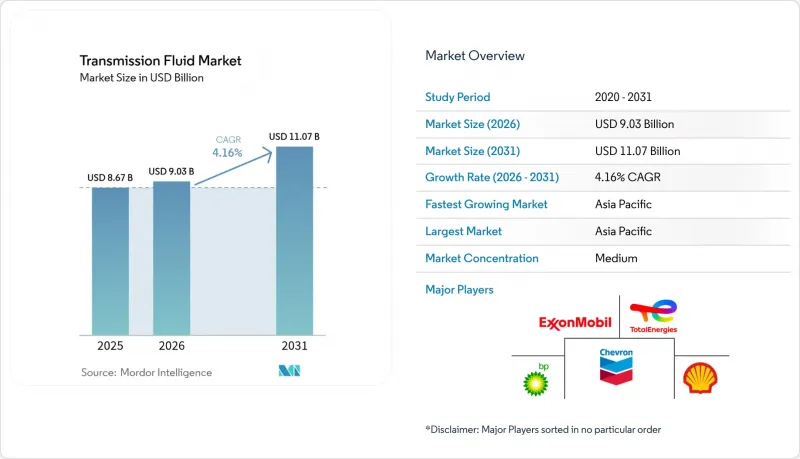
Mordor Intelligence에 의하면, 변속기 오일 시장 규모는 2025년에 86억 7,000만 달러로 평가되었고 2026년 90억 3,000만 달러에서 2031년까지 110억 7,000만 달러에 이를 것으로 예측되며, 예측 기간(2026-2031년) CAGR은 4.16%를 나타낼 전망입니다.
본 보고서는 유형(자동 변속기 오일, 수동 변속기 오일 등), 기유(광물유, 합성유, 반합성유),판매 채널(OEM, 애프터마켓), 최종 사용자 산업(자동차, 건설, 광업, 산업기계 등), 지역(아시아태평양, 북미, 유럽 등)별로 분류되어 있습니다. 시장 예측은 금액(달러) 기준으로 제시되어 있습니다.
전 세계 변속기 오일 시장 동향 및 인사이트
전 세계 자동변속기 및 듀얼 클러치 변속기(DCT) 탑재 차량 생산 급증
부드러운 변속을 원하는 소비자의 선호도가 높아짐에 따라, 자동차 제조업체들은 신차에 자동 변속기나 듀얼 클러치 변속기(DCT)를 탑재하는 비율을 늘리고 있습니다. 각 DCT에는 습식 클러치의 마찰과 기어의 윤활을 동시에 관리하는 오일이 필요하며, 차량 1대당 비용은 수동 변속기의 주입 비용이 약 25달러인 것에 비해 50달러를 초과하는 경우도 있습니다. 하이브리드 차량은 더욱 복잡해지고 있어, 엔진의 열 사이클을 견디면서 전기 모터를 냉각할 수 있는 오일이 요구되고 있습니다. 이러한 요인들이 복합적으로 작용하여, 차량당 오일 총 사용량이 감소 추세에 있더라도 단가 상승을 부추기고 있습니다.
OEM 공장 충전에서의 초저점도 ATF로의 전환
연비 규제로 인해 자동차 제조업체들은 기생 손실을 줄이면서도 기어와 클러치를 보호할 수 있는 초저점도 ATF로의 전환을 요구받고 있습니다. 2025년 3월부터 시행되는 새로운 ILSAC GF-7 성능 카테고리에서는 저속 영역에서의 예연소를 방지하고, 효율을 한층 더 향상시키는 첨가제 패키지가 요구되고 있습니다. 이 규격에 따라 기존 오일의 노후화가 가속화되며, 15만 마일의 오일 교환 주기에 대응 가능한 합성 배합 오일에 대한 수요가 촉진될 것입니다. 오일 성능의 향상은 평균 판매 가격을 끌어올려, 정비 주기 연장에 따른 판매량 감소를 일부 상쇄할 것입니다.
원유 가격 변동이 기유 비용에 미치는 영향
기유는 완제품 윤활유 비용의 70-80%를 차지하고 있어, 이익률은 원료 가격 변동의 영향을 받기 쉬운 상황입니다. 러시아·우크라이나 분쟁 초기 몇 달 동안 벤치마크 원유 가격은 50% 이상 급등하여 윤활유 가격의 여러 차례 인상을 초래했습니다. 미국 에너지정보청(EIA)은 2025년 브렌트 원유 가격의 평균을 배럴당 79달러로 예측하고 있지만, 지정학적 긴장과 정유시설 가동 중단은 수직 통합을 하지 않은 독립 블렌더들에게 여전히 압박 요인이 될 수 있습니다. 합성 기유 제조업체들은 원유가 아닌 석유화학제품공급 동향에 연동되는 알파올레핀 원료로 인해 추가적인 위험에 직면해 있습니다.
부문별 분석
자동 변속기 오일(ATF)은 2025년 매출의 47.58%를 차지하며, 행성 기어 시스템에서 수십 년에 걸친 세계적 표준화를 뒷받침하고 있습니다. 한편, 듀얼 클러치 변속기 오일(DCTF)은 각 OEM 업체들이 수동 변속기 수준의 효율성과 자동 변속기 수준의 사용 편의성을 겸비한 DCT를 채택함에 따라 2031년까지 연평균 성장률(CAGR) 4.79%를 나타낼 것으로 예측됩니다. 수동 변속기용 및 무단 변속기(CVT)용 오일은 상용차 및 소형 하이브리드 차량에서 틈새 시장이긴 하지만 안정적인 용도를 차지하고 있습니다. 컴팩트카에서 습식 클러치식 듀얼 기어박스의 채택이 확대됨에 따라, DCTF(듀얼 클러치 변속기 오일) 시장 규모는 급격히 확대될 전망입니다. 따라서 변속기 오일 시장의 경쟁 초점은 기존의 ATF(자동 변속기 오일) 블렌드에서 전문적이고 수익성이 높은 DCT용 배합으로 점차 이동하고 있습니다.
2025년 수요 중 광물유가 55.92%를 차지했으나, 각 OEM 업체들이 기존 기유로는 달성할 수 없는 0W-20 및 5W-20 점도 등급을 추구함에 따라 합성유 시장은 연평균 성장률(CAGR) 5.02%를 나타낼 것으로 예측됩니다. PAO 및 에스테르계 화학 물질은 극한 온도에서도 유막 강도를 유지하고 전단 손실을 견디기 때문에 합성유가 차지하는 변속기 오일 시장 점유율은 확대될 것입니다. 2025년 싱가포르에서 가동을 시작할 엑슨모빌의 EHC 340 MAX 베이스스톡과 같은 신규 생산 능력은 고성능 윤활유로의 이러한 구조적 전환을 뒷받침할 것입니다.
세미합성 블렌드는 그룹 II 광물유에서 전환하는 차량 플릿에 있어 중가대 제품으로서 가교 역할을 하겠지만, 절연 강도가 절대적인 조건이 되는 전동화 드라이브트레인의 공장 출고 시 충전유에서는 순수 합성유가 주류를 이룰 전망입니다. 따라서 차량 1대당 총 사용량이 감소하더라도 프리미엄화 추세가 수익 증대에 기여할 것입니다.
지역별 분석
아시아태평양은 중국의 거대한 자동차 생산 기반과 적극적인 전기차 보급 목표에 힘입어 2025년에는 매출 점유율 56.02%를 차지하며 변속기 오일 시장을 주도했습니다. BYD나 지리(Geely)와 같은 국내 브랜드들이 전용 설계된 전동 모터용 냉각액이 필요한 첨단 전동 모터 냉각 회로를 채택함에 따라, 이 지역은 2031년까지 연평균 성장률(CAGR) 5.16%를 나타낼 것으로 예측됩니다. 인도의 소형차 수출 거점 부상이 판매량을 더욱 뒷받침하는 한편, 한국의 구동계 연구 개발은 고수익률의 합성유 채택을 촉진하고 있습니다.
북미에서는 공장 출고 시 충전과 교체 주기가 긴 애프터마켓 사업이 균형 있게 공존하고 있습니다. 2027년 모델 연도부터 시행되는 EPA 배기가스 규제로 인해 소형차 제조업체들은 저점도 ATF로의 전환을 강요받고 있으며, 이는 합성 오일의 보급률을 끌어올리고 있습니다. 플릿 사업자들은 총소유비용(TCO)을 중시하기 때문에 공급업체들은 현장 시험을 통해 내구 기간 연장이라는 이점을 입증하도록 요구받고 있습니다.
유럽 시장은 엄격한 CO₂ 배출 기준 및 내구성 기준으로 인해 프리미엄 오일에 대한 수요가 집중되어 있습니다. 독일의 고급차 브랜드는 전용 유체가 필요한 듀얼 클러치 및 하이브리드 변속기를 선호하는 반면, 스칸디나비아 국가들의 전기차 조기 보급은 유전성 e-유체에 대한 수요를 끌어올리고 있습니다. 브렉시트에 따른 물류 체계 재편으로 인해, 유럽 대륙의 OEM 제조업체에 보다 효율적으로 서비스를 제공하기 위한 지역별 블렌딩 능력 확충이 진행되고 있습니다. 중동으로의 생산 거점으로서 튀르키예의 역할이 확대됨에 따라, 비용 효율이 뛰어난 광물유·합성유 블렌드에 대한 지역적 수요도 증가하고 있습니다.
남미, 중동 및 아프리카는 규모는 작지만 성장세가 두드러지는 시장이며, 인프라 개발이 오프로드 장비용 윤활유 수요를 견인하고 있습니다. 환율 변동이 합성 윤활유의 보급에 영향을 미칠 가능성은 있으나, 브라질과 남아프리카공화국의 농업 기계화 추세는 특수 배합 제품에 장기적인 성장 전망을 가져다주고 있습니다.
기타 혜택:
- 엑셀 형식 시장 예측(ME) 시트
- 3개월간의 애널리스트 지원
자주 묻는 질문
목차
제1장 서론
제2장 조사 방법
제3장 주요 요약
제4장 시장 구도
제5장 시장 규모와 성장 예측
제6장 경쟁 구도
제7장 시장 기회와 향후 전망
JHS 26.08.26According to Mordor Intelligence, the transmission fluid market size was valued at USD 8.67 billion in 2025 and estimated to grow from USD 9.03 billion in 2026 to reach USD 11.07 billion by 2031, at a CAGR of 4.16% during the forecast period (2026-2031).
This report is Segmented by Type (Automatic Transmission Fluid, Manual Transmission Fluid, and More), Base Oil (Mineral, Synthetic, and Semi-Synthetic), Sales Channel (OEM, Aftermarket), End-User Industry (Automotive, Construction, Mining, Industrial Machinery, and More), and Geography (Asia-Pacific, North America, Europe, and More). The Market Forecasts are Provided in Terms of Value (USD).
Global Transmission Fluid Market Trends and Insights
Surging Global Production of Automatic and Dual-Clutch Transmission Vehicles
Rising consumer preference for effortless shifting is pushing automakers to install automatic and dual-clutch gearboxes in a growing share of new cars. Each DCT requires a fluid that manages wet-clutch friction and gear lubrication simultaneously, and the cost per vehicle can exceed USD 50 compared with roughly USD 25 for a manual-gearbox fill. Hybrids layer further complexity, demanding fluids that tolerate thermal cycling from engines while cooling electric motors. Together, these factors elevate unit-value growth even when overall fluid volumes per vehicle trend downward.
OEM Factory-Fill Shift to Ultra-Low-Viscosity Automatic Transmission Fluids
Fuel-economy mandates are driving carmakers toward ultra-low-viscosity ATFs that cut parasitic losses yet still protect gears and clutches. The incoming ILSAC GF-7 performance category, effective March 2025, requires additive packages that guard against low-speed pre-ignition and deliver additional efficiency gains. This specification accelerates obsolescence for legacy fluids and steers demand toward synthetic formulations capable of 150,000-mile drains. Higher fluid performance lifts average selling prices, offsetting some volume decline linked to longer service intervals.
Crude-Oil Price Volatility Impacting Base-Oil Costs
Base oils make up 70-80% of finished-fluid cost, leaving margins exposed to feedstock swings. During the first months of the Russia-Ukraine conflict, benchmark crude prices surged more than 50%, prompting multiple lubricant price increases. Although the U.S. Energy Information Administration projects Brent to average USD 79 per barrel in 2025, geopolitical tensions and refining outages can still squeeze independent blenders lacking vertical integration. Synthetic-base producers face an added layer of risk from alpha-olefin feedstocks that track petrochemical, not crude, supply dynamics.
Other drivers and restraints analyzed in the detailed report include:
- Electrified Powertrains Demanding E-Fluids with Dielectric Properties
- Rising Vehicle Parc Age Boosting Aftermarket Fluid Changes
- Extended OEM Drain Intervals Reducing Service-Fill Volume
For complete list of drivers and restraints, kindly check the Table Of Contents.
Segment Analysis
Automatic Transmission Fluid captured 47.58% of 2025 revenue, underscoring decades of global standardization in planetary-gear systems. Dual-Clutch Transmission Fluid, however, is projected to grow at 4.79% CAGR through 2031 as OEMs deploy DCTs that deliver manual-level efficiency with automatic ease. Manual-Transmission and Continuously-Variable Transmission fluids serve niche but steady applications in commercial vehicles and small hybrids. The transmission fluid market size for DCTF is likely to climb sharply as more compact cars adopt wet-clutch dual-gearboxes. Competitive intensity within the transmission fluid market is therefore shifting from legacy ATF blends toward specialized, high-margin DCT formulations.
Mineral oils held 55.92% of 2025 demand, but synthetic formulations are forecast to grow at a 5.02% CAGR as OEMs pursue 0W-20 and 5W-20 viscosity grades unattainable with conventional stocks. The transmission fluid market share commanded by synthetics will widen because PAO and ester chemistries retain film strength at extreme temperatures and resist shear loss. New capacity such as ExxonMobil's EHC 340 MAX basestock coming online in Singapore in 2025 supports this structural shift toward higher-performance fluids.
Semi-synthetic blends offer a mid-price bridge for fleets transitioning from Group II mineral oils, but pure synthetics are set to dominate factory fills in electrified drivetrains where dielectric strength is non-negotiable. Accordingly, premiumization will help buoy revenue even as overall liters per vehicle decline.
Complete Report Scope:
- By Type
- Automatic Transmission Fluid (ATF)
- Manual Transmission Fluid (MTF)
- Dual-Clutch Transmission Fluid (DCTF)
- Continuously Variable Transmission Fluid (CVTF)
- By Base Oil
- Mineral
- Synthetic (PAO, esters)
- Semi-synthetic
- By Sales Channel
- OEM
- Aftermarket
- By End-User Industry
- Automotive Industry
- Construction
- Mining
- Industrial Machinery
- Agricultural
- Other End-User Industries
- By Geography
- Asia-Pacific
- China
- India
- Japan
- South Korea
- Malaysia
- Thailand
- Indonesia
- Vietnam
- Rest of Asia-Pacific
- North America
- United States
- Canada
- Mexico
- Europe
- Germany
- United Kingdom
- France
- Italy
- Spain
- NORDIC Countries
- Russia
- Turkey
- Rest of Europe
- South America
- Brazil
- Argentina
- Colombia
- Rest of South America
- Middle-East and Africa
- Saudi Arabia
- United Arab Emirates
- Qatar
- Egypt
- Nigeria
- South Africa
- Rest of Middle-East and Africa
- Asia-Pacific
Geography Analysis
Asia Pacific dominated the transmission fluid market with 56.02% revenue share in 2025, propelled by China's massive vehicle production base and aggressive electric-vehicle adoption targets. The region is forecast to log a 5.16% CAGR through 2031 as domestic brands such as BYD and Geely integrate advanced e-motor cooling circuits that need purpose-designed e-fluids. India's budding export platform for compact cars furnishes additional volume, while South Korea's drivetrain research and development underpins high-margin synthetic adoption.
North America maintains a balanced mix of factory fills and long-drain aftermarket business. EPA emissions rules effective for 2027 model years are steering light-duty OEMs toward lower-viscosity ATFs, which raises synthetic penetration rates. Fleets prioritize total cost of ownership, incentivizing suppliers to prove extended-service benefits in field trials.
Europe's market skews toward premium fluids given stringent CO2 and durability standards. German luxury-car brands favor dual-clutch and hybrid transmissions that command bespoke fluids, while Scandinavian countries' early EV uptake boosts demand for dielectric e-fluids. Brexit-related logistics realignment has encouraged regional blending capacity to serve continental OEMs more efficiently. Turkey's role as a production gateway to the Middle East expands regional demand for cost-effective mineral-synthetic blends.
South America, and the Middle-East and Africa represent smaller but growing pockets where infrastructure development fuels demand for off-highway equipment fluids. Currency volatility can affect synthetic uptake, yet agricultural mechanization trends in Brazil and South Africa provide long-run growth prospects for specialized formulations.
- Afton Chemical
- Amalie Oil Co.
- AMSOIL INC.
- BASF
- BP p.l.c.
- Chevron Corporation
- Exxon Mobil Corporation
- FUCHS
- Idemitsu Kosan Co., Ltd.
- Kemipex
- Motul
- Shell plc
- The Lubrizol Corporation
- TotalEnergies
- Valvoline
Additional Benefits:
- The market estimate (ME) sheet in Excel format
- 3 months of analyst support
TABLE OF CONTENTS
1 Introduction
- 1.1 Study Assumptions and Market Definition
- 1.2 Scope of the Study
2 Research Methodology
3 Executive Summary
4 Market Landscape
- 4.1 Market Overview
- 4.2 Market Drivers
- 4.2.1 Surging global production of automatic and Dual-Clutch Transmission (DCT) vehicles
- 4.2.2 OEM factory-fill shift to ultra-low-viscosity Automatic transmission fluid (ATFs)
- 4.2.3 Electrified powertrains demanding e-fluids with dielectric properties
- 4.2.4 Rising vehicle parc age boosting aftermarket fluid changes
- 4.2.5 Expanding OEM and Aftermarket Segments
- 4.3 Market Restraints
- 4.3.1 Crude-oil price volatility impacting base-oil costs
- 4.3.2 Extended OEM drain intervals reducing service-fill volume
- 4.3.3 Regulatory Complexity and Research and Development Pressure
- 4.4 Value Chain Analysis
- 4.5 Porter's Five Forces
- 4.5.1 Threat of New Entrants
- 4.5.2 Bargaining Power of Buyers
- 4.5.3 Bargaining Power of Suppliers
- 4.5.4 Threat of Substitute Products
- 4.5.5 Degree of Competition
5 Market Size and Growth Forecasts (Value)
- 5.1 By Type
- 5.1.1 Automatic Transmission Fluid (ATF)
- 5.1.2 Manual Transmission Fluid (MTF)
- 5.1.3 Dual-Clutch Transmission Fluid (DCTF)
- 5.1.4 Continuously Variable Transmission Fluid (CVTF)
- 5.2 By Base Oil
- 5.2.1 Mineral
- 5.2.2 Synthetic (PAO, esters)
- 5.2.3 Semi-synthetic
- 5.3 By Sales Channel
- 5.3.1 OEM
- 5.3.2 Aftermarket
- 5.4 By End-User Industry
- 5.4.1 Automotive Industry
- 5.4.2 Construction
- 5.4.3 Mining
- 5.4.4 Industrial Machinery
- 5.4.5 Agricultural
- 5.4.6 Other End-User Industries
- 5.5 By Geography
- 5.5.1 Asia-Pacific
- 5.5.1.1 China
- 5.5.1.2 India
- 5.5.1.3 Japan
- 5.5.1.4 South Korea
- 5.5.1.5 Malaysia
- 5.5.1.6 Thailand
- 5.5.1.7 Indonesia
- 5.5.1.8 Vietnam
- 5.5.1.9 Rest of Asia-Pacific
- 5.5.2 North America
- 5.5.2.1 United States
- 5.5.2.2 Canada
- 5.5.2.3 Mexico
- 5.5.3 Europe
- 5.5.3.1 Germany
- 5.5.3.2 United Kingdom
- 5.5.3.3 France
- 5.5.3.4 Italy
- 5.5.3.5 Spain
- 5.5.3.6 NORDIC Countries
- 5.5.3.7 Russia
- 5.5.3.8 Turkey
- 5.5.3.9 Rest of Europe
- 5.5.4 South America
- 5.5.4.1 Brazil
- 5.5.4.2 Argentina
- 5.5.4.3 Colombia
- 5.5.4.4 Rest of South America
- 5.5.5 Middle-East and Africa
- 5.5.5.1 Saudi Arabia
- 5.5.5.2 United Arab Emirates
- 5.5.5.3 Qatar
- 5.5.5.4 Egypt
- 5.5.5.5 Nigeria
- 5.5.5.6 South Africa
- 5.5.5.7 Rest of Middle-East and Africa
- 5.5.1 Asia-Pacific
6 Competitive Landscape
- 6.1 Market Concentration
- 6.2 Strategic Moves
- 6.3 Market Share (%)/ Ranking Analysis
- 6.4 Company Profiles (includes Global level Overview, Market level overview, Core Segments, Financials as available, Strategic Information, Market Rank/Share for key companies, Products and Services, and Recent Developments)
- 6.4.1 Afton Chemical
- 6.4.2 Amalie Oil Co.
- 6.4.3 AMSOIL INC.
- 6.4.4 BASF
- 6.4.5 BP p.l.c.
- 6.4.6 Chevron Corporation
- 6.4.7 Exxon Mobil Corporation
- 6.4.8 FUCHS
- 6.4.9 Idemitsu Kosan Co., Ltd.
- 6.4.10 Kemipex
- 6.4.11 Motul
- 6.4.12 Shell plc
- 6.4.13 The Lubrizol Corporation
- 6.4.14 TotalEnergies
- 6.4.15 Valvoline
7 Market Opportunities and Future Outlook
- 7.1 White-space and Unmet-Need Assessment